The beginning of heaven and Earth has no name : seven days with second-order cybernetics | Heinz von Foerster & Albert Muller & Karl H. Muller & Elinor Rooks & Michael Kasenbacher (2014)

source:

The beginning of heaven and Earth has no name : seven days with second-order cybernetics | Heinz von Foerster & Albert Muller & Karl H. Muller & Elinor Rooks & Michael Kasenbacher | download

The beginning of heaven and Earth has no name : seven days with second-order cybernetics

Heinz von Foerster & Albert Muller & Karl H. Muller & Elinor Rooks & Michael Kasenbacher0 / 0 0 comments Heinz von Foerster was the inventor of second-order cybernetics, which recognizes the investigator as part of the system he is investigating. The Beginning of Heaven and Earth Has No Name provides an accessible, nonmathematical, and comprehensive overview of von Foerster’s cybernetic ideas and of the philosophy latent within them. It distills concepts scattered across the lifework of this scientific polymath and influential interdisciplinarian. At the same time, as a book-length interview, it does justice to von Foerster’s élan as a speaker and improviser, his skill as a raconteur.

Developed from a week-long conversation between the editors and von Foerster near the end of his life, this work playfully engages von Foerster in developing the difference his notion of second-order cybernetics makes for topics ranging from emergence, life, order, and thermodynamics to observation, recursion, cognition, perception, memory, and communication.

The book gives an English-speaking audience a new ease of access to the rich thought and generous spirit of this remarkable and protean thinker

Unlocking Luhmann – Baraldi, Corsi and Esposito (2021)

Unlocking Luhmann A Keyword Introduction to Systems Theory Claudio Baraldi, Giancarlo Corsi and Elena Esposito

Unlocking Luhmann

Published by Bielefeld University Press 2021

Unlocking Luhmann

A Keyword Introduction to Systems Theory

Claudio Baraldi, Giancarlo Corsi and Elena Esposito

  • Translated by: Katherine Walker
  • Funded by: Universität Bielefeld

and

https://library.oapen.org/bitstream/handle/20.500.12657/48859/9783839456743.pdf?sequence=1

Introduction to Systems Theory – Luhmann, Gilgen (translated) (2012)

source

Introduction to Systems Theory | Wiley

Introduction to Systems Theory

Niklas LuhmannPeter Gilgen (Translated by)

ISBN: 978-0-745-64571-1 December 2012 Polity 300 Pages

 Paperback$28.00 HardcoverPrint on Demand$78.00

DESCRIPTION

Niklas Luhmann ranks as one of the most important sociologists and social theorists of the twentieth century. Through his many books he developed a highly original form of systems theory that has been hugely influential in a wide variety of disciplines.

In Introduction to Systems Theory, Luhmann explains the key ideas of general and sociological systems theory and supplies a wealth of examples to illustrate his approach. The book offers a wide range of concepts and theorems that can be applied to politics and the economy, religion and science, art and education, organization and the family. Moreover, Luhmann’s ideas address important contemporary issues in such diverse fields as cognitive science, ecology, and the study of social movements.

This book provides all the necessary resources for readers to work through the foundations of systems theory – no other work by Luhmann is as clear and accessible as this. There is also much he…

Introduction to Systems Theory Niklas Luhmann, Peter Gilgen (Translated by) ISBN: 978-0-745-64571-1 December 2012

Introduction to Systems Theory | Wiley

and

http://www.mediastudies.asia/wp-content/uploads/2016/08/Niklas_Luhmann_Introduction_to_System_Theory.pdf

Longer supply chains ‘bring innovation and lower prices’ – Supply Management

source:

Longer supply chains ‘bring innovation and lower prices’ – Supply Management

Longer supply chains ‘bring innovation and lower prices’

posted by Will Green in Procurement 10 January 2022

Companies have responded to Covid disruption by shortening supply chains but a study suggests longer supply chains provide more innovation and economic benefit.

A team of academics from the University of Oxford and Harvard University found supply chains – in which producers bought input goods, converted them into other goods and sold them to other producers – amplified the effects of technological improvements and price reduction.

“Longer production chains for an industry bias it toward faster price reduction, and longer production chains for a country bias it toward faster growth,” said the report.

continues in source: Longer supply chains ‘bring innovation and lower prices’

Longer supply chains ‘bring innovation and lower prices’ – Supply Management

Systemic Leadership Summit with over 100 encore summit sessions, January 16-25, 2022

SYSTEMIC LEADERSHIP SUMMIT When in doubt, Zoom out – Learn how from over 100 expert sessions covering: Leadership – Systems Thinking – Change and Much More! JANUARY 16-25, 2022 Register This year we offer over 100 encore summit sessions (and one or two new sessions as well)

Systemic Leadership Summit

Everyone is invited to present work related to complex systems at the Complex Systems Advanced Academic Workshop (CSAAW) biweekly seminar series, which has slots open for the Winter 2022 term!

CSAAW is a friendly, low-pressure environment where presenters can expect feedback from a highly intellectually diverse audience united by an interest in complex systems. CSAAW is a particularly good venue for researchers to: (a) present work using complex systems methods to an audience that is familiar with complex systems tools, (b) gather a wide range of feedback on complex systems research from many different disciplinary perspectives, or (c) discuss work that advances complex systems methods.

CSAAW seminars will typically occur on Wednesdays from 12:00-1:00 on Zoom, with some flexibility to accommodate potential speakers who have conflicts with that time. If you are interested in presenting, please email us at csaaw-organizers@umich.edu.

Lu Xian & Bernardo Modenesi
CSAAW Co-organizers

Autopoiesis: Foundations of Life, Cognition, and Emergence of Self/Other – Call for papers – BioSystems – Journal – Elsevier

BioSystems Submit your Paper View Articles Guide for authors Track your paperOrder journal Autopoiesis: Foundations of Life, Cognition, and Emergence of Self/Other December 2021

Autopoiesis: Foundations of Life, Cognition, and Emergence of Self/Other – Call for papers – BioSystems – Journal – Elsevier

Comparing Approaches to Addressing the Meta-Crisis | by Brandon Norgaard | Jan, 2022 | Medium

source:

Comparing Approaches to Addressing the Meta-Crisis | by Brandon Norgaard | Jan, 2022 | Medium

Comparing Approaches to Addressing the Meta-Crisis

Brandon Norgaard3 hours ago·6 min read

In the last couple of years, there has been an acceleration of community development, mostly online but also in-person, among people who are seeking new ideas and new ways of thinking about the world and about where our global society is headed. Many people have seized the opportunity to share concerns about the degradation of the natural environment and about threats to life on Earth and about where humanity might be headed in the years to come. To describe this growing phenomenon, we have these similar and partially overlapping notions of the liminal web, the sensemaking web, and the emergentsia among others. When we compare these people and organizations and the ideas they put forth and the values that drive them, we can find a lot of agreement that the world as we know it is in trouble and that we need to take this quite seriously.

cotninues in source: Comparing Approaches to Addressing the Meta-Crisis

Comparing Approaches to Addressing the Meta-Crisis | by Brandon Norgaard | Jan, 2022 | Medium

RUM – Really Useful Models | OpenDataSavesLives

source – an invitation to engage

RUM – Really Useful Models | OpenDataSavesLives

RUM – Really Useful Models

05 January 2022By Peter Lacey, Director, Whole Systems Partnership

Whole Systems Partnership

Just as patients often assume that information about them is shared by different parts of the health system there might be an assumption that when a really useful simulation model is developed it would be picked up and used elsewhere. We have some good examples of this, including work supporting more than 20 local systems to model the impact of COVID using the same model and a standard set of initialisation data tailored for each system. However, generally the spread and adoption of the models we build is limited.

We have explored several barriers to this including the ‘not invented here’ syndrome, or unfamiliarity with even the basics of system dynamics modeling, which is our tool of choice for strategic challenges in complex systems. There has been academic reflection on these challenges but we are confident that there is a way to break through.

continues in source: RUM – Really Useful Models

RUM – Really Useful Models | OpenDataSavesLives

The Substrate-Independence Theory: Advancing Constructor Theory to Scaffold Substrate Attributes for the Recursive Interaction between Knowledge and Information – Turner, Snowden and Thurlow (2021)

The Substrate-Independence Theory: Advancing Constructor Theory to Scaffold Substrate Attributes for the Recursive Interaction between Knowledge and Information by John Turner 1,*,Dave Snowden 2 andNigel Thurlow 3

Systems | Free Full-Text | The Substrate-Independence Theory: Advancing Constructor Theory to Scaffold Substrate Attributes for the Recursive Interaction between Knowledge and Information

System Dynamics Review volume 37, issue 4

source:

System Dynamics Society | System Dynamics Review
System Dynamics Review
Volume 37, Issue 4
 This issue discusses how En-ROADS is being used in a major bank, the role visuals play to help facilitators and users in participatory System Dynamics sessions, a new causal mapping tool that can be used with clients, and much more!

Members can access all articles by logging in on the Society website and clicking the “Member Only Access” button. Join now.
ACCESS ARTICLES
NOTES AND INSIGHTS
Science-based analysis for climate action: how HSBC Bank uses the En-ROADS climate policy simulation
by Florian Kapmeier, Andrew S. Greenspan, Andrew P. Jones, John D. Sterman
More than 2600 HSBC employees across different organizational levels and regions have experienced En-ROADS, improving their understanding of the risks of climate change, particularly transition risks, and catalyzing action at senior levels. In this article, the authors describe the pathway for this successful collaboration.
Fig 1. En-ROADS interface.
MAIN ARTICLES
Metacognition in action as a possible explanation for stock-flow failure
by Gürsu Aşιk, Zerrin Doğança Küçük
The authors examine the metacognitive activities of participants in solving stock-flow tasks and make inferences on the possible reasons for stock-flow failure which include planning, monitoring, and estimating possible outcomes.
See blog
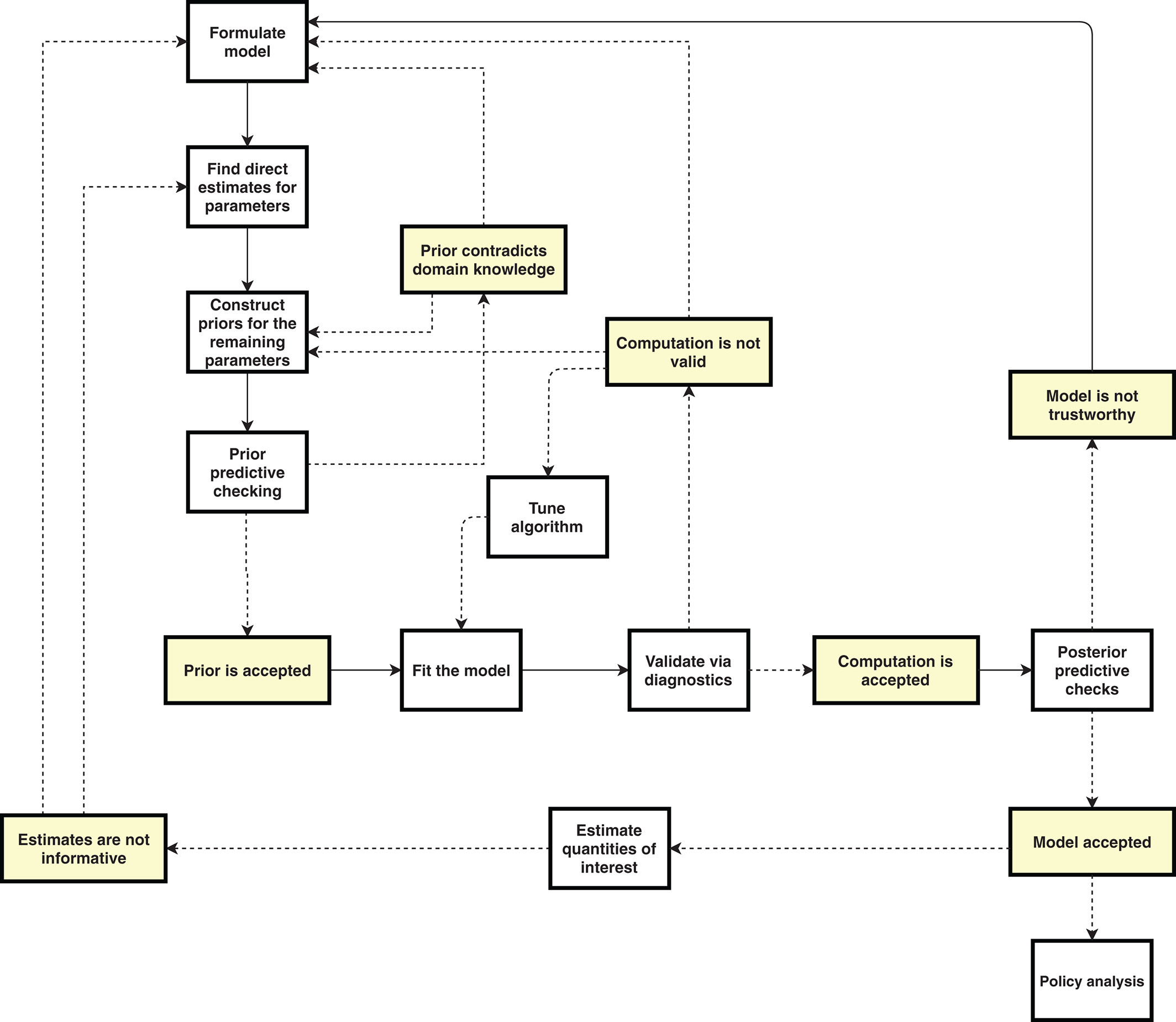
A Bayesian approach to calibrate system dynamics models using Hamiltonian Monte Carlo
by Jair Andrade, Jim Duggan
The authors introduce HMC, which outperforms random-walk methods, apply it to calibrate an SEIR model, and recommend visualization tools that facilitate the communication of results. The combination of SD software, R, and Stan produces robust results, facilitates reproducibility, and enhances the comprehension of the process undertaken.Fig 2. Bayesian workflow adaptation to calibrate SD models.
Boundary objects in translation: the role of language in participatory system dynamics modeling
by Ellis Ballard, Kelsey Werner, Pratiti Priyadarshini
Fig 1. Examples of visuals.Based on a multisite effort in rural India, the authors discuss how the use of visuals can help introduce models, capture the meaning of variables, and encourage model ownership. Challenges did not only include participants but also the facilitation team comprising NGO staff and field staff.
ANNOUNCEMENT
Introducing M-Tool: A standardised and inclusive mental model mapping tool
by Karlijn L. van den Broek, Sina A. Klein, Joseph Luomba, Helen Fischer


Fig 1. Mapped mental model using M-Tool.With M-Tool, participants create influence diagrams with a fixed set of pictograms representing the system variables, and weighted arrows to display their relations. It has already been used in contexts as diverse as fisher’s experience, plant-based protein transition, and COVID-19 transmission.
 
BOOK REVIEW
Feedback Economics: Economic Modeling with System Dynamics (2001)
by John T. Harvey
Ranging from macro to microeconomics, resources, policy analysis, and variations, this book is a phenomenal approach to economics. Visuals and a myriad of examples tremendously help to understand the concepts. Recommended to both neophytes and experienced SD researchers alike.
ACCESS ARTICLES

SYSTEM DYNAMICS REVIEW

System Dynamics Society | System Dynamics Review

A Quantum Model of Exaptation: Incorporating Potentiality into Evolutionary Theory – Gabora, Scott, Kauffman (2013)

source:

[1310.0558] A Quantum Model of Exaptation: Incorporating Potentiality into Evolutionary Theory

A Quantum Model of Exaptation: Incorporating Potentiality into Evolutionary Theory

Liane GaboraEric O. ScottStuart Kauffman

The phenomenon of preadaptation, or exaptation (wherein a trait that originally evolved to solve one problem is co-opted to solve a new problem) presents a formidable challenge to efforts to describe biological phenomena using a classical (Kolmogorovian) mathematical framework. We develop a quantum framework for exaptation with examples from both biological and cultural evolution. The state of a trait is written as a linear superposition of a set of basis states, or possible forms the trait could evolve into, in a complex Hilbert space. These basis states are represented by mutually orthogonal unit vectors, each weighted by an amplitude term. The choice of possible forms (basis states) depends on the adaptive function of interest (e.g., ability to metabolize lactose or thermoregulate), which plays the role of the observable. Observables are represented by self-adjoint operators on the Hilbert space. The possible forms (basis states) corresponding to this adaptive function (observable) are called eigenstates. The framework incorporates key features of exaptation: potentiality, contextuality, nonseparability, and emergence of new features. However, since it requires that one enumerate all possible contexts, its predictive value is limited, consistent with the assertion that there exists no biological equivalent to “laws of motion” by which we can predict the evolution of the biosphere.

A Quantum Model of Exaptation: Incorporating Potentiality into Evolutionary Theory

[1310.0558] A Quantum Model of Exaptation: Incorporating Potentiality into Evolutionary Theory

Robert Rosen’s anticipatory systems | Louie (2010)

source:

[PDF] Robert Rosen’s anticipatory systems | Semantic Scholar

Robert Rosen’s anticipatory systems

  • A. Louie
  • Published 1 June 2010
  • Sociology
  • Foresight

Purpose – This article aims to be an expository introduction to Robert Rosen’s anticipatory systems, the theory of which provides the conceptual basis for foresight studies.Design/methodology/approach – The ubiquity of anticipatory systems in nature is explained.Findings – Causality is not violated by anticipatory systems, and teleology is an integral aspect of science.Practical implications – A terse exposition for a general readership, such as the present article, by definition cannot get into too many details. For further exploration the reader is referred to the recent book More than Life Itself by the author.Originality/value – The topic of anticipatory systems in particular, and methods of relational biology in general, provide important tools for foresight studies. It is the author’s hope that this brief glimpse into the world of relational biology piques the interest of some readers to pursue the subject further

Robert Rosen’s anticipatory systems

[PDF] Robert Rosen’s anticipatory systems | Semantic Scholar

Enlightened Enterprise Newsletter and course: Critical Systems Thinking and the Management of Complexity (starts Jan 18)

STARTING SOON (Jan 18th) A Course for Executives – Critical Systems Thinking and the Management of Complexity (brochure) This is the world’s first executive education course on this topic being delivered by Dr Michael C Jackson OBE, author of the book with the same title, and an internationally recognise expert. I will be co-presenting it with him. The Enlightened Enterprise Academy advocates that, “the purpose of any enterprise in any sector should be the creation of value, defined as contributions to sustainable widely shared prosperity, measured in terms of human flourishing and wellbeing”. In practice that means creating real value by solving the problems and meeting the needs and wants. It requires clarity about what value you create who for and how. These are the three core questions for strategic thinking, planning and execution. Additionally, solutions will invariably require an understanding of the systems that need to be managed to deliver solutions. Complexity usually means managing multiple systems-of-systems and having a comprehensive and holistic view of them, and the ways in which they interrelate and are interdependent. It also means being able to determine which systems thinking approaches are appropriate in tackling a particular type of problem and changing them as the problem evolves dynamically, which most problems do.

(1) Enlightened Enterprise Newsletter 01/22 | LinkedIn

Acta Europeana Systemica Journal

Volume 10 and general information

source

Acta Europeana Systemica


Created in 2011 by the European Union for Systemics (EUS), Acta Europeana Systemica (AES) is an Open Access Journal without publication fees, publishing review papers, in French or in English, on topics in all areas of systems thinking (https://ojs.uclouvain.be/index.php/AES).

We relaunch the AESjournal with a larger editorial team, a more professionalized double-blind review system, an enlarged review committee and a new layout for the papers and the bibliography.

From now on, we open a permanent call for contributions. You can send us your submissions at any time via the platform (the first time, you will have to register on the platform and don’t forget to read the Authors Guidelines).

This permanent call for contribution is also open for the participants of the 11th UES congress and the 17th HSSS Conference. Feel free to share this call with your colleagues, your PhD students, and others systemics society and organizations all over the world!

Each submission includes:

1. title (optional: a subtitle)

2. information of the author(s) (First name Last name, Institution, Laboratory, University, email address)

3. summary (no more than 1 500 characters including spaces)

4. five keywords

5. text (preferably between 45,000 and 75,000 characters including spaces)

6. bibliography in APA style

For the integrity of the blind peer-review, all over the text and the bibliography, the authors should replace their names by the word “Author”.

Vol 10 (2020): Unlock consciences: Rethinking the world after the pandemic Damien Claeys, Andrée Piecq (eds.) Déconfiner les consciences : Repenser le monde après la pandémie UES-EUS, AFSCET, AIRS, HSSS, S&O, SESGE, december 2020 Published: 2020-12-09

Acta Europeana Systemica