
| Selected sources from Alan Hudson |
|---|
Author Archives: antlerboy - Benjamin P Taylor
100-day Challenge & Critical Systems Thinking
100-day Challenge & Critical Systems Thinking
Novi Milenkovic
Applying complexity science to product management practices
June 29, 2025
Whew, I completed a 100-day challenge on Bluesky and looked at 50 books through the lens of Critical Systems Thinking
https://www.linkedin.com/pulse/100-day-challenge-critical-systems-thinking-novi-milenkovic-9dnaf/
‘Variety Dynamics’
Variety Dynamics is an effective approach to managing difficult highly-complex real-world situations such as wars, epidemics, diplomacy, climate change, political decision making, terrorism, urban planning, economic change….
Managing variety dynamics is more effective than using force.
Variety Dynamics is concerned with the dynamic distribution of variety in any situation as the fundamental basis for use of power, control and management. This is an especially valuable understanding for managing complex situations. Variety is the number of possible options available to different elements in a situation.
Webinar with Patrick Hoverstadt – Wednesday, June 25, 2025 18:00 UK time
Vincent van der Lubbe LinkedIn
Do you recognize this? You build technically sound solutions, but:
● Business and IT speak different languages about strategy
● Vendor relationships become more complex than planned
● Technical roadmaps clash with organizational reality
● You’re reacting more than directing
On Wednesday June 25th from 18:00-19:30 hrs, Patrick Hoverstadt shares his insights. He saw how technically strong strategies bogged down with organizational dynamics. His conclusion? Look at organizations the way you look at systems: understand interrelationships and patterns.
My personal recommendation: Patrick combines sharp intellect with british humor, the depth of scientist with the breadth of a practitioner, and the accepting fatalism of an optimist ploughing on.
In this webinar, Patrick discusses:
● How organizations influence each other – and why your IT strategy often goes in a different direction than planned
● Vendor lock-in as a strategic pattern: when it works for you, when against you
● First Mover or Fast Follower? Understanding timing in technology adoption
● Navigate between collaboration and competition (with other departments, vendors, partners)
● Recognizing which forces drive your strategic direction – and how to leverage them
With real-world examples such as:
● Platform owners changing the rules of the game
● IT departments evolving from cost center to strategic partner
● Technical choices that unintentionally create strategic dependencies
● When following “best practice” is just not smart
For whom: IT architects, digital leaders and tech professionals who are curious about the intersection of technology, people and organization.
When: Wednesday, June 25th from 18:00-19:30 hrs
Speaker: Patrick Hoverstadt – systems thinker, consultant and author of “Patterns of Strategy” (2017) and “The Fractal Organization” (2008)
Language: English Duration: 90 minutes including Q&A
An initiative of the “Systems Thinking for Information Professionals” and “Governance” interest groups.
Event link: https://lnkd.in/dxKt-cKu NB DIRECT ACCESS TEAMS LINK
Original post:
Harish’s Notebook – the arbitrariness of objectivism – Jose (2025)
Reading List – Innovation in the Public Sector: A Systems Lens – Thea Snow (2025)
Large Language Models and Emergence: A Complex Systems Perspective – Krakauer, Krakauer and Mitchell (2025, preprint)
David C. Krakauer Santa Fe Institute, John W. Krakauer, Santa Fe Institute, Department of Neuroscience, Johns Hopkins School of Medicine, Melanie Mitchell, Santa Fe Institute
(June 10, 2025)
Abstract
Emergence is a concept in complexity science that describes how many-body systems manifest novel higher-level properties, properties that can be described by replacing high-dimensional mechanisms with lower-dimensional effective variables and theories. This is captured by the idea “more is different”. Intelligence is a consummate emergent property manifesting increasingly efficient—cheaper and faster—uses of emergent capabilities to solve problems. This is captured by the idea “less is more”. In this paper, we first examine claims that Large Language Models exhibit emergent capabilities, reviewing several approaches to quantifying emergence, and secondly ask whether LLMs possess emergent intelligence.
Harish’s Notebook – The Ethics of Choice: Ackoff Meets von Foerster, and When is a ‘System’? – Jose (2025)
Job: Joint Head of Systems Research, Defra, £45.5-£67k, deadline 1 July 2025
Department for Environment, Food and Rural Affairs
Apply before 11:55 pm on Tuesday 1st July 2025

Details
Reference number
410771
Salary
£54,470 – £67,090
National – £54,470 – £61,000
London £59,900 – £67,090
For details of our pay on appointment policy, please see below under the heading ‘Salary’.
A Civil Service Pension with an employer contribution of 28.97%
Job grade
Grade 7
Contract type
Permanent
Business area
Core Defra
Type of role
Other
Working pattern
Flexible working, Full-time, Homeworking, Job share, Part-time
Number of jobs available
1
Location
Bristol, London, Newcastle-upon-Tyne, York
About the job
Job summary
The Department for Environment, Food and Rural Affairs (Defra) is the UK government department responsible for safeguarding our natural environment, supporting our world-leading food and farming industry, and sustaining a thriving rural economy. Our broad remit means we play a major role in people’s day-to-day life, from the food we eat, and the air we breathe, to the water we drink.
The role is part of the Central Science Division (CSD) within the Science and Analysis Group. This sits at the heart of the Department’s science community, supporting the Chief Scientific Adviser (CSA) and Deputy CSA in all aspects of their work. The Division leads on cross cutting science issues, representing the Defra science community and bringing forward new and emerging science and technology across the Department.
The CSD is a friendly and welcoming team. Our remit reaches across the Defra organisations, providing leadership, guidance, and advice to ensure quality science is the foundation of policy making. The vision of the group is to put science at the heart of the way that Defra works. This needs to be supported by strong leadership and strategic direction and effective partnership working.
This role is to jointly lead Defra’s Systems Research Programme (SRP). The SRP team consists of civil servants and seconded academics with expertise in applied systems thinking analysis, natural and social sciences, and system dynamics modelling. These transdisciplinary skills allow us to combine systems thinking with conventional research approaches to explore complex and challenging questions. The SRP’s principles and ways of working are detailed in our primer for integrating systems approaches into Defra (https://www.gov.uk/government/publications/integrating-a-systems-approach-into-defra).
Our current and previous research topics include net zero, environmental targets, circular economy, land use, air and water quality, and food. Some of our work has been published as case studies (https://www.gov.uk/government/publications/systems-thinking-for-civil-servants/case-studies). Our outputs make high impact by helping to identify policy intervention points and trade-offs, frame narrative for emerging research and policy areas, flag strategic watchpoints and areas of uncertainty, and direct research funding to close evidence gaps.
Encouraging diverse applicants
We recognise the challenges that people with (multiple) protected characteristics may experience on the job market and in their career progression. We are fully committed to being an inclusive employer and ensuring equal opportunities. We are keen to make our workforce as diverse as possible, and we hope to attract applications from underrepresented groups.
Job description
This exciting, cross-cutting role provides strategic leadership to CSD’s in-house systems research team. Working alongside another Grade 7 already in post, the post holder will be jointly responsible for overseeing the work of up to 10 Defra scientists and seconded academic fellows.
The team’s remit spans all issues of relevance to Defra Group, as needed, as well as providing support to the Chief Scientific Adviser (CSA) on high priority topics.
Key responsibilities include:
- Designing and overseeing a coordinated programme of systems research on topics relevant to Defra’s remit to navigate complex, cross-cutting and interdependent policy issues by applying systems thinking methods.
- Managing a team of Senior Scientific Officers and seconded academics
- Managing a budget to second academics into the team and procure R&D
- Supporting the team in applying systems approaches
- Representing Defra’s systems function and the Central Science Division across Government
- Communicating complex ideas and science to a policy audience
- Managing governance arrangements for the programme
- Building and maintaining relationships with academia and key external stakeholders
- Implementing a work plan to build capability in systems approaches for Defra staff
- Supporting the Defra Chief Scientist in responding to emerging, high priority scientific issues across Defra’s remit
The post-holder will be expected to continually develop their knowledge and practice of systems research through reading, online training, networking and engagement in communities of practice.
Key internal stakeholders include the CSA, policy teams across the business, embedded science teams across Defra groups and central science, analysis and strategy teams. External stakeholders include academics, devolved administrations, ALBs and other government departments.
Person specification
Person specification:
- Strong scientific and analytical skills and experience of applying systems thinking approaches to inform decision making
- Experienced leader of diverse teams to deliver science or analysis
- Capability to influence at senior levels, especially at the science-policy interface
- Excellent convening and facilitation skills
- Developing effective partnerships with external stakeholders
- Managing budgets and procuring R&D
- Programme management skills
Qualifications
Minimum of a Degree in systems science or environmental science, or equivalent experience.
Memberships
Government Science and Engineering (GSE)
Behaviours
We’ll assess you against these behaviours during the selection process:
- Making Effective Decisions
- Seeing the Big Picture
- Leadership
Technical skills
We’ll assess you against these technical skills during the selection process:
- Degree/Masters/PhD in systems science or environmental science
Benefits
Alongside your salary of £54,470, Department for Environment, Food and Rural Affairs contributes £15,779 towards you being a member of the Civil Service Defined Benefit Pension scheme. Find out what benefits a Civil Service Pension provides.
A career in the Civil Service is like no other. If you’re looking to join a world class team and develop your career with us, then the Civil Service is the place for you! You might be wondering, “what’s in it for me”? Take a look below at some of the benefits available to you as a civil servant in Defra.
Science and Analysis Directorate Benefits
Learning and Development
Everyone in Defra is supported to develop their skills and capabilities. When you join the Directorate, you will be welcomed into your new team through an induction programme that will provide you with helpful information on the civil service, Defra, our work and our policies. Your line manager will also work with you to establish your priorities for the year, developing a performance, learning and development plan tailored to you and your role, while also working with you to connect you with a civil service mentor to help empower you in your new role with the opportunity to benefit from paid for coaching.
Most importantly, we’re keen to invest in you! As a civil servant, you will also have access to Civil Service Learning where you can participate in professional development programmes across a wide spectrum of subjects and professions.
Department Benefits
Technology
We’re a firm believer in agile and flexible working. When you join Defra, we’ll kit you out with a new Windows 11 Laptop, smartphone and rucksack to make sure that you perform your best wherever you are.
Leave
25 days’ paid leave per annum rising to 30 days after five years’ service, in addition to eight public holidays and the King’s Birthday privilege day. We also offer
– competitive maternity, paternity, parental and adoption leave;
– study leave for the pursuit of academic studies;
– 3 days paid leave for volunteering per annum;
– 15 days paid leave per year for reservist training; and,
– generous paid sick leave.
Cycle to Work Scheme
Defra loans you a bike for your commute as a tax-free benefit. At the end of the loan period, you have the option to buy the bike, saving 30% of the original cost.
Season Ticket and Bicycle Loan
We offer interest-free season ticket loans, to all Defra employees with more than three months’ service, for purchasing train and bus season tickets, as well as station car parking. For those unable to take advantage of tax-free benefits, we also offer an interest-free bicycle loan to enable the purchase of a bicycle for commuting.
Gym, Social and Sports Activities
Our offices have a range of different onsite facilities, including gym, fitness facilities, games room, showers and cycle storage. There are also a variety of networks and social groups to join. Ask your line manager for more information.
Restaurant and Café Facilities
A range of our offices offer onsite restaurant and café facilities.
Civil Service Benefits
Pension
Your pension is a valuable part of your total reward package, and you will be given the chance to join one of three different pension plans. You can find more information on the Civil Service Pension on the MyCSP Website at www.civilservicepensionscheme.org.uk
Civil Service Sports Council
The Civil Service Sports Council (CSSC) organises a wide choice of activities throughout the UK, from art, gliding, abseiling and orienteering to cabaret weekends and quiz and curry nights. Your CSSC membership will provide you with FREE access to hundreds of national and local sites, in addition to savings at many high street stores, cinemas, restaurants and historic houses.
Things you need to know
Selection process details
This vacancy is using Success Profiles (opens in a new window), and will assess your Behaviours, Experience and Technical skills.
Application Process
As part of the application process you will be asked to complete a CV, Personal Statement and 3 Behaviours
Further details around what this will entail are listed on the application form.
Sift
Should a large number of applications be received, an initial sift may be conducted using the lead behaviour – Making Effective Decisions. Candidates who pass the initial sift may be progressed to a full sift or progressed straight to assessment/interview.
Sifting is likely to occur week commencing 7th July with interviews likely to take place week commencing 4th August. These dates are indicative only.
Interview
If successful at application stage, you will be invited to interview where you will be assessed on Behaviours and a technical question this may be assessed through a presentation.
Interviews are expected to last no longer than 60 Minutes.
Your interview will either be conducted face to face or by video. You will be notified of the location if you are selected for interview.
Location
As part of the pre-employment process for this post, successful candidate(s) will be able to agree a contractual workplace from those locations listed in this advert. The agreed contractual workplace is then the substantive and permanent place of work for the successful candidate(s).
Where the location is ‘National’ the successful appointee should discuss and agree an appropriate contractual location in line with both Defra’s location policy and site capacity, prior to proceeding with pre-employment processes.
Successful applicants currently employed by the hiring Defra organisation for this post may choose to remain in their current contractual location or may choose to change contractual location to one of those listed above. This should be discussed and agreed prior to proceeding with pre-employment processes.
The agreed amount of time spent at a workplace for this post will reflect the requirement for Civil Servants to spend at least 60% of their working time in an organisation workplace with the option to work the remaining time flexibly from home. Working time spent at a workplace may include time spent at other organisational locations including field-based operational locations, together with supplier, customer or partner locations. This is a non-contractual agreement which is consistent with common Civil Service expectations.
Travel costs to non-contractual workplaces will be subject to departmental travel and subsistence policies. Travel costs to contractual workplaces are the responsibility of the employee.
The successful candidate is required to carry out all their duties from a UK location, and cannot do so from an overseas location at any time.
Defra includes the core department, APHA, RPA, Cefas and VMD.
Reserve List
A reserve list may be held for a period of 12 months from which further appointments can be made.
Merit Lists
Where more than one location is advertised, candidates will be appointed in merit order for each location. You will be asked to state your location preference on your application.
Salary
New entrants to the Civil Service are expected to start on the minimum of the pay band. The internal roles rules apply to existing Civil Servants, i.e. level transfers move on current salary or the pay range minimum, transfers on promotion move to new pay range minimum or receive 10% increase. Either case is determined by whichever is the highest.
Reasonable Adjustment
If a person with disabilities is put at a substantial disadvantage compared to a non-disabled person, we have a duty to make reasonable changes to our processes.
If you need a change to be made so that you can make your application, you should:
Contact Government Recruitment Service via defrarecruitment.grs@cabinetoffice.gov.uk as soon as possible before the closing date to discuss your needs.
Complete the ‘Assistance required’ section in the ‘Additional requirements’ page of your application form to tell us what changes or help you might need further on in the recruitment process. For instance, you may need wheelchair access at interview, or if you’re deaf, a Language Service Professional.
Accessibility
If you are experiencing accessibility problems with any attachments on this advert, please contact the email address in the ‘Contact point for applicants’ section.
Visa Sponsorship Statement
Please take note that Defra does not hold a UK Visa & Immigration (UKVI) Skilled Worker License sponsor and are unable to sponsor any individuals for Skilled Worker Sponsorship.
Criminal Record Check
If successful and transferring from another Government Department, a criminal record check maybe carried out.
In order to process applications without delay, we will be sending a Criminal Record Check to Disclosure and Barring Service on your behalf. However, we recognize in exceptional circumstance some candidates will want to send their completed forms direct. If you will be doing this, please advise Government Recruitment Service of your intention by emailing Pre-Employment.Checks@cabinetoffice.gov.uk stating the job reference number in the subject heading.
Internal Fraud Database Check
Applicants who are successful at interview will be, as part of pre-employment screening, subject to a check on the Internal Fraud Database (IFD). This check will provide information about employees who have been dismissed for fraud or dishonesty offences. This check also applies to employees who resign or otherwise leave before being dismissed for fraud or dishonesty had their employment continued. Any applicant’s details held on the IFD will be refused employment.
A candidate is not eligible to apply for a role within the Civil Service if the application is made within a 5 year period following a dismissal for carrying out internal fraud against government.
Higher Security Clearance:
Job offers are made on the basis of merit. Security vetting will only take place after the receipt of a job offer.
Please be aware the levels of national security clearance are changing which may impact on the level needed for this role by the time of appointment. All efforts will be made to keep candidates informed of any changes and what that will mean in terms of vetting criteria. For more information please See our vetting charter.
Job offers are made on the basis of merit. Security vetting will only take place after the receipt of a job offer.
If you are successful at interview all of these posts require the successful candidate to hold basic security clearance. Candidates posted to London may be subject to a higher level of clearance because of the security requirements for that location. Job offers to these posts are made on the basis of merit. Security vetting will only take place after the receipt of a job offer.
NSV
All of these posts require the successful candidate to hold basic security clearance. Candidates posted to London may be subject to a higher level of clearance because of the security requirements for that location. Job offers to these posts are made on the basis of merit. Security vetting will only take place after the receipt of a job offer.
For further information on National Security Vetting please visit the following page https://www.gov.uk/government/publications/demystifying-vetting
Please be aware the levels of national security clearance are changing which may impact on the level needed for this role by the time of appointment. All efforts will be made to keep candidates informed of any changes and what that will mean in terms of vetting criteria. For more information please See our vetting charter
Childcare Vouchers
Any move to DEFRA from another employer will mean you can no longer access childcare vouchers. This includes moves between government departments. You may however be eligible for other government schemes, including Tax Free Childcare; for further information visit the Childcare Choices website.
Feedback
Feedback will only be provided if you attend an interview or assessment.
Security
Successful candidates must undergo a criminal record check.
People working with government assets must complete baseline personnel security standard (opens in new window) checks.
Nationality requirements
This job is broadly open to the following groups:
- UK nationals
- nationals of the Republic of Ireland
- nationals of Commonwealth countries who have the right to work in the UK
- nationals of the EU, Switzerland, Norway, Iceland or Liechtenstein and family members of those nationalities with settled or pre-settled status under the European Union Settlement Scheme (EUSS) (opens in a new window)
- nationals of the EU, Switzerland, Norway, Iceland or Liechtenstein and family members of those nationalities who have made a valid application for settled or pre-settled status under the European Union Settlement Scheme (EUSS)
- individuals with limited leave to remain or indefinite leave to remain who were eligible to apply for EUSS on or before 31 December 2020
- Turkish nationals, and certain family members of Turkish nationals, who have accrued the right to work in the Civil Service
Further information on nationality requirements (opens in a new window)
Working for the Civil Service
The Civil Service Code (opens in a new window) sets out the standards of behaviour expected of civil servants.
We recruit by merit on the basis of fair and open competition, as outlined in the Civil Service Commission’s recruitment principles (opens in a new window).
The Civil Service embraces diversity and promotes equal opportunities. As such, we run a Disability Confident Scheme (DCS) for candidates with disabilities who meet the minimum selection criteria.
The Civil Service also offers a Redeployment Interview Scheme to civil servants who are at risk of redundancy, and who meet the minimum requirements for the advertised vacancy.
Diversity and Inclusion
The Civil Service is committed to attract, retain and invest in talent wherever it is found. To learn more please see the Civil Service People Plan (opens in a new window) and the Civil Service Diversity and Inclusion Strategy (opens in a new window).
Apply and further information
This vacancy is part of the Great Place to Work for Veterans (opens in a new window) initiative.
The Civil Service welcomes applications from people who have recently left prison or have an unspent conviction. Read more about prison leaver recruitment (opens in new window).
Once this job has closed, the job advert will no longer be available. You may want to save a copy for your records.
Contact point for applicants
Job contact :
- Name :Strategy, People and Resourcing
- Email :sandc.resourcing@defra.gov.uk
Recruitment team
- Email :defrarecruitment.grs@cabinetoffice.gov.uk
Further information
If you feel your application has not been treated in accordance with the Recruitment Principles and you wish to make a complaint, in the first instance, you should contact Government Recruitment Services via email: defrarecruitment.grs@cabinetoffice.gov.uk
If you are not satisfied with the response you receive from the Department, you can contact the Civil Service Commission: here
Link:
The 55 Minutes – Stauch (book, with Johnson and Papi-Thornton, 2025)
New England Complex Systems Institute – conversations – Carlos Gershensen on Complexity and the Limits of Science, June 16 2025, 10am EST – and archive of past events
[They appear to be communicating on their website solely in images, with no alt text, which is…. something!]
Why Everything in the Universe Turns More Complex
A new suggestion that complexity increases over time, not just in living organisms but in the nonliving world, promises to rewrite notions of time and evolution.
April 2, 2025
link: https://www.quantamagazine.org/why-everything-in-the-universe-turns-more-complex-20250402/
Charles Wang on Twitter – SFI Science complexity foundation papers and D.I.C.E.Y. complexity
[Not sure if useful or doing ‘to’ complexity theory what Derek Cabrera’s work does to systems thinking]
“This diagram is the gist of @sfiscience complexity foundation papers. It misses 50% of complexity—the more important half. I’d merge mechanics into dynamics Add: In-form-ation as structural-functional organization aka embodied symbols that enable computation Universality

Complexity is a field loaded with unnecessary complex concepts and lack of actionable insights. DICEY offers penetrating insights, fully actionable, you immediately see through the problems. Ex: You need only to master the left that can reproduce the right. Left vs right
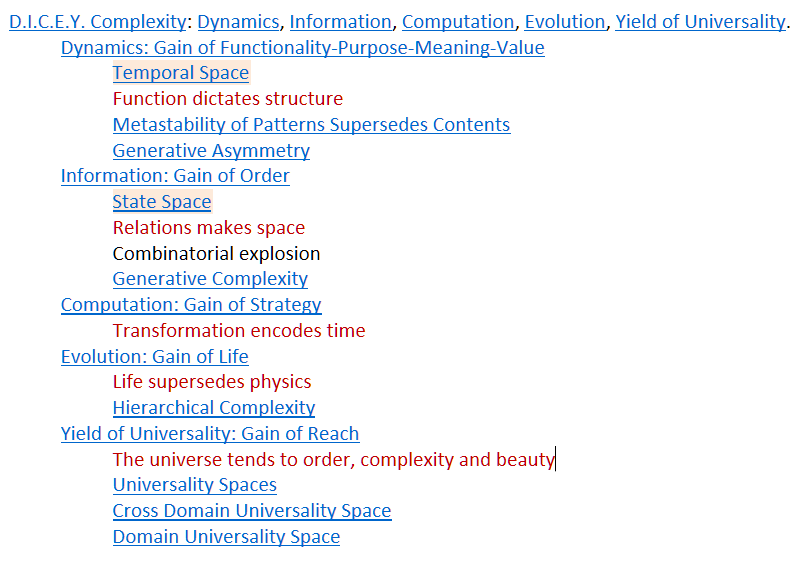

Is information the unifying principle that allows us to understand the evolution of complexity in nature? Not quite. It is DICEY.

Complexity Cat blog – dialectics and autopoietic aphorisms
Training Requirements for Collective Intelligence (CI) and Systems Thinking (ST) Facilitators – Hogan et al, 7 June 2025
[Found on Bluesky
…where I replied
Ah! This somewhat exists!
Delivered by me – https://systemspractice.org/courses/facilitation-workshops
Developed as part of the Level 7 Systems Thinking Practitioner apprenticeship, under the Apprenticeship Standard https://cherithsimmons.co.uk/apprenticeships/stp/
which is based on the Systems Practice professional standard
with a host of other intervention skills on offer:
Worth a chat to compare notes some time?]
Michael J. Hogan, Benjamin Broome, Owen M. Harney
First published: 07 June 2025
https://doi.org/10.1002/sres.3169
ABSTRACT
In this commentary paper, we address the issue of programme and module development for the purpose of clarifying training requirements for collective intelligence (CI) and systems thinking (ST) facilitators.
In efforts to address complex societal problems, teamwork and associated collective intelligence (CI) and systems thinking (ST) skills are increasingly valued in organisations and communities (Mulgan 2018; Jackson 2019). CI can be understood as the enhanced capacity that is created when a group of people work together on a shared problem, often with the help of technology (Mulgan 2018). CI processes can be designed to perform a variety of different group functions, and the functional capabilities we associate with individual intelligence—including our ability to observe, focus, analyse, remember, create, empathise, judge, decide and select wise actions in context—can emerge at the group level as part of a CI process (Mulgan 2018). When groups seek to address complex problems, methods that incorporate multiple, integrated, sequential group functions can be implemented as part of a CI process. Importantly, ST methods (which typically involve the coordination of multiple, sequential actions) can be designed and implemented as part of a CI process. ST can be understood as a pluralistic approach that integrates diverse methodologies to understand interconnections within complex systems, enabling context-specific solutions to practical problems (Jackson 2019). Jackson (2019) describes a range of ST methods for working in the context of technical complexity (e.g., Operations Research), process complexity (e.g., the Vanguard Method), structural complexity (e.g., System Dynamics), organisational complexity (e.g., Organisational Cybernetics), people complexity (e.g., Interactive Planning) and coercive complexity (e.g., Team Syntegrity). However, ST methods can be challenging to implement, and groups often need support from an experienced facilitator who can help them to orchestrate CI and the implementation of ST methodologies.
In a previous commentary paper published in Systems Research and Behavioural Science (Hogan and Broome 2020), we countered the view that teams can readily “facilitate themselves” when using ST methods (i.e., the idea that groups can easily orchestrate their own CI during the implementation of ST methods). Separately, in a second commentary (Hogan and Broome 2021), we argued that an educational focus on group process facilitation is needed as a key pillar of ST education and training (see also Kanne 2018). Finally, in a third commentary paper (Broome and Hogan 2021), we argued that educational training programmes designed to develop CI and ST facilitation skills should include a focus on competencies needed to perform the CI and ST facilitator role. We conceptualised facilitator skill development across three competency levels. Level 1 includes Foundational competencies, which involve knowledge of group dynamics and communication processes. Level 2 includes Performative competencies that allow the facilitator to plan and execute groupwork sessions, including developing skill facilitating groups using a range of different CI and ST methodologies. Level 3 includes competencies that enhance group project work through Mastery of the facilitation process, helping groups develop productive ways of behaving together by exercising mindfulness, vision and adaptability (see Table 1). In this commentary paper, we address the issue of programme and module development for the purpose of clarifying training requirements for CI and ST facilitators.TABLE 1. Core competencies of CI and ST facilitators.
| Facilitating collective intelligence and systems thinking | ||
|---|---|---|
| Level 1: Foundational | Foundational competencies include knowledge of group dynamics and communication processes and perspective on knowledge transfer across different CI and ST project applications. | Attention to group dynamics and communication processes is foundational for the facilitator of any group that wishes to be successful, but these competencies are particularly important in systems thinking and collective design. Working with groups facing complex problems, CI and ST facilitators need a strong understanding of processes such as group formation and building positive working relationships among team members. Systems design requires working through multiple variables that impact the situation, and facilitators must guide the group carefully through the process of managing conflict and engaging in dialogue. Participants need to be open to differing opinions and points of view, which requires listening and empathy. Conflict is inevitable and even desirable when groups are engaged in systems analysis, and it is critical that the facilitator is able to help groups identify their differences and manage them productively. Strong design work often necessitates bringing together participants from across organisational contexts, and learning to work together is vital for systems thinking. Forming a cohesive team that can withstand the challenges inherent in systems thinking requires facilitation skills that go beyond the usual skills required of a group moderator. To be successful in navigating the intricacies of complex systems design, facilitators needwell-developed competencies in managing group relations and promoting communication that builds positive working relationships. |
| Group dynamics | Focus on developing a foundational understanding of group dynamics, which helps in navigating the unique interactions within a group across different organisational contexts, including the dynamics of group formation, cohesion, teambuilding, intergroup relations and managing conflict. This knowledge can be developed through case studies, communication exercises, literature review and group projects. | |
| Organisational ecosystemsGroup formationGroup cohesionTeambuildingIntergroup relationsManaging conflict | ||
| Communication process | Focus on developing know-how and skill in applying facilitator communication processes that support meaningful dialogue, such that groups can communicate ideas and reasoning, develop shared values and goals, build positive working relationships and make collective decisions. Critical to this process is active listening with respect and curiosity, which encourages openness, empathy, and reflexivity, allowing group members to explore ideas and exercise their CI and ST skills. Communication process competencies can be developed through issue-based dialogue, idea generation, argumentation and relational thinking (e.g., causal loop and matrix structuring) exercises in class. | |
| DialogueListeningOpennessValidationEmpathyReflexivity | ||
| Level 2: Performative | Performative competencies allow facilitators to plan and execute a CI and ST session. | Facilitating CI and ST work is much more than managing an agenda and directing the conversation. The CI and ST facilitator’s work starts with planning the design session, and knowledge of the organisational and historical context is essential for properly constructing the flow of activities. Although all groups can benefit when facilitators have a solid understanding of the situation, the success of a group engaged in systems analysis is highly dependent on the CI and ST facilitator selecting appropriate methodologies that will help them generate, structure, and select ideas for action, while sequencing the flow so that each stage of the group work builds upon the products from the previous stage. Although there are a limited number of tested methodologies for CI and ST work, it is critical to choose from among them the techniques that will help the group explore all the relevant angles on the situation and map the array of factors that need to be taken into consideration. Central to the work of the CI and ST facilitator is the ability to implement these methodologies within the group context. Working with a carefully constructed session plan, the facilitator must be able to go beyond simply following the established steps of the methodology. As a group works through the complex set of factors that impact their situation, they will be discovering new insights, and the methodologies and the flow of activities might need to change. CI and ST facilitators must be able to pick up on the nuances in the discussion and maintain a pace that will allow progress while simultaneously making sure sufficient time is allowed for in-depth exploration of ideas. This requires knowledge and expertise in systems approaches that allows them to adjust to changing circumstances and needs. Maintaining a controlled environment while giving participants freedom to explore and play with ideas is key to promoting the innovation that is crucial for systems thinking. Only with methodological expertise and skills in session management can the CI and ST facilitator help a group design viable alternatives to complex problem situations. |
| Contextual knowledge | Focus on developing knowledge facilitators need to understand regarding various forms of contextual influence at play prior to, during, and after CI and ST groupwork. This may include the history of the group, the cultural and political contexts within which the group functions, as well as the social context. Knowledge of these contexts enables facilitators to select appropriate activities and methodologies while anticipating and managing individual and group behaviours. This knowledge can be developed through case studies, site visits, literature review and group projects. | |
| Organisational contextHistorical contextCultural contextPolitical contextSocial context | ||
| Methodological expertise | Focus on developing know-how and skill needed to implement the CI and ST methodologies that have been selected during the planning process. Facilitators are responsible for effectively implementing the selected methodologies that aid groups in generating, structuring and choosing ideas for action. Ideally, training programmes should equip facilitators with skills in a diverse range of systems thinking methods to enhance their effectiveness. Know-how and skill can be developed in a classroom context through implementation and reflection on process steps for each CI and ST method in turn. This can be complemented by the provision of process guides and workbooks. | |
| Generating ideasStructuring ideasSelecting ideas | ||
| Session management | Includes a focus on the know-how and skills required to plan and execute a CI and ST session, including sequencing of activities, managing discussions, setting and maintaining appropriate pacing and progression, anticipating tasks, and coordinating the facilitation team. Class activities including mock CI and ST design sessions and collaborative planning exercises can cultivate session management skills by allowing students to practice organising logistics, structuring discussions, and facilitating turn-taking in a controlled environment. Additionally, debriefing sessions with instructors and peer evaluations can enhance these skills by providing opportunities for students to reflect and further develop their management skills. | |
| Planning and organisationDiscussion managementTemporal regulationAnticipating tasksCo-facilitator teamwork | ||
| Level 3: Mastery | Mastery incorporates mindfulness, vision and adaptability and involves the ability to guide groups through complex CI and ST planning and implementation processes, including in sensitive situations with divided opinions or emotional topics. Developing mastery takes time, necessitating ongoing debriefing, feedback, reflection and a commitment to learning from experiences. | By definition, most CI and ST sessions are dealing with complex issues, many of which have long resisted resolution. For such sessions, Levels 1 and 2 competencies are essential for the CI and ST facilitator. But there will be times when the facilitator will be required to work with groups facing highly sensitive circumstances involving more emotional topics about which there may be strong division. These situations require a degree of mindfulness, vision and adaptability that facilitators rarely achieve at a high level. But with sufficient experience and proper guidance and reflection, a level of mastery can be reached that will position the CI and ST facilitator to take on more challenging situations. Through enhanced self and other awareness, qualities such as patience and curiosity can help strengthen a facilitator’s work in these more difficult sessions. CI and ST facilitation can often be a balancing act, and a level of mastery is required that will help facilitators make good choices about how to move forward with groups facing what sometimes seem to be overwhelming odds. Particularly when working in protracted conflict situations, the CI and ST facilitator may need to help the group move past failures and regain a sense of hope for the future. The facilitator can encourage the group to continue through bleak circumstances, or alternatively to take a break and wait out a dangerous turn of events. And when the group experiences failure or loses hope, it is important to help them recover and regain their motivation to continue. |
| Mindfulness | Mindfulness focuses on self-regulation of thought, behaviour and emotional and physiological reactivity during facilitation, which support important facilitator traits such as curiosity, impartiality, emotional awareness, and maintenance of integrity in the role requirements of the CI and ST facilitator. Classroom activities can include active mindfulness practices to enhance awareness and self-regulation (e.g., during dialogue, idea generation, argumentation and relational ST activities). Other activities include role-playing scenarios to practice impartiality and curiosity in challenging discussions, and reflection journals to analyse experiences and promote integrity in their facilitator roles. | |
| CuriosityPatienceEquanimityImpartialityEmotional awarenessIntegrity | ||
| Vision | Vision focuses on the need for the facilitator to offset any discouragement and adversity the group faces, projecting hopefulness, courage and resilience in their own vision of the task at hand. CI and ST instructors can use case studies and personal reflection coupled with role-playing scenario to support the development of perspective in students. | |
| HopefulnessCourageResilience | ||
| Adaptability/flexibility | Adaptability/flexibility focuses on the need for facilitators to accept and deal with uncertainty. This involves remaining open-minded, amenable to changing plans and approaches and the capacity and resilience to navigate unforeseen challenges. Classroom activities can include scenario-based simulations where students face unexpected challenges and must collaboratively find new solutions, fostering resilience and problem-solving skills. Additionally, group discussions focused on reflecting on setbacks can encourage students to articulate their vision for future group work while practicing adaptability in adjusting their plans. | |
| Open-mindednessAbility to adapt methodsRecovery capacityPressure resilience | ||
- Note: Overall, the competencies required of the CI and ST facilitator overlap in important ways with the skills of good managers, group leaders, teachers and others responsible for working with groups. Most of the qualities and skills we outline for CI and ST facilitators are important in general human relations. However, the demands of working with groups facing complex problem situations require not only specialised applications and adaptations of these competencies, but they also require a holistic integration of the components of each level and across the levels. In other words, facilitating CI and ST requires also a systems approach to the knowledge and expertise involved in the facilitation process. Neglect of any individual competency will leave the facilitator vulnerable to failure. Similar to the product that emerges from systems design work, the facilitation process needs to function as an integrated whole, modelling the process we are trying to help the group achieve in dealing successfully with complex issues.
 Systems Community of Inquiry
You must be logged in to post a comment.