Systemic wisdom for and beyond systems change – A critical systems perspective convening not only indigenous traditions of wisdom – EUSG

source

Systemic wisdom for and beyond systems change – A critical systems perspective convening not only indigenous traditions of wisdom – EUSG

European School of Governance, position paper #108 (29.10.21) by Louis Klein

Embracing indigenous wisdom traditions promises to successfully meet the challenges of the Anthropocene in the 21st century. They seem to bring what is needed to overcome the limits of the project managerial activism associated with systems change. However, wisdom is an embodied understanding of our human potential and our humanity that grows from deeply reflected human experience. We find this in wisdom practices and traditions all over the world, like the in Southern African Ubuntu, the ancient Chinese Tianxia or the contemporary Moroccan Tamkeen. A critical systems perspective allows for exploring the universality of their understanding of the interconnectedness and interdependence of the flow of the world. And it facilitates convening the different wisdom practices and traditions, growing in their in-between a global dialogue trusting our human potential and our humanity realising the existentiality of love. Isn’t this already the systems change we want to see in the world?

Continues in source: European School of Governance, position paper #108 (29.10.21) by Louis Klein

Systemic wisdom for and beyond systems change – A critical systems perspective convening not only indigenous traditions of wisdom – EUSG

The physics of higher-order interactions in complex systems

cxdig's avatarComplexity Digest

Federico Battiston, Enrico Amico, Alain Barrat, Ginestra Bianconi, Guilherme Ferraz de Arruda, Benedetta Franceschiello, Iacopo Iacopini, Sonia Kéfi, Vito Latora, Yamir Moreno, Micah M. Murray, Tiago P. Peixoto, Francesco Vaccarino & Giovanni Petri
Nature Physics volume17,pages1093–1098 (2021)

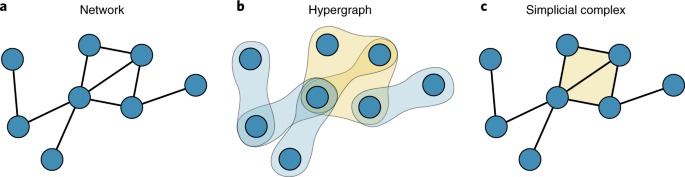
Complex networks have become the main paradigm for modelling the dynamics of interacting systems. However, networks are intrinsically limited to describing pairwise interactions, whereas real-world systems are often characterized by higher-order interactions involving groups of three or more units. Higher-order structures, such as hypergraphs and simplicial complexes, are therefore a better tool to map the real organization of many social, biological and man-made systems. Here, we highlight recent evidence of collective behaviours induced by higher-order interactions, and we outline three key challenges for the physics of higher-order systems.

Read the full article at: www.nature.com

View original post

SYSTAC Global Meeting, 2-9 November 2021 – Systems Thinking for Strengthening Health Systems

SYSTAC Global Meeting 2 – 9 November 2021 The popularity of the Alliance flagship report Systems Thinking for Strengthening Health Systems, has endured for more than a decade. In a new global climate of manifold uncertainties, ambiguities and adaptations, systems thinking has never been needed more. In LMICs especially, and in policymaking and practice in particular, systems thinking still remains underused as an approach to strengthen health systems.

SYSTAC Global Meeting

Systems Approaches for Accelerating the SDGs and Building Back Better – November 17, 2021, 2-6pm GMT


Wed, Nov 17, 2021 2:00 PM – 6:00 PM GMT

Systems Approaches for Accelerating the SDGs and Building Back Better Wed, Nov 17, 2021 2:00 PM – 6:00 PM GMT

Registration

Systems Approaches for Accelerating the SDGs and Building Back Better


Wed, Nov 17, 2021 2:00 PM – 6:00 PM GMT

Show in My Time Zone


SDGs address some of the most fundamental issues that are at stake for systems transformation in the frame of tackling the global challenges of our times. These issues require action-oriented systemic interventions but, however, SDGs are not systemic by design. As we approach the mid-term of the implementation of the United Nations Agenda 2030, we would like to pause and reflect while asking this question: “How can systems approaches help accelerate the achievement of the SDG in the post pandemic context for building back better?” The purpose of this event is, therefore, to discuss the challenges and explore potential pathways for transformation to embed systems approaches into the (re)design, implementation and evaluation of SDG, so as to accelerate progress in the achievement of the United Nations Agenda 2030. This online event is jointly organized by a group of academic partners: EADA Business School, University of Hull’s Centre for Systems Studies, Presencing Institute, Blue Marble Evaluation and Ethos of Management Consulting with the support of the United Nations Development Coordination Office.

Hybrid Webinar: Engineering for climate stability | 4 November 2021, 2-4pm UK time (Glasgow or online)

A COP fringe event

Hybrid Webinar: Engineering for climate stability | Glasgow

Hybrid Webinar: Engineering for climate stability

Quaker Meeting House, Glasgow

04 November 2021

Overview

This trio of talks will demonstrate that sustainable engineering requires an integrated cross-sectoral approach to be most effective, and also that technology is only part of a wider solution to the environmental problems that we face. Join for an afternoon of lectures exploring what engineering for climate stability truly means.

The event will comprise the following three talks on sustainable engineering with the opportunity for questions and discussion.

Join us either in person in Glasgow or via the online link to hear and benefit from these presentations!

more and book at source: Hybrid Webinar: Engineering for climate stability

Hybrid Webinar: Engineering for climate stability | Glasgow

Key Theories of Humberto Maturana – Literary Theory and Criticism – Mambrol (2018)

Key Theories of Humberto Maturana BY NASRULLAH MAMBROL on FEBRUARY 24, 2018

Key Theories of Humberto Maturana – Literary Theory and Criticism

Cybernetics, planning and situated action – JellevanDijk.org

Cybernetics, planning and situated action

No way to respond on the blog that I can see, so I’ll (BT) just add here:

I don’t think the first objection to ‘planning’ has real merit as presented here:

  • the word ‘plan’ or ‘planning’ is mentioned a grand total of three times in the Espejo and Gill piece which is the primary link in the referenced Anarchist Cybernetics piece
  • the difference between embodied, reflexive/habitual/entrained action and intentional action is precisely what is embodied in the VSM, and presumably something like what Allenna Leonard refers to in “the control of a skier going down a hill”. Automatic actions take place at one level, conscious management of emergent results takes place at another – just as the piece argues (‘against’ cybernetics)

The second point, on embodiment and materiality, is certainly something worth considering across the whole cybernetics | systems | complexity field (it seems to me to be precisely the objection that Prof Mike Jackson raised to much that goes in the name of ‘complexity’: ‘if you abstract everything that is human and contextual out of human, contextual action, of course you have something comparable over scales’ – my paraphrased recollection). But my understanding of cybernetics is *precisely* that it is situated and contextual, so I’m just going to puzzle over that one some more.

Anarchist Cybernetics by Thomas Swann – The Institute for Anarchist Studies (2021)

Anarchist Cybernetics

Anarchist Cybernetics by Thomas Swann – The Institute for Anarchist Studies

Anarchist Cybernetics

by Thomas Swann

May 13, 2021

What can anarchist engagements with the cybernetic science of self-organization, buried in an obscure anarchist journal from the 1960s and written by an elusive computer scientist, reveal about the effective functioning of anarchist organization?

(see also https://stream.syscoi.com/2020/10/22/bristol-university-press-anarchist-cybernetics-control-and-communication-in-radical-politics-by-thomas-swann/ )

The Viable System Model as a Framework for Understanding Organizations – Espejo and Gill (2011)

The Viable System Model as a Framework for Understanding Organizations

(PDF) The Viable System Model as a Framework for Understanding Organizations

The Viable System Model as a Framework for Understanding Organizations

  • October 2011

Introducing the Model The Viable System Model (VSM) is not a new idea. Created by Stafford Beer over twenty years ago, it has been used extensively as a conceptual tool for understanding organizations, redesigning them (where appropriate) and supporting the management of change. Despite its successful application within numerous private and public sector organizations, however, the VSM is not yet widely known among the general management population. There are two main reasons for this. Firstly, the ideas behind the model are not intuitively easy to grasp; secondly, they run counter to the great legacy of thinking about organizations dating from the Industrial Revolution -a legacy that is only now starting to be questioned. To deal with the second point in more detail, organizations have been viewed traditionally as hierarchical institutions that operate according to a top-down command structure: strategic plans are formulated at the top and implemented by a cascade of instructions through the tiered ranks. It is now widely acknowledged that this modus operandi is too slow and inflexible to cope with the increasing rate of change and complexity surrounding most organizations. Technology developments have helped to usher in a new concept of a flatter, networked-type organization with a wider distribution of data to reach all those who actually perform the work -in real time. The ground is now fertile for viewing the organization in a new light.

Opinion | What’s the Best Way to Stop Tragic Accidents? – The New York Times

source:

Opinion | What’s the Best Way to Stop Tragic Accidents? – The New York Times

What’s the Best Way to Stop Tragic Accidents?

Oct. 27, 202

Peter Coy

By Peter Coy

Opinion Writer

Tragic accidents have been in the news recently. The actor Alec Baldwin unintentionally shot and killed someone on a movie set after firing a gun that he was told was unloaded. A port explosion in Beirut killed more than 200 people last year. And a new documentary by Frontline, in partnership with The New York Times, examines the two crashes of Boeing 737 Max jets that killed 346 people over the course of four months in 2018 and 2019.

What can be done? Nancy Leveson has an answer. Leveson, an engineering professor at the Massachusetts Institute of Technology, has developed a distinctive approach to accident prevention. She doesn’t focus on identifying individual faulty components or singling out blundering people. Instead she looks at how accidents can be caused by unforeseen interactions between various components of a complex system.

Leveson’s approach, which is often described as “systems thinking,” is drawing a lot of interest…

Continues in source: What’s the Best Way to Stop Tragic Accidents?

Opinion | What’s the Best Way to Stop Tragic Accidents? – The New York Times

The Need for Systems Thinking in Cybersecurity – Ron Ross

The Need for Systems Thinking in Cybersecurity Ron Ross of NIST Discusses Moving Away From Stovepipe Thinking

The Need for Systems Thinking in Cybersecurity

Systems Thinking Analyses for Health Policy and Systems Development, Eds. Martins et al (2021)

Systems Thinking Analyses for Health Policy and Systems Development

Systems Thinking Analyses for Health Policy and Systems Development

Systems Thinking Analyses for Health Policy and Systems Development

A Malaysian Case Study

Systems Thinking Analyses for Health Policy and Systems Development
  • Publisher:Cambridge University Press
  • Online publication date:September 2021
  • Print publication year:2021

Linkedin Learning course: Applying systems thinking to product design – Walter Zesk

As far as I can see, they mean Systems Dynamics – maybe with a smidge of Systems Engineering thrown in?

source:

Applying systems thinking to product design

Systems Thinking for Product Designers

Applying systems thinking to product design

INSTRUCTOR

Walter ZeskDesigner, Professor, and Cofounder of Conform LabFollowing on LinkedIn

RELATED TO THIS COURSE

  • Certificates Show all

Course details

  • 2h 10m
  • Beginner + Intermediate
  • Released: 10/20/2021

While the internet and wireless communication technologies have been connecting people in new ways, it has also been linking together our products. The development of complex products requires bigger teams and greater specialization, and coordinating that effort is its own systemic challenge. As the complexity and interconnectedness of products rises, so does the need for an approach that guarantees that your products deliver the best experiences. In this course, Walter Zesk, professor and cofounder of Conform Lab, shows you how to apply systems thinking to product design. Walter points out several benefits of systematic product design, then steps you through how to analyze product mechanisms as systems. He explains how to identify innovative trends and optimize functionality in your designs., including functional conflict resolution. Plus, Walter goes over distributed products, experiential products, and network products.

Continues in source: Systems Thinking for Product Designers

Applying systems thinking to product design

Complexity and systems thinking, Merali and Allen (2011)

Complexity and systems thinking

(PDF) Complexity and systems thinking

Complexity and systems thinking

  • January 2011

Abstract

Once the whole is divided, the parts need names. There are already enough names. One must know when to stop. Knowing when to stop averts trouble. Tao in the world is like a river flowing home to the sea. Lau Tsu, Tao Te Ching.

Systems Thinking as if People Mattered Critical Systems Thinking for Citizens and Managers | Ulrich (1998)

Systems Thinking as if People Mattered Critical Systems Thinking for Citizens and Managers

[PDF] Systems Thinking as if People Mattered Critical Systems Thinking for Citizens and Managers | Semantic Scholar

Systems Thinking as if People Mattered Critical Systems Thinking for Citizens and Managers

This Working Paper offers a revised version of a talk that was given to the staff and the Ph.D. students of the Lincoln School of Management on January 16, 1997. The author’s research programme, ‘Critical Systems Thinking for Citizens’, was explained and discussed with special regard to its goal of contributing to the revival of civil society. The author argued that critical systems thinking has a potential of giving citizens a new sense of competence, and that this new competence will also alter our notion of competent management.

direct pdf link