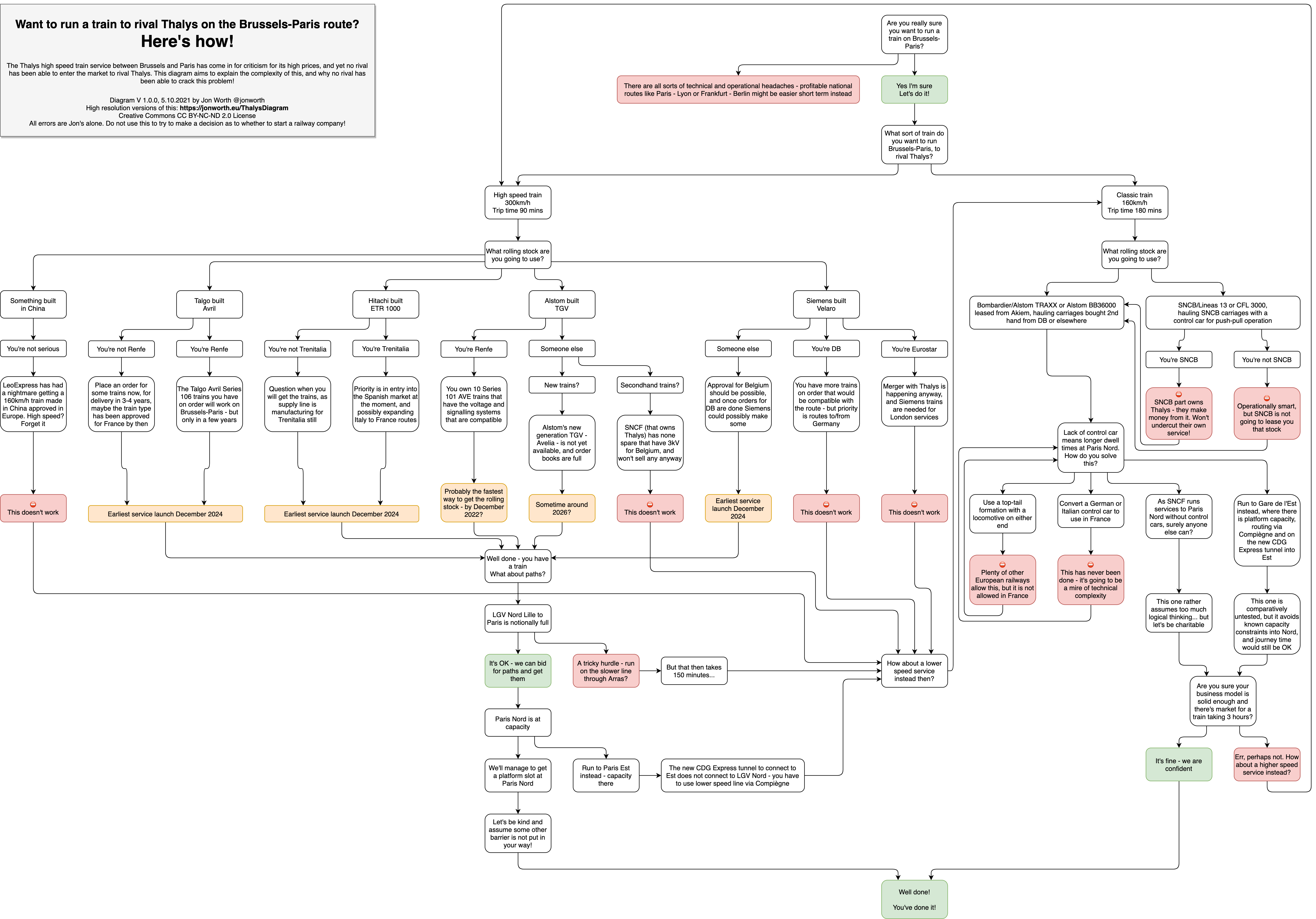
Thalys has been in the news this week – because its proposed merger with Eurostar is supposedly back on…
… so it’s time to examine why a rent seeking monopolist firm like Thalys can even exist on the Brussels-Paris route
Call for Papers: Special Issue on Alexander Bogdanov
For more information, please see here.
Submission Deadline: 15 January 2022
Please note all special issue papers must be submitted through the ScholarOne site: https://mc.manuscriptcentral.com/srbs
(Previously published in: The Analogical Mind: Perspectives from Cognitive Science, Dedre Gentner, Keith J. Holyoak, and Boicho N. Kokinov (eds.). Cambridge MA: The MIT Press/Bradford Book, 2001, pp. 499-538.)
Complex systems are characterised by randomness and disorder and are difficult to understand. This year’s Prize recognises new methods for describing them and predicting their long-term behaviour.
One complex system of vital importance to humankind is Earth’s climate. Syukuro Manabe demonstrated how increased levels of carbon dioxide in the atmosphere lead to increased temperatures at the surface of the Earth. In the 1960s, he led the development of physical models of the Earth’s climate and was the first person to explore the interaction between radiation balance and the vertical transport of air masses. His work laid the foundation for the development of current climate models.
About ten years later, Klaus Hasselmann created a model that links together weather and climate, thus answering the question of why climate models can be reliable despite weather being changeable and chaotic. He also developed methods for identifying specific signals, fingerprints, that both natural phenomena…
Ritual, Sanctity, and Cybernetics
Roy A. Rappaport
American Anthropologist
New Series, Vol. 73, No. 1 (Feb., 1971), pp. 59-76 (18 pages)
Published By: Wiley
POSITIONAL TRANSDUCTION: AN ALTERNATIVE TO CODE
MARK T. NADIR
Pages 191-227 | Received 01 Nov 1984, Published online: 03 Apr 2007
Download citation https://doi.org/10.1080/01969728508927766
References Citations Metrics Reprints & Permissions Get access
Abstract
A new method of transducing information into digitized form is described. This method does not result in any form of code, nor does it bear any resemblance to code. In this new system of information digitization the only data that appears on the transmission medium are the addresses of the multiplicity of receptors being addressed. The methodology is compatible witJi digital technology. This method (positional transduction) very markedly alters the characteristics of the systems wherein it is employed (in favorable ways). Unlike code that has one basic form, positional transduction can (and does) assume a multitude of differenl forms, which share a common characteristic. The systems resulting from employment of the described technology can be made self-routing, automatically multiplexing, parallel processing—or all three. Several of the multiplicity of ways in which positional transduction might be employed are described.
Part I of the article is devoted to describing ways of employing positional transduction. The descriptions are illustrated with communications examples. In Part II, a calculator system is briefly described, which leads to a computational system. The article concludes with a description of the salient features of a computer whose hardware is “software wired.”
Computing pioneer Jay Forrester, SM ’45, developed magnetic-core memory. Then he founded the field of system dynamics. Those are just two of his varied pursuits.by
It is a late March day in Massachusetts. The sky is clear, but the air is frigid and the wind fierce. Looking outside, Jay Forrester, SM ’45, turns to glimpse the swaying treetops. He knows all about the power of wind. As a teenager, he harnessed it to bring electricity to his family’s ranch in Nebraska.
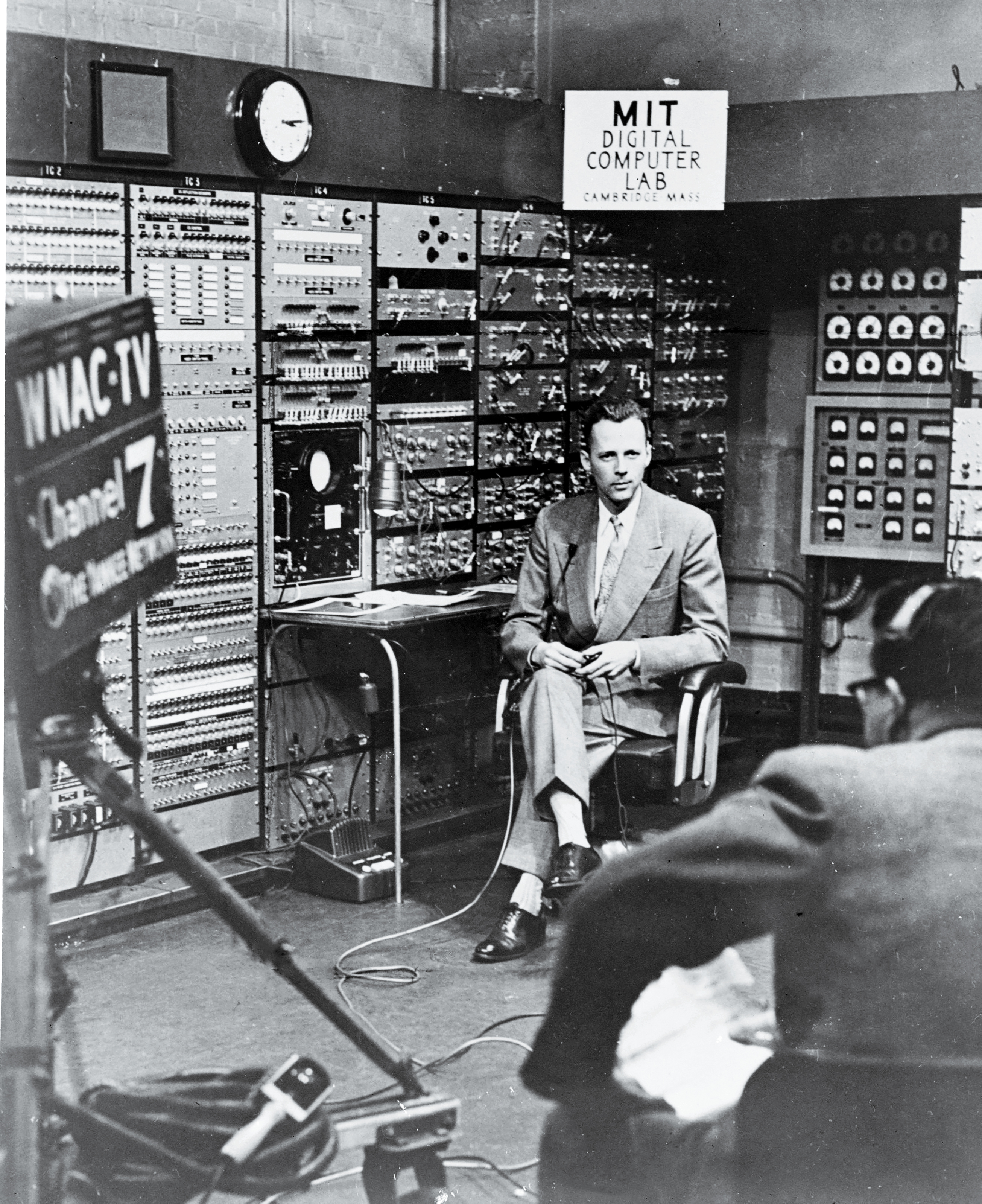
Jay Forrester, in front of Whirlwind in the MIT Digital Computer Lab, is interviewed by Boston’s Channel 7 in 1957.
A precocious tinkerer, Forrester studied electrical engineering at the University of Nebraska. He arrived at MIT as a graduate student in 1939 and never left, staying on as researcher, professor, and now professor emeritus. He has been at MIT for more than half the time that has passed since the Institute opened its doors.
Yet Forrester’s 76-year MIT tenure is even more notable for its breadth than its duration. He helped develop digital computing. He oversaw the creation of a national air defense system and helped launch MIT’s Lincoln Laboratory. Then he joined what is now the MIT Sloan School of Management and founded the field of system dynamics, which examines complex business, economic, and environmental systems—and the unexpected feedback effects human activity creates within them. “I’ve had several careers,” says Forrester, who turns 97 in July. “Starting with ranch hand.”
continues at source: https://www.technologyreview.com/2015/06/23/167538/the-many-careers-of-jay-forrester/
“Institutions established to serve the public can over time, become insular and increasingly focussed on self-preservation. Against this, a changing world posing new risks and opportunities, an absence of competition or change catalysts, and limited public input can then create a growing gap between what is, and what could be. When the gap and cost become intolerable it is time to act. This describes the current situation of reliance on a professional response model for fires. It is now time to disrupt the current model by amplifying the public voice and creating a space for innovation.”
David Wales
Why is this – and what can we do about it? Your thoughts would be welcome in the comments – and there’s an opportunity to participate:
Practice your thinking about system transformation
A package of presentation slide decks that can be used by you for training or sharing with people who want to learn more about networks.
Network Training Slide Decks quantityADD TO CART Report AbuseCategory: Free Resources Packages Description Reviews (0) Description A package of presentation slide decks that can be used by you for training or sharing with people who want to learn more about networks. Network Basics Presentation Slide Decks Network Skills Presentation Slide Decks Map Analysis & Weaving Related
Scientists from Tübingen show that people really walk in circles when lostAUGUST 20, 2009
It is a common theme in many books and films: when people get lost in a desert or a jungle, they end up walking in circles. No matter how hard they try, at some point they will cross their own tracks and despair, because they realize that they will never make it back to civilization. Surprisingly enough, the belief that people walk in circles when lost is mainly based on anecdotal evidence and has never been studied systematically in a real desert or forest. (Current Biology, August 20th 2009)



 Systems Community of Inquiry
You must be logged in to post a comment.