In this Global Strike for Our Future initiative , the organizers (Fridays For Future and Earth Strike from Lucca) propose a reflection on the link between the Coronavirus crisis and the ecological crisis. The point is essential: as fact discuss or to t the beginning of the pandemic of This Magazine, the spread of the virus and its many ramifications are essentially part of a deep crisis in the relationship between us and the nature of which we are a part. Many contribut e stud i have since been published and we can take a cue from these, other jobs, and the most recent events to reflect on the kind of bonds that we are often tempted not to try to understand and recognize.
Exploring the complexity of conflict and organising in the time of Covid-19
The Symposium booking site is now open and is available here . You can see the agenda for the day here.
The following is a post by member of DMan faculty Professor Karen Norman which speaks into the theme of the conference:
Exploring the complexity of conflict in organising in the time of Covid: washing our hands of a problem?
Infection prevention and control (IPC) in hospitals is essential at the best of times, but especially so in a time of Covid. From my previous experience as a Board Director responsible for Infection Control in hospitals, I understand the challenges facing staff in maintaining high IPC standards. In 2003, I was involved in a national initiative to reduce the incidence of hospital acquired Methicillin Resistant Staphylococcus Auereus, (MRSA) bacteraemias, because 9% of hospital inpatients had infections acquired whilst in hospital,
We use mathematical and statistical methods to probe how a sprawling, dynamic, complex narrative of massive scale achieved broad accessibility and acclaim without surrendering to the need for reductionist simplifications. Subtle narrational tricks such as how natural social networks are mirrored and how significant events are scheduled are unveiled. The narrative network matches evolved cognitive abilities to enable complex messages be conveyed in accessible ways while story time and discourse time are carefully distinguished in ways matching theories of narratology. This marriage of science and humanities opens avenues to comparative literary studies. It provides quantitative support, for example, for the widespread view that deaths appear to be randomly distributed throughout the narrative even though, in fact, they are not.
In 1999, Frederic Vester published a report to the Club of Rome named “The Art of Interconnected Thinking”. The main focus of the book is about understanding complex systems, and how a number of interconnected models, what he called the Sensitivity Model, can help us do so. The Sensitivity Model is an IT-based approach, today in the ownership of Malik Management. While other IT-based approaches try to connect some 200+ variables into a database, Vester is frugal in comparison, with 10-20 variables. The advantage of his approach over the more mathematical siblings is the acceptance and use of fuzziness. We simply cannot expect to be able to get a total picture of our system with sharply differentiated concepts and mathematical variables, so stop trying to do it anyway. The consequence is: we better accept that whatever model we use, it will be incomplete and partially wrong. It would be foolish to attempt something that is 100% correct. Therefore, a more realistic ambition is to create a model which is relevant to the pragmatical perspective of the beholder, and is sufficiently apt to produce this relevance.
AN INTRODUCTION TO COMPLEX SYSTEMS SCIENCE AND ITS APPLICATIONS
Cite as:
Alexander F. Siegenfeld and Yaneer Bar-Yam, An introduction to complex systems science and its applications, Complexity 2020 (July 27, 2020).
AN INTRODUCTION TO COMPLEX SYSTEMS SCIENCE AND ITS APPLICATIONS Cite as: Alexander F. Siegenfeld and Yaneer Bar-Yam, An introduction to complex systems science and its applications, Complexity 2020 (July 27, 2020).
Humans and viruses have been coevolving for millennia. Severe acute respiratory syndrome coronavirus 2 (SARS-CoV-2, the virus that causes COVID-19) has been particularly successful in evading our evolved defenses. The outcome has been tragic—across the globe, millions have been sickened and hundreds of thousands have died. Moreover, the quarantine has radically changed the structure of our lives, with devastating social and economic consequences that are likely to unfold for years. An evolutionary perspective can help us understand the progression and consequences of the pandemic. Here, a diverse group of scientists, with expertise from evolutionary medicine to cultural evolution, provide insights about the pandemic and its aftermath. At the most granular level, we consider how viruses might affect social behavior, and how quarantine, ironically, could make us susceptible to other maladies, due to a lack of microbial exposure. At the psychological level, we describe the ways in which the pandemic can affect mating behavior, cooperation (or the lack thereof), and gender norms, and how we can use disgust to better activate native “behavioral immunity” to combat disease spread. At the cultural level, we describe shifting cultural norms and how we might harness them to better combat disease and the negative social consequences of the pandemic. These insights can be used to craft solutions to problems produced by the pandemic and to lay the groundwork for a scientific agenda to capture and understand what has become, in effect, a worldwide social experiment.
For those interested, a history of readings for my @sfiscience Summer School lectures are available at the link below. I have yet to update for 2020, but will very soon.
In the meantime, plenty of notes, book recommendations, and Summer School drama.https://t.co/l2k7lYxwm7
Our 2019 lectures went from the biological priors of the visual system to meta-cultural knowledge production. A few sources that will enable you to follow up, or go more deeply, into the ideas in play:
FEATURE – This compelling article explores how our brain constantly looks for emotional resonance with the environment around us. Is this System-3 type thinking the key to enabling joint problem solving?
Words: Michael Ballé, lean author, executive coach and co-founder of Institut Lean France.
Nobel prize recipient Daniel Kahneman distinguishes two different thinking pathways according to whether we think hotly, which is quickly and automatically, or coldly, that is slowly and reflexively:
• With the system 1 thinking process, the brain forms thoughts that are fast, automatic, stereotypical, emotional and often unconscious – think of the first thing that comes to mind when you are presented with an object, an idea or a situation. • With the system 2 thinking process, the brain calculates wilfully a response by directing attention to the situation, figuring it out and formulating a deliberate response.
Max Boisot – The City as a Complex Adaptive System
27 Sep 2020
The first seminar in this Series took place on Thursday 18 November 2010 at the Lighthouse. The ATLAS Collaboration will conduct experiments at the very edge of science, using one of four detectors located on the Large Hadron Collider (LHC) at CERN. The Collaboration consists of over 3000 scientists working in over 174 research institutes and universities located in 38 countries around the globe. In such a complex and spatially extended network (what we would today call a complex adaptive system) how do the knowledge flows allow the creation of one of the most sophisticated technological objects ever built? Drawing on a conceptual framework, the Information-Space or I-Space, Max Boisot described and tried to make sense of the ATLAS collaboration’s culture. He explored the lessons that the management of globally distributed ‘big science’ projects such as the ATLAS collaboration hold for other complex adaptive systems such as cities. Source Glasgow Caledonian University CC BY-NC-SA https://edshare.gcu.ac.uk/143/ References Max Boisot https://en.wikipedia.org/wiki/Max_Boisot I-Space Institute http://www.ispaceinstitute.com/
Coronavirus (COVID-19) updates: We are open for Short Course bookings
Dartington always endeavours to provide a safe and supportive environment for all of our visitors. We are therefore not taking bookings for courses between 5 November – 2 December. If you have already made a booking for this period you will be contacted and given further details. We are taking bookings as normal for courses beyond the lockdown period and will continue to monitor the situation closely. We will refund or transfer your booking if we need to cancel any courses for covid-related reasons.
When you do arrive, there will be some changes to our usual practices but a warm welcome awaits you! We’ve put together some information about what we’re doing to keep you safe – you can read it here (pdf)(link is external). For peace of mind, we’re also making our risk assessments available – you can read them here.
Schumacher College delivers a unique brand of small-group experiences which embrace learning through head, hand, and heart. This takes place in the classroom, the gardens, the kitchen – it is part of everything we do. Short course participants join our learning community on courses ranging from a weekend to three weeks. Join us to discover things about yourself, make deep friendships with students from around the world and start a lifelong connection with the College. We hope that your involvement with Schumacher College will help to sustain you and we look forward to welcoming you in the near future.
Mon, 23/11/2020 to Sun, 03/01/2021With Lizzy Hawker
A short course over 6 weeks using movement to connect us to ourselves, the natural world around us and each other. In a time where many of us are again, or still, facing restrictions on movement and daily life developing a personal practice of movement can ground us and remind us of the freedoms that we always have.
Sat, 23/01/2021 to Sat, 27/02/2021With Matthew T. Segall
Participatory Knowing in Goethe and Whitehead: This short course explores how participatory ways of knowing can transform the natural sciences. It focuses on two towering exemplars of this approach, the German poet and naturalist Johann Wolfgang von Goethe (1749-1832) and the British mathematician and philosopher Alfred North Whitehead (1861-1947).
Mon, 01/02/2021 to Fri, 05/02/2021With Satish Kumar, Colum Pawson and Stephan Harding
Immerse yourself for a week in the vibrant community of Schumacher College. This course is designed to give you space to enquire into what has meaning in your life, and what role you wish to play in the world, while also being inspired and invigorated by some of the concepts and ideas the college is based upon and participating in the rich daily life of the Schumacher community.
Fri, 12/02/2021 to Sun, 14/02/2021With Satish Kumar and June Mitchell
This is a chance to spend an intimate weekend, hosted by Satish Kumar to consider the role of love in our lives and how we can use it to live in a more fulfilling way. It will be an opportunity for discussion and deep reflection, incorporating the wisdom of poets and mystics, to consider the most powerful force on earth.
Mon, 01/03/2021 to Thu, 01/04/2021With Kate Raworth, Rob Hopkins, Tom Crompton, Manda Scott, Jonathan Dawson and Jay Tompt
This course provides an opportunity for a deep dive, in the company of internationally recognised scientists, writers and artists in various media, into the science underlying the process by which we make sense of the world and how we can use this knowledge to become more effective communicators in the service of liberation. In addition to a study of the science underlying effective communication, there will be ample opportunity for solo and/or collaborative creativity, coached by our team of writers and artists.
Fri, 19/03/2021 to Sun, 21/03/2021With Kara Moses and Robin Bowman
A weekend of connecting deeply with trees in diverse ways, from identifying species and understanding basic tree biology, to intimate sensory experience and deep soulful connection.
Mon, 22/03/2021 to Fri, 26/03/2021With Jenny Mackewn and Robert Poynton
Our beautiful planet earth is under pressure, her diverse habitats are being destroyed, her wild animals are going extinct, What must we do? We need to develop and deepen our Wild Facilitation skills and use these creative methodologies to collaborate with individuals, groups, teams, communities, organizations and governments so that we can work together to serve and save the earth. We need to act fast.
Mon, 29/03/2021 to Thu, 01/04/2021With Stephan Harding, Satish Kumar and Dr Fiona Tilley
There is an ever-growing rise in people choosing to take time out of their daily lives to walk pilgrimage routes in the UK and other well-known place around the world. This course will explore the different ways intentional walks are nourishing people’s lives; from the Deep Time Walk, to forest bathing, to sacred pilgrimages and labyrinths to protest walks and pilgrimages for change. During the week there will be an opportunity to experience different styles of pilgrimage as well as meet those who have crafted the art of being a pilgrim in their lives.
Fri, 09/04/2021 to Sun, 11/04/2021With Satish Kumar and June Mitchell
Participate in a weekend meditating, walking and spending time in nature away from the daily stresses of life and discover the importance of bringing soul into the heart of everything you do.
Fri, 16/04/2021 to Sun, 18/04/2021With Ruairi Edwards and Christine Cairns
Discover who you are through song. This is a chance to find your own authentic voice with the support of a community of like-minded people. Maybe you are part of a choir and need the courage to step into the limelight? Maybe you want to sing but lack the confidence? Led by Ruairi Edwards – one of the UK’s most sought-after choral conductors and vocal coaches, this course offers the unique combination of individual attention to developing your technique combined with the sheer joy of experiencing communal voice.
Mon, 19/04/2021 to Fri, 23/04/2021With Carolyn Hillyer and Nigel Shaw and Dr Fiona Tilley
Will you reach for this primordial memory that long time ago belonged to you? Will you hold this powerful intuition, for once you knew it to be true? Will you trust to this unfettered spirit, for it is free and surely yours? Will you take this ferocious courage left for you by those who came before?
Mon, 26/04/2021 to Fri, 30/04/2021With Per Ingvar Haukeland and Stephan Harding
As the global crisis deepens, there is renewed interest in deep ecology as a philosophical and practical foundation for compassionate engagement with the world’s problems. This course brings deep ecology right up to date by reviving our deep ecological senses with new ways for connecting to our place and to the community of all beings and by developing our own personal ecological wisdom using the powerful Tree of Life model.
Mon, 26/04/2021 to Fri, 30/04/2021With Martin Crawford, Caroline Aitken and Jane Gleeson
Learn how to design, implement, and maintain forest gardens and other sustainable agroecological systems. Participants will experience both recently planted and well established 25-year old forest gardens, as well as other agroforestry in and around Dartington.Includes sessions on harvesting, preserving and cooking with forest garden produce.read more
Mon, 10/05/2021 to Fri, 14/05/2021With Dr Iain McGilchrist , Satish Kumar and June Mitchell
We have impoverished our understanding of the world by focussing so much on mechanism. The proper relationship of the two brain hemispheres is one that balances head and heart; one that gives weight to reason, intuition and imagination.
It is this connection that offers us remarkable insights into the unique harmony between ancient wisdom and cutting-edge neuroscience.
Sat, 15/05/2021 to Wed, 19/05/2021With Prof Rupert Read, Deepak Rughani, Skeena Rathor and Kanada Elizabeth Gorla
The idea of this course is to investigate deeply the spiritual orientation(s) that best suits the country’s growing truth-telling, Non-Violent Direct Action (NVDA) movements – movements that are almost certainly our last chance at averting or softening societal collapse.
Mon, 07/06/2021 to Fri, 18/06/2021With Jenny Mackewn
Led by Jenny Mackewn, with special contributors. This is a unique course introducing you to inspiring teachers and thinkers supporting you to develop your own personal leadership qualities and achieve your goals.
Join us for an eight-month journey that consists of: A period of preparation, a residential intensive and an 8 month community of practice through Virtual or Face-to-Face meeting.
Thu, 08/07/2021 to Sun, 11/07/2021With Emma Clark, Satish Kumar and June Mitchell
Gardening has a profound impact on the heart and soul. There will be talks by Satish Kumar on how we are all connected via the profound spiritual essence that is Nature and how through gardening we can connect intimately with nature; and by an expert on Islamic gardens, Emma Clark, on how gardening may be seen as a sacred art and on the spiritual symbolism of the Paradise Garden. Your experience will also include walks around the beautiful Dartington grounds and Qigong bamboo exercises led by the well-known and experienced practitioner June Mitchell.
Fri, 30/07/2021 to Fri, 06/08/2021With Colin Campbell, Lucy Hinton, Andrew McAulay, Satish Kumar and Wewo Kotokay
Join Colin Campbell, Lucy Hinton and Andrew McAulay for a process of deep ritual and bring together two areas of practice; nature vigil, and breathwork techniques. This is a chance for relational interaction to contribute to the regeneration of people, and the ‘other-than-human’ kin who speak a language that is both strange and achingly familiar.
Fri, 06/08/2021 to Sun, 08/08/2021With Jane Gleeson, Colum Pawson and Julia Ponsonby
This course will set you up with the basics of how to garden in a way that looks after the people, the plants and the whole ecosystem. Learn how to sow seeds, make great compost, look after your soil all in a way that restores the connection between human life and soil life.
Mon, 06/09/2021 to Fri, 10/09/2021With Dr Chris Johnstone and Professor David Peters
At a time of uncertainty in our world, the learnable skills of personal resilience strengthen our capacity to deal with difficult situations and rise to the occasion. Drawing upon psychological, relational and eco-spiritual perspectives, the course focuses on ways to cultivate resilience in ourselves (me), in other people (you), and within the teams, groups or communities we belong to (us).
Mon, 11/10/2021 to Wed, 13/10/2021With Julia Ponsonby, Colum Pawson and Caroline Walker
For our Gaia’s Kitchen short course, we will cook together a menu of lunches and suppers using garden produce and including some favourite menus inspired by our college cookbooks. We will also prepare chutney, sauerkraut, minced fruit for minced pies and a fruit cake which can be eaten at Christmas.
Mon, 20/06/2022 to Wed, 29/06/2022With Terry Irwin, Gideon Kossoff and Cameron Tonkinwise
This course provides an introduction to Transition Design, a new approach to seeding positive, systems-level change and catalysing the transition of entire societies toward more sustainable long-term futures.
A game is another name for a conversation. When people play together, or talk together, they are creating a game which lives through their participation. The ‘playing’ is the dynamic which maintains the boundary of the game, just as the internal and external processes of a cell maintain its boundary with its environment. Games are like cells.
Like all whole systems, there is a meta-system which maintains the integrity of the whole. Games have rules, and rules are determined by the meta-system. The game lives as a viable entity because of the dynamic relationship between the rules of the game and the play. The rules might be thought of as a meta-game.
The relationship between the meta-game and the game is very much like the relationship between the shifts of entropy in play, and the shifts of maximum entropy of possible moves. Maximum entropy determines the maximum amount of disorder available to the game – in effect this relates to the maximum moves allowed by the rules at any point. The entropy of play relates to the constraints (rules) imposed by the metasystem. Both the rules and the play can evolve.
This is rather like the game “Nomic”, where moves in the game change the rules.
There is an interesting question as to when a game comes to an end: the constraints produced by the meta-system mean that the entropy of play is zero.
If a conversation or dialogue is a game, then they can come to a pause, but somehow the “talk” goes on in other ways. The pause in a game is also the result of the entropy of play hitting zero – at least within a particular frame of play. The rules of a game can enforce this pausing-zeroing – like the games and sets in tennis, or timed halves in football. Their purpose is to impose pattern on the sequence of events, so as to set up the conditions for an eventual ending.
In education, summative assessment does the same thing: it sets up the conditions for an ending of the game. Appeals, mitigations, etc, open the thing up again, but this too is demarcated to create a pattern which is designed to come to an end.
Formative assessment, by contrast, is the actual “playing” of the game.
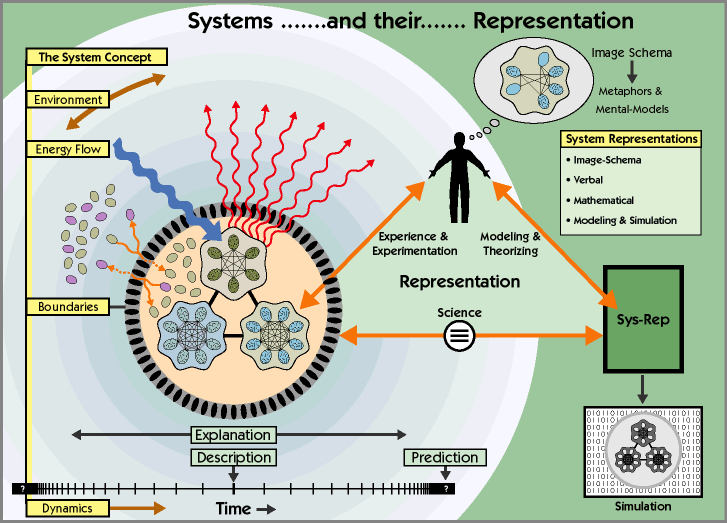
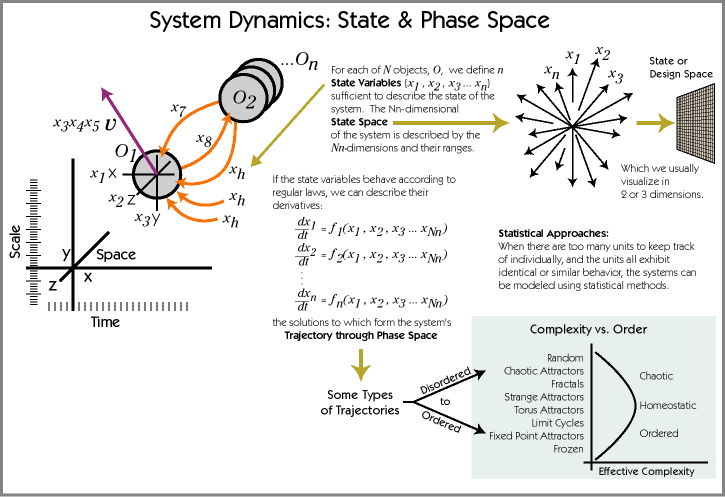
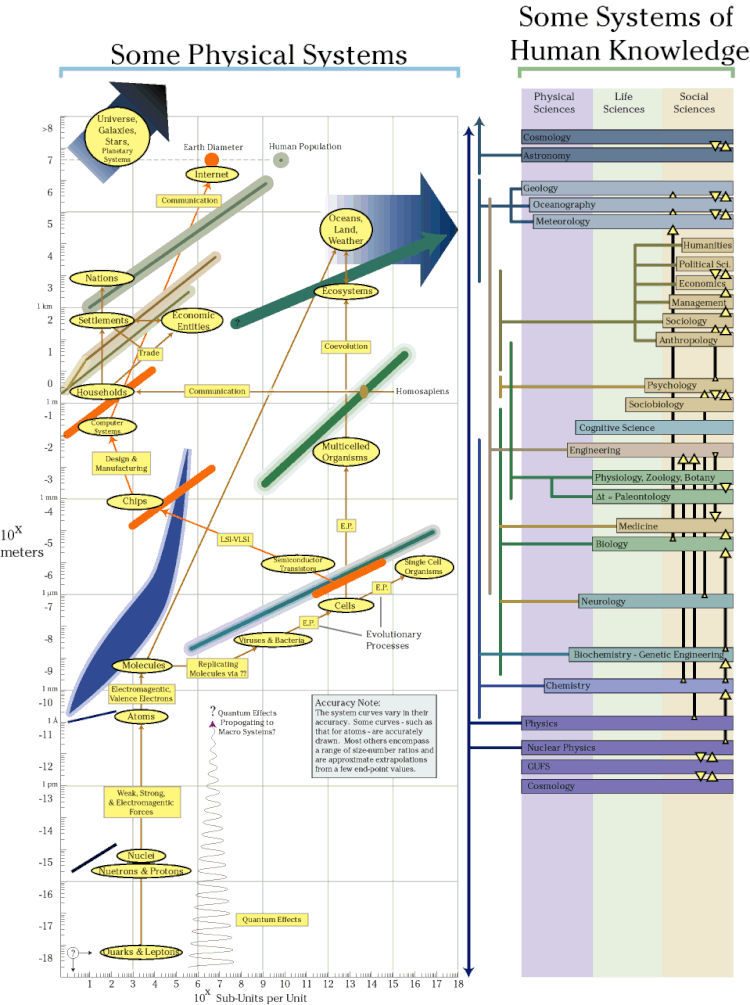
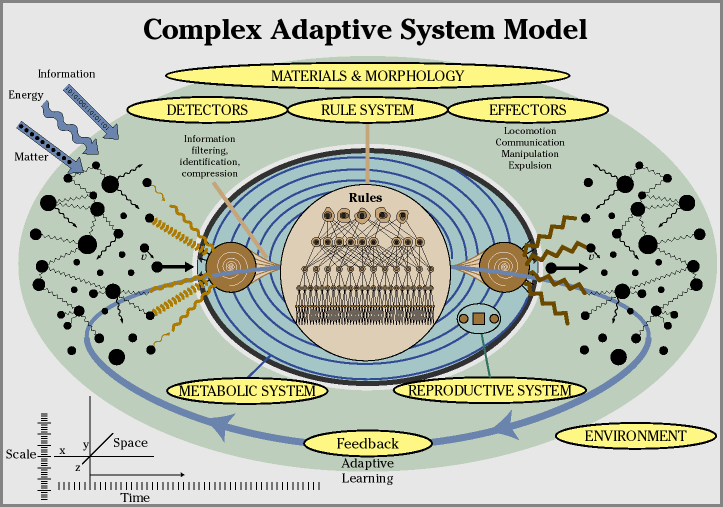
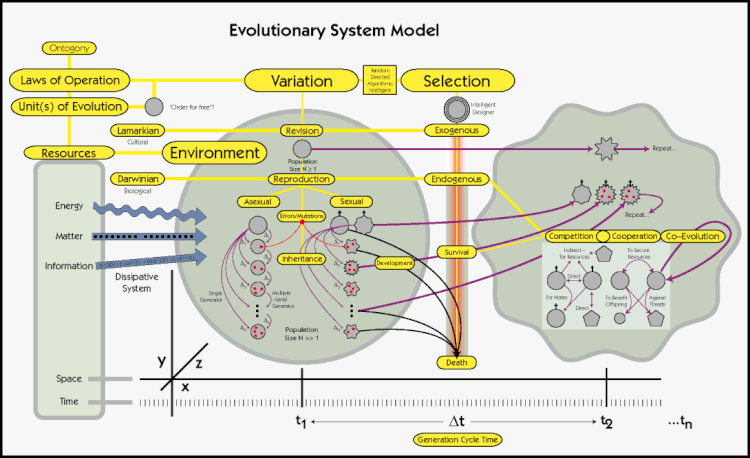
One of NECSI’s ongoing projects is to further the understanding, dissemination, and advancement of CSS by capturing key CSS concepts in visual models. Below are a few examples of this work in progress.
About the Visual Models
Generalized diagrammatic models present an abstract high-level view visualizing the fundamental phenomenon common to complexity studies. Ultimately these models will be expanded to show the connections between concepts and be linked to examples of how these general concepts are manifest in disparate, specialized areas of complexity research. Because CSS is a relatively new and transdisciplinary field, an effort to define its current state will benefit from an integration of knowledge across domains into a compact generalized form – most efficiently represented by diagrammatic models.
We’re delighted to announce the start of a new, online seminar series ‘Making connections- brains and other complex systems’, which is not specifically a CNN activity but we believe will be of interest to many on this list.
The series will cover brain networks and other complex systems, and aims to bring together researchers from a range of fields, including systems neuroscience, psychiatry, genomics, computer science, machine learning and physics.
We are starting off with a fantastic line up of speakers particularly focused on the brain- see the schedule below. Talks will be held at 3pm online on alternate Tuesdays, and titles/abstracts and a link to the meeting will be circulated nearer the time.
Tues 17th November 2020- Dr Conor Liston Tues 1st December 2020- Prof Dani Bassett Tues 15th December 2020- Dr Aaron Alexander-Bloch Tues 12th January 2021- Prof Olaf Sporns
Arguably, almost all truly intriguing systems are ones that are far away from equilibrium — such as stars, planetary atmospheres, and even digital circuits. But, until now, systems far from thermal equilibrium couldn’t be analyzed with conventional thermodynamics and statistical physics.
When physicists first explored thermodynamics and statistical physics during the 1800s, and through the 1900s, they focused on analyzing physical systems that are at or near equilibrium. Conventional thermodynamics and statistical physics have also focused on macroscopic systems, which contain few, if any, explicitly distinguished subsystems.
In a paper published in the journal Physical Review Letters, SFI Professor David Wolpert presents a new hybrid formalism to overcome all of these limitations.
Fortunately, at the turn of the millennium, “a formalism now known as nonequilibrium statistical physics was developed,” says Wolpert. “It applies to systems that are arbitrarily far away from equilibrium and of any size.”
Nonequilibrium statistical physics is so powerful that it has resolved one of the deepest mysteries about the nature of time: how does entropy evolve within an intermediate regime? This is the space between the macroscopic world, where the second law of thermodynamics tells us that it must always increase, and the microscopic world where it can’t ever change.
We now know it’s only the expected entropy of a system that can’t decrease with time. “There’s always a non-zero probability that any particular sample of the dynamics of a system will result in decreasing entropy — and the probability of shrinking entropy grows as the system gets smaller,” he says.
At the same time that this revolution in statistical physics was occurring, major advances involving so-called graphical models were being made within the machine learning community.
In particular, the formalism of Bayesian networks was developed, which provides a method to specify systems with many subsystems that interact probabilistically with each other. Bayes nets can be used to formally describe the synchronous evolution of the elements of a digital circuit — fully accounting for noise within that evolution.
Wolpert combined these advances into a hybrid formalism, which is allowing him to explore thermodynamics of off-equilibrium systems that have many explicitly distinguished subsystems coevolving according to a Bayes net.
As an example of the power of this new formalism, Wolpert derived results showing the relationship between three quantities of interest in studying nanoscale systems like biological cells: the statistical precision of any arbitrarily defined current within the subsystem (such as the probabilities that the currents differ from their average values), the heat generated by running the overall Bayes net composed of those subsystems, and the graphical structure of that Bayes net.
“Now we can start to analyze how the thermodynamics of systems ranging from cells to digital circuits depend on the network structures connecting the subsystems of those systems,” says Wolpert.



 Systems Community of Inquiry
You must be logged in to post a comment.