have discovered a neural correlate of sensory consciousness in a corvid bird (the carrion crow). The authors use an elegant set up involving barely perceptible visual stimuli to distinguish the delivery of a stimulus and the subjective percept that it engenders. The experiment clearly demonstrates that crows can maintain an internal representation for a period of time before taking an action based on a rule that is subsequently presented to them. This kind of task has been used in primates to distinguish what happens in the brain when an animal consciously detects a stimulus versus when it doesn’t. But is this really a correlate of conscious subjective experience or simply a marker of ongoing neural activity that mediates working memory? What do we even mean by conscious subjective experience? Does maintaining an active neural state necessarily entail a mental state?
by Daniel Papero 1,*,Randall Frost 2,Laura Havstad 3 andRobert Noone 41The Bowen Center for the Study of the Family, Washington, DC 20007, USA2Living Systems, 209-1500 Marine Drive, North Vancouver, BC V7P 1T7, Canada3Programs in Bowen Theory, 120 Pleasant Hill Ave N., Sebastopol, CA 95472, USA4Center for Family Consultation, 820 Davis Street, Suite 504, Evanston, IL 60201, USA*Author to whom correspondence should be addressed.Systems2018, 6(2), 19; https://doi.org/10.3390/systems6020019Received: 2 April 2018 / Revised: 28 May 2018 / Accepted: 30 May 2018 / Published: 1 June 2018(This article belongs to the Special Issue Systems Thinking)View Full-TextDownload PDFCite This Paper
Abstract
Broadly speaking, natural systems thinking is defined as a way of thinking that endeavors to conceptualize the functioning of living organisms as dependent on predictable forces at work within and around them. Systems concepts help to bring the function of those variables and life forces into better view. Psychiatrist Murray Bowen over the course of several years and a major research project at the National Institute of Mental Health (NIMH) developed a theory of the family as a system. He considered his theory a natural systems theory, “… designed to fit precisely with the principles of evolution and the human as an evolutionary being” The human family system, a network of relationships, linking each family member to every other, responds dynamically to its environment and the conditions to which all members must adapt. Each family member’s behavior influences that of every other to some degree. Although ideas of a general system theory and cybernetics were developing at the same time, Bowen reported that he knew nothing about those ideas at the time he developed his thinking. He believed that his systems orientation derived from his study of systems in nature and not from the “systems thinking” of the period. An emerging systems paradigm in biology and evolutionary thinking focuses on collective behavior and appears consistent in principle with Bowen’s thinking about the family. The collective behavior of the family unit cannot be understood by looking at the characteristics of the individuals who comprise it. The human family presents a highly integrated, interactive system of adaptation. Its roots extend along the path of hominid evolution and share common elements with other evolved collectivities. The complex development of the human brain appears to have co-evolved with the interactional processes of the family. The Bowen theory provides the potential for an integrative theory of human behavior reaching beyond the focus on the physiology and psychology of the individual to the operation and influence of the family system. Such an integrative theory can offer broader explanatory and investigative pathways for understanding physical, emotional, and social problems as they emerge in human activity. View Full-TextKeywords: family; family system; natural systems thinking; Murray Bowen; integrative theory
This paper aims to expose the inadequacy of social marketing to tackle complex social problems, while proposing an expansion in the discipline’ conceptual repertoire. The goal is to incorporate complexity tools, in particular from the system dynamics field, and the promotion of mindware within a true transdisciplinary paradigm.
Design/methodology/approach
This paper uses literature review to support the proposed theoretical development. It also presents a short case study.
Findings
Most problems that plague our modern societies have a distinctive complex nature that is not amenable to traditional social marketing interventions. Social marketing has simplified the problem of bringing about societal change by thinking that upstream social actors can be influenced in the same way as downstream individuals. This paper shows that this is not the case while proposing a framework to close this gap.
Research limitations/implications
The proposed framework is a theoretical one. It depends on further refinements and actual application to wicked problems.
Practical implications
Complex social problems – or wicked problems – remain widespread in modern societies. Moreover, they are getting worse over time. The paper presents a proposal to redefine the limits of the social marketing discipline so it can be more useful to tackle such problems. Practical approaches such as measuring the success of mindware in the marketplace of ideas are implied in the proposed framework.
Social implications
The increase in complexity of social problems has not been accompanied by an evolution in the discipline of social marketing. The lack of proper conceptual tools has prevented the discipline from contributing to tackling these problems effectively. Some interventions may actually worsen the underlying problems, as illustrated in the paper.
Originality/value
This paper identifies two major gaps associated with the social marketing discipline, in particular the lack of complexity and systems thinking and the forsaking of ideas (mindware) as a legitimate goal of the discipline. This realization corroborates the claim that boundaries among disciplines are often artificial, hindering the proper understanding of complex social problems. In turn, only the use of adequate conceptual lenses makes it possible to devise interventions and programs that tackle actual causes (instead of symptoms) of complex social problems.
“This book is like a magnificent suspension bridge, linking the science of the human brain to the practical craft of applying it in everyday life. I loved it.” – Rory Sutherland, Ogilvy’s Vice Chairman
“A SUPERB book […] by one of the profound thinkers in our field [behavioral economics].” – Michal G. Bartlett
“Luca’s book was so helpful to my work. Opened my eyes up to some more reasons why change is so hard.” – Chris Murman on the first edition
Reviews of Luca Dellanna’s previous books
“Absolutely brilliant.” – Alberto Pisanello
“A very thoughtful piece of writing, deep and wiring!” – David Krejca
“A thoughtfully written book in very straightforward language.” – A.L. Peevey
“Very good book. Read it in in two evenings. Great insights straight to the point (not the usual self-help babble). Highly recommended.”
“One of the best works I have read in that matter (I have read a few) and it’s surprising how realistically he depicts the condition.” – Manel Vilar (on Luca’s book on autism)
“So insightful with common sense applications of complexity and the ability to communicate clearly!!” – Bob Klapetzky
“A profound, useful and insightful book” – Lorenzo Dragani
The book
Why do you sometimes do things which are bad for you? Why are there some items on your to-do list that you keep procrastinating over and over? And what can you do about it?
Luca answers these questions and then some more, in what is probably the most comprehensive and densely-packed book you’ll ever read on human behavior. More importantly, Luca does not only provide answers, but also practical tips to get you to do what you set your mind to.
The book starts with observations of daily-life behavior. Then, it dissects our behavior from many lenses – neurology, risk management, evolution, complex systems – and distills the principles that guide human behavior, including the overarching one that gives the name to the book, “The Control Heuristic.” Luca then converts these principles into practical steps that he applied to his life, and that will help you fight resistance to change.
This is not your typical book telling stories about human behavior. Instead, it is a densely-packed analysis of human behavior from the perspectives that matter the most, and a set of practical, actionable rules guiding human behavior
The outline
Please click on the arrows at the sides of the cover image (at the top of this page) to explore the table of contents.
This post first appeared as Who controls public policy? on the UK in a Changing Europe website. There is also a 1-minute video, but you would need to be a completist to want to watch it.
Our #AcademicintheSpotlight series highlights social scientists doing innovative & dynamic research that you really ought to be aware of.
This week, it’s the turn of @CairneyPaul. Paul works on understanding the mechanics of public policy and policymaking. Interested? Read on… pic.twitter.com/bMs8RoQi2a
Most coverage of British politics focuses on the powers of a small group of people at the heart of government. In contrast, my research on public policy highlights two major limits to those powers, related to the enormous number of problems that policymakers face, and to the sheer size of the government machine.
This article is written by Hodan Abdullahi, Head of Exploration UNDP Somalia Accelerator Lab and Najoua Soudi, Head of Solutions Mapping UNDP Morocco Accelerator Lab
It doesn’t take a system thinker to point out that the pandemic has impacted every aspect of people’s lives, but it does take a system thinker to make sense of the underlying complexity of these connections, that too often go unnoticed, misrepresented, or unconsidered.
As the pandemic wears on, we are fast approaching the wickedest global economic recession. In the span of weeks, countries had to make hard decisions and many complex tradeoffs. Tradeoffs between citizen’s health and their data privacy, between the pace of medical innovation and its safety and, perhaps even more poignant, between Covid and non-Covid-19 deaths.
In our view, these choices made by policymakers everywhere often fall short of drawing upon a shared understanding of the new post-pandemic realities, let alone the new unintended effects and outcomes.
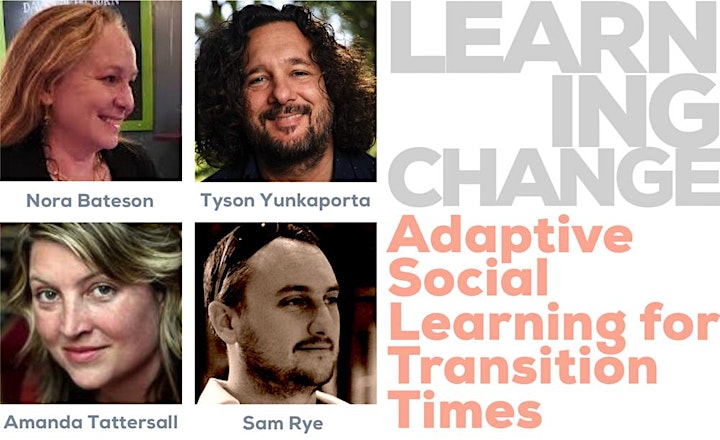
Join free-flowing in-depth conversations between four leading change-makers Wednesdays: SEP 23 / OCT 21 / NOV 18 / DEC 16 •• 6-8 PM *
About this Event
How do we embed collective learning as an essential part of whatever change processes we are involved with?
How do we harvest that learning in ways that make it useful to other communities and movements?
And how do we share those learnings across distributed networks?
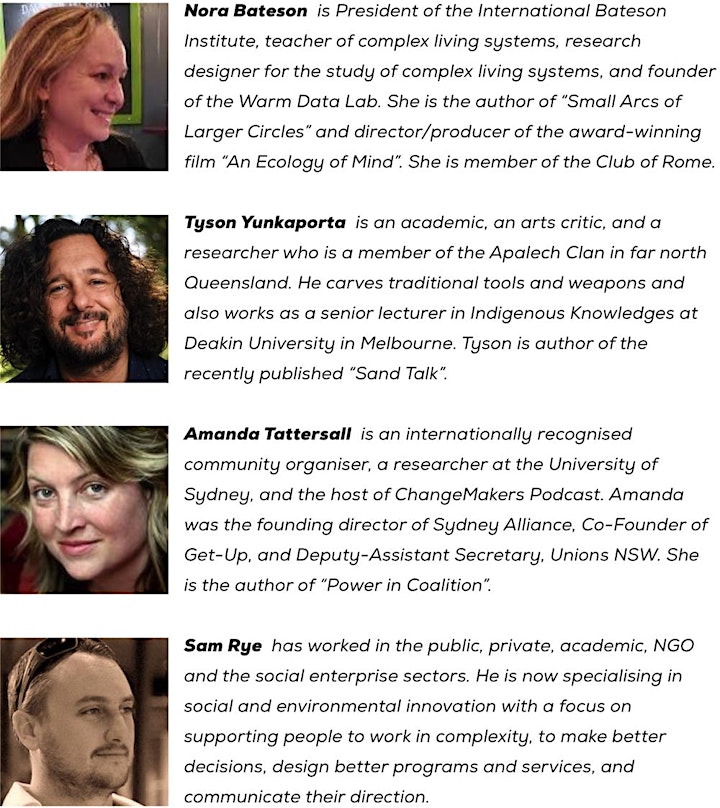
Nora, Tyson, Amanda and Sam will participate in all sessions. They bring a wealth of knowledge and experience across diverse arenas of systemic change-making and collaborative learning in action. Yet each has a very distinct praxis. Together they will take a deep dive into some of the most challenging questions of a time of uncertainty and cascading environmental and social upheaval.
This series of online conversations offer a unique co-learning opportunity for those who understand the urgency of systemic change and want to deepen and refresh their own practice.
Each session will conclude with time for Q&A.
* NOTE: Times are shown in AEST (UTC+10) for September 23 and Australian Daylight Saving Time (UTC+11) for October 21, November 18 and December 16.
Our guests for all four sessions:
Registration is essential to received the Zoom login link the day before each session
••• IF YOU PLAN TO PARTICIPATE IN ALL FOUR SESSIONS YOU NEED ONLY REGISTER FOR THE FIRST ONE AND YOU WILL BE SENT THE LOGIN INFO EACH MONTH •••
ATN donations policy • Please read carefully
Anthropocene Transition Network Inc is a self-funded volunteer-run incorporated association. We depend on the generosity of our program participants, supporters and friends to cover our costs, develop new programs, and cross-subsidise the involvement of people who can only afford a modest contribution.
Our policy is to invite participants in all our programs to make the most generous donation they can afford within a recommended range. Our practice is guided by the principle of ‘Dana’, a Sanskrit word that connotes the merit of generosity, one of the most basic human virtues.
This is an entirely voluntary expression of your support proportional to your means. No one is ever turned away from ATN programs because of inability to contribute.
For this on-line series we recommend a donation in the range $40-$400 FOR THE WHOLE SERIES, but this is entirely your choice. It is also possible to register for individual sessions. No one will be turned away while places are available.
Webinar – Elinor Ostrom’s Governing the Commons: 30 Years Later
The Ostrom Workshop at Indiana University Bloomington presents an online symposium:
Elinor Ostrom’s Governing the Commons: 30 Years Later Friday, October 2, 2020 9:00 – 12:30 (US, Indiana, Eastern Time Zone)
Join us in celebrating and reflecting on the impact and continuing relevance of Elinor Ostrom’s seminal and influential Governing the Commons (CUP). An opening panel with three short keynotes followed by four dynamic panels covering the impact of Governing the Commons on social-ecological systems thinking and practice, polycentric governance, the ‘new commons’, and environmental justice and policing studies.
October 28, 2020 – 12:00 PM ET (UTC -4)Elisa Omodei Who, where, why: non-traditional data and predictive analytics to map socio-economic vulnerabilities
Date TBA, 2020 – 12:00 PM ET (UTC -4)Stefani Crabtree
November 11, 2020 – 12:00 PM ET (UTC -4)Casey Fiesler
November 18, 2020 – 12:00 PM ET (UTC -4)Guillermo García-Pérez
December 9, 2020 – 12:00 PM ET (UTC -4)Karissa Sanbonmatsu
January 20, 2021 – 12:00 PM ET (UTC -4)Timnit Gebru
February 24, 2021 – 12:00 PM ET (UTC -4)Marie-Josée Fortin Ecological Networks in Dynamics Landscapes
March 17, 2021 – 12:00 PM ET (UTC -4)M. Ángeles Serrano
April 14, 2021 – 12:00 PM ET (UTC -4)Fernanda S. Valdovinos
April 21, 2021 – 12:00 PM ET (UTC -4)Carlos Gershenson
One individual who participated in it all is David L. Hawk.
In 1972, he started at U. Pennsylvania in the master’s program in Architecture and Urban Planning, then continuing to complete a Ph.D. in Social Systems Science in 1979.
We have been continuously been collaborators ever since. DLH served as the thesis advisor for Aalto University on my Open Innovation Learning research.
Each month we either focus on a specific presentation or we work together on a case. This month there is a presentation on Sociocracy.
Note: The local time in the Netherlands for this meeting is 15:00 – 17:00 CET. Meetings are in Dutch, but with “visitors from abroad” we can easily switch to English.
In the world of New Work, Teal, Agile, Self-Organisation/Self-Management, Systems Thinking and Blockchain, talk about governance is the new black. Just try to remember how often you recently read about teams experimenting with new ways of collaborating and deciding together.
One example could be Zappos, a daughter company of Amazon, which got known for using a governance framework called Holacracy. Its implementation caused controversy with 18% of employees leaving the company while early adopters like Twitter completely abandoned Holacracy. Meanwhile blockchain platforms are experimenting with voting and reputation systems to make decisions, with long discussions in distributed governance network DGOV about the pros and cons of the designs.
The most recent online conference on organisational model Rendanheyi, hosted by the global appliances giant Haier, invited management thinkers Gary Hamel, who just published his book Humanocracy, and Bill Fischer; both of their interventions focused on the opportunities for a more human ecosystem design approach to business. Creating conditions for autonomy, speed and entrepreneurship were only some of the main speaking points for presenters and panelists, who also had another topic in common: the need for co-creation, based on equivalence and care.
So how do we design for governance which is based on equivalence and care? Sociocracy might be a design choice to look at.
These are some questions Vincent would like to address and discuss with you (and feel free to add more by sending an email to me@vincentvanderlubbe.com):
Where did sociocracy come from?
What was the purpose? What problem is it supposed to solve?
How does it differ from other forms of governance?
What is the core principle?
What are core elements?
What are the core values?
What strands of sociocracy are there, what are the differences?
How does Holacracy relate to sociocracy?
Who is using sociocracy?
What are some examples of practicing sociocracy?
What doesn’t work so well?
What are the best resources on sociocracy?
Where can I start?
Vincent van der Lubbe
Our speaker for this session on sociocracy is Vincent van der Lubbe. After a career in financial services in an award winning network company he worked briefly for the systems thinking management consultancy Malik before venturing out on his own researching and improving practices for effective collaboration in organisations. He is also the Chair of Sociocracy for All, a non-profit membership organisation with the mission to make sociocracy accessible. For all, not just experts.
In this webinar, Pamela Teitelbaum, our Director of Evaluating Impact will hosted Tatiana Fraser and Rachel Sinha from Systems Sanctuary to share an overview of the capabilities and capacities of systems leadership
Complex challenges of the moment, like the Corona Virus crisis, climate change, rising economic inequality and gender-based violence call for new ways of leading. These new approaches demand leaders to move away from traditional hero style leadership towards relational approaches and emergence. While systems practice has risen in prominence over the last five years, it is often seen as rooted in western academia, and inaccessible.
This hour-long interactive session combinined reflection with an opportunity to assess your own skills and experience in the context of your work. From their research, Tatiana and Rachel surfaced some of the key capacities, capabilities and strategies for systems leadership.https://www.youtube.com/embed/vuijMnSp8wI
Masterclass on Systems Practice Starting October 13, small, international Cohort On Systems Change 101, Systems Leadership, Systems Mapping, Strategy for Systems Change, Working across Difference, Building Ecosystems for Positive Change and Reflective Practice.
Bridging the fields of feminist and systems practiceTatiana and Juniper Glass published Bridging the fields of feminist and systems practice: Building ecosystems for gender equity. Sharing insights, new frameworks and lessons from four years of work with eight systems change collaboratives in Canada.
Building ecosystems for Positive ChangeYou, along with a team or community – are starting to nurture a new ecosystem for systems change. In this guide we share common challenges we see our colleagues come up against to remind you you’re not alone, along with some insights and frameworks that have helped us and those that we wish we’d had when we were in this stage of development.
It is critical to understand the impact of distinct interventions on the ongoing coronavirus disease pandemic. I develop a behavioral dynamic epidemic model for multifaceted policy analysis comprising endogenous virus transmission (from severe or mild/asymptomatic cases), social contacts, and case testing and reporting. Calibration of the system dynamics model to the ongoing outbreak (31 December 2019–15 May 2020) using multiple time series data (reported cases and deaths, performed tests, and social interaction proxies) from six countries (South Korea, Germany, Italy, France, Sweden, and the United States) informs an explanatory analysis of outbreak responses and postpeak strategies. Specifically, I demonstrate, first, how timing and efforts of testing‐capacity expansion and social‐contact reduction interplay to affect outbreak dynamics and can explain a large share of cross‐country variation in outbreak pathways. Second, absent at‐scale availability of pharmaceutical solutions, postpeak social contacts must remain well below prepandemic values. Third, proactive (targeted) interventions, when complementing general deconfinement readiness, can considerably increase admissible postpeak social contacts.
The coronavirus disease (COVID-19) pandemic: simulation-based assessment of outbreak responses and post-peak strategies.By Jeroen StrubenIt is critical to understand the impact of distinct interventions on the ongoing coronavirus disease pandemic. Struben develops a behavioral dynamic epidemic model for multifaceted policy analysis comprising endogenous virus transmission (from severe or mild/asymptomatic cases), social contacts, and case testing and reporting. Calibration of the system dynamics model to the ongoing outbreak (31 December 2019–15 May 2020) using multiple time series data (reported cases and deaths, performed tests, and social interaction proxies) from six countries (South Korea, Germany, Italy, France, Sweden, and the United States) informs an explanatory analysis of outbreak responses and postpeak strategies. Specifically, Struben demonstrates, first, how timing and efforts of testing‐capacity expansion and social‐contact reduction interplay to affect outbreak dynamics and can explain a large share of cross‐country variation in outbreak pathways. Second, absent at‐scale availability of pharmaceutical solutions, postpeak social contacts must remain well below prepandemic values. Third, proactive (targeted) interventions, when complementing general deconfinement readiness, can considerably increase admissible postpeak social contacts.This article is available with Free Access.Please check out our improved journal page which now highlights the latest papers and provides a searchable database of all System Dynamics Review articles.For free access to all System Dynamics Review articles, join today.
Complexity Scientist Beats Traffic Jams Through Adaptation
To tame urban traffic, the computer scientist Carlos Gershenson finds that letting transportation systems adapt and self-organize often works better than trying to predict and control them.
READ LATER
The computer scientist Carlos Gershenson of the National Autonomous University of Mexico likes to solve urban mobility problems like heavy traffic by applying complexity research and principles of self-organization.Meghan Dhaliwal for Quanta Magazine
Mexico City is famous for its museums, food and culture, but also for its traffic jams. The city has a population of close to 22 million people and more than 6 million cars, and two-hour daily commutes to school or work are the rule for many people. Perhaps because delays are routine, it’s often socially acceptable to be 10 to 15 minutes late to classes or meetings.
How people travel in the Mexican capital is a complex problem that cannot be reduced to just one or two variables, and it is emblematic of the urban mobility challenges facing half of the world’s population. It’s also the kind of problem that for the past two decades has been a favorite of Carlos Gershenson, a computer scientist at the National Autonomous University of Mexico who is affiliated with both its Institute for Research in Applied Mathematics and Systems and its Center for Complexity Sciences.
To solve a complex problem, Gershenson believes, scientists need to let go of traditional methods and find novel ways to study ever-changing challenges. “Science and engineering have assumed that the world is predictable, and that we just need to find the proper laws of nature to be able to foresee the future,” he wrote while he was a visiting professor at the Massachusetts Institute of Technology and Northeastern University in 2016. “But the study of complex systems has shown that this assumption is misguided.”
How can the impact of sustainability and other initiatives be scaled or amplified to achieve transformative change?
There are hundreds of promising sustainability initiatives emerging around the world. A sustainability initiative is, for example, a local food initiative from citizens and farmers who promote healthy and organic food production and consumption. Another example is the installation of solar panels by a community to support the use of renewable energies. Such initiatives provide potential solutions for urgent sustainability problems, for instance, biodiversity loss, climate change, social injustice, and poverty in rural areas or cities.
This blog post is based on a review of the literature to understand how sustainability transformations research is currently conceptualizing the scaling or amplifying of impact from initiatives. Although our focus was on sustainability, the processes are likely to also be pertinent for other initiatives.
We synthesized eight processes that describe how initiatives can purposively amplify their impact: stabilizing, speeding up, growing, replicating, transferring, spreading, scaling up, and scaling deep.





 Elisa Omodei
 Stefani Crabtree
 Casey Fiesler
 Guillermo García-Pérez
 Timnit Gebru
 Josh Weitz – Modeling Shield Immunity: From Concept to Implementation


 Systems Community of Inquiry
You must be logged in to post a comment.