I spent a day recently at a workshop entitled “Introduction to Complex Responsive Processes of Relating”, run by Chris Mowles, Professor of Complexity and Management at Hertfordshire Uni’s Business School. Run by him, but giving a lot of time in the day for discussion with the 30 or so other attendees, a mixture of academics and practitioners, with far more of the latter.
CRPR is the result of an intellectual journey travelled by Ralph Stacey, (together with a number of fellow travellers including Chris Mowles) who began as economist, acquired an interest in complexity sciences from a quantitative modelling perspective and then became attracted to additional insights that can be derived from social sciences, pragmatic philosophy, and ultimately in group analytic psychotherapy.
As a discipline I find it curiously belligerent and defensive simultaneously. It draws attention to the limitations in orthodox management but is very…
INCOSE Systems Exchange Café
The Systems Exchange Café is a virtual meeting run on Zoom. It is based on the idea of a “book club”, where attendees come to meeting to discuss a book they agreed to read the time before. In the meeting they raise points raised in the book, debate the issues, and select a book for next time.
In the Systems Exchange café the idea is to discuss an idea related to systems – maybe a topic, a book chapter, a paper, a journal article or a topic in the news. A potential reading list will be prepared (so if a topic is chosen, some papers, articles, or books will have been suggested).
At the café meeting the topic will be discussed by those attending, and the conversation will go wherever the attendees take it. So it is not like a “Panel discussion” as there are no presentations or position statements to launch. Rather it’s like the conversation in a bar or a café when a group of Systems people meet and discuss systems.
INCOSE is opening three cafés in June 2020 at three different time slots, so anyone in the world can hopefully find a convenient time slot to join. After the first meeting (or “opening”) the cafés will most probably diverge in terms of topics. Initially each café meets once every two weeks for 90 minutes, but (obviously) the attendees can adjust that as they want as the series proceeds.
The café is open to all (not just INCOSE members) and is to allow those curious about Systems to have an opportunity to discuss systems issues. It is not being recorded, so there is no formal “output” or record from the meetings (apart from the next topic!). If separate follow-up discussions (and even articles or papers) evolve, initiated by the café between sub-sets of attendees then that is a desirable consequence.
The topic for the first session of each of the 3 cafes is the Systems Engineering and System Definitions produced by the INCOSE Fellows that can be found in the INCOSE Store. A detailed overview is found here. You may also like to look at and then debate other references and definitions of Systems Engineering.
The discussion can go in whatever direction the attendees take it, but to start the discussion it is suggested you consider what this definition means practically to your work, your organization and your domain.
It is hoped this will be a useful opening discussion, and hopefully relevant to those not members of INCOSE but curious about Systems and Engineering.
Further topics will be defined for future meetings by the attendees at the café openings.
To register for one of these Café series, please select from the three links below.
This will be a hosted Café using Zoom for the meeting, and we ask you to review these guidelines:
The café is open to the public (not just INCOSE members)
The discussion will not be recorded
The conversation and the topics for discussion set and go in whatever direction the attendees want
Debate and exchange of opinions is the purpose of the discussion, but it is expected
Attendees will treat the opinions of others with respect
Please do not dominate the meeting, but let all have a say
The use of the chat function in Zoom is encouraged, and if this starts further contact / discussion (separately) between attendees then that is a desirable result
Fir Tree Café: (Wednesday 8am Japan, 9am Australia, Tuesday (day -1) 4pm US Pacific , 7pm US East) click here to register
Oak Tree Café: (Wednesday 8am UK, 9am Europe, 12:30pm India, 5pm Australia) click here to register
Maple Tree Café: (Friday 8am US Pacific, 11am US East, 4pm UK, 5pm Europe) click here to register
Once registered you will receive a Zoom invitation to join the selected Café on the next scheduled date, and to continue to participate every two weeks thereafter. Your registration information is only used for these Café events, and will not be shared or used for any other purposes, in accordance with the INCOSE Privacy Policy.
The schedule starts with Fir Tree Café on 3rd/2nd June 2020, Maple Tree Café on 5th June and Oak Tree Café on 10th June, and each Café meets again two weeks later.
Power Failure in Management Circuits Posted on March 15, 2015 by m1084829 Rosabeth Moss Kanter In “Power Failure in Management Circuits”, Kanter thought that power is necessary existing in organizations for productive power brings accomplishment. Power is the access to resources and information and to direct/use them with support and approval. Power brings effectiveness, which is derived from two capacities: 1) access to resources, information, and support necessary to carry out a task; and 2) ability to get cooperation in doing what is necessary. Briefly, power creates effectiveness in the way of allocating resources and directing. Organizational sources of power consist of three lines: 1) lines of supply, 2) lines of information and 3) lines of support. Power is necessary in an organization. It is easier for managers to accomplish more when they are in powerful situations. The productive power has to do with connections in job activities and political alliances. Karter identifies three groups of positions of powerlessness: 1) first-line supervisors, 2) staff professionals, and 3) top executives. First-line supervisors are “people in the middle,” who are between workers and higher managers. They are at a virtual dead end in their careers. It is always hard/ impossible to go to the top in their careers. Furthermore, supervisors are forced to administer programs or explain policies that they have no had in shaping. They are playing the role more like of coordinators. Staff specialists are treated as organizational resources. The managers grow and develop these resources rather than pass on power to them. In addition, their overloaded works constrain them to gain power. Similarly, lack of supplies, information and support also make the top executives powerlessness. Different from Michels’ point of the end of oligarchy in an organization, Karter thought that organizational power can grow by being shared.
1Institutions and Organizations is the third text book I have written. The first I co-authored with Peter M. Blau many years ago—an early organization text, Formal Organization: A Comparative Approach, first published in 1962. I was Blau’s student from 1956-1961 at the University of Chicago and I owe him an enormous debt for inviting me to participate with him in co-authoring one of the “founding texts” of the fledging field of organization studies. I have recounted elsewhere (Scott, 2003) my views on the intellectual context of the time and the collaborative process that produced the book, and I have commented briefly on its intended contributions. But, for me, the lasting impact of the experience was recognizing that authoring a more generalized and programmatic text had the potential to exert a profound impact on the development of an academic field— defining its boundaries, specifying central premises, and identifying its future agenda. Talk about creating cultural capital!
2My second text was Organizations: Rational, Natural and Open Systems, first published in 1981. It was the product of teaching an “advanced-introductory” course on organizations to upper-level undergraduates and beginning graduate students at Stanford from 1960 to 1981—and beyond. In my mind, the defining factor that distinguished this text from others available at the time—e.g., Aldrich, 1979, Etzioni, 1961; Hall, 1972; Perrow, 1979—was my insistence that the arrival of the “open system” perspective during the late 1950s had fundamentally altered the field of organization studies. In their earlier book, the social psychologists Katz and Kahn (1966) had covered many of the insights associated with this conceptual framework, but they had not, in my view, adequately described its impact on macro or more sociological approaches. For a volume edited by Marshall Meyer, I wrote an introductory essay to a collection of articles dealing with changing perspectives on organization structure. In my essay, I first offered my suggestion that, after its emergence, the open systems perspective collided and interacted with the two reigning conceptual frameworks: the “rational” and “natural systems” models (Scott, 1978). I proposed that as open system models arrived, they evoked varying reactions—accommodations and revisions—as the two dominant perspectives, formed under closed system assumptions, attempted to learn from and adapt to the open systems revolution. I then traced these theoretical ripples through the literature. In addition to identifying shifts in underlying theoretical perspectives, I also emphasized the expanding levels of analysis employed by organization scholars as they moved from more “micro” (within organization) structures and processes to those operating at the organization set, organization population, and organization field levels. The “before” and “after” transformations associated with the introduction of open systems models, together with shifts in the level of analysis, were utilized to organize my review of the extant literature—through six editions of this work (Scott 1981/1987/1992/1998/2003; Scott and Davis, 2007).
3My assignment for this review essay is to focus on the third text— Institutions and Organizations—now in its 4th edition, (2013), but I must begin by pointing out continuities between this and my previous texts. In all three, I have attempted to exploit the opportunity afforded by the tutorial text-book format to sketch out the central issues defining the subject area and to delineate the boundaries of the intellectual territory claimed. All three have also emphasized the expanding levels of analysis which, I believe, have characterized organization studies from the early 1950s to the present. Particularly in the latter two texts, I have attempted to identify the foundational assumptions and to expose the various underlying conceptual dimensions that have created the critical fault-lines around which the field of study has been defined.
Sociotechnical systems (STS) in organizational development is an approach to complex organizational work design that recognizes the interaction between people and technology in workplaces. The term also refers to the interaction between society’s complex infrastructures and human behaviour. In this sense, society itself, and most of its substructures, are complex sociotechnical systems. The term sociotechnical systems was coined by Eric Trist, Ken Bamforth and Fred Emery, in the World War II era, based on their work with workers in English coal mines at the Tavistock Institute in London.
Sociotechnical systems pertains to theory regarding the social aspects of people and society and technical aspects of organizational structure and processes. Here, technical does not necessarily imply material technology. The focus is on procedures and related knowledge, i.e. it refers to the ancient Greek term techne. “Technical” is a term used to refer to structure and a broader sense of technicalities. Sociotechnical refers to the interrelatedness of social and technical aspects of an organization or the society as a whole.[2]Sociotechnical theory therefore is about joint optimization, with a shared emphasis on achievement of both excellence in technical performance and quality in people’s work lives. Sociotechnical theory, as distinct from sociotechnical systems, proposes a number of different ways of achieving joint optimisation. They are usually based on designing different kinds of organisation, ones in which the relationships between socio and technical elements lead to the emergence of productivity and wellbeing.
It is widely acknowledged that adopting a socio-technical approach to system development leads to systems that are more acceptable to end users and deliver better value to stakeholders. Despite this, such approaches are not widely practised. We analyse the reasons for this, highlighting some of the problems with the better known socio-technical design methods. Based on this analysis we propose a new pragmatic framework for socio-technical systems engineering (STSE) which builds on the (largely independent) research of groups investigating work design, information systems, computer-supported cooperative work, and cognitive systems engineering. STSE bridges the traditional gap between organisational change and system development using two main types of activity: sensitisation and awareness; and constructive engagement. From the framework, we identify an initial set of interdisciplinary research problems that address how to apply socio-technical approaches in a cost-effective way, and how to facilitate the integration of STSE with existing systems and software engineering approaches.
Command and control is the management infrastructure for any large, complex, dynamic resource system (Harris, C.J. and White, I., 1987. Advances in command, control and communication systems. London: Peregrinus). Traditional military command and control is increasingly challenged by a host of modern problems, namely, environmental complexity, dynamism, new technology and competition that is able to exploit the weaknesses of an organisational paradigm that has been dominant since the industrial revolution. The conceptual response to these challenges is a new type of command and control organisation called Network Enabled Capability (NEC). Although developed independently, NEC exhibits a high degree of overlap with concepts derived from sociotechnical systems theory, a fact that this paper aims to explore more fully. Uniquely, what sociotechnical theory brings to NEC research is a successful 50 year legacy in the application of open systems principles to commercial organisations. This track record is something that NEC research currently lacks. The paper reviews the twin concepts of NEC and sociotechnical systems theory, the underlying motivation behind the adoption of open systems thinking, a review of classic sociotechnical studies and the current state of the art. It is argued that ‘classic’ sociotechnical systems theory has much to offer ‘new’ command and control paradigms. The principles of sociotechnical systems theory align it exceptionally well with the challenges of modern organisational design. It is also reflective of a wider paradigm shift in ergonomics theory away from ‘industrial age’ modes of thought to systems-based ‘information age’ thinking.
Cooper, R., & Foster, M. (1971). Sociotechnical systems. American Psychologist, 26(5), 467–474. https://doi.org/10.1037/h0031539
Abstract
Reviews the theoretical and empirical work of social scientists in developing sociotechnical systems over the past 20 yr. At the tavistock institute of human relations in london. The sociotechnical system requires that any production system involve the technology (machinery, plant layout, raw materials) and work-relationship structure that relates the human operators to the technology and to each other. The implications of sociotechnical theory for task organization and organizational choice are discussed. The value of sociotechnical systems for various aspects of the man-machine relationship is also noted. A schematic diagram of a sociotechnical approach to a typical industrial production system is included. (PsycINFO Database Record (c) 2016 APA, all rights reserved)
It is a rare privilege to have been the inspiration behind the production of this collection of papers and I warmly thank all of the contributors, especially Patrick Waterson, for reminding me of so many debates and giving me so much to reflect upon. I was especially pleased to find such a strong theme running through these papers, a theme that has been an obsession for me for over 40 years: sociotechnical systems theory. Throughout my career I have been concerned with systems approaches in ergonomics because they enable us to recognize that people at work often engage in tasks as part of a complex system and this has profound effects on them and their task performance. Of all the systems approaches that are available I have found sociotechnical systems theory the most powerful way of explaining systems behaviour and the most useful in designing new systems. My aim in these pages is to use the insights that the authors in this volume have provided to reflect on what has been important to me about sociotechnical systems theory, on where this approach is in the present day and what contribution it might make in the future.
Sociotechnical systems studies 1970-1990
I was very fortunate in the 1970s to work with Lisl Klein and Harold Bridger who were at that time stalwarts of the Tavistock Institute of Human Relations in London, widely acknowledged to have been responsible for the development of sociotechnical sys- tems theory. The theory was developed to explain the human and organisational ramifications of the introduction of mechanization into coal mining, weaving and other industries. By the 1970s it was computer technology in all its forms that was beginning to have a major impact on work systems and when we started the HUSAT (Human Sciences and Advanced Technology) Research Group at Loughborough University, so graphically described by Tom Stewart and Leela Damodaran (Waterson, Stewart and Dam- odaran, this volume), it was natural for me to apply sociotechnical systems concepts in order to understand the impact of this new technology on people at work. At that time the main issue was that this technology was being used via ‘remote terminals’ linked to mainframe computers by ‘naïve users’, i.e. people who were not computer professionals, and these new users had to adapt to the unfriendly, rigid and literal ways in which computers operated. This started a major programme of work to render these devices easy to use for their new users leading to the ‘user friendly’ graph- ical interfaces used by most of the population today. My preoccu- pation, however, was that within each organisation there were different kinds of users whose work roles and tasks require specific service from the computer system. As a consequence we were soon writing papers about the needs of different kinds of computer user and my contribution to an early issue of this journal was a paper on ‘the manager as a computer user’. Sociotechnical systems theory, because of its emphasis upon the way technical and human resources are deployed to serve the needs of a collective task, was particularly well suited to examining how effectively the task needs of each user were served by computer systems and in most cases we found they were very badly served with the result that many systems were either rejected or ‘worked around’.
Healthcare systems with limited resources face rising demand pressures. Healthcare decision-makers increasingly recognise the potential of innovation to help respond to this challenge and to support high-quality care. However, comprehensive and actionable evidence on how to realise this potential is lacking. We adopt sociotechnical systems and innovation systems theoretical perspectives to examine conditions that can support and sustain innovating healthcare systems. We use primary data focussing on England (with 670 contributions over time) and triangulate findings against globally-relevant literature. We discuss the complexity of factors influencing an innovating healthcare system’s ability to support the development and uptake of innovations and share practical learning about changes in policy, culture, and behaviour that could support system improvement. Three themes are examined in detail: skills, capabilities, and leadership; motivations and accountabilities; and collaboration and coordination. We also contribute to advancing applications of sociotechnical systems thinking to major societal transformation challenges.
In the paper, Ken argues that socio-technical systems theory has a number of crucial contributions that are currently missing in the accounts in the field. He notes that many researchers on the issue have often mismatched between the prevailing work culture and the prescriptive propositions that underpin the novel technology system. Prescriptive assumptions in the socio-technical system perspective give insights into the reasons for the emergent codes of behavior that have everything to do with the reality of the work to be done. Ken notes that the emergent behaviors at work-places may be as a result of people trying to cope with the knock-on effects of the novel systems in their work processes. He gives an example of medical staff that may find pleasure in recording information regarding administration, but have fears recording their tentative clinical conclusions for the worries of who may access the information (Eason, 2013, p. 9).
Not sure if really systems thinking but hugely influenctial…
History: https://www.edbatista.com/2018/06/a-brief-history-of-t-groups.html
Wikipedia: https://en.wikipedia.org/wiki/T-groups
Training Groups, Encounter Groups, Sensitivity Groups and Group Psychotherapy: https://www.ncbi.nlm.nih.gov/pmc/articles/PMC1517989/
Beer’s Viable System Model and Luhmann’s Communication Theory: ‘Organizations’ from the Perspective of Meta-Games
Loet Leydesdorff
2013, Systems Research and Behavioral Science
130 Views
23 Pages
1 File ▾
Multidisciplinary,
Behavioral Science
Show more ▾
The Biology of Business: Love Expands Intelligence December 1999Reflections The SoL Journal 1(2):58-66 DOI: 10.1162/152417399570179 Humberto MaturanaPille Bunnell
Systems thinkers from across government at an event held earlier this year.
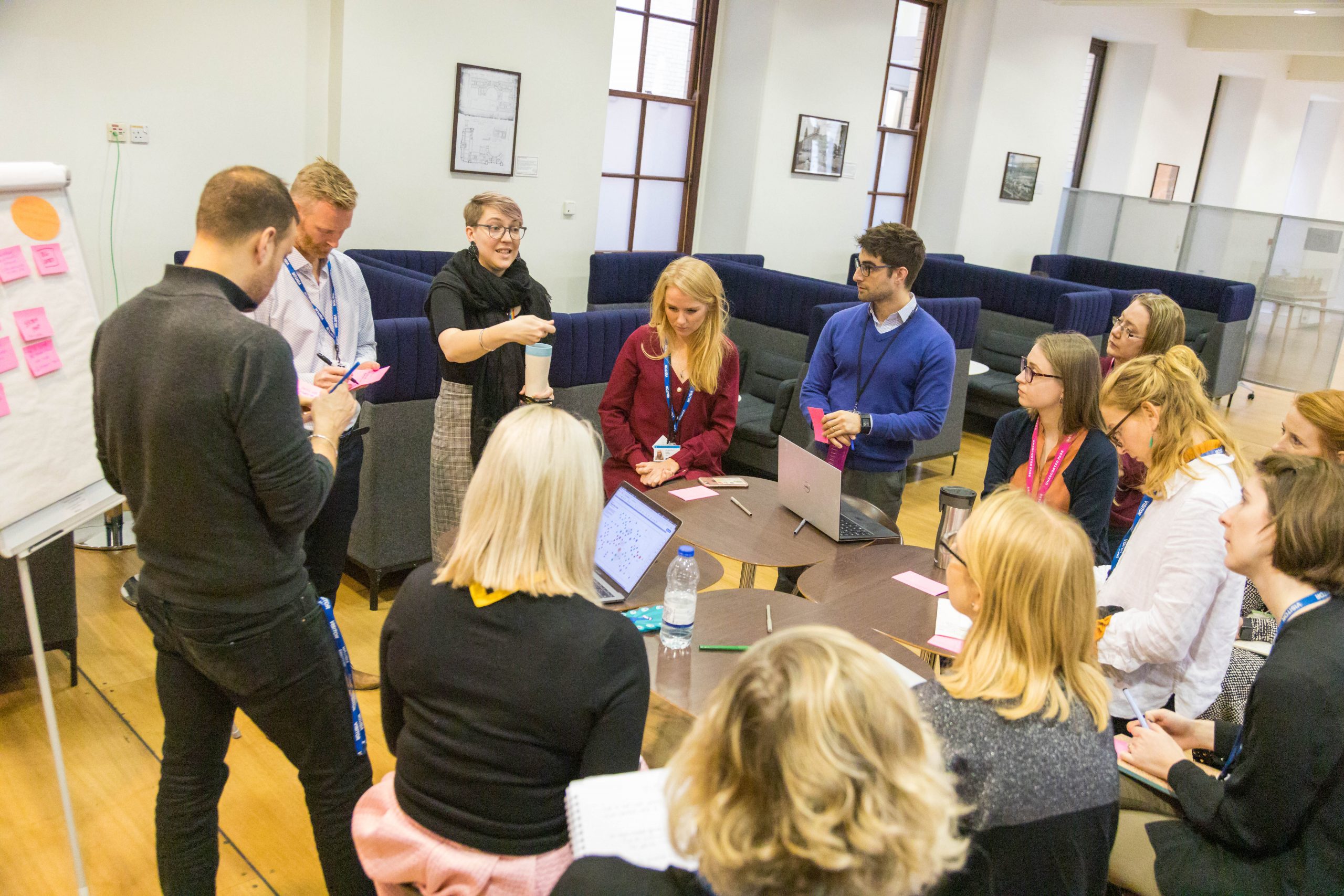
I am often challenged that systems thinking is just another workplace fad. I thought I’d share my systems thinking journey, how it has benefitted me and my work and how it makes a lasting difference.
I first came across systems thinking when my line manager handed me a copy of Peter Senge’s book, The Fifth Discipline. I wanted to understand how best to transform organisations and keep focussed on the outcomes we wanted.
Alongside the book, which I found really inspiring, I was lucky enough to be surrounded by experienced Operational Researchers in my team who were very used to applying the principles.
I managed to pick things up from them. This enabled me to design workshops to bring stakeholders together, gather their thoughts and different perspectives on their system and start to design possible solutions to their challenges.
I quickly realised the power of systems thinking. It focuses on outcomes and it uncovers complexities. Complexity is something which we often interact with in government and achieving the best outcomes for the citizens we serve is the reason many people go into public service.
The best policy decisions should be made with an understanding or proposal of how an intervention will impact the wider system.
Without it, the risk of unintended consequences is high.
I’m passionate about promoting systems thinking in the public sector because I really believe there is energy created in understanding the gap between where the current system is and where we want it to be. I believe it can help us to be more efficient and deliver better outcomes for citizens.
I’m so passionate about it that I co-founded STIG, the Systems Thinking Interest Group, which I’ll talk about in this post.
While I had long been planning to write a manifesto against the technological singularity and launch it into the conversational sphere for public reaction and comment, an invitation earlier this year from John Brockman to read and discuss The Human Use of Human Beings by Norbert Wiener with him and his illustrious group of thinkers as part of an ongoing collaborative book project contributed to the thoughts contained herein.
Phase 1 was the publication of this essay, using the PubPub open publishing platform in partnership with the MIT Press. In phase 2, this new version of the essay enriched and informed by input from open commentary has been published online, along with essay length contributions by others inspired by the seed essay, as a new issue of the Journal of Design and Science. In phase 3, a revised and edited selection of these contributions will be published as a print book by the MIT Press.
Version 1.2
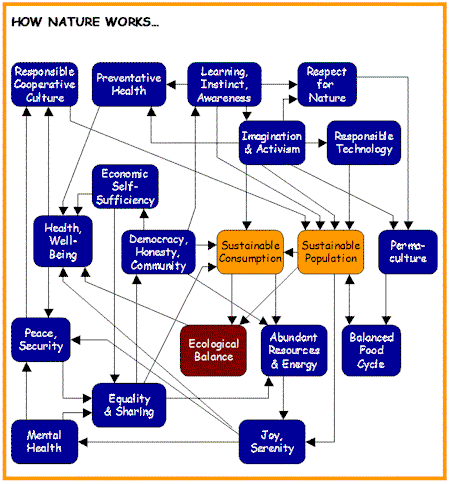
Nature’s ecosystem provides us with an elegant example of a complex adaptive system where myriad “currencies” interact and respond to feedback systems that enable both flourishing and regulation. This collaborative model–rather than a model of exponential financial growth or the Singularity, which promises the transcendence of our current human condition through advances in technology—should provide the paradigm for our approach to artificial intelligence. More than 60 years ago, MIT mathematician and philosopher Norbert Wiener warned us that “when human atoms are knit into an organization in which they are used, not in their full right as responsible human beings, but as cogs and levers and rods, it matters little that their raw material is flesh and blood.”1sergej lugovic We should heed Wiener’s warning.
“Applying the Concepts and Methods of Organisational Psychology to Society”
This website was set up to disseminate and discuss research on psychological aspects of society.
More specifically, the aim was, and is, to publish and discuss studies which throw light on the operation of society as a whole and the steps that need to be taken to improve its functioning.
The domain lies at the interface between sociology, psychology, politics, and economic
http://eyeonsociety.co.uk/resources/fulllist.html
And Professor Raven’s personal website:
Much of Prof. Raven’s research has pointed to the need for paradigm shifts in each of the areas listed below.
But the most important of these paradigm shifts has emerged at the very end of this programme of work and, to some degree, points to a need to re-formulate the insights gained in the other areas.
The most fundamental of these insights – the significance of which most readers will find hard to grasp – is that behaviour is not mainly determined by the values, talents, and priorities of individuals but by the social systems within which they live and work.
Figure 1Richard Manning’s book Against the Grain is a remarkable work — succinct, well-researched, solution-oriented and mind-altering. It’s an absolute must-read. Please don’t settle for the synopsis below, and don’t assume that because it’s about the history and economy of agriculture it’s a dull read. It’s riveting. The issues that Manning describes in the book were first raised in his Harper’s Magazine article last winter called The Oil We Eat. But the book goes much further.
Apologies for two self-referential posts in a row, given that David is co-owner of this site – however this is on topic, and, while sad news, is a positive remembrance of Doug McDavid. I have looked back and found an extensive trail of ‘breadcrumbs’ in my email archive, mostly of notifications of discussions Doug had contributed to at various iterations of what is now the Systems Thinking Network group on linkedin. He was well-informed, generous, calm, intelligent – rare attributes in internet discussions – he really came across as as avuncular as his profile image (below) might suggest. I’m proud to take a small place as part of the intellectual lineage here – David formed coevolving.com with Doug, and was kind enough to set up this iteration of syscoi.com with me.
Doug left us on May 9, while working at his desk, likely in the very earliest hours of the morning. His wife Carleen, accustomed to his habit of disappearing into intense all-nighters, expected to get him to pay a bit of attention to breakfast. Instead, she found him at peace amid his books and his papers.
For those interested in a long view of how thinking in computing has changed, Terry Winograd provided a historical overview of changes from the 1960s to the current day.
Shifting from ontologies into unstructured search (at the rise of Google)
Something I’ll have to ponder is social meaning (as more than low-quality low-interest information, as an alternative to thinking about information value). Searching in the same academic ballpark, social meaning may be explicated in:






You must be logged in to post a comment.