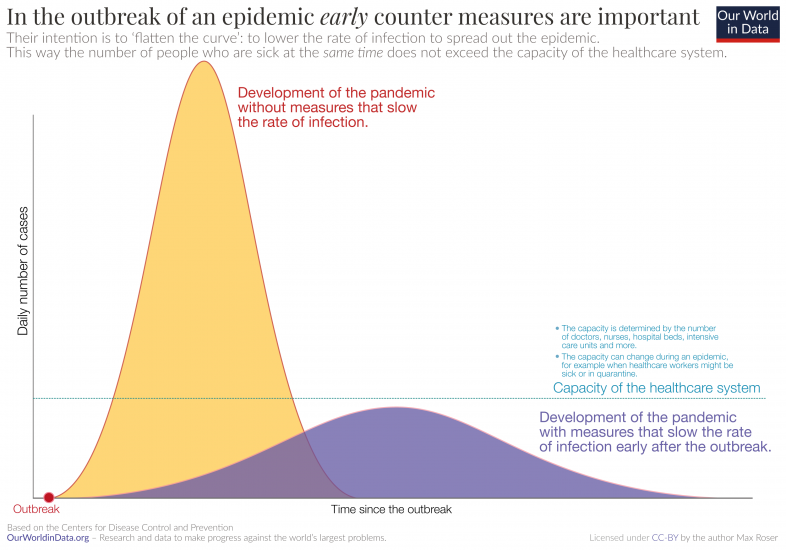
Phil Anderson’s article “More Is Different” describes how different levels of complexity require new ways of thinking. And as the virus multiplies and spreads, that’s just what the human race desperately needs
Source: blogs.scientificamerican.com
Phil Anderson’s article “More Is Different” describes how different levels of complexity require new ways of thinking. And as the virus multiplies and spreads, that’s just what the human race desperately needs
Source: blogs.scientificamerican.com
This is a good blog for a clear and cogent introduction to Elliot Jacques’ Requisite Organisation and its systemicity or otherwise…
via Impact of External Systems | Management Blog
By the time an organization reaches S-III maturity, its core system is maturing and provides for eventual profitability. At S-IV, the organization sees the emergence of multiple systems and sub-systems (marketing, sales, account management, operations, quality control, research and development, HR, accounting).
At S-V, with maturing multiple systems and sub-systems, the organization has to look outward, to external systems. No matter how well the company is organized internally, it is external systems that impact success (or failure).
Market (External System)
Markets organically shift related to demographics, trends, economic growth or contraction. These organic shifts are sometimes subtle and relatively slow. The relative slow speed allows companies to respond (market response).
Regulation (External System)
Most companies are financially regulated (taxes), some are subject to stringent environmental regulation. During COVID-19, regulation dramatically clamped market demand, by defining essential vs non-essential companies.
Labor (External System)
The US went from record low unemployment to depression level unemployment in a matter of 60 days. Labor is an external system that impacts the way we internally organize.
Finance (External System)
Finance includes institutional debt, credit lines, owner investment, private equity investment. The company believes it should be able to borrow as much money as it has the ability to repay. Banks, on the other hand have these concepts called covenants which require certain internal ratios. Finance, as an external system has an impact on the way we internally organize. COVID-19 shifted credit in some cases to forgivable debt guaranteed by government.
Most of these external systems stand alone, but COVID-19 has brought together a not-so-subtle interplay. The organizations who survive are those who are mature in their internal systems, but also understand the interplay and impact of external systems. Those companies funded in the first tranche of stimulus were those who kicked in applications immediately. Most smaller companies, with immature systems, without awareness of external systems were brushed to the second tranche or left in the cold.
It is the role of the CEO at S-V to ensure both, maturity of internal systems and skilled experience in external systems.
via Impact of External Systems | Management Blog
via This Danish Municipality Changed Its Management Model Inspired By Buurtzorg
I like this. It recalls Jane Searles’ Circles of Need model which was implemented in Chorley District Council (under the leadership of Donna Hall, who went on to Wigan and The Wigan Deal):
https://link.springer.com/chapter/10.1007/978-1-4614-1972-3_30
Click to access NI14-Nov-08-K-Boardman-10.pdf
Click to access chorley-borough-council-m-f00.pdf
Click to access blackburn-darwen-borough–6c2.pdf
And it recalls other thinking about ‘zones of time and space’, e.g.
https://stream.syscoi.com/2020/04/13/border-zones-of-ecology-and-systems-theory-becker-2011/
https://stream.syscoi.com/2020/03/31/permaculture-zones/
There seems to be a core systems principle hidden here… and notably lacking from most relevant thinking in the real world!
Professor Steve Easterbook has a blog (which I’m unlikely to pick up because there’s no email signup) at http://www.easterbrook.ca/steve/
via Systems Thinking for Global Problems
 Note switch of room, across the corridor from the original room!)
This course is unlike any other graduate course you have taken. You will play games, solve puzzles, and tell stories. Each activity will create a system around you, with its own dynamics. Sometimes you will try to beat the system and discover you cannot. Other times you will discover you can change a system by changing your perspective of it. In the process, you will discover how complex patterns of behaviour can arise from simple structures and simple rules. You will draw on such insights to develop a deeper understanding of how the world works. You will start to see the systems around you in a whole new light, and you will develop a new mental toolkit for analyzing complex global issues, modeling their structure and behaviour, and understanding how and why change happens.
Along the way, you will read about the theory and practice of systems thinking, trace the history of the key ideas, and discover how they have been applied. You will explore how systems thinking provides new ways of studying the relationships between the most important global challenges of the twenty-first century, including globalization, climate change, conflict, democracy, energy, health & wellbeing, and food security.
Key topics will include:
Course Requirements:
Note: This is the sixth incarnation of this course. It was originally developed in the summer of 2012 as part of the Dynamics of Global Change Collaborative Program, and taught again in the summer of 2013. It then migrated to the Computer Science department in the winter terms 2014 and 2016. The previous course pages are archived at:
Some similar courses at other Universities exist, and may have useful material relevant to this course:
If you’re looking for more opportunities to meet systems thinkers and discuss how we can apply systems thinking to solve important societal problems, you might be interested in the Systems Thinking Ontario group, which meets in Toronto every month.
Note: Some of this page still refers to the version of the course taught in the winter of 2018. I’ll update the outline and readings list as we go through the course.
| Seminar Topic & Notes | Notes and Background Readings | |
|---|---|---|
| (1) Tues Jan 7, 2020 |
Introduction & Basics
|
Notes:
For next seminar:
|
| (2) Tues Jan 14, 2020 |
Feedback Loops
|
Notes:
For next seminar:
|
| (3) Tues Jan 21, 2020 |
Flows and Limits
|
Notes:
For next seminar:
|
| (4) Tues Jan 28, 2020 |
Delay and Inertia
|
Notes:
For next seminar:
|
| (5) Tues Feb 4, 2020 |
Resilience and Collapse
|
Notes:
For next seminar:
|
| (6) Tues Feb 11, 2020 |
Systems Analysis
|
Notes:
For next seminar:
|
| Tues Feb 18, 2020 |
No Seminar – Reading Week | |
| (7) Tues Feb 25, 2020 |
Chaos and Complexity
|
Notes:
For next seminar:
|
| (8) Tues March 3, 2020 |
Complex Adaptive Systems
|
Notes:
For next seminar:
|
| (9) Tues Mar 10, 2020 |
Pandemics and Systems Change
|
Notes:
For next seminar: |
| (10) Tues Mar 17, 2020 |
No Seminar – A pause while we figure out how to take the course online due to COVID-19 pandemic | |
| Tues Mar 24, 2020 |
Pandemics
|
Notes:
For next seminar:
|
| (11) Tues Mar 31, 2020 |
Interpretive Systems Thinking
|
Notes:
For next seminar:
|
| (12) Tues April 7, 2020 |
Critical Systems Thinking
|
Notes:
|
(see also,
Now online, October 12-17 2020 via http://rsd9.org/
]via RSD9 Symposium « Systemic Design Association


In our myopic race towards progress humans have forgotten the interdependent web of life, putting the entire planet and its living beings deeper into issues of climate change, food scarcity, financial instability, energy shortages and resource unavailability. It is only through the lens of systemic thinking, with an understanding of the relational nature of action on any scale being resonated at all levels, can resolving of these issues be meaningful. We can with shifting our focus to a holistic human service approach and revisiting our ‘ways of understanding’ synchronise nature’s dynamic balance and our well-being.
See the Call for Participation – open now through May 10.
National Institute of Design is located in Ahmedabad, India.

The Relating Systems Thinking and Design Symposium series started at AHO in Oslo in 2012. The series has the intention to promote and foster the emerging practices and theory development for systemic design for service systems, social systems, policy development and complex contexts. RSD has been held in Europe and North America, in Oslo, Banff, Toronto, Torino, and Chicago. In 2020, RSD will be held at the National Institute of Design, Ahmedabad, India.
The RSD conferences are organized by the local hosts with the sanction, guidance and assistance of the Systemic Design Association (SDA) a democratic membership organisation registered in Norway. Become a member of the SDA on the same site today.
We will soon communicate any plans for contingencies and virtual alternatives. Look for registartion to open in June, as well as the conference program, travel and accommodation updates.
Join us at the 9th RSD in India!

Underlying many of the approaches to “systems change” is teleology – “a reason or explanation for something as a function of its end, purpose, or goal”. Moving beyond social systems into other domains (e.g. biology, ecology) raises questions about whether nature has an end or purpose.
An alternative philosophy is based on teleonomy – “the quality of apparent purposefulness and of goal-directedness of structures and functions in living organisms”. This came up in a recent meeting. I then had some online communications with @Zemina .
The philosophy of science that I’ve taken on is not teleology – goal-directed behavior – but teleonomy https://en.wikipedia.org/wiki/Teleonomy – that essentially means that you don’t work from the future-backwards, but that you are able to program options for your future.
See more in source.
I note with interest that in David’s Open Innovation Learning book (a section of the post signposts to a section of this for more), he points to Aristotle’s four causes:
Aristotle offered four explanations of why in four causes:
(i) material cause (that out of which)
(ii) the formal cause (the account of what it-is-to-be)
(iii) the efficient cause (the primary source of change or rest)
(iv) the final cause (the end, that for the sake of which a thing is done
This is pretty powerful stuff to play around with, and reminds me of my distinction, for organisations, between
(1) espoused purpose – the mission statement
(2) de facto purpose or POSIWID – the actual behaviour and outcomes which the organisation is producing (see forthcoming podcast interview with Allenna Leonard for more on this) an
(3) deep, meaningful purpose – the empowering purpose to which the organisation could aspire (usually neither of the above)
This is pretty much curated by David Ing (thanks as always David).
A lovely nine-minute, three-question video:
slightly longer:
David’s summary of that piece:
https://stream.syscoi.com/2018/07/30/the-power-of-profit-in-ecology-timothy-f-h-allen-2017-tedxmadison/
Wikipedia: Timothy F. H. Allen – Wikipedia
Profile piece on his retirement: https://badgerherald.com/news/2010/01/27/professor-timothy-al/
And David’s pic of him at the American Cybernetics Association:
Due to the ongoing COVID-19 outbreak, the Executive Committee has made the decision to move ICCS 2020 to an online-only event.
While the outlook for the unprecedented challenges we are facing from COVID-19 remain uncertain, our values are clearer than ever. The health and safety of our communities—academic, local, and business—are of the utmost priority. Further, we know as complex systems scientists that we must play our part by endeavoring to fragment our physical contact networks, yet strengthen our virtual social networks. We also remain committed to the pursuit of creating and sharing knowledge, and wish to honor our promise to provide a rich forum in which to do this. It is with these tenets in mind that we made the decision to make ICCS 2020 a 100% online-only event.
What you need to know:
The dates remain the same: July 26th – July 31st 2020
Registration has reopened, but…
View original post 108 more words
On twitter, Linda Booth Sweeney says:
Looking for activities to promote #wholesystemslearning at home? Join me April 30 9 am PDT for a fun @WatersCenterST OpenStudios session. Registration here: mailchi.mp/9c44e0fee332/i
links: Register Now: Open Studio April 30, Literature Connects
|
||||||
|
Excuse me for putting a business link here (I do it rarely) – but this is a community, principally focused on UK public services, and communities, voluntary sector – all of those with a primary focus on citizen and community outcomes) – to learn the lessons and build back better. We will be introducing systems concepts, and learning systems lessons, on an ongoing basis.
The days after – a learning community to build back better
-> We’ve been dynamic to deal with the crisis – amazing things have been achieved.
— How do we learn from these breakthroughs?
-> Things are still chaotic and confusing! And will be for some time as the ramifications continue.
— How do we make sense of things right now and for the future?
How do we prepare for a real reboot in ‘the days after’ the crisis?
We at the Public Service Transformation Academy have been working with some core organisations to start to think about these questions – and are now expanding to set up a wider learning community. There is no obligation and no charge. This is a place to share and build learning together.
Membership is open to anyone from any organisation with a primary focus on citizen and community outcomes – public services at any level, community and voluntary sector organisations, and others who deliver vital public services. The focus will be on the UK; those from other countries are welcome to join to share learning.
To join, email benjamin.taylor@publicservicetransformation.org
The group will meet fortnightly online, 2-3.30pm on Wednesdays.
The first virtual round table will take place on 13 May: what will we face in ‘the days after’?
An active online scenario planning session – and a look at the ‘three horizons’ model for future thinking.
The second virtual round table will take place on 27 May: how can we do radical rebuilding?
This will look at application of the ‘five worlds’ and ‘five key leadership practices’ applied not to organisations, but to creating place-based, emergent, learning systems.
Further dates to be planned. A core group will meet on the ‘off weeks’ to plan and input, and materials from each session will be shared with all participants. The community is supported with free groups on WhatsApp and groups.io
To join, email benjamin.taylor@publicservicetransformation.org
From the Public Service Transformation Academy (www.publicservicetransformation.org / www.twitter.com/servicereform) sponsored by RedQuadrant (www.redquadrant.com / www.twitter.com/redquadrant).
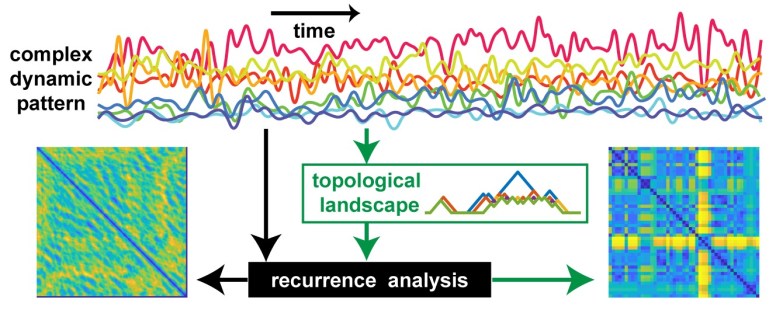
Zhang, M., Kalies, W., Kelso, J., Tognoli, E. (2020). Topological portraits of multiscale coordination dynamics. Journal of Neuroscience Methods https://dx.doi.org/10.1016/j.jneumeth.2020.108672
Living systems exhibit complex yet organized behavior on multiple spatiotemporal scales. To investigate the nature of multiscale coordination in living systems, one needs a meaningful and systematic way to quantify the complex dynamics, a challenge in both theoretical and empirical realms. The present work shows how integrating approaches from computational algebraic topology and dynamical systems may help us meet this challenge. In particular, we focus on the application of multiscale topological analysis to coordinated rhythmic processes. First, theoretical arguments are introduced as to why certain topological features and their scale-dependency are highly relevant to understanding complex collective dynamics. Second, we propose a method to capture such dynamically relevant topological information using persistent homology, which allows us to effectively construct a multiscale topological portrait of rhythmic coordination. Finally, the method…
View original post 122 more words
Three systemic points (but at the ‘technical’ not ‘adaptive’ level):
https://www.weforum.org/strategic-intelligence
https://www.weforum.org/communities/transformation-map-co-curator-community
https://forum.frontiersin.org/stephan-mergenthaler-wef-digital-transformation-maps
via What is a Transformation Map? | World Economic Forum
The World Economic Forum’s Transformation Maps – a constantly refreshed repository of knowledge about global issues, from climate change to the future of work – are now publicly available for the first time and free of charge. But what are they? And what can we do with them?
What exactly are the Transformation Maps?
Transformation Maps are the World Economic Forum’s dynamic knowledge tool. They help users to explore and make sense of the complex and interlinked forces that are transforming economies, industries and global issues. The maps present insights written by experts along with machine-curated content. Together, this allows users to visualise and understand more than 120 topics and the connections and inter-dependencies between them, helping in turn to support more informed decision-making by leaders.
https://intelligence.weforum.org/topics/a1Gb0000000LGk6EAG?tab=publications

Strategic Intelligence
The maps harness the Forum network’s collective intelligence as well as the knowledge and insights generated through our activities, communities and events. And because the Transformation Maps are interlinked, they provide a single place for users to understand each topic from multiple perspectives. Each of the maps has a feed with the latest research and analysis drawn from leading research institutions and media outlets around the world.
As an example, imagine you are a student or government official, and you need up-to-date information about the dynamics of over-fishing. The Transformation Map on Oceans, curated with the University of California in Santa Barbara, has a dedicated “key issue” section dealing with this. The over-fishing section in turn links to a number of related maps, among them the Illicit Economy Transformation Map, curated with the Global Initiative against Transnational Organised Crime. This map notes, among other things, how criminals are profiting from natural resources, including fish, in a way that threatens global biodiversity.
https://www.weforum.org/videos/introducing-transformation-maps
Introducing Transformation Maps
Alternatively you could explore the topic of over-fishing from a governance perspective by consulting the map on Global Governance, curated with the University of Oxford, or through the lens of possible innovative solutions by exploring the Innovation map, curated by Nesta, an innovation foundation. There are thousands of other possible pathways throughout the interlinked Transformation Maps, which shift according to developments in the real world, reflecting and helping to demystify our complex planet.
Why do you cover this selection of topics?
The Transformation Maps cover issues that are relevant to the World Economic Forum and the people and organisations we work with. Broadly speaking, these are topics of global importance that require leaders from across different sectors to work together, from urbanization to inclusive economic growth. The list of topics is continuously reviewed and updated.
Who curates the Transformation Maps?
Most of the maps are co-curated by a leading university, think tank or international organization. Their content is subject to continuous peer review and adjustment by the Forum and its network of experts. Many co-curators come from institutions that are members of the Forum’s Global University Leaders Forum (GULF) community.
What do co-curators do?
A co-curator works with the Forum to identify and explain the key trends or drivers of change for their particular topic, drawing on their expertise and the latest research in their field as well as the insights from various Forum activities and communities. They explore how the key trends affecting their subject are in turn affected by other Transformation Map topics – covering industries, countries or regions, or global issues – and in doing so, the curators create a record of the connections and inter-dependencies between the different topics. These relationships are clearly represented in the maps’ graphic representations and accompanying texts, enabling a greater understanding of the complex web of influences that surround each issue.
Why do articles and publications appear alongside the maps?
Each Transformation Map has a dynamic feed of the latest research and analysis drawn from leading research institutions and media outlets around the world. These feeds enable users to access the latest research on a topic by clicking on a link that will take them back to the original source. The research and analysis contained in the feeds does not necessarily represent the views, opinions or positions of the World Economic Forum.