The Center for Systems Awareness

via Center for Systems Awareness

Around the world a renaissance is unfolding in education, driven by a combination of bold new ideas and increasing awareness of the necessity for societal change – and the radical idea that young people could be key leaders in these changes and education a key vehicle. The Center for Systems Awareness exists to advance this renaissance based on profound inter-connectedness as the integrating idea – that ‘self,’ ‘other,’ society and the larger natural world all arise as entwined systems of relationships – and that recovering our sense of connectedness and caring at each level can shape our future.

CSA_about_center_logo

THE CENTER

The Center for Systems Awareness honors the mind-heart-body system of the learner, the social reality of relationships, family and community that is the context for all learning, and responds to the need to engage learners of all ages in fostering systemic well-being at all levels, from the individual to the larger systems of institutions, society, economy and ecology.

Billig Viagra Salg i Danmark Alle, eller for det meste alle, der har oplevet erektil dysfunktion har hørt om VIAGRA. Dette er berømt kendt for at øge blodgennemstrømningen til penis så du kan få og beholde en erektion hårdt nok til sex. Kamagra er et brand Sildenafil … levering fra EU til Danmark … dk køb cialis i danmark køb cialis i tyskland køb cialis online denmark køb cialis på nettet … Kamagra Oral Jelly har alle de samme ingredienser i den oprindelige Kamagra, men er meget mere hurtigtvirkende. Til at begynde med skal Kamagra Oral Jelly ikke være skræmmende, da det er let at administrere oralt, og det kommer i en bred vifte af smag. Disse omfatter jordbær, æble, banan og mange andre smagsoplevelser.

Read more

mycelium-fungus

OUR PURPOSE

  • centers on reconnecting with and cultivating our truest nature as interconnected individual humans, born out of life on this planet as unique expressions of nature’s innate creative capacity. This is what we relate to as the personal, emotional, individual system – the system of self
  • focuses on developing our capacity for connectedness with one another and to intentionally shape and nurture more generative and relational social fields and spaces. This is what we relate to as system of self and other
  • revolves around understanding and nurturing interdependence as nature’s organizing principle to support biological and social well-being. This is what we relate to as systems of self and larger societal and ecological realities

Introduction to the Compassionate Systems Framework in Schools | MIT J-WEL

via Introduction to the Compassionate Systems Framework in Schools | MIT J-WEL

Introduction to the Compassionate Systems Framework in Schools

Description
Related Content

Author

Abdul Latif Jameel World Education Lab

Description

In education, where interest in social and emotional learning (SEL), mindfulness, and systems thinking is growing, we find both an opportunity and a need to develop models of thinking and teaching that prepare students to better understand and respond to the systems to which these issues belong. We draw from established SEL models, together with developments in the emerging field of complexity science and the study of systems, to establish a framework—what we call a “compassionate systems” framework—for building a cognitive and affective foundation for global citizenship. This framework conceptualizes compassion as an essentially systemic property of mind: to cultivate compassion is to be able to appreciate the systemic forces that influence people’s feelings, thoughts and actions.


Mette Böll – Cultivating Generative Social Fields Emerge: Making Sense Of What’s Next podcast

via Mette Böll – Cultivating Generative Social Fields Emerge: Making Sense Of What’s Next podcast

Mette Böll – Cultivating Generative Social Fields

1:06:48 

By Daniel Thorson. Discovered by Player FM and our community — copyright is owned by the publisher, not Player FM, and audio is streamed directly from their servers. Hit the Subscribe button to track updates in Player FM, or paste the feed URL into other podcast apps.

This week I’m speaking with Mette Böll (Boell). Mette is a biologist by training, specializing in the evolution of complex social systems, mammalian play behavior and philosophy of nature. Mette has a Ph.D. in organizational ethology from the Center for Semiotics, Aarhus University, and holds additional degrees in contemplative leadership and the philosophy and history of science. She uses her training in these diverse areas to research how moods and feelings are transmitted in social relations and how the resulting relational fields in turn shape the larger systems human beings are parts of, with a particular focus on education.

We talk about the study of social fields, generative vs. degenerative fields, the relationship between fields and systems, how generative fields create ‘magical classrooms’, the characteristics of a generative field, how the combination of systems science and systems sensing can help educate people to respond to the complex challenges of our world, and what generative fields in the K-12 education setting looks like, and the need to empower young people and get out of their way. Mette also shares inspiring stories from the early prototypes of this work in the American education system.

Center for Systems Awareness

— Support this podcast: https://anchor.fm/emerge/support


via Mette Böll – Cultivating Generative Social Fields Emerge: Making Sense Of What’s Next podcast

Event cancellations – assume all 2020 events listed here have been cancelled, and double check

Please assume that any 2020 event you have read about here has been cancelled.

Unsurprisingly, so far the UKSS conference, ISSS conference, Systems Innovation London Meetup, the SCiO open day and development days, and the Mike Jackson lecture with Peter Senge, have all been cancelled or postponed.

Some of these may find an alternative life as virtual events – watch this space.

Commiserations to all event organisers – I know how much work it takes!

Abstract Reasoning as Emergent from Concrete Activity | Meaningness


via Abstract Reasoning as Emergent from Concrete Activity | Meaningness


The origins of Conways Laws (plus – “Why Waterfall was a big misunderstanding from the beginning”)


Linked by www.twitter.com/conways_law from this thread:


In response to ‘why waterfall was a big misunderstanding’ (side note: I love the way most things – from command-and-control to waterfall – aren’t what we think they are!), Mel Conway posted the original paper behind Conway’s Law (https://model.report/s/uav5w7/conway_s_law_-_wikipedia_the_free_encyclopedia).

(I also love the fact that he is conways_law on twitter because an Irish lawfirm already got conwayslaw :-))


1)

I was in a US Air Force selection in 1963 that was waterfall. The procedure was mandated by the lawyers, to block conflict of interest. Design contractors could not bid on implementation. The lawyers didn’t imagine coupling between design & implementation https://t.co/PAJTtY7U1a?amp=1

2)

The real original https://t.co/KjBRBwiHtL?amp=1

3)

Also Fred Brooks (p13-15): https://t.co/safHKOB7HX?amp=1


The Tim Ferriss Show Transcripts: Mike Phillips — How to Save a Species (#383) – The Blog of Author Tim Ferriss

via The Tim Ferriss Show Transcripts: Mike Phillips — How to Save a Species (#383) – The Blog of Author Tim Ferriss

#383

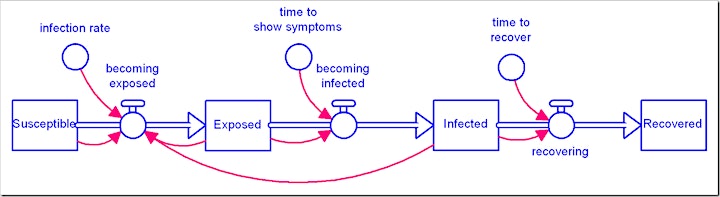
Modelling ‘flattening the curve’ – links #COVID19 #FlattenTheCurve #coronavirus


#covid19

Hull, UK, 27 April 2020 – Peter Senge at the Centre for Systems Studies 2020 annual Mike Jackson lecture on Systems Thinking, and SCiO open event


During the day, there is an open day from SCiO (systems and complexity in organisation – the systems practitioner organisation) with a number of excellent speakers, plus m’good self – http://systemspractice.org/events

  • Tony Korycki: Introducing Critical Systems Heuristics
  • Ray Ison & Ed Straw: The Hidden Power of Systems Thinking – Governance in a climate emergency
  • Patrick Hoverstadt: Buried treasure – using systems laws and principles
  • Steve Whittla – title tba
  • Benjamin Taylor: The ‘four quadrants of thinking threats’

(And on Sunday, if you join SCiO, there’s a collaborative, open agenda Development Day – see www.systemspractice.org for more)

Then in the early evening, the Mike Jackson lecture with special guest Peter Senge:

via THE CENTRE FOR SYSTEMS STUDIES 2020 ANNUAL MIKE JACKSON LECTURE ON SYSTEMS THINKING | CultureNet

THE FIFTH DISCIPLINE: MAKING THE FUTURE A FRIENDLY PLACE FOR HUMANKIND

DATE 27 April 2020

TIME 6.00pm

REGISTER YOUR PLACE BOOK NOW

Lecture

Join us for an evening with Dr Peter Senge, named as one of the world’s top management gurus by the Financial Times and BusinessWeek, and by the Schwab Foundation as one of the Global Thought Leaders in Social Innovation.

We live in a world of increasingly complex and intractable problems.  The Industrial Age model of progress harvesting social and natural capital to produce financial capital is not sustainable.  In a refreshingly non-dystopian analysis, Dr Peter Senge uses Systems Thinking to make visible a different, viable, future that is already emerging today: as they say in traditional Chinese culture, “You cannot move the river; dig a channel and the river moves itself.”

THE TALK: For over two hundred years, we have been harvesting social and natural capital to produce financial capital. This is not sustainable, as we are reminded by the global youth climate change movement. But climate change is more symptom than cause. The destruction of ecosystems and the disproportionate effects that growing scarcities of natural resources are having on the poor of the world, all call for a shift in how we perceive human progress. The still dominant Industrial Age model of progress has morphed into today’s obsession with technology, social media, and divisive politics – making the world an increasingly unhappy place.

The essence of systems thinking is to look beyond problem symptoms and better understand the forces that keep problems in place and how these can be shifted. In this Lecture Dr Senge takes us through the trajectory of his thinking, from the sensational success of his best-selling book The Fifth Discipline to his current focus on basic innovation in education, embodied in the ‘compassionate systems’ perspective being developed in schools around the world. While we face a short-term mandate to listen to one another and find pathways to moderation, this is unlikely to happen without a compelling image of ways of living that can build a future viable for our children and the living systems upon which we all depend. Rather than a utopian vision, such a future is already emerging today and will grow to the extent we cultivate ways of seeing it. In traditional Chinese culture they say, “You cannot move the river; dig a channel and the river moves itself.”

The Annual Mike Jackson lecture has been made possible by the support of University of Hull honorary graduate, Dr Andrew Chen, and is in recognition of the work of Professor Mike Jackson, former Dean of Hull University Business School and world-renowned academic in the field of systems thinking.

THE SPEAKER

Dr. Peter Senge is senior lecturer at the MIT Sloan School of Management and the founding chair of the Society for Organizational Learning (SoL), a global community of corporations, researchers, and consultants dedicated to the “interdependent development of people and their institutions.” He was named as one of the world’s top management gurus by the Financial Times and BusinessWeek, and by the Schwab Foundation as one of the Global Thought Leaders in Social Innovation. His 1990 book, The Fifth Discipline: The Art and Practice of the Learning Organization sold over a million copies worldwide, acclaimed by the Harvard Business Review in 1997 as one of the seminal management books of the past 75 years.

Dr Senge has lectured extensively throughout the world, translating the abstract ideas of systems theory into tools for the better understanding of economic and organizational change. Leading business periodicals including BusinessWeek, Fortune, Fast Company, and Sloan Management Review, have featured his work with colleagues at MIT and SoL. His work articulates a cornerstone position of human values in the workplace; namely, that vision, purpose, reflectiveness, and systems thinking are essential if organizations are to realize their potential.

ABOUT THE CENTRE FOR SYSTEMS STUDIES

The Centre for Systems Studies is an international centre of excellence for ground breaking research on systems thinking and practice. Today’s interconnected world presents novel challenges and opportunities for business and society. The interplay of social, technological, environmental and geo-political factors confronts decision makers with unprecedented complexity. Our challenge is to develop the new concepts and methodological approaches needed to address that complexity. Our research is concerned with advancing the understanding of complex phenomena– from the emergence of local community action and business ecosystems through to the impact of global policy interventions and climate change. We work in trans-disciplinary teams, collaborating with practitioners in public, private and third-sector organisations, and our ideas and methods are tested and refined in a broad range of application areas. Current collaborations include projects in health, policy analysis, development, resilience and sustainability of socio-economic systems and the environment, the digital economy and society, food security, cybersecurity, the low-carbon economy, radicalisation and marginalisation, innovation and community operational research


via THE CENTRE FOR SYSTEMS STUDIES 2020 ANNUAL MIKE JACKSON LECTURE ON SYSTEMS THINKING | CultureNet

Sensemaking and portfolios – two important concepts when facing wicked and complex problems | Marcus Jenal

via Sensemaking and portfolios – two important concepts when facing wicked and complex problems | Marcus Jenal

Sensemaking and portfolios – two important concepts when facing wicked and complex problems

In 2013, Richard Hummelbrunner and Harry Jones asked: “How can policy makers, managers and practitioners best plan in the face of complexity?”

Seven years later the search for answers to that question continues through different initiatives and programmes. For example, the Doing Development Differently Manifesto was published at the end of 2014. Matt Andrews and his colleagues at the Building State Capability programlaunched a successful online course on Problem Driven Iterative Adaptation and published a book in 2017. David Booth has written extensively about the adaptive and iterative approach of the Coalitions For Change programme of The Asia Foundation in The Philippines.

So, where are we in this discussion? What are the challenges around transitioning ideas from complexity into projects and programmes? To answer these questions I have reached out to Arnaldo Pellini, founder of Capability, to hear about his experiences working with development initiatives and discuss some of the open questions we are yet to answer.


Continued in source: Sensemaking and portfolios – two important concepts when facing wicked and complex problems | Marcus Jenal

Taking back control – GentlySerious – Medium

via Taking back control – GentlySerious – Medium

Taking back control

Aidan Ward

Mar 9 · 9 min read

A key move in living your own life is grasping what is true for you. We have been schooled and sanctioned to believe that truth is external, out there, and the same for everybody. But the most important things in our lives are what we truly understand because we live them; they are an integral part of our bodies and the way our bodies experience the world. In fact, we can only understand our environment as our environment and in that sense the world is the world we see.

What phenomenology and the enactive turn in philosophy tell us is that our freedom and autonomy is to direct our attention. When we do so, we act differently and notice different things. We cannot step outside our environment to decide what to pay attention to. We can, to some degree, empathically understand that other people are directing their attention differently and seeing and experiencing different things as a result.

Continues in source: Taking back control – GentlySerious – Medium


Sociopathy and myopia – GentlySerious – Medium

via Sociopathy and myopia – GentlySerious – Medium

Sociopathy and myopia

Aidan Ward

Aidan Ward
Oct 21, 2019 · 9 min read

Quixotic ventures

Objectivity is a subject’s delusion that observing can be done without him (sic). Invoking objectivity is abrogating responsibility — hence its popularity. Heinz von Foerster

I have been taxed recently by the sheer weight and volume of simple, linear explanations that are no such thing ­– not explanations at all — and I have been vexed by the popularity of the nonsense. The popularity distorts the democratic process — if enough people believe passionately in something that cannot possibly be true, it enters some twilight zone where it has to be dealt with. For instance, if enough people think the death penalty will reduce crime, it becomes a political factor that will tempt politicians to pander to it.

None of this is say that I know better. I am with von Foerster here: I am paying attention to the connection between the style of the claims made and the lack of responsibility taken for the outcomes.

Continues in source Sociopathy and myopia – GentlySerious – Medium


‘Systems Thinking’ Fires Up Your Brain’s Ability to Problem-Solve. Here’s How to Do It.

(Rather an example of oversimplifying systems thinking, I fear)

via ‘Systems Thinking’ Fires Up Your Brain’s Ability to Problem-Solve. Here’s How to Do It.

‘Systems Thinking’ Fires Up Your Brain’s Ability to Problem-Solve. Here’s How to Do It.

Systems thinking can help you manage and solve problems big and small.
'Systems Thinking' Fires Up Your Brain's Ability to Problem-Solve. Here's How to Do It.
Image credit: 10’000 Hours | Getty Images
Aytekin Tank
VIP CONTRIBUTOR
Entrepreneur; Founder and CEO, JotForm

Guidelines for the Governance of Systemic Risks – IRGC

via Guidelines for the Governance of Systemic Risks – IRGC

Guidelines for the Governance of Systemic Risks

Complex systemic risks are fundamentally different from conventional risks, and traditional risk management practices are not sufficient for dealing with them. Elaborating on previous IRGC work, IRGC’s guidelines for the governance of systemic risks address the question of how to deal with systemic risks in the context of transitions, i.e. in situations that require adaptation to new context conditions or transformation. Examples include desertification processes, fisheries depletion, transformation of energy systems or new transportation systems and even mobility patterns.

The guidelines have the following objectives:

  • Provide guidance to organisations in their initiatives to understanding complex system dynamics and reflecting upon their own position within these dynamics.
  • Help actors in a system to either prevent the shift of the system within which the organisation operates to an undesirable regime, or trigger and facilitate the transition of the respective system to a preferable regime, considering changes in underlying context conditions or proximity to a tipping point that may trigger a regime shift.

The guidelines comprise seven interlinked steps to:

  • Step 1 Explore the system in which the organisation operates; define the boundaries of the system and the organisation’s position in a dynamic environment.
  • Step 2 Develop scenarios, considering ongoing and potential future transitions.
  • Step 3 Determine goals and the level of tolerability for risk and uncertainty.
  • Step 4 Co-develop management strategies to deal with each scenario and the systemic risks that affect or may affect the organisation, and to navigate the transition.
  • Step 5 Address unanticipated barriers and sudden critical shifts that may come up during the process.
  • Step 6 Decide, test and implement strategies.
  • Step 7 Monitor, learn from, review and adapt.


In the face of many unknowns, increasing the overall resilience of an organisation can be a way to prepare for and better deal with the shocks and stresses arising from systemic risks. In line with mainstream recommendations for resilience building, the IRGC suggests three main strategic approaches for governing systemic risks in the context of transitions:

  • Support and strengthen the ability of a system to self-organise and self-control
  • Engage in pro-active intervention strategies:
    – Prevention
    – Mitigation
    – Adaptation
    – Transformation
  • Prepare for disruptions, accidents and crises

These strategies can be combined or implemented successively if proximity to a regime shift seems to increase.

There must be iteration between the steps, orchestrated by a facilitator. At all stages, communication, openness and transparency are key to ensure smooth proceedings. Collaboration, learning together and experimentation are essential for improving an organisation’s capacity to deal with systemic risks. This can be organised by a ‘navigator’, who also has the task of organising some form of ownership for systemic risks.


Paul Pangaro’s description of CLEAT, as a conversation model of Gordon Pask’s Conversation Theory – via Steve Hertzberg on LinkedIn

See the discussion on LinkedIn – and Paul’s further links etc.

Steven Hertzberg
A video we share & discuss with every new team member. Paul Pangaro’s description of CLEAT, as a conversation model of Gordon Pask’s Conversation Theory, is an essential foundation for collaborating with Grey Swan Digital.

hashtag#cybernetics hashtag#complexity

via LinkedIn