Prof Becky Malby interviews thought leaders to inform and guide NHS leaders through the current context.
The first interview is with Keith Grint, Emeritus Professor at Warwick University on the lessons from his work on leading Critical, Tame and Wicked Problems. We discuss the interplay between command and control and adaptive leadership, the role of soft power, and how to ensure as leaders are the best decision-maker you can be.
From a great tweet-starter by Thea Snow – ‘systems thinking comes naturally in oral cultures but is v difficult in literary cultures’ – discuss!
Hi systems tweeps 👋. A non-COVID related tweet.
The book I'm reading makes the very compelling point that thinking in systems comes naturally in oral cultures (thought is fluid), but is v difficult in literary cultures (thought is linear). Interested in other's reflections.
‘The effort to know a place deeply is, ultimately, an expression of the human desire to belong, to fit somewhere.’
When I was young, and just beginning to travel with them, I imagined that indigenous people saw more and heard more, that they were overall simply more aware than I was. They were more aware, and did see and hear more than I did. The absence of spoken conversation whenever I was traveling with them, however, should have provided me with a clue about why this might be true; but it didn’t, not for a while. It’s this: when an observer doesn’t immediately turn what his senses convey to him into language, into the vocabulary and syntactical framework we all employ when trying to define our experiences, there’s a much greater opportunity for minor details, which might at first seem unimportant, to remain alive in the foreground of an impression, where, later, they might deepen the meaning of an experience.
If my companions and I, for example, encountered a grizzly bear feeding on a caribou carcass, I would tend to focus almost exclusively on the bear. My companions would focus on the part of the world of which, at that moment, the bear was only a fragment. The bear here might be compared with a bonfire, a kind of incandescence that throws light on everything around it. My companions would glance off into the outer reaches of that light, then look back to the fire, back and forth. They would repeatedly situate the smaller thing within the larger thing, back and forth. As they noticed trace odors in the air, or listened for birdsong or the sound of brittle brush rattling, they in effect extended the moment of encounter with the bear backward and forward in time. Their framework for the phenomenon, one that I might later shorten just to ‘meeting the bear’, was more voluminous than mine; and where my temporal boundaries for the event would normally consist of little more than the moments of the encounter itself, theirs included the time before we arrived, as well as the time after we left. For me, the bear was a noun, the subject of a sentence; for them, it was a verb, the gerund ‘bearing’.
Thanks for signing up to the UnSchool Online and taking part in a community of creative change-makers! If you want more community, join our LinkedIn group here.
If you one of the quarter of the world’s population who are currently in #quarantine, #lockdown and #workingfromhome then you are probably experiencing the same fear and frustration as the rest of us. We are also in lockdown, and yes, that means many extra hours of time to reflect and engage with content. Some of it is helpful, while some of it, well, maybe not so much…
To help everyone #staypositive, last week we gave away lots of free content every day and were overwhelmed with thousands of you downloading and engaging with our changer-maker stuff.
Now it appears this COVID-19 situation is likely to continue for a while, we’ve kept ourselves busy looking for more creative ways to help our community #staypositive and develop skills as a creative change-maker despite these complex times. Our entire existence as the UnSchool is to find unique ways to help more people make positive change so that we can design a more positive, sustainable and regenerative future.
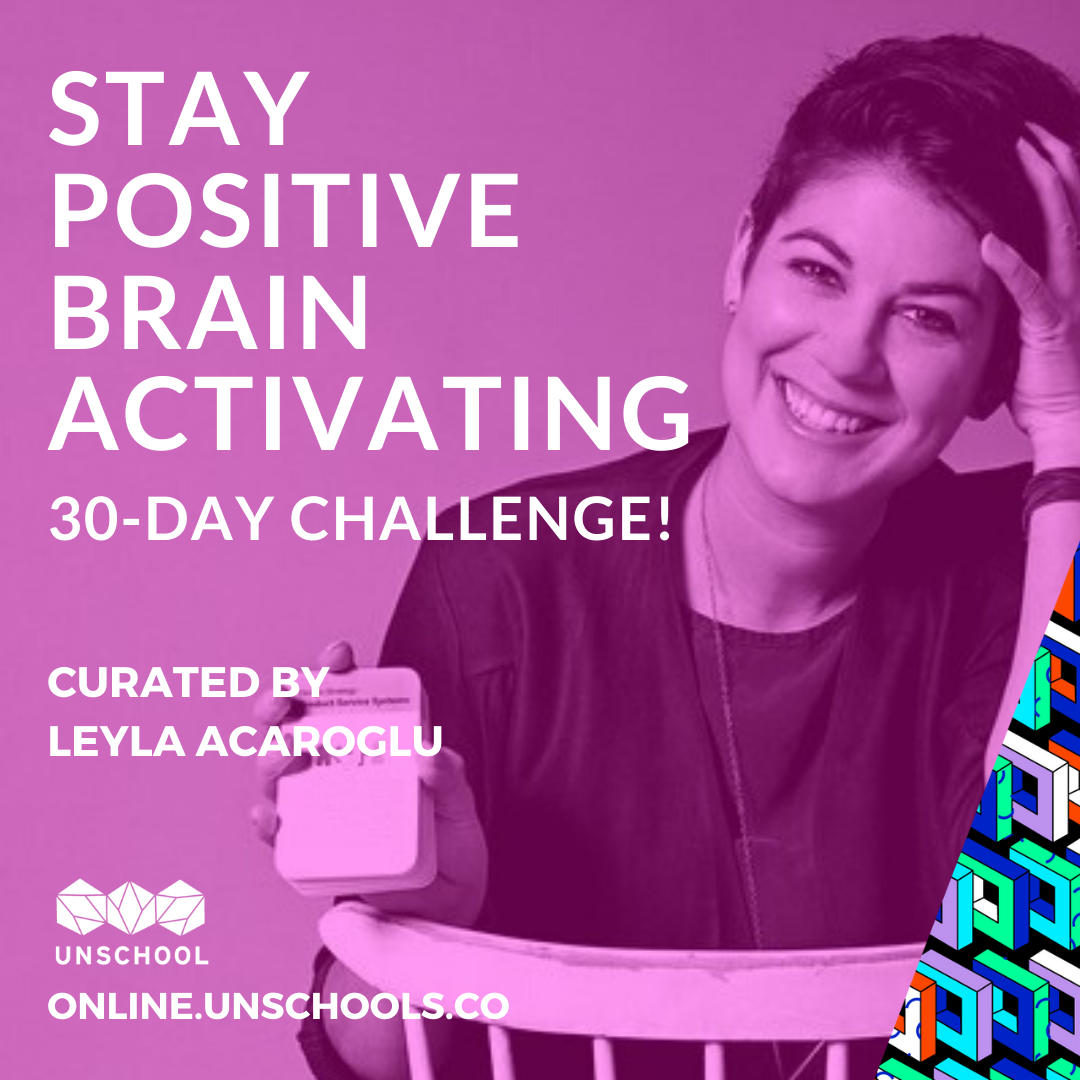
So now, we are excited to launch a new brain activating 30-day challenge to help anyone #staypositive, learn new tools and get cool shit done. Built around the new handbook Design Systems Change by Leyla Acaroglu (which you get as part of the pack), Leyla curated the 30-day bootcamp with daily doses of content that you watch, read and then do. With 30 downloadable worksheets you will be able to explore many different ways you can build your own agency and capacity to effect positive change in the world around you – even if it’s from your bed or lounge room for the moment!
The bootcamp is usually designed to be self-paced and individual, but with so many of us in the same boat at the moment, we figured you might enjoy doing this as a #30daychallenge together! We’re starting on April 1, and if you sign up to join before April 1 (5pm UTC) you also get a 50% discount and keep motivated with us!
Check it out here for all the deets on the booster pack and use code > designsystemschange < at checkout to activate the discount.
As with all our offerings if you can’t afford this right now but still want to take part then please reach out via email and a team member will give you free access.
If you are keen to get more free juicy brain food from us then sign up hereto get the UnSchool Journal delivered into your inbox every Monday. And if you don’t want to receive any emails like this from us anymore, then please just login to your UnSchools online account that you signed up for and delete it 🙂
Wishing you all the best in these complex times and hope you stay safe and healthy!
LEARN HOW THE PACT™ PROCESS, POLARITY MAP® AND POLARITY ASSESSMENT™ ARE THE MOST ROBUST SUITE OF PRACTICES AND TOOLS AVAILABLE TO ACHIEVE YOUR DESIRED RESULTS FASTER AND MORE SUSTAINABLY
In today’s world of increasing interdependency and complexity, it is vital to utilize problem solving AND both/and thinking to address your most strategic challenges and opportunities. The research is clear – leaders, teams and organizations that leverage Polarities well outperform those that don’t. Discover how to leverage your most strategic Polarities (AKA paradox, wicked problems, chronic tensions, dilemmas, etc.) to become more innovative, agile, profitable and competitive immediately and over time.
Pouvreau has written extensively on this subject and Beralanffy in general – looks interesting, I haven’t read yet. (Parts II and III are available on Academia.edu also)
If you’ve been reading along, you’ll know by now that I spend a lot of my time trying to build the capability of others to think and act in systemic ways.
Systems thinking is not the norm, by any measure, even though there are glimmers of hope. In my last blog, I shared a range of strategies for circumnavigating some of the barriers to embedding systems thinking in large organisations. Those structural barriers matter, without a doubt, but addressing them may not be enough.
Our world, and our brains, are not naturally built for thinking in systemic ways. There are almost certainly limits to our capacity to join the dots, to see the bigger picture, and to comprehend the dynamics and interconnections of an increasingly complex world.
Of course, there are some limits that are actually limits, and others that we create, believe into being, and which can be pushed or dissolved entirely. The trick is knowing which is which.
What are some of these limits?
1. We struggle with uncertainty
The human mind is incredibly averse to uncertainty and ambiguity; from an early age, we respond to uncertainty or lack of clarity by spontaneously generating plausible explanations. What’s more, we hold on to these invented explanations as having intrinsic value of their own. Once we have them, we don’t like to let them go.
We have known for a long time that uncertainty resolution determines how we act. When we can’t immediately gratify our desire to know, we become highly motivated to reach a concrete explanation. That motivation lies at the heart of most other human desires: achievement, affiliation, and power. We want to eliminate the distress of the unknown. When faced with heightened ambiguity and a lack of clear-cut answers, we need to know – and as quickly as possible.
Our desire for certainty is present wherever you look. In science, it appears as Occam’s Razor, which is the idea that the simplest explanation is probably true. And yes, while you it is possible to have a simple theory that solves that one particular problem, if it doesn’t fit into the larger context of a complex world, it probably isn’t the right theory.
In public policy, we search for the ‘silver bullet’, or the one-size-fits-all solution, rather than recognising that all human behaviour is exceptionally context dependent.
Our western legal system is built upon the premise of individual personhood and autonomy, a convenient illusion, but one that helps us create a container to deal with the uncertainty. When we can assign blame and attribute responsibility to individuals and individual acts, we strip away the uncertainty that comes with understanding causation in a complex world.
2. We like to pretend the world is made up of fixed categories
Although the world in which we live is essentially continuous, we experience it as discrete chunks: “strangers” and “acquaintances,” “fiction” and “nonfiction,” “normal” and “perverse.” Categorisation is crucial for cognition and making these kinds of distinctions involves two simultaneous cognitive acts – lumping and splitting. The former entails grouping “similar” things together in a single mental cluster. The latter involves perceiving “different” clusters as separate from one another. Lumping allows us to perceive orange juice as similar to grape juice and Labradors as similar to poodles. Splitting allows us to perceive grape juice as different from wine and dogs as different from wolves.
Lumping and splitting help us set hard conceptual boundaries. But boundaries in a complex world aren’t hard – they’re uncertain, ambiguous, relational, and context dependent.
Fuzzy boundaries are hard work and we’re primed to avoid them. Folklore is full of stories that illustrate the challenge humans have always faced, as they’ve attempted to create hard boundaries in a continuous world. In Norse Mythology, Loki famously made a bet with the dwarf Brok, and wagered his head. He lost in due time the dwarves came to collect. Loki had no problem with giving up his head but insisted they had absolutely no right to take any part of his neck. Everyone concerned discussed the matter; certain parts were obviously head, and certain parts were obviously neck, but neither side could agree exactly where one ended and the other began. So Loki kept his head indefinitely, although his lips were stitched shut as punishment for getting out of the bet with tricky wordplay.
3. Our language and culture shape how we think
While the relationship between language and thought is controversial, recent research has thrown up some interesting findings. There is growing acceptance that the language we speak may bias our attention toward certain parts of the world, reinforce particular cognitive limits, and foster specific ways of processing information.
A powerful example of this phenomena is how eye-witness memory differs depending on the language a witness speaks. Recent research has shown that, strikingly, speakers of different languages remember different things about the same events. Whether or not someone is likely to remember who did what is influenced by how events are normally described in in the particular language spoken.
If the syntax and structure of language affects cognitive processes, it likely has an influence on whether or not people are able to perceive and comprehend the world in a systemic way. This particular connection is yet to be tested but there is enough evidence for a strong hypothesis. Where English is a sequential language (subject-verb-object), which results in a bias toward linear thinking, many indigenous languages – where holistic and non-linear is the norm – are free-word order languages, which is less prone to this kind of bias.
The evidence for the influence of culture is much more of a slam dunk. Research has repeatedly shown that Westerners pay attention primarily to objects, whereas East Asians display pay attention to relationships between objects and the broader environment in which they are embedded.
It’s rampant speculation, of course, but these differences could be influence influenced by long-term cultural differences that are rooted intellectual traditions of ancient Greece and ancient China. Where the Greek intellectual tradition was focused on breaking problems into their constituent parts, the intellectual traditions in ancient China were heavily shaped by Confucianism, Taoism, and Buddhism. These philosophies were holistic in nature which could have contributed to the development of East Asians’ focus on relationships between objects and their context, and to the tendency of explaining events on the basis of these relationships.
Pushing limits
Where to from here, then? For most of us, we have been raised in context that values and affirms linear thinking. We think A + B = C. We speak subject-verb-object. The good news though is although it may be unnatural to us, children can learn systems thinking more easily than adults, because they have not yet been as thoroughly initiated into the linear ways of being and seeing that we impose on the world. Each of these cognitive constraints, which work against the use of systems mindset, can be tested.
There are, of course, already many stories of people actively subverting these limits – questioning assumptions and pushing the boundaries of language, culture and cognition. It is more common than you think. Our language is full of metaphors to help us understand the complexity of the world – “the straw that breaks the camel’s back”, “a whole greater than the sum of parts”, “the butterfly effect”. These are all attempts that someone has made, at some points in history, to create a space where they can momentarily confront the uncertainty, interconnectedness, and complexity of the world. The best we can do is try.
Brilliant example of the importance of perspective and framing (and the inevitability of modelling and situated rationality – good #systemsthinking points
SIGNAL: FOSTERING THE EMERGENCE OF SYSTEM LEADERSHIP WORLDWIDE
WEDNESDAY, APRIL 1, 2020
SESSION DESCRIPTION
In this informative and interactive virtual session, you’ll learn about SIGNAL, a global initiative to foster the system leadership needed to address the toughest challenges faced by our communities, countries, and society.
A uniquely diverse and collaborative research initiative, SIGNAL is designed to understand the real needs of people leading systemic change around the world AND build a powerful system of learning and support to foster their success. Speakers from Forum for the Future, Ashoka, Mastercard Foundation, Catalyst 2030, Garfield Foundation, Vibrancy Network, Social Innovation Canada, and CoCreative will share why they’re contributing to SIGNAL and why they’re investing in building system leadership.
During the session, you’ll learn about SIGNAL’s research objectives, hear some of the early insights from the research so far, discover our plan for collaboratively expanding SIGNAL research across countries and regions, and join a conversation about how SIGNAL research can be leveraged to build a powerful ecosystem of learning and support to foster systems leadership.
Join us as we leverage interactive polling technology to engage in a creative and dynamic discussion to explore system leadership, expand insights into what the field needs, and think together how we might more deeply collaborate to expand the new leadership that the world sorely needs.
Why is it so difficult to replicate stories of success?
Why is it so difficult to “scale” good solutions when we find them?
Why there are no simple recipes for solving today’s biggest challenges?
You might have indulged in questions of this kind before. Why when something goes really well in one situation, it is so hard to apply the learning points from that solution in another context / domain / in another country’s offices? And yet we see that a lot of time when we ask this kind of questions, the answers are either a seemingly vague “It depends” which sounds reasonable to some and frustrates others; or a well-meaning “Of course it will work here too” which will fail the moment this assumption exits the realm of textbooks and nice-looking theories and meets the real world.
In this blog post I explore our temptation for “rollout strategies”; then we will take a look at a complexity framework to understand the role of context in different situations; we will see the journey that context has travelled through over the last decades; and how this could have very practical consequences in our work when we deal with complex situations like environmental sustainability, climate change, aid and development.
Let’s start from where this is all too familiar.
The need to “scale up” good solutions is evident (see climate crisis) and the temptation for quick wins and highly replicable solutions is strong in us. Institutions around us are geared to reward this potential to ‘scale things up’, be it an accelerator for start up’s (first question they asked to my consultancy: “how will you scale your product?”) a government grant (“could this be replicated and positively impact more people?”) or aid money (“let’s roll out this new technology in other countries”). Now, the temptation is for a linear pathway made of: testing out something -> looking for what works -> identifying a recipe of sorts -> do a big roll-out implementation. Progress is achieved, the world is changed, we are all happy. This is fine in situations where replication is easy -except that in the most complex scenarios we have to forgo this hope that a copy-paste approach to roll-out solutions be a viable option.
The whole notion of scale implies ‘standardization’ and comes from the idea that you do a replica of your successful project elsewhere. The trick with a standardization is that it minimizes (or better say: bypasses) the importance of context. We get excited about scaling an idea that works: it becomes a trend on twitter and makes the headlines and we all get excited around flashy headlines of the type
“this [new technical solution] could end [systemic problem] in [developing country we are addicted to mention]!”.
Other than some obvious considerations like the lack of a systemic approach to the challenge, at times ignoring the context could be the most troubling of all blunders. This “theory of action” usually works well in a mechanical/technical system, where the level of adaptation to a local context is minimal. The reality though is that when we apply a solution to a rich, complex human system, context becomes everything and the solution we devise needs to be emergent: an answer that is so context-specific that will only work in that context, with at best the possibility to teach us something about a blue-print for actions in other context, but that can never give us a manual with the inspiring headline “here is how you can initiate change in your community!”
Last autumn, I was part of a small team of volunteers from the Department for Education (DfE), HMRC and the Department for International Development (DfID) who spent some time working with the Systems Unit in the Cabinet Office.
We wanted to explore what systems leadership meant.
If you’d asked me before we started what I thought a system leader was, I would have said someone who took a more ‘elevated’ view than a traditional leader, someone able to see further and wider. Someone able to work more effectively across a wider landscape.
I came to find that while those are features of systems leadership, they’re not the most interesting features. Nor are they what truly differentiate it from other forms of leadership.
In this post, I’ll share what we found out about systems leadership – from humility to ‘mastering the dance.’ Yes. It surprised me too.
Systems leadership: in theory
Advocates of systems leadership see it as the only viable response to so-called ‘wicked’ problems – those that are complex, messy and longstanding. They don’t fit neatly into a single organisation’s remit. They need cross-cutting action.
Some examples include tackling obesity, reducing violent crime, giving children the best possible start in life, levelling up the economy, and tackling climate change. There are lots of smaller examples too. The issues are different in every case, but they share one thing in common – solutions will only be found if we recognise that we are dealing with complex systems.
We talked to experienced systems leaders and observed one of the System Unit’s pilot programmes. We reviewed literature about systems leadership. Others have been exploring systems approaches for a while. There are lots of great case studies already out there, and we tapped into those.
We liked this particular definition of systems leadership: ‘the collaborative leadership of a network of people in different places and at different levels in the system creating a shared endeavour and cooperating to make a significant change.’
It captured important elements of systems: that it looks wider than usual so that every part of the system is identified and involved. Geography matters, not least because local factors often influence ‘what works’ in a system. Hierarchy isn’t that important, it’s about getting the right people involved. It’s also about outcomes, a positive result for the citizen.
…and in practice
Although the definition appears to be straightforward, there are significant barriers to being a systems leader.
Firstly, there are strong incentives to operate with a silo mentality.
Secondly, the “day job” gets in the way and so there’s just a lot to do and little time to think in a systems way, let alone think about systems leadership. I know the Systems Unit would argue this doesn’t have to be the case!
Additionally, it can seem this work is less important than work closer to core departmental or organisational objectives. Funding arrangements can push resources into silos.
Individuals may lack the levers of action and/or accountability. Then there is short-termism, possible tensions and misunderstandings. Even if none of the above were the case, it would still be hard work!
Overcoming the challenges of systems leadership
Systems leadership really captured our imagination when we realised it was about accepting the limits of traditional leadership reach, about being pushed into terrain that is too difficult to control.
Each leader is just one leader among many. Only through collaborating with others can anyone make progress. One early challenge is to agree on a shared goal – the ‘North Star’ to guide collective endeavour.
Simple solutions are also entirely out. You will need to test and iterate before you implement. Systems thinking tools and techniques can help here but the biggest challenge for leaders may be simply to create the space to understand the problem – going slowly at first to go fast later. Avoiding the rush to launch initiatives demands a counter cultural approach. It may never be possible to understand the system in its entirety. Hence cycles of learning and staying humble are the order of the day.
As Donella Meadows, an early systems thinker put it, systems can’t be controlled but they can be envisioned, designed and carefully brought into being. It just demands another way of doing. She called this ‘the dance’ because to dance well you have to bring your full self and respond to feedback of the other dancers and to the rhythm, much as you do when engaging with a complex system.
Experience from local government and healthcare shows systems leadership can play real dividends.
Whole systems can be moved forward where people in leadership positions:
acknowledge the complexity of systems;
take time to explore the problem;
lead with others;
iterate towards shared solutions;
act as catalyst for change, and
play a stewardship role over time.
From good to great
One way through all these challenges is to put the citizen front and centre. Engaging with a complex system you need help to work your way through to solutions – being guided by user needs can provide just the assistance needed. The number one suggestion from our work – included as the first tip in our top tips for systems leaders, see earlier blog – was therefore to spend time with citizens, with those directly affected by the problem. If we do that, we also won’t be able to bear not responding.
Finally, what makes a great systems leader? We concluded that systems leaders aspire to be strategic, collaborative, listening, humble, self-reflective, passionate, courageous, and inspiring. Systems leaders see themselves as a leader in a system rather than the leader of a system. They identify and galvanise other leaders, leaving their ego at the door. They believe – in line with an oft-quoted proverb: ‘If you want to go fast, go alone. If you want to go far, go together.’
It would be great to hear what you think systems leadership is, so please leave a comment below.
A nice offer from Jennifer Campbell, the force behind the Systemic Leadership Summit –
[declaration – I’m one of the speakers – but although I previously had a franchise link for the summit I was directly involved in, I have no commercial interest in this one]
77+ highly valuable thought leader sessions, weekly live calls, online community
The ultimate daily cadence for leaders and systems thinking practitioners in times of crisis
MARCH 30 – JUNE 28, 2020
Only $77
3 month Systemic Leadership Journey
In these times of crisis, many leaders and professionals are concerned and anxious. We all share the same complex problems and wonder how to deal with the uncertainty and volatility that this brings to our work and our lives. We want to step up and do something.
Unprecedented times call for unprecedented leadership.
To help you navigate this uncertain period, we want to offer you daily support, inspiration and a moment to pause and reflect.
As you may know our summits contain highly valuable expert summit sessions with thought leaders and wise individuals.
Participants have paid hundreds of dollars to have access to their value packed systems thinking based strategies.
Now, we want to help you hold space for whatever emerges and lead in uncertain times.
Gain access to the best of what we’ve learned and accumulated over the years.
We are offering the best of ALL four summits to you for only $1 per summit session.
Online community and weekly live calls with participants (and possibly speakers) are included.
Sessions are broadcast daily from Monday to Saturday at 4pm CET
Fritjof Capra
A Systems View of Life
Scientist, Educator, Activist,
Author of best selling books
Dr. Eliat Aram
Leading in Complex Times
CEO of the Tavistock Institute of
Human Relations
Dr. William Tate
Understanding Systemic Leadership
Director of the Systemic Leadership Institute, author of books about systemic leadership
Nora Bateson
Liminal Leadership:
Leading from the In-between
President of the International Bateson Institute, research designer, film-maker, writer.
Dr. Peter Senge
System Leadership:
Solving Problems That Matter
Founding Chair of System Leadership Institute, author of the Fifth Discipline , senior lecturer MIT.
Arawana Hayashi
Social Presencing Theatre
Head of the creation of Social Presencing Theater at Presencing Institute. Choreographer, performer educator
JOIN OUR ONLINE JOURNEY HERE
Speakers April 6 – 12
Sessions are broadcast daily from Monday to Saturday at 4pm CET
Margaret Wheatley
Who do we Choose to be?
Speaker, teacher, community worker, consultant, advisor, formal leader. Best selling author of nine books.
Mathias Weitbrecht
The Why & How Of Visualization
Founder and Managing Director of Visual Facilitators, Facilitator, Visual Strategist, Graphic Recorder
Noomi Natan
The Power Of Constellations
Certified Coach and Constellatory trained at The Centre for Systemic Constellation and the Nowhere Academy
Dave Snowden
The Cynefin Framework
The renowned developer of the Cynefin framework. Founder & chief scientific officer of Cognitive Edge Researcher knowledge management.
Jan Jacob Stam
Systemic Phenomenological Work
Pioneer in systemic work in the Netherlands , founder of the Bert Hellinger Institute in Groningen,
the Netherlands.
Benjamin Taylor
Paradoxes, polarities, paradigm shifts
Chief Executive of the Public Service Transformation Academy and managing partner of RedQuadrant. Passionate about systems thinking.
JOIN OUR ONLINE JOURNEY HERE
Speakers April 13 – 19
Sessions are broadcast daily from Monday to Saturday at 4pm CET
Peter Hawkins
The Future of Leadership and Leadership Team Coaching
Professor of Leadership at Henley Business School, best-selling author of Leadership Team Coaching
Heather Plett
Holding Liminal Space
Speaker, Writer, Facilitator of the Holding Space Facilitator Program
Dr. Leslie Brissett
Contemporary Challenges when Leading Systemically
Company Secretary & Principal Consultant at the Tavistock Institute, Co-Director of the Dynamics at Board Level programme
John Renesch
A Shift in Consciousness
Advisor, mentor, futurist. Writer on social & organizational change
Christiane Seuhs-Schoeller
Language Of Spaces
Founding member and partner at Encode.org and Evolution at Work, Creator of Language of Spaces
Dr. Louis Klein
Governance, Purpose, Change
and Potential
Internationally recognized expert in the field of systemic change and complex project management.
JOIN OUR ONLINE JOURNEY HERE
Speakers April 20 – 26
Sessions are broadcast daily from Monday to Saturday at 4pm CET
Phil Cady
The Organic System Framework
President of Cognitive Leadership Strategies West, Master Facilitator Organization Workshop
Kathleen E. Allen
Leading from the Roots
President of Kathleen Allen and Associates, leadership expert, author of Systemic Leadership books
Ed & Peter Schein
Humble Leadership
Bestselling author, father of organizational culture studies and
Silicon Valley strategy consultant, helps start-ups & expansion-phase technology companies.
Anthony Howard
Human Centered Leadership
CEO, entrepreneur, thought leader, philosopher, author of the book “Humanise”,
“CEO Whisperer”
Deborah Rowland
Still Moving
Deborah is an experienced change leader, founder of a research consulting firm, executive coach and author of the book Still Moving.
Giles Hutchins
Regenerative leadership
Chair of the Future Fit Leadership Academy, co-author of Regenerative Leadership,(co)founder of Leadership Immersions, Regenerators, a.o.
JOIN OUR ONLINE JOURNEY HERE
Speakers April 27 – May 3
Sessions are broadcast daily from Monday to Saturday at 4pm CET
Nora Bateson
The Leadership Paradox
President of the International Bateson Institute, a research designer, independent film-maker, writer, and lecturer.
Marshall Goldsmith
Great Leadership
World renown #1 Executive Coach, bestselling author of “What got you here won’t get you there”
Dr. Michael Buehler
Global Systemic Leadership in Political and Business Environments
Head of Infrastructure and Urban Development at the World Economic Forum, project manager, consultant
Marita Fridjhon
Intelligent Teams
Co-founder & CEO CRR Global,
co-creator of ORSC
Dr. Morne Mostert
Systemic Leadership Learning
Director of the Institute for Futures Research, President World Leadership Day
Gina Hayden
Questions for Conscious Leaders
Leadership expert, Author of Becoming a Conscious Leader
JOIN OUR ONLINE JOURNEY HERE
Speakers May 4 – 10
Sessions are broadcast daily from Monday to Saturday at 4pm CET
Joan Lurie
Orgonomics
CEO of Orgonomix, helps leaders & organisations to transform
Jim Kouzes
Relationship Building for Leaders
Bestselling author, co-author of The Leadership
Ella Saltmarshe
Role of Story in Systems Change
Writer, co-founder, innovator
Anne Rød
Systemic Leadership in Action
Intercultural management consultant and executive team coach, Systems Inspired Leadership Faculty, co-author of “Intelligent Teams”
Dion Johnson
Women Leadership & Systemic Change
Strategic Ally, Master Coach, Founder of Woman Leader Global,
“The Womanologist”
Klaus Lombardozzi
Leading With Relationship Intelligence
Leader in Multinational Organizations, Internationally CRR Global Certified Organizational & Systems/Team Coach
JOIN OUR ONLINE JOURNEY HERE
Speakers May 11 – 17
Sessions are broadcast daily from Monday to Saturday at 4pm CET
Siets Bakker
Moving Questions
Organization consultant, forerunner in applied systemic work. Family & organizational constellator.
Jo McHale
Nonviolent Communication
Certified Non Violent Communication (NVC) Trainer,
Leadership Coach
Andre Wierdsma
SL: The Fragility of the ‘In-between’
Emeritus Professor of Organization & Co-creation (Nijenrode University), best-selling author
Katherine Long
The Application And Practice Of Systemic (Leadership) Approaches
Eco-systems development practitioner at Evolution OD, writer and international speaker.
Katherine Tyler Scott
Leading Highly Anxious Systems
Managing Principal of KiThoughtBridge , Chair of the International Leadership Association Board (ILA)
Olivier Piazza
Collective Intelligence
Collective Intelligence
Program Leader,
Executive Coach
JOIN OUR ONLINE JOURNEY HERE
Speakers May 18 – 24
Sessions are broadcast daily from Monday to Saturday at 4pm CET
Edward Howard &
Sarah Rozenthuler
Purpose-Led Leadership
Co-directors of The Whole Partnership, systemic work, constellations & dialogue experts.
Dr. Glenda Eoyang
Human Systems Dynamics
Pioneer in the applications of complexity science to organizational systems, developed human systems dynamics (HSD).
Zachary Green
Leadership and Group Relations
Co-founder Group Relations International, Associate Director Leadership Institute (San Diego)
Dr. Aftab Omer
An Exploration Of Transformative Leadership
President of Meridian University, former president of the Council for Humanistic and Transpersonal Psychologies, sociologist, psychologist and futurist.
Pilar García Sánchez
Beyond the Numbers
Strategic business development manager at Medtronic and Chair of the Medtronic Women’s Network in The Netherlands.
Brian “Ponch” Rivera
The Flow System™
Co-creator of the Flow System™, worked at the US Navy,
Agile & innovation trainer.
JOIN OUR ONLINE JOURNEY HERE
Speakers May 25 – 31
Sessions are broadcast daily from Monday to Saturday at 4pm CET
Dr. Amy Mindell
Process Work and Deep Democracy
Process Work & Deep Democracy expert, creator of MetaSkills
Jeremy Lloyd
Hearing the Customers Voice
Independent consultant, former leader in business, creating customer-centric solutions and executing strategic plans.
Cynthia Loy Darst
The Inside Team
Master Certified Coach (ICF), Front of the Room Leader CTI and CRR Global, speaker, author
Sarah Cornally
Systems Intelligence In The Corporate Space
Strategic Leadership Advisor, Systemic Intelligence Pioneer and Educator of Practitioners, Leadership Circle™ Faculty in Asia Pacific region.
Max Schupbach
Deep Democracy
Co-founder of the Deep Democracy Institute (DDI), a think tank, learning hub and consulting group based on the Process Work paradigm, an inclusive whole system paradigm.
Dr. Susan Gantt
Systems-centered Training
Director of the Systems-Centered Training & Research Institute,
Educator in Systems-Centered Training
JOIN OUR ONLINE JOURNEY HERE
Speakers June 1 – 7
Sessions are broadcast daily from Monday to Saturday at 4pm CET
Myrna Lewis
The Power and Potential of Conflict
Co-founder of the Lewis Method of Deep Democracy and Head of Professional Services for Deep Democracy Ltd.
Antonio Belgrave
Positive Deviant Performance
Former leader in pharmaceutical industry, Organisation Development Specialist
Brian Robertson
Holacracy: Leadership When Goals and Roles Rule
Inventor Holacracy, experienced entrepreneur HolacracyOne, pioneer, author of book ‘Holacracy’
Ray Haddock
Developing Organizations with Systems Centered Training
Qualified in medicine, Psychiatry, Psychotherapy, Systems Centered Training Expert
Gaston Schmitz
Community Behavior Change
Former UN program advisor,
Coach Asian Leadership Institute
Monica Velarde Lazart
The Hope of the Amazon – Systemic Leadership Case Study
Director of T-Consult Socioanalytic Practice. Social scientist, org. & leadership development consultant and coach
JOIN OUR ONLINE JOURNEY HERE
Speakers June 8 – 14
Sessions are broadcast daily from Monday to Saturday at 4pm CET
Diederick Janse
Getting Teams Done: Leading and Serving
Entrepreneur, Holacracy expert, Co-founder of Energized.org, author of Getting Teams Done
Danielle Braun
Building Tribes
Co-founder and director of the Culture Academy (NL), co-author of The Corporate Tribe, leadership & culture expert
Patrick Hoverstadt
The Viable Systems Model
Consultant, author of The Fractal Organization: Creating sustainable organizations with the Viable System Model and other books.
Jitske Kramer
Culture Change in the Corporate Tribe
Co-founder and Chief of the Culture Academy, Founder of Human Dimensions, author, trainer
John Watters
Systems Blindness and Stuck Systems
Managing Director of Living Leadership, Master Trainer and Leading authority on Barry Oshry’s systems leadership work
Dr. Stuart Hill
Enabling Real Change Ecologically
Emeritus Professor and Foundation Chair of Social Ecology in the School of Education. Received “Leadership for Sustainability Award” from Australia’s Centre for Sustainability Leadership.
JOIN OUR ONLINE JOURNEY HERE
Speakers June 15 – 21
Sessions are broadcast daily from Monday to Saturday at 4pm CET
Dr. Mette Böll
Shapeshifting Education
Biologist, specializing in the evolution of complex social systems, organizational ethology, holds additional degrees in contemplative leadership and philosophy & history of science.
Dr. Alexander Laszlo
Thrivability & Being The Systems You Want To See In The World
Director of Development at L-INPR, President of B of D BCSSS & ISSS, Founding Dir. of the Doctoral Program in Leadership & Systemic Innovation at ITBA (Arg.)
George Pór
Evolutionary Purpose
Founder of Community Intelligence, Creator of the Enlivening Edge Community and Faculty member at Meridian University
Laura Storm
Regenerative Leadership and the Practice of Silence
Awarded the title “Worldchanger” by Greenbiz, selected by the World Economic Forum as a Young Global Leader and Sustainability Expert.
Christian Kromme
Humanification: Go Digital, Stay Human
Author of Humanification, Public Speaker, and board member at a.o. the Workforce Institute EMEA and the Human Genome Foundation
Dr. Orit Gal
Social Acupuncture
Senior Lecturer for Strategy and Complexity at Regent’s University London, political economist, founder of tech start-up “Urbaniser”.
JOIN OUR ONLINE JOURNEY HERE
Speakers June 22 – 28
Sessions are broadcast daily from Monday to Saturday at 4pm CET
Jean-Louis Lamboray
Strength-based Community Building
Co-founder of The Constellation, former UNAIDS health specialist, author: “What makes us human?”
Wendy Mahoney
Why Innovation is Human
Head of Newmella Holdings, seminal expert and lecturer on the topic of Business Innovation
Lili Gulbert
Strategic Systemic Change
Systemic Change Strategist, builds collaborative intelligence with executives
Dr. Peter Robertson
Ecology In Business
Executive Lecturer at Nyenrode Business University, visiting professor to universities in NL, USA and China, author of Always Change A Winning Team and The Ecological Leader, Senior consultant.
Nora Bateson
Warm Data and Warm Data Labs
President of the International Bateson Institute, a research designer, independent film-maker, writer, and lecturer.
Martin Kalungu-Banda
Leading from the Emerging Future
Martin is a consultant in organization and leadership development, a facilitator of innovation and change; trainer, coach and author. He is faculty for the Presencing Institute.
When, along with applied systems scientist Dr Joe Norman, we first reacted to coronavirus on 25 January with the publication of an academic note urging caution, the virus had reportedly infected fewer than 2,000 people worldwide and fewer than 60 people were dead. That number need not have been so high.
At the time of writing, the numbers are 351,000 and 15,000 respectively. Our research did not use any complicated model with a vast number of variables, no more than someone watching an avalanche heading in their direction calls for complicated statistical models to see if they need to get out of the way.
We called for a simple exercise of the precautionary principle in a domain where it mattered: interconnected complex systems have some attributes that allow some things to cascade out of control, delivering extreme outcomes. Enact robust measures that would have been, at the time, of small cost: constrain mobility. Immediately. Later, we invoked a rapid investment in preparedness: tests, hospital capacity, means to treat patients. Just in case, you know. Things can happen.
The error in the UK is on two levels. Modelling and policymaking.
First, at the modelling level, the government relied at all stages on epidemiological models that were designed to show us roughly what happens when a preselected set of actions are made, and not what we should make happen, and how.
The modellers use hypotheses/assumptions, which they then feed into models, and use to draw conclusions and make policy recommendations. Critically, they do not produce an error rate. What if these assumptions are wrong? Have they been tested? The answer is often no. For academic papers, this is fine. Flawed theories can provoke discussion. Risk management – like wisdom – requires robustness in models.
But if we base our pandemic response plans on flawed academic models, people die. And they will.
This was the case with the disastrous “herd immunity” thesis. The idea behind herd immunity was that the outbreak would stop if enough people got sick and gained immunity. Once a critical mass of young people gained immunity, so the epidemiological modellers told us, vulnerable populations (old and sick people) would be protected. Of course, this idea was nothing more than a dressed-up version of the “just do nothing” approach.
Individuals and scientists around the world immediately pointed out the obvious flaws: there’s no way to ensure only young people get infected; you need 60-70% of the population to be infected and recover to have a shot at herd immunity, and there aren’t that many young and healthy people in the UK, or anywhere. Moreover, many young people have severe cases of the disease, overloading healthcare systems, and a not-so-small number of them die. It is not a free ride.
This doesn’t even include the possibility, already suspected in some cases, of reccurrence of the disease. Immunity may not even be reliable for this virus.
Worse, it did not take into account that the duration of hospitalisation can be lengthier than they think, or that one can incur a shortage of hospital beds.
Second, but more grave, is the policymaking. No 10 appears to be enamoured with “scientism” – things that have the cosmetic attributes of science but without its rigour. This manifests itself in the nudge group that engages in experimenting with UK citizens or applying methods from behavioural economics that fail to work outside the university – yet patronise citizens as an insult to their ancestral wisdom and risk-perception apparatus. Social science is in a “replication crisis”, where less than half the results replicate (under exact same conditions), less than a tenth can be taken seriously, and less than a hundredth translate into the real world.
So what is called “evidence-based” methods have a dire track record and are pretty much evidence-free. This scientism also manifests itself in Boris Johnson’s chief adviser Dominic Cummings’s love of complexity and complex systems (our speciality) which he appears to apply incorrectly. And letting a segment of the population die for the sake of the economy is a false dichotomy – aside from the moral repugnance of the idea.
As we said, when one deals with deep uncertainty, both governance and precaution require us to hedge for the worst. While risk-taking is a business that is left to individuals, collective safety and systemic risk are the business of the state. Failing that mandate of prudence by gambling with the lives of citizens is a professional wrongdoing that extends beyond academic mistake; it is a violation of the ethics of governing.
The obvious policy left now is a lockdown, with overactive testing and contact tracing: follow the evidence from China and South Korea rather than thousands of error-prone computer codes. So we have wasted weeks, and ones that matter with a multiplicative threat.
• Nassim Nicholas Taleb is distinguished professor of risk engineering at New York University’s Tandon School of Engineering and author of The Black Swan. Yaneer Bar-Yam is president of the New England Complex System Institute
Following the workshop at 2019 CANSEE Conference, cohosted with David L. Hawk, we were invited to contribute an article to a special issue of WEI Magazine. Here’s the abstract for the workshop in May:
[HEADINGS ONLY]
Systems Changes, Environmental Deterioration
This dialogue-oriented workshop will be framed by two short position papers (< 30 minutes each) towards energizing a discussion on the prospects for systems thinking and ecological economics.
(1) Systems Changes research program
(2) Environmental Deterioration: What have we learned about systems change(s) over the past 50 years?
(3) Dialectic: Group Discussion
Ecology and Economy: Systems Changes Ahead?
By: David Ing
One doesn’t recognize the really important moments in one’s life until it’s too late. — Agatha Christie
Living in a world where systems changes are omnipresent, where do we focus our attention? We read every day about climate change and economic change as major forces that are impacting our world. These forces — partially under human control and partially not — are perplexing in their plurality: systems changes as beyond stable states we have enjoyed, and beyond the limits that we have previously expected. Action by individuals and groups range from (i) dealing with imminent systems changes when the evidence cannot be denied, to (ii) anticipating negative and positive systems changes on the horizon with proactive foresight.
Let’s step through three ideas: (a) three attitudes towards systems changes; (b) human responses to impending tragedy; and (c) surfacing the values that we appreciate.







You must be logged in to post a comment.