Evaluating the impact of long-term systems change work is always complex- there is no one-stop primer or resource that will truly encompass the questions that need to be asked and the data collection methods to use. Evaluating complex initiatives or evaluating programs in complex environments requires the application of a systems lens and a set of principles of practice, as well as attending to the particular contextual characteristics of each case.
Where does one start then when looking at your own systems change work and how to learn from its design and implementation? What do you need to think about when gauging your progress and the initiative’s intended effects, influence, and impact?
Join FSG and the Collective Impact Forum for this discussion with Hallie Preskill and Joelle Cook who lead FSG’s Strategic Learning and Evaluation practice, as we delve into how evaluating system change is different from evaluating programs, and talk about some of the core evaluation principles needed when advancing systems change work.
Webinar Presentation: Access a copy of the webinar presentation at the link on the left of this page. (Logging into your Forum account will be necessary to download.)
Do you lead change or strive to make a difference?
What if we bring our collective effort to bear in new ways to address increasingly complex challenges?
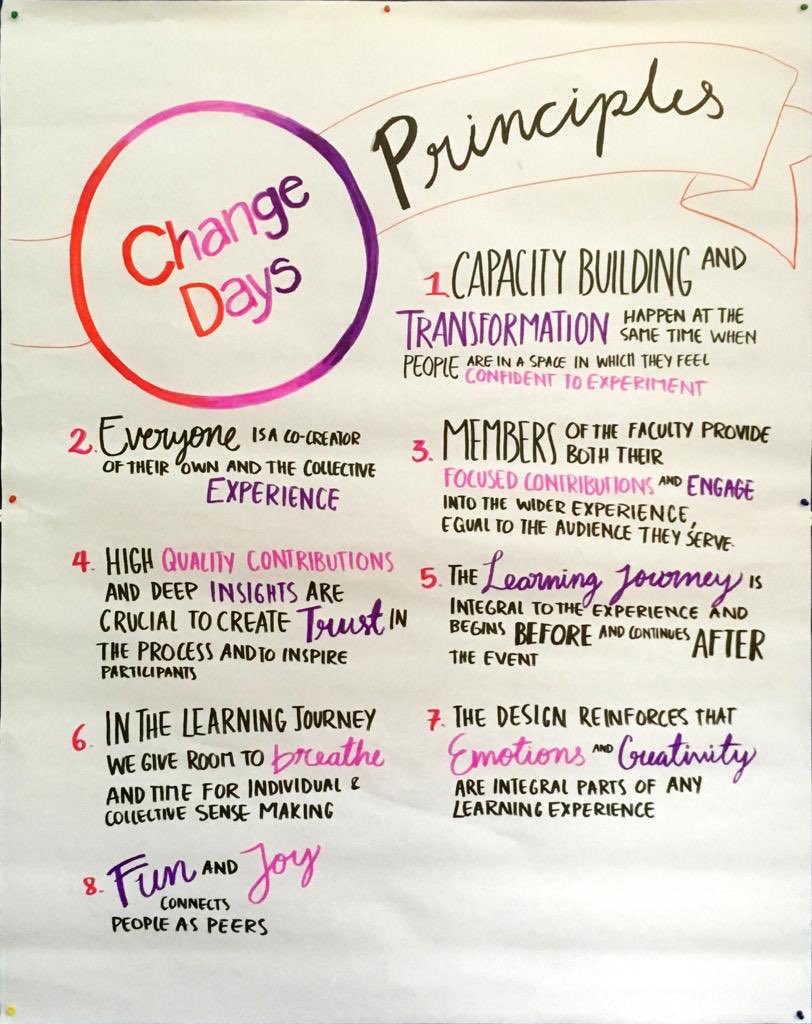
Somewhere between a conference and a festival is the space for Change Days.
Come and be a part of the first Australasian Change Days in Perth, Western Australia, a city that is both the most isolated capital city in the world AND in the same time zone as 60% of the world’s population.
The Australasian Change Days Community (ACDC) will
• Provide a unique space and opportunity for people who are passionate about change to: connect, share, debate, learn and evolve the practice of Change Management.
• Be a place where participants share and learn from and with an inclusive, evidence-based community of practice, looking to experiment with leading edge approaches to lead change in organisations and communities
• Invite participants to create connections with others based on shared values
• Give space and time to foster new connections (making friends) and nurturing existing connections (strengthening existing friendships)
Every facilitator is a participant!
Be part of the ACDC changemaker tribe by offering a 1 ½ hour interactive workshop session, piece of art, or a learning journey before, during or even after the conference contributing with your experience, excitement and energy to the effort of building Connectedness.
What can you add to the topic of Connectedness? We want to include a breadth of topics related to the theme, not just those deemed traditional “Change Management”.
If you would like to host a pre or post conference workshop then contact me below.
Three figures sit next to each other on a bench, displaying the typical characteristics of smartphone users: their heads are bent, fingers typing and swiping, and their faces are lit up by their phone screens. While their bodies are physically present, their minds are elsewhere.
‘Absorbed by Light’, designed by the British Gali May Lucas and executed by Berlin-based sculptor Karoline Hinz.
The phone and computer screens that, literally and figuratively, light up our lives are irresistible. We read new messages immediately and want easy access to our social media, useful apps, and browser. Our smartphones are with us all the time – in bed, on the toilet, in the train, at our desk. They are an extension of our contact with our families, friends, and even people on the other side of the world. And as a result, we engage ourselves more with the virtual and superficial reality than with each other and the real world around us, something Lucas makes painfully clear. Actively involving the audience in the ‘story’ is a recurring feature in the work of the British artist, who works in Amsterdam as a graphic designer.
“It is vital to reawaken the wisdom of the body.” – Mark Vernon introduces Constellations
The body has its own intelligence. It can sound strange to put it like that because we live in an age that has become preoccupied with computers as the paradigm of smartness. This approach values the sort of intelligence that solves problems, calculates and works with concepts. But it’s increasingly being recognised that there are other ways of knowing, and that the body plays a key part.
One way it is showing up is in the cognitive sciences. For example, Philip Barnard of Cambridge University has developed a model to understand how the mind works that includes the body. It draws on empirical research in psychology and sees the body as connected to what Barnard calls the ‘implicational subsystem’.
This implicit mode of understanding is particularly active when we are interacting with the world…
The nucleolus makes the machines that make the machines that do virtually everything. The cell tour in the Animated Textbook 'Life' thus goes from the nucleolus outward, structurally AND functionally, so students can appreciate the cell as a whole #biology#animation#educationpic.twitter.com/J80D6yCYZN
My first formal introduction to Complexity was in 2002. I vividly remember being in the audience of an IBM-sponsored event where I first heard Dave Snowden speak about Complexity theory and the Cynefin sense-making framework. Maybe it was my background in meteorology, or perhaps a natural disposition towards messiness, but I experienced an immediate resonance with thes ideas. Ever since that day, Complexity has become the primary lens through which I view the world.
One of the foundational principles of Dave’s Cynefin framework is “bounded applicability”. This is not an unfamliar concept. We have many idioms we use in every day language that illustrate an understanding of this … horses for courses (which alludes to racehorses performing best on particular racecourses), and different strokes for different folks (we all have different tastes). As with many other common wisdoms, we forget about this in business contexts and too often apply methods and tools as if they are universally applicable. In reality, methods and tools have utility only within appropriate contexts. Methods and tools that work in ordered and predictable domains don’t work in complex and emergent ones. (You can find out more about the difference between ordered and complex contexts in this post.)
My own interest is specifically in Complexity, its implications and how to practically apply learnings from that field in organisations. Current business and management paradigms are firmly rooted in a mechanistic worldview. Much of my writing has therefore been aimed at critiquing practices and ways of thinking that are not appropriate in complex contexts. I may not always make it clear enough that such critiques are not meant to be general. Taylorism, reductionism, linear processes, standard operating procedures, best practices are valid within boundaries. In appropriately ordered contexts they have value, in complex contexts, they either make no impact (best case) or make things worse.
We cannot evaluate the usefulness of a method or tool independent from the context in which it will be applied.
Everything centers around an understanding of context. We cannot evaluate the usefulness of a method or tool independent from the context in which it will be applied. Claims of the universal applicability of methods and tools are at the heart of many expensive failed initiatives I encounter in client organisations. For example, Agile transformations fail because particular frameworks are universally forced onto teams regardless of the nature of their work. Similarly, Lean has many benefits, but when misapplied, it can create near irreparable damage. One example is the famously quoted 3M case that credits Six Sigma with destroying their innovation capability.
As the world becomes more aware of Complexity and more and more “complexity consultants” make their appearance, it will serve us well to remember that not everything is Complex. We are, however emerging from a few decades where order and control were dominant paradigms. There is a need to challenge old ways of thinking and ensure that leaders and practitioners are enabled to be effective in complex contexts. We must just be careful that we don’t allow the pendulum to swing too far the other way where we denigrate things that remain useful in ordered contexts. It won’t serve any of us if Complexity is seen as just the next “fad”.
The International Conference on Complex Systems is a unique interdisciplinary forum that unifies and bridges the traditional domains of science and a multitude of real world systems. Participants will contribute and be exposed to mind expanding concepts and methods from across the diverse field of complex systems science. The conference will be held July 26-31, 2020, in Nashua, NH, USA.
In the late 1960s, Terry Winograd designed SHRDLU, perhaps the most impressive AI system of all time. In the mid-’80s, he recognized that Dreyfus’ critique was mainly correct.
The first half of his Understanding Computers and Cognition, written with Fernando Flores, is a short, clear meta-rational account of human activity. It is written for the STEM-educated, and may well be the best overall introduction if that’s you. For some readers, it may be a bit too short, with not quite enough detail to enable you to grasp meta-rationality.
(The second half of the book is based on speech act theory, a rationalist account of language that seems to clash with the meta-rationalism of the first half.)
I took the title of my book In the Cells of the Eggplant from a dialog in Understanding Computers and Cognition:
A. Is there any water in the refrigerator?
B. Yes.
A. Where? I don’t see it.
B. In the cells of the eggplant.
Was “there is water in the refrigerator” true?
That question can only be answered meta-rationally: “True in what sense? Relative to what purpose?”
In today’s post, I am looking at wu wei. “Wu wei” is an important concept detailed in the Chinese classic text “Tao Te Cheng” by Lao Tzu. This term is generally translated into English as Wu = No, Wei = Action, or no-action. There are other similar concepts in Taosim such as Wu-shin or no-mind.
Alan Watts, the delightful English philosopher described wu wei as “not forcing”:
The whole conception of nature is as a self-regulating, self-governing, indeed democratic organism. But it has a totality that all goes together and this totality is the Tao. When we can speak in Taoism of “following the course of nature; following the way”, what it means is more like this. Doing things in accordance with the grain. It doesn’t mean you don’t cut wood, but it means that you cut wood, along the lines where wood is most easy to cut, and…
Artwork by young people who are refugees and migrants, in The Children’s Society’s Birmingham office. Sketched hearts with “love” written in them.
Four Stories of Systems Change
emrosebaz
Following
Jan 24 · 6 min read
I spent August — December 2019 working with The Children’s Society to prototype how they might operate differently to better achieve their strategy, which includes being systems-led. I have struggled with the academic nature of a lot of systems change writing. Like everyone, I’ve personally experienced broken systems, but I haven’t seen (or perhaps haven’t noticed) many examples of tangible systems change and how it was implemented. Until I worked with The Children’s Society.
Systems change is a small, experimental (but growing) part of The Children’s Society’s work, led by practitioners. What I heard during my user research with practitioners and policy teams: systems change is 5% post-its and 95% unglamorous hard graft. Systems change is sending 10 emails to the local authority until you find the person with the ability to make a policy change. It is justifying to your manager the time that you’re spending building relationships with organisations and groups (instead of with young people directly). It is managing yourself so you have the confidence to turn up to a meeting you’re not invited to and the resilience to keep going when you’re turned away. It is keeping a campaign alive for five years to change our national laws.




You must be logged in to post a comment.