The Human Network

cxdig's avatarComplexity Digest

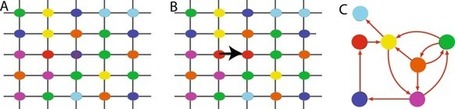
It discusses how a handful of simple and quantifiable features of human networks yield enormous insight into why we behave the way we do.   Two threads are interwoven: why human networks have special features, and how those features determine our power, opinions, opportunities, behaviors, and accomplishments.  Some of the topics included are:  the different ways in which a person’s position in a network determines their influence;  which systematic errors we make when forming opinions based on what we learn from our friends; how financial contagions work and why are they different from the spread of a flu; how splits in our social networks feed inequality, immobility, and polarization; and how network patterns of trade and globalization are changing international conflict and wars.
The book is non-technical, with no equations but many pictures, and is full of rich examples and…

View original post 30 more words

infed.org | Chris Argyris: theories of action, double-loop learning and organizational learning

Source: infed.org | Chris Argyris: theories of action, double-loop learning and organizational learning


Picture: Double loop learning by Boris Drenec. Sourced from Flickr and reproduced under a Attribution-NonCommercial-ShareAlike 2.0 Generic (CC BY-NC-SA 2.0) licence.

Chris Argyris: theories of action, double-loop learning and organizational learning. The work of Chris Argyris (1923-2013) has influenced thinking about the relationship of people and organizations, organizational learning and action research. Here we examine some key aspects of his thinking.

contentsintroduction · life · theories of action: theory in use and espoused theory · single-loop and double-loop learning · model I and model II · organizational learning · conclusion · further reading and references · links · cite

Chris Argyris has made a significant contribution to the development of our appreciation of organizational learning, and, almost in passing, deepened our understanding of experiential learning. On this page we examine the significance of the models he developed with Donald Schön of single-loop and double-loop learning, and how these translate into contrasting models of organizational learning systems.

Life

Chris Argyris was born in Newark, New Jersey on July 16, 1923 and grew up in Irvington, New Jersey. During the Second World War he joined the Signal Corps in the U.S. Army eventually becoming a Second Lieutenant (Elkjaer 2000). He went to university at Clark, where he came into contact with Kurt Lewin (Lewin had begun the Research Center for Group Dynamics at M.I.T.). He graduated with a degree in Psychology (1947). He went on to gain an MA in Psychology and Economics from Kansas University (1949), and a Ph.D. in Organizational Behavior from Cornell University (he was supervised by William F. Whyte) in 1951. In a distinguished career Chris Argyris has been a faculty member at Yale University (1951-1971) where he served as the Beach Professor of Administrative Science and Chairperson of the department; and the James Bryant Conant Professor of Education and Organizational Behavior at Harvard University (1971- ). As well as making a significant contribution to the literature Chris Argyris was known as a dedicated and committed teacher. Argyris was also a director of the Monitor Company in Cambridge, Massachusetts.

Chris Argyris enjoyed the outdoors – and, in particular hiking (especially in the mountains of New Hampshire and across New England). He is reported as saying that his best thinking was done while taking long walks (which he did daily upto a year before his death). He died peacefully surrounded by his family, on Saturday, November 16, 2013 (Boston Globe 2013).

Chris Argyris’ early research explored the impact of formal organizational structures, control systems, and management on individuals (and how they responded and adapted to them). This research resulted in the books Personality and Organization (1957) and Integrating the Individual and the Organization (1964). He then shifted his focus to organizational change, in particular exploring the behaviour of senior executives in organizations (Interpersonal Competence and Organizational Effectiveness, 1962; Organization and Innovation, 1965). From there he moved onto a particularly fruitful inquiry into the role of the social scientist as both researcher and actor (Intervention Theory and Method, 1970; Inner Contradictions of Rigorous Research, 1980 and Action Science, 1985 – with Robert Putnam and Diana McLain Smith). Much of the focus on this page lies with his fourth major area of research and theorizing – in significant part undertaken with Donald Schön – around individual and organizational learning. Here the interest lies in the extent to which human reasoning, not just behaviour, can become the basis for diagnosis and action (Theory in Practice, 1974 ; Organizational Learning, 1978; Organizational Learning II, 1996 – all with Donald Schön). He has also developed this thinking in Overcoming Organizational Defenses (1990), Knowledge for Action (1993).

As well as writing and researching, Chris Argyris has been an influential teacher. This is how Peter Senge (1990: 182-3) talks about his own experience of Argyris as a teacher.

Despite having read much of his writing, I was unprepared for what I learned when I first saw Chris Argyris practice his approach in an informal workshop… Ostensibly an academic presentation of Argyris’s methods, it quickly evolved into a powerful demonstration of what action science practitioners call ‘reflection in action’…. Within a matter of minutes, I watched the level of alertness and ‘presentness’ of the entire group rise ten notches – thanks not so much to Argyris’s personal charisma, but to his skilful practice of drawing out… generalizations. As the afternoon moved on, all of us were led to see (sometimes for he first time in our lives) subtle patterns of reasoning which underlay our behaviour; and how those patterns continually got us into trouble. I had never had such a dramatic demonstration of own mental models in action… But even more interesting, it became clear that, with proper training, I could become much more aware of my mental models and how they operated. This was exciting.

The ability, demonstrated here, to engage with others, to make links with the general and the particular, and to explore basic orientations and values is just what Argyris talks about when exploring the sorts of behaviours and beliefs that are necessary if organizations are to learn and develop.

Theories of action: theory in use and espoused theory

Our starting point is Argyris and Schön’s (1974) argument that people have mental maps with regard to how to act in situations. This involves the way they plan, implement and review their actions. Furthermore, they assert that it is these maps that guide people’s actions rather than the theories they explicitly espouse. What is more, fewer people are aware of the maps or theories they do use (Argyris, 1980). One way of making sense of this is to say that there is split between theory and action. However, Argyris and Schön suggest that two theories of action are involved.

The notion of a theory of action can be seen as growing out of earlier research by Chris Argyris into the relationships between individuals and organizations (Argyris 1957, 1962, 1964). A theory of action is first a theory: ‘its most general properties are properties that all theories share, and the most general criteria that apply to it – such as generality, centrality and simplicity – are criteria applied to all theories’ (Argyris and Schön 1974: 4). The distinction made between the two contrasting theories of action is between those theories that are implicit in what we do as practitioners and managers, and those on which we call to speak of our actions to others. The former can be described as theories-in-use. They govern actual behaviour and tend to be tacit structures. Their relation to action ‘is like the relation of grammar-in-use to speech; they contain assumptions about self, others and environment – these assumptions constitute a microcosm of science in everyday life’ (Argyris & Schön 1974: 30). The words we use to convey what we, do or what we would like others to think we do, can then be called espoused theory.

When someone is asked how he would behave under certain circumstances, the answer he usually gives is his espoused theory of action for that situation. This is the theory of action to which he gives allegiance, and which, upon request, he communicates to others. However, the theory that actually governs his actions is this theory-in-use. (Argyris and Schön 1974: 6-7)

Making this distinction allows us to ask questions about the extent to which behaviour fits espoused theory; and whether inner feelings become expressed in actions. In other words, is there congruence between the two? Argyris (1980) makes the case that effectiveness results from developing congruence between theory-in-use and espoused theory. For example, in explaining our actions to a colleague we may call upon some convenient piece of theory. We might explain our sudden rush out of the office to others, or even to ourselves at some level, by saying that a ‘crisis’ had arisen with one of ‘our’ clients. The theory-in-use might be quite different. We may have become bored and tired by the paper work or meeting and felt that a quick trip out to an apparently difficult situation would bring welcome relief. A key role of reflection, we could argue, is to reveal the theory-in-use and to explore the nature of the ‘fit’. Much of the business of supervision, where it is focused on the practitioner’s thoughts, feelings and actions, is concerned with the gulf between espoused theory and theory-in-use or in bringing the later to the surface. This gulf is no bad thing. If it gets too wide then there is clearly a difficulty. But provided the two remain connected then the gap creates a dynamic for reflection and for dialogue.

To fully appreciate theory-in-use we require a model of the processes involved. To this end Argyris and Schön (1974) initially looked to three elements:

Governing variables: those dimensions that people are trying to keep within acceptable limits. Any action is likely to impact upon a number of such variables – thus any situation can trigger a trade-off among governing variables.

Action strategies: the moves and plans used by people to keep their governing values within the acceptable range.

Consequences: what happens as a result of an action. These can be both intended – those actor believe will result – and unintended. In addition those consequences can be for the self, and/or for others. (Anderson 1997)

Where the consequences of the strategy used are what the person wanted, then the theory-in-use is confirmed. This is because there is a match between intention and outcome. There may be a mismatch between intention and outcome. In other words, the consequences may be unintended. They may also not match, or work against, the person’s governing values. Argyris and Schön suggest two responses to this mismatch, and these are can be seen in the notion of single and double-loop learning.

Single-loop and double-loop learning

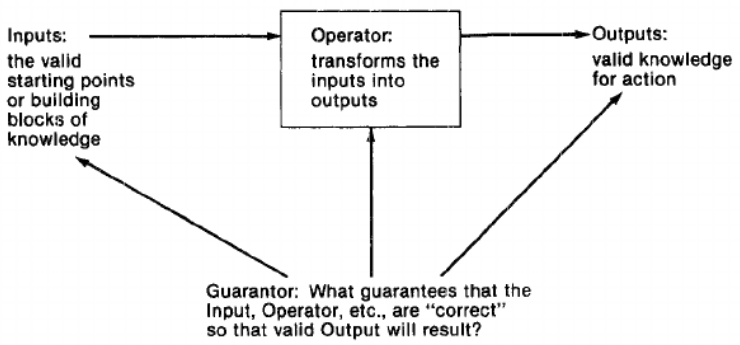
For Argyris and Schön (1978: 2) learning involves the detection and correction of error. Where something goes wrong, it is suggested, an initial port of call for many people is to look for another strategy that will address and work within the governing variables. In other words, given or chosen goals, values, plans and rules are operationalized rather than questioned. According to Argyris and Schön (1974), this is single-loop learning. An alternative response is to question to governing variables themselves, to subject them to critical scrutiny. This they describe as double-loop learning. Such learning may then lead to an alteration in the governing variables and, thus, a shift in the way in which strategies and consequences are framed. Thus, when they came to explore the nature of organizational learning. This is how Argyris and Schön (1978: 2-3) described the process in the context of organizational learning:

When the error detected and corrected permits the organization to carry on its present policies or achieve its presents objectives, then that error-and-correction process is single-loop learning. Single-loop learning is like a thermostat that learns when it is too hot or too cold and turns the heat on or off. The thermostat can perform this task because it can receive information (the temperature of the room) and take corrective action. Double-loop learning occurs when error is detected and corrected in ways that involve the modification of an organization’s underlying norms, policies and objectives.

Single-loop learning seems to be present when goals, values, frameworks and, to a significant extent, strategies are taken for granted. The emphasis is on ‘techniques and making techniques more efficient’ (Usher and Bryant: 1989: 87) Any reflection is directed toward making the strategy more effective. Double-loop learning, in contrast, ‘involves questioning the role of the framing and learning systems which underlie actual goals and strategies (op. cit.). In many respects the distinction at work here is the one used by Aristotle, when exploringtechnical andpractical thought. The former involves following routines and some sort of preset plan – and is both less risky for the individual and the organization, and affords greater control. The latter is more creative and reflexive, and involves consideration notions of the good. Reflection here is more fundamental: the basic assumptions behind ideas or policies are confronted… hypotheses are publicly tested… processes are disconfirmable not self-seeking (Argyris 1982: 103-4).

The focus of much of Chris Argyris’ intervention research has been to explore how organizations may increase their capacity for double-loop learning. He argues that double-loop learning is necessary if practitioners and organizations are to make informed decisions in rapidly changing and often uncertain contexts (Argyris 1974; 1982; 1990). As Edmondson and Moingeon (1999:160) put it:

The underlying theory, supported by years of empirical research, is that the reasoning processes employed by individuals in organizations inhibit the exchange of relevant information in ways that make double-loop learning difficult – and all but impossible in situations in which much is at stake. This creates a dilemma as these are the very organizational situations in which double-loop learning is most needed.

The next step that Argyris and Schön take is to set up two models that describe features of theories-in-use that either inhibit or enhance double-loop learning. The belief is that all people utilize a common theory-in-use in problematic situations. This they describe as Model I – and it can be said to inhibit double-loop learning. Model II is where the governing values associated with theories-in-use enhance double-loop learning.

Model I and Model II

Argyris has claimed that just about all the participants in his studies operated from theories-in-use or values consistent with Model I (Argyris et al. 1985: 89). It involves ‘making inferences about another person’s behaviour without checking whether they are valid and advocating one’s own views abstractly without explaining or illustrating one’s reasoning’ (Edmondson and Moingeon 1999:161). The theories-in-use are shaped by an implicit disposition to winning (and to avoid embarrassment). The primary action strategy looks to the unilateral control of the environment and task plus the unilateral protection of self and others. As such Model I leads to often deeply entrenched defensive routines (Argyris 1990; 1993) – and these can operate at individual, group and organizational levels. Exposing actions, thoughts and feelings can make people vulnerable to the reaction of others. However, the assertion that Model I is predominantly defensive has a further consequence:

Acting defensively can be viewed as moving away from something, usually some truth about ourselves. If our actions are driven by moving away from something then our actions are controlled and defined by whatever it is we are moving away from, not by us and what we would like to be moving towards. Therefore our potential for growth and learning is seriously impaired. If my behaviour is driven by my not wanting to be seen as incompetent, this may lead me to hide things from myself and others, in order to avoid feelings of incompetence. For example, if my behaviour is driven by wanting to be competent, honest evaluation of my behaviour by myself and others would be welcome and useful. (Anderson 1997)

It is only by interrogating and changing the governing values, the argument goes, is it possible to produce new action strategies that can address changing circumstances.

Chris Argyris looks to move people from a Model I to a Model II orientation and practice – one that fosters double-loop learning. He suggests that most people, when asked, will espouse Model II. As Anderson (1997) has commented, Argyris offers no reason why most people espouse Model II. In addition, we need to note that the vast bulk of research around the models has been undertaken by Argyris or his associates.

Exhibit 1: Model I theory-in-use characteristics


The governing Values of Model I are:

Achieve the purpose as the actor defines it

Win, do not lose

Suppress negative feelings

Emphasize rationality

Primary Strategies are:

Control environment and task unilaterally

Protect self and others unilaterally

Usually operationalized by:

Unillustrated attributions and evaluations e.g.. “You seem unmotivated”

Advocating courses of action which discourage inquiry e.g.. “Lets not talk about the past, that’s over.”

Treating ones’ own views as obviously correct

Making covert attributions and evaluations

Face-saving moves such as leaving potentially embarrassing facts unstated

Consequences include:

Defensive relationships

Low freedom of choice

Reduced production of valid information

Little public testing of ideas

Taken from Argyris, Putnam & McLain Smith (1985, p. 89)


The significant features of Model II include the ability to call upon good quality data and to make inferences. It looks to include the views and experiences of participants rather than seeking to impose a view upon the situation. Theories should be made explicit and tested, positions should be reasoned and open to exploration by others. In other words, Model II can be seen as dialogical – and more likely to be found in settings and organizations that look toshared leadership. It looks to:

Emphasize common goals and mutual influence.

Encourage open communication, and to publicly test assumptions and beliefs.

Combine advocacy with inquiry (Argyris and Schön 1996; Bolman and Deal 1997: 147-8).

We can see these in the table below.


Exhibit 2: Model II characteristics


The governing values of Model II include:

Valid information

Free and informed choice

Internal commitment

Strategies include:

Sharing control

Participation in design and implementation of action

Operationalized by:

Attribution and evaluation illustrated with relatively directly observable data

Surfacing conflicting view

Encouraging public testing of evaluations

Consequences should include:

Minimally defensive relationships

High freedom of choice

Increased likelihood of double-loop learning

Taken from Anderson 1997


As Edmondson and Moingeon (1999:162) comment, employing Model II in difficult interpersonal interactions ‘requires profound attentiveness and skill for human beings socialized in a Model I world’. While they are not being asked to relinquish control altogether, they do need to share that control.

Organizational learning

Chris Argyris and Donald Schön suggest that each member of an organization constructs his or her own representation or image of the theory-in-use of the whole (1978: 16). The picture is always incomplete – and people, thus, are continually working to add pieces and to get a view of the whole. They need to know their place in the organization, it is argued.

An organization is like an organism each of whose cells contains a particular, partial, changing image if itself in relation to the whole. And like such an organism, the organization’s practice stems from those very images. Organization is an artifact of individual ways of representing organization.

Hence, our inquiry into organizational learning must concern itself not with static entities called organizations, but with an active process of organizing which is, at root, a cognitive enterprise. Individual members are continually engaged in attempting to know the organization, and to know themselves in the context of the organization. At the same time, their continuing efforts to know and to test their knowledge represent the object of their inquiry. Organizing is reflexive inquiry….

[Members] require external references. There must be public representations of organizational theory-in-use to which individuals can refer. This is the function of organizational maps. These are the shared descriptions of the organization which individuals jointly construct and use to guide their own inquiry….

Organizational theory-in-use, continually constructed through individual inquiry, is encoded in private images and in public maps. These are the media of organizational learning. (Argyris and Schön 1978: 16-17)

With this set of moves we can see how Chris Argyris and Donald Schön connect up the individual world of the worker and practitioner with the world of organization. Their focus is much more strongly on individual and group interactions and defenses than upon systems and structures (we could contrast their position with that of Peter Senge 1990, for example). By looking at the way that people jointly construct maps it is then possible to talk about organizational learning (involving the detection and correction of error) and organizational theory-in-use. For organizational learning to occur, ‘learning agents’, discoveries, inventions, and evaluations must be embedded in organizational memory’ (Argyris and Schön 1978: 19). If it is not encoded in the images that individuals have, and the maps they construct with others, then ‘the individual will have learned but the organization will not have done so’ (op. cit.).

In this organizational schema single-loop learning is characterized as when, ‘members of the organization respond to changes in the internal and external environment of the organization by detecting errors which they then correct so as to maintain the central features of theory-in-use’ (ibid.: 18). Double-loop learning then becomes:

… those sorts of organizational inquiry which resolve incompatible organizational norms by setting new priorities and weightings of norms, or by restructuring the norms themselves together with associated strategies and assumptions. (Argyris and Schön 1978: 18)

The next step is to argue that individuals using Model I create Organizational I (O-I) learning systems. These are characterized by ‘defensiveness, self-fulfilling prophecies, self-fuelling processes, and escalating error’ (Argyris 1982: 8). O-I systems involve a web of feedback loops that ‘make organizational assumptions and behavioural routines self-reinforcing – inhibiting “detection and correction of error” and giving rise to mistrust, defensiveness and self-fulfilling prophecy’ (Edmondson and Moingeon 1999:161). In other words, if individuals in an organization make use of Model I learning the organization itself can begin to function in ways that act against its long-term interests. Indeed, in a very real sense systems can begin to malfunction. As Argyris and Schön (1996: 28) put it, ‘The actions we take to promote productive organizational learning actually inhibit deeper learning’. The challenge is, then, to create a rare phenomenon – an Organizational II (O-II) learning system.

Here we come to the focus of organizational effort – the formulation and implementation of an intervention strategy. This, according to Argyris and Schön (1978: 220-1) involves the ‘interventionist’ in moving through six phases of work:


Phase 1 Mapping the problem as clients see it. This includes the factors and relationships that define the problem, and the relationship with the living systems of the organization.
Phase 2 The internalization of the map by clients. Through inquiry and confrontation the interventionists work with clients to develop a map for which clients can accept responsibility. However, it also needs to be comprehensive.
Phase 3 Test the model. This involves looking at what ‘testable predictions’ can be derived from the map – and looking to practice and history to see if the predictions stand up. If they do not, the map has to be modified.
Phase 4 Invent solutions to the problem and simulate them to explore their possible impact.
Phase 5 Produce the intervention.
Phase 6 Study the impact. This allows for the correction of errors as well as generating knowledge for future designs. If things work well under the conditions specified by the model, then the map is not disconfirmed.


By running through this sequence and attending to key criteria suggested by Model II, it is argued, organizational development is possible. The process entails looking for the maximum participation of clients, minimizing the risks of candid participation, starting where people want to begin (often with instrumental problems), and designing methods so that they value rationality and honesty.

Conclusion

How are we to evaluate these models and line of argument? First, we can say that while there has been a growing research base concerning the models and interventionist strategy, it is still limited – and people sympathetic to the approach have largely undertaken it. However, asPeter Senge’s experience (recounted at the top of the page) demonstrates, the process and the focus on reflection-in-action does appear to bear fruit in terms of people’s connection with the exercise and their readiness to explore personal and organizational questions.

Second, it is assumed that ‘good’ learning ‘takes place in a climate of openness where political behaviour is minimized’ (Easterby-Smith and Araujo 1999: 13). This is an assumption that can be questioned. It could be argued that organizations are inherently political – and that it is important to recognize this. Organizations can be seen as coalitions of various individuals and interest groups. ‘Organizational goals, structure and policies emerge from an ongoing process of bargaining and negotiation among major interest groups’ Bolman and Deal 1997: 175). Thus, perhaps we need to develop theory that looks to the political nature of structures, knowledge and information. Here we might profitably look to games theory, the contribution of partisan and political institutions (Beem 1999) and an exploration of how managers can make explicit, and work with, political processes (Coopey 1998). Perhaps the aim should be ‘to incorporate politics into organizational learning, rather than to eradicate it’ (Easterby-Smith and Araujo 1999: 13).

Third, and this might be my prejudice, I think we need to be distrustful of bipolar models like Model I and Model II. They tend to set up an ‘either-or’ orientation. They are useful as teaching or sensitizing devices, alerting us to different and important aspects of organizational life, but the area between the models (and beyond them) might well yield interesting alternatives.

Fourth, the interventionist strategy is staged or phased – and this does bring with it some problems. Why should things operate in this order. Significantly, this does highlight a tension between Argyris’s orientation and that of Schön (1983). Schön in his later work on reflection-in-action draws on his pragmatist heritage (and especially the work of Dewey) and presents the making of theory-in-action and the expression of professional artistry in a far less linear fashion. Rather than there being phases, we could argue that intervention of this kind involves a number of elements or dimensions working at once.

This said, the theorizing of theory-in-action, the educative power of the models, and the conceptualization of organizational learning have been, and continue to be, significant contributions to our appreciation of processes in organizations. The notion of ‘double-loop learning’ does help us to approach some of the more taken-for-granted aspects of organizations and experiences. It provides us with a way of naming a phenomenon (and problem), and a possible way of ‘learning our way out’ (Finger and Asún 2000). Argyris and Schön have made a significant contribution to pragmatic learning theory (following in the line of Dewey 1933; Lewin 1948, 1951; and Kolb 1984). First, by introducing the term ‘theory’ or ‘theory in action’, ‘they provide the function of abstract conceptualization (see experiential learning) ‘more structure and more coherence’ (Finger and Asún 2000: 45). Abstract conceptualization ‘becomes something one can analyze and work from’ (op. cit.). Second, through the notion of ‘learning-in-action’ Argyris and Schön rework the experiential learning cycle.

Unlike Dewey’s, Lewin’s or Kolb’s learning cycle, where one had, so to speak, to make a mistake and reflect upon it – that is, learn by trial and error – it is now possible thanks to Argyris and Schön’s conceptualization, to learn by simply reflecting critically upon the theory-in-action. In other words, it is no longer necessary to go through the entire learning circle in order to develop the theory further. It is sufficient to readjust the theory through double-loop learning. (Finger and Asún 2000: 45-6)

This is a very significant development and has important implications for educators. In theexperiential learning model of Kolb (1984) the educator is in essence a facilitator of a person’s learning cycle. To this role can be added that of teacher, coach or mentor, the person who ‘helps individuals (managers, professionals, workers) to reflect upon their theories-in-action’ (Finger and Asún 2000: 46). It is a significant development – but it has gone largely unnoticed in the adult education and lifelong learning fields. This is a result, in part, of rather blinkered reading by professionals and academics within that area, and because Argyris and Schön did not address, to any significant degree, the arena directly (Argyris’s continued to focus on organization and management, and Schön’s on professional thinking).

Further reading and references

Argyris, M. and Schön, D. (1974) Theory in Practice. Increasing professional effectiveness, San Francisco: Jossey-Bass. Landmark statement of ‘double-loop’ learning’ and distinction between espoused theory and theory-in-action.

Argyris, C., & Schön, D. (1978) Organizational learning: A theory of action perspective, Reading, Mass: Addison Wesley.

Argyris, C., Putnam, R., & McLain Smith, D (1985) Action ScienceConcepts, methods, and skills for research and intervention, San Francisco: Jossey-Bass. [The entire book is available for download from: Action Design: http://www.actiondesign.com/action_science/index.htm].

Argyris, C. (1993) Knowledge for Action. A guide to overcoming barriers to organizational change, San Francisco: Jossey Bass.

References

Anderson, L. (1997) Argyris and Schön’s theory on congruence and learning [On line]. Available at http://www.scu.edu.au/schools/gcm/ar/arp/argyris.html.

Argyris, C. (1957) Personality and Organization, New York: Harper Collins.

Argyris, C. (1962) Interpersonal Competence and Organizational Effectiveness, Homewood, Ill.: Dorsey Press.

Argyris, C. (1964) Integrating the Individual and the Organization, New York: Wiley.

Argyris, C. (1965) Organization and Innovation, Homewood, Ill. : R. D. Irwin.

Argyris, C. (1970) Intervention Theory and Method: A behavioral science view, Reading, Mass.: Addison Wesley.

Argyris, C. (1974) Behind the front page, San Francisco: Jossey Bass.

Argyris, C. (1976) Increasing leadership effectiveness, New York: Wiley-Interscience.

Argyris, C. (1980) Inner contradictions of rigorous research, New York: Academic Press.

Argyris, C. (1982) Reasoning, learning, and action: Individual and organizational, San Francisco: Jossey-Bass

Argyris, C. (1985) Strategy, change & defensive routines, Boston: Pitman.

Argyris, C. (1985) Action ScienceConcepts, methods, and skills for research and intervention, San Francisco: Jossey-Bass

Argyris, C. (1987) Reasoning, action strategies, and defensive routines: The case of OD practitioners, in Woodman, R. A. & Pasmore, A.A. (eds.), Research in organizational change and developmentVolume 1, Greenwich: JAI Press.

Argyris, C. (1990) Overcoming Organizational Defenses. Facilitating organizational learning, Boston: Allyn and Bacon.

Argyris, C. (1991) Teaching smart people how to learn. Harvard Business Review, May-June.

Argyris, C. (1993) Knowledge for Action. A guide to overcoming barriers to organizational change, San Francisco: Jossey Bass.

Argyris, C. and Schön, D. (1974) Theory in practice: Increasing professional effectiveness, San Francisco: Jossey-Bass.

Argyris, C., & Schön, D. (1978) Organizational learning: A theory of action perspective, Reading, Mass: Addison Wesley.

Argyris, C. and Schön, D. (1996) Organizational learning II: Theory, method and practice, Reading, Mass: Addison Wesley.

Argyris, C., Putnam, R., & McLain Smith, D. (1985) Action science: concepts, methods, and skills for research and intervention, San Francisco: Jossey-Bass.

Beem, C. (1999) The Necessity of Politics. Reclaiming American public life, Chicago: University of Chicago Press.

Boston Globe (2013). Chris Argyris – Obituary. Boston Globe. November 18 [http://www.legacy.com/obituaries/bostonglobe/obituary.aspx?n=chris-argyris&pid=168078121&fhid=15200]

Bulman, L. G. and Deal, T. E. (1997) Reframing Organizations. Artistry, choice and leadership, San Francisco: Jossey-Bass.

.Coopey, J. (1998) ‘Learning to trust and trusting to learn: a role for radical theatre’ Management Learning 29(3): 365-82.

Dewey, J. (1933) How We Think. A restatement of the relation of reflective thinking to the educative process (Revised edn.), Boston: D. C. Heath.

Easterby-Smith, M. and Araujo, L. ‘Current debates and opportunities’ in M. Easterby-Smith, L. Araujo and J. Burgoyne (eds.) Organizational Learning and the Learning Organization, London: Sage.

Edmondson, A. and Moingeon, B. (1999) ‘Learning, trust and organizational change’ in M. Easterby-Smith, L. Araujo and J. Burgoyne (eds.) Organizational Learning and the Learning Organization, London: Sage.

Finger, M. and Asún, M. (2000) Adult Education at the Crossroads. Learning our way out, London: Zed Books.

Kolb, D. A. (1984) Experiential Learning. Experience as the source of learning and development, Englewood Cliffs, New Jersey: Prentice Hall.

Lewin, K. (1948) Resolving Social Conflicts. Selected papers on group dynamics, New York: Harper and Row.

Lewin, K. (1951) Field Theory in Social Science, New York: Harper and Row.

Senge, P. (1990) The Fifth Discipline. The art and practice of the learning organization, London: Random House.

Schön, D. A. (1983) The Reflective Practitioner. How professionals think in action, London: Temple Smith.

Usher, R. and Bryant, I. (1989) Adult Education as Theory, Practice and Research, London: Routledge.

Links

An interview with Chris Argyris – includes discussion of model I and model II organizations. (from Thought Leaders)

Action Science Network – includes an outline of action science (and model I and model II) and a detailed bibliography of Argyris¢¢ work.

Chris Argyris – useful, short biography by Bente Elkjaer

Chris Argyris – brief biography from Harvard Business Review.

Good communication that blocks learning – article by Argyris for Harvard Business Review, 1994

Motivation Theory article reviewing Argyris’ concern with increasing interpersonal competence.

Chris Argyris – Page from the Monitor Group (where Argyris is a director) with links to some of his publications.

Acknowledgements: Picture: Double loop learning by Boris Drenec. Sourced from Flickr and reproduced under a Attribution-NonCommercial-ShareAlike 2.0 Generic (CC BY-NC-SA 2.0) licence. http://www.flickr.com/photos/_boris/2818214746/.

How to cite this article: Smith, M. K. (2001, 2013). ‘Chris Argyris: theories of action, double-loop learning and organizational learning’, the encyclopedia of informal education. [http://infed.org/mobi/chris-argyris-theories-of-action-double-loop-learning-and-organizational-learning/. Retrieved: insert date]

© Mark K. Smith 2001, 2013

Kevin Kelly: The Nine Laws of God – The Corner


Source: Kevin Kelly: The Nine Laws of God – The Corner

HURSDAY, APRIL 23, 2009

Competence in Complexity – programme 25-26 April 2019, Scotland – International Futures Forum Academy

Source: Competence in Complexity


Competence in Complexity

Next running of the programme:
25-26 April 2019
Click for details
This programme offers a process to develop the 21st century competencies in participants and to demonstrate them in practice.

The curriculum is designed around three modules, typically of two days each.  There is scope to vary this pattern for something more or less intensive (for example, we also offer a condensed three day programme) and to extend it after the third module to provide greater support for the implementation of culture-shifting, transformative initiatives.

The programme is based on the book Dancing at the Edge:  Competence, Culture and Organisation in the 21st Century

Dancing at the Edge takes a distinctive stand in relation to competence.

  • We follow the OECD definition that competence is not an abstract achievement but “the ability to meet important challenges in life in a complex world”;
  • This is not a capacity of the individual.  Our competence is always demonstrated in a human system, in a culture, in a pattern of relationships. It is impossible to be competent alone;
  • Competencies are qualities of persons as a whole.  They cannot be distinguished one from another, developed in isolation and mastered one stage at a time.

The 21st century competencies are innate – but they require the right setting to show themselves and a supportive environment in which to develop.

We know that these competencies exist because we have seen them demonstrated in practice by the ‘persons of tomorrow’ all around us.

In tune with the underlying ethos of Dancing at the Edge, the programme offers all participants an opportunity to explore and develop their 21st century competencies in practice.  It offers a framework for mutual exploration, or – as the book has it – a ‘rehearsal space’.  It is an ‘experiment’ in the sense that life itself is an experiment – an opportunity for learning in the presence of others as abstract plans meet complex reality.

The flow of the programme starts with a first module (‘Awareness’) bringing to conscious awareness three ‘threshold competencies’ – which facilitate access to all the others.  We also call these ‘literacies’ since they are ways of reading the complex landscape – both within ourselves, our interactions with others and with the wider world.  These 21st century literacies are:  psychological literacy, cultural literacy and knowledge literacy (which includes knowledge in relation to the future).

The promise of this first module is to develop conscious capacity in all three of these domains – leaving participants less prone to overwhelm and to sub-optimal responses to a complex operating environment (at work, at home, in society at large).  Like Federer playing tennis, participants will leave feeling that they have more time on the ball.  They also leave with a sense of their own emerging 21stcentury competencies (their ‘edge’) and a plan to develop them.

The second module (‘Tuning Up’) deepens experience of these new literacies in practice and explores the qualities of being in the world that are associated with the 21st century competencies and demonstrated by persons of tomorrow, especially in groups and organisations.  The module includes a series of experiential sessions and practices designed to bring these qualities to awareness and foster their development.  It concludes by raising our awareness of the future potential of the present moment – as a bridge towards action that will help to bring about the future we desire.

The promise of the second module is to develop qualities of being in the contemporary world that will maintain health, balance, effectiveness and hope, tuning up these qualities of persons of tomorrow in readiness to take on ‘an important challenge in life’ to express the 21st century competences in practice.

The third module (‘Doing’) involves exploring an important professional challenge in the context of the participant’s work and organisation.  The module includes a structure to support and coach effective learning over time in the delivery of a culture-shifting initiative (‘a small act of creative transgression’).

The promise of the third module is that people will leave with the design of an initiative and a first step to take on the journey to demonstrate and expand their 21stcentury competencies in practice and deliver transformative results.  It is the accumulation of many such initiatives over time that will transform organisational culture, ambition and performance.

Some participants may opt to enrol in our Capability Accelerator following the third module – a process of peer-supported action learning to consolidate and deepen their learning through delivering a transformative initiative and exceptional results in their professional context.

Enquire about participation in a Competence in Complexity programme


The fruit salad maker; it’s an interdisciplinary tale

The Möbius Stripper's avatarAbeba Birhane

Multidisciplinary = the fruit bowl (single disciplines brought together) Interdisciplinary = a fruit salad (combine disciplines together for one output) Transdisciplinary = the smoothie (disciplines transformed-new). EU EnRRICH project

fruit saladEU EnRRICH project

A young fruit enthusiast wanted to make a fruit salad. Seeing that so many different fruit suppliers bring all sorts of fruit to her fruit bar, and many customers in return buy individual fruits, she thought she’d make something that each fruit supplier doesn’t produce by combining their supplies – a fruit salad. Besides, there seems to be a great deal of excitement over this new mixing of various fruits and everybody seems to want and encourage it.

Having sampled many different fruits over the years, the fruit salad maker decided it is a good use of her time and expertise to get into the fruit salad making business. She decided on mango, kiwi and pineapple as her…

View original post 1,018 more words

Kettering Review Winter 2019 | Kettering Foundation

Elinor Ostrom and John McKnight!

Source: Kettering Review Winter 2019 | Kettering Foundation


Kettering Review Winter 2019

Full Description

Public goods are often seen as the domain of institutions and experts.  This issue of the Review considers matters a little differently. How might formal public institutions work with informal publics?  How can organizations and institutions align themselves with the work of a democratic citizenry to foster a better functioning democracy? These simple questions form the backbone of this issue of the Kettering Review.

The Kettering Review is a journal of ideas and activities dedicated to improving the quality of public life in American democracy. The Review is edited by Noëlle McAfee and Nicholas A. Felts.


CLICK HERE to have Kettering Review delivered to your doorstep annually.


Item Details

Page Count:
46
Published Date:
2019
Product Language:
English
Editors’ Letter by Noëlle McAfee, Nicholas A. Felts  ( PDF )
Covenanting, Coproducing, and the Good Society by Elinor Ostrom  ( PDF )
What Is a Democratic Professional? by Albert W. Dzur  ( PDF )
A History of the Asset-Based Community Development Institute: Unintentionally Creating a Movement by John McKnight  ( PDF )
Public Things: Democracy in Disrepair by Bonnie Honig  ( PDF )
Civic Networks: An Interview with Lewis Friedland by Noëlle McAfee  ( PDF )
A Question of Culture by David Mathews  ( PDF )

Opportunities to experience the power+systems workshop – in person in June (Brighton, UK) and innovative ‘webinar’ sessions in April

John Watters, the man behind these opportunities, is the person who has done more than anyone, I think, to bring Barry Oshry’s power+systems work and insights to the UK.

There are three opportunities to understand this deeply experiential theory – two of them innovative, short online sessions, timed for people in most of the world to be able to join – and one in the UK for a full day in person:

Webinars on Wed 3 April:

07:30-09:30 British Summer Time: https://www.eventbrite.co.uk/e/empowering-the-whole-system-distributed-leadership-in-action-tickets-57676664456

15:00-17:00 BST Empowering the Whole System – Distributed Leadership in Action Tickets, Wed 3 Apr 2019 at 15:00 | Eventbrite

In person Friday 14 June 2019

https://www.eventbrite.co.uk/e/leadership-a-systems-view-barry-oshrys-organisation-workshop-tickets-52935428291?aff=ebapi


Blurb below is from the ‘webinar’ version – click the links above for prices, more info, and to book.


Empowering the Whole System – Distributed Leadership in Action

Discover the power of Barry Oshry’s work
See how context shapes behaviour
Lead with systems insight

Barry Oshry‘s powerful work on system dynamics reveals how context shapes behaviour and consciousness – what we see, think and feel about ourselves and others.

Oshry’s work highlights that the problems we believe to be personal or interpersonal – “I’m not being effective in my role”, “If only I had a better boss, things would be OK”,”We’re not a good team“ – are not primarily personal problems. The workshop illuminates how our blindness to contextkills trust, increases blame, corrodes potentially supportive and productive relationships and stops us from making a reality of distributed leadership.

This facilitated online workshop uses an experiential simulation to briefly immerse people in three leadership contexts that we encounter every day. We explore how we blindly fall into limiting patterns of behaviour and we highlight the empowering actions that are possible in each context. Distributed leadership sees an organisation as an interconnected whole where each part has unique power to contribute to the survival and vitality of the system. Oshry’s work throws new light on what constrains and enables distributed leadership.

What can you expect?

  • An engaging and thought-provoking workshop.
  • Experiential work and dialogue with some of the world’s leading practitioners of this approach.
  • Identifying next steps to deepen your systems leadership

By the end of the workshop you will:

  • Understand the impact of context on leadership behaviours and actions.
  • Gain new insights into how to make distributed leadership a reality.
  • Have tasted the breadth and depth of Barry Oshry’s work.

Who is leading the workshop?

John Watters is one of the leading authorities on Barry Oshry’s systems leadership work having worked closely with Barry Oshry for 20 years. John uses this framework in his consulting work with organisations of all sizes and sectors across the world. He specialises in working with complex challenges that involve multiple stakeholders; creating the conditions for fundamental shifts in performance and realising personal and organisational purpose. John is Managing Director of Living Leadership, Associate of Future Considerations and Senior Associate of Power+Systems.

Ali Warner is an Associate of Future Considerations and Living Leadership, and an experienced trainer in all of Barry Oshry’s frameworks. She specialises in arts-based facilitation practices including graphic harvesting, creating eye-catching hosting materials and leading voice & body work, which she offers in a wide range of contexts from large organisations to community groups. She also performs as a singer, with a particular focus on traditional song and experimental free improvisation.

Julie Beedon is Director of JBVista, an accredited trainer in the Organisation Workshop and a long-time collaborator of Barry Oshry. Julie brings a passion, energy and depth of experience in applying whole systems change principles and is a pioneer in the field of working with large groups. Julie is also a Director of the NTL UK OD Certificate Programme and on the Board of ODN Europe.

For any questions, please contact: angela@futureconsiderations.com

Testimonials about the Organisation Workshop

“Insightful, moving. The best training I’ve ever taken part in.”

Emma Kenny, Head of Strategy, National Citizen Service, UK

“It’s easy to underestimate the power of Oshry’s work until you have taken this workshop. It was a life changing experience. You will find instant applications to both your personal and professional life.”

Seema Malhotra, MP for Feltham and Weston, UK

“The Organisation Workshop is an astonishing and reliable process. I’ve experienced it in several different cultures and amongst very different people. It never fails to reveal the dynamics of leadership and power in organisations that are universal.”

Margaret J, Wheatley PhD, Author, Who Do you Choose to Be?

Evolution of Complex Life – May 15-17, 2019 @GeorgiaTech

cxdig's avatarComplexity Digest

The evolution of complex life is an inherently multidisciplinary problem encompassing a wide range of topics, including:

How do new levels of the biological hierarchy evolve?
How do interactions between individual organisms contribute to complex phenotypes and behaviors?
How do social behaviors evolve?
How do evolutionary novelties emerge and evolve?
How do organisms drive geochemical cycles and how do geochemical changes influence evolution?
At this conference we will bring together scientists from different backgrounds to discuss these and other important topics about one of the most salient aspects of life: the evolution of complexity.

Source: eclife.biosci.gatech.edu

View original post

Kenneth Boulding, General Systems Theory (1956)

Source: Kenneth Boulding, General Systems Theory (1956)

Kenneth Boulding

General Systems Theory
The Skeleton of Science

(1956)


Note

This paper was written especially for Management Science, 2, 3 (Apr. 1956) pp.197-208 and was reprinted in General Systems, Yearbook of the Society for General Systems Research, vol. 1, 1956.

It presents an interesting classification of levels of systems and it elaborates on the vastness of the work that waits us if we want to push forward the scientific endeavour. For that we need not only the General Systems Theory but also a series of new concepts better capable of presenting reality in its full complexity.


General Systems Theory is a name which has come into use to describe a level of theoretical model-building which lies somewhere between the highly generalized constructions of pure mathematics and the specific theories of the specialized disciplines. Mathematics attempts to organize highly general relationships into a coherent system, a system however which does not have any necessary connections with the “real” world around us. It studies all thinkable relationships abstracted from any concrete situation or body of empirical knowledge. It is not even confined to “quantitative” relationships narrowly defined – indeed, the developments of a mathematics of quality and structure is already on the way, even though it is not as far advanced as the “classical” mathematics of quantity and number. Nevertheless because in a sense mathematics contains all theories it contains none; it is the language of theory but it does not give us the content. At the other extreme we have the separate’ disciplines and sciences, with their separate bodies of theory. Each discipline corresponds to a certain segment of the empirical world, and each develops theories which have particular applicability to its own empirical segment. Physics, chemistry, biology, psychology, sociology, economics and so on all carve out for themselves certain elements of the experience of man and develop theories and patterns of activity (research) which yield satisfaction in understanding, and which are appropriate to their special segments.In recent years increasing need has been felt for a body of systematic theoretical constructs which will discuss the general relationships of the empirical world. This is the quest of General Systems Theory. It does not seek, of course, to establish a single, self-contained “general theory of practically everything” which will replace all the special theories of particular disciplines. Such a theory would be almost without content, for we always pay for generality by sacrificing content, and all we can say about practically everything is almost nothing. Somewhere however between the specific that has no meaning and the general that has no content there must be, for each purpose and at each level of abstraction, an optimum degree of generality. It is the contention of the General Systems Theorists that this optimum degree of generality in theory is not always reached by the particular sciences. The objectives of General Systems Theory then can be set out with varying degrees of ambition and confidence. At a low level of ambition but with a high degree of confidence it aims to point out similarities in the theoretical constructions of different disciplines, where these exist, and to develop theoretical models having applicability to at least two different fields of study. At a higher level of ambition, but with perhaps a lower degree of confidence it hopes to develop something like a “spectrum” of theories – a system of systems which may perform the function of a “gestalt” in theoretical construction. Such “gestalts” in special fields have been of great value in directing research towards the gaps which they reveal. Thus the periodic table of elements in chemistry directed research for many decades towards the discovery of unknown elements to fill gaps in the table until the table was completely filled. Similarly a “system of systems” might be of value in directing the attention of theorists toward gaps in theoretical models, and might even be of value in pointing towards methods of filling them.

The need for general systems theory is accentuated by the present sociological situation in science. Knowledge is not something which exists and grows in the abstract. It is a function of human organisms and of social organization. Knowledge, that is to say, is always what somebody knows: the most perfect transcript of knowledge in writing is not knowledge if nobody knows it. Knowledge however grows by the receipt of meaningful information – that is, by the intake of messages by a knower which are capable of reorganising his knowledge. We will quietly duck the question as to what reorganizations constitute “growth” of knowledge by defining “semantic growth” of knowledge as those reorganizations which can profitably be talked about, in writing or speech, by the Right People. Science, that is to say, is what can be talked about profitably by scientists in their role as scientists. The crisis of science today arises because of the increasing difficulty of such profitable talk among scientists as a whole. Specialization has outrun Trade, communication between the disciples becomes increasingly difficult, and the Republic of Learning is breaking up into isolated subcultures with only tenuous lines of communication between them – a situation which threatens intellectual civil war. The reason for this breakup in the body of knowledge is that in the course of specialization the receptors of information themselves become specialized. Hence physicists only talk to physicists, economists to economists – worse still, nuclear physicists only talk to nuclear physicists and econometricians to econometricians. One wonders sometimes if science will not grind to a stop in an assemblage of walled-in hermits, each mumbling to himself words in a private language that only he can understand. In these days the arts may have beaten the sciences to this desert of mutual unintelligibility, but that may be merely because the swift intuitions of art reach the future faster than the plodding leg work of the scientist. The more science breaks into sub-groups, and the less communication is possible among the disciplines, however, the greater chance there is that the total growth of knowledge is being slowed down by the loss of relevant communications. The spread of specialized deafness means that someone who ought to know something that someone else knows isn’t able to find it out for lack of generalized ears.

It is one of the main objectives of General Systems Theory to develop these generalized ears, and by developing a framework of general theory to enable one specialist to catch relevant communications from others. Thus the economist who realizes the strong formal similarity between utility theory in economics and field theory in physics is probably in a better position to learn from the physicists than one who does not. Similarly a specialist who works with the growth concept – whether the crystallographer, the virologist, the cytologist, the physiologist, the psychologist, the sociologist or the economist – will be more sensitive to the contributions of other fields if he is aware of the many similarities of the growth process in widely different empirical fields.

There is not much doubt about the demand for general systems theory under one brand name or another. It is a little more embarrassing to inquire into the supply. Does any of it exist, and if so where? What is the chance of getting more of it, and if so, how? The situation might be described as promising and in ferment, though it is not wholly clear what is being promised or brewed. Something which might be called an “interdisciplinary movement” has been abroad for some time. The first signs of this are usually the development of hybrid disciplines. Thus physical chemistry emerged in the third quarter of the nineteenth century, social psychology in the second quarter of the twentieth. In the physical and biological sciences the list of hybrid disciplines is now quite long – biophysics, biochemistry, astrophysics are all well established. In the social sciences social anthropology is fairly well established, economic psychology and economic sociology are just beginning. There are signs, even, that Political Economy, which died in infancy some hundred years ago, may have a re-birth.

In recent years there has been an additional development of great interest in the form of “multisexual” interdisciplines. The hybrid disciplines, as their hyphenated names indicate, come from two respectable and honest academic parents. The newer interdisciplines have a much more varied and occasionally even obscure ancestry, and result from the reorganization of material from many different fields of study. Cybernetics, for instance, comes out of electrical engineering, neurophysiology, physics, biology, with even a dash of economics. Information theory, which originated in communications engineering, has important applications in many fields stretching from biology to the social sciences. Organization theory comes out of economics, sociology, engineering, physiology, and Management Science itself is an equally multidisciplinary product.

On the more empirical and practical side the interdisciplinary movement is reflected in the development of interdepartmental institutes of many kinds. Some of these find their basis of unity in the empirical field which they study, such as institutes of industrial relations, of public administration, of international affairs, and so on. Others are organized around the application of a common methodology to many different fields and problems, such as the Survey Research Center and the Group Dynamics Center at the University of Michigan. Even more important than these visible developments, perhaps, though harder to perceive and identify, is a growing dissatisfaction in many departments, especially at the level of graduate study, with the existing traditional theoretical backgrounds for the empirical studies which form the major part of the output of Ph.D. theses. To take but a single example from the field with which I am most familiar. It is traditional for studies of labor relations, money and banking, and foreign investment to come out of departments of economics. Many of the needed theoretical models and frameworks in these fields, however, do not come out of “economic theory” as this is usually taught, but from sociology, social psychology, and cultural anthropology. Students in the department of economics however rarely get a chance to become acquainted with these theoretical models, which may be relevant to their studies, and they become impatient with economic theory, much of which may not be relevant.

It is clear that there is a good deal of interdisciplinary excitement abroad. If this excitement is to be productive, however, it must operate within a certain framework of coherence. It is all too easy for the interdisciplinary to degenerate into the undisciplined. If the interdisciplinary movement, therefore, is not to lose that sense of form and structure which is the “discipline” involved in the various separate disciplines, it should develop a structure of its own. This I conceive to be the great task of general systems theory. For the rest of this paper, therefore, I propose to look at some possible ways in which general systems theory might be structured.

Two possible approaches to the organization of general systems theory suggest themselves, which are to be thought of as complementary rather than competitive, or at least as two roads each of which is worth exploring. The first approach is to look over the empirical universe and to pick out certain general phenomena which are found in many different disciplines, and to seek to build up general theoretical models relevant to these phenomena. The second approach is to arrange the empirical fields in a hierarchy of complexity of organization of their basic “individual” or unit of behavior, and to try to develop a level of abstraction appropriate to each.

Some examples of the first approach will serve to clarify it, without pretending to be exhaustive. In almost all disciplines, for instance, we find examples of populations – aggregates of individuals conforming to a common definition, to which individuals are added (born) and subtracted (die) and in which the age of the individual is a relevant and identifiable variable. These populations exhibit dynamic movements of their own, which can frequently be described by fairly simple systems of difference equations. The populations of different species also exhibit dynamic interactions among themselves, as in the theory of Volterra. Models of population change and interaction cut across a great many different fields – ecological systems in biology, capital theory in economics which deals with populations of “goods,” social ecology, and even certain problems of statistical mechanics. In all these fields population change, both in absolute numbers and in structure, can be discussed in terms of birth and survival functions relating numbers of births and of deaths in specific age ” groups to various aspects of the system. In all these fields the interaction of population can be discussed in terms of competitive, complementary, or parasitic relationships among populations of different species, “whether the species consist of animals, commodities, social classes or molecules.

Another phenomenon of almost universal significance for all disciplines is that of the interaction of an “individual” of some kind with its environment. Every discipline studies some kind of “individual” electron, atom, molecule, crystal, virus, cell, plant, animal, man, family, tribe, state, church, firm, corporation, university, and so on. . Each of these individuals exhibits “behavior,” action, or change, and this behavior is considered to be related in some way to the environment of the individual – that is, with other individuals with which it comes into contact or into some relationship. Each individual is thought of as consisting of a structure or complex of individuals of the order immediately below it – atoms are an arrangement of protons and electrons, molecules of atoms, cells of molecules, plants, animals and men of cells, social organizations of men. The “behavior” of each individual is “explained” by the structure and arrangement of the lower individuals of which it is composed, or by certain principles of equilibrium or homeostasis according to which certain “states” of the individual are “preferred.” Behavior is described in terms of the restoration of these preferred states when they are disturbed by changes in the environment.

Another phenomenon of universal significance is growth. Growth theory is in a sense a subdivision of the theory of individual “behavior,” growth being one important aspect of behavior. Nevertheless there are important differences between equilibrium theory and growth theory, which perhaps warrant giving growth theory a special category. There is hardly a science in which the growth phenomenon does not have some importance, and though there is a great difference in complexity between the growth of crystals, embryos, and societies, many of the principles and concepts which are important at the lower levels are also illuminating at higher levels. Some growth phenomena can be dealt with in terms of relatively simple population models, the solution of which yields growth curves of single variables. At the more complex levels structural problems become dominant and the complex interrelationships between growth and form are the focus of interest. All growth phenomena are sufficiently alike however to suggest that a general theory of growth is by no means an impossibility.

Another aspect of the theory of the individual and also of interrelationships among individuals which might be singled out for special treatment is the theory of information and communication. The information concept as developed by Shannon has had interesting applications outside its original field of electrical engineering. It is not adequate, of course, to deal with problems involving the semantic level of communication. At the biological level however the information concept may serve to develop general notions of structuredness and abstract measures of organization which give us, as it were, a third basic dimension beyond mass and energy. Communication and information processes are found in a wide variety of empirical situations, and are unquestionably essential in the development of organization, both in the biological and the social world.

These various approaches to general systems through various aspects of the empirical world may lead ultimately to something like a general field theory of the dynamics of action and interaction. This, however is a 1ong way ahead.

A second possible approach to general systems theory is through the arrangement of theoretical systems and constructs in a hierarchy of complexity, roughly corresponding to the complexity of the “individuals” of the various empirical fields. This approach is more systematic than the first, leading towards a “system of systems.” It may not replace the first entirely, however, as there may always be important theoretical concepts and constructs lying outside the systematic framework. I suggest below a possible arrangement of “levels” of theoretical discourse.

(i) The first level is that of the static structure. It might be called the level of frameworks. This is the geography and anatomy of the universe – the patterns of electrons around a nucleus, the pattern of atoms in a molecular formula, the arrangement of atoms in a crystal, the anatomy of the gene, the cell, the plant, the animal, the mapping of the earth, the solar system, the astronomical universe. The accurate description of these frameworks is the beginning of organized theoretical knowledge in almost any field, for without accuracy in this description of static relationships no accurate functional or dynamic theory is possible. Thus the Copernican revolution was really the discovery of a new static framework for the solar system which permitted a simpler description of its dynamics.

(ii) The next level of systematic analysis is that of the simple dynamic system with predetermined, necessary motions. This might be called the level of clockworks. The solar system itself is of course the great clock of the universe from man’s point of view, and the deliciously exact predictions of the astronomers are a testimony to the excellence of the clock which they study. Simple machines such as the lever and the pulley, even quite complicated machines like steam engines and dynamos fall mostly under this category. The greater part of the theoretical structure of physics, chemistry, and even of: economics falls into this category. Two special cases might be noted. Simple equilibrium systems really fall into the dynamic category, as every equilibrium system must be considered as a limiting case of a dynamic system, and its stability cannot be determined except from the properties of its parent dynamic system. Stochastic dynamic systems leading to equilibria, for all their complexity, also fall into this group of systems; such is the modem view of the atom and even of the molecule, each position or part of the system being given with a certain degree of probability, the whole nevertheless exhibiting a determinate structure. Two types of analytical method are important here, which we may call, with the usage of the economists, comparative statics and true dynamics. In comparative statics we compare two equilibrium positions of the system under different values for the basic parameters. These equilibrium positions are usually expressed as the solution of a set of simultaneous equations. The method of comparative statics is to compare the solutions when the parameters of the equations are changed. Most simple mechanical problems are solved in this way. In true dynamics on the other hand we exhibit the system as a set of difference or differential equations, which are then solved in the form of an explicit function of each variable with time. Such a system may reach a position of stationary equilibrium, or it may not – there are plenty of examples of explosive , dynamic systems, a very simple one being the growth of a sum at compound interest. Most physical and chemical reactions and most social systems do in fact exhibit a tendency to equilibrium – otherwise the world would have exploded or imploded long ago.

(iii) The next level is that of the control mechanism or cybernetic system, which might be nicknamed the level of the thermostat. This differs from the simple stable equilibrium system mainly in the fact that the transmission and interpretation of information is an essential part of the system. As a result of this, the equilibrium position is not merely determined by the equations of the system, but the system will move to the maintenance of any given equilibrium, within limits. Thus the thermostat will maintain any temperature at which it can be set; the equilibrium temperature of the system is not determined solely by its equations. The trick here of course is that the essential variable of the dynamic system is the difference between an “observed” or “recorded” value of the maintained variable and its “ideal” value. If this difference is not zero the system moves so as to diminish it; thus the furnace sends up heat when the temperature as recorded is “too cold” and is turned off when the recorded temperature is “too hot.” The homeostasis model, which is, of such importance in physiology, is an example of a cybernetic mechanism, and such mechanisms exist through the whole empirical world of the biologist and the social scientist.

(iv) The fourth level is that of the “open system,” or self-maintaining structure. This is the level at which life begins to differentiate itself from not life: it might be called the level of the cell. Something like an open system exists, of course, even in physico-chemical equilibrium systems; atomic structures maintain themselves in the midst of a throughput of electrons, molecular structures maintain themselves in the midst of a throughput of atoms. Flames and rivers likewise are essentially open systems of a very simple kind. As we pass up the scale of complexity of organization towards living systems, however, the property of self-maintenance of structure in the midst of a throughput of material becomes of dominant importance. An atom or a molecule can presumably exist without throughput: the existence of even the simplest living organism is inconceivable without ingestion, excretion and metabolic exchange. Closely connected with the property of self-maintenance is the property of self-reproduction. It may be, indeed, that self-reproduction is a more primitive or “lower level” system than the open system, and that the gene and the virus, for instance, may be able to reproduce themselves without being open systems. It is not perhaps an important question at what point in the scale of increasing complexity “life” begins. What is clear, however, is that by the time we have got to systems which both reproduce themselves and maintain themselves in the midst of a throughput of material and energy, we have something to which it would be hard to deny the title of “life.”

(v) The fifth level might be called the genetic~societal level; it is typified by the plant, and it dominates the empirical world of the botanist. The outstanding characteristics of these systems are first, a division of labor among cells to form a cell-society with differentiated and mutually dependent parts (roots, leaves, seeds, etc.), and second, a sharp differentiation between the genotype and the phenotype, associated with the phenomenon of equifinal or “blueprinted” growth. At this level there are no highly specialized sense organs and information receptors are diffuse and incapable of much throughput of information – it is doubtful whether a tree can distinguish much more than light from dark, long days from short days, cold from hot.

(vi) As we move upward from the plant world towards the animal kingdom we gradually pass over into a new level, the “animal” level, characterized by increased mobility, teleological behavior and self-awareness. Here we have the development of specialized ‘information receptors (eyes, ears, etc.) leading to an enormous increase in the intake of information; we have also a great development of nervous systems, leading ultimately to the brain, as an organizer of the information intake into a knowledge structure or “image.” Increasingly as we ascend the scale of animal life, behavior is response not to a specific stimulus but to an “image” or knowledge structure or view of the environment as a whole. This image is of course determined ultimately by information received into the organism; the relation between the receipt of information and the building up of an image however is exceedingly complex. It is not a simple piling up or accumulation of information received, although this frequently happens, but a structuring of information into something essentially different from the information itself. After the image structure is well established most information received produces very little change in the image – it goes through the loose structure, as it were, without hitting it, much as a subatomic particle might go through an atom without hitting anything. Sometimes however the information is “captured” by the image and added to it, and sometimes the information hits some kind of a “nucleus” of the image and a reorganization takes place, with far reaching and radical changes in behavior in apparent response to what seems like a very small stimulus. The difficulties in the prediction of the behavior of these systems arises largely because of this intervention of the image between the stimulus and the response.

(vii) The next level is the “human” level, that is of the individual human being considered as a system. In, addition to all, or nearly all, of the characteristics of animal systems man possesses self consciousness, which is something different from mere awareness. His image, besides being much more complex than that even of the higher animals, has a self-reflexive quality – he not only knows, but knows that he knows. This property is probably bound up with the phenomenon of language and symbolism. It is the capacity for speech – the ability to produce, absorb, and interpret symbols, as opposed to mere signs like the warning cry of an animal – which most clearly marks man off from his humbler brethren. Man is distinguished from the animals also by a much more elaborate image of time and relationship; man is probably the only organization that knows that it dies, that contemplates in its behavior a whole life span, and more than a life span. Man exists not only in time and space but in history, and his behavior is profoundly affected by his view of the time process in which he stands.

(viii) Because of the vital importance for the individual man of symbolic images and behavior based on them it is not easy to separate clearly the level of the individual human organism from the next level, that of social organizations. In spite of the occasional stones of feral children raised by animals, man isolated from his fellows is practically unknown. So essential is the symbolic image in human behavior that one suspects that a truly isolated man would not be “human” in the usually accepted sense, though he would be potentially human. Nevertheless it is convenient for some purposes to distinguish the individual human as a system from the social systems which surround him, and in this sense social organizations may be said to constitute another level of organization. The unit of such systems is not perhaps the person – the individual human as such – but the “role” – that part of the person which is concerned with the organization or situation in question, and it is tempting to define social organizations, or almost any social system, as a set of roles tied together with channels of communication. The interrelations of the role and the person however can never be completely neglected – a square person in a round role may become a little rounder, but he also makes the role squarer, and the perception of a role is affected by the personalities of those who have occupied it in the past. At this level we must concern ourselves with the content and meaning of messages, the nature and dimensions of value systems, the transcription of images into a historical record, the subtle symbolizations of art, music, and poetry, and the complex gamut of human emotion. The empirical universe here is human life and society in all its complexity and richness.

(ix) To complete the structure of systems we should add a final turret for transcendental systems; even if we may be accused at this point of having built Babel to the clouds. There are however the ultimates and absolutes and the inescapable unknowables, and they also exhibit systematic structure and relationship. It will be a sad day for man when nobody is allowed to ask questions that do not have any answers.

One advantage of exhibiting a hierarchy of systems in this way is that it gives us some idea of the present gaps in both theoretical and empirical knowledge. Adequate theoretical models extend up to about the fourth level, and not much beyond. Empirical knowledge is deficient at practically all levels. Thus at the level of the static structure, fairly adequate descriptive models are available for geography, chemistry, geology, anatomy, and descriptive social science. Even at this simplest level, however, the problem of the adequate description of complex structures is still far from solved. The theory of indexing and cataloguing, for instance, is only in its infancy. Librarians are fairly good at cataloguing books, chemists have begun to catalogue structural formulae, and anthropologists have begun to catalogue culture trails. The cataloguing of events, ideas, theories, statistics, and empirical data has hardly begun. The very multiplication of records however as time goes on will force us into much more adequate cataloguing and reference systems than we now have. This is perhaps the major unsolved theoretical problem at the level of the static structure. In the empirical field there are still great areas where static structures are very imperfectly known, although knowledge is advancing rapidly, thanks to new probing devices such as the electron microscope. The anatomy of that part of the empirical world which lies between the large molecule and the cell however, is still obscure at many points. It is precisely this area however – which includes, for instance, the gene and the virus – that holds the secret of life, and until its anatomy is made clear the nature of the functional systems which are involved will inevitably be obscure.

The level of the “clockwork” is the level of “classical” natural science, especially physics and astronomy, and is probably the most completely developed level in the present state of knowledge, especially if we extend the concept to include the field theory and stochastic models of modem physics. Even here however there are important gaps, especially at the higher empirical levels. There is much yet to be known about the sheer mechanics of cells and nervous systems, of brains and of societies.

Beyond the second level adequate theoretical models get scarcer. The last few years have seen great developments at the third and fourth levels. The theory of control mechanisms (“thermostats”) has established itself as the new discipline of cybernetics, and the theory of self-maintaining systems or “open systems” likewise has made rapid strides. We could hardly maintain, however, that much more than a beginning has been made in these fields. We know very little about the cybernetics of genes and genetic systems, for instance, and still less about the control mechanisms involved in the mental and social world. Similarly the processes of self-maintenance remain essentially mysterious at many points, and although the theoretical possibility of constructing a self-maintaining machine which would be a true open system has been suggested, we seem to be a long way from the actual construction of such a mechanical similitude of life.

Beyond the fourth level it may be doubted whether we have as yet even the rudiments of theoretical systems. The intricate machinery of growth by which the genetic complex organizes the matter around it is almost a complete mystery. Up to now, whatever the future may hold, only God can make a tree. In the face of living systems we are almost helpless; we can occasionally cooperate with systems which we do not understand: we cannot even begin to reproduce them. The ambiguous status of medicine, hovering as it does uneasily between magic and science, is a testimony to the state of systematic knowledge in this area. As we move up the scale the absence of the appropriate theoretical systems becomes ever more noticeable. We can hardly conceive ourselves constructing a system which would be in any recognizable sense “aware,” much less self conscious. Nevertheless as we move towards the human and societal level a curious thing happens: the fact that we have, as it were, an inside track, and that we ourselves are the systems which we are studying, enables us to utilize systems which we do not really understand. It is almost inconceivable that we should make a machine that would make a poem: nevertheless, poems are made by fools like us by processes which are largely hidden from us. The kind of knowledge and skill that we have at the symbolic level is very different from that which we have at lower levels – it is like, shall we say, the “knowhow” of the gene as compared with the knowhow of the biologist. Nevertheless it is a real kind of knowledge and it is the source of the creative achievements of man as artist, writer, architect, and composer.

Perhaps one of the most valuable uses of the above scheme is to prevent us from accepting as final a level of theoretical analysis which is below the level of the empirical world which we are investigating. Because, in a sense, each level incorporates all those below it, much valuable information and insights can be obtained by applying low-level systems to high-level subject matter. Thus most of the theoretical schemes of the social sciences are still at level (ii), just rising now to (iii), although the subject matter clearly involves level (viii).

Economics, for instance, is still largely a “mechanics of utility and self interest,” in Jevons’ masterly phrase. Its theoretical and mathematical base is drawn largely from the level of simple equilibrium theory and dynamic mechanisms. It has hardly begun to use concepts such as information which are appropriate at level (iii), and makes no use of higher level systems. Furthermore, with this crude apparatus it has achieved a modicum of success, in the sense that anybody trying to manipulate an economic system is almost certain to be better off if he knows some economics than if he doesn’t. Nevertheless at some point progress in economics is going to depend on its ability to break out of these low-level systems, useful as they are as first approximations, and utilize systems which are more directly appropriate to its universe – when, of course, these systems are discovered. Many other examples could be given – the wholly inappropriate use in psychoanalytic theory, for instance, of the concept of energy, and the long inability of psychology to break loose from a sterile stimulus-response model.

Finally, the above scheme might serve as a mild word of warning even to Management Science. This new discipline represents an important breakaway from overly simple mechanical models in the theory of organization and control. Its emphasis on communication systems and organizational structure, on principles of homeostasis and growth, on decision processes under uncertainty, is carrying us far beyond the simple models of maximizing behavior of even ten years ago. This advance in the level of theoretical analysis is bound to lead to more powerful and fruitful systems. Nevertheless we must never quite forget that even these advances do not carry us much beyond the third and fourth levels, and that in dealing with human personalities and organizations we are dealing with systems in the empirical world far beyond our ability to formulate. We should not be wholly surprised, therefore, if our simpler systems, for all their importance and validity, occasionally let us down.

I chose the subtitle of my paper with some eye to its possible overtones of meaning, General Systems Theory is the skeleton of science in the sense that it aims to provide a framework or structure of systems on which to hang the flesh and blood of particular disciplines and particular subject matters in an orderly and coherent corpus of knowledge. It is also, however, something of a skeleton in a cupboard – the cupboard in this case being the unwillingness of science to admit the very low level of its successes in systematization, and its tendency to shut the door on problems and subject matters which do not fit easily into simple mechanical schemes. Science, for all its successes, still has a very long way to go. General Systems Theory may at times be an embarrassment in pointing out how very far we still have to go, and in debating excessive philosophical claims for overly simple systems. It also may be helpful however in pointing out to some extent where we have to go. The skeleton must come out of the cupboard before its dry bones can live.


Boulding’s Classification of Systems

1. Frameworks. The geography and anatomy of the universe : the patterns of electrons around a nucleus, the pattern of atoms in a molecular formula, the arrangement of atoms in a crystal, the anatomy of the gene, the mapping of the earth, etc.

2. Clockworks. The solar system or simple machines such as the lever and the pulley, even quite complicated machines like steam engines and dynamos fall mostly under this category.

3. Thermostats. Control Mechanisms or Cybernetic Systems : the system will move to the maintenance of any given equilibrium, within limits.

4. Cells. Open systems or self-maintaining structures. This is the level at which life begins to differentiate itself from not life.

5. Plants. The outstanding characteristics of these systems (studied by the botanists) are first, a division of labor with differentiated and mutually dependent parts (roots, leaves, seeds, etc.), and second, a sharp differentiation between the genotype and the phenotype, associated with the phenomenon of equifinal or “blueprinted” growth.

6. Animals. Level characterized by increased mobility, teleological behavior and self-awareness, with the development of specialized ‘information receptors (eyes, ears, etc.) leading to an enormous increase in the intake of information.

7. Human Beings. In, addition to all, or nearly all, of the characteristics of animal systems man possesses self consciousness, which is something different from mere awareness.

8. Social Organizations. The unit of such systems is not perhaps the person but the “role” – that part of the person which is concerned with the organization or situation in question. Social organizations might be defined as a set of roles tied together with channels of communication.

9. Trascendental Systems. The ultimates and absolutes and the inescapable unknowables, that also exhibit systematic structure and relationship.

Emergence: How Complex Wholes Emerge From Simple Parts

cxdig's avatarComplexity Digest

Throughout nature, throngs of relatively simple elements can self-organize into behaviors that seem unexpectedly complex. Scientists are beginning to understand why and how these phenomena emerge without a central organizing entity.

Source: www.quantamagazine.org

View original post

Helping Leaders Change With The People They Lead | Jennifer Campbell – free ‘systems oriented leaders’ ebook 

Nice little book (22 pages) with some key conceptual points, mainly from a behaviours and approaches perspective to ‘systems oriented leadership’

Source: Helping Leaders Change With The People They Lead | Jennifer Campbell


HELPING YOU LEAD CHANGE AND
SOLVE PROBLEMS THAT MATTER

We live in turbulent times. We need solutions to problems we can’t solve as individuals.
The old top down leadership paradigm falls short in making these deep changes happen.

I help you lead people through change and transformation, the new way:
collectively, sustainably and purpose driven.

PROGRAMS AND SERVICES 

Norbert Wiener’s Human Use of Human Beings is more relevant than ever – Seth Lloyd, future tense, Slate

I’m not sure this doesn’t misunderstand Wiener’s use of ‘control’ – and something about AI – but interesting – and interesting that so many articles about the origins of cybernetics continue to come out!

Source: Norbert Wiener’s Human Use of Human Beings is more relevant than ever.

What Would the Father of Cybernetics Think About A.I. Today?

Looking back on Norbert Wiener’s seminal 1950 book, The Human Use of Human Beings.

A robot trying to tie a shoelace on a shoe with question marks around it.
Photo illustration by Slate. Photos by prill/iStock/Getty Images Plus and AlexLMX/iStock/Getty Images Plus.

Wiener’s Cybernetics looked in close scientific detail at the process of control via feedback. (Cybernetics, from the ancient Greek for helmsman, is the etymological basis of our word governor, which is what James Watt called his pathbreaking feedback control device that transformed the use of steam engines.) Because he was immersed in problems of control, Wiener saw the world as a set of complex, interlocking feedback loops, in which sensors, signals, and actuators such as engines interact via an intricate exchange of signals and information. The engineering applications of Cybernetics were tremendously influential and effective, giving rise to rockets, robots, automated assembly lines, and a host of precision-engineering techniques—in other words, to the basis of contemporary industrial society.

Wiener had greater ambitions for cybernetic concepts, however, and in The Human Use of Human Beings, he spells out his thoughts on its application to topics as diverse as the thought experiment Maxwell’s demon, human language, the brain, insect metabolism, the legal system, the role of technological innovation in government, and religion. These broader applications of cybernetics were an almost unequivocal failure. Vigorously hyped from the late 1940s to the early 1960s—to a degree similar to the hype of computer and communication technology that led to the dot-com crash of 2000–2001—cybernetics delivered satellites and telephone switching systems but generated few if any useful developments in social organization and society at large.

Nearly 70 years later, however, The Human Use of Human Beings has more to teach us humans than it did the first time around. Perhaps the most remarkable feature of the book is that it introduces a large number of topics concerning human/machine interactions that are still of considerable relevance. Dark in tone, the book makes several predictions about disasters to come in the second half of the 20th century, many of which are almost identical to predictions made today about the second half of the 21st.

But Wiener failed to foresee crucial technological developments. Like pretty much all technologists of the 1950s, he failed to predict the computer revolution. Computers, he thought, would eventually fall in price from hundreds of thousands of (1950s) dollars to tens of thousands; neither he nor his compeers anticipated the tremendous explosion of computer power that would follow the development of the transistor and the integrated circuit. Finally, because of his emphasis on control, Wiener could not foresee a technological world in which innovation and self-organization bubble up from the bottom rather than being imposed from the top.

What Wiener Got Right

Wiener’s most famous mathematical works focused on problems of signal analysis and the effects of noise. During World War II, he developed techniques for aiming antiaircraft fire by making models that could predict the future trajectory of an airplane by extrapolating from its past behavior. In Cybernetics and in The Human Use of Human Beings, Wiener notes that this past behavior includes quirks and habits of the human pilot; thus, a mechanized device can predict the behavior of humans. Like Alan Turing, whose Turing test suggested that computing machines could give responses to questions that were indistinguishable from human responses, Wiener was fascinated by the notion of capturing human behavior by mathematical description. In the 1940s, he applied his knowledge of control and feedback loops to neuromuscular feedback in living systems, and was responsible for bringing Warren McCulloch and Walter Pitts to MIT, where they did their pioneering work on artificial neural networks.

Wiener’s central insight was that the world should be understood in terms of information. Complex systems, such as organisms, brains, and human societies, consist of interlocking feedback loops in which signals exchanged between subsystems result in complex but stable behavior. When feedback loops break down, the system goes unstable. He constructed a compelling picture of how complex biological systems function, a picture that is by and large universally accepted today.

Wiener’s vision of information as the central quantity in governing the behavior of complex systems was remarkable at the time. Nowadays, when cars and refrigerators are jammed with microprocessors and much of human society revolves around computers and cellphones connected by the internet, it seems prosaic to emphasize the centrality of information, computation, and communication. In Wiener’s time, however, the first digital computers had only just come into existence, and the internet was not even a twinkle in the technologist’s eye.

Wiener’s powerful conception of not just engineered complex systems but all complex systems as revolving around cycles of signals and computation led to tremendous contributions to the development of complex human-made systems. The methods he and others developed for the control of missiles, for example, were later put to work in building the Saturn V moon rocket, one of the crowning engineering achievements of the 20th century. In particular, Wiener’s applications of cybernetic concepts to the brain and to computerized perception are the direct precursors of today’s neural network–based deep-learning circuits, and of artificial intelligence itself. But current developments in these fields have diverged from his vision, and their future development may well affect the human uses both of human beings and of machines.

What Wiener Got Wrong

It is exactly in the extension of the cybernetic idea to human beings that Wiener’s conceptions missed their target. Setting aside his ruminations on language, law, and human society for the moment, look at a humbler but potentially useful innovation that he thought was imminent in 1950. Wiener notes that prosthetic limbs would be much more effective if their wearers could communicate directly with their prosthetics by their own neural signals, receiving information about pressure and position from the limb and directing its subsequent motion. This turned out to be a much harder problem than Wiener envisaged: Seventy years down the road, prosthetic limbs that incorporate neural feedback are still in the very early stages. Wiener’s concept was an excellent one—it’s just that the problem of interfacing neural signals with mechanical-electrical devices is hard.

More significantly, Wiener (along with pretty much everyone else in 1950) greatly underappreciated the potential of digital computation. As noted, Wiener’s mathematical contributions were to the analysis of signals and noise, and his analytic methods apply to continuously varying, or analog, signals. Although he participated in the wartime development of digital computation, he never foresaw the exponential explosion of computing power brought on by the introduction and progressive miniaturization of semiconductor circuits. This is hardly Wiener’s fault: The transistor hadn’t been invented yet, and the vacuum-tube technology of the digital computers he was familiar with was clunky, unreliable, and unscalable to ever larger devices. In an appendix to the 1948 edition of Cybernetics, he anticipates chess-playing computers and predicts that they’ll be able to look two or three moves ahead. He might have been surprised to learn that within half a century a computer would beat the human world champion at chess.

Technological Overstimulation and the Existential Risks of the Singularity

When Wiener wrote his books, a significant example of technological overestimation was about to occur. The 1950s saw the first efforts at developing artificial intelligence by researchers such as Herbert Simon, John McCarthy, and Marvin Minsky, who began to program computers to perform simple tasks and to construct rudimentary robots. The success of these initial efforts inspired Simon to declare that “machines will be capable, within 20 years, of doing any work a man can do.” Such predictions turned out to be spectacularly wrong. As they became more powerful, computers got better and better at playing chess because they could systematically generate and evaluate a vast selection of possible future moves. But the majority of predictions of A.I., e.g., robotic maids, turned out to be illusory. When Deep Blue beat Garry Kasparov at chess in 1997, the most powerful room-cleaning robot was a Roomba, which moved around vacuuming at random and squeaked when it got caught under the couch.

Technological prediction is particularly chancy, given that technologies progress by a series of refinements, halted by obstacles and overcome by innovation. Many obstacles and some innovations can be anticipated, but more cannot. In my own work with experimentalists on building quantum computers, I typically find that some of the technological steps I expect to be easy turn out to be impossible, whereas some of the tasks I imagine to be impossible turn out to be easy. You don’t know until you try.

In the 1950s, partly inspired by conversations with Wiener, John von Neumann introduced the notion of the “technological singularity.” Technologies tend to improve exponentially, doubling in power or sensitivity over some interval of time. (For example, since 1950, computer technologies have been doubling in power roughly every two years, an observation enshrined as Moore’s law.) Von Neumann extrapolated from the observed exponential rate of technological improvement to predict that “technological progress will become incomprehensively rapid and complicated,” outstripping human capabilities in the not-too-distant future. Indeed, if one extrapolates the growth of raw computing power—expressed in terms of bits and bit flips—into the future at its current rate, computers should match human brains sometime in the next two to four decades (depending on how one estimates the information-processing power of human brains).

The failure of the initial overly optimistic predictions of A.I. dampened talk about the technological singularity for a few decades, but since the 2005 publication of Ray Kurzweil’s The Singularity Is Nearthe idea of technological advance leading to superintelligence is back in force. Some believers, Kurzweil included, regard this singularity as an opportunity: Humans can merge their brains with the superintelligence and thereby live forever. Others, such as Stephen Hawking and Elon Musk, worried that this superintelligence would prove to be malign and regarded it as the greatest existing threat to human civilization. Still others think such talk is overblown.

Wiener’s lifework and his failure to predict its consequences are intimately bound up in the idea of an impending technological singularity. His work on neuroscience and his initial support of McCulloch and Pitts adumbrated the startlingly effective deep-learning methods of the present day. Over the past decade, and particularly in the last five years, such deep-learning techniques have finally exhibited what Wiener liked to call Gestalt—for example, the ability to recognize that a circle is a circle even if when slanted sideways it looks like an ellipse. His work on control, combined with his work on neuromuscular feedback, was significant for the development of robotics and is the inspiration for neural-based human/machine interfaces. His lapses in technological prediction, however, suggest that we should take the notion of a technological singularity with a grain of salt. The general difficulties of technological prediction and the problems specific to the development of a superintelligence should warn us against overestimating both the power and the efficacy of information processing.

The Arguments for Singularity Skepticism

No exponential increase lasts forever. An atomic explosion grows exponentially, but only until it runs out of fuel. Similarly, the exponential advances in Moore’s law are starting to run into limits imposed by basic physics. The clock speed of computers maxed out at a few gigahertz a decade and a half ago, simply because the chips were starting to melt. The miniaturization of transistors is already running into quantum-mechanical problems due to tunneling and leakage currents. Eventually, the various exponential improvements in memory and processing driven by Moore’s law will grind to a halt. A few more decades, however, will probably be time enough for the raw information-processing power of computers to match that of brains—at least by the crude measures of number of bits and number of bit-flips per second.

Human brains are intricately constructed, the process of millions of years of natural selection. In Wiener’s time, our understanding of the architecture of the brain was rudimentary and simplistic. Since then, increasingly sensitive instrumentation and imaging techniques have shown our brains to be far more varied in structure and complex in function than Wiener could have imagined. I recently asked Tomaso Poggio, one of the pioneers of modern neuroscience, whether he was worried that computers, with their rapidly increasing processing power, would soon emulate the functioning of the human brain. “Not a chance,” he replied.

The recent advances in deep learning and neuromorphic computation are very good at reproducing a particular aspect of human intelligence focused on the operation of the brain’s cortex, where patterns are processed and recognized. These advances have enabled a computer to beat the world champion not just of chess but of Go, an impressive feat, but they’re far short of enabling a computerized robot to tidy a room. (In fact, robots with anything approaching human capability in a broad range of flexible movements are still far away—search “robots falling down.” Robots are good at making precision welds on assembly lines, but they still can’t tie their own shoes.)

Raw information-processing power does not mean sophisticated information-processing power. While computer power has advanced exponentially, the programs by which computers operate have often failed to advance at all. One of the primary responses of software companies to increased processing power is to add “useful” features, which often make the software harder to use. Microsoft Word reached its apex in 1995 and has been slowly sinking under the weight of added features ever since. Once Moore’s law starts slowing down, software developers will be confronted with hard choices between efficiency, speed, and functionality.

A major fear of the singulariteers is that as computers become more involved in designing their own software, they’ll rapidly bootstrap themselves into achieving superhuman computational ability. But the evidence of machine learning points in the opposite direction. As machines become more powerful and capable of learning, they learn more and more as human beings do—from multiple examples, often under the supervision of human and machine teachers. Education is as hard and slow for computers as it is for teenagers. Consequently, systems based on deep learning are becoming more rather than less human. The skills they bring to learning are not “better than” but “complementary to” human learning: Computer learning systems can identify patterns that humans cannot—and vice versa. The world’s best chess players are neither computers nor humans but humans working together with computers. Cyberspace is indeed inhabited by harmful programs, but these primarily take the form of malware—viruses notable for their malign mindlessness, not for their superintelligence.

Whither Wiener

Wiener noted that exponential technological progress is a relatively modern phenomenon and not all of it is good. He regarded atomic weapons and the development of missiles with nuclear warheads as a recipe for the suicide of the human species. He compared the headlong exploitation of the planet’s resources with the Mad Tea Party of Alice in Wonderland: Having laid waste to one local environment, we make progress simply by moving on to lay waste to the next. Wiener’s optimism about the development of computers and neuromechanical systems was tempered by his pessimism about their exploitation by authoritarian governments, such as the Soviet Union, and the tendency for democracies, such as the United States, to become more authoritarian themselves in confronting the threat of authoritarianism.

Unsurprised by global warming—the Mad Tea Party of our era—Wiener would applaud the exponential improvement in alternative-energy technologies and would apply his cybernetic expertise to developing the intricate set of feedback loops needed to incorporate such technologies into the coming smart electrical grid. Nonetheless, recognizing that the solution to the problem of climate change is at least as much political as it is technological, he would undoubtedly be pessimistic about our chances of solving this civilization-threatening problem in time. Wiener hated hucksters—political hucksters most of all—but he acknowledged that hucksters would always be with us.

From “Wrong, but More Relevant Than Ever” by Seth Lloyd. Adapted from Possible Minds: 25 Ways of Looking at AI edited by John Brockman, published by Penguin Press, an imprint of Penguin Publishing Group, a division of Penguin Random House LLC. Copyright © 2019 by John Brockman.

Possible Minds book cover.

Future Tense is a partnership of SlateNew America, and Arizona State University that examines emerging technologies, public policy, and society.


Continues in source: Norbert Wiener’s Human Use of Human Beings is more relevant than ever.


PS I enjoyed the irony that I had to click this to read the article:

Eric Trist, his biography, legacy and work on Socio-Tech Systems Theory at London’s Tavistock

A *very* 1993 website

Source: Eric Trist, his biography, legacy and work on Socio-Tech Systems Theory at London’s Tavistock


Contains:

at http://www.moderntimesworkplace.com/archives/archives.html

Eric L. Trist… founding Socio-Technical Systems Theorist

The history, context and early development of Socio-Technical Systems theory and practice is largely expressed in the work of the Tavistock Institute of Human Relations. These web pages provide resources for understanding and accessing that history.

Note:- “Permission to publish this web version of the Tavistock Anthology for viewing and download has been granted by the University of Pennsylvania Press.”

The Tavistock Institute of Human Relations

Foundation, History, Research and Publications

1941 – 1989

“The Social Engagement of Social Science:
A Tavistock Anthology”

Volume I – The Socio-Psychological Perspective
Volume II – The Socio-Technical Systems Perspective
Volume III – The Socio-Ecological Perspective

Biography of Eric L.Trist (1911 – 1993)

Eric Trist was a founder member of the Tavistock Institute and chairman from 1956 – 1966. He spent his last years in the preparation of The Social Engagement of Social Science.

This website is archival. It provides a history/work of the Tavistock Institute and describes the contributions of the Tavistock to social science by reference to the publications of its members and associates.


And on source page:

ERIC L. TRIST – 1911 – 1993

GUILTY OF ENTHUSIASM An autobiographical view of Eric Trist, a founding member of the Tavistock Institute of Human Relations, published in “Management Laureates” edited by Arthur G. Bedeian, Volume 3, Copyright © Jai Press, 1993 *

Contents
Family Fortunes, Early Life and Education
Life at University

To America, 1933-1935
Early Research in Social Psychology
Politics before World War II
World War ll and the Making of a Clinician
Back to Americxa – From 1966 to [1989]
Across America to Pennsylvania
To Canada
Science Policy and Future Studies
Selected Bibliography
Publications

FAMILY FORTUNES, EARLY LIFE AND EDUCATION

My father was Frederick James Lansdown Trist and my mother was Alexina Middleton. Father’s family was Cornish and he was a sea captain. His family did a mix of farming and fishing and – as most families did in those parts – smuggling. In the nineteenth-century they had three clippers in the China tea trade and, coming back from China, they would take their clippers over to the Brittany coast, and smuggle French lace to sell in Plymouth. Great-aunt Rachel’s crinoline provided a safe hiding place! The British navy suspected them, and forbade the family to take their ships anywhere south of a certain point in the English Channel. But my great-uncle, Phil, a very rambunctious character, said, “To hell with that!” When he took the ships south toward Brittany the British Navy went after him, seized the ships and broke them up in Devonport shipyard. Phil then went to the gold rush in Western Australia, into coastal trade, and made a fortune. He came back to England looking for my grandfather, whom he didn’t find. Instead, he found another branch of the family, and they got his money. That was the end of any family fortunes on my father’s side. My mother’s side of the family is highland Scot – so I’m Celt, again – and her people had a small estate in Kincardinshire. During the early period of the Industrial Revolution there was a reconciliation between her family and their neighbors who had supported opposite sides in the 1745 rebellion. My great-grandfather stood bond for his neighbor in some enterprise which went bankrupt. So again the whole family was in ruins. He started building up again, and became manager of a bleach field in Brechin north of Dundee.

My mother, who was about three years younger than my father, had been a governess in a military family in Shoeburyness where my father was stationed – thatÕs how they met. Both parents were the youngest in large Victorian families. They were married in the 1890s, and had given up the idea of having a child by the time I came along in September 1909 when they were in their forties. They had, unofficially, adopted a cousin of mine on my father’s side. Her father had been drowned at sea in the tropics. She was in her teens when I was born. My cousins were all years and years older than me.

I went to the local elementary School, St Martin’s, in Dover where we lived. World War I was a very dramatic experience, very vivid to me in 1916. Bombardment and air raids all the time.

Education was the central thing in our Scottish tradition. My father was as inclined towards education as my mother, but he wasnÕt as emphatic. He certainly didn’t want me to follow his example and go to sea, which I might otherwise have done.

I attended the local secondary school because there was not enough money to send me away to boarding school. I tended toward the arts side rather than to science, and took English, French, history and Latin, keeping geography as my science option in the sixth form. English and French literature were my favorites. My French master, Thomas Watt, was absolutely magnificent, a great personal friend, and utterly exceptional in all respects. He was my main influence at school. The other very influential master, W.E. Pearce, taught physics, and wrote a textbook, School Physics, which became nationally adopted.

Two special friends at school were Henry Garland, who was a year ahead of me and went to Emmanuel College, Cambridge, became a Fellow and eventually the Professor of German at the University of Exeter; the other was my contemporary, Clifford Jarrett, the most brilliant scholar I’ve ever known. He came top in his year in the examination for entry into Division I of the British Civil Service. He became a Permanent Under-Secretary and was awarded a knighthood.

My secondary school wasn’t one where people went on to university, so my generation was the first to go to Oxford or Cambridge. I had no notion of going to a university. It never entered anybody’s head at school except this French master who selected Clifford Jarrett and myself, and told the headmaster he must enter us for State Scholarships. I didn’t understand what that meant. The French master explained it to me, and told us a bit about what it would be like to go to university. He said that you would have a future, especially if you went to Oxford or Cambridge.

There was nothing immediately around in Dover that I wanted to do. I liked school up to the last year or two, but then I found it very provincial. I had got beyond the school, and was ready to leave in May 1927, but I had to stay on for a year to be sure of getting a scholarship.

LIFE AT UNIVERSITY

I went to Cambridge – Pembroke College – in the fall of 1928. Pembroke didn’t accept me very well because I was from a Grammar School rather than a Public School, although they did take a number of people, like me, from Grammar Schools, as scholars. I didn’t have a pre-existing circle of friends among the college students. I didn’t have the culture of people who were born well, had gone to good schools and were well off.

There was the games business, but to play you had to have a reputation of having been in a first eleven, say at cricket, somewhere that was recognized. And, of course, I didn’t. Though to play for the university was beyond my aspiration, I should have like to play for the first or second team of my college, but the standards were beyond my reach. The fifth team was my level and not much fun. So I had to give up the passion for games that I once had at school. Also, I wasn’t good enough to get anywhere scholastically without putting in a tremendous amount of effort and time. I had to get First Class Honours, and I had to work very hard to do that and so I dropped out of games at Cambridge. Our College was a ‘hearty’ college, but I wasn’t one of the ‘hearties.’

I had a certain interest in the stage and dramatic work. I let all that go, too, because I wasn’t in the same league as others such as Michael Redgrave and Alistair Cooke. There was a tremendous amount of conversation and interaction in the societies that were newly established, such as the film society. One was over-busy, going to things, and it was often hard finding private time to work. I was not religious. I was a member of the university Labour Club, and used to go there regularly. I had several friends there, and I was known, but not well known.

I didn’t have much of a social life, but managed with a small coterie of friends, including some people in other colleges. One of my best friends, Grey Walter, was at King’s College. He became very famous for work on the human brain. He was one of the people I greatly admired, and who helped me change from literature to science. Also, while I was still doing English, I was very influenced by I.A. Richards, the most famous English don at that time, who linked philosophy, literature and linguistics. With F.R. Leavis, Richards had a tremendous influence on the study of English at Cambridge, which in those days was world famous.

From September 1928 to May 1931 I read English literature. It was very exciting because of the reading, the tutors and the subject itself, which was very modern. I wrote an essay every week, but I didnÕt publish anything, or speak at any of the undergraduate societies because I wasn’t confident enough. I went regularly to hear debates at the Cambridge Union, but I was very shy, and only listened.

After I graduated – First Class Honours in both parts of the English Tripos – I wasn’t sure what I wanted to do. I thought of doing either philosophy or psychology. Through Richards I got interested in psychology, especially Gestalt psychology and psycho-analysis. I remember going to see Broad, the philosopher in Trinity, and him asking, “Why do you want to do philosophy?” I replied, “I was wondering between philosophy and psychology.” And he suggested, “You read psychology. Go and see Professor Bartlett.” I went, and Bartlett accepted me to read psychology which was then a Part II in the Moral Sciences Tripos.

Of course, at Oxford and Cambridge one knew perfectly well that some of the best of one’s generation were there, and that quite a number were going to become famous, so one was always comparing oneself with these others. I did as well academically as anybody could, but I never thought of myself as very outstanding.

The Psychology Tripos comprised a small group where everybody knew everybody else. I was more interested in psycho-analysis than experimental stuff, but psycho-analysis was not very popular in Cambridge. You had lectures, and you read, but it was up to the scholar to involve himself. For the two years I had P.E. Vernon as my tutor. He was excellent. He didn’t tell me what to do or anything and we were not really close, though he did help me with my career afterward. I read pretty broadly in experimental psychology, social psychology, and Gestalt psychology.

I was very much influenced by Kurt Lewin in those days, and there was an incident which was very negative to my future in the Cambridge psychology laboratory. I came in one afternoon, very excited, and Professor Frederick Bartlett asked, “Well, what’s the matter with you?” I answered, “I’ve just read Lewin’s article on the Galilean and Aristotelian methods.” I was feeling very excited. This went against me – young Trist had shown himself guilty of enthusiasm, of being uncritically over-impressed, not detached enough, too involved.

I once met Kurt Lewin in Cambridge. When he left Germany, he went to Israel, and then he was invited to the United States. On his way he visited Cambridge. It was thought that he might stay for a while but that didn’t happen. The last day he was there was one of the high points of my life. I was invited to tea with Bartlett and other professors. When the tea party ended Bartlett said, “Trist, you have an hour to show Professor Lewin around Cambridge before his train.” I asked him, “What is it you most want to see?” He replied, “I want to see the statue of Isaac Newton.” So I took him to Trinity and there was Newton’s statue. Kurt stood gazing at Newton and started to gesticulate, just like the fan-tracery in the roof. This was the kind of diagram that he was doing for the book on topological psychology, which he was then writing. So, I got an advance view of what it was going to be about in front of the statue of Isaac Newton. Then, we had to rush to the train. We almost missed it because he had been so enthralled with Isaac Newton. It had started to move when we got into the station and I just managed to open the carriage door and push him in. I always treasure that memory of Lewin being thrust, by me, into a railway carriage.

I was very impressed with Bartlett as a thinker and as a teacher. His book on remembering came out while I was there, and he was elected to the Royal Society. The first psychologist ever to be so. He was, in hindsight, a great man of profound originality, but he was also an extremely pragmatic individual, and he went with the times.

The only funds for psychology that you could get at Cambridge in those days were for physiological psychology. Because I showed all the signs of becoming a social psychologist I was out.

I graduated in Psychology in May 1933. 1 got not only First Class Honours, but also a Distinction Star – the first time it had been awarded since World War 1.

The Fellowships were highly competitive, and I think the awards themselves were given whimsically. I don’t know whether they were just, although a lot of the outstanding people got them. No exam. You had a big panel interview and your referees were very important. Bartlett supported me and so did I.A. Richards. Those two together got me through.

My interview was hilarious. Sir James Irvine, the Principal of St. Andrews, was chairman that year. During my interview one of the main members of the committee, Lord Somebody-or-other, went to sleep. He woke and asked me a question I had already answered, and I wasn’t quite sure how I should play it. Sir James interrupted, “The candidate answered that question while you were asleep.” The whole place went up in mirth, including me. I always thought that was the reason why I got a Commonwealth Fund Fellowship. My subject wasn’t in line; I was the first psychologist to get one; and what I planned to do at Yale – to amalgamate anthropology and social psychology – wasn’t really of interest to any of the people on the committee.

TO AMERICA, 1933-1935

The scholarship paid my return fare, university expenses and a personal income of $150 a month, which in those days was quite handsome. I sailed in September 1933 with the other Commonwealth fellows, and found I was paid great attention to by the fund director, Edwin Bliss, because of my Distinction Star. Apparently he thought that they had got hold of someone special. The M.S. Britannic left from Liverpool, went to Cork, Galway Bay, Boston and then down to New York in ten days. Most of the passengers were very wealthy Americans so I didn’t move outside the company of the Commonwealth Fellows.

At Yale I greatly admired Sapir, whom I went to study with. He was the biggest influence on my intellectual life, ever. I attended a lot of classes in psychology, went to Clark Hull’s seminar as well as Sapir’s. But I didn’t get on very well because I didn’t have any clear direction or specialization, but I knew I had to do something in social psychology. I became close friends with the then Professor of Social Psychology at Yale, Spike Robinson. But he was killed in a car accident. It was terrible.

Sapir’s concept of culture was important to me. It came from the internal world of the individual, and was shared with others, and was not a fixed thing which you passively absorbed. You actively, selectively got it, so no two people got it quite the same. I was very influenced by that, and by the experience of a field trip to one of Sapir’s post-doctoral people, Walter Dyke, and his wife on a Navaho reservation. They were taking down autobiographies of Navaho Indians, translating them and comparing one man’s account of his culture with another’s. That was what was being done at that time in Sapir’s anthropology. He used to say that any language will do its stuff but you can’t escape from the instrument. I was deeply bitten into by this set of beliefs and the Whorff-Sapir hypotheses.

At Clark Hull’s seminar at Yale, which was where I had my initiation into behaviorism, there was an experimental situation set up such that the subject (presumed to be a child) would see a piece of chocolate in the middle of the table but would only be able to reach it by turning right around and moving in the opposite direction before finding a way to secure it. Various big noises came down to the seminar but no one – not even Lewin – could work out how to get the chocolate.

I had some time with Lewin in the United States, and I was thoroughly hooked. He was at Cornell, and then later at Iowa at the Child Development Center where the big experiments were done with Lippitt and White – the democratic climate experiments.

At Cambridge, in England, I.A. Richards had said to me that there was a very bright behaviorist at Harvard, Fred Skinner, who had written on Gertrude Stein, an interesting chap, a very nice man, and I should see him. So I went up to Boston, and Skinner took me to see his laboratory. There was more apparatus and more money in Fred Skinner’s laboratory than in the whole of psychology in England. It was simply breathtaking. It took me a long time to realize what he was doing. He kept talking about a “lever” and I didn’t know what a “lever” was. Eventually I managed to deduce that a “lever” was a “leever,” as we pronounce it! He took me to lunch with the girl to whom he was then engaged. She was a very beautiful girl. Later we went back to his lab and he said his experiments were the most interesting thing in his life. And I said, “My God, if I were you there would be something else that would be more interesting in my life!” I was never able to embrace Skinner’s views, except that I was influenced by a paper that he wrote – was it 1932? – called “The General Character of the Stimulus and the Response.” It was very good and I used to teach that four years later at St. Andrews in Scotland.

I rejected the Hull seminars, but I was very interested in attending them. You had to do the politics of your ticket. The idea of graduate studies, as such, was not known in Britain, but in America it was pretty well established. And I wasn’t organized for it. To get a Ph.D. I would have had to stay three years and my scholarship was for only two. Sapir nominated me because I did want to stay a third year, but I wasn’t accepted.

When I was in America, like all Commonwealth Fellows, I travelled around the United States and wrote a report. In the summer of 1934, in my Model A Ford, I went south along the east coast, then west to Denver and the Rockies, from Denver down to New Mexico to Santa Fe, and then across the desert to Los Angeles. Then I went up from Los Angeles to Berkeley where I stayed for a while, and then up the north west coast and back across the mountains through Montana, to Chicago and back to New Haven.

I began to get interested in the world and politics and the Depression. It was a tremendous shock coming back from New York one night when I picked up a guy who was starving. I took him into a diner for a meal. I had never seen anything like that. This made the Depression real for me. And when I was travelling in the south that summer, there was a textile workers’ strike, and several people were killed. That was a terrible thing which upset me very much. And when I was in Arizona there was big trouble in a company said to be owned by the Rockefellers. One of the organizers, a communist, was chased out of the place, and left to die in the scrub on the Navaho reservation. I was there when he was picked up. These sort of things disturbed me. I had never experienced any violence, or seen how bad it could get. Previously I had no concept of the realities of politics. Later in San Francisco I walked in a big parade in memory of the dead from certain incidents of several years before. It was a very, very moving experience.

Back in New Haven, I joined The Hunger and Strike Committee which supported strikes in Connecticut. I used to go out onto the picket line, and once I went out in the drenching rain in Hartford when there was a big arms strike. One morning we were all hosed down. The workers were very badly treated. That was the first time I was politically active, and the first time that I read any Marx, which both enlightened and confused me. I was confused by what seemed to be a metaphysic, and therefore nothing I could subscribe to. Wittgenstein had convinced us that metaphysics was ‘nonsense.’ On the other hand, in the Depression, Marx made every sense to me as an analyst of society.

EARLY RESEARCH IN SOCIAL PSYCHOLOGY

When I returned to England in 1935 I had a hell of a time. Just before I came back Sir Frederick Bartlett had sent one of his people to tell me that there was no job for me in psychology in Britain, not even a corner in Cambridge, nowhere! I knew Bartlett had control of all the appointments in psychology in England. Nevertheless, I went up to Cambridge to find out about jobs and I met Sir Frederick in the corridor to the psychology lab. He didn’t recognize me though I had been his student for two years. Then he asked, “Look, I know you, don’t I?” I replied, “Yes, I was here for two years.” And then he said, “Oh, I remember now.” That was how vanished I had been. That evening I was allowed to go to High Table in my College, but the Fellows thought that I was an odd joke. Going into psychology! Going to America! That wasn’t their way.

Then I got a break. Oscar Oeser, whom I had met in 1932 in Cambridge, came back from Germany having finished his Ph.D. He had transferred from physics to psychology, and then gone to Germany to finish his degree. He had got some money from the Pilgrim Trust for interdisciplinary work on longterm unemployment in a Scottish area. Oeser interviewed me for the job of social psychologist in his three year project, and was interested in what I had to say about Kurt Lewin, and my political experiences of the Depression. Oscar Oeser was a committed academic and an action researcher who wanted to study unemployment and was a very enlightened social democrat at that time. So that was an enormous break for me, otherwise I would have had to fall back on my English and be a school teacher.

There were two industrial psychologists in Oeser’s team who went off on their own. The economist, the sociologist and I worked pretty closely. We lived for the two major years of the project in Dundee. Occasionally we used to go over to St. Andrews where Oscar Oeser headed the Department of Psychology. He wasnÕt an effective organizer of our work, and the team never really worked as a complete whole.

With the economist, I was analyzing a large sample of Department of Labour records about the long-term unemployed. I had got married in the United States to a very intelligent girl, and she worked on this too.

The amount of work we had to do in finding data, and transcribing it, was monumental. The data showed that long-term unemployment – not so much unemployment itself – was due to a whole constellation of factors in Dundee. I analyzed records of juveniles’ attitudes to getting jobs as the lads were coming out of school. They went to the ‘low mill’ in the jute industry until they were eighteen and then tried to get other jobs but met barriers in the local community. A lot of them would join the army. They would go in for seven years, come out again, and then have another big struggle to find employment.

The sociological side of their life was met by a psychological reality which bound them into long-term unemployment, and they couldn’t get out. I didn’t write it up, but I had analyzed the data, and I sent a report to Oscar Oeser who was going to write a book about it in Australia.

POLITICS BEFORE WORLD WAR II

I was politically involved with Spain before World War II, and with the unemployed. We knew what was coming up, and it was very, very hard to just be a psychologist. In 1938 I was beginning to get worried when I saw the Popular Front was not going to be a success in Britain. I sweated my guts out to help that one along, especially when Stafford Cripps came up to a big meeting in Dundee. But I just had no heart left to believe in these things any more. War was coming, and I had just got to prepare for war. Had Britain gone into the Popular Front in Spain the rot may have been stopped and we may not have needed to have had World War II. It was stoppable in Spain about the time of Guernica in the late 1930s. One was disgusted with one’s own government in those days. It was awful. I read a book on the diplomacy just before World War II broke out. I was amazed at how everybody bluffed everybody else.

After my last year on the Dundee unemployment project at St. Andrews, I stayed on as Acting Head of the Department of Psychology. I replaced Oeser who had gone to Harvard for a year. When he came back war broke out. That period at St. Andrews was pretty rough. I was administrating this Department, never having taught in it, from September 1938 to June 1939. Then I left St. Andrews and lived in Dover with my family and my American relatives who were visiting us, and had got caught in Britain at the outbreak of war.

WORLD WAR II AND THE MAKING OF A CLINICIAN

What was I going to do in the war? I simply didn’t know. I didn’t volunteer for the army although I had had some association with the military in the cadets when I was at school. Then, just as I had given up trying to think about what to do with the War, there was an advertisement in The Times for a job in Columbia for someone with a background in English. I applied and, mercifully, was turned down. Philip Vernon, my tutor at Cambridge, who had been the clinical psychologist at the Maudsley Psychiatric Hospital, had moved into the armed services as a psychological adviser. He recommended me to Sir Aubrey Lewis at the Maudsley, as a clinical psychologist, and Sir Aubrey accepted me. So for the first two years of the war I was a clinical psychologist in the part of the Maudsley housed in Mill Hill School, London. The first war casualties came from Dunkirk and most of the mental casualties were sent to us. In the summer of 1940 when the London blitzes started, some very frightened people came out of their rooms, ran all over the grounds and we had to go and find them.

One very interesting assignment came from the National Head Injuries Committee which was looking at similarities with what had happened in the trenches in World War I when soldiers would put their heads up from the trenches and get head injuries. I was asked to do a study of closed head injuries, especially the psychological repercussions of those injuries, which Sir Aubrey Lewis suspected might be picked up by a psychologist before being identified neurologically. I analyzed the data in great detail and gave a paper on closed head injuries at the Royal Society of Medicine. That was one of the first papers I published. My wife worked with me on it. Her family was back in America by this time.

After two years at Mill Hill I was very well experienced in clinical psychology because every kind of psychiatry was there, including psycho-analysis. It was a teaching hospital and I learned a lot from its seminars. I was one of few people very well grounded in clinical psychology in Britain at that time.

While I was at Mill Hill, people from the Tavistock Clinic, who had gone into the army, visited the hospital, saw what I was doing, were impressed and asked me to join them. I was in a reserved occupation and couldn’t be released. Sir Aubrey Lewis wouldn’t let me go. But no one could prevent my volunteering to join the armed services. So I volunteered and joined the Tavistock group in the army. At the Maudsley people were furious because they didn’t at all approve of the Tavvy. To them I had committed treason, I was a deserter. But they could do nothing. I moved into the military because there was very much more scope there than at Mill Hill and I wanted to be with the Tavistock people. I had got stale at Mill Hill. I recommended Hans J. Eysenck as my successor and he performed incredibly well.

My wife and I went to Edinburgh where I was the psychologist for the experimental work on War Office Selection Boards (WOSBs). I then became Senior Psychologist for the whole development of WOSBs. I was a Captain, but within eighteen months I was promoted to Lieutenant Colonel.

In the WOSB experiment I worked with Majors Jock Sutherland and Wilfred Bion. The scheme was first suggested by the late Ferguson Rodger, a psychiatrist. He had the idea of a group of selectors working with a group of candidates. But the form of the Boards was developed by Sutherland, Bion and myself. A very good account of this is in Hugh MurrayÕs article in Volume I of the history of our work – The Social Engagement of Social Science (SESS). My first job was to devise a psychological test program with intelligence tests, projective tests like the Thematic Apperception Test (TAT) and a life history questionnaire. At that time I had the only copy of Henry A. Murray’s TAT in Britain and I kept it longer than I should out of the Cambridge library.

This was 1942 and my son, Alan, was born in Edinburgh. We were then transferred to Pierpoint MorganÕs country house near London, and the family came back to London. We worked on WOSBs for three months before they became operational – see the Introduction to The Social Engagement of Social Science (SESS).

During the last two years of the war, I was the Chief Psychologist to the Civil Resettlement Units (CRUs), for repatriated prisoners of war. The CRUs were the second therapeutic community. The first, at Northfield Military Hospital, was based on a proposal by Wilfred Bion in a memorandum in 1940 – the Wharcliffe Memorandum – which was never fully carried out.

In CRUs we first interviewed repatriates and escapers from 1943 onwards. Tommy Wilson conceived the scheme when doing morale studies in the Middle East; he had found that when people were separated from their relations they tended to go a bit haywire, especially after eighteen months away. Suspicions and other symptoms arose. Tommy Wilson asked for me to work on its planning and development. The aim was to devise a therapeutic community for helping repatriated prisoners of war to adjust to their home society from which they had been absent for five years. They were at first those from the German camps, most of whom had been captured at Dunkirk early in the war; later, others came from the Japanese camps. In Britain they lived in a special residence. It was very, very carefully worked out and an account of the CRUs appears in Volume I of The Social Engagement of Social Science.

My time as Senior Psychologist in the WOSBs was very exciting because I had a lot of development work to do, designing the first follow-ups and being a policy adviser. But the CRUs were probably the most exciting single experience of my professional life. It was a tremendous success and broke very new ground. I invented the terms ‘social reconnection’ and ‘de-socialization.’ I wanted to introduce a new terminology which was neutral, psychiatrically. We couldn’t call these people ‘patients’ or ‘clients’, or anything with therapeutic overtones. We had to train ordinary soldiers to do this work because there were very few technical people available in psychology or psychiatry. We had twenty CRUs with an average attendance of 240 at any one time and an average stay of one month. Also there was an extension scheme for the people who didn’t or wouldn’t come to the CRUs. We would visit every one of those people in their homes. Altogether it was a very moving experience.

During the war we created these social systems, such as WOSBs and CRUs, within the military for the solution of key problems that werenÕt solvable by ordinary military methods. I wasn’t demobilized until September 1946. By this time a group had formed of young psychiatrists who had gone into army psychiatry, and, as a group, had spearheaded all of these social system creations. They drew in many other people and became known as “the Tavistock Group.”

Before World War II the Tavistock Clinic had become a professional democracy. Towards the end of the war there was a postal ballot of members of the Clinic asking them who they wanted on the Post War Planning Committee. The key people in the army group were elected to that Committee, and they asked Jock Sutherland and myself to join them. From the beginning I was in on all these plans. The Tavistock Institute of Human Relations, as distinct from the Tavistock Clinic, was formed. We had a starting grant from the Rockefeller Foundation in February 1946 when the Institute and the Clinic were one. Then the National Health Service came into being in Britain, so we had to prepare the Clinic to enter that scheme and establish it as an ‘out-patients’ psychiatric facility. It was based theoretically on depth-psychology, particularly the object-relations approach in psychoanalysis. One of the first appointments was John Bowlby who was to be Head of the Department of Children and Parents. Three or four leading army psychiatrists, who weren’t at the Tavistock but who were in London before the war, were appointed.

Among the army group I had experienced psychoanalysis as an important way of viewing the wartime projects. We found that the object-relations approach linked the social and psychological fields. Not many of the people at this time were analysts – they were trained after the war – but they were psychoanalytically inclined people, and they had the understanding and skills which had worked in practice.

Immediately after the war we began to enter psychoanalytic training. At that time it was a rule that everybody at the Tavistock went into psychoanalysis. I am not an official Kleinian, though much influenced by her views, particularly her theory of the two developmental positions: the theory of manic-depressive states and schizoid mechanisms and the envy and gratitude theory. But I have also been very influenced by my colleague, John Bowlby, and his work on mother-child separation; by Winnicott on the concept of the facilitating environment; and by Bion and Sutherland.

As Melanie Klein aged she turned more inward and paid less attention to the environment. Meanwhile at the Tavistock we paid major attention to the environment, and became interested in social applications of psychoanalysis. As I developed, I didn’t confine my attentions or sympathies to any single form of psychoanalysis. Also I became interested in Jung. I always had an independent mind in social psychology, and I tried to link it to the object-relations approach. In classical psychoanalysis Oedipus had number one place, but for me now, as the field of mother-child relations opened up, it wasn’t number one.

The British government was very worried about the economy and, under Sir Stafford Cripps, formed a Productivity Committee which had a Human Factors Panel administered by the Medical Research Council. The Tavistock had three projects with the Council: the Glacier Metal project, which studied group relations in depth at all levels; a coal-mining project; and a project to develop a method for training people in postgraduate fieldwork in industry. We had six fellows for two years, one of whom was my pupil, Ken Bamforth. It was a very elaborate scheme based on experiential learning. All the fellows were in the Glacier Metal Project where they had a common field experience; they were all in some other project in the Institute; they were all in a therapy group; and, finally, they had their own group which looked at their own prejudices and problems. Universities would have nothing to do with us. There was great hostility to both the Tavistock Clinic and the Institute. How the hell we survived was a miracle.

Wilfred Bion and I were very close throughout the whole of the War and I was in BionÕs original therapy group as his assistant. In the late 1940s he wanted me to go into practice with him working with groups. That was impossible for me, because I was Deputy Chairman of the Institute, committed full-time to its projects. It would have been a big mistake to join Bion because he left groups in the 1950s – which flummoxed everybody – and got completely absorbed in psychoanalysis, though he didn’t lose his sense of the social field. Very few people knew exactly what group work he had done; even so all the psychiatrists in the Tavistock Clinic started taking groups. For the psychiatrists one-on-one treatment wouldnÕt do. They had to develop a flow of enough patients to be cost effective in the National Health Service. Developments of the Tavistock always were highly pragmatic and linked to the realities of the society. Group therapy was not, in the beginning, a theory; rather it was something we did. And nobody exactly followed Bion. He was only followed exactly in Bethel-type labs that we developed with the University of Leicester. That was when the cult of Bion – a wrong cult in my view – became established.

The first studies that led the Tavistock Institute to find an identity were in industry – the Glacier Metal Project and the coal project. The first coal study was in Ken BamforthÕs original pit, and was stopped by the Divisional Board in Yorkshire because it did not wish to have attention drawn to work in autonomous groups. This was an early intimation to us of the resistance and the strength of the opposition to organizational change.

We got going again in East Midlands Division, but were again stopped when the Divisional Board wouldnÕt support us. So we had to go all over the British coal fields until we found, in Durham, one with a sympathetic Area General Manager. He was James Nimmo, an outstanding individual who had been at my college in Cambridge. Sir Sam Watson, Regional Secretary of the National Union of Mineworkers in the Durham Area, actively supported our work from the beginning.

The original paper on our coal project study was published in 1951. 1 had also delivered papers in 1950 to the Industrial Section of the British Psychological Society and to the British Association. But we weren’t allowed to publish on the autonomous groups. Again the Divisional Board didnÕt want it referred to. We had the choice then of either playing along with the industry or not; if we had once left, we would never have got back in. So we kept our mouths shut for a time. Tommy Wilson mentioned the work in his Lewin Lecture, when the Institute, as a group, was given the Lewin Award in 1951.

Another major project was with the Family Welfare Association. In Britain with the inception of the welfare state, their previous work, which had been for the material alleviation of extreme poverty, was no longer relevant. They were besieged by people with emotional and social problems. The staff werenÕt able to cope with the new problems, so the head of the Association, Enid Eichholz, who had been head of the Civil Assistance Boards during the war, consulted Wilson. This led to the formation of what was first called ‘The Family Discussion Group,’ which later became the Institute of Marital Studies. Its methodology was developed by Michael Balint, a senior psychoanalyst; later he worked with general practitioners and with all health professionals, and marital studies became a major undertaking of the Tavistock Institute. There was also the beginning of Bowlby’s world famous studies on mother-child separation and the establishment of family systems therapy. The creativeness in the early years was very, very great.

1951 saw the end of the Medical Research Council grants for industrial research at the Tavistock Institute. We weren’t recognized as fit to receive funds from any British source, foundation or government, at that time, The Tavistock Clinic got extra funds from American foundations. The Rockefeller Foundation’s funds went largely into the clinical field, while the new Ford Foundation funds were to go to the social and industrial field. In 1951 we had put up a proposal for a grant from the Ford Foundation which unexpectedly fell through.

So we had to do consulting for industry and find out if we could pay our way. The great project which was our salvation was with Unilever. Lord Heyworth, who was then Chairman of Unilever, had become interested in WOSBs during the war; and, because Unilever were going to expand, he had a huge problem of selection of managers. At the time there was a lot of nepotism and he wasn’t going to let it continue. We developed conjointly with them what became known as the Unilever Companies’ Management Development program. Selection procedures were derived from WOSB techniques and training utilized group methods and related techniques. This became the big bread-and-butter line for the Institute. Today it is a network organization, and has been developed in a most amazing way by my colleague, Harold Bridger.

Then we were asked to start consumer studies by people who had got to know us during the War. In fact all our early projects came from wartime contacts. It was because we werenÕt generally approved of at the time that our work had to come by that kind of route. The first consumer study we did was with Mars. I was highly involved in that one and created a concept that was both Lewinian and psychoanalytic. It was called the ‘pleasure foods region,’ and it referred to products, such as confectionery, alcohol, and tobacco, that were not of much nutritional value, but met psychological needs. The extended studies and theoretical development awaited the arrival of my Australian colleague, Fred Emery.

We had to do something to get a reputable name for the Tavistock Institute. Our policy was to establish the journal, Human Relations, with Kurt Lewin’s group in the United States. His notions of action-research were parallel with our socio-clinical, action-oriented work and I was regarded as his representative in Britain. A lot of his field theory was very congenial to some of my colleagues. Establishing a connection between Lewin’s group, later situated at the University of Michigan in Ann Arbor, and our work was primarily my endeavor. If I hadn’t been to the United States in the 1930s it wouldn’t have happened. Lewin was enthusiastic and wrote two celebrated papers for the first two numbers of Human Relations. He died just before they were published. His people in Ann Arbor carried on after his death.

Human Relations succeeded in establishing us internationally, especially in the United States; and it gave us an outlet for our kind of work. Its articles wouldn’t have been accepted by any of the other British psychological journals. For the same reason, we also had to establish a publishing company – Tavistock Publications – otherwise Elliott Jaques’s book, The Changing Culture of a Factory, would not have been published in 1951.

After World War II, in the early days of the Tavistock, I was the first nonpsychiatrist. I was essentially a clinical social-psychologist, and nobody had my particular tradition. I was very lonely, and although I had most cooperative colleagues, I didn’t have anyone that I could test my thinking with. Also I was so busy and so occupied with institution-building and policy matters, that I got out of date. I’d already had the bulk of the war period getting out of date. I was very quickly thrust into a policy-making role in the army and had been promoted very quickly. Then the Tavistock grew so rapidly that I felt I couldn’t maintain myself technically to the extent that I might have done. But they weren’t the only reasons. I had dreadful trouble with my personal life; my wife became very ill and eventually died. I remarried in 1959 and our daughter, Carolyn, was born in 1962.

In Britain my career had four phases. The first phase was becoming a social psychologist with the study of the social and psychological factors in long-term unemployment in Dundee; the second was really in group dynamics, which I learned during the war and afterwards in a psychoanalytic context; third came the socio-technical system ideas from the coal project; and fourth, development of the idea of socio-organizational ecology which dates from a joint paper with Fred Emery in 1965 on “The Causal Texture of the Organizational Environment.”

BACK TO AMERICA – FROM 1966 TO THE PRESENT

I had developed close connections with a number of people in the United States, especially during 1960-61 when I was a Fellow at the Center for Advanced Study in the Behavioral Sciences at Palo Alto. And I had two colleagues in the Behavioral Sciences Group in the Management School at the University of California at Los Angeles (UCLA). One was Bob Tannenbaum, a close personal friend of mine, with whom I trained a T-Group at Bethel. Although we used entirely different methods, we managed to complement each other, and worked very well together. Another member of the UCLA staff was William McWhinney who came over to Britain to the Department of Industry at Leeds University. I became a consultant to their studies and used to go up to Leeds University at least once a month. I liked McWhinney tremendously. When he went back to the United States he proposed me as Regent’s Lecturer at UCLA in 1964. When I came back to England after that month I received a letter from the then department chairman asking if I would be interested to come to UCLA permanently.

At the time Beulah, my wife, had just been told that for her health she should live in a drier and warmer climate. After a lot of meditation I decided to accept the appointment, and for about six months I worked on it with the Tavistock people.

My appointment at UCLA started in July 1966. To go to America permanently wasn’t part of my career plan, but I had been at the Tavistock since the beginning, and I felt it was time I left.

The irony of the decision to go to a drier climate because of Beulah’s health appeared when one of my medical friends from London came to UCLA during the second year I was there. He said he would like to see her X-rays. He said the diagnosis was wrong, and was absolutely furious with the Harley Street specialist who had made it.

At UCLA I was professor of Organizational Behavior and Social Ecology in the Graduate School of Business Administration until 1969. I had been asked to go there by the Behavioral Science people, but I found that I wasn’t in their group. I was put in a group called Management Theory, with people I’d never heard of. I was in a new country, in a new department and I didnÕt know the politics – so there wasn’t very much that I could do.

Then Russell Ackoff from University of Pennsylvania came out with his Dean and asked me why I hadn’t come over to him instead of UCLA? He was very upset and offended. Earlier Russ had come to England on a sabbatical leave and we saw a great deal of him when he played a major role with the British Operational Research Society, getting together their social science inclined group with our people in the Tavistock. Fred Emery met him and they discovered their common interest in Singer’s ideas and Sommerhoff’s theory of directive correlations, and began their book On Purposeful Systems. That was a very big development. I stayed at UCLA from September 1966 to July 1969, working at a distance from, but in collaboration with, Lou Davis and other people. I taught a Ph.D. seminar and worked with MBAs. At UCLA they gave me a very good deal financially and, had the dean been quicker and got me a named chair, I would probably have stayed. He talked about it, but was too slow. I was also worried about my son, Alan, who had become very ill in London.

ACROSS AMERICA TO PENNSYLVANIA

You’re much nearer to London on the east coast of America. So I was drawn to the east coast and in 1969 began work as Professor of Organizational Behavior and Social Ecology at the Wharton School with Russell Ackoff. I became Chairman of the Management and Behavioral Science Center at the University of Pennsylvania and had a large Ph.D. program there for almost ten years.

I started a big project in the medical school center at the University with one or two of my colleagues, and others with Russ. Very soon, I got a project at Rushton, a coal mine in Pennsylvania. We wanted to see if the methods we had developed in England’s coal mine studies could be transferred to the United States where the technology and culture were different.

It was an independent mine, not part of a big outfit. Arthur Miller had become general secretary of the mine workers union. Theyd had a huge tragedy and a row with the previous secretary – there had even been murders. ‘Miners For Democracy’ came out of all of this trouble. So I got that wave of union support. The owner of Rushton Mine was a Christian Scientist with extremely advanced social views about industrial organization. He was very charismatic and gave the project his complete support. Nevertheless, we did meet resistance to the changes we were seeking. In that project I had two staff not from the University of Pennsylvania: Gerry Susman, whom I had known at UCLA, and Grant Brown, a mining engineer from the Department of Mines and Minerals at Penn State. I used to go up there twice a month. In a way this project failed, and in a way it succeeded, and the incredible story about that is reported in Volume II of SESS.

Then I did the Jamestown Project in a manufacturing town in northwestern New York State. I wanted to move to another system level. Jamestown was the first small town where innovative industrial cooperation took place. This was initiated by the then mayor, Stan Lundine, who has since been in Congress and is now Lientenant Governor of New York State. I heard about this through a colleague, Neal Herrick, who directed me to Jamestown. I went up there to see them, and they became interested. So I took one of my graduate students up for the summer and we made an anthropological survey of the whole place, and presented proposals which were accepted. In Jamestown there existed an institution, the Jamestown Area Labor Management Committee, that was at a higher system level than the individual companies concerned. We found that having the commitment of this overall body had a stabilizing effect. Local small projects would go up and down but they would hold because of the Committee. This led me to what I called the Õfunction of a continuant.Õ I introduced the concept publicly in Oslo in 1987. The term comes from a book on logic by W. E. P. Johnson, the Cambridge philosopher, written in 1924. It was then mentioned in an article by Maurice Ginsberg in the mid-1930s. I had a new use for it, namely the need for a point of stability in a change-making organization.

One of the big troubles in change-making organizations is that they have no resources, they are very unstable, and the field that they are concerned with often just collapses. The Tavistock projects were full of this, with one or two exceptions, like the Unilever project. So I made this into a theory. It was the first time any socio-technical work had been done at the community level, while the mining project was actually the first research-funded, socio-technical study started in the United States.

We had another big project going in the public sector. At the time there was trouble about laws like Proposition 13 in California, that is, a policy of cutting back on government expenditure. What we called Project Network comprised projects in twelve cities at that time. Again, this will be reported in Volume III of SESS.

Also there was a major project with a large international engineering company which spanned ten years from the early ’70s. They had sixty or seventy socio-technical studies going in various places, and nothing was known about these at the center of the firm. They all failed eventually, or were phased out, except two. The first was in another country – Canada – and the second was in a new plant in the United States with new technology. But all the other projects faded even though some of them were marvelously successful for three or four years. My interest was to find out why the projects failed, and why there was no communication of the studies to the center. We found that the projects had been initiated by managers who had picked up something at a conference, got things going, and when they were transferred the project would collapse. This project was published in 1982 and will be republished in Volume III of SESS.

In 1970-71 Fred Emery came over and we decided to put our work together in the book, Towards a Social Ecology: Contextual Appreciations of the Future in the Present. Unfortunately, its publication was delayed for three years because of a big row between publishers in Britain and New York. Otherwise, our book would have been out before Don Schon’s Beyond the Stable State, and Alvin Toffler’s Future Shock. That delay damaged our appeal very much, as did the conceptual difficulty of the work.

From 1973-74, after becoming separated from the work of Russ Ackoff, I carried on my projects at the University of Pennsylvania until 1978 when I was made emeritus.

TO CANADA

Meanwhile I had developed a long association with people in Canada. Michel Chevalier and others had known me at Tavistock, and some of them had been to the University of Pennsylvania. I was invited to go to Toronto and join the Faculty of Environmental Studies at York University as Professor of Organizational Behaviour and Social Ecology. They were interested in developing their institutional, organizational side. So from 1978 to 1985, I went there, and I was very happy.

At York, I was adviser to Labour Canada. I had projects with them, and for two years was going all over the country getting very involved with people starting up Quality of Working Life (QWL) projects. We had a community group in Sudbury in northwestern Ontario, a regional project in Nova Scotia, and started Search Conferences in Alberta. My major task was to consult and advise, and set up projects and see them through.

In 1979, 1 found out that I had coronary artery disease. A triple by-pass operation was done in May 1983. I stayed at York University until 1985.

I went to Minneapolis for the fall term as a guest professor, at the invitation of Andy Van de Ven, Chairman of the Department of Management at the University of Minnesota. I was invited to stay but the climate made it impossible. I retired to Gainesville, Florida.

SCIENCE POLICY AND FUTURE STUDIES

I had introduced future studies at York and taught a course for two or three years which meant an immense amount of work. I was headed in that direction and that’s where I ended academically.

During the ’60s concern regarding recognition of, and government support of, social research had led to the formation of a Social Science Research Council in Britain. Sir Hugh Beaver, the Chairman of the Tavistock Council, wanted the Institute to take a public position on these issues and asked me to do a monograph on our experience. This attracted the interest of OECD and then of UNESCO. I became a member of the latterÕs committee on Research Trends in the Human and Social Sciences and produced a report on Social Science Policy: The Organization and Financing of Social Research. This was published in 1970 as part of the overall UNESCO study and as an independent monograph. In it, I included a critique of academic individualism and an account of a new type of social science illustrated in the work of the Tavistock – in addition to basic research and standard applied research there is a third type concerned with emerging societal problems and involving the stakeholders in projects of actively inquiring into them (cf. SESS).

This led me to extend my empirical interests from socio-technical projects to the wider field of social ecology and future studies.

Methodologically, I moved from action research to the search conference and then into action learning. I would start micro-exploratory processes in the field, then get people concerned with them, and in turn I would get involved with them. Always I believed that the methodology would lead to new insights, and that in the social sciences not everything would be found out or done by conventional methods.

In the early days of action research and action learning we couldn’t always find organizations that had a ‘continuant function.’ Often we got support from people higher up, but that led to problems when they didn’t follow through. We found, repeatedly, that the political problems of the action researcher are monumental. Otherwise every project would be a success!

Now – with Hugh Murray and Fred Emery – Beulah, and I are editing The Social Engagement of Social Science, a three-volume collection of writings giving an account of the work of the Tavistock Institute. The first volume was published by the University of Pennsylvania Press in June 1990 and the second in July 1993. I conceived the book in three perspectives. The socio-psychological perspective is about our studies in groups and organizations. It came from our wartime work. Then comes the socio-technical perspective which grew from work of my own in the early ’50s and, finally, the socio-ecological perspective, which is more recent and expands the earlier work to wider systems. I am trying to put all the work together in one standing collection with over thirty contributors, and co-editors from Europe, Australia, and America.

Eric L. Trist died on June 4, 1993

*”Guilty of Enthusiasm” was based on interviews between Trist and Richard C. S. Trahair in 1989. Trahair, who teaches and does biographical research at the School of Social Sciences,La Trobe University, Melbourne, Australia, edited the interviews for inclusion in “Management Laureates.”]

TOP


2013/10 Rethinking Systems Thinking: Learning and Coevolving with the World | Coevolving Innovations – David Ing

Source: 2013/10 Rethinking Systems Thinking: Learning and Coevolving with the World | Coevolving Innovations

2013/10 Rethinking Systems Thinking: Learning and Coevolving with the World

Submitted by daviding on Sat, 12/17/2016 – 23:33

Author

David Ing

Abstract

Much of systems thinking, as commonly espoused today, was developed by a generation in the context of the 1950s to 1980s. In the 2010s, has system thinking changed with the world in which it is to be applied? Is systems thinking learning and coevolving with the world?

Some contemporary systems thinkers continue to push the frontiers of theory, methods and practice. Others situationally increment the traditions of their preferred gurus, where approaches proven successful in prior experiences are replicated for new circumstances.

Founded on interactions with a variety of systems communities over the past 15 years, three ways to rethink systems thinking are proposed:

  1. “Parts and Wholes” Snapshots → “Learning and Coevolving” Over Time
  2. Social and Ecological → Emerged Environments of the Service Economy and the Anthropocene
  3. Episteme and Techne → Phronesis for the Living and Non-living

These proposed ways are neither exhaustive nor sufficient. The degree to which systems thinking should be rethought may itself be controversial. If, however, systems thinking is to be authentic, the changed world of the 21st century should lead systems thinkers to engage in a reflective inquiry.

Citation

David Ing, “Rethinking Systems Thinking: Learning and Coevolving with the World”, in Systems Research and Behavioral Science, Volume 30, Number 5, (October 2013) pp. 527-547.

Content

Systems generating systems — architectural design theory by Christopher Alexander (1968) – Coevolving Innovations – David Ing

Source: Systems generating systems — architectural design theory by Christopher Alexander (1968) – Coevolving Innovations


The systems thinking roots from architect Christopher Alexander aren’t completely obvious in his work on pattern language.  A republished version of an 1968 article resurfaces some clarification on a perspective on systems thinking originating from practices in architecture.  This article introduced ways in which systems thinking could be most directly applied to built environments.  The cross-appropriation of pattern languages across a variety of domain types — object-oriented programmers were the earliest motivating adopters — could be enlightened by revisiting the foundations.  Alexander concisely presented 4 points, and then provided detailed reasoning for each:

1. There are two ideas hidden in the word system: the idea of a system as a whole and the idea of a generating system.

2. A system as a whole is not an object but a way of looking at an object. It focuses on some holistic property which can only be understood as a product of interaction among parts.

3. A generating system is not a view of a single thing. It is a kit of parts, with rules  about the way these parts may be combined.

4. Almost every ‘system as a whole’ is generated by a ‘generating system’. If we wish to make things which function as ‘wholes’ we shall have to invent generating systems to create them.  [Alexander 2011, p. 59; Alexander 1968, p. 605]

In a properly functioning building, the building and the people in it together form a whole: a social, human whole. The building systems which have so far been created do not in this sense generate wholes at all.  [Alexander 2011, p. 58; Alexander 1968, p. 605]

Let’s leave analytical explications of the original 1968 text as secondary, to first appreciate the idea of “systems generating systems” through sensemaking done some decades after 1968, and in the broader context of Alexander’s other writings and interviews.


Continues in source: Systems generating systems — architectural design theory by Christopher Alexander (1968) – Coevolving Innovations