Action research scholar in neo-endogenous management and systems thinking
October 11, 2024
Reflections on Systems Mapping and Wicked Problems in Food SystemsMarija RoglicAction research scholar in neo-endogenous management and systems thinkingOctober 11, 2024
Worth saying also in relation to ‘meta-rationality’ that all forms (I think) of ‘adult development’ could also be seen as ways of raising our awareness of this foundation of reality and our ability to embody and understand – and even ‘model’ – these different contextualities. (As is, for example, Donna Meadows’ ‘places to intervene in a system’, and Mike has already on Linkedin drawn attention to
We’re growing! Applications for Assistant Professor Position Now Open.
The Center for the Study of Complex Systems (CSCS) at the University of Michigan seeks applicants for a tenure-track faculty position in complex systems science.
Save14 views 7 Oct 2024WOSC congress 2024 Keynote John Beckford “Still in Torment: (Re)Designing Freedom” It is now 30 years since ‘World in Torment’ explored ‘chronic societary triage’ (WOSC, Beer 1993) and 50 since ‘Designing Freedom’ considered the role of ‘science in the service of man’. This address will briefly rehearse the key ideas of those works and then consider the current state of the world. Examining the societary, political, economic and planetary challenges we are now facing it will examine thosechallenges from a cybernetic perspective and show how those ideas can support us in resolving ‘The Real Threat to “All We Hold Most Dear
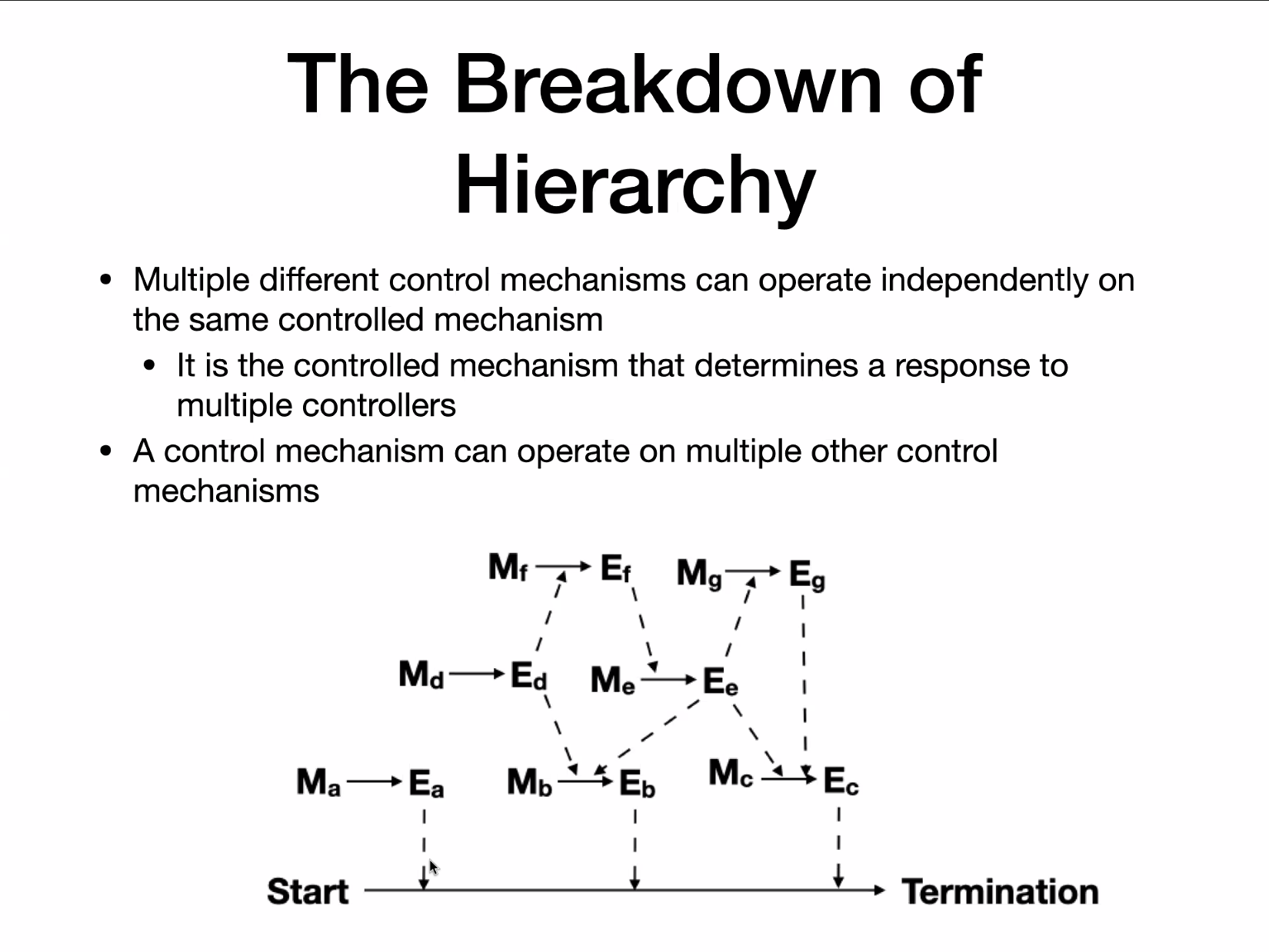
Neuroscience & Philosophy SalonWilliam Bechtel discusses his new book “Philosophy of Neuroscience” (with Linus Huang), including mechanisms and hierarchy/heterarchy (audio only)Paul Cisek discusses his phylogenetic approach (audio only)
Willard van Orman Quine once said that he had a preference for a desert ontology. This was in an earlier day when concerns with logical structure and ontological simplicity reigned supreme. Ontological genocide was practiced upon whole classes of upper-level or ‘derivative’ entities in the name of elegance, and we were secure in the belief that one strayed irremediably into the realm of conceptual confusion and possible error the further one got from ontic fundamentalism. In those days, one paid more attention to generic worries about possible errors (motivated by our common training in philosophical skepticism) than to actual errors derived from distancing oneself too far from the nitty-gritty details of actual theory, actual inferences from actual data, the actual conditions under which we posited and detected entities, calibrated and ‘burned in’ instruments, identified and rejected artifacts, debugged programs and procedures, explained the mechanisms behind regularities, judged correlations to be spurious, and in general, to the real complexities and richness of actual scientific practice
[I think I have been getting his surname wrong for years?!]
Version 1 : Received: 6 August 2024 / Approved: 7 August 2024 / Online: 8 August 2024 (12:22:55 CEST)
How to cite: Gershenson, C. Self-Organizing Systems: What, How, and Why?. Preprints2024, 2024080549. https://doi.org/10.20944/preprints202408.0549.v1 Gershenson, C. Self-Organizing Systems: What, How, and Why?. Preprints 2024, 2024080549. https://doi.org/10.20944/preprints202408.0549.v1Copy
Abstract
I present a personal account of self-organizing systems. As such, it is necessarily biased and partial. Nevertheless, it should be useful to motivate useful discussions. The relevant contribution is not my attempts at answering questions (maybe all my answers are wrong), but the steps towards framing relevant questions to better understand self-organization, information, complexity, and emergence. With this aim, I start with a notion and examples of self-organizing systems (what?), continue with their properties and related concepts (how?), and close with applications (why?).
•Understanding natural behavior requires not just new ways of collecting data, but also new theories for interpreting data.
•We suggest a stepwise approach for making experiments and theories more naturalistic without losing interpretability.
•Theories that address natural behavior can look for inspiration in ethology and evolution.
•Ecologically valid theories and experiments that test them should incorporate closed loop interaction with the world.
•A key challenge is to balance developing more ecologically valid theories while keeping aspects of existing concepts.
Toward a neuroscience of natural behaviorAuthor links open overlay panelPaul Cisek, Andrea M. GreenShow moreAdd to MendeleyShareCitehttps://doi.org/10.1016/j.conb.2024.102859Get rights and contentUnder a Creative Commons licenseopen accessHighlights•Understanding natural behavior requires not just new ways of collecting data, but also new theories for interpreting data.•We suggest a stepwise approach for making experiments and theories more naturalistic without losing interpretability.•Theories that address natural behavior can look for inspiration in ethology and evolution.•Ecologically valid theories and experiments that test them should incorporate closed loop interaction with the world.•A key challenge is to balance developing more ecologically valid theories while keeping aspects of existing concepts.
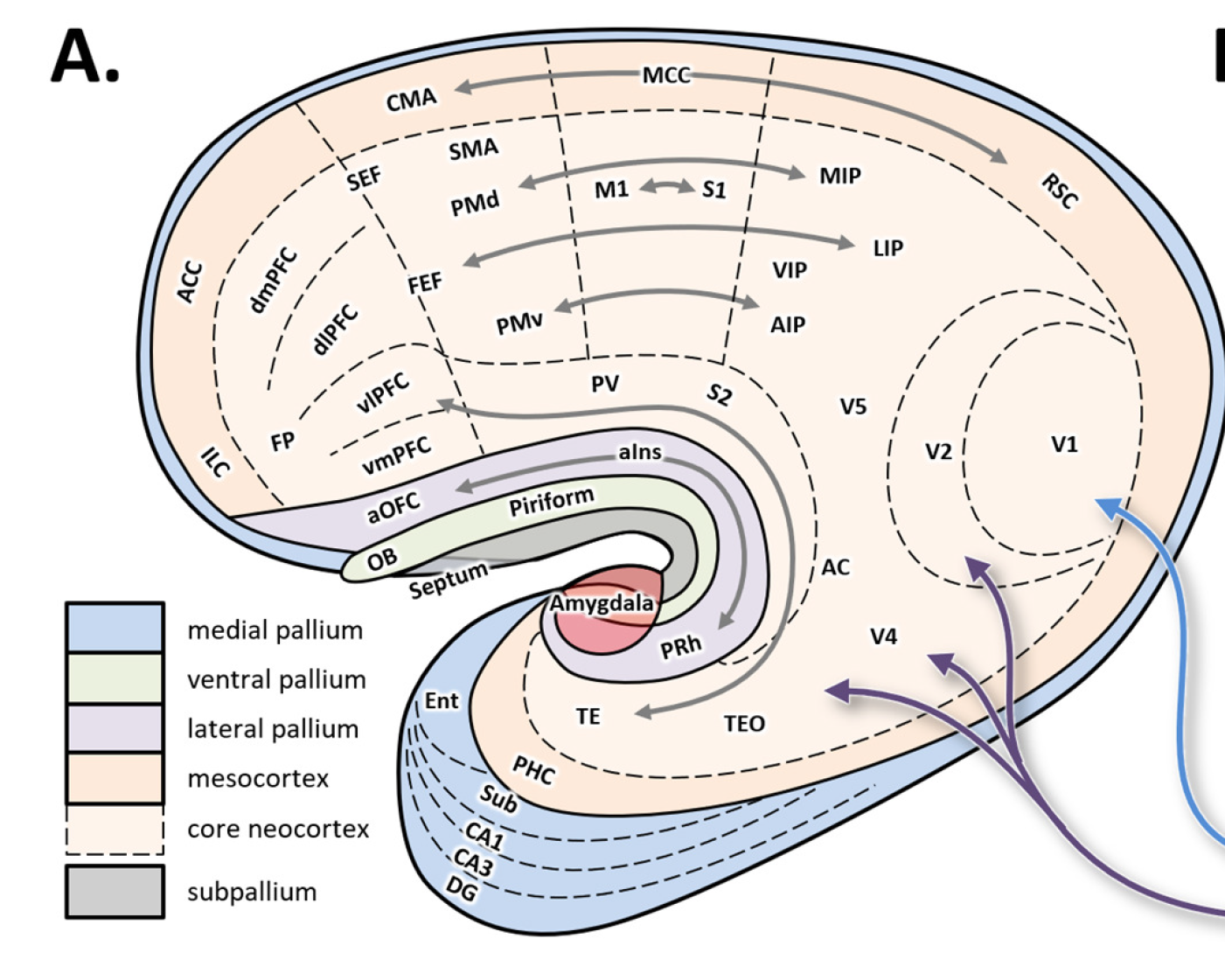
This article outlines a hypothetical sequence of evolutionary innovations, along the lineage that produced humans, which extended behavioural control from simple feedback loops to sophisticated control of diverse species-typical actions. I begin with basic feedback mechanisms of ancient mobile animals and follow the major niche transitions from aquatic to terrestrial life, the retreat into nocturnality in early mammals, the transition to arboreal life and the return to diurnality. Along the way, I propose a sequence of elaboration and diversification of the behavioural repertoire and associated neuroanatomical substrates. This includes midbrain control of approach versus escape actions, telencephalic control of local versus long-range foraging, detection of affordances by the dorsal pallium, diversified control of nocturnal foraging in the mammalian neocortex and expansion of primate frontal, temporal and parietal cortex to support a wide variety of primate-specific behavioural strategies. The result is a proposed functional architecture consisting of parallel control systems, each dedicated to specifying the affordances for guiding particular species-typical actions, which compete against each other through a hierarchy of selection mechanisms.
This article is part of the theme issue ‘Systems neuroscience through the lens of evolutionary theory’.
Evolution of behavioural control from chordates to primatesPaul CisekPublished:27 December 2021https://doi.org/10.1098/rstb.2020.0522AbstractThis article outlines a hypothetical sequence of evolutionary innovations, along the lineage that produced humans, which extended behavioural control from simple feedback loops to sophisticated control of diverse species-typical actions. I begin with basic feedback mechanisms of ancient mobile animals and follow the major niche transitions from aquatic to terrestrial life, the retreat into nocturnality in early mammals, the transition to arboreal life and the return to diurnality. Along the way, I propose a sequence of elaboration and diversification of the behavioural repertoire and associated neuroanatomical substrates. This includes midbrain control of approach versus escape actions, telencephalic control of local versus long-range foraging, detection of affordances by the dorsal pallium, diversified control of nocturnal foraging in the mammalian neocortex and expansion of primate frontal, temporal and parietal cortex to support a wide variety of primate-specific behavioural strategies. The result is a proposed functional architecture consisting of parallel control systems, each dedicated to specifying the affordances for guiding particular species-typical actions, which compete against each other through a hierarchy of selection mechanisms.This article is part of the theme issue ‘Systems neuroscience through the lens of evolutionary theory’.
Three new papers refute claims for the assembly theory of molecular complexity being claimed as a new “theory of everything.”
First publicly posited in 2017, assembly theory is a hypothesis concerning the measurability of molecular complexity that claims to characterize life, explain natural selection and evolution, and even to redefine our understanding of time, matter, life and the universe.
However, researchers led by Dr. Hector Zenil from the School of Biomedical Engineering & Imaging Sciences (BMEIS), in collaboration with colleagues from King Abdullah University for Science and Technology (KAUST) and the Karolinska Institute in Sweden, have successfully demonstrated in a paper published in npj Systems Biology, that the same results can be achieved by using traditional statistical algorithms and compression algorithms.
In a second paper just published by PLoS Complex Systems, they have also mathematically proven that assembly theory is an equivalent to Shannon Entropy and therefore not a novel approach to any of those applications and is an implementation of a well-known and popular compression algorithm used behind ZIP compression and image encoding formats such as PNG.

 Share
Share Cite
Cite
 Systems Community of Inquiry
You must be logged in to post a comment.