Systems Thinker | Management Consultant | Educator
April 24, 2024
Systems thinking has seen growing popularity in current times. With world events such as the COVID-19 pandemic, the Ukraine war, the macro-economic uncertainty in the developed world, and the climate emergency, governments, industries, nonprofits, and education institutions have come to realize that everything is connected to everything else and working in silos can be a recipe for disaster.
This is the Day 1 opening session of Waves Forum for Changemakers 2024 in Helsinki, Finland. In this fireside chat with Nora Bateson, International Bateson Institute, and Dave Snowden, Cynefin Company, hosted by Sara Lindeman, Leapfrog, we explore what changemakers can learn from complexity science to better understand change in complex social systems.
Key takeaways from the afternoon fireside chat about hashtag#complexity by Dave Snowden and Nora Bateson in Helsinki Waves event for change makers. 1️⃣ You can’t change a complex system by changing parts, but you can change interactions. 2️⃣ Do not try to fix a problem, change the ecosystem. 3️⃣ Do not change mindsets, change the context. 4️⃣ There are no linear causalities in complex systems. 5️⃣ Heterogenous systems evolve, homogenous do not. 6️⃣ Learn where you are now (as a system), move to ”adjacent possible”, and evaluate again. 7️⃣ Sustainable change happens at the local level.
A man with a watch knows what time it is. A man with two watches is never sure.[1]
At surface level, the adage emphasizes the consistency that arises when information comes from a single source and points out the potential pitfalls of having too much conflicting information. However, the underlying message is to question the apparent certainty of anyone who only has one source of information. The man with one watch has no way to identify error or uncertainty.
The saying was coined by the San Diego Union on September 20, 1930: “Confusion.—Retail jewelers assert that every man should carry two watches. But a man with one watch knows what time it is, and a man with two watches could never be sure.” Later this was — mistakenly — attributed to Lee Segall of KIXL, then to be misquoted again by Arthur Bloch as “Segal’s Law”.[2]
Segal’s law3 languagesArticleTalkReadEditView historyToolsFrom Wikipedia, the free encyclopediaSegal’s law is an adage that states:A man with a watch knows what time it is. A man with two watches is never sure.[1]At surface level, the adage emphasizes the consistency that arises when information comes from a single source and points out the potential pitfalls of having too much conflicting information. However, the underlying message is to question the apparent certainty of anyone who only has one source of information. The man with one watch has no way to identify error or uncertainty.History[edit]The saying was coined by the San Diego Union on September 20, 1930: “Confusion.—Retail jewelers assert that every man should carry two watches. But a man with one watch knows what time it is, and a man with two watches could never be sure.” Later this was — mistakenly — attributed to Lee Segall of KIXL, then to be misquoted again by Arthur Bloch as “Segal’s Law”.[2]
Georgina Voss’ book Systems Ultra: Making Sense of Technology in a Complex Worldis published by Verso in the UK and the US, in January 2024 https://gsvoss.com/systems-ultra
Georgina Voss will explore what a systems worldview is and how we experience and feel out our way within these structures.
By Centre for the Study of Existential Risk
Date and time
Tuesday, April 23 · 6 – 7:30pm GMT+1
Location
West HubJJ Thomson Avenue Cambridge CB3 0US United KingdomShow map
From finance to supply chains to payment platforms, our lives are increasingly defined by complex technological systems. Yet it can be surprisingly difficult to define what a system actually is, or what it feels like. In this public lecture, Georgina Voss will draw on storytelling and artistic practice to explore what a systems worldview is, what it does, and, crucially, how we experience and feel out our way within these structures.
Professor Emily So will act as discussant for the lecture. The event will be chaired by Dr Maya Indira Ganesh.
Speakers:
Georgina Voss is an artist, writer, and educator, and author of ‘Systems Ultra: Making Sense of Technology in a Complex World’ (Verso 2024). She co-founded and led the creative studios Strange Telemetry, and Supra Systems Studio (University of the Arts London).
Professor Emily So is Professor of Architectural Engineering in the Department of Architecture and Director of the Cambridge University Centre for Risk in the Built Environment (CURBE). Emily is a chartered civil engineer, specialising in urban risk and seismic safety, with notable work in earthquake casualty estimation and interdisciplinary collaborations. She contributed to an award-winning seismic-resilient building design in China (2017) and advises on disaster risk mitigation through SAGE. Recognized with the 2010 Shah Family Innovation Prize, Emily’s expertise spans diverse natural perils and international research initiatives.
Dr Maya Indira Ganesh is an assistant teaching professor at the Institute of Continuing Education (ICE) where she co-directs the , co-directing the MSt in AI Ethics and Society. Her research, rooted in cultural studies and feminist scholarship, explores the societal implications of algorithmic/AI technologies.. At CFI, Maya investigates how technology design intersects with people, places, and organizations, focusing on ethical and responsible AI. She has over a decade of experience as a researcher and activist in gender justice, security, and digital freedom of expression.
Please note there are tickets available for online or in-person.
If you are unable to attend the lecture, please return your ticket before the event through Eventbrite.
The Centre for the Study of Existential Risk is a multidisciplinary research centre within the University of Cambridge dedicated to the study and mitigation of existential risks that could lead to human extinction or civilisational collapse.
A presentation for the Oceania Chapter of the System Dynamics Society of the most memorable aha moments occurring during the past five decades while searching for understanding on the other side of complexity. These aha moments inspired me to become a Storyteller/Recovering Systems Thinker.
Send feedback to SystemsWiki@gmail.com or if you have a Kumu Account you can start a discussion on one of the elements or add to an existing discussion by clicking on a red asterisk.
The last time we teased you with a rebuild was in 2013. Back then, we were a nimble product with a small but keen set of users. Ten years on, it’s time to start talking about Kumu’s next chapter.In the years since we lost Ryan, we’ve struggled to iterate on Kumu at the speed that you deserve. The UI still has some rough edges and there are longstanding bugs that we can’t easily fix. We’ve decided that it’s time for a rewrite.Keep reading P.S. Interested in following along with the engineering and the design behind v3? Check out Making Kumu our new behind-the-scenes blog.
Financing systems health As society, we’ve collectively built a set of norms, practices, and organizations to deliver funding for point solutions. Unfortunately, this architecture undercuts our ability to fund other critical drivers of system health that go beyond individual projects.Changing the way we fund system health work will not be easy, but it is necessary to create lasting change. In their most recent blog, Rob Ricigliano and Anna Muoio propose three correctives that might help. Keep reading
Map the system We had the honor of supporting the University of Oxford’s Map the System competition again this year. Each year they host a global learning program and social innovation competition that equips students to use systems thinking to tackle social and environmental challenges. Head over to the blog to learn more about this year’s winners.
We’ve been more intentional about showcasing compelling Kumu projects made by our community. Make sure to follow us on on your favorite social platform.
The Cybernetics Society was honored to host Professor Karl J. Friston, Scientific Director: Wellcome Trust Centre for Neuroimaging for this talk. Professor Friston addressed the topic of how we can understand ourselves as sentient creatures and the principles that underwrite sentient behaviour, using the free energy principle to furnish an account in terms of active inference. A Q&A session followed.
[As I was told – IIRC by Aidan Ward (https://medium.com/@aidanward), the original Club of Rome modelling work included the water cycle (and more), but that was stripped out in terms of accessibility and a ‘simpler model’ and metric]
Five years ago, Rob Lewis stumbled on a part of the story of climate science that he had never heard about: the impact of “land change” and the role of ecosystems as active co-creators of climate, rather than passive victims of changes in the atmosphere. In this conversation, we trace the story of how this side of the story of a changing climate was eclipsed by a focus on CO2 and other industrial emissions – and we ask how this changes the binary of doom vs techno-optimism that mostly frames the public debate and the discussions within the environmental movement over climate change. Check out Rob’s work: — The Climate According to Life on Substack: https://theclimateaccordingtolife.sub… — Putting the Land Back in Climate at Resilience.org: https://www.resilience.org/stories/20… — The Silence of Vanishing Things – more of Rob’s poetry – https://www.thesilenceofvanishingthin… To watch the full recording, including Q&A, you’ll need a paid subscription to Writing Home (which is also your ticket to join us for fortnightly live sessions on Zoom): https://dougald.substack.com/subscribe Meanwhile, you can watch the first forty minutes here on YouTube.
Collaborating with teams to experience and think sustainably through games and participation.
INTE.RES.T welcomes you to the GARDEN – the online platform where you can explore the power of systems thinking in games and alternate resources for your development, enlightenment, and nurturing.


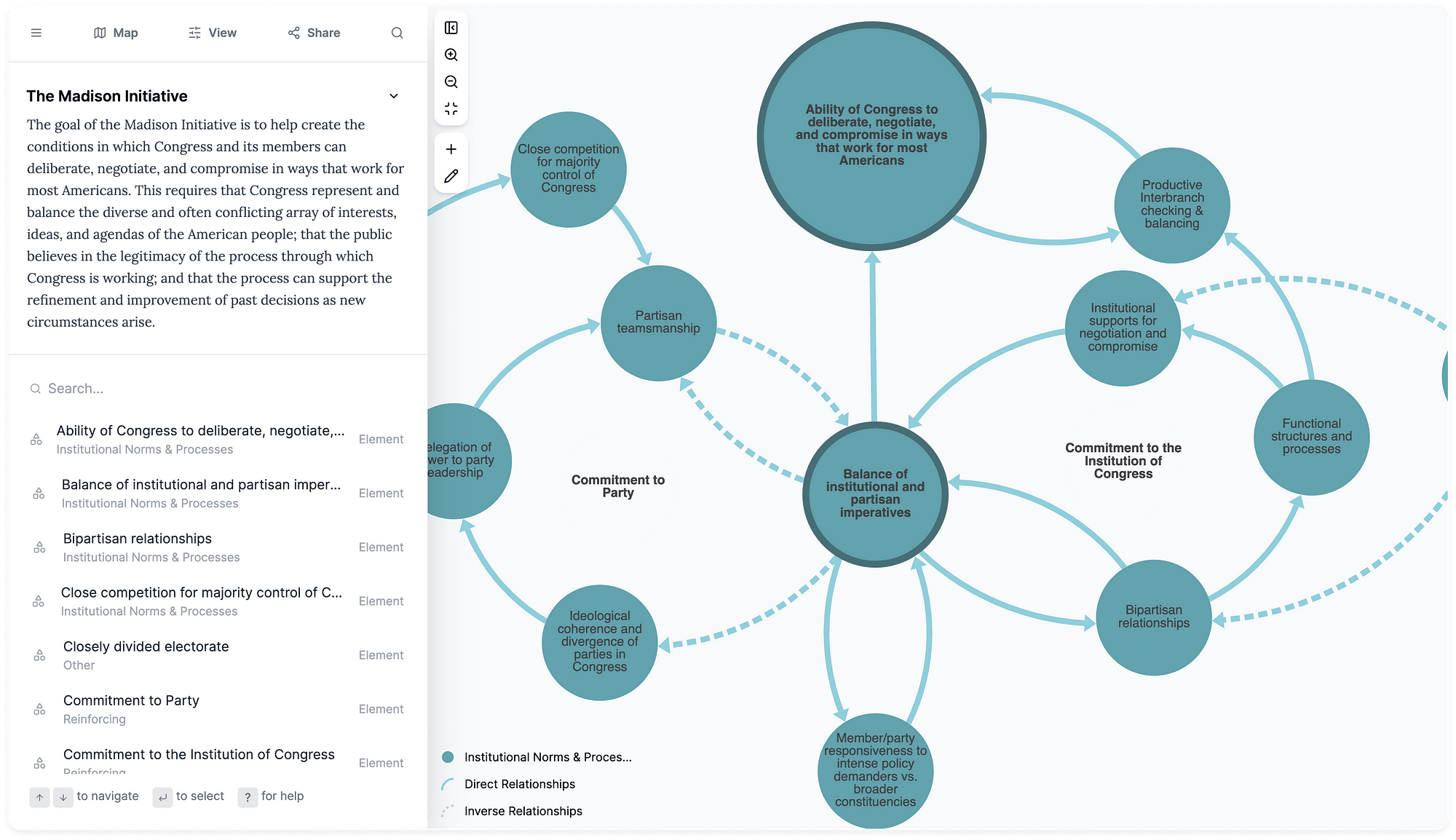 In the years since we lost Ryan, we’ve struggled to iterate on Kumu at the speed that you deserve. The UI still has some rough edges and there are longstanding bugs that we can’t easily fix. We’ve decided that it’s time for a rewrite.Keep reading
 Systems Community of Inquiry
You must be logged in to post a comment.