[You may need to get your browser to translate from Dutch. Teun Slujs presented at Systems Innovation 2024 last week and amongst his System Dynamics modelling, showed this cube – interesting stuff. He shared the links – I hope to share his presentation when he has a public version available]
A first prototype: The WISE Cube
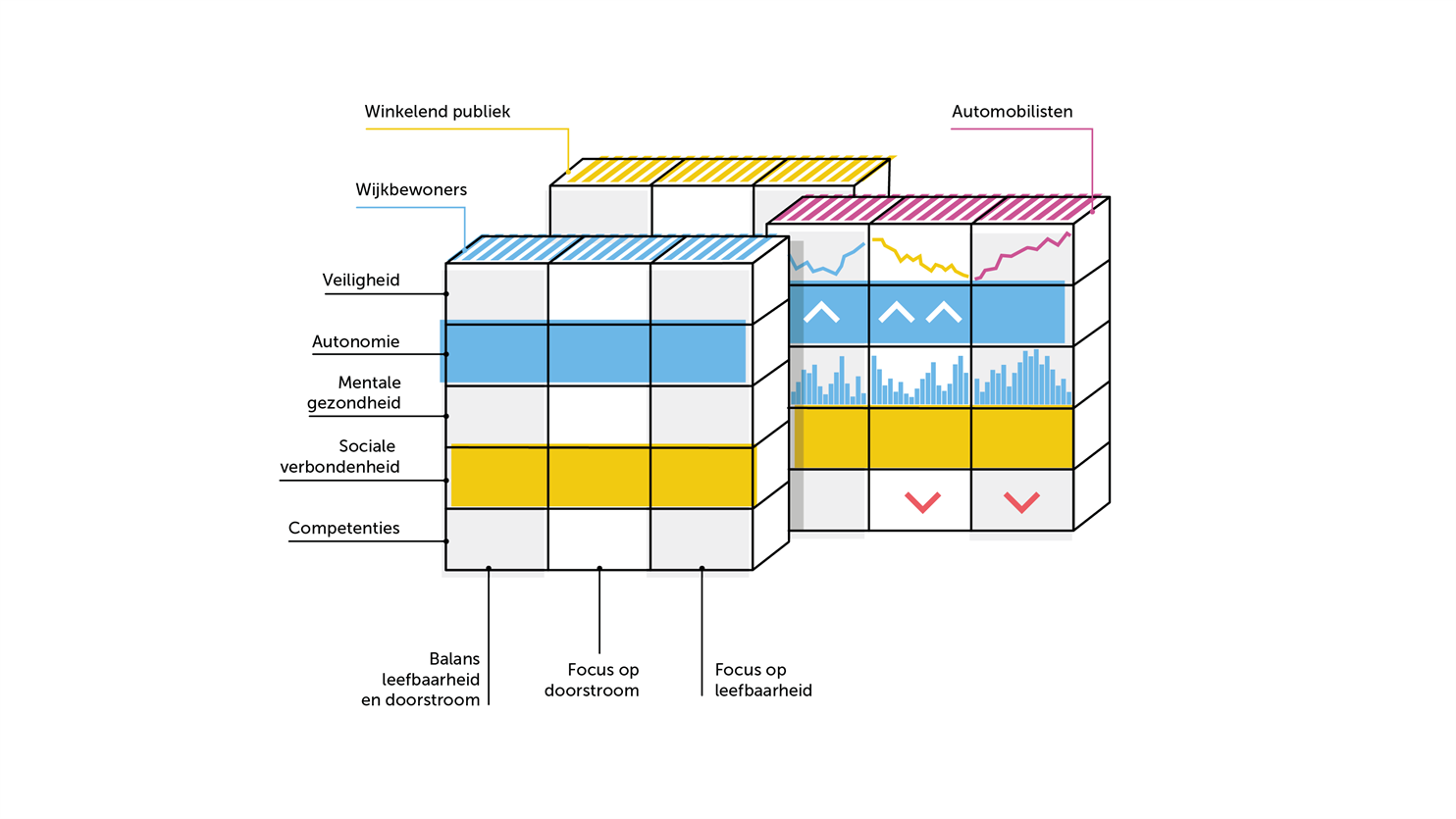
The WISE Policy Making research has led to models that can compare the effects of different policy options on social welfare. The effects of the different policy options are displayed in an interactive cube, the WISE Cube. The cube is designed in such a way that policymakers from different domains with different expertise and responsibilities can work on it together – a systemic approach.
Figure 2: The WISE Cube has three dimensions. The different policy options are horizontal, elements of well-being vertical and the different population groups from front to back.
The interactive WISE Cube provides visual insight into how policy options relate to each other in various ways. For example, a distinction is made between the effects in the short, medium and long term. The cube also offers the possibility to see per policy option how the various aspects contribute to the various dimensions of well-being.
The interactive WISE Cube is part of a prototype tool that supports the systematic completion of the ‘Grip on welfare’ method steps. With this online tool, involved parties can simultaneously complete the steps at different locations. The tool provides focus, helps with structuring and secures the results per step. Visualisations provide insight into the coherence. The tool can easily be linked to tools for modelling and data analysis, for example.
[h/t Roger James. Also a serious trigger warning – first large image in article appears to show dead bodies (in the context of the aftermath of the Rwandan massacre)]
02 Dec 2008 Bob Williams
Bucking the system: Systems concepts and developmentCIVIC ACTION,DEVELOPMENT POLICY02 DEC 2008BOB WILLIAMS
New third edition of The Solutions Focus book out this week (in UK and on Kindle)This fully revised and expanded edition comes 22 years after the first edition – proving that the book is a classic!MARK MCKERGOWMAY 08, 2024
Stepping out of the known and into reflective practice when the ground keeps shifting under our feet
By SCiO Ireland
Date and time
Wednesday, October 9 · 7:30 – 8:30pm GMT+1
Living together with uncertaintyStepping out of the known and into reflective practice when the ground keeps shifting under our feetBy SCiO Ireland30 followersFollowDate and timeWednesday, October 9 · 7:30 – 8:30pm GMT+1
The 9th International Systemic Practice and Research School is in Edinburgh in October with workshops on Movement in/as Systemic Practice
By Everything is Connected Press CIC
Date and time Wed, 9 Oct 2024 13:00 – Sat, 12 Oct 2024 13:00 BST
Wednesday, 9 OctoberMOVEMENT IN /AS SYSTEMIC PRACTICEThe 9th International Systemic Practice and Research School is in Edinburgh in October with workshops on Movement in/as Systemic PracticeBy Everything is Connected Press CIC277 followers31 events hosted 📈FollowingDate and timeWed, 9 Oct 2024 13:00 – Sat, 12 Oct 2024 13:00 BST
Social Presencing as a way for unsticking ourselves from habitual ways of knowing and being
Accessing that spacious place where new ideas and possibilities can arise is something that is available to all of us, once we turn our attention to our body wisdom.
I have experienced how it turns places where I have felt stuck into rich spacious landscapes that allow for more choice than my habitual ways of being.
From tightly pulled knotted string to a loose structure; I am unpicked, reformed, and can breathe more freely again. No longer needing to be right, or feeling all wrong, but released from the energy that holding tight absorbs and with space for curiosity about what else?
This is the end-August 2024 monthly events mailing from SCiO. Autumn events are now kicking in and there is plenty happening. Click on the flags or group titles below to go to the events that interest you. Please remember that you can attend online events organised by any of the SCiO groups if they are held in a language you speak/understand (and you are a member if it is a member-only meeting). Further details of events may be available by clicking on the event titles below and you can also book each event directly from the Book now text.
Please note that some groups post events and add details quite late, so it is always worth checking the website – also for changes to dates and times. Please click here to see all the events in a browser.
It is time again for the SCiO AGM and again we will again be holding a mini-conference. We will be doing this on a Saturday morning this year, for the first time, in the belief that this may work better for some of you. We are still arranging speakers so watch out for more details on the website. In the meanwhile, you can book now:
This message is confidential to the intended recipient. It does not constitute a legally binding document on the part of either the sender or the recipient. If this message has been received by you in error please reply to: steve.hales@systemspractice.org with UNSUBSCRIBE as the title
Systems and Complexity in Organisation Ltd is a company registered in England with Company Number: 3499590 Registered address: Unit 14 Tower Street, Century Building, Brunswick Business Park, Liverpool L3 4BJ UK
SCiO organises Open Meetings to provide opportunities for practitioners to learn and develop new practice, to build relationships, network, hear about skills, tools, practice and experiences. This virtual session will be held on Zoom.
SCiO’s Development Event offer an opportunity to draw upon the collective expertise of SCiO members in a friendly and supportive atmosphere. By taking Development Events online, using the Zoom meeting platform, we aim to make them accessible to more SCiO members Development Events are both for members who are just starting out on a journey to explore Systems Thinking approaches, and for those who have many years of exploration and practice.
SCIO-NL komt elke 2e vrijdag van de maand live bijeen in Vianen (Hagenweg 3c). Er staan geen vaste onderwerpen op de agenda (daarvoor organiseren we specifieke andere meetings), maar de ervaring leert dat er altijd wel een interessant gesprek op gang komt over een systemisch onderwerp. Toegankelijk voor iedereen die de jaarlijkse fee voor de live-bijeenkomsten (€50,-) hiervoor betaald. En voor gasten. Neem contact op via ed@doitogether.nl als je interesse hebt, maar nog geen lid van de club bent.
NL Members + guests; Free; Hagenweg 3c, Vianen, Netherlands; Dutch Book now
SCIO-NL komt elke 2e vrijdag van de maand live bijeen in Vianen (Hagenweg 3c). Er staan geen vaste onderwerpen op de agenda (daarvoor organiseren we specifieke andere meetings), maar de ervaring leert dat er altijd wel een interessant gesprek op gang komt over een systemisch onderwerp. Toegankelijk voor iedereen die de jaarlijkse fee voor de live-bijeenkomsten (€50,-) hiervoor betaald. En voor gasten. Neem contact op via ed@doitogether.nl als je interesse hebt, maar nog geen lid van de club bent.
NL Members + guests; Free; Hagenweg 3c, Vianen, Netherlands; Dutch BOOK NOW
Stimulated by the digital meta trend, corporations have created the role of Digital Transformation Manager to develop their strategy around this. In this session, we will delve into a practical use case, providing real-world insights and solutions, shedding light on the essential components of a digital transformation journey at Hitachi.
Is there a systemic approach to digital transformation, is there a success formula, and what are best practices?
”Opening the box” invites you to delve into the realms of systems thinking , by exploring four layers of ‘systems’: parts and wholes, nascent development, coherence, and metamorphosis.
This book is for those who may not believe that they use systems thinking, but already consider relationships and connections in situations, or those who wish to learn who are seeking a place to start, or those already practicing systems thinking looking for a different ‘take’ on the discipline.
The story uncovers the power of critical and systemic thinking, as Pandora and her grandmother challenge surface – level solutions, and advocate for deeper exploration. You can learn through their dialogue how we can challenge assumptions, embrace interconnectedness, and harness the power of action, to create positive change.
We verbreden in deze Deep Dive reeks onze systemische kaders. Waar we in de vorige Deep Dives ons hebben verdiept in het Viable Systems Model laten we nu drie andere benaderingen aan bod komen: De kritische systeembenadering, de systeem dynamische benadering en de strategische optie formuleringsbenadering.
Members only + Guests; 150 euro (werkingskosten), Locn: tbc, Belgium; Dutch BOOK NOW
Paikka: VTT Future Hub Espoon Otaniemessä. Huomaathan, että pääsisäänkäynti sijaitsee FutureHubin rakennustyömaan vuoksi osoitteessa Maarintie 3, vaikka virallinen osoite onkin Tekniikantie 21. Käsiteltävä kirja: Jamshid Gharajedaghi: Systems Thinking: Managing Chaos and Complexity – A Platform for Designing Business Architecture
Tilaisuuden alustaa ja vetää Hannu Lepomäki.
All Welcome; FREE; VTT Future Hub, Espoo, (Maarintie 3), FinnishBOOK NOW
Päätöksentekijä käyttää päätöksenteossa tietoisesti tai tietämättään malleja. Kun mallien käyttö on tietoista, päätöksenteko on sujuvampaa ja päätökset johtavat paremmin haluttuihin tavoitteisiin. Mutta mitä nämä mallit ovat, miten niitä syntyy ja luodaan, ja millaisia malleja pystytään käyttämään päätöksenteossa. Esityksessä käydään läpi mallien käytön perusteita. Puhuja: Professori Matti Vilkko, Automaatio- ja konetekniikan yksikön päällikkö, Tampereen yliopisto Online event
Event Date Thu, Sep 26, 2024 – 18:00 – Thu, Sep 26, 2024 – 19:00 CET
Organisationsweite Kollaboration: DAS Ziel agiler Transformation in Unternehmen – was leider häufig so schwer zu erreichen scheint. Was auf Teamebene, z.B. durch die Nutzung eines agilen Frameworks, häufig gut gelingt, sieht über die Teamgrenzen hinweg nicht selten ganz anders aus. Flight Levels als Denkmodell verspricht hier einen neuen, leichtgewichtigen Zugang zur Lösung von Barrieren und Anbindung sogenannter „agiler Inseln”. Aktuell ist Biedulski als Agile Coach, Flight Levels Coach und Organisationsberater bei der Colenet GmbH tätig.
Members only + Guests, FREE, Online event. German Book now
There is a substantial programme of events for SCiO Ireland, but in order for the group to build attendance inIreland, these are not publicised here or on the website. Please contact SCiO Ireland for events over the next months.
Spontaneity and Control: Friedrich Hayek, Stafford Beer, and the Principles of Self-OrganizationPublished online by Cambridge University Press: 22 April 2024Max Hancock


 Systems Community of Inquiry
You must be logged in to post a comment.