Maps of Bounded Rationality: Psychology for Behavioral Economics – Kahneman (2023)

AMERICAN ECONOMIC REVIEW

VOL. 93, NO. 5, DECEMBER 2003

(pp. 1449-1475)

Maps of Bounded Rationality: Psychology for Behavioral EconomicsDaniel KahnemanAMERICAN ECONOMIC REVIEWVOL. 93, NO. 5, DECEMBER 2003(pp. 1449-1475)

Maps of Bounded Rationality: Psychology for Behavioral Economics – American Economic Association

https://www.aeaweb.org/articles?id=10.1257/000282803322655392

https://houdekpetr.cz/%21data/public_html/papers/Kahnem%202003.pdf

Encounters with the Other (second edition, revised) – Oshry (2024)

Imprint: Triarchy Press
Edition: Second, revised
Published: March 2024
List Price: £15
Format: Paperback
Extent: 62pp.
Size: 14 x 21.6 cm (8.5×5.5″)
ISBN: 978-1-911193-48-7
Tags: Systems Thinking, Power and Love, Society, Genocide, Migration, Immigration, Purity, ToleranceBuy the paperback (£15)
Published 5 March 2024, available here  now
Postage chargesQuantity:   Buy the pdf  ​(£10)Click the ‘Buy’ button below. At checkout, click No postage on ebooks from the dropdown. 
After paying, we will send an immediate confirmation and email your ebook file within 24 hours. PDF ISBN 978-1-911193-63-0​​​​​
version: bookmarked pdf
(pdf text cannot be edited, printed or copied – email us if you need this capability.)Read more reviews of the book
Encounters with the Other

How we continue to misunderstand, 
dehumanize, scorn, humiliate, 
oppress−and even kill−others. 

And how we can stop.

Barry Oshry
Systems Thinking for Societies

Encounters with the Other​How we continue to misunderstand, dehumanize, scorn, humiliate, oppress−and even kill−others. And how we can stop.​Barry OshrySystems Thinking for Societies

Encounters with the Other – Triarchy Press

https://www.triarchypress.net/encounters.html

History of Philosophy without any gaps 442. Scott Williams on Disability and the New World

[Another one with lots of systems | cybernetics | complexity implications and applications – adding philosophy of disability to the ‘fellow travellers’ list]

Posted on 31 March 2024

In this interview we learn about the main issues in modern-day philosophy of disability, and the relevance of this topic for the European encounter with the Americas.

442. Scott Williams on Disability and the New WorldPosted on 31 March 2024In this interview we learn about the main issues in modern-day philosophy of disability, and the relevance of this topic for the European encounter with the Americas.

442. Scott Williams on Disability and the New World | History of Philosophy without any gaps

https://www.historyofphilosophy.net/disability-williams

System effects mapping: a tool for promoting collaborative community ecological action – Baker et al (2024)

System effects mapping: a tool for promoting collaborative community ecological action

COMMUNITY CASE STUDY article

Front. Environ. Sci., 09 February 2024
Sec. Environmental Citizen Science
Volume 12 – 2024 | https://doi.org/10.3389/fenvs.2024.1356065

System effects mapping: a tool for promoting collaborative community ecological action

Virginia Baker1,2 Mat Walton1 Suzanne Manning, Jamie Ataria3, Carla Gee4, Robin Taua-Gordon5

https://www.frontiersin.org/articles/10.3389/fenvs.2024.1356065/full

Frontiers | System effects mapping: a tool for promoting collaborative community ecological action

Luke Craven on LinkedIn https://www.linkedin.com/posts/lukecraven_openaccess-systemeffects-activity-7179992956643295232-r8Gz/?utm_source=share&utm_medium=member_ios says:

🎉It is wonderful to see a new application of System Effects published in Frontiers, this time used to visualise how people connect to and value their local waterways.

🔍The project, undertaken by ESR – Science and Research in partnership with the local community, explored issues of environmental pollution and contamination within the Whau River catchment, an urban estuarine system in the west of Auckland City, Aotearoa, New Zealand.

🛠System Effects was used by ESR scientists as a tool for local action and planning, collaborative sense-making and more complex problem structuring.

📊The paper concludes that the use of the tool enabled the ESR team to have more meaningful impacts for the local community.

👏Well done, Mat Walton and colleagues, for bringing this application to life!

🌐You can read the full hashtag#OpenAccess paper here: https://lnkd.in/gkh_xQKm

hashtag#SystemEffects

From Unfreezing-Refreezing, to Systems Changes Learning | EQ Lab Dialogic Drinks | 2024-03-14/15 – David Ing

 March 20, 2024  daviding

From Unfreezing-Refreezing, to Systems Changes Learning | EQ Lab Dialogic Drinks | 2024-03-14/15 March 20, 2024 daviding

From Unfreezing-Refreezing, to Systems Changes Learning | EQ Lab Dialogic Drinks | 2024-03-14/15 – Coevolving Innovations

The Layers of Irony Model

The Philosopher’s Meme

“The Layers of Irony Model: How a metameme spread across academia and subcultures”. 2024-03-17. Seong-Young Her, University of Canterbury, New Zealand. Presented at the University of Bucharest for the 2024 Philosophy of Memes Conference. Mentions works by YouTubers @oliSUNvia@JREG@fromthedeskofprofessorskye (@professorskye) @iDubbbzTV@HydeWars Slides, references, and supplementary materials will soon be made available on https://thephilosophersmeme.com . Please consider supporting this work via   / thephilosophersmeme   and joining the Discord server via   / discord   .

The Layers of Irony Model – YouTube

https://thephilosophersmeme.com/2016/01/18/the-revised-quadrant-model

https://thephilosophersmeme.com/irony

How Our Perceptions Shape Society | Karl Friston Λ Anna Lembke – Theories of Everything with Curt Jaimungal

[The premise of ‘theories of everything’ sort of annoys me and sometimes these conversations are too technical or self-involved for me to listen all the way through – also, panel discussions on podcasts can be very annoying, and the ‘day in the life of a podcaster’ is one of the most accidental revealing, yet amusing and earnest, bits you could find about aspirant public intellectuals (https://www.youtube.com/watch?v=c7tLFNz-oXw) – but the earnestness and engagement often do generate good results.

Anyway, sharing because this is one where I was just wryly resisting screaming ‘cybernetics, folks!’ – obviously particularly in the Active Inference bit].

Theories of Everything with Curt Jaimungal

306K subscribers

21 Mar 2024

Theories of Everything with Curt Jaimungal

In today’s episode, Karl Friston and Anna Lembke emphasize the urgency of reevaluating our personal and societal practices in the face of environmental, mental health, and addiction crises, through the lens of “active inference”. Please consider signing up for TOEmail at https://www.curtjaimungal.org

How Our Perceptions Shape Society | Karl Friston Λ Anna Lembke – YouTube

NECSI Complexity Intensive: Summer Session 2024, June 3-14, paid, recorded and live online

Announcing: NECSI Two-Week Intensive Summer Course in ComplexityJune 3-14, 2024 // Virtual (Attend from anywhere)Our Complexity Course is a two-week intensive program featuring:Live lecture and Q&A sessions with world-renowned complex systems physicist, Yaneer Bar-YamSpecial guest lecturer (to be announced)Access to over 12 hours of self-paced course modules, covering key complexity science concepts and its applicationsAmple networking and collaboration opportunitiesThis summer, discover the science that teaches us about collected patterns of behavior, helps us understand the fluctuations of global finance, and can help us meet societal, organization and global challenges.Register TodayRegister by April 27th for a 15% Early Bird Discount“I would definitely recommend it to colleagues or anyone interested. I think it was very accessible to the lay person”“I think it’s universal which discipline it can be applied to, or juts hte change of mindset – I think it’s powerful on its own”“Step-by-step, Yaneer guides us on a very exciting scientific journey that helps us to understand the real world and how to tackle it using traditional scientific tools as well as complex ones … he does it in a way that is accessible to not only academic people, but to laypeople too”NECSI has become the go-to place for leaders from all industries and sectors to learn about Complex Systems Science (CSS). CSS allows us to accurately predict real-world events and describe unintended consequences, dynamics, and emergent behaviors in real-world systems.Research from NECSI
NECSI125 Mount Auburn St. #380301 , Cambridge, MA 02238, United States

Complexity Intensive: Summer Session 2024

Learn — New England Complex Systems Institute
https://necsi.edu/summer-2024-complexity-course?ss_source=sscampaigns&ss_campaign_id=6605baa65239e43ddf058157&ss_email_id=6606e502ef297e3f17e33bc6&ss_campaign_name=ANNOUNCEMENT%3A+Join+us+for+the+Summer+2024+Complexity+Course&ss_campaign_sent_date=2024-03-29T15%3A58%3A04Z

Bateson on meaning, shared by Bhavana Nissima

[Sharing as this is such a zinger]

Bhavana writes:

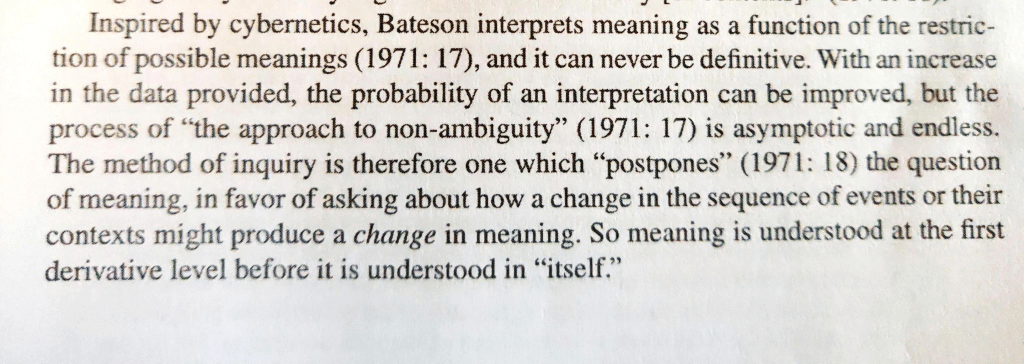
This quote from the Chapter 7 “G. Spencer Brown on the Paradoxes of “Not”– And Gregory Bateson on the Richness of Analog Communication” of this book by Phillip Guddemi “Gregory Bateson on Relational Communication: From Octopuses to Nations.”Me is quiet, pondering about our worlds.

Test reads ‘Inspired by cybernetics, Bateson interprets meaning as a function of the restriction of possible meanings (1971: 17), and it can never be definitive. With an increase in the data provided, the probability of an interpretation can be improved, but the process of “the approach to non-ambiguity” (1971: 17) is asymptotic and endless. The method of inquiry is therefore one which “postpones” (1971: 18) the question of meaning, in favor of asking about how a change in the sequence of events or their contexts might produce a change in meaning. So meaning is understood at the first derivative level before it is understood in “itself.”’

Post | LinkedIn
https://www.linkedin.com/posts/bhavana-nissima_this-quote-from-the-chapter-7-g-spencer-activity-7172177200706781184-xUvx/?utm_source=share&utm_medium=member_ios

EMBRACE THE VOID podcast – What’s Left of Meritocracy with Gil Morejón

[

Some really interesting themes – meritocracy of course, and the complex interplay between individual attributes and actions (effort, talent) and systemic forces (social, economic conditions).

Capital accumulation and societal rewards and feedback loops, generl complexity of social systems, adaptive systems and policy responses, and value pluralism and systemic diversity]

March 16, 2024

What’s Left of Meritocracy with Gil Morejón

Embrace the Void

Download

My guest this week is Gil Morejón, a historian of ideas currently teaching at Grenell college, one of the 4 amazing hosts of the What’s Left of Philosophy? Podcast. We discuss leftist takes on meritocracy, possible alternatives, and the differences between doing politics and ethics. Enjoy!

What’s Left of Meritocracy with Gil Morejón — Embrace The Void

https://www.voidpod.com/podcasts/2024/3/16/whats-left-of-meritocracy-with-gil-morejn

A Viable System Model: Consideration of Knowledge Management – Leonard (1999)

Journal of Knowledge Management Practice, August 1999

Allenna Leonard, PhD, The Complementary Set


ABSTRACT:

Contends that individual and organizational knowledge is difficult to value and therefore difficult to manage. Looks at the management of knowledge from the perspective of the individual, the network and the organization using Stafford Beer’s Viable System Model, a powerful descriptive and diagnostic tool to map management capacities and promote viability.

http://www.tlainc.com/articl12.htm

The Viable System: An Introduction – Leonard (1992)

Allenna Leonard, PhD

Volume 14, Issue 1 | https://doi.org/10.1177/014233129201400102

Abstract

This article provides an introduction to the Viable System Model (VSM). The importance of organisational identity is described. The VSM is shown to be a model which enables the recognition of patterns necessary for survival within organisations. The five systems of the VSM are outlined. Emphasis is given to the distinctive channels of communication made explicit by the VSM. The importance of developing common perspectives and common languages is highlighted. The VSM is put forward as a useful contribution in this endeavour. Examples were chosen from the public sector.

https://journals.sagepub.com/doi/10.1177/014233129201400102?icid=int.sj-abstract.similar-articles.1

https://sci-hub.se/https://doi.org/10.1177/014233129201400102

Kybernetes: The International Journal of Systems & Cybernetics Volume 33, Numbers 3-4, 2004, tribute to Stafford Beer (ed, Espejo)

ISSN 0368-492X (Print)

Publisher: Emerald Group Publishing Limited

Volume 33, Numbers 3-4, 2004

Kybernetes: The International Journal of Systems & CyberneticsISSN 0368-492X (Print)Publisher: Emerald Group Publishing LimitedVolume 33, Numbers 3-4, 2004

Kybernetes: The International Journal of Systems & Cybernetics: Ingenta Connect Table Of Contents

https://www.ingentaconnect.com/content/mcb/067/2004/00000033/f0020003;jsessionid=7fseknub4efg9.x-ic-live-01

[download link looks dodgy but worked for me – no guarantees!:]

https://dokumen.pub/qdownload/tribute-to-stafford-beer-9781845443900-9780861769407.html

The Systems Perspective: Methods And Models For The Future – Leonard and Beer (2001)

  • February 2001

Abstract

CONTENTS ACKNOWLEDGMENTS I INTRODUCTION A Brief History The Field Today II FOCUSING ON THE SYSTEM AS A PURPOSEFUL WHOLE Time and Motion Probability Complexity and Variety III DESIGNING AND BUILDING MODELS Establishing a Purpose Defining The System Data Gathering and Illustration Testing and Revision IV STRENGTHS AND WEAKNESSES OF THE SYSTEMS APPROACH A Situational Example A Reductionist Model Outlook for the Systems Approach Some Specific Models Interactive Planning How To Do It When to Use Interactive Planning Comparison/Combination with Other Models Outlook for the Future Living Systems Theory How To Do It When To Use It Comparison/Combination with Other Models Futures Research Methodology The Systems Perspective EXIT AC/UNU Millennium Project Futures Research Methodology The Systems Perspective Outlook for the Future Operations Research How To Do It When To Use It Comparison/Combination With Other Model

The Systems Perspective: Methods And Models For The Future | Request PDF

https://www.researchgate.net/publication/2572918_The_Systems_Perspective_Methods_And_Models_For_The_Future

https://citeseerx.ist.psu.edu/document?repid=rep1&type=pdf&doi=47323f4399ca706736e4ef665c3613e3ef1bc0e8

Introducing managers to the VSM using a personal VSM – Robinson (2013)

David T. Robinson 

Kybernetes

ISSN: 0368-492X

Article publication date: 4 January 2013 

Abstract

Purpose

The purpose of this paper is to present the results of a short research study that introduced a group of busy managers, in an organisation in turmoil, to Stafford Beer’s Viable System Model (VSM) through the use of a personal construct, developed by Allenna Leonard.

Design/methodology/approach

This study, designed as systemic action research, was a final project towards an Open University Masters in Systems Thinking in Practice. Initially managers were introduced to the personal VSM and invited to design their own VSM as systemic action learning. This was followed by an introductory collaborative inquiry to enable the managers to use their VSM learning to interrogate their organisational domain through the VSM lens.

Findings

The managers engaged well with the personal VSM (PVSM). All the managers reported that the PVSM was a useful learning tool and provided beneficial professional development to help clarify activities, priorities and their roles. They reported that the collaborative meeting was a very useful means to help them see others’ perspectives and work towards gaining a shared understanding of the issues and challenges within the organisation through the VSM lens.

Practical implications

The VSM is not well understood or routinely used in current management thinking. This method of introducing the VSM to managers has wide implications for providing managers with an introduction to systems thinking and an opportunity to engage openly with a valuable tool that will help their understanding of modern organisational complexity.

Originality/value

Using the personal VSM with managers has not been reported before and this study provides new opportunities to develop a means to introduce complex conceptual systems models to busy managers.

Keywords

Citation

Robinson, D.T. (2013), “Introducing managers to the VSM using a personal VSM”, Kybernetes, Vol. 42 No. 1, pp. 125-139. https://doi.org/10.1108/03684921311295529

Introducing managers to the VSM using a personal VSMDavid T. Robinson KybernetesISSN: 0368-492XArticle publication date: 4 January 2013 Permissions DOWNLOADS1003AbstractPurposeThe purpose of this paper is to present the results of a short research study that introduced a group of busy managers, in an organisation in turmoil, to Stafford Beer’s Viable System Model (VSM) through the use of a personal construct, developed by Allenna Leonard.Design/methodology/approachThis study, designed as systemic action research, was a final project towards an Open University Masters in Systems Thinking in Practice. Initially managers were introduced to the personal VSM and invited to design their own VSM as systemic action learning. This was followed by an introductory collaborative inquiry to enable the managers to use their VSM learning to interrogate their organisational domain through the VSM lens.FindingsThe managers engaged well with the personal VSM (PVSM). All the managers reported that the PVSM was a useful learning tool and provided beneficial professional development to help clarify activities, priorities and their roles. They reported that the collaborative meeting was a very useful means to help them see others’ perspectives and work towards gaining a shared understanding of the issues and challenges within the organisation through the VSM lens.Practical implicationsThe VSM is not well understood or routinely used in current management thinking. This method of introducing the VSM to managers has wide implications for providing managers with an introduction to systems thinking and an opportunity to engage openly with a valuable tool that will help their understanding of modern organisational complexity.Originality/valueUsing the personal VSM with managers has not been reported before and this study provides new opportunities to develop a means to introduce complex conceptual systems models to busy managers.KeywordsManagers Organizational structures Change management Adaptability Action research Viable System Model Personal VSM Systems thinking Collaborative inquiryCitationRobinson, D.T. (2013), “Introducing managers to the VSM using a personal VSM”, Kybernetes, Vol. 42 No. 1, pp. 125-139. https://doi.org/10.1108/03684921311295529

Introducing managers to the VSM using a personal VSM | Emerald Insight

https://www.emerald.com/insight/content/doi/10.1108/03684921311295529/full/html

https://sci-hub.se/10.1108/03684921311295529