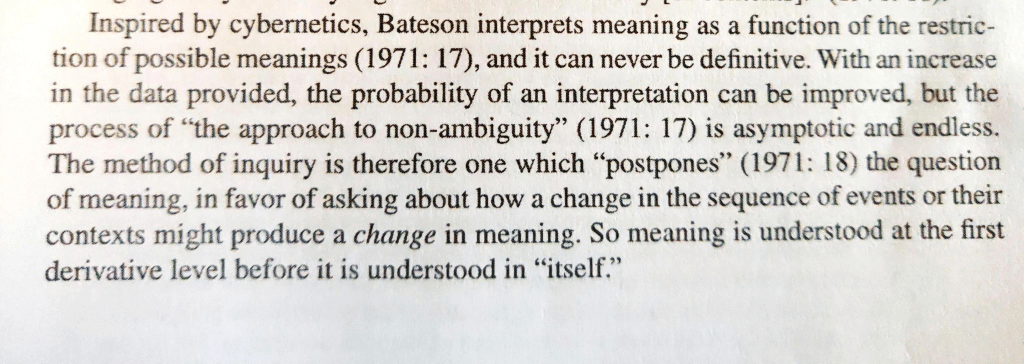
This quote from the Chapter 7 “G. Spencer Brown on the Paradoxes of “Not”– And Gregory Bateson on the Richness of Analog Communication” of this book by Phillip Guddemi “Gregory Bateson on Relational Communication: From Octopuses to Nations.”Me is quiet, pondering about our worlds.
Test reads ‘Inspired by cybernetics, Bateson interprets meaning as a function of the restriction of possible meanings (1971: 17), and it can never be definitive. With an increase in the data provided, the probability of an interpretation can be improved, but the process of “the approach to non-ambiguity” (1971: 17) is asymptotic and endless. The method of inquiry is therefore one which “postpones” (1971: 18) the question of meaning, in favor of asking about how a change in the sequence of events or their contexts might produce a change in meaning. So meaning is understood at the first derivative level before it is understood in “itself.”’
Some really interesting themes – meritocracy of course, and the complex interplay between individual attributes and actions (effort, talent) and systemic forces (social, economic conditions).
Capital accumulation and societal rewards and feedback loops, generl complexity of social systems, adaptive systems and policy responses, and value pluralism and systemic diversity]
My guest this week is Gil Morejón, a historian of ideas currently teaching at Grenell college, one of the 4 amazing hosts of the What’s Left of Philosophy? Podcast. We discuss leftist takes on meritocracy, possible alternatives, and the differences between doing politics and ethics. Enjoy!
Journal of Knowledge Management Practice, August 1999
Allenna Leonard, PhD, The Complementary Set
ABSTRACT:
Contends that individual and organizational knowledge is difficult to value and therefore difficult to manage. Looks at the management of knowledge from the perspective of the individual, the network and the organization using Stafford Beer’s Viable System Model, a powerful descriptive and diagnostic tool to map management capacities and promote viability.
This article provides an introduction to the Viable System Model (VSM). The importance of organisational identity is described. The VSM is shown to be a model which enables the recognition of patterns necessary for survival within organisations. The five systems of the VSM are outlined. Emphasis is given to the distinctive channels of communication made explicit by the VSM. The importance of developing common perspectives and common languages is highlighted. The VSM is put forward as a useful contribution in this endeavour. Examples were chosen from the public sector.
Kybernetes: The International Journal of Systems & CyberneticsISSN 0368-492X (Print)Publisher: Emerald Group Publishing LimitedVolume 33, Numbers 3-4, 2004
CONTENTS ACKNOWLEDGMENTS I INTRODUCTION A Brief History The Field Today II FOCUSING ON THE SYSTEM AS A PURPOSEFUL WHOLE Time and Motion Probability Complexity and Variety III DESIGNING AND BUILDING MODELS Establishing a Purpose Defining The System Data Gathering and Illustration Testing and Revision IV STRENGTHS AND WEAKNESSES OF THE SYSTEMS APPROACH A Situational Example A Reductionist Model Outlook for the Systems Approach Some Specific Models Interactive Planning How To Do It When to Use Interactive Planning Comparison/Combination with Other Models Outlook for the Future Living Systems Theory How To Do It When To Use It Comparison/Combination with Other Models Futures Research Methodology The Systems Perspective EXIT AC/UNU Millennium Project Futures Research Methodology The Systems Perspective Outlook for the Future Operations Research How To Do It When To Use It Comparison/Combination With Other Model
The purpose of this paper is to present the results of a short research study that introduced a group of busy managers, in an organisation in turmoil, to Stafford Beer’s Viable System Model (VSM) through the use of a personal construct, developed by Allenna Leonard.
Design/methodology/approach
This study, designed as systemic action research, was a final project towards an Open University Masters in Systems Thinking in Practice. Initially managers were introduced to the personal VSM and invited to design their own VSM as systemic action learning. This was followed by an introductory collaborative inquiry to enable the managers to use their VSM learning to interrogate their organisational domain through the VSM lens.
Findings
The managers engaged well with the personal VSM (PVSM). All the managers reported that the PVSM was a useful learning tool and provided beneficial professional development to help clarify activities, priorities and their roles. They reported that the collaborative meeting was a very useful means to help them see others’ perspectives and work towards gaining a shared understanding of the issues and challenges within the organisation through the VSM lens.
Practical implications
The VSM is not well understood or routinely used in current management thinking. This method of introducing the VSM to managers has wide implications for providing managers with an introduction to systems thinking and an opportunity to engage openly with a valuable tool that will help their understanding of modern organisational complexity.
Originality/value
Using the personal VSM with managers has not been reported before and this study provides new opportunities to develop a means to introduce complex conceptual systems models to busy managers.
Introducing managers to the VSM using a personal VSMDavid T. Robinson KybernetesISSN: 0368-492XArticle publication date: 4 January 2013 Permissions DOWNLOADS1003AbstractPurposeThe purpose of this paper is to present the results of a short research study that introduced a group of busy managers, in an organisation in turmoil, to Stafford Beer’s Viable System Model (VSM) through the use of a personal construct, developed by Allenna Leonard.Design/methodology/approachThis study, designed as systemic action research, was a final project towards an Open University Masters in Systems Thinking in Practice. Initially managers were introduced to the personal VSM and invited to design their own VSM as systemic action learning. This was followed by an introductory collaborative inquiry to enable the managers to use their VSM learning to interrogate their organisational domain through the VSM lens.FindingsThe managers engaged well with the personal VSM (PVSM). All the managers reported that the PVSM was a useful learning tool and provided beneficial professional development to help clarify activities, priorities and their roles. They reported that the collaborative meeting was a very useful means to help them see others’ perspectives and work towards gaining a shared understanding of the issues and challenges within the organisation through the VSM lens.Practical implicationsThe VSM is not well understood or routinely used in current management thinking. This method of introducing the VSM to managers has wide implications for providing managers with an introduction to systems thinking and an opportunity to engage openly with a valuable tool that will help their understanding of modern organisational complexity.Originality/valueUsing the personal VSM with managers has not been reported before and this study provides new opportunities to develop a means to introduce complex conceptual systems models to busy managers.KeywordsManagers Organizational structures Change management Adaptability Action research Viable System Model Personal VSM Systems thinking Collaborative inquiryCitationRobinson, D.T. (2013), “Introducing managers to the VSM using a personal VSM”, Kybernetes, Vol. 42 No. 1, pp. 125-139. https://doi.org/10.1108/03684921311295529
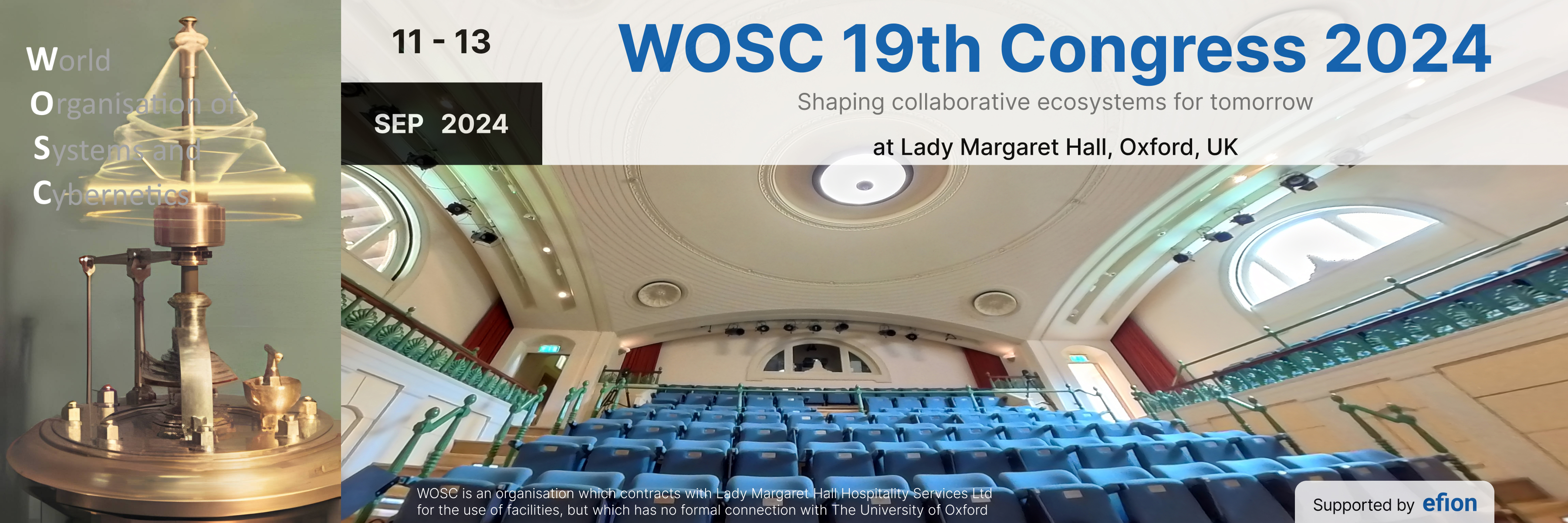
The complexity of interactions and relationships in our world have consistently surpassed our ability to fully comprehend and govern. The presence of intelligent tools, both in the digital and physical realms, is progressively enhancing our capacities to act on personal, organizational, national, and international levels, leading to both intended and unintended consequences. Collectively, these changes are reshaping our primary habitat—the planet Earth—at a speed and scale that necessitate earnest consideration. In the midst of uncertainty, the development and utilization of these new capabilities would greatly benefit from CyberSystemic approaches and methods of learning. This advancement is crucial for fostering a sustainable understanding and taking actions to avert major threats to our civilization.
Therefore, Congress’s submissions are encouraged but not constrained by the following themes:
[[When I uploaded this, I thought it was – oddly – in person online. The latest update confirmed live screening]
Reserve your free tickets through The Lensic Box Office online or call (505) 988.1234. Santa Fe residents are encouraged to attend in person. This lecture will be streaming from Twitter, Facebook, LinkedIn and our YouTube page.
When Francis Spufford wrote Red Plenty, his celebrated novel about Soviet economic planning, he couldn’t have anticipated the reaction. Some saw it as a parable of the problems of capitalism after the financial crisis, others as an elegant demonstration in fictional form that capitalism never had any real alternative. Still others read it as a license to revive the dream of the planned economy. Were the vast economic apparatuses of Amazon and Walmart actually a blueprint for how to do socialism at scale? Now, as Silicon Valley tries to rebuild the economy around optimizing algorithms and AGI, old debates over markets and planning are opening up again. In this conversation, Henry Farrell, Professor of Democracy and International Affairs at Johns Hopkins University, interviews Spufford about the old dream of socialist optimization and the new debates that have arisen since. Introduced by SFI President David Krakauer
The Metaphorum 2024 Conference is set to take place in Berlin, Germany. This will be a two-day event from Monday September 16th to Tuesday September 17th.
This year’s conference theme centres around the role of creativity in sustaining viability. The primary conference activities are scheduled for Monday and Tuesday, to be held at The Change Hub, an innovative space dedicated to creating sustainable transformation and social impact.
In keeping with the theme of the conference, this will be an innovative experience, unlike any other Metaphorum conference you have attended.
Berlin 2024 Conference – Creativity and ViabilityMetaphorum 2024 ConferenceCreativity and Viability16 – 17 September 2024Berlin, Germany The Metaphorum 2024 Conference is set to take place in Berlin, Germany. This will be a two-day event from Monday September 16th to Tuesday September 17th.This year’s conference theme centres around the role of creativity in sustaining viability. The primary conference activities are scheduled for Monday and Tuesday, to be held at The Change Hub, an innovative space dedicated to creating sustainable transformation and social impact.In keeping with the theme of the conference, this will be an innovative experience, unlike any other Metaphorum conference you have attended.
Extension of “The Game of Life” into the third dimension by using time as z-axis. Done with the simulation zone of Blenders geometry nodes. It’s a cellular automaton developed by the British mathematician John Conway in 1970. The animation render had some hickups (missing and duplicate frames) which I had to correct manually afterwars. Still not sure what was causing it.
Simulation with Blender 4.0.0. Rendered with Blender3D/Cycles.
SCIO-NL komt elke 2e vrijdag van de maand live bijeen in Vianen (Hagenweg 3c). Er staan geen vaste onderwerpen op de agenda (daarvoor organiseren we specifieke andere meetings), maar de ervaring leert dat er altijd wel een interessant gesprek op gang komt over een systemisch onderwerp. Toegankelijk voor iedereen die de jaarlijkse fee voor de live-bijeenkomsten (€50,-) hiervoor betaald. En voor gasten. Neem contact op via ed@doitogether.nl als je interesse hebt, maar nog geen lid van de club bent…. Read more
SCiO’s Development Event offer an opportunity to draw upon the collective expertise of SCiO members in a friendly and supportive atmosphere. By taking Development Events online, using the Zoom meeting platform, we aim to make them accessible to more SCiO members Development Events are both for members who are just starting out on a journey to explore Systems Thinking approaches, and for those who have many years of exploration and practice…. Read more
Das Viable System Model war durch den Aufbau des menschlichen Nervensystems inspiriert, daher wird es oft als rein morphologisches Abbild eines lebensfähigen Unternehmens betrachtet, Wie auch in der Neurologie erlaubt diese Betrachtungsweise die bestehenden Störungen und Abweichungen auf eines der Systemteile wie Kleinhirn, bestimmte Großhirnareale, oder einzelne Nerven zurückzuführen, somit eine Diagnose zu stellen und eine richtige Therapieform zu wählen. Wie funktioniert aber ein gesundes “Nervensystem” einer Organisation? Welche Rolle spielen die zahlreichen Verbindungen zwischen de… Read more
Event Date Thu, Apr 25, 2024 – 18:00 – Thu, Apr 25, 2024 – 19:00 CET
SCIO-NL komt elke 2e vrijdag van de maand live bijeen in Vianen (Hagenweg 3c). Er staan geen vaste onderwerpen op de agenda (daarvoor organiseren we specifieke andere meetings), maar de ervaring leert dat er altijd wel een interessant gesprek op gang komt over een systemisch onderwerp. Toegankelijk voor iedereen die de jaarlijkse fee voor de live-bijeenkomsten (€50,-) hiervoor betaald. En voor gasten. Neem contact op via ed@doitogether.nl als je interesse hebt, maar nog geen lid van de club bent…. Read more
Vianen
Netherlands
Event Date Fri, May 10, 2024 – 11:30 – Fri, May 10, 2024 – 15:00 CET+1
Dit jaar werken we rond het thema ‘hoe eigenaarschap cultiveren’. We doelen met eigenaarschap op meer dan enkel het opnemen van verantwoordelijkheid voor de resultaten waarvoor iemand zijn commitment geeft en het daarop aanspreekbaar zijn. EIgenaarschap slaat in deze conferentie ook op de diepere connectie met het zelf, de verbinding met de eigen roeping, authenticiteit boven volgzaamheid, … Je kan dit thema vanuit verschillende systemische lenzen benaderen en elke lens zal interafhankelijk zijn met andere lenzen. Denk aan organisatieontwerp, veranderkunde, persoonlijke ontwikkeli… Read more
Mechelen
Belgium
Event Date Tue, May 14, 2024 – 12:30 – Tue, May 14, 2024 – 17:30 CET+1
Systeemidynamiikan työkalut auttavat organisaatiota ymmärtämään monimutkaisia yhteyksiä ja riippuvuuksia toimintaympäristössään sekä ennakoimaan päätösten ja toimintamallien pitkän aikavälin vaikutuksia. Auttamalla tunnistamaan ja ymmärtämään takaisinkytkentöjä ja niiden vaikutuksia organisaation toimintaan, ne tukevat tulevaisuuden eri mahdollisuuksien hahmottamista ja valmistautumista niihin. Työkalut voivat auttaa organisaatioita parantamaan strategista suunnittelua, päätöksentekoa ja kykyä sopeutua toimintaympäristönsä muutoksiin. Niillä voidaan tukea kestävämpää kehitystä ja tehokkaampaa … Read more
Event Date Thu, May 16, 2024 – 16:00 – Thu, May 16, 2024 – 17:30 EEST
Virtual Open Meeting: A series of presentations of general interest to Systems and Complexity in Organisation’s members and others. About this Event SCiO organises Open Meetings to provide opportunities for practitioners to learn and develop new practice, to build relationships, networks hear about skills, tools, practice and experiences. This virtual session will be held on Zoom. An agenda will be posted as soon as speakers are confirmed. … Read more
Event Date Mon, May 20, 2024 – 18:30 – Mon, May 20, 2024 – 21:00 GMT+1
SCiO’s Development Event offer an opportunity to draw upon the collective expertise of SCiO members in a friendly and supportive atmosphere. By taking Development Events online, using the Zoom meeting platform, we aim to make them accessible to more SCiO members Development Events are both for members who are just starting out on a journey to explore Systems Thinking approaches, and for those who have many years of exploration and practice…. Read more
Event Date Tue, Jun 18, 2024 – 18:30 – Tue, Jun 18, 2024 – 20:30 GMT+1
Virtual Open Meeting: A series of presentations of general interest to Systems and Complexity in Organisation’s members and others. About this Event SCiO organises Open Meetings to provide opportunities for practitioners to learn and develop new practice, to build relationships, networks hear about skills, tools, practice and experiences. This virtual session will be held on Zoom. An agenda will be posted as soon as speakers are confirmed. … Read more
SCiO’s Development Event offer an opportunity to draw upon the collective expertise of SCiO members in a friendly and supportive atmosphere. By taking Development Events online, using the Zoom meeting platform, we aim to make them accessible to more SCiO members Development Events are both for members who are just starting out on a journey to explore Systems Thinking approaches, and for those who have many years of exploration and practice…. Read more
Event Date Tue, Aug 13, 2024 – 18:30 – Tue, Aug 13, 2024 – 20:30 GMT+1
Face-to-Face Open Meeting: A series of presentations of general interest to Systems and Complexity in Organisation’s members and others. About this Event SCiO organises Open Meetings to provide opportunities for practitioners to learn and develop new practice, to build relationships, networks hear about skills, tools, practice and experiences. This all-day session will be held in the Penthouse Room at the Alliance Manchester Business School. An agenda will be posted as soon as speakers are confirmed. … Read more
Organisationsweite Kollaboration: DAS Ziel agiler Transformation in Unternehmen – was leider häufig so schwer zu erreichen scheint. Was auf Teamebene, z.B. durch die Nutzung eines agilen Frameworks, häufig gut gelingt, sieht über die Teamgrenzen hinweg nicht selten ganz anders aus. Flight Levels als Denkmodell verspricht hier einen neuen, leichtgewichtigen Zugang zur Lösung von Barrieren und Anbindung sogenannter „agiler Inseln”. Aktuell ist Biedulski als Agile Coach, Flight Levels Coach und Organisationsberater bei der Colenet GmbH tätig. … Read more
Event Date Thu, Sep 26, 2024 – 18:00 – Thu, Sep 26, 2024 – 19:00 CET
SCiO’s Development Event offer an opportunity to draw upon the collective expertise of SCiO members in a friendly and supportive atmosphere. By taking Development Events online, using the Zoom meeting platform, we aim to make them accessible to more SCiO members Development Events are both for members who are just starting out on a journey to explore Systems Thinking approaches, and for those who have many years of exploration and practice…. Read more
Event Date Tue, Oct 15, 2024 – 18:30 – Tue, Oct 15, 2024 – 20:30 GMT+1
Virtual Open Meeting: A series of presentations of general interest to Systems and Complexity in Organisation’s members and others. About this Event SCiO organises Open Meetings to provide opportunities for practitioners to learn and develop new practice, to build relationships, networks hear about skills, tools, practice and experiences. This virtual session will be held on Zoom. An agenda will be posted as soon as speakers are confirmed. … Read more
Event Date Mon, Nov 18, 2024 – 18:30 – Mon, Nov 18, 2024 – 21:00 GMT
Michael Frahm, Jahrgang 1979. Ausbildung in Stuttgart, Kaiserslautern, Saarbrücken in Bauingenieurwesen und Wirtschaftsrecht. Managementkurse an der HEC Paris, der HHL und an der Northwestern University. Im Jahr 2010 Gewinner des Young PM Awards der GPM. Zertifizierung zum Senior PM der IAPM und Zertifizierung als Advanced System Thinking Practitioner der SCiO. Verfasser von Bauprojektmanagement Büchern mit System Perspektive. Zahlreiche Artikel und Vorträge zu Ingenieurwesen und Management. Dozent für das Management von Großprojekten und Systems Practice. Mehr als 15 Jahre Erfahrung im Bauwes… Read more
Event Date Thu, Nov 28, 2024 – 18:00 – Thu, Nov 28, 2024 – 19:00 CET
SCiO’s Development Event offer an opportunity to draw upon the collective expertise of SCiO members in a friendly and supportive atmosphere. By taking Development Events online, using the Zoom meeting platform, we aim to make them accessible to more SCiO members Development Events are both for members who are just starting out on a journey to explore Systems Thinking approaches, and for those who have many years of exploration and practice…. Read more
Event Date Tue, Dec 10, 2024 – 18:30 – Tue, Dec 10, 2024 – 20:30 GMT
Online-Jahresabschlussfeier für alle Mitglieder. Es besteht die Möglichkeit kurz zusammengefasste Ergebnisse der eigenen Forschung/Arbeit im Bereich Systems Practice des vergangenen Jahres den übrigen Mitgliedern vorzustellen…. Read more
Event Date Thu, Dec 19, 2024 – 18:00 – Thu, Dec 19, 2024 – 19:00 CET
[Regular readers will know of my scepticism about MDPI as a publisher, as judged by my understanding of the value of their systems journals. I really conclude that something is broken here. I don’t *think* it’s me, but if it is, it might be by trying to read some of this. Trying to make it make sense, I idly followed the profile of the ‘Academic Editor, Prof. Vladimír Bure, who is a Professor (I think of Systems Engineering) at the University of Hradec Kralove – and perhaps the strangely wide range of topics in his published articles (https://sciprofiles.com/profile/255730) fits in Systems Engineering? And tried A System Dynamics Perspective on Workplace Spirituality and Employee Behavior (from the Administrative Sciences Journal – perhaps he can’t publish in Systems as he’s the Academic Editor?) – as the paper I might be most likely to make some sense of and… look, here’s a typical paragraph (the first):
“The corporate sphere has perpetually prioritized productivity and profitability. Researchers from developed nations consistently analyze potential factors impacting productivity and performance, aiming to propose strategies for optimizing resource utilization. It can be asserted that the most pivotal resource influencing organizational productivity is its human resources—the individuals comprising the organization. When organizational members experience satisfaction, their productivity and creativity tend to soar. Personal accomplishment and heightened morale are closely intertwined with superior performance, directly impacting the organization’s productivity and profitability. Conversely, a discontented work environment is prone to low morale, elevated turnover, burnout, stress-related issues, and increased absenteeism (Srivastava and Pradhan 2021).”
…which certainly is a collection of words? Then there’s the cover story of this actual journal, which is… a systematic review of papers? Which misspells “water shed” in the abstract. There’s an editorial for a special edition on public health, the articles of which appear (https://www.mdpi.com/journal/systems/special_issues/STMPH) to have been published in 2022 and 2023 (one of the two authors is from a Department of Computer Science & Software Engineer, does that make sense?), there’s at least one name I recognise, and I dunno, maybe they are all good and worthy papers but there seems to be no coherence of topics, methods, theory, citations or… anything? I suspose they do broadly all fit within the declared scope: https://www.mdpi.com/journal/systems/about
Most papers seem to be published within a month of submission – some within two weeks – and there’s a fee of CHF 2,400 (about £2,100) for publication, and apparently they are a member of the Committee on Publication Ethics (did they deliberately name it COPE?!) and ‘take the responsibility to enforce a rigorous peer-review together with strict ethical policies and standards…’
Can anyone put me out of my misery? Am I just not understanding? Does it make sense? The ISSS affiliation and several names on the (apparently hundred-strong) editorial board remain]
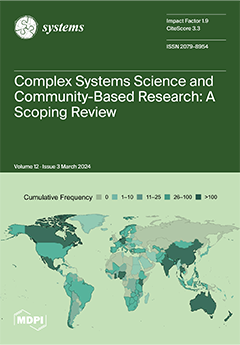
Cover Story: Complex Systems Science (CSS) and Community-Based Research (CBR) have emerged as complementary disciplines. Yet, understanding their recent integration to tackle complex issues remains incomplete. Using DistillerSR, we conducted a scoping review of articles employing both CSS and CBR. Employing natural language processing, including a named entity recognition model and dynamic topic modeling, we analyzed the manuscript data. The findings show CBR topic frequency surpassing CSS, often utilizing CSS concepts and analytical techniques. Key topics driving this trend include social system collaboration, business management, food and land use, and watershed management. This review sheds light on the integration of CSS and CBR and its implications for addressing complex social, economic, and health-related issues. View this paper
Systems, Volume 12, Issue 3 (March 2024) – 42 articlesCover Story (view full-size image): Complex Systems Science (CSS) and Community-Based Research (CBR) have emerged as complementary disciplines. Yet, understanding their recent integration to tackle complex issues remains incomplete. Using DistillerSR, we conducted a scoping review of articles employing both CSS and CBR. Employing natural language processing, including a named entity recognition model and dynamic topic modeling, we analyzed the manuscript data. The findings show CBR topic frequency surpassing CSS, often utilizing CSS concepts and analytical techniques. Key topics driving this trend include social system collaboration, business management, food and land use, and watershed management. This review sheds light on the integration of CSS and CBR and its implications for addressing complex social, economic, and health-related issues. View this paper

 Systems Community of Inquiry
You must be logged in to post a comment.