
Seven methods for mapping systems
February 28, 2023
By Pete Barbrook-Johnson and Alexandra S. Penn
Seven methods for mapping systems – Integration and Implementation Insights
Author Archives: antlerboy - Benjamin P Taylor
Implementation of Systems Thinking in Public Policy: A Systematic Review – Nguyen et al (2023)
[Double warning: a systematic review (i.e. word search on papers) and an MDPI Journal]
Implementation of Systems Thinking in Public Policy: A Systematic Review
by
Le-Khanh-Ngan Nguyen 1,2,
Bowen Jiang 1 and
Nici Zimmermann 1,*
Systems | Free Full-Text | Implementation of Systems Thinking in Public Policy: A Systematic Review
Frontiers in Complex Systems, San Miguel (2023)
[From the usually-reliable Complexity Digest. I may be tired, but I’m struggling to see why it’s noteworthy. Sharing anyway!]
FIELD GRAND CHALLENGE article
Front. Complex Syst., 16 February 2023
Volume 1 – 2023 | https://doi.org/10.3389/fcpxs.2023.1080801Frontiers in Complex Systems
Frontiers | Frontiers in Complex Systems
- Institute for Cross-Disciplinary Physics and Complex Systems, IFISC (CSIC—UIB), Campus Universitat Illes Balears, Palma de Mallorca, Spain
InFusion Labs – Creating Flexible Spaces for Practitioners to Explore and Learn
InFusion LabsCreating Flexible Spaces for Practitioners to Explore and Learn
InFusion Labs – Creating Flexible Spaces for Practitioners to Explore and Learn
Alexander Bogdanov, Stafford Beer and intimations of a post-capitalist future, Prof Mike Jackson online, March 15th, 5:00-6:30 pm Metaphorum’s Webinar Series
Join Zoom Meeting:
https://lnkd.in/enihtrxv
Alexander Bogdanov (1873–1928) was a Russian social theorist and revolutionary activist whose ‘universal organizational science’, or Tektology, is increasingly being recognized as offering stronger foundations for the systems approach than the later ‘general system theory’ of Ludwig von Bertalanffy. Had his thinking not been suppressed by Stalin, the course of Soviet history might have been different. Stafford Beer (1926–2002) was a British management scientist and consultant who was a pioneer in the development of ‘organizational cybernetics’. His best-known engagement was with the government of Salvador Allende, in Chile, seeking to use his ‘viable system model’ to create a socialist society that did not rest on a command economy. This experiment was cut short by the Pinochet coup d’etat. I have found no evidence that Beer was familiar with the work of Bogdanov, and this makes the similarities in their thinking particularly striking. This paper explores the ideas they shared. The work of other writers who have drawn on the work of Bogdanov and Beer, in formulating contemporary visions of post-capitalism, is also noted.
Bioentropy, Aesthetics and Meta-dualism: The Transdisciplinary Ecology of Gregory Bateson, Harries-Jones
Bioentropy, Aesthetics and Meta-dualism: The Transdisciplinary Ecology of Gregory Batesonby Peter Harries-Jones
Entropy | Free Full-Text | Bioentropy, Aesthetics and Meta-dualism: The Transdisciplinary Ecology of Gregory Bateson
“From Anthropology to Epistemology”: Extensions to an Autobiography of Gregory Bateson, Harries-Jones
Peter Harries‑Jones
York University (Ontario)
2021
“From Anthropology to Epistemology”: Extensions to an Autobiography of Gregory BatesonPeter Harries‑JonesYork University (Ontario)2021
“From Anthropology to Epistemology” : Extensions to an Autobiography of (…) – Bérose
IMBRICATE! Technics Lifeless and Technics Alive: Activity Without and With Content – Andrew Murphie
via @AndrewMurphie@indieweb.social
Technics Lifeless and Technics Alive: Activity Without and With Content
Andrew Murphie
IMBRICATE! Technics Lifeless and Technics Alive: Activity Without and With Content
Home | Bridging Systems
What are bridging systems?
Home | Bridging Systems
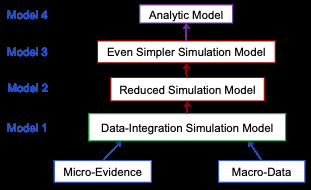
The inevitable “layering” of models to extend the reach of our understanding

Bruce Edmonds
RofASSS
There is a modelling norm that one should be able tocompletelyunderstand one’s own model. Whilst acknowledging there is a trade-off between a model’s representational adequacy and its simplicity of formulation, this tradition assumes there will be a “sweet spot” where the model is just tractable but also good enough to be usefully informative about the target of modelling – in the words attributed to Einstein, “Everything should be made as simple as possible, but no simpler”1. But what do we do about all the phenomena where to get an adequate model2one has to settle for a complex one (where by “complex” I mean a model that we do not completely understand)? Despite the tradition in Physics to the contrary, it would be an incredibly strong assumption that there areno such phenomena, i.e. that an adequate simple model…
View original post 11 more words
RSD12 – Relating Systems and Design – will be October 9-20 at Georgetown University, USA
| RSD12 ANNOUNCEMENT | February 22, 2023 |
| RSD12 organising institution announced Georgetown University, USAThis year, RSD12 is a multi-event symposium. The invitation to submit an expression of interest to host a hub site is now open. Proposal deadline is March 7, 2023. |
| RSD12 HUB EOI & CONCEPT PAPER |
| RSD12 Concept |
| SAVE THE DATES: OCTOBER 9–20, 2023READ MORE |
| The Georgetown proposal is a multi-event symposia concept, connecting systemic design hubs around the world in a sequence of in-person, online, and hybrid sessions. Hub symposia are augmented by a daily four-hour online program dedicated to full papers and emergent programming (RSD12 co-schedule). The working dates for RSD12 are October 9th–20th, 2023, excluding weekends (the dates will be finalized following input from confirmed hubs).The RSD12 program will feature up to eight hubs, plus Georgetown University. Hubs will run programs sequentially to avoid an overlap in programming and consist of in-person sessions over at least one day, including a live-streamed keynote speaker. RSD12 will culminate with a three-day event, October 18–20, 2023, hosted on-campus at Georgetown University in Washington, DC, and the SDA General Assembly on Friday, October 20th, 2023. |
| RSD12 Call for hubs |
| The Systemic Design Association and Georgetown University are ready to receive Expressions of Interest from partner organizations to host one or multiple days of RSD12 as part of the collaborative hub model envisioned for October 2023. Please submit your EoI before March 1, 2023.READ MORE |
| Expression of Interest and FAQsThe expression of interest provides clear steps for putting your hub idea forward. There’s a schedule and budget template to help make planning easier. FAQs include what you need to do, what to expect from organisers, proceedings and how to apply. |
| Take a minute |
| Systemic Design Symposium SurveySURVEY |
| Please take a minute to complete this brief survey to help guide planning for the next phase of the systemic design symposium and RSD12. The results of this systemic design symposium survey will guide RSD12 planning group decision-making.Since the first RSD symposium was held in 2012 a symposium has been held each year. The inaugural two-day seminar, organized by Birger Sevaldson and Marit Helgesen at the Oslo School of Architecture and Design, has expanded to accommodate the systemic design community and the trove of interdisciplinary contributions each year. The planning teams have adapted the programme to online and hybrid formats and in 2021, SDA launched RSDsymposium.org to provide a robust, searchable repository. The repository represents leading thinking on systemic design and consists of hundreds of presentations, papers, and gigamaps. |
| About Georgetown |
| Located in Northwest Washington, D.C., situated along the Potomac River.RSD12 INFO |
| Georgetown University is a top-ranking academic and research institution comprised of 11 undergraduate and graduate schools and degrees in more than 40 disciplines. RSD12 chair, Evan Barba, is an associate professor in the Communication, Culture and Technology Program and co-director of the Iteration Lab, a multidisciplinary laboratory for the design and analysis of socio-technical systems. Evan is an SDA founding member, a consistent contributor to RSD symposia, and joined the SDA board in 2019.If you plan to join the culminating in-person three-day event at Georgetown University, it’s worth planning to stay the weekend. RSD12 is situated near Washington DC museums, which number more than 75 and include the Smithsonian Institution’s 17 museums, many galleries and a zoo. (Bonus: many of the museums are free of charge.) |
| Opportunities |
| TU Delft and AHO have open calls for professors of systemic design.Assistant Professor Systemic Design, TU Delft—deadline March 16Professor/Associate Professor in Design, AHO—deadline March 26 |
| “How we might design with and across intergenerational communities to cultivate pluralistic, participatory communities?” Elon University’s Design Forge 2023 sessions run from March 29-31. Sign up now for free online registration. For more information contact Danielle Lake. |
 |
Complexity72h
Complexity72h is an interdisciplinary workshop for young researchers in complex systems. Participants form teams and carry out projects in a three days’ time, i.e. 72 hours. The goal of each team is to upload on the arXiv (or similar repositories) a report of their work by the end of the event. The editions of 2018 and 2019 were a success: 11 out of 11 projects became arXiv preprints and new collaborations were born. Complexity72h is back for a 2023 edition, which will take place in Palma (Mallorca, Spain) on June 26-30.
More info & application: www.complexity72h.com
Deadline for applications: March 1st 2023
Complexity Explorables | The Prisoner’s Kaleidoscope

This explorable illustrates beautiful dynamical patterns that can be generated by a simple game theoretic model on a lattice. The core of the model is the Prisoner’s Dilemma, a legendary game analyzed in game theory. In the game, two players can choose to cooperate or defect. Depending on their choice, they receive a pre-specified payoffs. The payoffs are chosen such that it seems difficult to make the right strategy choice.
Read the full article at: www.complexity-explorables.org
Davide Nicolini on the Tavistock Institute and associated socio-technical systems tradition in Approaches to the Study of Work part 2- Classics AoM PDW LIVE – Talking About Organizations Podcast 93
Shared for Davide Nicolini on the Tavistock Institute and associated socio-technical systems tradition (second speaker in Part 2)
93: Approaches to the Study of Work — Classics AoM PDW LIVESEPTEMBER 13, 2022 EPISODES, EVENTS, ORGANIZATIONAL THEORY 00:03:29Audio Player00:0000:00Use Up/Down Arrow keys to increase or decrease volume.From the Academy of Management Annual Meeting 2022With panelists Steve Barley, Gina Dokko, Ingrid Erickson, and Davide Nicolini (pictured at left)
93: Approaches to the Study of Work – Classics AoM PDW LIVE – Talking About Organizations Podcast
Nature’s order | #11 – by Christian Lemp
Nature’s order | #11Biological systems, information theory, research updates, and leading with the heartChristian Lemp
Nature’s order | #11 – by Christian Lemp
 Systems Community of Inquiry
You must be logged in to post a comment.