This paper introduces the Viable Systems Model and in particular the Meta System component of that model, as a framework within which to consider how foresight can be facilitated in organisations. Shows how the System 4 function within the meta system is in a position to facilitate processes that will produce effectiveness and the development of overall system identity. Also shows how adopting another framework for understanding the paradigms or worldviews that operate in organisations can enhance the likelihood that these processes will be successful.
also via https://www.researchgate.net/publication/235291881_Facilitating_foresight_Where_the_foresight_function_is_placed_in_organisations
FuturePod EP 2: Deep Inquiry and Dealing with Complexity – Peter Hayward
In 2012, a literally game-changing economics paper was published. I believe can eventually transform the very structure of civilization. (I don’t make these kinds of statements lightly.) Yet it’s still virtually unknown outside of academia.
The (highly technical) paper, “Iterated Prisoner’s Dilemma contains strategies that dominate any evolutionary opponent”, is by legendary physicist Freeman Dyson (RIP) and William Press of “Numerical Recipes” fame. Hereon “D&P”.
In 2012, a literally game-changing economics paper was published. I believe can eventually transform the very structure of civilization. (I don't make these kinds of statements lightly.) Yet it's still virtually unknown outside of academia. 🧵
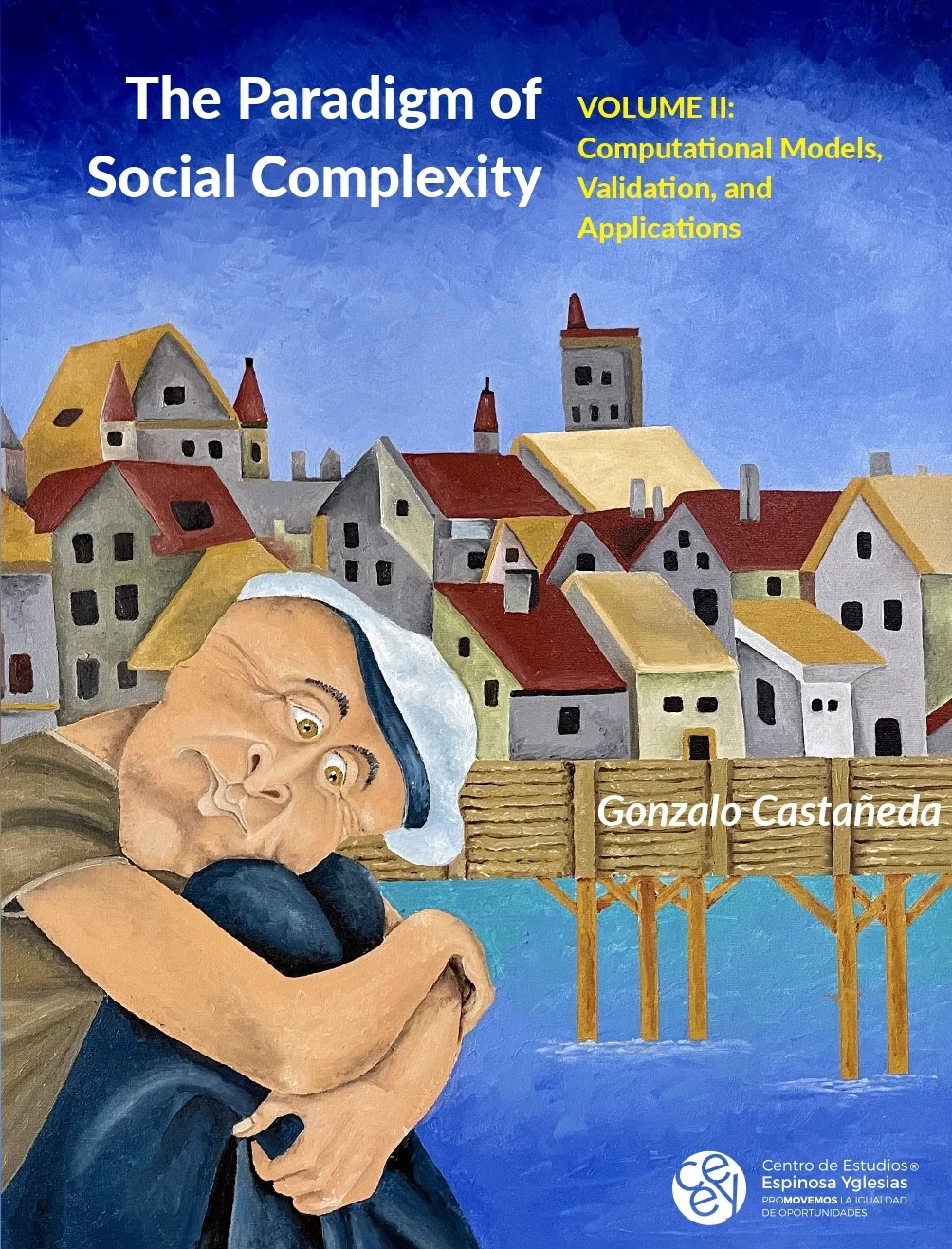
Volume I: An Alternative Way of Understanding Societies and their Economies Volume II: Computational Models, Validation, and Applications
Gonzalo Castañeda
With the recent developments in computing technologies and the thriving research scene in Complexity Science, economists and other social scientists have become aware of a more flexible and promising alternative for modelling socioeconomic systems; one that, in contrast with neoclassical economics, advocates for the realism of the assumptions, the importance of context and culture, the heterogeneity of agents (individuals or organisations), and the bounded rationality of individuals who behave and learn in multifaceted ways in uncertain environments. The book synthesises an extensive body of work in the field of social complexity and constructs a unifying framework that allows developing concrete applications to important socioeconomic problems. This one-of-a-kind textbook provides a comprehensive panorama for advanced undergraduates and graduate students who want to become familiar with a wide range of issues related…
Causal emergence is the theory that macroscales can reduce the noise in causal relationships, leading to stronger causes at the macroscale. First identified using the effective information and later the integrated information in model systems, causal emergence has been analyzed in real data across the sciences since. But is it simply a quirk of these original measures? To answer this question we examined over a dozen popular measures of causation, all independently developed and widely used, and spanning different fields from philosophy to statistics to psychology to genetics. All showed cases of causal emergence. This is because, we prove, measures of causation are based on a small set of related “causal primitives.” This consilience of independently-developed measures of causation shows that macroscale causation is a general fact about causal relationships, is scientifically detectable, and is not a quirk of any particular measure of causation. This finding sets the science of emergence on firmer ground, opening the door for the detection of intrinsic scales of function in complex systems, as well as assisting with scientific modeling and experimental interventions.
Manifesto of Transdisciplinarity, 1994, signed by B. Nicolescu, E. Morin and L. de Freitas
The “Charter of Transdisciplinarity” offered here appears as the first appendix to Nicolescu’s Manifesto of Transdisciplinarity (2002). Actually, however, the Charter has been adopted at the First World Congress of Transdisciplinarity, held in 1994. In the author’s view, “transdisciplinarity” defines a space for synthesis “across, between and beyond” disciplines. It is worth noting the deep anthropological import of transdisciplinarity (evident throughout the Charter), as well as the values of rigour, opening and tolerance mentioned in Article 14. Nicolescu’s promotion of transdisciplinarity is still in progress at present.
Preamble
Whereas, the present proliferation of academic and nonacademic disciplines is leading to an exponential increase of knowledge which makes a global view of the human being impossible;
Whereas, only a form of intelligence capable of grasping the cosmic dimension of the present conflicts is able to confront the complexity of our world and the present challenge of the spiritual and material self-destruction of the human species;
Whereas, life on earth is seriously threatened by the triumph of a techno-science that obeys only the terrible logic of efficacy of efficacy’s sake;
Whereas, the present rupture between increasingly quantitative knowledge and increasingly impoverished inner identity is leading to the rise of a new brand of obscurantism with incalculable social and personal consequences;
Whereas, an historically unprecedented growth of knowledge is increasing the inequality between those who have and those who do not, thus engendering increasing inequality within and between the different nations of our planet;
Whereas, at the same time, hope is the counterpart of all the afore-mentioned challenges, a hope that this extraordinary development of knowledge could eventually lead to an evolution not unlike the development of primates into human beings;
Therefore, in consideration of all the above, the participants of the First World Congress of Transdisciplinarity (Convento da Arrábida, Portugal, November 2-7, 1994) have adopted the present Charter, which comprises the fundamental principles of the community of transdisciplinary researchers, and constitutes a personal moral commitment, without any legal or institutional constraint, on the part of everyone who signs this Charter .
Article 1:
Any attempt to reduce the human being by formally defining what a human being is and subjecting the human being to reductive analyses within a framework of formal structures, no matter what they are, is incompatible with the transdisciplinary vision.
Article 2:
The recognition of the existence of different levels of reality governed by different types of logic is inherent in the transdisciplinary attitude. Any attempt to reduce reality to a single level governed by a single form of logic does not lie within the scope of Transdisciplinarity.
Article 3:
Transdisciplinarity complements disciplinary approaches. It occasions the emergence of new data and new interactions from out of the encounter between disciplines. It offers us a new vision of nature and reality. Transdisciplinarity does not strive for mastery of several disciplines but aims to open all disciplines to that which they share and to that which lies beyond them.
Article 4:
The keystone of Transdisciplinarity is the semantic and practical unification of the meanings that traverse and lie beyond different disciplines. It presupposes an open-minded rationality by re-examining the concepts of “definition” and “objectivity.” An excess of formalism, rigidity of definitions and a claim to total objectivity, entailing the exclusion of the subject, can only have a life-negating effect.
Article 5:
The transdisciplinary vision is resolutely open insofar as it goes beyond the field of the exact sciences and demands their dialogue and their reconciliation with the humanities and the social sciences as well as with art, literature, poetry and spiritual experience.
Article 6:
In comparison with interdisciplinarity and multidisciplinarity, transdisciplinarity is multireferential and multidimensional. While taking account of the various approaches to time and history, transdisciplinarity does not exclude a transhistorical horizon.
Article 7:
Transdisciplinarity constitutes neither a new religion, nor a new philosophy, nor a new metaphysics, nor a science of sciences.
Article 8:
The dignity of the human being is of both planetary and cosmic dimensions. The appearance of human beings on Earth is one of the stages in the history of the Universe. The recognition of the Earth as our home is one of the imperatives of transdisciplinarity. Every human being is entitled to a nationality, but as an inhabitant of the Earth is also a transnational being. The acknowledgement by international law of this twofold belonging, to a nation and to the Earth, is one of the goals of transdisciplinary research.
Article 9:
Transdisciplinarity leads to an open attitude towards myths and religions, and also towards those who respect them in a transdisciplinary spirit.
Article 10:
No single culture is privileged over any other culture. The transdisciplinary approach is inherently transcultural.
Article 11:
Authentic education cannot value abstraction over other forms of knowledge. It must teach contextual, concrete and global approaches. Transdisciplinary education revalues the role of intuition, imagination, sensibility and the body in the transmission of knowledge.
Article 12:
The development of a transdisciplinary economy is based on the postulate that the economy must serve the human being and not the reverse.
Article 13:
The transdisciplinary ethic rejects any attitude that refuses dialogue and discussion, regardless of whether the origin of this attitude is ideological, scientistic, religious, economic, political or philosophical. Shared knowledge should lead to a shared understanding based on an absolute respect for the collective and individual Otherness united by our common life on one and the same Earth.
Article 14:
Rigor, opening and tolerance are the fundamental characteristics of the transdisciplinary attitude and vision. Rigor in argument, taking into account of all existing data, is the best defense against possible distortions. Opening involves an acceptance of the unknown, the unexpected and the unpredictable. Tolerance implies acknowledging the right to ideas and truths opposed to our own.
Final Article:
The present Charter of Transdisciplinarity was adopted by the participants of the first World Congress of Transdisciplinarity, with no claim to any authority other than that of their own work and activity.
In accordance with procedures to be agreed upon by transdisciplinary-minded persons of all countries, this Charter is open to the signature of anyone who is interested in promoting progressive national, international and transnational measures to ensure the application of these Articles in everyday life.
Convento de Arrábida, November 6, 1994
Editorial Committee: Lima de Freitas, Edgar Morin, Basarab Nicolescu
B. Nicolescu, Manifesto of Transdisciplinarity, translated by K. Claire Voss (Albany: State University of New York Press, 2002), pp. 147-152.
Haven’t come across this before (the site was set up, I think, in November 2021). Comes across as very ‘sales-y’ and there are certainly some books in the ‘top 35’ that I wouldn’t choose – quite interesting.
Our Systems Change Frameworks
We at The Systems Sanctuary teach and train people who want to create the conditions for systemic change. We use many frameworks and tools to do this. Here are some of the frameworks we have created ourselves (along with a few favorites created by others).
SCiO organises Open Meetings to provide opportunities for practitioners to learn and develop new practice, to build relationships, networks hear about skills, tools, practice and experiences. This virtual session will be held on Zoom, the details of which will be confirmed nearer the time.
There will be two sessions during this open meeting.
This meeting replaces a provisional F2F event, moved back online due to Covid – it will NOT be held in London as originally planned.
Roger Duck and Jane Searles will share their recent experience of creating conditions to enable exploration of transformational systemic change. The work involved the collaborative development of a visionary whole system transition architecture. The specific context was regional transport, but the … Read more
Patrick will talk about his new book ‘The Grammar of Systems’ which is in two parts: the ‘Grammar’ describing 33 Systems Laws and Principles and how to use them; and ‘How to think like a Systems Thinker’ which goes through 9 thought patterns involved in systems thinking. In the session we’ll loo… Read more
SCiO UK Virtual Open Meeting – March 2022 Mon 21 March 2022 18:30–20:30 GMT Event type: Open Meeting Organiser(s): SCiO UK Event access: All welcome Book now SCiO UK Virtual Open Meeting – March 2022 Virtual Open Meeting: A series of presentations of general interest to Systems & Complexity in Organisation’s members and others.
I’m including this here mostly because I was absolutely blown away by this conversation, and I want more people to listen to it. It’s four hours, sorry.
And it isn’t really ‘systems thinking’ per se. But the effortlessness with which they – especially the guest, Shrayan Bhattacharya – shift between the ‘topics’ of economy, art, movies, taste, sexism, society, economy, change, joy, sexuality, politics, and so on – almost as if they weren’t actually ‘topics’ at all, but one interrelated weaving of lives – is beautiful and very appropriate. And it’s hella metamodern (to coin a phrase), it’s about fandom and trivia and media mix and the collective journey and the female gaze on the economy. It’s quite brilliant.
10 Jan 2022 Episode 259: The Loneliness of the Indian Woman Indian women are lonely in the bedroom, lonely in the kitchen, lonely in the workplace. Shrayana Bhattacharya joins Amit Varma in episode 259 of The Seen and the Unseen to discuss the interior and exterior lives of these unseen millions.
JPHMP Editor-in-chief Lloyd Novick speaks with Kristina Y. Risley and Christina R. Welter about best practices for enacting change at different levels while describing the factors, processes, skills, and tools required for leading complex change.
We live in an increasingly complex world. Against the backdrop of the COVID-19 pandemic, deepening racial, health, and social inequities have only accentuated this complexity. More than a traditional behavioral change approach is needed to address systemic challenges. Creating genuine, effective, equitable, and lasting change in our systems and institutions requires that we expand who we involve and how we think to ask questions that get to the root of problems and lead to solutions that work for everyone — especially those who are most impacted by our systems.
Written for public health practitioners and partners, Leading Systems Change in Public Health: A Field Guide for Practitioners provides an inclusive process and framework with tools for implementing change that leads to transformation. This comprehensive resource translates academic and practice experiences into a roadmap that is approachable and easy to use, regardless of where you or your institution are on the journey to change. Leading Systems Change also features real-life public health systems change initiatives that apply concepts explored in the book.
I recently had the opportunity to speak with two of the book’s editors, Kristina Risley and Christina Welter.
Kristina Risley
Kristina Y. Risley, DrPH, CPCC, is an Executive and Leadership Coach with Kris Risley Coaching. She has served the public health field in this role since being certified with the Co-Active Coaching Institute in 2004. Dr. Risley earned her DrPH in Maternal and Child Health from the University of Alabama at Birmingham. She also has a Master’s Degree in Developmental Psychology; she has a sincere interest in the intersection of human and public health workforce development.
Christina Welter
Christina R. Welter, DrPH, MPH is a nationally recognized policy practitioner, visionary leader, and practice-based researcher committed to helping organizations and communities co-create equity-centered systems change. She is the Director of the Doctorate in Public Health Leadership Program and a Clinical Assistant Professor in the Division of Health Policy and Administration at the University of Illinois at Chicago (UIC) School of Public Health. Dr. Welter’s scholarship focuses on mixed-method participatory action research and evaluation approaches to understand and address the structural determinants of health; facilitate learning, leadership development, and power building for structural change; and drive policy and systems change toward racial and economic justice.




You must be logged in to post a comment.