A person is sought who has some familiarity or interest in the Systems/cybernetics fields to provide part-time research assistance to the president of IFSR (currently Prof. Ray Ison). The post is for 6 hours per week and would be suited to someone currently undertaking PhD study or might like to become familiar with the systems field as preparation for future PhD study.
Role specification:
Assist the President in drafting and circulating strategic position papers amongst IFSR members and to policy makers and selected journalists;
Undertake relevant literature research and drafting of material on behalf of the president; assist with submissions of IFSR policy publications when relevant
Assist the president in compiling data from IFSR member websites and from one-to-one conversations with individuals in leadership positions in IFSR member organisations as contributions to strategy documents
Help identify potential funding sources for research and/or policy entrepreneurship based on IFSR strategy proposals
Assist in bid preparation for funding
Liaise with other EC members and IFSR Community Curator in relation to other tasks.
For further information, for leads, and applications please contact Prof Ray Ison and Louis Klein at application@ifsr.org.
An introduction to the UNDP Sensemaking toolkit and then a discussion about how Sensemaking could be used in your organisation.
About this event
The UNDP Asia Pacific Innovation team have developed an approach to Sensemaking which we use to support strategy and impact development across the UNDP Country Offices. There is potential for this methodology to be useful for any organisation who delivers programmes and is looking to find better routes to impact for those programmes. This session is designed to introduce interested people to the Sensemaking Toolkit and to discuss how Sensemaking could be used in organisations outside the UNDP.
A zoom link will be sent to registered participants along with the Toolkit prior to the event.
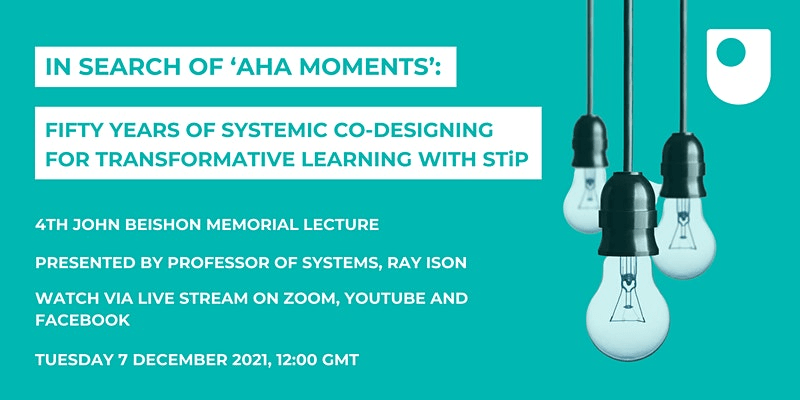
Explore the history and achievements of The Open University’s 50 year-commitment to co-designing and providing Systems education.
About this event
About the event
As part of the STiP@50 event series, Professor Ray Ison employs a STiP (Systems Thinking in Practice) lens to explore the history and achievements of The Open University’s 50 year-commitment to co-designing and providing Systems education, drawing from these experiences lessons for our current circumstances and future action.
Ray will be introduced by Kris Stutchbury, Senior Lecturer in Teacher Education at The Open University and Academic Director for the multi award-winning Teacher Education in sub-Saharan Africa (TESSA) programme – the largest established teacher education network in Africa. Kris is also daughter of the renowned systems thinking practitioner Peter Checkland.
About STiP at The Open University
In 1971, The Open University (OU) in the UK pioneered academic education with the creation of the Department of Systems responsible for presenting a widening range of Systems learning opportunities, now under the aegis of STiP (Systems Thinking in Practice). Since 1971, nearly 50,000 students have studied STiP modules, and many systems resources can be found on the OpenLearn and FutureLearn platforms.
After 50 years, the OU offers a thriving postgraduate suite of qualifications in STiP, supported by internationally acclaimed academics. STiP capabilities are increasingly demanded to make sense, strategise and improve problematical situations in all areas and at all levels, from global human-induced climate change to public health, addressing domestic violence through community health services or business viability. In response to this growing need in 2022 the OU will also become a provider (in England) of masters level Systems Thinking Practitioner Apprenticeships.
Please join us in the 2021 event series that celebrates the STiP Jubilee of The Open University. To receive the live links for the talk, you are invited to register on this page through Eventbrite. Here you will have the option of watching Ray on YouTube or Facebook Live if you prefer not to join through The Open University Zoom platform.
We hope you will join us online for the talk, and/or on social media for the conversation using #OUSTiP and #OUSTiP50. Please feel free to circulate details to friends and colleagues who may not be on this email listing.
A short history of OU systems thinking is available to download here.
We look forward to your participation in fruitful conversations to appreciate the value of STiP for the betterment of all lives in Home Earth.
Privacy Notice – Open University Events booked through Eventbrite, document owned and updated as necessary by the Data Protection team.
About the presenter
Professor Ray Ison joined the Systems Department at The Open University as Professor of Systems in 1994 having moved from the University of Sydney. Since then Ray has been involved in all facets of academic life, including considerable external engagement with STiP alumni, international networks of STiP-oriented scholars and researchers, and in international leadership roles within the Systems and Cybernetics communities. Ray is currently in his second term as President of IFSR (International Federation for Systems Research) a ‘peak body’ of systems, cybernetic and complexity organisations and professional bodies.
In his talk Ray hopes to provide insights into claims made by Diana Laurillard from research which identified “Five distinct ways in which university students describe what they mean by ‘learning’. This research was replicated at many universities with the same result, except at the OU. OU students also saw learning as a way of ‘changing as a person’ – something that students at other universities did not identify.” In the OU STiP experience, learning associated with ‘Aha moments’ extends beyond students.
Ray will claim that the life of a STiP educator/academic and ‘would be improver’ of our world pivots around the emergence of Aha moments. This presentation will explore the nature and scope of Aha moments that have emerged from 50 years of STiP praxis at the OU. In a world facing the need for new ways of thinking and acting in what some now call the Anthropocene, a new framing for human-induced changes in the biosphere, there has never been a greater need for Aha moments! In this regard, the OU STiP experience has much of value to offer: the purposeful design of learning systems; a constant striving to provide an active, situated and embodied pedagogy; a strong ethos of the importance of relationship, multiple perspectives and, thus co-design and co-inquiry processes, to name but a few.
About the John Beishon memorial lecture series
John Beishon (1930-2001) was the first Professor of Systems at The Open University
John Beishon’s life and contribution, and based on his work, the contributions of the Systems Group at the OU, are celebrated in this 4th John Beishon Memorial Lecture.
John Beishon set the essential directions for systems teaching at the OU. Under his chairmanship, T241: Systems Behaviour, the first systems course, ran for 18 years from 1972-1990. The earliest systems-academic staff appointments were made by him. Some of these staff have only recently retired.
The Next Frontier for Naturalistic Decision Making: A Call to Action
John Schmitt suggests a new frontier for applying NDM principles and provides a landscape of current NDM tools that may be relevant to this emerging area. We are actively seeking input from the community about tools for addressing wicked problems!
Dear Complexity Friends, we are holding a Social Enterprise Complexity & Systems Change Day in Adelaide, Australia on 15/3/22. Will definitely be worth the trip to Australia as before the event we have our world famous WOMADelaide music festival. #socent https://womadelaide.com.au
A journal for relationally attuned and systemic social constructionist practitioners and practitioner-researchers with a commitment to social responsibility in community, leadership, therapy, education, organisations, health and social care.
THE WRITING PROJECT
POETRY FOR NOW!
Share your poems or stanza writing about relational changes and their unfolding consequences across human and non-human systems
Announcing Part 2 of The Systemic Flux Writing Project hosted by Murmurations: Journal of Transformative Systemic Practice. Please send us your poetry, your stanza form writings. Check out what this is about. Click on the image to access Poetry For Now! Please share with your colleague, systemic and otherwise.
‘How cybernetics explains behavioural tensegrity and its advantages for organisations’, Presentation for the 18th Annual Congress of World Organisation of Systems and Cybernetics (WOSC) online September to 27thhttps://papers.ssrn.com/sol3/papers.cfm?abstract_id=3913811
If you don’t have a subscription, open the link and before the page has loaded hit ‘print’, select print to pdf, and hit ‘print’ on the print dialogue (works on Chrome on Windows computer).
he operations room of “Project Cybersyn” (short for “cybernetics synergy”) was created by Chile’s president Salvador Allende in the early 1970s as a place from which the country’s newly nationalised and socialised economy could be directed. To build it, Allende had hired Staord Beer, a British consultant, who requisitioned a mainframe computer and connected it to telex machines in factories. Industrial managers would input data which would then be centrally analysed; instructions for any necessary changes would be sent back. Ironically, the socialist system’s most notable success was in outmanoeuvring lorry drivers whose strike threatened to bring down Allende’s government in 1972. After Chile’s generals stormed the presidential palace on September 11th 1973 and Allende killed himself, Cybersyn was destroyed: a soldier is said to have stabbed all the screens in the operations room with a knife. It was a bloody reprisal of a then half-century-old debate about how best to run an economy. Allende had thought that, with state-of-the-art 1970s communications and computers, it would be possible for government to
optimise an industrial economy. The Chicago-school economists advising Pinochet in Chile thought that the far greater information-processing capacity of the market would do better. In Chile their opinion was imposed by force. The success of market- and semi-market-based economies since then has made the notion of a planned economy seem like a thing of the past. But were a latter-day Allende to build a Cybersyn 2.0 it could now gather data via billions of sensors rather than a few telex machines, and crunch them in data centres packed with tens of thousands of servers. Given enough power, might it not replace the autonomous choices on which the market is based?
As part of his plan for socialism in the early 1970s, Salvador Allende created Project Cybersyn. The Chilean president’s idea was to ooffer bureaucrats unprecedented insight into the country’s economy. Managers would feed information from factories and elds into a central database. In an operations room bureaucrats could see if production was rising in the metals sector but falling on farms, or what was happening to wages in mining. They would quickly be able to analyse the impact of a tweak to regulations or production quotas Cybersyn never got o the ground. But something curiously similar has emerged in Salina, a small city in Kansas.
…
Whatever the concerns, the pandemic has given economists a new lease of life. During the Chilean coup of 1973 members of the armed forces broke into Cybersyn’s operations room and smashed up the slides of graphs—not only because it was Allende’s creation, but because the idea of an electrocardiogram of the economy just seemed a bit weird. Third-wave economics is still unusual, but ever less odd.
The connection you made between the value of real-time information andSalvador Allende’s Project Cybersyn is a reminder of a lost opportunity. One ofAllende’s principal advisers when he was president of Chile was Staff ord Beer, avisionary cyberneticist, then at Manchester Business School, who came up withthe pioneering viable system model. Some of us were not entirely sure aboutStaff ord’s connection with reality, but that was our mistake. Had Allende livedon we might now be much further ahead in this burgeoning fi eld of analysis andadministration. Still, better late than never. tony eccles London
The SDGs address some of the most fundamental issues that are at stake for systems transformation in the context of tackling the global challenges of our time. These issues require action-oriented systemic interventions, but the SDGs are not systemic by design. As we approach the mid-term of the implementation of the United Nations Agenda 2030, we would like to pause and reflect while asking this question: “How can systems approaches help accelerate the achievement of the SDGs in the post-pandemic context for building back better?” Therefore, the purpose of this event is to discuss the challenges and explore potential pathways for transformation to embed systems approaches into the (re)design, implementation and evaluation of the SDGs, so as to accelerate progress in the achievement of the United Nations Agenda 2030. This online event is jointly organized by a group of academic partners: EADA Business School, University of Hull’s Centre for Systems Studies, Presencing Institute, Blue Marble Evaluation and Ethos of Management Consulting with the support of the United Nations Development Coordination Office.
I have a google alert for ‘systems thinking’ and normally, I pick out the most relevant pieces – and often it’s rather simplistic takes in marketing or generally vague aspirational pieces. Today’s update was particularly rich though – so here they all are.






 Systems Community of Inquiry
You must be logged in to post a comment.