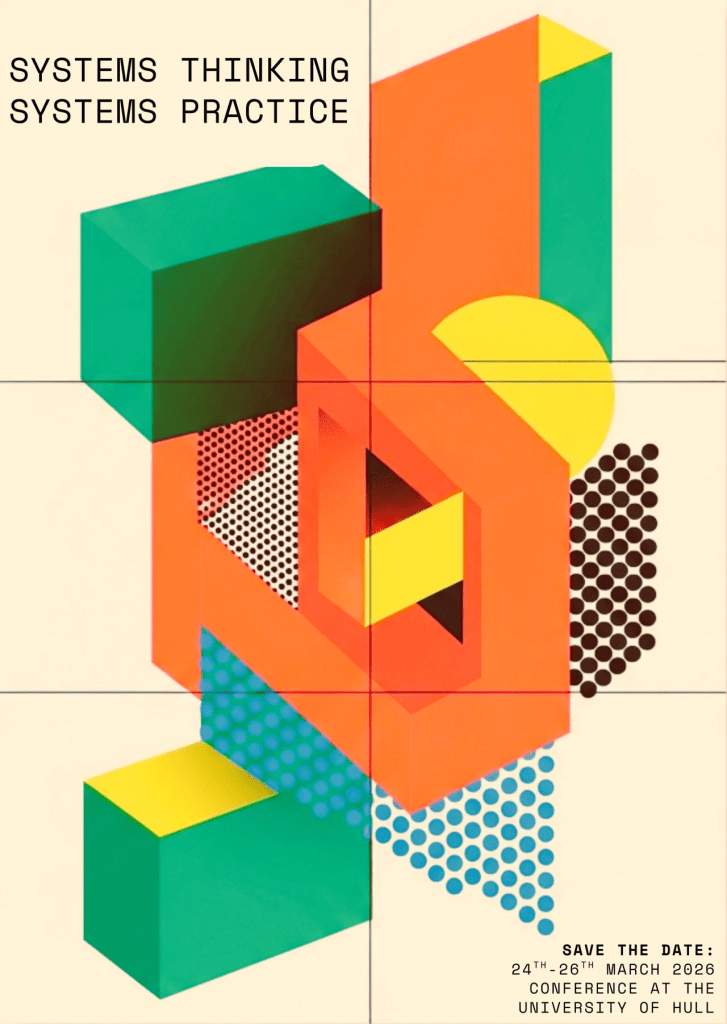
Steering towards Agency and Resilience in the Age of Alien Intelligence and Instability.
Manchester Business School, Manchester, UK July 3rd – 5th 2025
Humans at risk? Steering towards Agency and Resilience in the Age of Alien Intelligence and Instability. Manchester Business School, Manchester, UK July 3rd – 5th 2025
If you are interested to learn more about Systems thinking I have co-written a book for the curious. It’s an informal book with great pictures that takes you on a walk around Zurich with me and John as we discuss some core principles of Systems Thinking. I tell real stories of examples and John gives the academic background to the points. Our hope is it will introduce a whole new audience to a powerful way of thinking.
https://lnkd.in/eGJquN9S
Here is the free full book as a PDF if you prefer electronic versions.
Carola, Michael and Matvei will look at management cybernetics as a general framework to successfully implement lean management in several industries (construction, mechanical engineering & healthcare). Numerous lean transformation projects fail or do not achieve the desired performance and/or viability that is necessary for a sustainable implementation of lean management. However, there are some factors that support the successful implementation of lean management in day-to-day business. In the opinion of the authors, these include management cybernetics and, in particular, Stafford Beer’s viable system model (VSM) as a structuring element. The paper was published in our journal and the link is below: https://doi.org/10.58695/ec.12
[Honestly, I can’t think of anyone else who has such a well-developed, complexity-aware, thoroughly researched and detailed analysis and prescription for a large and important part of the US (and by implication world) system. If you know of any, let me know!]
Monday Feb 24, 2025
In this episode of the Strong Towns Podcast, Chuck explores the flawed nature of North America’s current “housing bargain,” where most neighborhoods are allowed to stay exactly the same as long as some neighborhoods — usually those that are poorer and have less political clout — are forced to radically change. He proposes a new way forward that respects cities as living and evolving systems.
America Needs a New Housing Bargain. Here’s Why. Monday Feb 24, 2025
Timothy F.H. Allen, president of International Society for the Systems Sciences 2008-2009, passed away peacefully in his home, surrounded by his family, on May 1, 2025.
With his work on ecosystem ecology, I learned more about living systems than anyone else in the systems community. After his retirement, he was proud of putting together a reader, so that other could continue to learn.
Curtin, Charles G., and Timothy F. H. Allen, eds. 2018. Complex Ecology: Foundational Perspectives on Dynamic Approaches to Ecology and Conservation. Cambridge: Cambridge University Press. https://lnkd.in/gxj8NKDt .
More details on news forwarded by Tom Brandner is reposted at https://lnkd.in/gN7Csbv2
Calling everyone in Ireland with a stake in ensuring a Green Just Transition that leaves no one behind. Due to some last minute cancellations, we have a few spots available on this valuable engaged workshop on 8 May in Dublin and encourage your participation!
What will a Just Transition look like? How will we know when we get there?
SCiO Ireland and Eurofound, the EU Agency for the Improvement of Living and Working Conditions, are hosting a workshop on 8 May 2025 on the critical challenge of the Green Just Transition – specifically the complex dilemma facing policymakers who must address climate change while ensuring: Fairness for vulnerable populations Equitable economic opportunities Sustainable development that leaves no one behind We believe that effective evaluation approaches are crucial to designing and executing a truly Just Transition. We are therefore developing An Irish Case Study with European relevance. The central question our project explores is: “If evaluators take the idea that no one should be left behind seriously, what would a just transition look like?” This experiential process workshop forms a key part of a wider project. We will engage in a hands-on interactive process of inquiry to access collective group wisdom to access fresh insights for policymakers in Ireland and across the EU. The methodology draws on systems thinking and Social Presencing Theatre, a methodology developed at MIT for embodied learning. This workshop will provide learning and insights that will feed into a paper to document the process and outcomes of this workshop: the abstract has been accepted for a Special Edition of the European journal “Evaluation”. Workshop Information
When: 8 May 2025 10.30am – 4pm Where: in the offices of Eurofound: Eurofound, Wyattville Road, Loughlinstown, Co. Dublin, D18 KP65, Ireland (Eurofound’s Conference Centre, downstairs, Meeting room CC2) How to get there: Map and transport information | European Foundation for the Improvement of Living and Working Conditions Format: Interactive systemic co-inquiry process Participants: 20-30 representatives from government, local authorities, employer organizations, trade unions, civil society, and subject matter experts Outcome: Insights that will directly inform our journal paper and provide valuable perspectives for evaluators, researchers, policymakers, and communities grappling with the challenges of the Green Just Transition. Participants in the process will gain insights from interaction with other perspectives and stakeholders. To register email: joanodonnell@systemspractice.org
[If, like me, you react with some distaste to the inherent concept in the title – well at least it say ‘brain’ not ‘mind’ – and in the podcast’s name – bear with… this is actually a very neat intro to Information Theory]
Published Apr 28, 2025, 3:01 PM
Description
We’re welcoming back Christopher Lynn, Assistant Professor of Physics at Yale University, to chat about how the brain works.
In this episode, Christopher discusses how statistical mechanics and information theory can help us gain a deeper understanding of brain function and consciousness.
SysPrac25 brings together systems thinking practitioners, academics and learners from around the world and from a wide range of systems thinking disciplines. Participants will come together to share and learn practical new skills and about different approaches from one another.
We are a community of change agents, consultants, academics, some with long track records, some just starting out, but all with a thirst to learn and share.
It’s now commonplace for people in all sectors to talk about the world and their organisations becoming more complex. The recognition that systems approaches offer solutions to dealing with this complexity is increasingly understood, so the demand for systems practitioners has never been greater.
SysPrac25 is being run by SCiO, the professional body for systems practitioners, in partnership with the Open University’s Systems Thinking in Practice (STiP) group, and the International Federation for Systems Research (IFSR). It is hosted by the Open University’s STiP group – one of the longest standing and renowned academic systems group in the world.
Join us as participant, contributor or sponsor
Who will benefit from attending SysPrac25?
Systems Practitioners – from every systems thinking discipline
Learners – whether going through formal courses like the Master’s level apprenticeship in the UK, or self-paced learning, there will be a wide range of workshops where you can pick up new skills from established practitioners
Experts – an opportunity to share your experiences with others
Systems Academics – as Reg Revans famously stated, “There is no learning without action and no action without learning.” At the heart of our discipline lies the continual effort to close the theory–practice loop. This conference offers a valuable opportunity to engage directly with practitioners and collaboratively strengthen that essential connection.
Problem owners – if you have a complex problem you’re struggling with, bring it to a problem clinic for some expert input.
Organising team: SCiO, and friends Mike Jones, Patrick Hoverstadt, Jo Caughlin, Gavin Roberts, Lesley Rowan, Steve Hales, Simon McCormac, Martin Reynolds and Russ Lewis.
Chile’s privately managed individual pension fund system, with its low replacement rates and pension incomes far below the minimum wage, has long been the subject of serious criticism. A new model is required that considers not only financial, economic and demographic variables but realistic assumptions about the behaviour of actors in a design that guarantees minimally acceptable incomes. With that in mind, the literature pertaining to the Chilean pension system found on the Web of Science (WoS) platform’s Master Journal List is surveyed to identify the system’s bases, assumptions and critiques. An approach is then proposed based on the mathematical theory of viability as an extension of system dynamics techniques. We argue that the combination of these techniques and viability theory are not only useful for solving the problem of the pension system’s viability but in fact the only method of solving it. Based on concepts of chance and necessity of viable systems, the approach is a multi-system one that provides a wider range of solutions over multiple dimensions compared to the current system, in particular replacing the latter’s narrow view of workers as \emph{homo oeconomicus} with a much broader concept we denote \emph{home ecologicus}. Although there is currently no algorithmic method for solving the model’s set of variables, we believe the proposed model has great potential as a basis for the design of a truly viable pension system.
Battle-Fisher, M. (2024). Disrupting Public Health Disparities toward Equity: a conceptual investigation using systems thinking and systems science. (Thesis). University of Hull. https://lnkd.in/ewD7uhMp
You must be logged in to post a comment.