
Purpose: The rise of Socio-Technical Systems (STS) and Socio-Ecological Systems (SES) perspectives originated in the industrialization of the 1950s and 1960s. With ubiquitous computing and globalization compressing time and space, interests in systems thinking by the 2020s have turned towards systems changes. This refocusing on changes has encouraged hypothesizing an alternative world theory of (con)texturalism-dyadicism with a root metaphor of yinyang dancing through [eight] seasons. Through post-colonial sciencing in constructionist philosophizing across Western and Classical Chinese traditions, SES alongside STS are recast as kairotic rhythms casting on and binding off weaves in time.
Approach: This inquiry began with behavioral histories of open-sourcing-while-private-sourcing, in an inductive approach to theory building. Curiosity on the origins of causal texture theory led to plunging into the history of pragmatism, and its associated metaphilosophy. An exploration of processual philosophies revealed a better appreciation through a non-Western approach, via yinyang at the foundation of Classical Chinese Medicine. Developing a (con)textural-dyadic world theory enables conjoining SES and STS as diachronic complements.
Findings: Changes in SES and STS based on Western philosophy presuppose functions and structures as primordial, evoking systems conceptions of rearranging objects. Clarifying root metaphors, changes in SES and STS that foreground processes and behaviors elevate the repacing of rhythms in systems concepts. Systems practice approaches involving action learning can be adapted for the altered foundations..
Originality: In organizational theory, SES and STS have been expressed as different perspectives on systems of interest. Tracing back to metaphilosophy from the 1940s, an alternative branch of pragmatism incorporating yinyang enlarges the scope of systems thinking from its Anglo-American traditions.
Keywords: Socio-Ecological Systems, Socio-Technical Systems, Systems Change, Systems Thinking
STPIS 2024 Proceedings: Reifying Socio-Technical and Socio-Ecological Perspectives for Systems Changes December 30, 2024 daviding
STPIS 2024 Proceedings: Reifying Socio-Technical and Socio-Ecological Perspectives for Systems Changes – Coevolving Innovations
Category Archives: Discussion
A view or perspective on the world
Systems Thinking and Systems Modelling [System Dynamics/Causal Loop Diagrams]
h/t Systems Innovation network – sharing this at
https://www.systemsinnovation.network/posts/ebooks-systems-dynamics-ebook-42726988
Main link:
https://loopsconsulting.kumu.io/systems-thinking-and-systems-modelling
pdf:
[NB it seems that the content for lesson one is lacking[
An Online Course for Understanding and Creating Systems Models
Systems Thinking and Systems ModellingAn Online Course for Understanding and Creating Systems Models
Systems Thinking and Systems Modelling, by The Sustainability Laboratory with Loops Consulting
An ecology of bad ideas: approaching human relations with wider nature from an ecological-complexity perspective – Hay (2024)
h/t Ivo Velitchkov
Authors
- Emma HayN elson Mandela University
In this article, human relations with wider nature are approached from an ecological-complexity perspective. From this viewpoint, environmental issues such as ongoing biodiversity loss and mass extinction are co-implicated with economic and social problems and regarded as symptomatic of a deeper ‘crisis of thinking’. Borrowing from Félix Guattari’s (1989) The Three Ecologies, which foregrounds the overlapping interrelationality of different mental, social, and environmental ‘registers’, ecological economics and ecopsychology are brought into interdisciplinary dialogue. Here critical attention is drawn to the “ecologics of growthmanship” (bigger, faster, more is better), as explored through the concept of “economism”, which illustrates the interplay between the individual (psyche) and its surrounding social milieu. Revealed by this networking is an “ecology of bad ideas” that materially, symbolically, and psychologically detaches humans from wider nature. An ecological-complexity lens provides fresh theoretical insight into urgent collective problems and opens the dialogue for different theoretical, ethical, and practical responses
DOI:
https://doi.org/10.38140/aa.v56i2.8974
Keywords:
ecological-complexity, ecologics, growthmanship, economism, negative capability
An ecology of bad ideas: approaching human relations with wider nature from an ecological-complexity perspectiveAuthorsEmma HayNelson Mandela UniversityDOI: https://doi.org/10.38140/aa.v56i2.8974Keywords: ecological-complexity, ecologics, growthmanship, economism, negative capability
An ecology of bad ideas: approaching human relations with wider nature from an ecological-complexity perspective | Acta Academica: Critical views on society, culture and politics
https://journals.ufs.ac.za/index.php/aa/article/view/8974
pdf:
ASC: Dancing with Ambiguity – Bunnell (2015)
- P. Bunnell
- Published in Cybernetics & Human Knowing 2015
- Art
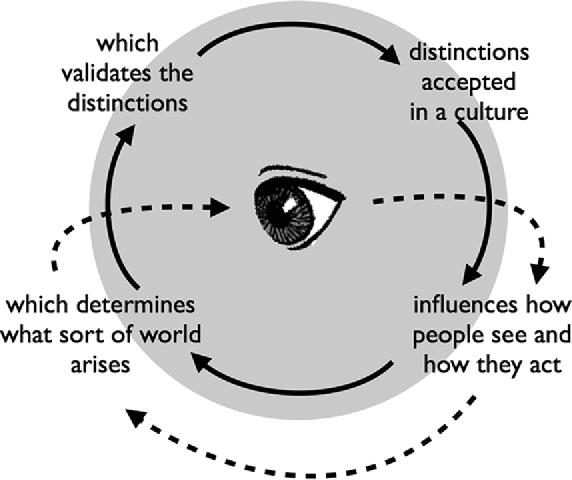
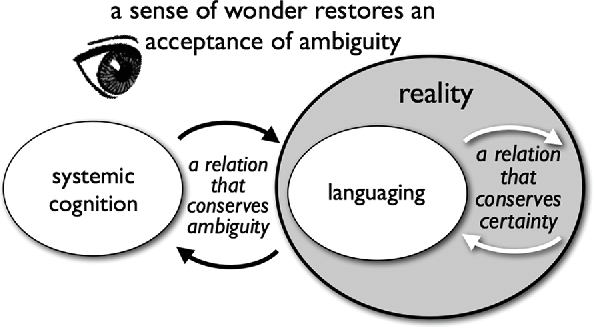
For us humans ambiguity is, I think, a necessary concomitant to complexity. Since we are living systems living systemically, in a complex systemic network of relations, complexity is a given. Thus ambiguity is also a given, though at times we would like to dispose of it or ignore it. In this paper I will approach the topic of ambiguity via some common metaphors, a parable, and through my understanding of biology, language, culture, cybernetics and systems. I began working with simulation models in the late 1960s, using punch cards and one-day batch processing at the University of California Berkeley campus computer center. As the complexity of our computing systems grew, I like many of my colleagues, became enchanted with this new possibility of dealing with complexity. Simulation models enabled us to consider many interrelated variables and to expand our time horizon through projection of the consequences of multiple causal dynamics, that is, we could build systems. Of course, that is exactly what we did, we built systems that represented our understanding, even though we may have thought of them as mirrors of the systems we were distinguishing as such. Like others, I eventually became disenchanted with what I came to regard as a selected concatenation of linear and quasi-linear causal relations. As I continued to discuss systems and eventually teach systems courses, I became acquainted with the work of Donella Meadows; and found myself deeply respectful of her insights and clarity. In particular I liked her paper “Dancing with Systems”2 where she claims “We can’t control systems or figure them out. But we can dance with them!” (Meadows, 2008, p. 170).3 I like the notion of dancing with as it implies both an ongoing coordination with another, or a group, and a coherence with something
link:
[PDF] ASC: Dancing with Ambiguity | Semantic Scholar

Social Organizations as Reconstitutable Networks of Conversation – Krippendorff (2008)
This essay intends to recover human agency from holistic, abstract, even oppressive conceptions of social organization, common in the social sciences, social systems theory in particular. To do so, I am taking the use of language as simultaneously accompanying the performance of and constructing reality (my version of social constructivism). The essay starts with a definition of human agency in terms of its linguistic manifestation. It then sketches several leading conceptions of social organization, their metaphorical origin and entailments. Finally, it contextualizes the use of these metaphors in conversation, which leads to the main thesis of this essay that the reconstitutability of networks of conversation precedes all other criteria of the viability of organizational forms. The paper transcends the traditional second-order cybernetic preoccupation with individual cognition – observation and description – into the social domain of participation.
https://repository.upenn.edu/entities/publication/6fa7c4e5-ea8d-4b02-94b3-4134e5a138d4
The resonance of Mike Jackson’s work with the use of systems ideas in community operational research – Herron et al (2024)
Rebecca J. M. Herron, Zoraida Mendiwelso Bendek, David E. Salinas Navarro, Eliseo Vilalta-Perdomo, Miles W Weaver
First published: 22 December 2024
https://doi.org/10.1002/sres.3100
Abstract
The body of work of Mike Jackson covers several major themes in OR/Systems Thinking and articulates key aspects of Critical Systems Thinking; with an interest throughout in applications to complex social challenges. In this paper, as a direct response to this Festschrift, and acknowledging his contribution to Community OR, five active UK-based researchers have engaged in their own process of community-based learning in order to articulate the ways Jackson’s work resonates with their contemporary research and practice. The researchers used a variation of the Delphi method to reflect first on the ways that the body of work of Jackson resonated with their practice and research agendas. This produced a framework of ideas. Examples from the UK and overseas are then provided to illustrate these points. Ultimately, the researchers used these experiences and reflections to produce a series of statements for developing Community OR practice (and theory)—reflecting and extending Jackson’s work.
Executive Summary
The work of Mike Jackson covers several important themes in Systems Thinking and Operational Research (OR) and articulates key aspects of Soft OR—arguably most notably, through differentiating problem-solving in different contexts (through The System of Systems Methodologies) and by encouraging the application of Systems Thinking to complex large-scale and contemporary challenges. Much of Jackson’s work reflects his interest in working on complex social challenges, indicated by his support for Community OR as an emerging subfield (indeed bringing the Community OR Unit to Lincoln during his time there as Head of School). In this paper, as a direct response to this Festschrift, and acknowledging his contribution to Community OR, five active UK-based researchers connected to the Community OR Stream of the UK Operational Research Society have engaged in their own process of community-based learning in order to articulate the ways Jackson’s work resonates with their contemporary research and practice. In undertaking this self-organised process, researchers reviewed the literature and Jackson’s contributions and articulated a number of ways his work resonates with their understanding about how Systems Thinking relates to sustainable communities in rearticulated contexts—looking increasingly now towards 2030 and 2050 global agendas. The researchers used a variation of the Delphi method to reflect first on the ways that the body of work of Jackson resonated with their practice and research agendas. This produced a framework of ideas that echoes through their own research. Examples from multiple Higher Education Institutions (in the UK and overseas) are then provided to illustrate these points. Ultimately, the researchers used these experiences and reflections to produce a series of statements and refreshed research questions for developing Community OR practice (and theory) that respond to this body of work in relation to current Grand Challenges, including environmental, social and economic ones that impact, and are impacted by, the communities we engage with. This reflective and scholarly process reinforced to us that Jackson’s work resonates as much now as it did before. We conclude that what Jackson et al. did for critical systems and emancipation, the next generation of researchers needs to reshape and extend with a greater focus on marginalised/absent stakeholders, community-led research and with a co-creation and sustainability lens including future generations and non-human stakeholders. Systems Thinking also requires the OR/Systems Thinking research community to keep co-creating relevant and meaningful approaches that enable researchers and communities to work together, but that also enable communities to work by themselves—putting communities at the heart of understanding social challenges and the solutions co-created. What seems at risk of being forgotten is how to improve the abilities of our community partners to become independent-minded researchers—not dependent on external experts. This perspective focusses on enhancing self-organisation, participation and democratic problem-solving and decision-making, rather than favouring researchers’ external interventions or impositions. In collectively reviewing the body of scholarly work from Jackson, we hope we have highlighted once more the value of re-connecting current wo0rk on these issues to the rich systemic literature that comes before.
The resonance of Mike Jackson’s work with the use of systems ideas in community operational research – Herron – Systems Research and Behavioral Science – Wiley Online Library
The Patron Saint of Complexity (Wittgenstein) – Harish Jose
Quite a lively discussion on LinkedIn:
What Emergence Can Possibly Mean – Carroll and Parola (2024)
Sean M. Carroll, Achyuth Parola
We consider emergence from the perspective of dynamics: states of a system evolving with time. We focus on the role of a decomposition of wholes into parts, and attempt to characterize relationships between levels without reference to whether higher-level properties are “novel” or “unexpected.” We offer a classification of different varieties of emergence, with and without new ontological elements at higher levels.
| Comments: | Submitted to a volume on Real Patterns (Tyler Milhouse, ed.), to be published by MIT Press |
| Subjects: | History and Philosophy of Physics (physics.hist-ph); Statistical Mechanics (cond-mat.stat-mech) |
| Cite as: | arXiv:2410.15468 [physics.hist-ph] |
| (or arXiv:2410.15468v1 [physics.hist-ph] for this version) | |
| https://doi.org/10.48550/arXiv.2410.15468Focus to learn more |
Submission history
From: Sean Carroll [view email]
[v1] Sun, 20 Oct 2024 18:45:11 UTC (145 KB)
[2410.15468] What Emergence Can Possibly Mean
https://arxiv.org/abs/2410.15468#
Related podcast
295 | Solo: Emergence and Layers of Reality
November 11, 2024 / Philosophy / 21 Comments
Emergence is a centrally important concept in science and philosophy. Indeed, the existence of higher-level emergent properties helps render the world intelligible to us — we can sensibly understand the macroscopic world around us without a complete microscopic picture. But there are various different ways in which emergence might happen, and a tendency for definitions of emergence to rely on vague or subjective criteria. Recently Achyuth Parola and I wrote a paper trying to clear up some of these issues: What Emergence Can Possibly Mean. In this solo podcast I discuss the way we suggest to think about emergence, with examples from physics and elsewhere.
Reflections on a Half-Century of Organizational Sociology – Scott (2004)
David Ing writes:
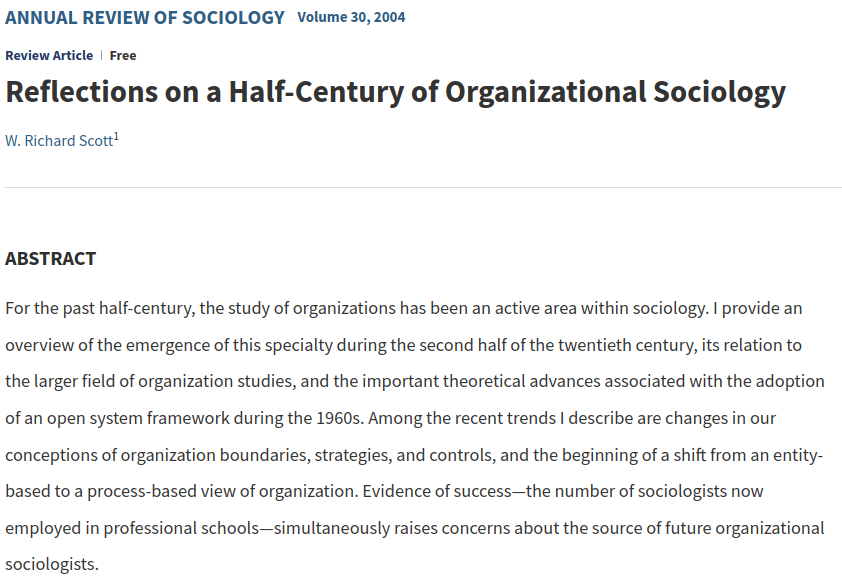
From the 1982 publication of _Organizations: Rational, Natural, and Open systems_, W. Richard Scott in 2004 reflected back on the history of organizational sociology.
> Before open system ideas, organizational scholars had concentrated on actors (workers, work groups, managers) and processes (motivation, cohesion, control) within organizations. Scant attention was accorded to the environment within which the organization operated.
Scott, W. Richard. “Reflections on a half-century of organizational sociology.” Annu. Rev. Sociol. 30, no. 1 (2004): 1-21 at https://www.annualreviews.org/…/annurev.soc.30.012703…
Reflections on a Half-Century of Organizational Sociology | Annual Reviews
Systems approach – Nikiforovoa (2022, revised to 2024), Encyclopedia of Knowledge Organization
David Ing writes:
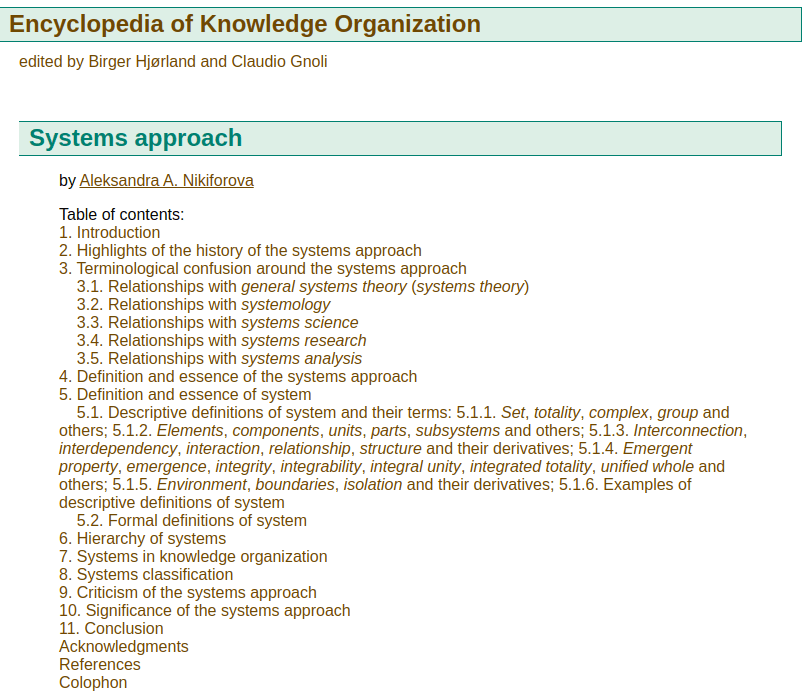
For those interested in detailed distinctions between systems approach, systems thinking, General Systems Theory, system science, etc, Aleksandra A. Nikiforova (Lomonosov Moscow State University) started an entry in the Encyclopedia of Knowledge Organization in 2022 that has been revised to 2024.
https://www.isko.org/cyclo/systems
The International Society for Knowledge Organization is a “scholarly society devoted to the theory and practice of knowledge organization, bringing together professionals from different disciplines such as information science, philosophy, linguistics, and computer science, as well as special domains such as health informatics”.
Systems approach (IEKO)

After Organizations: Rational, Natural, and Open Systems (1982) | W. Richard Scott (2004)
From the 1982 publication of Organizations: Rational, Natural, and Open Systems, W. Richard Scott in 2004 reflected back on the history of organizational sociology.
> Before open system ideas, organizational scholars had concentrated on actors (workers, work groups, managers) and processes (motivation, cohesion, control) within organizations. Scant attention was accorded to the environment within which the organization operated.
Scott, W. Richard. “Reflections on a half-century of organizational sociology.” Annu. Rev. Sociol. 30, no. 1 (2004): 1-21 at https://www.annualreviews.org/content/journals/10.1146/annurev.soc.30.012703.110644
Systems approach | Encyclopedia of Knowledge Organization
For those interested in detailed distinctions between systems approach, systems thinking, General Systems Theory, system science, etc, Aleksandra A. Nikiforova (Lomonosov Moscow State University) started an entry in the Encyclopedia of Knowledge Organization in 2022 that has been revised to 2024.
https://www.isko.org/cyclo/systems
The International Society for Knowledge Organization is a “scholarly society devoted to the theory and practice of knowledge organization, bringing together professionals from different disciplines such as information science, philosophy, linguistics, and computer science, as well as special domains such as health informatics”.
Boundary Issues – In the Search for a General Systems Theory – Rasmussen (2024)
Lynn Rasmussen
Dec 17, 2024
Boundary IssuesIn the Search for a General Systems TheoryLYNN RASMUSSENDEC 17, 2024
Boundary Issues – by Lynn Rasmussen
The AI We Deserve – Evgeny Morozov – with responses from Brian Eno, Audrey Tang, Terry Winograd, Bruce Schneier & Nathan Sanders, Sarah Myers West & Amba Kak, Wendy Liu, Edward Ongweso Jr., and Brian Merchant (2024)
Critiques of artificial intelligence abound. Where’s the utopian vision for what it could be?
With responses from Brian Eno, Audrey Tang, Terry Winograd, Bruce Schneier & Nathan Sanders, Sarah Myers West & Amba Kak, Wendy Liu, Edward Ongweso Jr., and Brian Merchant
- December 4, 2024
link:
The AI We Deserve – Boston Review
Why Gregory Bateson Matters – Gioia (2024)
h/t Arthur Battram
Or what a counterculture might look like in the 21st century
Dec 16, 2024
Why Gregory Bateson MattersOr what a counterculture might look like in the 21st centuryTED GIOIADEC 16, 2024
Why Gregory Bateson Matters – by Ted Gioia
 Systems Community of Inquiry
You must be logged in to post a comment.