Worth saying also in relation to ‘meta-rationality’ that all forms (I think) of ‘adult development’ could also be seen as ways of raising our awareness of this foundation of reality and our ability to embody and understand – and even ‘model’ – these different contextualities. (As is, for example, Donna Meadows’ ‘places to intervene in a system’, and Mike has already on Linkedin drawn attention to
We’re growing! Applications for Assistant Professor Position Now Open.
The Center for the Study of Complex Systems (CSCS) at the University of Michigan seeks applicants for a tenure-track faculty position in complex systems science.
Save14 views 7 Oct 2024WOSC congress 2024 Keynote John Beckford “Still in Torment: (Re)Designing Freedom” It is now 30 years since ‘World in Torment’ explored ‘chronic societary triage’ (WOSC, Beer 1993) and 50 since ‘Designing Freedom’ considered the role of ‘science in the service of man’. This address will briefly rehearse the key ideas of those works and then consider the current state of the world. Examining the societary, political, economic and planetary challenges we are now facing it will examine thosechallenges from a cybernetic perspective and show how those ideas can support us in resolving ‘The Real Threat to “All We Hold Most Dear
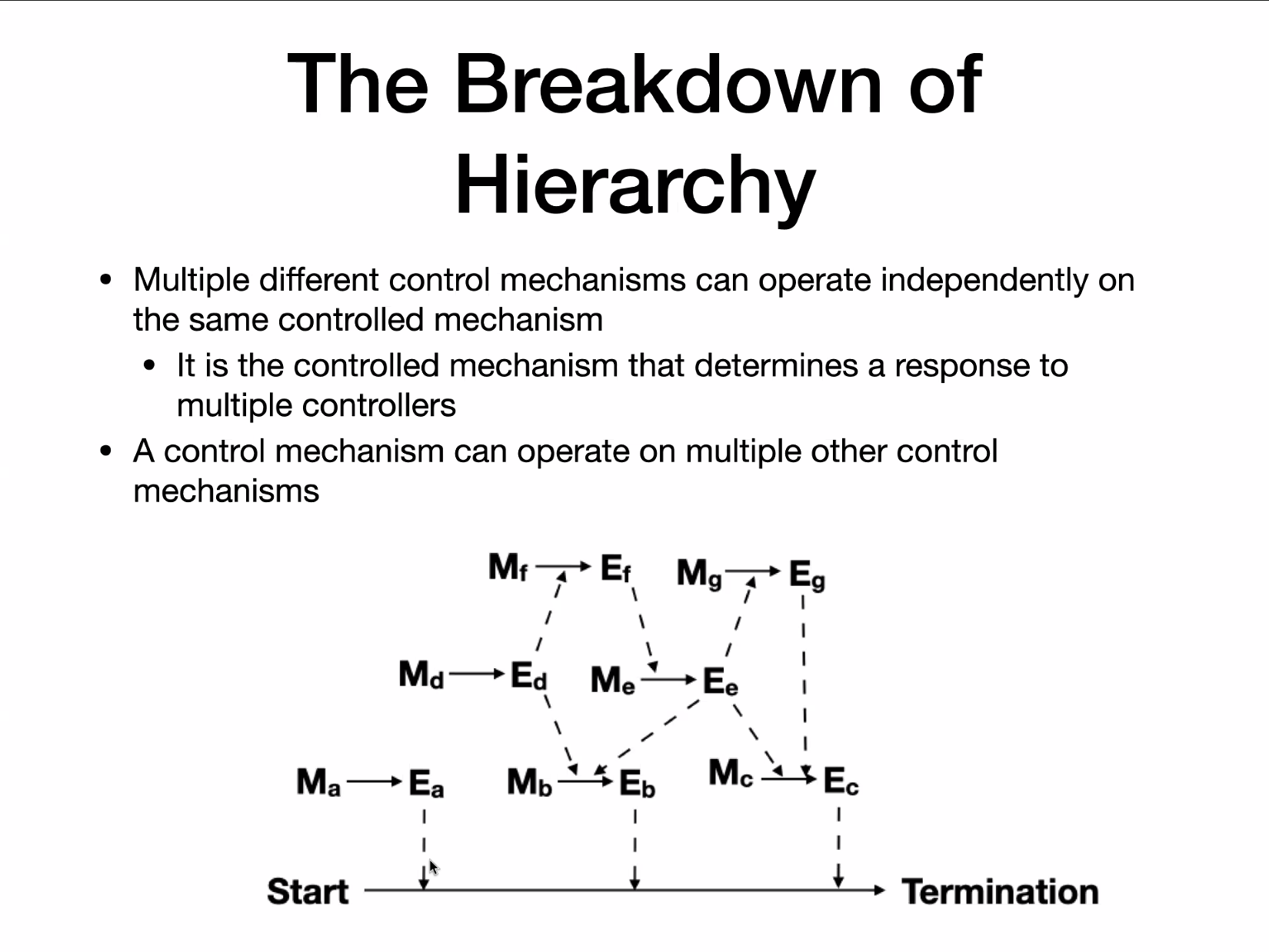
Neuroscience & Philosophy SalonWilliam Bechtel discusses his new book “Philosophy of Neuroscience” (with Linus Huang), including mechanisms and hierarchy/heterarchy (audio only)Paul Cisek discusses his phylogenetic approach (audio only)
Willard van Orman Quine once said that he had a preference for a desert ontology. This was in an earlier day when concerns with logical structure and ontological simplicity reigned supreme. Ontological genocide was practiced upon whole classes of upper-level or ‘derivative’ entities in the name of elegance, and we were secure in the belief that one strayed irremediably into the realm of conceptual confusion and possible error the further one got from ontic fundamentalism. In those days, one paid more attention to generic worries about possible errors (motivated by our common training in philosophical skepticism) than to actual errors derived from distancing oneself too far from the nitty-gritty details of actual theory, actual inferences from actual data, the actual conditions under which we posited and detected entities, calibrated and ‘burned in’ instruments, identified and rejected artifacts, debugged programs and procedures, explained the mechanisms behind regularities, judged correlations to be spurious, and in general, to the real complexities and richness of actual scientific practice
[I think I have been getting his surname wrong for years?!]
Version 1 : Received: 6 August 2024 / Approved: 7 August 2024 / Online: 8 August 2024 (12:22:55 CEST)
How to cite: Gershenson, C. Self-Organizing Systems: What, How, and Why?. Preprints2024, 2024080549. https://doi.org/10.20944/preprints202408.0549.v1 Gershenson, C. Self-Organizing Systems: What, How, and Why?. Preprints 2024, 2024080549. https://doi.org/10.20944/preprints202408.0549.v1Copy
Abstract
I present a personal account of self-organizing systems. As such, it is necessarily biased and partial. Nevertheless, it should be useful to motivate useful discussions. The relevant contribution is not my attempts at answering questions (maybe all my answers are wrong), but the steps towards framing relevant questions to better understand self-organization, information, complexity, and emergence. With this aim, I start with a notion and examples of self-organizing systems (what?), continue with their properties and related concepts (how?), and close with applications (why?).
•Understanding natural behavior requires not just new ways of collecting data, but also new theories for interpreting data.
•We suggest a stepwise approach for making experiments and theories more naturalistic without losing interpretability.
•Theories that address natural behavior can look for inspiration in ethology and evolution.
•Ecologically valid theories and experiments that test them should incorporate closed loop interaction with the world.
•A key challenge is to balance developing more ecologically valid theories while keeping aspects of existing concepts.
Toward a neuroscience of natural behaviorAuthor links open overlay panelPaul Cisek, Andrea M. GreenShow moreAdd to MendeleyShareCitehttps://doi.org/10.1016/j.conb.2024.102859Get rights and contentUnder a Creative Commons licenseopen accessHighlights•Understanding natural behavior requires not just new ways of collecting data, but also new theories for interpreting data.•We suggest a stepwise approach for making experiments and theories more naturalistic without losing interpretability.•Theories that address natural behavior can look for inspiration in ethology and evolution.•Ecologically valid theories and experiments that test them should incorporate closed loop interaction with the world.•A key challenge is to balance developing more ecologically valid theories while keeping aspects of existing concepts.
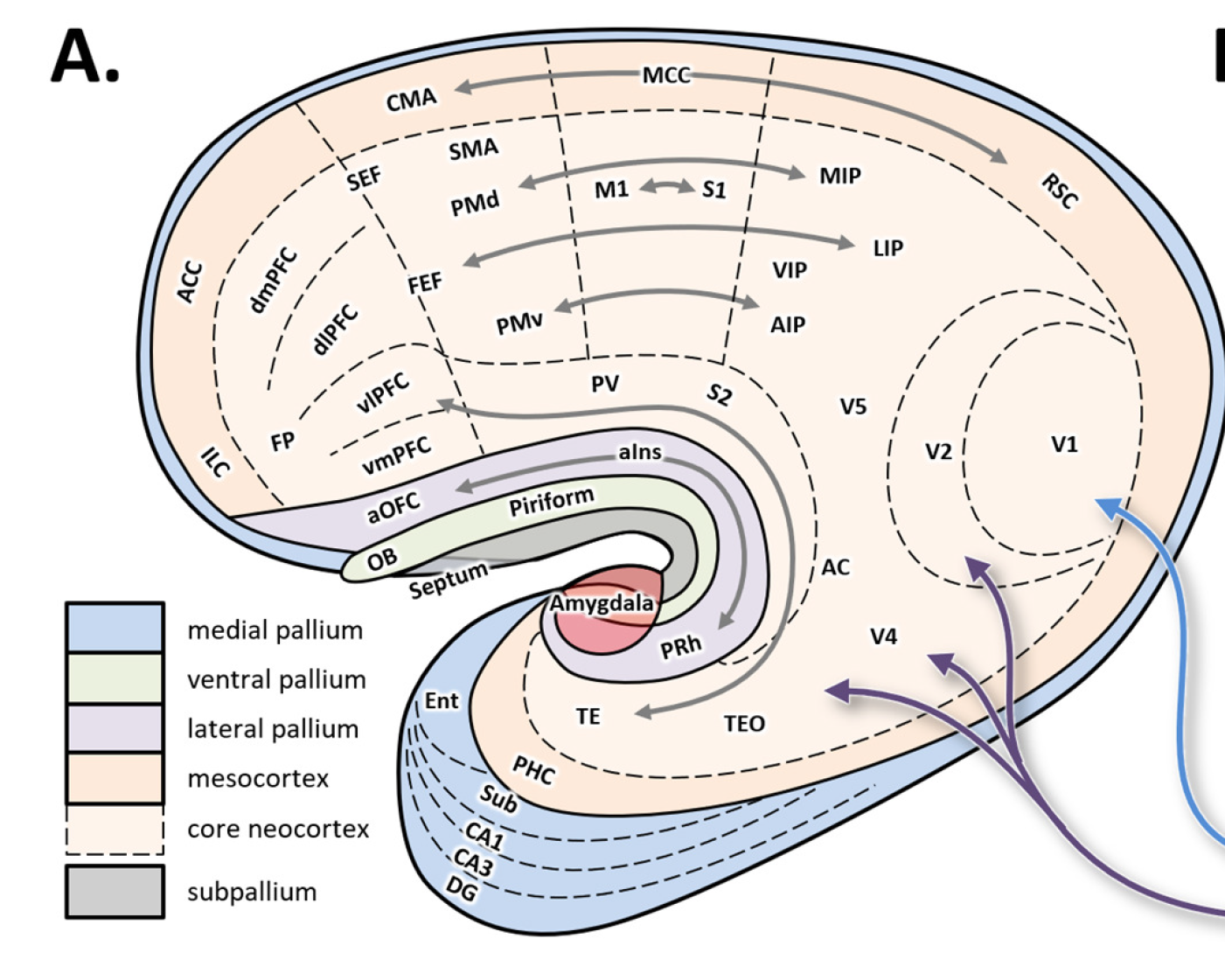
This article outlines a hypothetical sequence of evolutionary innovations, along the lineage that produced humans, which extended behavioural control from simple feedback loops to sophisticated control of diverse species-typical actions. I begin with basic feedback mechanisms of ancient mobile animals and follow the major niche transitions from aquatic to terrestrial life, the retreat into nocturnality in early mammals, the transition to arboreal life and the return to diurnality. Along the way, I propose a sequence of elaboration and diversification of the behavioural repertoire and associated neuroanatomical substrates. This includes midbrain control of approach versus escape actions, telencephalic control of local versus long-range foraging, detection of affordances by the dorsal pallium, diversified control of nocturnal foraging in the mammalian neocortex and expansion of primate frontal, temporal and parietal cortex to support a wide variety of primate-specific behavioural strategies. The result is a proposed functional architecture consisting of parallel control systems, each dedicated to specifying the affordances for guiding particular species-typical actions, which compete against each other through a hierarchy of selection mechanisms.
This article is part of the theme issue ‘Systems neuroscience through the lens of evolutionary theory’.
Evolution of behavioural control from chordates to primatesPaul CisekPublished:27 December 2021https://doi.org/10.1098/rstb.2020.0522AbstractThis article outlines a hypothetical sequence of evolutionary innovations, along the lineage that produced humans, which extended behavioural control from simple feedback loops to sophisticated control of diverse species-typical actions. I begin with basic feedback mechanisms of ancient mobile animals and follow the major niche transitions from aquatic to terrestrial life, the retreat into nocturnality in early mammals, the transition to arboreal life and the return to diurnality. Along the way, I propose a sequence of elaboration and diversification of the behavioural repertoire and associated neuroanatomical substrates. This includes midbrain control of approach versus escape actions, telencephalic control of local versus long-range foraging, detection of affordances by the dorsal pallium, diversified control of nocturnal foraging in the mammalian neocortex and expansion of primate frontal, temporal and parietal cortex to support a wide variety of primate-specific behavioural strategies. The result is a proposed functional architecture consisting of parallel control systems, each dedicated to specifying the affordances for guiding particular species-typical actions, which compete against each other through a hierarchy of selection mechanisms.This article is part of the theme issue ‘Systems neuroscience through the lens of evolutionary theory’.
Three new papers refute claims for the assembly theory of molecular complexity being claimed as a new “theory of everything.”
First publicly posited in 2017, assembly theory is a hypothesis concerning the measurability of molecular complexity that claims to characterize life, explain natural selection and evolution, and even to redefine our understanding of time, matter, life and the universe.
However, researchers led by Dr. Hector Zenil from the School of Biomedical Engineering & Imaging Sciences (BMEIS), in collaboration with colleagues from King Abdullah University for Science and Technology (KAUST) and the Karolinska Institute in Sweden, have successfully demonstrated in a paper published in npj Systems Biology, that the same results can be achieved by using traditional statistical algorithms and compression algorithms.
In a second paper just published by PLoS Complex Systems, they have also mathematically proven that assembly theory is an equivalent to Shannon Entropy and therefore not a novel approach to any of those applications and is an implementation of a well-known and popular compression algorithm used behind ZIP compression and image encoding formats such as PNG.
This is the end-September 2024 monthly events mailing from SCiO. There are plenty of events now planned. Click on the flags or group titles below to go to the events that interest you. Please remember that you can attend online events organised by any of the SCiO groups if they are held in a language you speak/understand (and you are a member if it is a member-only meeting). Further details of events may be available by clicking on the event titles below and you can also book each event directly from the Book now text.
Please note that some groups post events and add details quite late, so it is always worth checking the website – also for changes to dates and times. Please click here to see all the events in a browser.
The SCiO AGM was held this last weekend and a video and the minutes of it are available to members – see the bottom of the Home page on the website or click here.
This message is confidential to the intended recipient. It does not constitute a legally binding document on the part of either the sender or the recipient. If this message has been received by you in error please reply to: steve.hales@systemspractice.org with UNSUBSCRIBE as the title
Systems and Complexity in Organisation Ltd is a company registered in England with Company Number: 3499590 Registered address: Unit 14 Tower Street, Century Building, Brunswick Business Park, Liverpool L3 4BJ UK
CSH and the Climate/ Biodiversity Emergencies – Development Event
Tue, Oct 15th, 2024 18:30 – 20:30 GMT+1
The October event is a ‘special’, concluding our exploration of the applicability of Critical Systems Heuristics to understanding and shaping interventions on the climate and biodiversity emergencies. We will be looking at sources of legitimacy, what are the current structures and participants and:
who ought to be representing the interests of those negatively affected?
what ought to be the opportunities for those negatively affected to have agency in decisions?
what opportunities ought there to be for reconciling different worldviews relating to climate and biodiversity systems?
SCiO organises Open Meetings to provide opportunities for practitioners to learn and develop new practice, to build relationships, networks hear about skills, tools, practice and experiences. This virtual meeting will be held on Zoom.
The first session speaker will be Ed Fish, who will talk about “Causation seen through a Sociotechnical Lens”
A second session will be posted as soon as the speaker is confirmed.
SCIO-NL komt elke 2e vrijdag van de maand live bijeen in Vianen (Hagenweg 3c). Er staan geen vaste onderwerpen op de agenda (daarvoor organiseren we specifieke andere meetings), maar de ervaring leert dat er altijd wel een interessant gesprek op gang komt over een systemisch onderwerp. Toegankelijk voor iedereen die de jaarlijkse fee voor de live-bijeenkomsten (€50,-) hiervoor betaald. En voor gasten. Neem contact op via ed@doitogether.nl als je interesse hebt, maar nog geen lid van de club bent.
NL Members + guests; Free; Hagenweg 3c, Vianen, Netherlands; Dutch BOOK NOW
Open SCIO-NL monthly meeting November 2024 (live in Vianen and in Dutch) configuration options
SCIO-NL komt elke 2e vrijdag van de maand live bijeen in Vianen (Hagenweg 3c). Er staan geen vaste onderwerpen op de agenda (daarvoor organiseren we specifieke andere meetings), maar de ervaring leert dat er altijd wel een interessant gesprek op gang komt over een systemisch onderwerp. Toegankelijk voor iedereen die de jaarlijkse fee voor de live-bijeenkomsten (€50,-) hiervoor betaald. En voor gasten. Neem contact op via ed@doitogether.nl als je interesse hebt, maar nog geen lid van de club bent.
NL Members + guests; Free; Hagenweg 3c, Vianen, Netherlands; Dutch; BOOK NOW
We verbreden in deze Deep Dive reeks onze systemische kaders. Waar we in de vorige Deep Dives ons hebben verdiept in het Viable Systems Model laten we nu drie andere benaderingen aan bod komen: De kritische systeembenadering, de systeem dynamische benadering en de strategische optie formuleringsbenadering.
Members only + Guests; 150 euro (werkingskosten), Locn: tbc, Belgium; Dutch BOOK NOW
In an era where the traditional corporate paradigm often views employees merely as cogs in the machinery of profit, Humanizing the Corporation: A Regenerative Leadership Playbook offers a revolutionary perspective. This insightful guide presents seven key principles to help organizations transition toward a more humane and sustainable way of operating. Jan De Visch and Kashmir Birk explain the key ideas of their new book….
Päätöksentekijä käyttää päätöksenteossa tietoisesti tai tietämättään malleja. Kun mallien käyttö on tietoista, päätöksenteko on sujuvampaa ja päätökset johtavat paremmin haluttuihin tavoitteisiin. Mutta mitä nämä mallit ovat, miten niitä syntyy ja luodaan, ja millaisia malleja pystytään käyttämään päätöksenteossa. Esityksessä käydään läpi mallien käytön perusteita. Puhuja: Professori Matti Vilkko, Automaatio- ja konetekniikan yksikön päällikkö, Tampereen yliopisto Online event
“Opening the Box: Systems Thinking for Transformative Conversations” delves into the core principles of systems thinking, offering practical insights to help individuals and organizations navigate complexity. Authored by Jan De Visch, Miguel Pantaleon, Namrata Arora and Tony Korycki, this book promises to be an invaluable resource for anyone interested in understanding and applying systems thinking in their personal and professional lives. This session will feature the book’s authors, sharing their insights and engaging in a transformative conversation, applying the book’s insights.
Michael Frahm spricht in diesem Vortrag über Komplexität und über Konzepte damit umzugehen. Dabei unternimmt er einen Streifzug durch verschiedene Wissensgebiete (Naturwissenschaften, Kybernetik, Komplexitäts Theorie, etc…) und geht der Interpretation von Komplexität und den unterschiedlichen Konzepten verschiedener Akteure mit Komplexität umzugehen nach. Von Henri Poincaré (1854-1912) bis Mike C. Jackson und vielen anderen.
Members only + Guests, FREE, Online event. German; BOOK NOW
Join us for a conversation on living together with uncertainty. It can be deeply unsettling when the ground beneath us keeps shifting. Perhaps it can be comforting to reach for certainty and knowing. However, could there be possibilities present in embracing and “listening” to uncertainty while recognising our interconnectedness? The session is an invitation for reflective practice where we play with stepping out of our knowing and embrace the “ecology of ideas” we can open for each other. There will be a short presentation followed by a space for reflective practice together. …
Ireland Members only + Guests, FREE, Online event; English; BOOK NOW

 Share
Share Cite
Cite
 Systems Community of Inquiry
You must be logged in to post a comment.