This is a recording of a lecture titled “Design Cybernetics – An Introduction” delivered on 23-Oct-2024 at the Department of Architecture of the South China University of Technology (SCUT), Guangzhou by Prof. Thomas Fischer and Prof. Christiane M. Herr of the School of Design of the Southern University of science and Technology (SUSTech), Shenzhen. The lecture was hosted by Prof. Liu Yubo and Prof. Deng Qiaoming of the SCUT Department of Architecture.
I am pleased to inform you that JiscMail has approved our application for a mailing list dedicated to systems theories of all forms, including, but not limited to, open, closed, general, and autopoietic systems theories. We invite you to subscribe at → http://jiscmail.ac.uk/systems ←
Scholarship Applications are Open for NECSI Winter Session 2025 Partial scholarships are available to support participants in studying complex systems science and its real-world applications. The deadline to apply is December 6, 2024. NECSI is dedicated to expanding access to complexity science education, equipping participants with the methodologies needed to analyze and understand the behavior of interconnected systems. Registration Details: Course Dates: 10–21 February 2025 Early Registration Pricing Ends: 23 December 2024 Email programs@necsi.edu for questions about our course options. Apply Now NECSI’s Winter Session bridges theoretical frameworks and applied methodologies, equipping participants with tools to model and analyze dynamic systems.*Knowledge of advanced mathematical methods is not necessary for this course.Email programs@necsi.edu for questions about our course options.
I’m hoping that my network can take 5 minutes (or less) to answer some simple questions relating to decision making. This is for my PhD research and it would be especially helpfully if people connected with small businesses could complete and/or share the link.
Matt Lloyd PLY Member of the Centre for Systems Studies at the University of Hull. Chair of the Systems Thinking SIG at The OR Society. Researching SMEs and Systems Thinking. Strategy and Compliance Consultant.
Systems Thinking Ontario as Systems Convening | ST-ON | 2024-10-21 November 25, 2024 daviding 0 CommentsThe 125th meeting of Systems Thinking Ontario coincided with the closing day for the RSD13-RSDX online program. As a regular systems convening group, we’ve had monthly meetings since January 2013.Zaid Khan moderated a discussion including me (David Ing), Tim Lloyd, Allenna Leonard, and Kelly Okamura.
We often think of an “equilibrium” as something standing still, like a scale in perfect balance.But many equilibria are dynamic, like a flowing river which is never changing—yet never standing still.These dynamic equilibria are nicely described by so-called “detailed balance”
Alicia is an icon in the subject of complex systems, but her earlier work was rooted in the idea of cause and intent, and associated by many to Bateson’s idea of “conscious purpose’, or Snowden’s cautions against destinations, visions, and future states. Let’s explore how Alicia’s focus has evolved and how these adjacent and complementary ideas intersect
Voices | Alicia Juarrero | Intent and other Constraints
Join us for a dynamic 1.5 hour talk that unlocks the potential of integrating TRIZ/ Sprint methodologies with artificial intelligence to drive innovation across any industry.
The core content is about using TRIZ to define and solve problems and how AI and a sprint methodology can accelerate and improve this process
Why Join ? Participants will leave the session with a better understanding of how TRIZ and AI can be leveraged together to foster innovation in any field.
This engaging and informative session is perfect for anyone looking to expand their toolkit for innovation, offering valuable insights into the intersection of AI and TRIZ methodologies. See less
Better, Faster Innovation with TRIZ, Sprints and AI
Hiring 4 new TT faculty into our research-intensive Population Health Sciences department at UCF College of Medicine. Hard $. Strong salaries. Areas include Data Science, Policy, Economics, Aging, Evaluation, Systems, or other areas. Details below: ucf.wd1.myworkdayjobs.com/careers/job/…
🚨🚨🚨 Hiring 4 new TT faculty into our research-intensive Population Health Sciences department at UCF College of Medicine. Hard $. Strong salaries. Areas include Data Science, Policy, Economics, Aging, Evaluation, Systems, or other areas. Details below: ucf.wd1.myworkdayjobs.com/careers/job/…
🚨 Population Health Sciences at the University of Central Florida is hiring FOUR new TT faculty at the Assistant and Associate levels 🚨 Happy to talk with interested folks about UCF, Orlando, and the Pop Health department! Photo attached with some details and link to apply: shorturl.at/ACsGN
🚨 Population Health Sciences at the University of Central Florida is hiring FOUR new TT faculty at the Assistant and Associate levels 🚨 Happy to talk with interested folks about UCF, Orlando, and the Pop Health department! Photo attached with some details and link to apply: shorturl.at/ACsGN
Lecturer in Systems Thinking (Education and Scholarship)location_onExeter04/12/2024Lecturer in Systems Thinking (Education and Scholarship) Apply onlineThe job requirements are detailed below. Where applicable the skills, qualifications and memberships required for this job have also been included.Job detailsSalaryThe starting salary will be from £42,632 on Grade F, depending on qualifications and experience.Contractual hours36.5PackageGenerous holiday allowances, flexible working, pension scheme and relocation package (if applicable).Job category/typeAcademicDate posted20/11/2024Job referenceQ00545
Webinar The results of the 2024 U.S. Presidential Election will send shockwaves through political, social, and economic systems, impacting and exposing deep vulnerabilities in society and governance structures worldwide. What does Complexity Science reveal about the dynamics driving these outcomes, their causes, and broader implications? Join Dr. Yaneer Bar-Yam, founder of the New England Complex Systems Institute (NECSI) and co-founder of the World Health Network (WHN), who will analyze the election through the lens of complexity science, offering critical insights into the systemic issues underlying today’s governance challenges. We will discuss:•Emergent behaviors•Feedback loops and tipping points•The structural inadequacy of traditional governance•New models for governance•The role of collective action and public engagementWhether you are an academic, policymaker, activist, or concerned citizen, you’ll discover how to tackle global challenges and how we can collectively build more adaptive and effective systems in the face of growing complexity.
The Election And Complexity Science: Insights for Collective Action

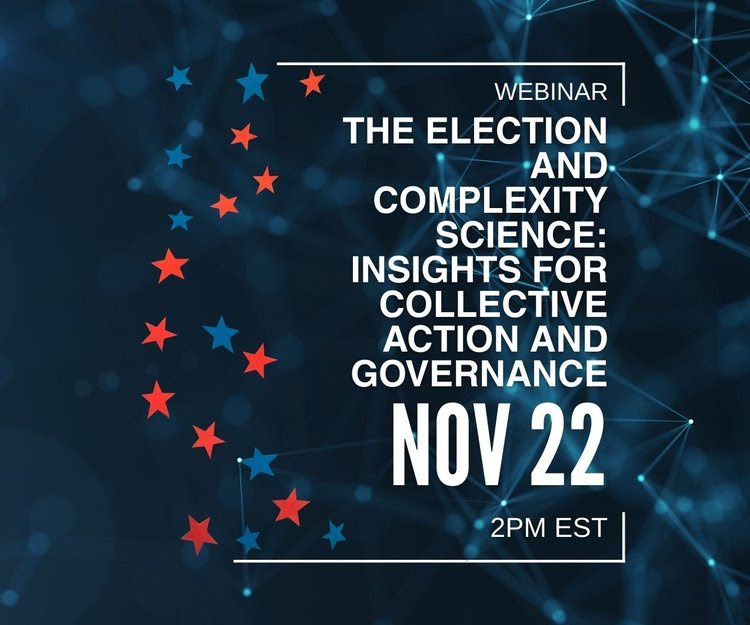 Webinar
 Systems Community of Inquiry
You must be logged in to post a comment.