Source: A Curriculum for Cybernetics and Systems Theory
A Curriculum for Cybernetics and Systems Theory
Alan B. Scrivener
abs@well.com
FIRST DRAFT
(c) 1 March 1990 by Alan Scrivener
SECOND DRAFT
(c) 22 August 2002 by Alan Scrivener
MINOR EDITS
(c) 4 March 2012 by Alan Scrivener
MINOR EDITS
(c) 26 November 2012 by Alan Scrivener
| New! Beginning in September 2002, I will be sharing a free e-Zine, “Cybernetics in the Third Millenium” (C3M), about 1,000 – 18,000 words per issue and about one isssue every other month. If you are interested in a free subscription to this electronic newsletter, please email abs@well.com with C3M in the subject. |
Note:
Albert Ward of Plovdiv, Bulgaria, has graciously done the work to translate this document into Bulgarian.
( www.fatcow.com/edu/well-curriculum-bl
CONTENTS
INTRODUCTION
What This Is
This is a list, with reviews, of suggested books, periodicals, television shows and computer programs for a classroom curriculum or individual study in cybernetics and systems theory. It does not (yet) include a course plan, glossary, or extended bibliography. I was asked to write this by some teachers who received a copy of class notes I prepared for a course in “Understanding Whole Systems” sixteen years ago at the University of California at Santa Cruz. They asked how I would revise it based on what I know today. This document answers that question.
[A similar web site exists at the Principia Cybernetica Project. – ABS 8/11/96]
Cybernetics and Systems Theory Defined
Right off, let’s dispense with the childish belief that words “have” meanings. Charles Dodson / Lewis Carroll was close to the mark with this dialogue between Alice and Humpty Dumpty:
-
Humpty Dumpty: [Having just proved it is 364 times better to celebrate
-
your un-birthday] There’s glory for you!
-
Humpty Dumpty: Of course you don’t — ’till I tell you. I meant
-
‘there’s a nice knock-down argument for you!’
-
Humpty Dumpty: When I use a word, it means just what I choose it to
-
mean — neither more nor less.
A lot of time has been wasted arguing over what the terms cybernetics and systems theory “really” mean. Rather than add to the muddle, let me just define them, and some other related concepts, the way I mean them and leave it at that.
- Information is “a difference that makes a difference,” to use Gregory Bateson’s definition. It is a measure of the reduction of uncertainty (entropy) that results from receiving a message. The term was rigorously defined by Claude Shannon of Bell Labs in 1950. Its unit is the bit, which is the amount by which your uncertainty is decreased when you find out that something happened which had a probablity one half. The bit measures in units of the minus the log to the base two of probablity: -log2(p) By this definiton news that of event which had a probablity of one fourth yields two bits of information, news that of event which had a probablity of one eighth yields three bits of information, and so on.
- System is a word that we use to describe any “experience-cluster” that we can map as a set of interacting elements over time. Typically a system is mapped by identifying the pathways of information flow — as well as possibly the flow of energy, matter and other variables. But the “flow” of information is special, because only information can go from A to B while also staying at A. (Consider that photocopy machines would be useless if you didn’t get to keep your original.)
- Cybernetics is the study of systems which can be mapped using loops (or more complicated looping structures) in the network defining the flow of information. Systems of automatic control will of necessity use at least one loop of information flow providing feedback. (Appropriately the word cybernetics is derived from the Greek for “pilot,” as in “auto pilot” and “pilot light.”) The word was first coined in 1945 by Nobert Wiener in the book Cybernetics (listed below), in which he defined it as “the study of control and communication in the animal and the machine.” Gregory Bateson clarifies the methodology in “Cybernetic Explanation” (one of the essays in the book Steps to an Ecology of Mind, listed below.) In a nutshell, he says:Causal explanation is usually positive. We say that billiard ball B moved in such and such a direction because billiard ball A hit it at such and such an angle. In contrast to this, cybernetic explanation is always negative. We consider what alternate possibilites could conceivably have occurred and and then ask why many of the alternatives were not followed, so that the particular event was one of the few which could, in fact occur…In cybernetic language, the course of events is said to be subject to restraints, and it is assumed that, apart from such restraints, the pathways of change would be governed only by equal probability.
- Systems theory is the study of systems which can be mapped using any kind of network to define the flow of information. This includes the study of systems whose emergent properties we cannot yet predict due to a lack of plausable mechanisms, rigorous mapping techniques and/or robust mathematical treatment. By these definitions systems theory includes and is more abstract than cybernetics. In General System Theory (listed below), Ludwig Bertalanffy draws this distinction:Cybernetics is a theory of control systems based on communication (transfer of information) between systems and environment and within the system, and control (feedback) of the system’s function in regard to environment… The model is of wide application but should not be identified with “systems theory” in general.… Cybernetic systems are a special case, however important, of systems showing self-regulation.
Whatever distinctions you draw, what I am aiming at is the study of properties that emerge from the interconnectedness and complexity of relationships between parts.
Why We Need Cybernetics and Systems Theory Now
      "When we try to pick up anything by itself
       we find it is attached to everything in the universe."

                                            -- John Muir
I keep having this image of a survey course in human physiology, in which the syllabus covers each body system in turn, and in the final week it is all put together into a whole person. But, as the semester drags on the instructor gets behind in the material, until suddenly it is time for finals and the integrative material has not been covered. “Well,” says the teacher, “I will leave it to the more ambitious students as an extra credit project.”
I see this as a metaphor for what is wrong with our educational system, and the body of knowledge on which it is based: we have great methods for taking things apart and analyzing them, but the problem of putting them back together is trivialized even though it is unsolved. If Western Civilization’s science, religion, philosophy and epistemology were in better shape (more mature?), we would not need cybernetics and systems theory as separate areas of inquiry; they would be woven into the fabric of our knowledge as already are other prior mental tools such as: the flexibility of language, the rigor of linear algebra, and the etiquette of professional communication. But instead our tradition of education has a blind spot when it comes to complexity, interconnectedness and relationship, and properties that emerge from them.
This might all seem like abstraction of abstraction, some kind of “airy fairy” diversion of language, except that the results are vital to questions of survival. As columnist Ellen Goodman pointed out about health research (LA Times 5/26/87): “There’s a tendency to study single diseases and small body parts instead of lives. The group concerned with the maintenance of lungs doesn’t always ‘do’ ankles and the cancer- prevention team isn’t ‘into’ cardiovascular diseases. As the last generalists, we, the owners of whole bodies, are supposed to think of ourselves as nothing more than the sum of parts and potential diseases to be taken care of with separate regimens.” [Emphasis mine.] Or, as a Buddhist baker once said, “We’re all in this alone.” We each face the integration of life, the universe and everything with few really useful clues from our mainstream culture and educational systems.
The blind spot in our civilization when it comes to wholeness and loops goes back a long way. Plato said, in Georgics, that “Helmsmanship is unassuming and modest and does not boast and does not behave as if it had done something wonderful.” This contempt for piloting fits in with the general ancient Greek aversion to any linking truth-seeking with useful activity. This meant the literate philosophers and the skilled workers were kept apart. The Romans were by contrast ruthlessly practical, had literate engineers (who could write down their skills and plans). They conquered the known world with their “practicality,” which had toxic social, religious and ecological side effects. Christinanity swept the Roman empire partially as an antidote to the Roman toxic pragmatism. The dark ages were, in Europe, a period of avoidance of practical applications of technology in favor of the search for religious grace. Our civilization didn’t deviate from this pattern until the 13th Century, when literate monks were forced to garden, and dragged out a bunch of Roman engineering books, rediscovering hydraulics and inventing the windmill. Similar integrations of learning and labor helped bring about the Renaissance and the Industrial Revolution. And yet today we call schools where more practical skills are taught “Junior Colleges,” while all the really useless ideas are confined to “Universities.” Greek logic was made symbolic by nineteenth century academic George Boole, who — like the Greeks — prohibited loops in logic chains. But in this century electronic engineers found that you can build logic gates physically, and you can hook them up in loops, resulting in both digital memories and digital oscillators. These humble engineers were “off the map” of Western civilization’s mathematics and philosophy. One of the simplest of these circuits was a one-bit memory, which was named a “flip flop” — indicating the lack of academic tradition for the whole idea.
Our traditions cling to the idea that explanations can be built of short causal chains: event A causes event B, which causes event C. Loops are prohibited because they are hard to analyze, introducing non-linear terms into the equations. Therefore our current scientific method has become a form of pretend madness in which we deny that anything is connected to anything else unless we can prove that it is. We use this method because we can so much more easily start with assumed isolation and then prove the connectedness of the components of a system than do the opposite. But our simplifying assumption has become an article of faith, and this false faith is aggravating the “externalities” of our society: pollution, crime, alienation, illiteracy, the decay of our infrastructure, the decline of our industry. All of these problems have been amplified by the success of our technology in achieving narrowly defined goals. Cybernetics and systems theory are part of the antidote to the toxic byproducts of our short-sighted reductionism.
Where Cybernetics and Systems Theory Came From
"What is a man, that he may know a number,
or a number, that a man may know it?"

                                        -- Warren McCulloch
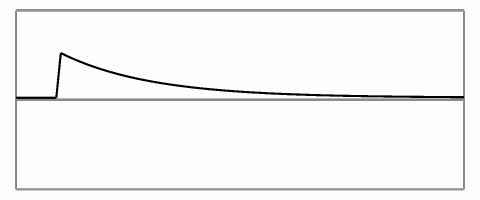
In 1868 James Clerk Maxwell (author Maxwell’s equations of the electrodynamics, and inventor of the mental construct Maxwell’s Demon) was invited by steam engineers to help them figure out why the governors on their engines didn’t always work right: sometimes the steam engines exploded. Maxwell analyzed the “steam-engine-with- governor under a changing load” as a system of non-linear differential equations, and concluded the system would do one of five things based on the coefficients of the equations. (1) It corrected the speed back to the desired level fairly smoothly (the most desired response):
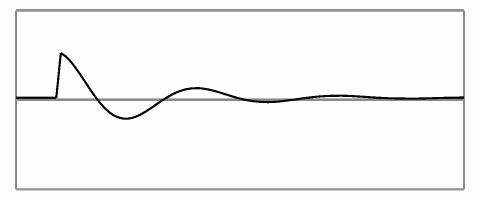
Or (2) it corrected the speed back to the desired level after some overshoot (also a desired response):
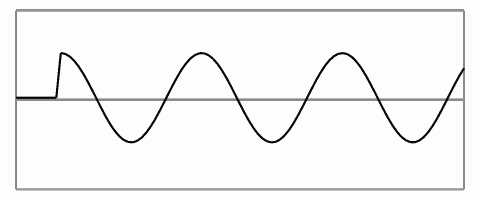
Or (3) it oscillated continuously — an annoying and inefficient repsonse later called “hunting” in the 1930’s by electronics researches (actually this behavior was not explicitly described by Maxwell, probably because it is unstable, but it is implicit in his analysis):
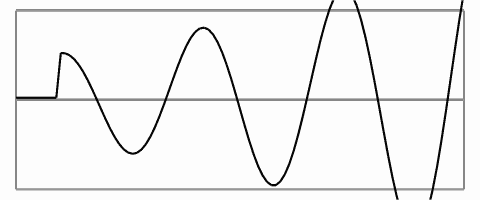
Or (4) it oscillated with increasing amplitude until it blew up (also sometimes called “hunting”:
Or (5) it just blew up:
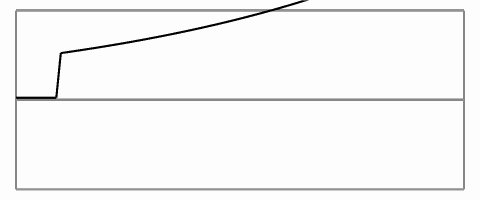
This was the first explicitly cybernetic analysis of a system I can find. Thanks to it the engineers were able to design their governors so that the steam engines didn’t explode so often. The governor became a metaphor for some 19th century visionaries: Samuel Butler in Erewhon predicted thinking machines evolving out of governors, and Alfred Russell Wallace came up with the idea of evolution by natural selection — independently from Darwin — when he realized that adaptive restraints operated like a governor on a steam engine.
By the 1930’s, when electronics was still young, electrical network theory had developed, and the select few who studied it began to understand self-correcting systems. Doctors also tended to gain this intuition, and in 1932 physician Walter Cannon in The Wisdom of the Body coined the term homeostasis to describe this phenomenon.
By the late 1940’s, thanks mostly to the growth of electronics, a lot of people were running around with the idea that “feedback” was somehow important. One of them was Warren McCulloch, a pioneer brain researcher who first proposed the mathematical modeling of neurons. He was approached by the Macy Foundation to chair a conference on the nervous system. The Macy Foundation, funded by the family that ran Macy’s department store (and its famous Thanksgiving Day parade), funded conferences on medicine; they had done the heart, lungs, skin, etc. but never the brain or nerves. But McCulloch was determined to make these meetings more than a typical medical conference. He invited physiologists, electronics specialists, mathematicians, physicists, even social scientists — including husband and wife anthropologists Gregory Bateson and Margaret Mead. The participants met for a few days every six months over a period of several years. At first McCulloch only let the “neuro” people talk; he wanted everyone to understand the great questions facing them before they started looking for answers. But eventually a cautious collaboration developed, as the participants probed their intuition of what was missing from their knowledge of minds.
In 1948 one of the attendees, mathemetician Norbert Wiener, published a book in which he purported to name the new field of inquiry they were investigating: Cybernetics was the name of the field and the book. This move received mixed reviews from the other participants in the conference. However, many of the attendees did return to their disciplines and begin using the new set of tools provided by the conference, and by Wiener (including two who I had the good fortune to meet and study under: Gregory Bateson and Heinz von Foerster).
Meanwhile, in Germany, Ludwig von Bertalanffy began publishing papers on the theory of general systems, in which he (prophetically in many cases) laid down some of the criteria of such a theory. He pointed out that the fundamental tool of general systems theory was the system of differential equations, but any such set of equations robust enough to describe non-trivial systems was unsolvable. Therefore, intuition and computer simulation should play important roles in a theory of complex systems. But his work had little impact initially.
In 1950 Shannon and Weaver at Bell Labs published their first paper on what has been called “information theory” and “communication theory,” but I would prefer to call “transmission theory.” It is the study of how to get bits reliably over an unreliable channel — a topic of great interest to Bell Telephone at that time. In academia this work eclipsed cybernetics, probably because it was less intellectually threatening; cybernetics advocated connecting outputs to inputs, which had been forbidden since the ancient Greeks, while information theory dealt with the familar model of:
                    +-------+     +---------+     +--------+
                    | INPUT |---->| PROCESS |---->| OUTPUT |
                    +-------+     +---------+     +--------+
Also, it didn’t help that the popular press picked up and began to abuse the word “cybernetics,” as if it meant “the study of computers, robots, and electronic gizmos,” or that the book Psycho-Cybernetics was published by plastic surgeon Maxwell Maltz in 1960; it was a useful pop-psychology self-help book about auto-suggestion, but had little to do with cybernetics.
With the advance of digital computers in the 50’s and 60’s, the field of “information science” was heralded, which included the study of computer languages and their compilers, as well as Shannon’s work. But cybernetics mostly suffered benign neglect by information science departments. By way of an example, in 1966 Scientific American published an entire issue devoted to the new technology of information, and later re- issued it as one of their theme paperbacks, called Information. Every diagram in this book has the same structure as the one above: INPUT, PROCESS, OUTPUT.
Yet, while the so-called information scientists ignored cybernetics (which they could because they designed systems and were free to design them without feedback), those scientists investigating the biochemistry of cell metabolism, the principles of nervous systems, and the population biology of ecologies (all pre-existing systems) were drawn to cybernetics because it offered more accurate models of the systems they were studying.
Some progress was made by topologists in the late 60’s in classifying systems in terms of all possible behaviors they could exhibit. Initially this work, called the theory of dynamical systems, simply refined the distinctions drawn by Maxwell’s governor paper.
The biggest methodological barrier to the advance of cybernetics in the 50’s and 60’s was the expense of computer time. But in the 70’s pocket calculators became affordable, and it was on such a calculator that some of the earliest examples of chaos were discovered. This term is not used here in the every-day sense, but to describe a fifth category of system behavior besides the four illustrated above: non- periodic deterministic behavior. The discoveries of chaos, along with increasingly available computer power, sparked a renaissance of interest in cybernetics and systems theory in the late 80’s.
Won’t it be exciting to see what the 90’s will bring?
How I Got Into Cybernetics and Systems Theory
"Watch out -- you might get what you're after."

                                  -- David Byrne, 1983
                                     "Burning Down the House"
In the fall of 1969, while a Junior in high school in southern California, I got my hands on an early Whole Earth Catalog. I was attracted to it because the title sounded integrative, and sure enough the first section was entitled Understanding Whole Systems. Here I was exposed to the ideas of Bucky Fuller, Norbert Wiener, Marshall McLuhan, and Paul Ehrlich. I went to a college where I could design my own major program (University of California at Santa Cruz, Kresge Collge), and searched for three years for a faculty member who would sponsor my major in “Understanding Whole Systems.” Dr. Gregory Bateson arrived at Kresge in the fall of 1973, and I had even studied his English accent for a school play, but it wasn’t until he was featured on the first page of the Understanding Whole Systems section of the new Whole Earth Epilog in summer of 1974 that I realized he was who I had been looking for. Starting in my senior year I took all of his classes, and he sponsored a student-directed seminar which I taught in early 1975 on Understanding Whole Systems. I’d planned to extend this activity into my major program, but I too quickly reached the end of my senior year, I hadn’t met the university breadth requirements to graduate, and I was out of scholarship money.
Also in my senior year I met Dixie. We dropped out of school and bicycled across America together in 1976-77. On this journey I discovered that poverty was a real danger in an unplanned life — a lesson that had escaped me both while growing up in suburbia and while attending a Liberal Arts university — so upon our return from this trip I earned money and got a new scholarship so I could go back to school. I proposed marriage to Dixie, and I switched my major to Information Sciences in hopes of being more employable. Sure enough, after six months of school in 1977, at the dawn of the Personal Computer revolution I got my first job in computers, even though I had not studied Info Sci long enough to get a degree. We wed and moved from northern California to Massachusetts.
For a decade I rode the computer wave, letting my interest in whole systems be a hobby on my back burner. About the only thing I did to keep this interest alive to was to occasionally visit libraries on the Dewey Decimal System and scan the shelf that started with 000. This is where all the books on cybernetics, systems theory, theory of knowledge, philosophy of science, library science, management science, ESP, flying saucers, witchcraft and Atlantis may be found.
By 1987 I was a computer graphics programmer for the NASA Space Station project at Rockwell International in southern California, which was exciting work until Rockwell lost the Space Station contract. In casting about for a new challenge I fell into working for a company (currently named Stardent Computer Inc.) which manufactures Graphics Supercomputers. Now it so happens that the users of these kind of computers are people who need extremely high-speed computation combined with interactive graphics, and most people who fit that description are doing scientific research using a new methodogy called numerical simulation. And this methodology is on the forefront of systems theory. So I find that I am reaping the dual bonus that my hobby is useful in my job, and my job gives me opportunities to expand my understanding of my hobby.
As I explained above, some teachers recently received, through a mutual friend, a copy of my class handouts from that course in “Understanding Whole Systems” which Bateson sponsored me in teaching sixteen years ago at the University of California at Santa Cruz (UCSC). They asked how I would revise those notes based on what I have learned in the intervening years. I am happy to answer that question.
FORMAT
"I throw a spear into the dark -- that is intuition.
Then I have to send an expedition into the jungle
to find the way of the spear -- that is logic."

                       -- Ingmar Bergman
 |
Title
(with link to Amazon.com — why use this link?) |
Author(s) |
| publisher name and address |
year of publication |
|
| IDEAS: |
For each item below, I list the key concepts to be gained from the work. |
| NOTES: |
I tell you why to read this, how to get value out of it and what to watch for (and watch out for); also any relevant history or conections. |
| QUOTE: |
One or several informative and representative quotes. |
| RIGOR: |
How good is it in imparting rigorous ideas, on a scale of one to five? |
| INTUITION: |
How good is it in imparting intuitive ideas, on a scale of one to five?
|
BOOKS
Multi-Valued (These books defy categorization.)
"Lovers of wisdom must be inquirers into many things indeed."

                            -- Heraclitus, 5th Century B. C.
Whole Earth Catalogs
 |
| Original Whole Earth Catalog, 30th Anniversary Issue |
Brand, Stewart, and Warshall, Peter |
| Whole Earth |
2002 |
| The Updated Last Whole Earth Catalog : Access to Tools |
Brand, Stewart, ed. |
| Portola Institute, Inc.; dist. by Random House Inc., NY |
1972 |
| Whole Earth Epilog: Access to Tools |
Brand, Stewart, ed. |
POINT Foundation; dist. by Penguin Books,
7110 Ambassador Rd., Baltimore, MD 21207 |
1974 |
| The Next Whole Earth Catalog: Access to Tools |
Brand, Stewart, ed. |
| POINT Foundation; dist. by Random House Inc., NY |
1980 |
| The Essential Whole Earth Catalog |
Brand, Stewart, ed. |
Doubleday and Company, Inc.,
Garden City, NY |
1986 |
| The Millennium Whole Earth Catalog |
Rheingold, Howard, ed. |
|
1994 |
|
| IDEAS: |
cybernetics, understanding whole systems, tool, ecology |
| NOTES: |
Stewart Brand was running around in the mid-sixties (when NASA had taken its first satellite photos of the earth with the entire round profile in the frame but wouldn’t release them to the public), handing out protest buttons which said, “WHY HAVEN’T WE SEEN THE WHOLE EARTH?” And sure enough, when detailed color pictures taken by the Apollo Eight crew of our home planet were published right after Christmas 1968, they galvanized the public and helped in the popularization of the ecology movement. As Joni Mitchell sang:“In a highway service station, over the month of June,
Was a photograph of the Earth taken coming back from the Moon.
And you couldn’t see a city on that marble bowling ball,
Or a forest or a highway, or me the least of all.” It was this type of romanticization of the Whole Earth which lead me to the Whole Earth Catalog. Actually, the WEC (as it calls itself) began as a mail- order catalog for back-to-the-land communes, but it had an eccelctic, holistic view that quickly took it into cybernetcis and systems theory, and I followed. As I explained in the introduction, these “catalogs” edited by Stewart Brand first introduced me to most of the ideas and thinkers listed in this essay. |
| QUOTE: |
The WHOLE EARTH CATALOG got started in a plane over Nebraska in March 1968. I was returning to California from my father’s long dying and funeral that morning in Illinois. The sun had set ahead of the plane while I read Spaceship Earth by Barbara Ward. Between chapters I gazed out the window into dark nothing and slid into a reverie about my friends who were starting their own civilization hither and yon in the sticks and how could I help. The L. L. Bean catalog of outdoor stuff came to mind and I pondered upon Mr. Bean’s service to humanity over the years. So many of the problems I could identify came down to a matter of access. Where to buy a windmill. Where to get good information about bee-keeping. Where to lay hands on a computer without forfeiting freedom…Shortly I was fantasizing access service. A Truck Store, maybe, travelling around with information and samples of what was worth getting and information where to get it. A Catalog too, continuously updated, in part by the users. A Catalog that owed nothing to the suppliers and everything to the users. It would be something I could put some years into.
Amid the fever I was in by this time, I remembered Fuller’s admonition that you have about 10 minutes to act on an idea before it recedes back into dreamland. I started writing on the end papers of Barbara Ward’s book (never did finish reading it).
* * * * * *
Understanding whole systems is knowing how to fly. You can rise above local circumstances, travel with blurring speed, and set down in a place wholly distant, strange and wonderful. Or maybe not so wonderful, in which case you best know how to take off in a tight situation, and remember where home is.
The price you pay for understanding is the grim knowledge of trade-offs in design. That you can have an airplane that goes fast or one that lands in 200 ft., but not both. That to save these people you may have to starve those people.
By and by you dwell in a wilderness of conflicting considerations. If you survive your wishful solutions — and there’s usually margin — you may become a wily and sky-hooked metaphysician. The solutions are always meta. The means always funky field expedient.
* * * * * *
Evolution and cybernetics are going to come together. This is the edge of knowledge right now, and it’s right at the heart of education, and the schools don’t know it.
[– all from The Last Whole Earth Catalog, 1971] |
RIGOR: ***__ INTUITION: *****
 |
| Powers of Ten |
Morrison, Philip & Phylis |
Scientific American Books
distributed by W. H. Freeman & Co.
41 Madison Ave., New York, NY 10010 |
1982 |
|
| IDEAS: |
scale |
| NOTES: |
In getting my mind ready to study systems of all types, I find it useful to zoom through the universe looking at all size scales. This is an old idea; as Jonathan Swift penned:So, Nat’ralists observe, a Flea
Hath smaller Fleas that on them prey,
And these have smaller Fleas to bite ’em,
And so proceed ad infinitum.
There are several books and films that take this kind of Cosmic Zoom through the universe; this book (along with its namesake film) is my favorite. |
| QUOTE: |
Powers of Ten is a phrase you will hear soon enough in almost any scientific conversation. It is also the short title of a brief and beautiful film produced by the Office of Charles and Ray Eames. We came to know the Eameses and their studio through taking part in the filmmaking…This book is a transformation of the film, as the film was itself a transformation of an earlier little book, Cosmic View: The Universe in Forty Jumps, by a Dutch school teacher. Kees Boeke’s innovative book for children was our introduction to this ingenious itinerary, and we treasured it for years. |
RIGOR: *____ INTUITION: ***__
|
| II Cybernetic Frontiers |
Brand, Stewart |
co-published by:
Random House Inc., 2021 E. 50th St., New York, NY 10022
Bookworks, 1409 5th St., Berkeley, CA 94710 |
1974 |
|
| IDEAS: |
difference, paradox, interactive computer games |
| NOTES: |
Two pieces in one book: The first, “Both Sides of the Necessary Paradox,” an interview with Bateson that probes well into the man’s ideas about metacommunication and his metacommunication about ideas. This is the article that got me motivated enough to read Steps to an Ecology of Mind.The second piece is “Fanatic Life and Symbolic Death Among the Computer Bums,” a look at the “outlaw” origins of interactive computer (video) games, written at a moment in history when we didn’t all know they were coming. The failure of “information science” to predict the important changes in computing comes from the lack of cybernetic awareness which leads to drawing a box around the computer excluding the human. Only with the programmer/operator “in the loop” do the magical effects of computers appear. |
| QUOTE: |
My father, the geneticist William Bateson, used to read us passages of the Bible at breakfast — lest we grow up to be empty-headed athiests.[– Gregory Bateson quoted in “Both Sides of the Necessary Paradox”]
* * * * * *
Ready or not, computers are coming to the people.
[– Stewart Brand, in “Fanatic Life and Symbolic Death…”] |
RIGOR: **___ INTUITION: ****_
(My personal teacher of these disciplines.)
|
|
| IDEAS: |
epistemology, homology, isomorphism, minimum criteria of mental processes, cybernetics |
| NOTES: |
If Spinoza was right when he said in De Emendatione that “the greatest good is the knowledge of the union which the mind has with the whole of nature,” then this is a great book indeed.Thinking he had a year to live (incorrectly as it turned out) Bateson condensed all the non-trivial things he knew into a book for laypersons. The bottom line: minds in organisms and ecologies are simularly organized, using digital internal reshuffling followed by analog natural selection involving an interface to an environment to achieve “mental” effects. |
| QUOTE: |
In June 1977, I thought I had the beginnings of two books. One I called The Evolutionary Idea and the other Every Schoolboy Knows*. The first was to be an attempt to reexamine the theories of biological evolution in the light of cybernetics and information theory. But as I began to write that book, I found it difficult to write with a real audience in mind who, I could hope, would understand the formal and therefore simple presuppositions of what I was saying. It became monstrously evident that the schooling in this country [USA] and in England and, I suppose, in the entire Occident was so careful to avoid all crucial issues that I would have to write a second book to explain what seemed to me elementary ideas relevant to evolution and to almost any other biological or social thinking — to daily life and to the eating of breakfast. Official education was telling people almost nothing of the nature of all those things on the seashores and in the redwood forests, in the deserts and the plains. Even grown-up persons with children of their own cannot give a reasonable account of concepts such as entropy, sacrament, syntax, number, quantity, pattern, linear relation, name, class, relevance, energy, redundancy, force, probability, parts, whole, information, tautology, homolgy, mass (either Newtonian or Christian), explanation, rule of dimensions, logical type, metaphor, topology, and so on. What are butterflies? What are starfish? What are beauty and ugliness?It seemed to me that the writing out of some of these very elementary ideas could be entitled, with a little irony, “Every Schoolboy Knows.”
But as I sat in Lindisfarne working on these two manuscripts, sometimes adding a piece to one and sometimes a piece to the other, the two gradually came together, and the product of that coming together is what I think is called a Platonic view. It seemed to me that in “Schoolboy,” I was laying down very elementary ideas about epistemology, about how we can know anything. In the pronoun we I of course included the starfish and the redwood forest, the segmenting egg, and the Senate of the United States.
And in the anything which these creatures variously know, I included “how to grow into five-way symmetry,” “how to survive a forest fire,” “how to grow and still stay the same shape,” “how to learn,” “how to write a constitution,” “how to to invent and drive a car,” “how to count to seven,” and so on. Marvelous creatures with almost miraculous knowledges and skills.
Above all I included “how to evolve,” because it seemed to me that both evolution and learning must fit the same formal regularities or so-called laws. I was, you see, starting to use the ideas of “Schoolboy” to reflect, not on our own knowing, but on the wider knowing which is the glue holding together the starfishes and sea anemones and redwood forests and human committees.
My two manuscripts were becoming a single book because there is a single knowing which characterizes evolution as well as aggregates of humans, even though committees and nations may seem stupid to two-legged geniuses like you and me.
I was transcending that line which is sometimes supposed to enclose the human being. In other words, mind became, for me, a reflection of large parts and many parts of the natural world outside the thinker.
(* A favorite phrase of Lord Macaulay’s. He is credited with “Every schoolboy knows who imprisoned Montezuma, and who strangled Atahaulpa.”) |
RIGOR: ****_ INTUITION: *****
 |
|
| IDEAS: |
metalogue, schismogenesis, deutero-learning, redundancy, coding, pathology, double bind, cybernetics, grace |
| NOTES: |
A collection of a life’s work of interdisciplinary thinking that grew more cybernetic over the years. On the first page of the “Understanding Whole Systems” section of the Whole Earth Epilog in 1974, Stewart Brand had this to say about this book:Where the insights of Buckminster Fuller initiated the Whole Earth Catalog [in 1968], Gregory Bateson’s insights lurk behind most of what’s going on in this Epilog.Through him I became convinced that much more of whole systems could be understood than I thought — that mysticism, mood, ignorance and paradox could be rigorous, for instance, and that the most potent tool for grasping these essences — these influnece nets — is cybernetics.
Bateson is responsible for a number of formal discoveries, most notably the “Double Bind” theory of schizophrenia. As an anthropologist he did pioneer work in New Guinea and (with Margaret Mead) in Bali. He participated in the Macy Foundation meetings that founded the science of cybernetics but kept a healthy distance from computers. He has wandered thornily in and out of various disciplines — biology, ethnology, linguistics, epistemology, psychotherapy — and left each of them altered with his passage.
This book chronicles the journey. It is a collection of all his major papers, 1935 – 1971. In recommending the book I’ve learned to suggest that it be read backwards. Read the recent broad analyses of mind and ecology at the end of the book and then work back to see where the premises come from.
In my view Bateson’s special contribution to cybernetics is in exploring its second, more difficult realm (where the first is feedback, a process influencing itself, which Bateson calls ‘circuit’; and the second is the meta-realm of hierarchic levels, the domain of context, of paradox and abundant pathology, and of learning.)
Strong medicine.
To give the above advice more detail, I recommend that you read the sections in this order, and be sure to read the connecting text after each section:
-
V. – Epistemolgy and Ecology
-
VI. – Crisis in the Ecology of Mind (the easily fatigued can stop here)
-
IV. – Biology and Evolution
-
III. – Form and Pathology in Relationship
-
II. – Form and Pattern in Anthropolgy
|
| QUOTE: |
They say that power corrupts; but this, I suspect, is nonsense. What is true is that the idea of power corrupts.* * * * * *
In no system which shows mental characteristics can any part have unilateral control over the whole. In other words, the mental characteristics of the system are immanent, not in some part, but in the system as a whole.
* * * * * *
The social scene is nowadays characterized by the existence of a large number of self-maximizing entities which, in law, have something like the status of ‘persons’ — trusts, companies, political parties, unions, commercial and financial agencies, nations, and the like. In biological fact, these entities are precisely not persons and are not even aggregates of whole persons. They are aggregates of parts of persons.
* * * * * *
When your cat is trying to tell you to give her food, how does she do it? She has no word for food or milk. What she does is to make movements and sounds that are characteristically those that a kitten makes to a mother cat. If we were to translate the cat’s message into words, it would not be correct to say that she is crying ‘Milk!’ Rather, she is saying something ike ‘Mama!’ Or, perhaps still more correctly, we should say that she is asserting ‘Dependency! Dependency!’ The cat talks in terms of patterns and contingencies of relationship, and from this talk it is up to you to take a deductive step, guessing that it is milk that the cat wants.
[– “Problems in Cetacean and Other Mammalian Communication,” 1966]
* * * * * *
Evolution has long been badly taught. In particular, students — and even professional biologists — acquire theories of evolution without any deep understanding of what problem these theories attempt to solve. They learn but little of the evolution of evolutionary theory.
[– “On Emptyheadedness Among Biologists and State Boards of Education,” 1970, not in the paperback edition]
|
RIGOR: ****_ INTUITION: *****
Cybernetics
"I think that cybernetics is the biggest bite
out of the fruit of the Tree of Knowledge
that mankind has taken in the last 2000 years.
But most such bites out of the apple have
proven to be rather indigestible --
usually for cybernetic reasons"

                -- Gregory Bateson, 1966
                   "From Versailles to Cybernetics,"
                   in Steps To an Ecology of Mind
| IDEAS: |
finite state machine, Markov machine, Law of Requisite Variety |
| NOTES: |
A good set of first principles for the mathematical treatment of cybernetics. |
| QUOTE: |
The most fundamental concept in cybernetics is that of “difference,” either that two things are recognizably different or that one thing has changed with time. [p. 9] |
RIGOR: ***** INTUITION: ***__
| IDEAS: |
homeostat |
| NOTES: |
I wish Ashby had written more. This and the above book are all we got from this great, precise thinker. |
| QUOTE: |
The development of life on earth must thus not be seen as something remarkable. On the contrary, it was inevitable. It was inevitable in the sense that if a system as large as the surface of the earth, basically polystable, is kept gently simmering dynamically for five thousand million years, then nothing short of a miracle could keep the system away from those states in which the variables are aggregated into intensely self-preserving forms. |
RIGOR: ****_ INTUITION: ***__
|
|
| IDEAS: |
finite state machine, Turing machine, neural nets, Godel’s Theorem |
| NOTES: |
The limit of algorithms is mapped clearly, with a firm mathematical introduction to computability and what the mind cannot do if it is merely a computer. |
| QUOTE: |
This book forms an introduction to the common ground of brains, machines, and mathematics, where mathematics is used to exploit analogies between the working of brains and the control-computation-communication aspects of machines. It is designed for a reader who has heard of currently fashionable topics such as cybernetics, information theory, and Godel’s theorem and wants to gain from one source more of an understanding of them than is afforded by popularizations. Here the reader will find not only what certain results are, but also why. The number of pages has been kept deliberately small [about 160] so that a first reading is feasable in an evening or two. Yet a lot of ground is covered, and the reader who wants to go further should find himself reasonably well prepared to tackle the technical literature. Full use of the book does require a moderate mathematical background — a year of college calculus (or the equivalent “mathematical maturity”). However, much of the book should be intelligible to the reader who chooses to skip the mathematical proofs, and no previous study of biology or computers is required at all. [p. vii] |
RIGOR: ***** INTUITION: ***__
|
|
| IDEAS: |
meta |
| NOTES: |
Heinz Von Foerster was a co-founder of cybernetics, and he retired near where I went to college, so I got to meet him a few times (his wife made great strudel), but what I really got a lot out of was sitting in Bateson’s office thumbing through this book Heinz put together as a year long class project (’73-’74) at the Biological Computer Lab at the University of Illinois at Urbana, taking notes longhand becasue the book wasn’t loaned out. Included are definitons of key concepts by Ross Ashby, Gregory Bateson, Stafford Beer, Stewart Brand, Jurgen Habermas, Garrett Hardin, Ivan Illich, John Lilly, Humberto Maturana, Warren McCulloch, Gordon Pask, Bill Powers, G. Spencer- Brown, Francisco Valera, Heinz Von Foerster and Norbert Wiener. A new edition was brought out by the Cybernetic Systems Program at SJSU in ’86. |
| QUOTE: |
TOOLSomething with a use on one end and a grasp on the other end. [–Stewart Brand]
FEEDBACK
The return of part of a system’s output to change its input. Positive feedback increases the input, negative feedback decreases it. Hence if feedback is used (as it is in all regulatory systems) in comparing output with some standard to be approached, negative feedback is inherently stabilizing (because it decreases the error) while positive feedback is inherently de-stabilizing (and the error gains explosively in magnitude). The casual use of ‘feedback’ to mean ‘response to a stimulus’ is incorrect.
* * * * * *
An unpoetic inexpressive word that shrieks for replacement. Correct use of the word would refer to eating your own vomit. ‘Positive’or ‘negative’ feedback would signify whether you like the vomit or not. I’d prefer a term like ‘circuit’ to indicate any system or subsystem that responds to its own action — and something like ‘convergent’ or ‘divergent’ to indicate the nature of response (‘divergent’ would cover the two unstable forms — anti-corrective ‘positive feedback’ and over-corrective hunting oscillation.) |
RIGOR: *____ INTUITION: ****_
 The Human Use of Human Beings:... Wiener, Norbert 1950
Avon Books, a division of The Hearst Corp.
105 Madison Ave., New York, NY 10016
The Human Use of Human Beings:... 				Wiener, Norbert	1950
Avon Books, a division of The Hearst Corp.
105 Madison Ave., New York, NY 10016
| IDEAS: |
entropy, secrecy is counterproductive, robots are never bored but people are creative |
| NOTES: |
Okay, since Wiener coined the word you might want to read something he wrote. |
| QUOTE: |
There are those who are skeptical as to the precise identity between entropy and biological disorganization. It will be necessary for me to evaluate these criticisms sooner ot later, but for the present I must assume that the differences lie, not in the fundamental nature of these quantities, but in the systems in which they are observed. It is too much to expect a final, clear-cut definition of entropy on which all writers will agree in any less than the closed, isolated system. [p. 21] |
RIGOR: **___ INTUITION: **___
 Cybernetics - 2nd Edition Wiener, Norbert 1948,61
or control and communication in the animal and the machine
MIT Press, Cambridge, MA
Cybernetics - 2nd Edition 						Wiener, Norbert	1948,61
or control and communication in the animal and the machine
MIT Press, Cambridge, MA
| IDEAS: |
cybernetics, function prediction |
| NOTES: |
The problem here is that Wiener was a mathematical prodigy and he had no patience for people who couldn’t instantly follow his symbology. This means that you aren’t warned what the prerequisites are for this book, and there isn’t enough context for his equations. Still, this was the seminal book on cybernetics, so I have to mention it. Wiener’s emphasis was on function prediction and statistics; this was his background, and he had designed self-aiming anti-aircraft guns in World War II, which predicted an aircraft’s future path based on its previous positions. |
| QUOTE: |
When I came to M.I.T. around 1920, the general mode of putting the questions concerning non-linear apparatus was to look for a direct extension of the notion of impedance which would cover linear as well as non-linear systems. The result was that the study of non-linear electrical engineering was getting into a state comparable with that of the last stages of the Ptolemaic system of astronomy, in which epicycle was piled on epicycle, correction upon correction, until a vast patchwork structure ultimately broke down under its own weight.
[p. viii, preface to 1961 edition] |
RIGOR: ***__ INTUITION: *____
Systems Theory
"The division of the perceived universe
into parts and wholes is convenient
and may be necessary, but no necessity determines
how it shall be done."
-- Gregory Bateson, 1979
Mind and Nature: A Necessary Unity
 An Introduction to General Systems Thinking Weinberg, Gerald M. 1975, 2001
Dorset House Publishing
353 W. 12th St.
New York, NY 10014
www.dorsethouse.com
An Introduction to General Systems Thinking Weinberg, Gerald M. 1975, 2001
Dorset House Publishing
353 W. 12th St.
New York, NY 10014
www.dorsethouse.com
| IDEAS: |
system, state, tool, mapping |
| NOTES: |
This is the best single book in this list for classroom or individual use to specifically learn introductory general systems theory. |
| QUOTE: |
Paradoxically, one way to master the power of a tool is to probe its weaknesses. Thus we offer the Count-to-Three Principle:
IF YOU CANNOT THINK OF THREE WAYS OF ABUSING A TOOL, YOU DO NOT UNDERSTAND HOW TO USE IT.
Faithful adherence to this principle would protect us from the enthusiasm of the optimizers, maximizers and other species of perfectionists. |
RIGOR: ***__ INTUITION: ****_
 General System Theory Von Bertalanffy, Ludwig 1968
George Braziller
General System Theory 					Von Bertalanffy, Ludwig    1968
George Braziller
| IDEAS: |
differential equations, open systems |
| NOTES: |
A strong case is made for the theoretically correct approach of using systems of interacting differential equations to describe natural and artificial systems, and then this approach is rejected for lack of rigorous solutions. |
| QUOTE: |
Major functions [of the Society for General Systems Research] are to: (1) investigate the isomorphy of concepts, laws and models in various fields, and to help in useful transfers from one field to another; (2) encourage the development of adequate theoretical models in the fields which lack them; (3) minimize the duplication of theoretical effort in different fields; (4) promote the unity of science through improving communication among specialists.[– from “General System Theory: Foundation, Development, Applications”]
[When I joined the Institute for Advanced Study in Princeton] I did this in the hope that by rubbing elbows with those great atomic physicists and mathematicians I would learn something about living matters. But as soon as I revealed that in any living system there are more than two electrons, the physicists would not speak to me. With all their computers they could not say what the third electron might do. The remarkable thing is that it knows exactly what to do. So that little electron knows something that all the wise men of Princeton don’t, and this can only be something very simple.
[– A. Szent-Gyorgyi, 1964] |
RIGOR: **___ INTUITION: ***__
 Chaos: Making a New Science Gleick, James 1987
Viking-Penguin, 299 Murray Hill Parkway
East Rutherford, NJ 07073
Chaos: Making a New Science					Gleick, James		1987
Viking-Penguin, 299 Murray Hill Parkway
East Rutherford, NJ 07073
| IDEAS: |
periodic non-deterministic system, strange attractor, fractal dimension |
| NOTES: |
The traditional wisdom was that all systems do nothing, oscillate or blow up. Then the paradigm ripped, and the word “chaos” was borrowed from its everyday meaning to describe systems of non-linear differential equations which do none of the above: never stopping, never repeating. This excellent social history ties together the math, the philosophy and the real-world applications (turbulent fluids, unstable ecologies, heart fibrillations) of chaos theory. |
| QUOTE: |
Big whorls have little whorls
Which feed on their velocity,
And little whorls have lesser whorls
And so on to viscosity.
[– Lewis F. Richardson]
I know that most men, including those at ease with problems of the greatest complexity, can seldom accept even the simplest and most obvious truth if it be such as would oblige them to admit the falsity of conclusions which they have delighted in explaining to colleagues, which they have proudly taught to others, and which they have woven, thread by thread, into the fabric of their lives.
[– Tolstoy, quoted by Joseph Ford, 1985,in “Chaos: Solving the Unsolvable, Predicting the Unpredictable”) |
RIGOR: **___ INTUITION: *****
Dynamics--The Geometry of Behavior                               Abraham & Shaw		1982
Part One: Periodic Behavior
Part Two: Chaotic Behavior
Part Three: Global Behavior
Part Four: Bifurcation Behavior
Aerial Press, Inc. P.O. Box 1360, Santa Cruz, CA 95061
| IDEAS: |
differential equations, topology |
| NOTES: |
A topological approach “all possible systems” is here introduced intuitively using diagrams, and with all the symbolic math in an appendix. This book set came out of the chaos group at UC Santa Cruz that formed the year after I left. |
| QUOTE: |
The strategies for making mathematical models for observed phenomena have been evolving since ancient times. An organism — physical, biological, or social — is observed in different states. This observed system is the target of the modeling activity. Its states cannot really be described by only a few observable parameters, but we pretend that they can. This is the first step in the process of “mathematical idealization” and leads to a geometric model for the set of all idealized states: the state space of the model. Different models may begin with different state spaces. The relationship between the actual states of the real organism and the points on the geometric model is a fiction maintained for the sake of discussion, theory, thought, and so on: this is known as the conventional interpretation
|
RIGOR: ***__ INTUITION: *****
Systemantics :
The Underground Text of Systems Lore: How Systems Really Work and How They Fail  	Gall, John		1975

General Systemantics Press, 3200 W. Liberty Rd., Ann Arbor, MI 48103
| IDEAS: |
intra-system goals |
| NOTES: |
Never a false word in jest, this parody of systems theory books tell the ugly truth about how little we control the systems we instigate. |
| QUOTE: |
A COMPLEX SYSTEM THAT WORKS IS INVARIABLY FOUND TO HAVE EVOLVED FROM A SIMPLE SYSTEM THAT WORKED.
The inverse proposition also appears to be true:
A COMPLEX SYSTEM DESIGNED FROM SCRATCH NEVER WORKS AND CANNOT BE MADE TO WORK. YOU HAVE TO START OVER, BEGINNING WITH A WORKING SIMPLE SYSTEM.
* * * * * *
“SUCCESS” OR “FUNCTION” IN ANY SYSTEM MAY BE FAILURE IN THE LARGER OR SMALLER SYSTEMS TO WHICH THE SYSTEM IS CONNECTED.
Corollary:
IN SETTING UP A NEW SYSTEM, TREAD SOFTLY. YOU MAY BE DISTURBING ANOTHER SYSTEM THAT IS ACTUALLY WORKING. |
RIGOR: *____ INTUITION: *****
A Fuller Explanation : The Synergetic Geometry of R. Buckminister Fuller	  Edmondson, Amy C.	1987

Birkhauser Boston, Inc., 380 Green St., POB 2007, Cambridge, MA 02139
| IDEAS: |
tension and compression, octet truss, tensegrity |
| NOTES: |
An island chain off of the intellectual continent, “Bucky” Fuller’s theories of systems are here explained cogently, and with connections back to the mainland of consensus science, for the first time. Appropriately, the author was Fuller’s personal assistant for many years. She waited until he died to write this, so with impunity she can also tell us when Fuller doesn’t make sense. |
| QUOTE: |
The term “pattern integrity” is a product of Fuller’s lifelong commitment to vocabulary suitable for describing Scenario Universe.When we speak of pattern integrities, we refer to generalized patterns of conceptuality gleaned sensorially from a plurality of special-case pattern experiences… . In a comprehensive view of nature, the physical world is seen as a patterning of patternings… . (505.01-4)
Let’s start with his own simplest illustration. Tie a knot in a piece of nylon rope. An “overhand knot,” as the simplest possible knot, is a good starting point. Hold both ends of the rope and make a loop… [etc.] The procedure applies a set of instructions to a piece of material, and a pattern thereby becomes visible.
What if we had applied the same instructions to a segment of manila roap instead? Or a shoelace? Or even a piece of cooked spaghetti? We would still create an overhand knot… The knot isn’t that little bundle that we can see and touch, it’s a weightless design, made visible by the rope.
|
RIGOR: ****_ INTUITION: ****_
 Critical Path Fuller, R. Buckminster
St. Martin's Press, 175 Fifth Ave., New York, NY 10010 1981
Critical Path							Fuller, R. Buckminster
St. Martin's Press, 175 Fifth Ave., New York, NY 10010				1981
| IDEAS: |
ephemeralization, world game, geoscope |
| NOTES: |
A holographic stream-of-consciousness blend of the true history of the struggle to control technology combined with a prescription for individual action to make the world work. Stewart Brand had this to say about Bucky on the first page of the “Understanding Whole Systems” section of the Last Whole Earth Catalog:
-
The insights of Buckminister Fuller initiated this catalog. … People who beef about Fuller mainly complain about his repetition — the same ideas again and again, it’s embarassing, also illuminating, because the same notions take on different contexts. Fuller’s lectures have a raga quality of rich nonlinear endless improvisations full of convergent surprises.
Some are put off by his language, which makes demands on your head like suddenly dicovering an extra engine in your car — if you don’t let it drive you faster, it’ll drag you. Fuller won’t wait. He spent two years silent after illusory language got him in trouble, and he returned to human communication with a redesigned instrument.
Fuller said that as a result of his Navy experiences, he would rather be not understood than misuderstood. Plenty of both do occur, unfortunately, and the irony is that so many of the Bucky groupies I met at World Game events and such completely misunderstood his ideas. Be warned. Yet the best way to access his ideas is not through his writings, but through audio and videotapes of his talks. There he made his expression of his ideas the simplest. |
| QUOTE: |
Ninety-nine per cent of humanity does not know that we have the option to “make it” economically on this planet and in the Universe. We do. It can only be accomplished, however, through a design science initiative and technological revolution.For three-quarters of all the trillions of nights that humans have been on board planet Earth, the Moon has been their most intimate sky companion. For millions of years humans assumed it to be obvious that no one would really touch the Moon. Those who did not assume that to be obvious were obviously loony — lunatics, “Moon touchers.”
In the battle for human power systems to see who is to control the world’s people and their economies, the communist U.S.S.R. and the capitalist U.S.A. had been taught by World War II that whoever could fly the highest would gain the observational advantage for controlling the firepower of their guns and thus win the military supremacy of the world. In the “cold” Third World War the U.S.S.R. and U.S.A., inspired by the German rocketry, saw that whoever could maintain the most around-the-world-outer-space-platforms could control around-the-world-firepower. The Moon was just such a “permanent” sky advantage.
Greatly challenged by the Russian’s initially most successful space-operating accomplishments, President John Kennedy authorized the funds for the Apollo Project, which had first to do all of the tasks here on Earth preparatory to getting a team of humans ferried over to the Moon, to land, and then to return safely to Earth.
There were obvious first things first to be accomplished — second things before third things and 7308 things before 7309 things. Some were going to take longer than others. There would be a pattern of start-ups and lead-ins of differing time lengths. This complex, shad-bone-like pattern would be known as “the critical path.” The critical path of overall human history’s technological evolution involved [approximately] two million things that had to be done before blast-off of the first Earth-to-Moon ferrying-over-and-back….
Now, in 1980, a large number of humans ten years of age and under, all of whom were born after humans reached the Moon, have learned so much about the Apollo Project as to be quite familiar with its critical path accomplishment. They have entered the evolutionary scenario at a spontaneous conceptual level twice as well informed as initially as were any pre-Apollo Project humans…. The under-ten-year-old post-Moon-landers are saying, “Humans can do anything they need to do.” They are writing me letters saying so and asking why we don’t make our world work satisfactorily for all humans. This is encouraging.
By 1989 those successful Moon-ferry-over conditioned, thoughtful young ones will be twenty. That’s just the right age for commanding and executing the 1989 world-embracing design science revolution, which will result in the conversion of humanity into an integrated, omniharmonious, economically successful, one-world family. |
RIGOR: **___ INTUITION: ***__
 The Sciences of the Artificial Simon, Herbert A. 1969
The MIT Press, Cambridge, MA
The Sciences of the Artificial					Simon, Herbert A.	1969
The MIT Press, Cambridge, MA
| IDEAS: |
synthetic, hierarchy, module |
| NOTES: |
A useful definiton of invention is given, linking the concrete physical manifestations that make an invention work with the abstract linguistic constructs that make it possible to communicate and reproduce inventions. Consise and clear mental tools for the study of artefacts. |
| QUOTE: |
Think of the design process as involving first the generation of alternatives and then the testing of these alternatives against a whole array of requirements and restraints.* * * * * *
…all mathematical derivation can be viewed as change in representation, making evident what was previously true but obscure. This view can be extended to all of problem solving — solving a problem simply means representing it so as to make the solution transparent. If the problem solving could actually be organized in these terms, the issue of representation would indeed become central. |
RIGOR: ***__ INTUITION: ****_
Psychology
"Man need not be degraded to a machine
by being denied to be a ghost in a machine."

                            -- Gilbert Ryle
(See also Bateson’s essays in section III of Steps to an Ecology of Mind above.)
What Do You Say After You Say Hello?			Berne, Eric		1972
Bantam Books, Inc., 666 Fifth Ave., New York, NY 10019
| IDEAS: |
life script |
| NOTES: |
Someone once asked Werner Erhardt, of “The est Training” fame, how people get into behavior traps. He said, “You don’t find them; they find you.” This answer shows an awareness of elementray memetics, the theory of self-replicating messages. Before the word was coined, Dr. Eric Berne was using an awareness of its principles to analyize behavior traps, using the methods of Transactional Analysis, which he founded. (He first described it in the book Games People Play, and others went on to promote it in I’m OK, You’re OK.).Do be aware: Grinder and Bandler (below) say that the Parent-Adult-Child (PAC) parts of the mind described by Berne are not really there until the patient is taught Transactional Analysis; they form just another “script,” albeit one with useful handles for the therapist to grab onto. |
| QUOTE: |
Life-script scenes have to be set up and motivated ahead of time, just like theatrical scenes. A simple example is running out of gas. It is nearly always set up two or three days in advance by looking at the gauge, “planning” to get gas “some time soon,” and then not doing it. In fact it is impossible to run out of gas “right now” except in a strange car with a broken gauge. Many winners go through a whole lifetime without running dry.Life scripts are based on parental programming, which the child seeks out for three reasons. (1) It gives a purpose to life where it might otherwise be wanting. A child does most things for the sake of people, usually his parents. (2) It gives him an acceptable way to structure time (acceptable, that is, to his parents). (3) People have to be told how to do things. Learning for oneself may be inspiring, but it is not very practical. A man does not become a good pilot by wrecking a few airplanes and learning from his errors. He has to learn through other people’s failures, not his own…. So parents program their children by passing on to them what they have learned, or what they think they have learned. If they are losers, they will pass on their loser’s programming, and if they are winners, they will pass on that kind of program. The long term always has a story line. |
RIGOR: **___ INTUITION: ***__
Frogs into Princes : Neuro Linguistic Programming	Grinder & Bandler	1979
Real People Press, Box F, Moab, Utah 84532
| IDEAS: |
representational systems, pacing, anchoring, trance induction |
| NOTES: |
A linguist and a computer programmer analyzed the work of several incredibly effective hypnotherapists who could cure life-long neuroses in a few minutes, and converted their (mostly unconscious) techniques into a rigorous set of instructions for behavior change: Neuro-Linguistsic Programming (NLP). I studied briefly under these guys at UCSC, where they managed to anger Bateson royally, and though I coudn’t bear them in person either (because of their endless arrogance and amorality) I do get a lot of value from their books — perhaps for the same reason I got a lot out of The Prince by Machiavelli. |
| QUOTE: |
There are several important ways in which what we do differs radically from others who do workshops on communication or psychotherapy. When we first started in the field, we would watch brilliant people do interesting things and then afterwards they would tell various particular metaphors that they called theorizing. They would tell stories about millions of holes, or about plumbing: that you have to understand that people are just a circle with pipes coming from every direction, and all you need is Drano or something like that. Most of these metaphors weren’t very useful in helping people learn specifically what to do or how to do it….There’s also a group of people who are called theoreticians. They will tell you what their beliefs are about the true nature of humans and what the completely “transparent, adjusted, genuine, authentic,” etc. person should be, but they don’t show you how to do anything.
Most knowledge in the field of psychology is organized in ways that mix together what we call “modeling” — what traditionally has been called “theorizing” — and what we consider theology. The descriptions of what people do have been mixed together with descriptions of what really “is.” When you mix experience together with theories and wrap them all up in a package, that’s a psychotheology. What has developed in psychology is different religious belief systems with very powerful evangelists working from all of these differing orientations.
Another strange thing about psychology is that there’s a whole body of people called “researchers” who will not associate with the people who are practicing. Somehow the field of psychology got divided up so that the researchers no longer provide information for, and respond to, the practitioners in the field. In medicine, the people doing research are trying to find things to help the practitioners in the field. And the practitioners respond to the researchers, telling them what they need to know more about. |
RIGOR: *____ INTUITION: *****
Biology
"The hen is an egg's way of making another egg".

                        -- Samuel Butler
(See also Bateson’s essays in section IV of Steps to an Ecology of Mind above.)
 The Lives of a Cell: Notes of a Biology Watcher Thomas, Lewis 1974
Bantam Books, 414 E. Golf Rd., Des Plaines, IL 60016
The Lives of a Cell: Notes of a Biology Watcher		Thomas, Lewis		1974
Bantam Books, 414 E. Golf Rd., Des Plaines, IL 60016
| IDEAS: |
coevolution |
| NOTES: |
Bateson said the disease of Western civilization was piety, and the cure was more natural history. Hang out with frog ponds and moth-filled meadows, mental patients and people from other cultures. Stewart Brand started out in his pre-Catalog days as a budding biologist, and insisted it molded his whole systems thinking. So given that it is useful to think biologically, this book (and the sequels) can help you get there. News flash: the real natural world is messy! |
| QUOTE: |
Item. I have been trying to think of the earth as a kind of organism, but it is no go. I cannot think of it this way. It is too big, too complex, with too many working parts lacking visible connections. The other night, driving through a hilly, wooded part of southern New England, I wondered about this. If not like an organism, what is it like, what is it most like? Then, satisfactorily for that moment, it came to me: it is most like a single cell. [p. 4]* * * * * *
Item. A good case can be made for our nonexistence as entities. We are not made up, as we had always supposed, of successively enriched packets of our own parts. We are shared, rented, occupied. At the interior of our cells, driving them, providing the oxidative energy that sends us out for the improvement of each shining day, are the mitochondria, and in a strict sense they are not ours. They turn out to be little seperate creatures, the colonial posterity of migrant prokaryocytes, probably primitve bacteria that swam into ancestral precursors and stayed there. Ever since, they have maintained themselves and their ways, replicating in their own fashion, with their own DNA and RNA different from ours. [p. 2] |
RIGOR: **___ INTUITION: ****_
Infinite in All Directions		Dyson, Freeman	1988
Harper and Row, Publishers
10 E. 53rd St., New York, NY 10022
| IDEAS: |
symbiosis |
| NOTES: |
A very smart eclectic physicist speculates with great insight into the origins of life, among other things. |
| QUOTE: |
So far as modern science is concerned, we have to abandon completely the idea that by going into the realm of the small we shall reach the ultimate foundations of the universe. I believe we can abandon this idea without any regret. The universe is infinite in all directions, not only above us in the large but also below us in the small. If we start from our human scale of existence and explore the content of the universe further and further, we finally arrive, both in the large and in the small, at misty distances where first our senses and then even our concepts fail us.
* * * * * *
Technology without morality is barbarous; morality without technology is impotent.
* * * * * *
Let us summarize the story up to this point. Our illustrious predecessor Erwin Schrodinger gave his book the title What Is Life? but neglected to ask whether the two functions of life, metabolism and replication, are separable or inseparable. Our illustrious predecessor John von Neumann raised the question which Schrodinger had missed and gave it a provisional answer. Von Neumann observed that metabolism and replication, however intricately they may be linked in the biological world as it now exists, are logically separable. It is logically possible to postulate organisms composed of pure hardware, capable of metabolism but incapable of replication. It is possible to postulate organisms composed of pure software, capable of replication but incapable of metabolism. And if the functions of life are separated in this fashion, it is to be expected that the latter type of organism will become an obligitory parasite upon the former.
|
RIGOR: ***__ INTUITION: ***__
 Engines of Creation: The Coming Era of Nanotechnology Drexler, K. Eric 1986
Anchor Press/Doubleday, New York
Engines of Creation: The Coming Era of Nanotechnology	Drexler, K. Eric	1986
Anchor Press/Doubleday, New York
| IDEAS: |
Von Neuman machines, Feynman machines (nanotechnology) |
| NOTES: |
Wake up! Watch out! The nanites (as they are called on Star Trek: The Next Generation) are coming, and you’d better be ready for them! Smaller-than- micro-miniature self-reproducing robots (that can mutate!) could be the plague or terror weapon of the nineties and beyond, and could also be the panacea that achieves universal prosperity and life extension. No kidding!This book also has excellent introductions to memetics and hypertext. |
| QUOTE: |
On December 29, 1959, Richard Feynman (now a Nobel laureate) gave a talk at an annual meeting of the American Physical Society entitled “There’s Always Room at the Bottom.” He described a non-biochemical approach to nanomachinery (working down, step by step, using larger machines to build smaller machines), and stated that the principles of physics “do not speak against the possibility of maneuvering things atom by atom. It is not an attempt to violate any laws; it is something, in principle, which can be done; but in practice, it has not been done because we are too big…. Ultimately, we can do chemical synthesis… put the atoms down where the chemist says, and so you make the substance.” In brief, he sketched another, nonbiochemical path to the assembler. He also stated, even then, that it is “a development which I think cannot be avoided.” |
RIGOR: ***__ INTUITION: ****_
 The Selfish Gene Dawkins, Richard 1976
Oxford University Press, New York and Oxford
The Selfish Gene						Dawkins, Richard	1976
Oxford University Press, New York and Oxford
| IDEAS: |
gene, meme |
| NOTES: |
This book has a lot going for it. Dawkins provides a good rigorous basis for sociobiology, demonstrating a useful set of mental tools for thinking about teleology without anthropomorphism. This is worth the price of admission alone. He also sheds light on the generation gap and the battle of the sexes using these tools. (He explains why, as Bertrand Russell once said on Laughing Gas: “hogamus higamus, man is polygamous, higamus hogamus, woman’s monogomous.”) And then he goes on to do the most useful thing of all: he coins the term meme, as an informational analog to gene, and explains it thoroughly. The new science of memetics explains why, as Horace said nine hundred years ago: “Words challenge eternity.” And how Samuel Butler, who died long before I was born, could make this promise to me (and to you):
-
Yet meet we shall, and part, and meet again,
Where dead men meet, on lips of living men.
|
| QUOTE: |
The essential concept Maynard Smith introduces is that of the evolutionarily stable strategy…. A ‘strategy’ is a pre-programmed behavioral policy. An example of a strategy is: ‘Attack oppontent; if he flees pursue him; if he retaliates run away.’ It is important to realize that we are not thinking of the strategy as being consciously worked out by the individual. Remember that we are picturing the animal as as a robot survival machine with a pre- programmed computer controlling the muscles. To write a strategy out as a set of simple instructions in English is just a convenient way for us to think about it. By some unspecified mechanism, the animal behaves as if he were following these instructions.An evolutionarily stable strategy or ESS is defined as a strategy which, if most members of the population adopt it, cannot be bettered by an alternative strategy. It is a subtle and important idea. Another way of putting it is to say that the best strategy for an individual depends on what the majority of the population are doing. Since the rest of the population consists of individuals, each one trying to maximize his own success, the only strategy which persists will be one which, once evolved, cannot be bettered by any deviant individual. Following a major environmental change there may be a brief period of evolutionary instability, perhaps even oscillation in the population. But once an ESS is achieved it will stay; selection will penalize deviation from it.
|
RIGOR: ***__ INTUITION: *****
Nature and Man's Fate	Hardin, Garrett	1959
New American Library, Inc.
1301 Avenue of the Americas, New York, NY
| IDEAS: |
evolution |
| NOTES: |
I almost didn’t list this book because I’m still annoyed by Hardin’s whole “Lifeboat Ethics” thing, but then I remebered I used to be into the Population Bomb/Limits to Growth doom-saying myself… I am listing it here because it’s a good introduction to some of the central problems of Darwin’s theory of evolution (including bravely facing some of the necessary paradoxes and sticky ethical issues inherent in Darwin’s ideas), and the theory of evolution was the first in Western science to use cybernetic explanation in its arguments. Hardin makes the theory even more explicitly cybernetic, especially with the aid of some excellent diagrams. |
| QUOTE: |
Those who take an interest in the transmission of ideas have often pointed out how a concept may be first be developed in the “exact sciences” (physics, chemistry) and then move out into the less exact (biology, psychology), perhaps even reaching those dimly scientific regions called the social sciences. There is a hierarchy of prestige among the sciences that makes it easy for us to see examples of transmission in this direction. What has been less often noticed is that ideas may just as well go the other way: in the idea of cybernetics we have a clear-cut example. The principle of the survival of the fittest, said John Maynard Keynes, is just a vast generalization of Ricardian economics. We need now to see what this cryptic statement means, in order not only to understand the origin of an important idea, but also to see the source of some enduring conflicts in human thought.An idea is always older than its name. The idea of cybernetics was used implicitly by the French physiologist, Claude Bernard, in 1787. The Scottish physicist, Clerk Maxwell, used it in 1868 in developing the theory of the steam-engine governor. But long before both of them Adam Smith had just as clearly used the idea in his Wealth of Nations (1776). The “invisible hand” that regulates prices to a nicety is clearly this idea. In a free market, says Smith in effect, prices are regulated by negative feedback. The line of thought begun by Smith was carried through in greater detail in the early 1800’s by the London stock speculator and brilliant amateur economist, David Ricardo. Because his work is more thorough (and perhaps also because “Smithian” is un-Englishic) the name “Ricardian economics” is often applied to this system of thought.
|
RIGOR: ***__ INTUITION: ***__
Sociology
Conflict and Defense: A General Theory			Boulding, Kenneth    1962
Harper Torchbooks
| IDEAS: |
phase diagram, continuous state space |
| NOTES: |
A rigorous theory of behaviors of interacting potential belligerents is presented, using the graphical tools of phase diagrams of continuous state spaces. This is the one book on this list which I haven’t read all the way through, but I was so impressed with the first few chapters that I recommend it anyway. |
RIGOR: ****_ INTUITION: **___
 Understanding media: the extensions of man McLuhan, Marshall 1964
The New American Library, Inc.,
1301 Ave. of the Americas, NY 10019
Understanding media: the extensions of man	McLuhan, Marshall	1964
The New American Library, Inc.,
1301 Ave. of the Americas, NY 10019
| IDEAS: |
hot, cool, medium |
| NOTES: |
Poetry disguised as analysis and vice versa. Damn useful.Some of the ideas I’ve gotten from McLuhan are:
- the medium is the message (the message in a medium itself drowns out any “content” delivered through it)
- the newest media are always invisible, except by side-effects
- the content of a new medium is always an older displaced medium, which becomes visible and “nostalgic” as a result of being “re-framed” in this way
- your skill set for processing reality gets established during your childhood, shaped by the media you learned through; therefore it becomes useful to call those born in the 1910’s “book babies,” those born in the 1930’s “radio babies,” those born in the 1950’s “television babies,” and those born in the 1970’s “computer babies”
|
| QUOTE: |
[from the table of contents:]
-
9 The Written Word: An Eye for an Ear
-
10 Roads and Paper Routes
-
11 Numbers: Profile of the Crowd
-
14 Money: The Poor Man’s Credit Card
-
18 The Printed Word: Architect of Nationalism
-
20 The Photograph: The Brothel-without-Walls
-
21 Press: Government by News Leak
-
25 Telegraph: The Social Hormone
-
26 The Typewriter: Into the Age of the Iron Whim
-
30 Radio: The Tribal Drum
32 Weapons: War of the Icons
* * * * * *“The medium is the message” means, in terms of the electronic age, that a totally new environment has been created. The “content” of this new environment is the old mechanized environment of the industrial age. The new environment reprocesses the old one as radically as TV is reprocessing the film. For the “content” of TV is the movie. TV is environmental and imperceptible, like all environments. We are aware only of the “content” or the old environment. When machine production was new, it gradually created an environment whose content was the old environment of agrarian life and the arts and crafts. This older environment was elevated to an art form by the new mechanical environment. The machine turned Nature into an art form. For the first time men began to regard Nature as source of aesthetic and spiritual values. They began to marvel that earlier ages had been so unaware of the world of Nature as Art. Each new technology creates a new environment which is itself regarded as corrupt and degrading. Yet the new one turns its predecessor into an art form. When writing was new, Plato transformed the old oral dialog into an art form. When printing was new the Middle Ages became an art form. “The Elizabethan world view” was a view of the Middle Ages. And the industrial age turned the Renaissance into an art form as seen in the work of Jacob Burckhardt. Siegfried Giedion, in turn, has in the electric age taught us to see the entire process of mechanization as an art process. |
RIGOR: **___ INTUITION: ***__
 The Medium is the Massage -- An Inventory of Effects McLuhan, Marshall & 1967
Bantam Books, New York Fiore, Quinton
co-ordinated by Jerome Agel
The Medium is the Massage -- An Inventory of Effects	McLuhan, Marshall &	1967
Bantam Books, New York					Fiore, Quinton
								co-ordinated by Jerome Agel
| IDEAS: |
art, fragmentation, global village |
| NOTES: |
As Thomas Pynchon said in Gravity’s Rainbow, “If they can get you asking the wrong questions, they don’t have to worry about the answers.” That’s the whole point of the Judo-like statement “the medium is the message” — it’s designed to shock you into realizing you were asking the wrong questions. But you can get thoroughly “McLuhanized,” pick up the lingo and talk “media speak” up a storm, and still be asking the wrong questions. Since McLuhan wrote (lineal, mechanized, pre-electronic) books, many of his “followers” stayed in a lineal thinking trap — even while contemplating a simutaneous global village — and many of the “hip” young people who could more easily grasp his ideas (the “TV babies”) were put off by his pages of type with no pictures. So, this book is a sort of collage-book, graphically bold and innovative (for 1967), facilitated by a guy named Jerome Agel — who also did I Seem To Be a Verb with Bucky Fuller, The Making of Kubrick’s 2001, and other collage-books in the late 60’s.This is the best book on McLuhan’s ideas to give an MTV baby, too. |
| QUOTE: |
There is a world of difference between the modern home environment of integrated electronic information and the classroom. Today’s television child is attuned to the up-to-the-minute “adult” news — inflation, rioting, war, taxes, crime, bathing beauties — and is bewildered when he enters the nineteenth-century environment that characterizes the educational establishment where information is scarce but ordered and structured by fragmented, classified patterns, subjects, and schedules. It is naturally an environment much like any factory set-up with its inventories and assembly lines. |
RIGOR: _____ INTUITION: ****_
Oh, What a Blow That Phantom Gave Me!			Carpenter, Edmund	1973
Bantam Books, Inc., 666 Fifth Ave., New York, NY 10019 [out of print!!!]
| IDEAS: |
media shock |
| NOTES: |
This is such an excellent book. An anthropologist in New Guinea and environs writes on the effects of Western media technologies on the “natives,” including us. He speaks both from first-hand experience and an amazing set of accounts by others. |
| QUOTE: |
“Love thy label as thyself.” — JoyceIn Kandangan village the people became co-producers with us in making a film. The initial proposal came from us, but the actual filming of an initiation ceremony became largely their production…. The initiates were barely conscious at the end of their ordeal, but they grinned happily when shown Polaroid shots of their scarified backs. The elders asked to have the sound track played back to them. They then asked that the film be brought back and projected, promising to erect another sacred enclosure for the screening.
Finally they announced that this was to be the last involuntary initiation, and they offered for sale their sacred water drums, the most sacred objects in this ceremony. Film threatened to replace a ceremony hundreds, perhaps thousands, of years old.
* * * * * *
[French Guinea prince] Modupe left Africa for the United States where he studied anthropology, then worked for MGM as an actor and consultant. To avoid offending African governments, MGM insisted that no film on Africa resemble Africa. Moduope’s task was purely creative: design buildings, songs, shields, dances, masks, even “languages,” all of which Americans would accept as authentically African but which no African would recognize as his. Module was so successful at this that he convinced even Africans and they modified their art accordingly.
* * * * * *
To depict a whole object on a flat surface, literate man employs three- dimensional perspective: he shows only that surface visible from a single position at a single moment. In short, he fails.
In contrast, native artists of British Columbia represent a bear, say, in full face and profile, from back, above and below, from within and without, all simultaneously. By an extraordinary mixture of convention and realism, these butcher-draftsmen skinned and boned and even removed the entrails, to to construct a new being, on a flat surface, that retained every significant element of the whole creature.
|
RIGOR: *____ INTUITION: ****_
 The Media Lab; Inventing the Future at MIT Brand, Stewart 1987
Viking Penguin Inc., 40 W. 23rd St., New York, NY 10010
The Media Lab; Inventing the Future at MIT	Brand, Stewart	1987
Viking Penguin Inc., 40 W. 23rd St., New York, NY 10010
| IDEAS: |
narrowcast, broadcatch, the room who giggles |
| NOTES: |
Brand’s earnest metalogue about how media shapes us and we shape media in the human communication environment, disguised as a tour of MIT’s R&D facilites for exploring new media. |
| QUOTE: |
Information wants to be free.It also wants to be expensive.
Information wants to be free because it has become so cheap to distribute, copy and recombine — too cheap to meter. It wants to be expensive because it can be immeasurably valuable to the recipient. That tension will not go away. It leads to endless wrenching debate about price, copyright, “intellectual property,” and the moral rightness of casual distribution, because each round of new devices makes the tension worse, not better.
* * * * * *
“I’m for sloppy corrective programming,” [Marvin] Minsky told students at a Vivarium meeting. “When you’ve got a bug, don’t fix it. Write another piece of code to recognize that it’s about to happen and head it off.” He paused. “The biological way of cleaning up code is very cowardly, and you all know what that is: death. Hans Moravec at Carnegie-Mellon is working on how to cure death — trying to figure out how to merge code of immortals without including the bugs. Immortality has this problem: if you live forever, then you get an infinite number of bugs.”
* * * * * *
“A couple of hundred years from now, maybe [science fiction writers] Isaac Asimov and Fred Pohl will be considered the important philosophers of the twentieth century, and the professional philosophers will almost all be forgotten, because they’re just shallow and wrong, and their ideas aren’t very powerful.” |
RIGOR: ***__ INTUITION: *****
Earthwalk					Slater, Philip	1974
Anchor Press/Doubleday, Garden City, NY
| IDEAS: |
psychic pollution, community, messiah |
| NOTES: |
Slater is the only sociologist I’ve read who pays attention to the paradoxes of the human web. Maybe that’s because he studied under Bateson. His theory of how a “messiah” changes a society is invaluable. |
| QUOTE: |
To exercise control over the environment limits its freedom to influence us. We act in such a way as to make its influence a product, in part, of our own efforts — that is, we help create the stimulus to which we respond. Control means we put a bit of us in the environment and then treat it as if it were a wholly independent stimulus.Control thus dulls and deadens our experience. The more we control our environment the less possible it is to experience novelty, however avidly we seek it and seek to coerce it. For novelty and freshness cannot be coerced — cannot be commissioned or scheduled, like a happening. They are dependent for their very existence on our having no control over them. To pursue them is to destroy them. [p. 10] |
RIGOR: **___ INTUITION: ****_
 The Devil's Dictionary Bierce, Ambrose 1911
Dover Publications, Inc.
180 Varick St., New York, NY 10014
The Devil's Dictionary		Bierce, Ambrose	1911
Dover Publications, Inc.
180 Varick St., New York, NY 10014
| IDEAS: |
wit & wisdom |
| NOTES: |
Cynicism sweetened with humor sometimes liberates us to confront the truth. Bierce was a Civil War correspondent who called ’em as he saw ’em, and later became a satirist in newspapers. |
| QUOTE: |
cannon, n. An instrument employed in the rectification of national boundaries.grapeshot, n. An argument which the future is preparing in answer to the demands of American Socialism.
habit, n. A shackle for the free.
hope, n. Desire and expectation rolled into one.
intention, n. The mind’s sense of the prevalence of one set of influences over another set; an effect whose cause is the immanence, immediate or remote, of the performance of an involuntary act.
|
RIGOR: _____ INTUITION: ***__
Dynamo and Virgin Reconsidered		White, Lynn Jr.	1968
MIT Press
| IDEAS: |
historical roots of ecological crisis |
| NOTES: |
Harry Truman said “The only thing that’s really news is the history you don’t know.” This applies especially to the history of technology. Lynn White, Jr. was the first scholar to look at technological change as a crucial driver and indicator of social change. (White’s research helped inspire James Burke to produce the TV series Connections.) |
RIGOR: *____ INTUITION: ****_
Ecology
"There ain't no such thing as a free lunch."

                          -- Robert Heinlein

Perspectives in Ecological Theory				Margalef, Ramon	1968
University of Chicago Press
11030 S. Langley Ave., Chicago, IL 60628
| IDEAS: |
variety, biomass, exploitation, juvenile and climax ecology |
| NOTES: |
Margalef presents a heuristsic theory of ecology, arrived at by Bertalanffy’s method of rejecting systems of differential equations as unsoluble and then patiently rigorizing cybernetic “rules of thumb” gained intuitively by examining lots of data — in his case on algae. A very good condensation of the book, with great new diagrams, appeared in the Summer 1975 issue of the CoEvolution Quarterly (listed below under Whole Earth Review). |
| QUOTE: |
A BASIC PRINCIPLE OF ORGANIZATIONEverywhere in nature we can draw arbitrary surfaces and arbitrarily declare them boundaries separating two subsystems. More often than not it turns out that such boundaries are asymmetric; they separate two subsystems that, although arbitrarily limited, are different in their degrees of organization. There is some energy exchange between the two sub-systems in the sense that the less-organized subsystem gives energy to the more-organized subsystem, and, in the process of exchange, some information in the less-organized is destroyed and some information is gained by the already more-organized. Probably it is useful from the point of view of general science (but distracting from the point of view of ecology) to remember a few such couplings: gas/Maxwell demon, electrical conductor/semiconductor, atmosphere/sea, environment/thermostat, substrate/enzyme, enzyme/RNA, cytoplasm/nucleus, mesenchym/nervous system, biotop/community, plants/animals, prey/predator, plankton/benthos, agrarian communites/industrial societies. |
RIGOR: ****_ INTUITION: ****_
 Pilgrim at Tinker Creek Dillard, Annie 1974
Harper Perennial
Pilgrim at Tinker Creek          Dillard, Annie	1974
Harper Perennial
| IDEAS: |
nature |
| NOTES: |
This lady can see the natural world in all its naked horror. No sentimentalist, and yet in love with all life, she helped me see wildlife — and human society — more clearly. |
RIGOR: *____ INTUITION: *****
Limits to Growth: A Report for the Club of Rome				Meadows, et. al.	1972
The New American Library
1301 Ave. of the Americas, New York, NY 10019
| IDEAS: |
difference equations, exponential growth |
| NOTES: |
Computer simulations predict that, as Werner Erhardt once said, “If we don’t change course, we will very likely end up where we’re headed.” In this case we are headed for a massive die-off due to overpopulation, pollution, lack of resources and/or economic depresion triggered by the above. This makes the human agenda from here on out quite clear. Most of the people who attacked these conclusions did so by attacking the methodology. The methodology is correct, it just needs to be refined. (We went from having no rigorous model of the world system to having a simple, inaccurate one.) And in fact, then model has been refined, and more recent conclusions are less dire in the short term. But all modelers agree we need more modeling. |
| QUOTE: |
For a short time the situation is especially serious because population, with the delays inherent in the age structure and the process of social adjustment, keeps rising. Population finally decreases when the death rate is driven upward by lack of food and health services. |
RIGOR: ****_ INTUITION: ****_
Chemistry
 Order Out of Chaos : Man's New Dialogue With Nature Prigogine, Ilya 1984
Bantam Books, Inc., 666 Fifth Ave., New York, NY 10103
Order Out of Chaos : Man's New Dialogue With Nature	Prigogine, Ilya	1984
Bantam Books, Inc., 666 Fifth Ave., New York, NY 10103
| IDEAS: |
dynamics, thermodynamics, entropy |
| NOTES: |
In this book Maxwell’s Demon at last is slain. The thermodynamics of Boltzmann tells us that if you put a bunch of gas molecules in one side of a chamber by temporarily using a barrier, when you remove the barrier the gas will fill the chamber evenly, increasing the entropy of the system. The dynamics of Newton tells us that if you then reverse the direction of each gas molecule’s motion, they will all end up on one side of the chamber again (if only briefly), despite the apparent decrease in entropy which results.This book explores this paradox between dynamics and thermodynamics, and concludes that “reversing the directions of the molecules” imparts a tremendous amount of negentropy (negative entropy, or information) to the system. Similarly, a “stacked” deck of cards may appear random upon casual observation, but when it is dealt to the right number of players and one of them has a Royal Flush, it becomes obvious that the entropy of the stacked deck was much lower (and therefore the information content much higher) than a random arrangement. |
| QUOTE: |
To come back to our previous question, how can the world of processes and the world of trajectories ever be linked together?However, while it is easy to criticize the subjectivistic interpretation of irreversibility and to point out its weaknesses, it is not so easy to go beyond it and formulate an “objective” theory of irreversible processes. The history of the subject has some dramatic overtones. Many people believe that it is the recognition of the basic difficulties involved that may have lead to Boltzmann’s suicide in 1906. |
RIGOR: ***__ INTUITION: ****_
Physics
 Mr Tompkins in Paperback Gamow, George 1965
Press Syndicate of the University of Cambridge
32 E. 57th St., New York, NY 10022
Mr Tompkins in Paperback					Gamow, George		1965
Press Syndicate of the University of Cambridge
32 E. 57th St., New York, NY 10022
| IDEAS: |
speed of light (c), Planck’s constant (h), Maxwell’s Demon |
| NOTES: |
George Gamov, though a great physicist who helped build quantum theory and the atom bomb, was a hilarious prankster and wrote very droll books. This book is a reprint in paperback of Mr. Thomkins In Wonderland (1940) and Mr. Thompkins Explores the Atom (1945), delightful stories in which the love-struck Mr. Thompkins tries to impress his girlfriend’s father, a physics professor, by attending the old man’s public lectures. But Mr. Thompkins is always lulled to sleep by the lecture, and dreams incredible dreams in which twentieth-century physics is made comprehensible to the layperson, mostly by altering the scale of physical constants to see what would happen. |
RIGOR: **___ INTUITION: ****_
 QED Feynman, Richard 1985
Princeton University Press, Princeton, NJ
QED								Feynman, Richard	1985
Princeton University Press, Princeton, NJ
| IDEAS: |
the collapse of the wave equation |
| NOTES: |
Quantum physics is a 51-year-old theory and still most scientists can’t make it fit common sense and so they reject the theory emotionally. Feynman accepts it emotionally and understands enough to see some of its astounding consequences. In this book he explains Quantum Electro-Dynamics (QED) without resorting to extrapolating it from Newtonian approximations, thereby freeing the ideas from their nineteenth-century baggage. QED describes the interaction of photons (radiant energy) and electrons (the outer shell of matter), and so is the theory of all the physics and chemistry we experience in normal life. |
RIGOR: ***__ INTUITION: *****
 Feynman Lectures On Physics (3 Volumes) Feynman, Richard 1963
Addison-Wesley Publishing Co., Reading, MA
Feynman Lectures On Physics (3 Volumes)		Feynman, Richard	1963
Addison-Wesley Publishing Co., Reading, MA
| IDEAS: |
physical law, mechanics, heat, quantum mechnics, electromagnetism, relativity |
| NOTES: |
If you want to learn physics, with intuition and rigor being given equal attention, there is no better source than the three-volume Feynman lectures. They are edited transcripts of tape recordings of freshman lectures by Feynman at Cal Tech, and therefore have a flowing, personable style that can sustain the reader; plus it’s excellent physics. Feynman never approximates or simplifies without telling you that is what he is doing. Why study physics to learn systems theory? Because the deterministic, reductionist dogma still asserts that we will eventually break everything down to physics, and whether that is true or not we will have to study physics to find out. |
| QUOTE: |
…there is a physical problem that is common to many fields, that is very old, and that has not been solved. It is not the problem of finding new fundamental particles, but something left over from a long time ago — over a hundred years. Nobody in physics has been able to analyze it mathematically satisfactorily in spite of its importance to the sister sciences. It is the analysis of circulating or turbulent fluids. If we watch the evolution of a star, there comes a point where we can deduce that it is going to start convection, and thereafter we can no longer deduce what should happen. A few million years later the star explodes, but we cannot figure out the reason. We cannot analyze the weather. We do not know the patterns of motions there should be inside the earth. The simplest form of the problem is to take a pipe that is very long and push water through it at high speed. We ask: to push a given amount of water through that pipe, how much pressure is needed? No one can analyze it from first principles and the properties of water. If the water flows very slowly, or if we use a thick goo like honey, then we can do it nicely. You will find that in your textbook. What we really cannot do is deal with actual, wet water running through a pipe. That is the central problem which we ought to solve some day, and we have not. |
RIGOR: ***** INTUITION: *****
 Sensitive Chaos: The Creation of Flowing Forms in Water and Air Schwenk, Theodor 1965
Schocken Books, 200 Madison Ave., New York, NY 10016 [out of print!!!]
Sensitive Chaos: The Creation of Flowing Forms in Water and Air		Schwenk, Theodor	1965
Schocken Books, 200 Madison Ave., New York, NY 10016 [out of print!!!]
| IDEAS: |
flow |
| NOTES: |
A mystic pointed at the almost intelligent behaviors of fluids that physics could not then explain, before physics hit upon chaos as a way to solve these problems. |
| QUOTE: |
Together earth, plant world and atmosphere form a single great organism, in which water streams like living blood.* * * * * *
Do the forms of the living organism merely betray the character of the watery phase through which they have passed, or is it that the water itself, impressionable as it is, is subject to living, formative forces and creative ideas of which it is but the visible expression? If so water as such would be the embodiment a higher world of forces penetrating through it to the material world and using it to form the living organisms.
* * * * * *
The objection could be raised that all this happens quite automatically according to the fixed rules of cause and effect. But in these processes cause and effect so often change places. In many processes in the realm of the liquid element the cause is in the same moment also effect and the effect at the same moment cause, whereby they unite in manifold interplay to form a moving totality. Just as in a living organism cause and effect intermingle in a simultaneous correlation, so they do also in water. |
RIGOR: _____ INTUITION: ***__
Future Magic		Forward, Robert L.	1988
Avon Books, a division of The Hearst Corp.
105 Madison Ave., New York, NY 10016
| IDEAS: |
light sails, skyhooks, mirror matter, antigravity, time travel |
| NOTES: |
Besides studying the principles of physics, it is useful to look what you can do with this stuff — or what we may be able to do sooner or later. Robert Forward works for an R&D center of Hughes Aircraft located in Malibu, and likes to look at problems whose physics are solved but whose engineering implementations are about 50 years off. |
| QUOTE: |
“Any sufficiently advanced technology is indistinguishable from magic.”
— Arthur C. Clark, Profiles of the Future
Einstein’s gravity theory allows many shapes for a time machine. In fact, it seems that any rotating object that is dense enough to produce a region with a twisted ultra-gravity field can produce time-confusing regions. There are some shapes, however, that can produce time-travel regions that might be usable to humans. One gravitational mass configuration that can act as a time machine is a large, rapidly rotating, dense obect that is collapsing to a black hole just as its spin speed is rising to that of light. This extreme version of a spinning, collapsing star can be described quite accurately by a mathematically rigorous solution to the full, nonlinear Einstein gravity equations. No approximations are used. This solution is called the Kerr metric, after the theorist Roy Kerr, who probably was dismayed when he found that the mathematical beauty that he had discovered not only described something physical, but something that might have some future application. |
RIGOR: ***__ INTUITION: ****_
Information Science
"When the looms spin by themselves,
we'll have no need for slaves."

                -- Aristotle

Computer Lib/Dream Machines					Nelson, Ted  1974
Aperture
| IDEAS: |
hypertext |
| NOTES: |
In 1974 the inventor of hypertext (1) explained computers clearly so we can get that out of the way, and (2) described his vision of the power of interactive computers, a vision that has half come true since. (In 1987 he came out with a revised version. I liked the original better, with its IBM slectric text clumsily pasted together with woodcuts of the Tick-Tock Man of Oz.) |
| QUOTE: |
Any nitwit can understand computers, and many do.* * * * * *
If you enjoy juggling straight razors, then you’ll enjoy working with today’s operating systems.
* * * * * *
On a sunny day, I give humanity a fifty-fifty chance of survival in the near term. My friend Eric Gullichsen aksed if I knew anyone more pessimistic. I named someone more pessimistic; a very great programmer and teacher, who thinks humanity has less than twenty years, period. Eric’s reply: “That’s because he uses VMS instead of UNIX.” |
RIGOR: ****_ INTUITION: ****_
 Hackers: Heroes of the Computer Revolution Levy, Steven 1984
Dell Books, PO Box 1000, Pinebrook, NJ 07058-01000
Hackers: Heroes of the Computer Revolution			Levy, Steven		1984
Dell Books, PO Box 1000, Pinebrook, NJ 07058-01000
| IDEAS: |
the hacker ethic |
| NOTES: |
The social history of the interactive computer revolution, from the first interactive text editor using paper tape and oscilloscopes at MIT in the 50’s to graphical adventure games using color monitors and floppy disks from software companies in the Sierra mountains in the 80’s. Wizardry. Computers are recursive and heuristic at their lowest levels,though these features are usually hidden at higher levels of user interfaces, to avoid boogling the minds of the masses. Those who operate at the lowest levels, hackers and system programmers, learn powerful cybernetic lessons, which show up in their social activites and outlooks.In the movie War Games, the Kid, who cracked a NORAD computer and accidentally started it counting down to World War III, was talking to the Old Professor, who’d designed that NORAD computer, as they tried to stop armaggedon by distracting the computer with a game of tic-tac-toe. “Can you get it to play itself?” the Kid asked. The Old Professor replied, “Number of players: zero.”
That is a hacker joke. |
| QUOTE: |
It was an endless spiraling logical loop. As people used ITS, they might admire this feature or that, but most likely they would think of ways to improve it. This was only natural, because an important corollary of hackerism states that no system or program is ever completed. You can always make it better. Systems are organic, living creations; if people stop working on them and improving them, they die.* * * * * *
There’s a lot of problems in the world that can really be solved by applying two or three times the persistence that other people will. |
RIGOR: *____ INTUITION: ****_
 The New Hacker's Dictionary - 3rd Edition Raymond, Eric S.
MIT Press
The New Hacker's Dictionary - 3rd Edition		Raymond, Eric S.
MIT Press
| IDEAS: |
meta, language extension |
| NOTES: |
A good companion piece to Hackers, this book lets you into the vocabulary of a remarkable subculture of seekers. |
| QUOTE: |
FOO – noun. The first metasyntactic variable. When you have invent an arbitrary temporary name for something for the sake of exposition, FOO is usually used. |
RIGOR: *____ INTUITION: ***__
The Devil's Dp Dictionary	Kelly-Bootle, Stan	1981
McGraw Hill Book Co.
1221 Ave. of the Americas, New York, NY 10020
| IDEAS: |
floppy drum |
| NOTES: |
A cynical look at data processing (with a bias towards the big obsolete “mainframe” computers of the 50’s and 60’s) manages to reveal what failed in the non-interactive use of computers. |
| QUOTE: |
benchmark (v. trans.) To subject (a system) to a series of tests in order to obtain prearranged results not available on competitive systems.implementation – n. The fruitless struggle by the talented and underpaid to fulfill promises made by the rich and ignorant. |
RIGOR: _____ INTUITION: ***__
 True Names: And the Opening of the Cyberspace Frontier. Vinge, Vernor 1981
Baen Publishing Enterprises, 260 Fifth Ave., New York, NY 10001
True Names: And the Opening of the Cyberspace Frontier.		Vinge, Vernor		1981
Baen Publishing Enterprises, 260 Fifth Ave., New York, NY 10001
| IDEAS: |
cyberspace, metaphor |
| NOTES: |
A compelling vision of the future of interactive computers. Only through metaphorical illusions can our minds handle the complexity and bandwidth of data transfer with computers which the future will require of us. The Army will study the fantasy gamers, to learn their interfacing technniques. This vision was considered ridiculous for years, then suddenly it was obvious. |
| QUOTE: |
In the once-upon-a-time days of the First Age of Magic, the prudent sorcerer regarded his own true name as his most valued possesion but also the greatest threat to his continued good health, for — the stories go — once an enemy, even a weak unskilled enemy, learned the sorcerer’s true name, then routine and widely known spells could destroy or enslave even the most powerful. As time passed, and we graduated to the Age of Reason and thence to the first and second industrial revolutions, such notions were discredited. Now it seems that the Wheel has turned full circle (even if there never really was a First Age) and we are back to worrying about true names again:The first hint that Mr. Slippery had that his own true name might be known — and for that matter, known to the Great Enemy — came with the appearance of two black Lincolns humming up the long dirt driveway that stretched through the dripping pine forest down to Road 29. |
RIGOR: *____ INTUITION: ****_
 A Computer Perspective: Background to the Computer Age Eames, Office of 1973
Harvard University Press Charles & Ray
79 Garden St., Cambridge, MA 02138
A Computer Perspective: Background to the Computer Age	Eames, Office of	1973
Harvard University Press				Charles & Ray
79 Garden St., Cambridge, MA 02138
| IDEAS: |
modeling, mechanization of computation, artifial intelligence |
| NOTES: |
This history of calculating devices before true electronic programmable digital computers is really a history of the idea of numerical simulation. It is essentially a transcript of a museum exhibit comissioned by IBM, and executed by the ubiquitous Offcie of Charles and Ray Eames in Chicago. |
| QUOTE: |
The Dynamo and the VirginHistorian Henry Adams came away from the 1900 Trocadero Exposition in Paris with a new way of viewing the machine. He concluded that what the Church had been to medieval culture, the dynamo was to ours — an idea he expressed by metaphorically juxtaposing “The Dynamo and the Virgin” in The Education of Henry Adams. In it he wrote: “The new American, like the new European, was the servant of the power house.”
* * * * * *
Bjerknes’ Weather Mechanics
With the advent of the telegraph came widespread simultaneous weather reports. Forecasters drew weather charts, then made predictions by following the movement of weather conditions across them.
But Norwegian physicist Vilhelm Bjerknes saw that accurate forecasting would depend on mathematical techniques for describing atmospheric behavior. He shifted the focus of weather prediction back to problems of mechanics and physics.
However, the mathematical techniques Bjerknes sought did not appear until Lewis Fry Richardson developed them during World War I. And the technology for implementing them did not appear until the forties.
A student of Poincare and Heinrich Hertz, Vilhelm Bjerknes’ early training was in the field of hydrodynamics. His work on electronic resonance aided in the development of the electromagnetic theory of radiation.
Weather Forecasting as a Problem in Mechanics and Physics, in which Bjerknes suggested methods of predicting weather by translating weather data into mathematical terms, was first published in [Meteorologische Zeitschrift, an] Austrian meteorological journal in 1904.
* * * * * *
When the practicality of his work was challenged, Bjerknes replied: “It may require many years to bore a tunnel through a mountain. Many a laborer may not live to see the cut finished. Nevertheless this will not prevent later comers from riding through the tunnel at express-train speed.”
A Weather Forecast Factory
Nearly forty years before electronic computers, Lewis Fry Richardson imagined a “forecasting factory” in which thousands of mathematicians raced the weather around the globe. From this factory he developed the basis for a model for numerical weather prediction. The model was fundamentally the same as that used today by computers.
“After so much hard reasoning, may one play with a fantasy? Imagine a large hall like a theater…. The walls of this chamber are painted to form a map of the globe. The ceiling represents the north polar regions, England is in the gallery, the tropics in the upper circle, Australia on the dress circle and the antarctic in the pit. A myriad of computers [human] are at work upon the weather of the part of the map where each sits, but each computer attends to only one equation or part of equation… Numerous little ‘night signs’ display the instantaneous values so that neighboring computers can read them. Each number is thus displayed in three adjacent zones so as to maintain communi- cation to the North and South on the map. From the floor of the pit a tall pillar rises to half the height of the hall. It carries a large pulpit on its top. In this sits the man in charge of the whole theater… One of his duties is to maintain a uniform speed of progress in all parts of the globe. In this respect he is like the conductor of an orchestra in which the instru- ments are slide-rules and calculating machines. But instead of waving a baton he turns a beam of rosy light upon those who are behindhand.”
* * * * * *
In his book The Mathematical Psychology of War, Richardson tried to apply mathematical concepts and techniques to the examination of human conflict.
* * * * * *
Richardson was a Quaker and conscientious objector. His wife recalled, “There came a time of heartbreak when those most interested in his ‘upper air’ researches proved to be the ‘poison gas’ experts. Lewis stopped his meteorology researches, destroying such as had not been published. What this cost him none will ever know!” |
RIGOR: *____ INTUITION: ***__
The Recursive Universe : Cosmic Complexity and the Limits of Scientific Knowledge	Poundstone, William	1985
William Morrow and Co., 105 Madison Ave., New York, NY 10016
| IDEAS: |
negentropy, Maxwell’s Demon, Von Neuman machines, cellular automata |
| NOTES: |
How does complexity arise? This book uses “life” — the video aquarium-like computer program based on mathematician Conway’s graph-paper “game” — as a metaphor for the question. A lot of good ideas are stirred up. |
RIGOR: ***__ INTUITION: ****_
 Godel, Escher, Bach : An Eternal Golden Braid Hofstadter, Douglas 1979
Vintage Books/Random House, 400 Hahn Rd., Westminster, MD 21157
Godel, Escher, Bach : An Eternal Golden Braid		Hofstadter, Douglas	1979
Vintage Books/Random House, 400 Hahn Rd., Westminster, MD 21157
| IDEAS: |
recursion, Godel’s Theorem |
| NOTES: |
A great work that explores consciousness, recursion and aesthetics with a witty and serendipitous blend of the mathematics of Godel, the graphic art of Escher, and the music of Bach, borrowing from the style of Lewis Carroll. |
RIGOR: ****_ INTUITION: ****_
 Metamagical Themas : Questing for the Essence of Mind and Pattern Hofstadter, Douglas 1985
Basic Books, Inc., New York
Metamagical Themas : Questing for the Essence of Mind and Pattern	Hofstadter, Douglas	1985
Basic Books, Inc., New York
| IDEAS: |
memes, strange attractors |
| NOTES: |
Hofstadter was invited to take over Martin Gardner’s Mathematical Games column in Scientific American, and he re-arranged the letters to spell Metamagical Themas. This book is a collection of those columns, which continue some of the issues of Godel, Escher, Bach. I especially recommend sections I and III. |
RIGOR: ***__ INTUITION: ****_
 Software Tools Kernighan, Brain W.,
Addison-Wesley Publishing Co., Reading, MA and Plaugher, P. J. 1976
Software Tools			Kernighan, Brain W.,
Addison-Wesley Publishing Co., Reading, MA			and Plaugher, P. J.	1976
| IDEAS: |
filter programs |
| NOTES: |
Okay, a good part of what I do in my job is program computers, and this book really helped me get straight early on about how to use computers well. |
| QUOTE: |
Most users of a tool are willing to meet you halfway; if you do ninety per cent of the job, they will ecstatic.* * * * * *
What sorts of tools? Computing is a broad field, and we can’t begin to cover every kind of application. Instead we have concentrated on an activity which is central to programming — tools that help us develop other programs. They are programs that we use regularly, most of them every day; we used essentially all of them while we were writing this book.
* * * * * *
How should we test [a program to count the lines in a file] to make sure it really works? When bugs occur, they usually arise at the “boundaries” or extremes of program operation. These are the “exceptions that prove the rule.” Here the boundaries are fairly simple: a file with no lines and a file with one line. If the code handles these cases correctly, and and the general case of a file with more than one line, it is probable that it will handle all inputs correctly. |
RIGOR: ****_ INTUITION: ***__
 The UNIX Programming Environment Kernighan, Brain W., &
Prentice-Hall, Inc., Englewood Cliffs, NJ 07632 Pike, Rob 1984
The UNIX  Programming Environment 				Kernighan, Brain W., &
Prentice-Hall, Inc., Englewood Cliffs, NJ 07632		Pike, Rob		1984
| IDEAS: |
pipes, electronic mail, software tools |
| NOTES: |
If you program, and you’re not using the C language and the UNIX operating system, you’re probably working too hard. C is the only langauge designed by a programmer for programmers to code in. (When FORTRAN was designed there were no programmers; it was for engineers. PASCAL was to teach programming. BASIC was used to teach graduate students how to implement an interpreter, etc…) Most operating systems are written by hardware vendors to run only on their systems, are incompatible with anything else, and are rushed out the door before they are ready to help sell a specific piece of equipment. UNIX and C were developed by programmers at Bell Labs over a period of twelve years, during which the Federal government would not let the phone company sell software. The honed the language and the system into a marvelously powerful toolkit. This book is an excellent guide to using these toolkits together. |
| QUOTE: |
As the UNIX system has spread, the fraction of its users who are skilled in its application has decreased.* * * * * *
Often the manual is kept on-line so that you can read it on your terminal. If you get stuck on something, and can’t find expert help, you can print any manual page on your terminal with the command man command-name. Thus to read about the who command type:
and, of course,
tells about the man command.
* * * * * *
yacc stands for “yet another compiler compiler,” a comment by its creator, Steve Johnson, on the number of such programs extant at the time it was being developed (around 1972). yacc is one of a handful that have flourished. |
RIGOR: ****_ INTUITION: ***__
TELEVISION
"My children had lived several lifetimes
compared to their grandparents
when they began grade one."
-- an IBM executive
quoted by Marshall McLuhan
Understanding Media

 Connections Burke, James
| IDEAS: |
social history of technology |
| NOTES: |
In the vein of Lynn White, this witty and very likable Englishman proceeds to bop through history finding some of the most remarkable connections within the history of technology and its relationship to society. The show aired first around the same time as Carl Sagan’s much-hailed Cosmos. Sagan put me to sleep; Burke woke me up. |
RIGOR: **___ INTUITION: ****_
 Planet Earth
| IDEAS: |
hydrosphere |
| NOTES: |
Geology, meteorology, ecology and biology are blended nicely in this PBS series, which has a lot of nice sequences of turbulence in the hydrosphere. |
RIGOR: **___ INTUITION: ***__
PERIODICALS
The Whole Earth Review (formerly The CoEvolution Quarterly)
$18/4 issues from 27 Gate Five Road, Sausalito, CA 94965
| NOTES: |
Stewart Brand gave up publishing Whole Earth Catalogs in 1970 because they were losing money. He bowed out with the monster Last Whole Earth Catalog. Surprise, it made it to the New York Times best seller list and Brand made it to the talk show circuit. How did he follow and act like that? After drifitng for four years, he came out with the Whole Earth Epilog and began publishing The CoEvolution Quarterly. Later the name was changed to the higher-profile Whole Earth Review. Some of the great new ideas of the last two decades appeared early on in this eclectic journal of “access to tools.” |
| QUOTE: |
“COEVOLUTION” — The term was coined in 1965 by Paul Ehrlich and Peter Raven in their study of the predator-prey relationship of caterpillars and plants. They found that the eaters and the eaten evolved in close response to each other — coevolution. (Some plants developed defensive alkaloid poisons. Some caterpillars developed a taste for alkaloids. The plants diversified wildly. The caterpillars diversified with them. What really evolved was the relationship, stably dynamic, unpredicatble and sure.)It seems that all evolution is coevolution. The beauty of the term is what it adds to the concepts of ecology. Language such as “preserving the ecology” suggests something quite perfect — static, knowable, oriented backward, unwelcoming to human foolishness… unreal. Ecology is whole system alright, but coevolution is whole system in TIME. The health of it is forward — systemic self-education which feeds on constant imperfection. We coevolving watchers and meddlers are not left out of it.
Ecology maintains. Coevolution learns.
[– Stewart Brand, Summer 1975]
Theory of Game-Change
YOU CAN’T CHANGE A GAME BY WINNING IT, goes the formula, OR LOSING IT OR REFEREEING IT OR SPECTATING IT. YOU CHANGE A GAME BY LEAVING IT, GOING SOMEWHERE ELSE, AND STARTING A NEW GAME. IF IT WORKS, IT WILL IN TIME ALTER OR REPLACE THE OLD GAME.
[– Stewart Brand, Summer 1976] |
Scientific American
$27/12 issues from P.O. Box 3186, Harlan IA 51593-0377
| NOTES: |
I read “50 and 100 Years Ago,” “Science and the Citizen,” “Science and Business,” and “Computer Recreations” every month. |
IEEE Computer Graphics and Applications
| NOTES: |
The great new tool in systems theory for the nineties is the graphics supercomputer, running visualization software, and the trickle-down from this vanguard to the Personal Computer, and so it pays to keep an eye on the graphics frontier. This magazine is the most rigorous and the most leading edge in the CG field. |
SOFTWARE
Mathematica
Wolfram Research Inc., PO Box 6059, Champaign, IL 61821-9902
| NOTES: |
I asked Craig Upson, who did visualization research for Stardent Computer, what the best way was to learn differential equations. He said play with Mathematica. Apparently you can, for example, construct the chaotic system of differential equations which generate the Lorenz attractor, and then watch as the attractor is traced out. The program runs on the Macintosh as well as Stardent’s graphics supercomputers. The chief architect of Mathematica, Steve Wolfram, is also a pioneer of cellular automata and complexity theory. |
Hypercard
Apple Computer, Inc., 20525 Mariani Ave., Cupertino, CA 95014
| IDEAS: |
hypertext, open software |
| NOTES: |
Bill Atkinson wrote MacPaint for the first Apple Macintosh computer, and as a believer in the “hacker ethic” (see Hackers, above) wanted it given away to all Mac users. This policy was reversed behinf Bill’s back about the time he came up with a grand vision for an open software package to do hypertext on the Mac.He went to John Scully and the executive staff of Apple and said: “What I want is to bundle [HyperCard]. If you want to bundle it, I’ll write it for Apple. You can have the exclusive proprietary rights and all that stuff, but if you don’t want to bundle it then it’s time for me to graduate from Apple and become an independent developer myself. I’m going to get this out to the people whether I give it away or whether I get Apple to give it away.” So Apple accepted his terms, and hypercard has become the de-facto standard in hypertext software. Because of its open design, there is no way to “lock” a hypercard program (called a “stack”) so that others can’t see it; there is no such thing as “source code” which is unavailable at run time. A powerful mind tool from a brilliant visionary. |
RIGOR: ****_ INTUITION: ***__
The Application Visualization System (AVS)
Advanced Visual Systems, Inc., 300 5th Ave., Waltham, Ma 02154
| IDEAS: |
vector field, curvilinear data, mapping, network |
| NOTES: |
Perhaps it is a bit unfair for me to list here software which now runs only on a $100,000 Graphics Supercomputer, but this software is so useful and amazing. AVS allows the easy interactive visualization of static or changing scientific data, from measurements or simulations, using a visual programming interface (with a mouse and menus) to achieve a visualization workbench, where “what-if” experiments in data representation can be immediately performed. It makes very good use of the human-machine graphical interface to accomplish visualization.AVS is currently available from AVS, Inc. |
RIGOR: ****_ INTUITION: ****_
ACTION
Write Your Own Software
| IDEAS: |
simulation, debugging |
| NOTES: |
Many of the mathematical models described in the above works can be easily and enjoyably simulated on a Personal Computer. I’m surprised more of this has not been done. Consider that Commodore 64 computer, usually thought of as “a toy,” can be bought for a song at a swap meet in 1990, and yet has more compute capability than Whirlwind or Eniac or any of the first eletronic digital computers. It is easy, given a complete spec, to program a modern PC to emulate an early digital computer, an analog device, or any rigorous model of a system. I myself have written two such simulations: one of Ross Ashby’s homeostat (see Design for a Brain, above) using text output to dislay results on a Data General minicomputer, and the other of of a general Markov machine (see An Introduction to Cybernetics, also by Ashby) which displayed its changing states graphically on an Apple II+ microcomputer. This type of programming project is very educational for the programmer, and has additional educational value to those who play with the finished programs. |
RIGOR: ***** INTUITION: ****_
Fantasy, War and Simulation Games
| IDEAS: |
suspension of disbelief |
| NOTES: |
Play Monopoly, Diplomacy, Risk, Dungeons and Dragons, and/or The Battle of Shiloh, all available in box form. Find a group perpuating the underground political-economic-military game, “Empire.” Get some of those pop-sociology simulation games that first appeared in the late sixties. Play physical strategy games, like Capture the Flag, Laser Tag and Paint-Gun War. Design your own games and play them. All the really important work gets done during play. |
RIGOR: ****_ INTUITION: ***__
Field Work
| IDEAS: |
scientific method |
| NOTES: |
Find a system and study it. Use the disciplines of one or more of the natural sciences. Check the literature. Take good notes. Form testable conclusions, and test them. Publish your results somehow. |
RIGOR: ***__ INTUITION: ****_
Solving Real Problems
| IDEAS: |
responsibility, results |
| NOTES: |
In Utopia or Oblivion, Bucky Fuller said: “My experience teaches me that all philosophic concepts which are translated only into ‘bright ideas’ as voiced or written suggestions or criticisms are abortions of intellect’s higher potentials. My experience teaches me that philosophic conclusions which are always teleologically derived may always be reduced to design-science changes in the environment which can permit other individuals spontaneous realization of higher destiny, i.e., behaving unconsciously in more effective manner. For instance, a turn in a highway may be banked angularly…”In my course at UCSC in Understanding Whole Systems the final paper was to be on a real problem that the student had solved. Some were frightened of the world beyond the ivory tower and copped out; others made a real difference. I have always found making a real difference to be the most educational and empowering thing I can do. |
RIGOR: ***** INTUITION: *****
FEEDBACK REQUESTED
You can help me solve a real problem. This is my first distribution of this document, and I want to know if it helps anyone. Comments to:
Alan B. Scrivener
abs@well.com
Questions I am specifically interested in answers to:
- Did you learn anything valuable from this document, or from a source listed in it?
- Did you teach anyone anything valuable using this document, or using a source listed in it?
- Do you have any unanswered questions?
- What would you change to make this better?
- Would you like a free subscription to my e-Zine, “Cybernetics in the Third Millenium” emailed to you each month? (If so see the top of this document.)
Last update: Sat Nov 26 19:38:41 PST 2016 by ABS.















 Abstract
 Acknowledgements
 Systems Community of Inquiry
You must be logged in to post a comment.