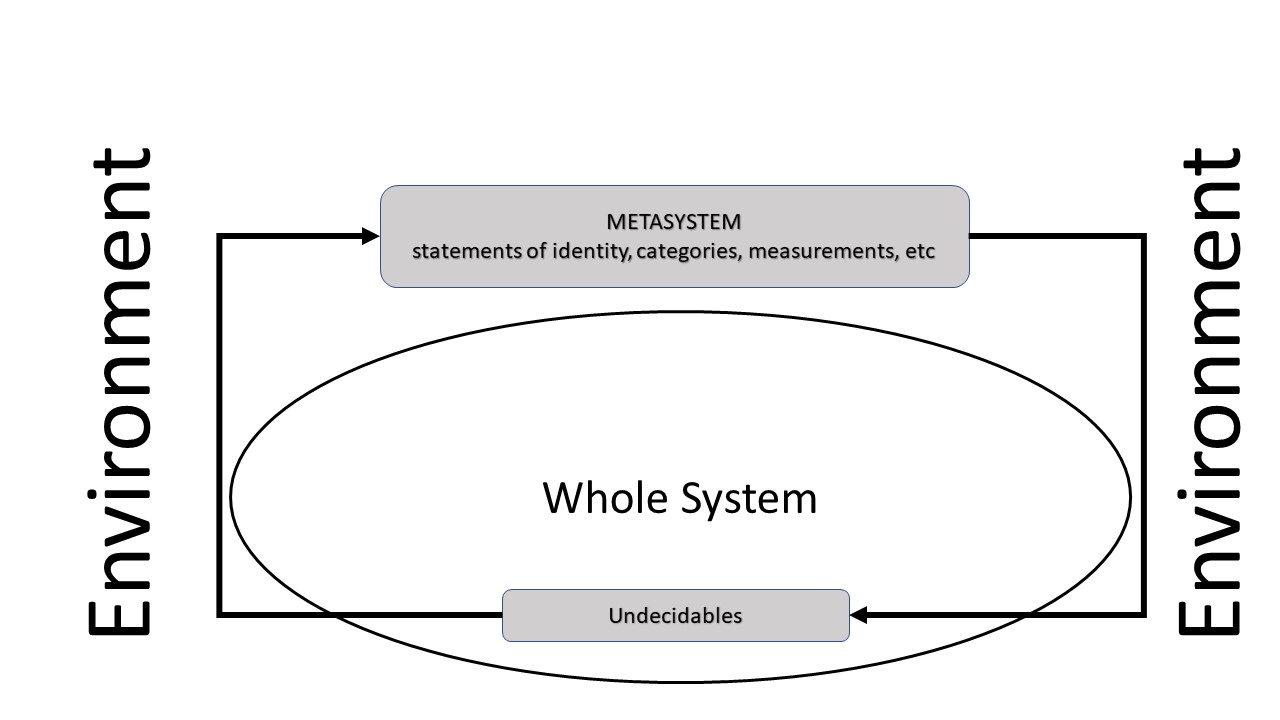
A SYSTEMIC VISION OF THE CRISES From optimization to change strategy? 10th congress of the European Union for Systemics (UES2018) 15-16-17/10/2018, Brussels, Belgium

The proceedings of the working version will be published in Acta Europeana Systemica, the Journal of the European Union for Systemics available on-line (http://aes.ues-eus.eu) [ISSN 2225-9635].

CONGRESS PROGRAM

source:

EUS – UES 2018

Biocentrism – Robert Lanza

Biocentrism (theory of everything)

Biocentrism (from Greek: βίος, bios, “life”; and κέντρονkentron, “center”) — also known as the biocentric universe — is a theory proposed in 2007 by American scientist Robert Lanza, which sees biology as the central driving science in the universe, and an understanding of the other sciences as reliant on a deeper understanding of biology. Lanza believes that life and biology are central to being, reality, and the cosmos—consciousness creates the universe rather than the other way around. While physics is considered fundamental to the study of the universe, and chemistry fundamental to the study of life, Lanza claims that scientists will need to place biology before the other sciences to produce a “theory of everything”

Critics have questioned whether the theory is falsifiable. Lanza has argued that future experiments, such as scaled-up quantum superposition, will either support or contradict the theory.

Theory

Biocentrism was first proposed in a 2007 article by Robert Lanza that appeared in “The American Scholar,” where the goal was to show how biology could build upon quantum physics. Two years later, Lanza published a book with astronomer and author Bob Berman entitled “Biocentrism: How Life and Consciousness Are the Keys to Understanding the True Nature of the Universe”, which expanded upon the ideas that Lanza wrote about in his essay for the “Scholar”.

Biocentrism argues that the primacy of consciousness features in the work of René Descartes, Immanuel Kant, Gottfried Leibniz, George Berkeley, Arthur Schopenhauer, and Henri Bergson. He sees this as supporting the central claim that what we call space and time are forms of animal sense perception, rather than external physical objects.

Robert Lanza argues that biocentrism offers insight into several major puzzles of science, including Heisenberg’s uncertainty principle, the double-slit experiment, and the fine tuning of the forces, constants, and laws that shape the universe as we perceive it. According to Robert Lanza and Bob Berman, “biocentrism offers a more promising way to bring together all of physics, as scientists have been trying to do since Einstein’s unsuccessful unified field theories of eight decades ago.”

Seven principles form the core of biocentrism. The first principle of biocentrism is based on the premise that what we observe is dependent on the observer, and says that what we perceive as reality is “a process that involves our consciousness.” The second and third principles state that “our external and internal perceptions are intertwined” and that the behavior of particles “is inextricably linked to the presence of an observer,” respectively. The fourth principle suggests that consciousness must exist and that without it “matter dwells in an undetermined state of probability.” The fifth principle points to the structure of the universe itself, and that the laws, forces, and constants of the universe appear to be fine-tuned for life. Finally, the sixth and seventh principles state that space and time are not objects or things, but rather tools of our animal understanding. Lanza says that we carry space and time around with us “like turtles with shells.”

Robert Lanza claims that biological observers actually create the arrow of time. In his papers on relativity (also published in Annalen der Physik), Einstein showed that time was relative to the observer; in their paper, Podolskiy and Lanza argue that quantum gravitational decoherence is too ineffective to guarantee the emergence of the arrow of time and the “quantum-to-classical” transition to happen at scales of physical interest. They argue that the emergence of the arrow of time is directly related to the way biological observers with memory functions process and remember information. They cite Robert Lanza’s American Scholar paper on biocentrism, stating that the “brainless” observer does not experience time and/or decoherence of any degrees of freedom.

Synopsis of Dr. Robert Lanza’s book “Biocentrism”

According to Lanza’s book, “Biocentrism” suggests that life is not an accidental byproduct of physics, but rather is a key part of our understanding of the universe. Biocentrism states that there is no independent external universe outside of biological existence. Part of what it sees as evidence of this is that there are over 200 physical parameters within the universe so exact that it is seen as more probable that they are that way in order to allow for existence of life and consciousness, rather than coming about at random. Biocentrism claims that allowing the observer into the equation opens new approaches to understanding cognition. Through this, biocentrism purports to offer a way to unify the laws of the universe.

Synopsis of Robert Lanza’s book “Beyond Biocentrism”

In 2016, Robert Lanza wrote a follow-up book on biocentrism with Bob Berman, “Beyond Biocentrism.” The book extends Lanza’s ideas, providing a more through explanation of his theory, including the latest scientific findings in fields ranging from botany and astrophysics to quantum mechanics and neuroscience; it also includes chapters that solely address issues such as whether death is an illusion, whether plants have awareness, and whether machines will ever achieve consciousness. In addition to presenting the scientific evidence, the book presents the philosophical arguments behind biocentrism to explain its implications for society and our individual lives, including the underlying unity of nature and the observer with all its implications ‒ chief among them the unreality of death.

Source: Biocentrism Wiki – Robert Lanza


From https://weilerpsiblog.wordpress.com/2011/03/11/biocentrism-a-consciousness-centric-view-of-the-universe/ :

The 7 Principles of Biocentrism

First Principle of Biocentrism: What we perceive as reality is a process that involves our consciousness.

Second Principle of Biocentrism: Our external and internal perceptions are inextricably intertwined. They are different sides of the same coin and cannot be divorced from one another.

Third Principle of Biocentrism: The behavior of subatomic particles –indeed all particles and objects – is inextricably linked to the presence of an observer. Without the presence of a conscious observer, they at best exist in an undetermined state of probability waves.

Fourth Principle of Biocentrism: Without consciousness, “matter” dwells in an undetermined state of probability. Any universe that could have preceded consciousness only existed in a probability state.

Fifth Principle of Biocentrism:  The structure of the universe is explainable only through biocentrism. The universe is fine-tuned for life, which makes perfect sense as life creates the universe, not the other way around. The “universe” is simply the complete spatiotemporal logic of the self.

Sixth Principle of Biocentrism: Time does not have a real existence outside of animal-sense perception. It is the process by which we perceive changes in the universe.

Seventh Principle of Biocentrism: Space, like time, is not an object or a thing. Space is another form of our animal understanding and does not have an independent reality. We carry space and time around with us like turtles with shells. Thus, there is no absolute self-existing matrix in which physical events occur independent of life.


And on Robert Lanza’s (other?) own site: http://www.robertlanza.com/biocentrism-how-life-and-consciousness-are-the-keys-to-understanding-the-true-nature-of-the-universe/

Peter Harries-Jones, “Upside-Down Gods: Gregory Bateson’s World of Difference” (Fordham UP, 2016) |

PETER HARRIES-JONES

Upside-Down Gods

Gregory Bateson’s World of Difference

FORDHAM UNIVERSITY PRESS 2016

October 4, 2018 Tom Scholte

The work of polymath Gregory Bateson has long been the road to cybernetics travelled by those approaching this trans-disciplinary field from the direction of the social sciences and even the humanities.  Fortunately for devotees of Bateson’s expansive vision, Peter Harries-Jones has continued the expert analysis that gave us 1995’s A Recursive Vision: Ecological Understanding and Gregory Bateson, with his 2016 offering, Upside-Down Gods: Gregory Bateson’s World of Difference (Fordham University Press, 2016). Harries-Jones has clearly thought deeply about the totality of Bateson’s corpus while drawing upon a wide variety of sources including personal correspondence. The result is an illuminating study that, amongst other accomplishments, productively positions Bateson’s work as a foundation of today’s burgeoning field of biosemiotics.  In our wide-ranging conversation, Harries-Jones warns us of the perils of a strictly algorithmic “world without mind,” details Bateson’s intellectual tussle with Bertrand Russell’s Theory of Logical Types, and amplifies Bateson’s bold challenges to the social sciences to let go of the centrality of power and control and replace them with an appreciation of aesthetics and form, to heal the “epistemic cut” between the human and the animal, and even dare to recuperate selected elements of the thought of Jean-Baptiste Lamarck in a challenge to Darwinian orthodoxy.  All of this makes for a conversation that is as incisive and articulate as his highly readable monograph asking us to carefully consider the intellectual and ecological benefits of Bateson’s “upside down” ontology with “mind” as foundation rather than emergent phenomenon.

Amazon says:

Science’s conventional understanding of environment as an inert material resource underlies our unwillingness to acknowledge the military-industrial role in ongoing ecological catastrophes. In a crucial challenge to modern science’s exclusive attachment to materialist premises, Bateson reframed culture, psychology, biology, and evolution in terms of feedback and communication, fundamentally altering perception of our relationship with nature.

This intellectual biography covers the whole trajectory of Bateson’s career, from his first anthropological work alongside Margaret Mead through the continuing relevance of his late forays into biosemiotics. Harries-Jones shows how the sum of Bateson’s thinking across numerous fields turns our notions of causality upside down, providing a moral divide between sustainable creativity and our current biocide.


Harries-Jones profile – http://laps-dept.apps01.yorku.ca/anth/faculty/emeriti/harries.html


Harries-Jones on video – Feedback and the Voice of Sanity

The interesting parts of the Deming story aren’t really Deming

[Though I would say I believe there may be another story about Deming’s behaviour – as a typical mid-20th Century male guru figure – which may or may not come out. But that could apply to many heroes.
The point of this comment reproduced here as a post is that there are multiple complex inputs to the ‘Japanese economic miracle’ and all that came from it. See also (April 2026) more on the impact of Homer Sarasohn on Apple:
https://x.com/PatrickMcGee_/status/2039577362602537308?s=20 ]

Source: comments on The Relevance of Giants – 1. Deming On most every occasion when I’m speaking in public – at conferences, workshops, and the like – I tend to mention one or more of my “Giants” of …

The Relevance of Giants – 1. Deming | Think Different


Me:

An interesting post from Bob Marshall, which inspired me to revisit and explore some of the Deming story – and, more intriguingly, the whole ‘Japanese miracle’ story. This is just surface level stuff, in an area that has been well researched (but little actually picked up on), but I think it’s relevance to systems thinking is that Deming is still claimed (despite his own admission) as a part of ‘systems thinking’, and there’s some reason for this, too – and, more importantly, that the commonplace language of ‘gurus’ and giants, while keeping some core headline material alive (and I think everything in Bob’s post and the usual Deming stuff is worthy of some study), can (a) obscure some richer ecosystems of learning and (b) perpetuate some myths which (perhaps originally well-intentioned partial truths) can actually steer people wrong, if taken at face value, or undermine the message, if dug into from that face value perspective.

___ my long comment:
Bob, I don’t know how helpful this is, but for some reason, I’ve always been tempted to question the cult of Deming. I don’t want to detract from the man or from his wisdom, or the enormous value of practicing what he taught. It’s just that the uncritical lines which are the ‘received wisdom’ about his life and approaches do, I admit, bother me a bit. I sure wish I had been to his seminars, but I feel that digging deeper her might be more interesting than the headlines. This has turned into a much longer comment than your post – but perhaps is interesting, particularly on your theme of ‘the relevance of giants’!

So:
– “his pivotal role in the Japanese post-war miracle”. Yes, undoubtedly – we have the evidence of the Japanese recognition of this. And yet, your wiki link intriguingly /doesn’t/ mention Deming – and credits two main reasons: successful economic reform by the government and the outbreak of the Korean War… the former point, however, amongst a lot of intriguing stuff, includes Keiretsu, ‘mirroring wartime conglomerates, or zaibatsu’, which spurred both horizontal and vertical integration – precisely the sort of message Deming preached, as I understand it – but a result, or a happy coincidence? The rest, including ownership and loan measures, would reward richer study.

– his Plan-Do-Study-Act cycle. Yes. But I think he always talked about this as the Shewhart cycle (I have a lovely photo of his original overhead transparency, including this phrase, from one of his interns – who, incidentally, also said – if I heard right – that she slept in his hotel room, at the foot of his bed, on his many teaching tours). I think it’s interesting and valuable to situate him in the context of others he learned from…
Your comment about the link to agile is also interesting – intuitively, it makes great sense, of course – however, is there an explicit, intentional link that you’re aware of?

What’s perhaps interesting as well is the ‘organisation as a system’ diagram (Deming acknowledged that he didn’t know ‘systems thinking’, and was talking about processes – a confusion which has left a bit of a legacy – but I think ‘processes as a system’ are interesting) – https://blog.deming.org/2012/10/appreciation-for-a-system/ – and Deming’s insistence, in his Japanese lecture (translation http://hclectures.blogspot.com/1970/08/demings-1950-lecture-to-japanese.html), that PDSA must be applied not only to the the traditional three steps:

1. Product design (shoes, cotton materials, silk materials, magnetic products, electrical appliances)
2. Manufacture
3. Sales

(It’s interesting he chooses this instead of Shewart’s “three-step process of specification, production, and inspection” https://en.wikipedia.org/wiki/PDCA#About )
But…
“Today, in 1950, we all must design, manufacture, and sell in the same way, but science has expanded. Rather than following the example of these three steps, four stages, including market surveys which I have just highlighted have become necessary.”
I think he designed and sold the ‘market surveys’ – that’s interesting…

– “Deming’s 95/5” – I have it on good authority that the original statistic was based on a study of work in a US prison, published in 1911 from research done much earlier. And the wiki you link to – https://en.wikipedia.org/wiki/W._Edwards_Deming – including the intriguing line “He told Ford that management actions were responsible for 85% of all problems in developing better cars.”
And, anyway, the 95% is partly about the people anyway… so this is intriguing, really, worthy of further exploration…
(The Tripp Babbit quote is nice – I see he picked up the John Seddon phrasing; it seems to imply that they were taught directly, which I am not sure is the case!)
Two downsides of the ’95/5 rule’ – as I’ve seen it cast – are (1) a serious risk of denial of individual responsibility and (2) a tendency to ‘blame’ (a fairly non-systemic concept, I’d say) ‘management’ instead of ‘workers’. Neither very helpful, really…

This looks like a good sourcing of 94/6 from ‘Out of the Crisis’ and 90-95 from Deming’s introduction to Scholtes’ Team Handbook (not Scholtes himself) – https://management.curiouscatblog.net/2013/04/24/94-belongs-to-the-system/

“Red bead experiment” – it’s cool, I’ve participated and facilitated. It makes some very good points. It could be argued that it’s a ‘lie to children’ – a simplification for the purposes of teaching, for rhetorical effect if experiential learning can be considered rhetorical. But it therefore, by exaggerating the conditions, threatens to weaken the real deep long-term learning. According to https://www.spcforexcel.com/knowledge/variation/red-bead-experiment, “Dr. W. Edwards Deming often referred to it as a stupid experiment that you’ll never forget.”
BTW, how and who developed the red bead experiment, I can’t quite be sure. This – http://www.redbead.com/what/ (archived link: https://web.archive.org/web/20200220080702/http://www.redbead.com/what/ ) – says “In 1982, a teaching tool was created with Dr. Deming that he used in his seminars around the world to teach his famous 14 Obligations of Management.” – ‘created with’ sounds really interesting!

Thanks for indulging my exploration here – two more points to make from googling and trawling these links:

1) Christianity – I never knew that he and Scholtes were big Christians, and evidently both wrote devotional music. That’s intriguing!

2) There’s an even bigger issue – what is the *real* history of post-war quality in Japan? Deming was certainly recognised and honoured. But Myron Tribus and Ken Hopper, serious historians and documenters of the quality revolution in Japan and later in the US, report that Sarasohn probably deserves more credit (along perhaps with Protzman… and Shewhart)

“Homer Sarasohn… the mad who made Japan successful”
http://www.firstmetre.co.uk/library/documents/493/
archived link: https://web.archive.org/web/20160114184315/http://www.firstmetre.co.uk/library/documents/493/

“Had Deming and I stayed at home, the Japanese would have achieved world quality leadership all the same.”
(Joseph Juran) in https://link.springer.com/chapter/10.1057%2F9780230282179_15

Superb article: Quality management and quality practice: Perspectives on their history and their future
https://deepblue.lib.umich.edu/bitstream/handle/2027.42/61868/756_ftp.pdf?sequence%3D1
(archived link: https://web.archive.org/web/20170817005203/https://deepblue.lib.umich.edu/bitstream/handle/2027.42/61868/756_ftp.pdf?sequence%3D1 )

“Why haven’t we heard much of poor old Homer? Because of the American quality guru W.Edwards Deming, a master of self-promotion, who was brought to Japan to continue the work of Sarasohn and Protzman. While Sarasohn was MacArthur’s man, Deming was perceived as the Japan Union of Scientists and Engineer’s man, which helped ensure his place in history.”

Homer Sarasohn from Nimal Namboodiripad
The comments on this economist ‘guru’ article on Deming (https://www.economist.com/node/13805735/comments) are enlightening!

Kenneth Hopper himself says:
“In four years this democrat in dictator’s clothing (Homer Sarasohn) may have accomplished more than any economic dictator in history” “A lesson learned and a lesson forgotten”, Robert Wood, FORBES.
“Sarasohn teamed up with Protzman in 1948 to design and teach intensive management training seminars, the Civil Communication Section (CCS) Management Seminar .. After World War II, Japan’s ‘captains of industry’ fortified Sarasohn’s management values with Japanese Bushido values.. , they … produced the postwar ‘miracle’? Yoshio Kondo, Baruch College, City of New York.
“A leader’s main obligation is to secure the faith and respect of those under him”, Charles Protzman and Homer Sarasohn, CCS Manual, GHQ Tokyo, 1950
“I gave over 500 lectures in every part of Japan from Hokkaido in the north to Kyushu in the south” “CCS was the light that illuminated everything” “By the end of the (1950) CCS seminar we all knew we would catch up with the Americans”
Bunzaemon Inoue, co-chair, CCS Seminars. Chairman, Sumitomo Rubber Industries
General MacArthur’s Civil Communications Section was very important for both Deming and Japan’s success. Our ignorance of it is surprising. CCS drilled into Japanese top executives that they were responsible for good management. When one missed a CCS session, CCS was on the phone to remonstrate. “Our slightest wish was their command”, Protzman remembered(1) Deming would be saddened at CCS neglect. I know. When illness struck, he sent me a substantial sum to help me tell the CCS story. When Human Resource Management published my “Creating Japan’s New Industrial Management” Deming wrote me “This is just what I need.”
Late in 1969 Peter Drucker phoned to say he had someone I should meet. I asked no questions and turned up to find a near mythical Japanese Sensei (teacher) Takeo Kato. Kato started to tell me about CCS when the tall Polkinghorn appeared and Kato said, “No man has done more for Japanese industry”. I was hooked. In 1979, my wife and I were treated like royalty in Japan at the invitation of Sumitomo Electric, Sumitomo Rubber and Matsushita Electric. Because we knew the great CCS engineers, dinners, waiting limousines, guides and interpreters were everywhere. The story of CCS is now well known in industry but has not reached business schools who prefer to see Japan’s success as an inexplicable Miracle. Simplistic Shock Treatment was given Russia when the lesson from Japan was rebuilding requires work in depth including improving how factories run. The most let down were non Asian developing nations.
Communications in Japan in 1945 were a disaster. The War Department approached US industry for help and able people responded including a young Homer Sarasohn who had impressed the US Army at MIT’s Rad Lab, Charles Protzman, a 6.ft 4in manufacturing superintendent with decades of experience from Western Electric and Frank Polkinghorn a high engineer in Bell Labs. I came to know all well. Their ability and domain knowledge made it possible for Japan’s unimpressive electrical manufacturers to become its world stunning Consumer Electronics Industry. Influenced by Morgenthau, the US had shackled MacArthur with Secret Order JCS1380/15 to take no responsibility for the Japanese economy. As a result, when Truman announced the Reverse Course in late 1948, CCS was the only Section engaged with manufacturing. CCS proposed that it combine seminars with working with its manufacturers to help them compete in world markets. Sarasohn loved to recount his 1949 confrontation before MacArthur with the large Economic and Scientific Section who argued the US would be giving away too much. MacArthur sat expressionless through both presentations, got up and walked to the door. Sarasohn thought, “I’ve blown it”. MacArthur turned, pointed the stem of his corncob pipe at him and said, “Go do it”. The rest is history. Japan’s electronics industry would have a major influence on management in the rest of Japanese industry and the world.
Japan’s specialists wanted a visit from Shewhart. Sarasohn refused until 1950. When he phoned, Shewhart declined for ill health. Sarasohn confirmed Deming’s ability. At his request, ESS issued the formal invitation. Many have confirmed CCS importance. My brother Will has a selection at http://www.puritangift.com including an abbreviated chapter on CCS and Japan’s extraordinary executives from our book The Puritan Gift, a Financial Times Top Ten Business Book of 2007 Ken Hopper
“A lesson learned and a lesson forgotten”, Robert Wood, FORBES, Feb 6, 1989. “Homer Sarasohn and American Involvement in the Evolution of Quality Management in Japan, 1945–1950”. N. I. Fisher, International Statistical Review (2008). K. Kobayashi, Chairman NEC Corporation, in his 1985 address to Bell Laboratories. “For more about the early development of quality control in postwar Japan, see ‘Quality, Japan and the U.S.: the First Chapter’” Ken Hopper Quality Progress Sept 1985

And, even more intriguing to me, it could be that Elliott Jaques’ Requisite Organization theory might have played a valuable role:
Ken CraddockJun 13th 2009, 19:25
The Japanese also adopted Elliott Jaques’ requisite theory to counter upper-level organizational design, long-term appraisals, and executive selection and development. Deming consulted and taught four days per month for 10 years at GM with little apparent effect. The two theories are robust to each other – but only if both are implemented. Treating either as a short-term fad negates it. Does any US-based Board of Directors know what to do and how to do it?

Excellent downloadable article:
https://www.researchgate.net/publication/46537675_Homer_Sarasohn_and_American_Involvement_in_the_Evolution_of_Quality_Management_in_Japan_1945-1950

Whole site trying to redress the balance: https://honoringhomer.net/ (archived link https://web.archive.org/web/20220409062443/https://honoringhomer.net/ )

Brilliant overview by Bob Cringely: http://qualiticien.over-blog.com/article-679016.html

More or less the same piece by someone else: http://www.richmore.com/html/protzman.html

Another overview: http://quality-history.blogspot.com/2007/11/how-general-macarthur-allowed-japan-to.html

https://en.wikipedia.org/wiki/Homer_Sarasohn

Myron Tribus video interview:
https://blog.deming.org/2017/02/myron-tribus-interview-of-homer-sarasohn/

I hope this illustrates both that the footnotes might be as interesting as the headlines – and that there might be more to the Deming story – and more interesting things there that are *not* Deming.

The Complexity of Failure – Sidney Dekker

Those at the cutting edge of improving safety – and particularly some people around safetydifferently.com – are some of the most practical and sophisticated systems thinkers, combining theory and praxis and sensemaking and much else…
two good summaries
http://www.safetydifferently.com/why-do-things-go-right/ (this one links to Deming et al)
http://www.safetydifferently.com/wp-content/uploads/2018/10/Safety-Differently-ASSE-Proceedings-Paper.pdf
and a couple of good sources:
https://preaccidentpodcast.podbean.com/
https://humanisticsystems.com/
(I think there was an excellent Australian podcast, but it must have stopped releasing as I haven’t heard it recently; will add if I find it)
video:

Published on 2 Oct 2018

When James Titcombe is hit by the biggest tragedy imaginable to any parent, he and his wife need to confront a tragedy on a bigger scale still: the structural learning disabilities of the organization that robbed them of their child. The ‘complexity of failure’ documents the struggle to get the largest employer of the land to account for what was lost. Behind the bureaucracy and posturing, the lies and denials, it discovers a humanity and a richly facetted suffering by many others. It drives a determined James Titcombe to change how we learn from failure forever.


The Adaptive Behavior of a Soccer Team: An Entropy-Based Analysis

cxdig's avatarComplexity Digest

To optimize its performance, a competitive team, such as a soccer team, must maintain a delicate balance between organization and disorganization. On the one hand, the team should maintain organized patterns of behavior to maximize the cooperation between its members. On the other hand, the team’s behavior should be disordered enough to mislead its opponent and to maintain enough degrees of freedom. In this paper, we have analyzed this dynamic in the context of soccer games and examined whether it is correlated with the team’s performance. We measured the organization associated with the behavior of a soccer team through the Tsallis entropy of ball passes between the players. Analyzing data taken from the English Premier League (2015/2016), we show that the team’s position at the end of the season is correlated with the team’s entropy as measured with a super-additive entropy index. Moreover, the entropy score of a team significantly…

View original post 55 more words

Systems practices you can do every day – The Australian Prevention Partnership Centre (pdf)

From https://preventioncentre.org.au/

Systems practices you can do every day

Systems practices develop your
ability to better understand and
make sense of complex situations,
which enables more effective
decision making. Applying these
practices helps you to see the
system, its parts, relationships
and dynamics.
SEE THE
BIGGER
PICTURE
QUESTION
ASSUMPTIONS
REFLECT
REGULARLY
LISTEN
DEEPLY
ENGAGE
DIVERSE
PERSPECTIVES
SEE YOURSELF
IN THE SYSTEM
UNCOVER
UNINTENDED
CONSEQUENCES
LOOK FOR
CONNECTIONS
AND PATTERNS
BE AWARE OF
YOUR MENTAL
MODEL
USE VISUAL
MODELLING
Engaging in systems practice is an ongoing activity – like a
muscle, it continually needs to be exercised. Use these prompts
to help you apply systems practices every day.
Step back from the details to see the bigger picture and
explore what else may be influencing a situation. What
else is going on here?
Be aware of your mental model and how it influences
your perspective and actions. What beliefs and values
inform how I see, engage, and react to this situation?
See yourself in the system and how you engage,
contribute and influence it. What is my role in this
situation? What can I influence?
Engage diverse perspectives to see a situation from
different vantage points. Who has a different perspective
from my own on this situation and how might they see it?
Whose voice is not being heard?
Be present in the moment and listen deeply, without
trying to ‘fix’ a problem. Am I listening or waiting to talk?
Am I suspending judgement and criticism? Am I being
open to new information?
Question assumptions to surface what has informed
them and to question if they are true. What assumptions
am I making about this situation and how can I test them?
Uncover unintended consequences before committing
to a decision or action. What else might happen if we do
this? What adaptations need to be made as a result?
Use visual modelling to make sense of, or explain a
complex situation, which may reveal new insights. Can I
draw or illustrate this situation with diagrams, metaphors,
relationships or symbols?
Look for connections and relationships between parts
to gain new insights about the whole. Which parts have
a connection? What is their relationship? Is there an
emerging or reoccurring pattern?
Reflect regularly on a situation, interpret and give it
meaning to draw deeper learning. What did I intend to
happen and what actually happened? What does it tell me
about the system? How can I work with this new insight?
For further information, visit preventioncentre.org.au/resources/
learn-about-systems August, 2018
We would like to acknowledge and are grateful for the work of others to identify
and develop systems practices. Our practices are drawn both from these
existing resources and our own experience working in systems. There are many
more practices, but we feel these are the most practical for everyday use.
Which practice will
you apply today?


at (pdf)

Click to access Systems-Thinking-DL-flyer_Without-crop-marks_Aug18.pdf

Decentralized Collective Learning for Self-managed Sharing Economies

cxdig's avatarComplexity Digest

The Internet of Things equips citizens with phenomenal new means for online participation in sharing economies. When agents self-determine options from which they choose, for instance their resource consump- tion and production, while these choices have a collective system-wide impact, optimal decision-making turns into a combinatorial optimization problem known as NP-hard. In such challenging computational problems, centrally managed (deep) learning systems often require personal data with implications on privacy and citizens’ autonomy. This paper envisions an alternative unsupervised and decentralized collective learning approach that preserves privacy, autonomy and participation of multi-agent systems self-organized into a hierarchical tree structure. Remote interactions orchestrate a highly efficient process for decentralized collective learning. This disruptive concept is realized by I-EPOS, the Iterative Economic Planning and Optimized Selections, accompanied by a paradigmatic software artifact. Strikingly, I-EPOS outperforms related algorithms that in- volve non-local brute-force operations or exchange full information. This paper contributes new experimental findings…

View original post 65 more words

System Change – bi-annual journal of the Schumacher Institute

System Change

SYSTEM CHANGE is the bi-annual journal of The Schumacher Institute, focused on interdisciplinary systems theory and practice for a sustainable world. For more about the philosophy behind the journal, please see here.

Source: System Change

About the journal https://systemchange.online/index.php/systemchange/about :

Welcome to SYSTEM CHANGE

Interdisciplinary systems theory and practice for a sustainable world

‘System Change’ is our title as this includes a number of related areas:

  • analysis of the world as different kinds of systems in process and in relationship
  • understanding the interactions of systemic levels – from micro to macro and local-to-global
  • methods and examples of how to intervene in systems to transition to forms that can be better for people and planet
  • methods and examples of how to design and develop effective systems for human well-being and ecological sustainability
  • the extent but also the limits of knowledge in recognition of process, complexity and emergence
  • inspiration and hope for positive change from a wide variety of existing and new traditions grounded in human and ecological values based on systemic knowledge and wisdom
  • an overall aim to support knowledge creation and circulation to help make positive system change for a sustainable world

SYSTEM CHANGE is published by the Schumacher Institute for Sustainable Systems. This means we begin by drawing our contributors and ideas from the institute’s networks but we are open to working with other groups that share our general goals. Please get in touch! We are especially interested to keep in being a critical mass of systems thinkers so we are keen to connect with individuals who would like to engage with a community of thinking through this journal and associated activities.

Aims:

  • a freely accessible journal for a wide variety of systemic work supporting sustainability
  • a journal that can host contributions from a diversity of cultures and perspectives
  • thematic issues that help to develop key areas of debate and practice
  • encourage learning between social movements for sustainability, theorists/researchers, business – particularly social and ecological business – and policy/government
  • exploration of focussed examples of change placed in the context of their wider relationships

Thematic areas of focus include:

  • systems learning, philosophy and methodology
  • changing education and research systems
  • economic system change
  • systems approaches to the past and future
  • socio-ecological and socio-technical systems change
  • policy challenges and systemic knowledge and intervention
  • methodology of interdisciplinary research and project development
  • socio-economic and political change and governance systems
  • cultural and belief systems, emotional identity and narrative aspects of change
  • concepts of human being and relationships to wider systems

A project in development:

This journal is conceived as a process that we hope will flourish…and we welcome new contributors, ideas and editorial suggestions. We are also happy to develop special themed issues linked to events and/or projects and to extend the range of organisations with which this journal is linked. We particularly welcome contributions and nominations for our editorial board from areas of the world which are not currently represented.


Cafe system change magazine from the Schumacher Institute

[I’m trying to track down the Schumacher Institute’s new journal, System Change – meanwhile, here’s a ‘lighter verison’]

Café SYSTEM CHANGE magazine
A lighter companion to SYSTEM CHANGE Journal
May 2018 | For SYSTEM CHANGE Journal Issue 1


Source: Systems Learning – Free your thinking | Systems Community of Inquiry

Systems Learning – Free your thinking

Systems Learning. Free your thinking to deal effectively with the world as it is – messy, complex, unpredictable.

Systems Learning aims to free you from the existing limitations of business as usual.

Our courses are designed to help people and organisations free their thinking, to deal with challenges,  uncertainty, complex systems and stuck relationships in a far more effective way. We also show how to translate sustainability into action.

Do you, or your organisation, wrestle with complex, messy problems that seem impossible to solve?

Come and deepen your thinking at one of our courses in Bristol or London – we also run in-house courses for organisations of all sizes.

For a taste of the knowledge and skills you will gain, enjoy access to our FREE six-part Introduction to Systems Learning online course.

“The Free Your Thinking course with Martin Sandbrook is a must for everyone who wants to better understand the complexity of the world we are living in, and at the same time wants to be a positive agent of change in their personal or professional lives.” Kathrine Maceratta – Digital Transformation Director, Unilever

Systems Learning is part of The Schumacher Institute for Sustainable Systems

Source: Systems Learning – Free your thinking


NERCCS 2019: Second Northeast Regional Conference on Complex Systems,3-5 April 2019, Binghampton, NY, USA

[Apologies if this is a duplicate – I’ve seen it before (I know someone from Binghampton, so I noticed it… but I can’t find it here. Benjamin]

APRIL 3–5, 2019   BINGHAMTON, NY

NERCCS 2019:
Second Northeast Regional Conference on Complex Systems

LEARN MORE

NERCCS 2019: The Second Northeast Regional Conference on Complex Systems will follow the success of the previous inaugural NERCCS to promote the emerging venue of interdisciplinary scholarly exchange for complex systems researchers in the Northeast U.S. region to share their research outcomes through presentations and post-conference online publications, network with their peers in the region, and promote inter-campus collaboration and the growth of the research community.

NERCCS will particularly focus on facilitating the professional growth of early career faculty, postdocs, and students in the region who will likely play a leading role in the field of complex systems science and engineering in the coming years.

The conference will be held in the Innovative Technologies Complex at Binghamton University, which is within driving distance from all major urban areas in the U.S. Northeast region.

DOWNLOAD CONFERENCE FLYER

CALL FOR SUBMISSIONS

We call for submissions for oral and poster presentations on a wide variety of complex systems research. Relevant topics include (but are not limited to):

Theoretical foundations of complex systems
Nonlinear dynamics and chaos
Systems theory, information theory, and systems science
Game theory, decision theory, and socio-economical applications

Self-organization, pattern formation, and collective behavior
Structure and dynamics of complex networks
Sustainability and adaptability of complex systems
Bio-inspired systems, machine learning, and evolutionary computation

Data-driven approaches to complex systems
Applications to the humanities, art, and literature
Historical and philosophical aspects of complex systems
Complex systems and education

Submissions should be made as a single PDF file via EasyChair, in either extended abstract format (preferred; 1 page, including one figure) or full paper format (optional; 8 pages max.).

Click here for formatting instructions

Formatting example in LaTeX

Click here to log in to EasyChair

Submissions will be evaluated and selected through a rigorous peer review process.

Important Dates:

Submission deadline: January 15, 2019
Notification to authors: February 15, 2019
Revision deadline: March 15, 2019
Registration deadline: March 29, 2019
Conference: April 3-5, 2019

We will publish post-conference proceedings as a special issue of the Northeast Journal of Complex Systems (NEJCS), an open-access online journal hosted by the Open Repository @ Binghamton (ORB). No publication fee will be required. This will be an ideal venue for authors to publish an extended full paper on the work they present at NERCCS. There will be no strict length limit to full papers for the post-conference proceedings (but with an expected length no more than about 10,000 words). Interested authors should contact the Publication Chairs (Barney Ricca and Georgi Georgiev).

KEYNOTE & INVITED SPEAKERS

Keynote Speakers

Image

BROOKE FOUCAULT WELLESCOMMUNICATION STUDIES AND NETWORK SCIENCE
NORTHEASTERN UNIVERSITY

Title TBA

Image

GERMANO IANNACCHIONEPHYSICS
WORCESTER POLYTECHNIC INSTITUTE
NATIONAL SCIENCE FOUNDATION

Title TBA

Image

MORE SPEAKER TBA

Invited Speakers

Image

CHRYSTOPHER NEHANIVSYSTEMS DESIGN ENGINEERING
UNIVERSITY OF WATERLOO

Title TBA

Image

LISA SOROSINFORMATION TECHNOLOGY AND SCIENCES
CHAMPLAIN COLLEGE

Title TBA

Image

CARL LIPOENVIRONMENTAL STUDIES AND ANTHROPOLOGY
BINGHAMTON UNIVERSITY

Title TBA

PROGRAM

Coming Soon

VENUE

Center of Excellence Symposium Hall & Engineering Science Building ES 2008
Innovative Technologies Complex
Binghamton University, State University of New York
85 Murray Hill Road, Vestal, NY 13850

Parking will be available on the venue. Parking permit will be provided to registered participants not affiliated with Binghamton University.

NERCCS 2019 Hotel Rates
Call the hotel directly and tell them you will be staying for “NERCCS Conference” to get the special rate.

Local accommodation options (Google Maps)

Information about Greater Binghamton Area

www.visitbinghamton.org

REGISTRATION

Coming Soon

ORGANIZERS & SPONSORS

Organizing Committee:

General Chair: Hiroki Sayama (Binghamton University, SUNY)
Program Chairs: Alfredo Morales (New England Complex Systems Institute / MIT Media Lab)
Esteban Moro (MIT Media Lab / Universidad Carlos III de Madrid)
Poster Session Chairs: Changqing Cheng (Binghamton University, SUNY)
Ashwin Vaidya (Montclair State University)
Sponsorship Chair: Andreas Pape (Binghamton University, SUNY)
Logistics Chair: Shelley Dionne (Binghamton University, SUNY)
Education & Career
Development Chairs:
Sarah Muldoon (University at Buffalo, SUNY)
Dane Taylor (University at Buffalo, SUNY)
Publication Chairs: Georgi Georgiev (Assumption College / Worcester Polytechnic Institute)
Barney Ricca (St. John Fisher College)

Contact:

nerccs2019@gmail.com

Source: NERCCS 2019: Second Northeast Regional Conference on Complex Systems

Epistemological crises, dramatic narrative and the philosophy of science / Alasdair MacIntyre. – The Monist, 1977

Handy link to the paper

Click to access macintyre-epistemological-crises-1.pdf

Another one to file under ‘perhaps not systems thinking, but I believe it should be here’ – such a strong alignment with deep systems thinking, this is about meaning-making and is an illustration using an epistemological crisis  as a way to explore meaning-making…


Good review which I have edited down below (removing references to Rorty and Pirsig): http://pirsigaffliction.blogspot.com/2006/05/epistemological-crises-and-dramatic.html

“Epistemological Crises, Dramatic Narrative and the Philosophy of Science,” is an excellent little thing and contains the basic anti-theoretical insights he carries in books like After Virtue and Whose Justice? Whose Rationality?. (MacIntyre has said that this essay was a turning point for him from his earlier work to the writing of After Virtue.) The basic idea is that the idea of tradition has been woefully lacking in our accounts of rationality.

MacIntyre begins his essay by thinking about what it means to be in an “epistemological crisis”. He does so in a very down to earth, real life manner, like when “someone who has believed that he was highly valued by his employers and colleagues is suddenly fired” or when “someone falls out of love and needs to know how he or she can possibly be so mistaken in the other.” (241) These are real problems that most of us have faced, or can at least imagine being in similar circumstances. What we think about people is based on how they behave, but sometimes our entire outlook on them changes and all their behavioral cues become transmogrified–and worse, sometimes we cease to be certain about how to take their behavior at all. What we “took to be evidence pointing unambiguously in some one direction now turns out to have been equally susceptible of rival interpretations.”

This produces a frightful situation in which we lose our hold on reality. For “my ability to understand what you are doing and my ability to act intelligibly (both to myself and to others) are one and the same ability.” (242) If we begin to lose our hold on others, we begin to lose our hold on ourselves. Recurring to the example of Hamlet as an exemplar of epistemological crisis, MacIntyre says perceptively that “to be unable to render oneself intelligible is to risk being taken to be mad–is, if carried far enough, to be mad. And madness or death may always be the outcomes that prevent the resolution of an epistemological crisis, for an epistemological crisis is always a crisis in human relationships.” (243)

The wisdom that MacIntyre is pulling out of the example of such an individual in distress has the same implications for disciplines or paradigms of thought in distress. “When an epistemological crisis is resolved, it is by the construction of a new narrative, which enables the agent to understand both how he or she could intelligibly have held his or her original beliefs and how he or she could have been so drastically misled by them.”

The most important reason for such narratives is that without them we would be taken over by the kind of radical, paralyzing skepticism that Descartes (and every epistemological skeptic after) pretends to have. MacIntyre points out that even Descartes, having formally eschewed narrative for formal deduction from self-evident premises, constructs narratives to couch his process in the Meditations. The epistemological consequences are large. MacIntyre says that an epistemological crisis, even after being abated, can induce two conclusions: 1) that our understanding of a situation, the schemata or paradigms we use to interpret, even the ones we just adopted to end the crisis, “may themselves, in turn, come to be put in question at any time” (244) and 2) “because in such crises the criteria of truth, intelligibility and rationality may always themselves be put in question … we are never in a position to claim that now we possess the truth or now are fully rational. The most that we can claim is that this is the best account anyone has been able to give so far, and that our beliefs about what the marks of ‘a best account so far’ are will themselves change in what are, at present, unpredictable ways.”

MacIntyre, here, doesn’t pull out the point most explicitly, but the point is an important one… how do we know we are getting any better, that we aren’t just swinging unhooked from reality in a limitless abyss with no touchstone?

What is terrifying is that we, “we” being made up of our paradigms of thinking, could be terribly and radically wrong about reality, and therefore terribly and radically wrong about who we really are. Death has always been terrifying, and death is exactly what’s on the table. On the cultural scale, if we keep pulling up floorboards on the deck of the U. S. S. Neurath, how can we identify the totally new ship we will someday be aboard as embodying the culture we now identify with? And if that’s the case, wouldn’t that count as the death of an entire culture? That is scary, to think that democracy and freedom could someday end, but what is even more pressing is the personal death we risk at the hands of global belief replacement. For if all the beliefs we now own are replaced by others, wouldn’t we no longer count as being us? If I had totally and utterly different beliefs than those that I hold now, how would I identify as that person? Would I recognize me as me? Wouldn’t, then, I be dead?

MacIntyre and Rorty recognize, as post-Cartesian epistemology does not, the importance of narrative for the ordering and stablizing of beliefs. Without narrative, something like global skepticism would indeed be frightening. However, part of who we are, both as a culture and as individuals, is because of the story we tell ourselves of how we got from our old, bad beliefs to our new, better beliefs… This gives us continuity, the continuity in being able to claim that I did all those dumb, stupid things when I was younger. It gives you a coherent self. Without the story, we wouldn’t be able to claim any of that.

MacIntyre suggests that the difference between Descartes’ Meditations and Shakespeare’s Hamlet is that “Shakespeare invites us to reflect on the crisis of the self as a crisis in the tradition that has formed the self.” (248) Cultures are made up of traditions that create people and an epistemological crisis is a crisis of a particular tradition. A new, successful theory or paradigm or schema of science, art, religion, or philosophy does so because it “enables us to understand precisely why its predecessors have to be rejected or modified and also why, without and before its illumination, past theory could have remained credible. It introduces new standards of evaluating the past. It recasts the narrative that constitutes the continuous reconstruction” of the tradition of discourse. (249) MacIntyre is important for enabling us to to see that when a tradition is in a crisis, the successful resolution of that crisis extends the tradition. And it does so by its own tools. A tradition “is a conflict of interpretations of that tradition, a conflict which itself has a history susceptible of rival interpretations.” “A tradition then not only embodies the narrative of an argument, but is only to be recovered by an argumentative retelling of that narrative which will itself be in conflict with other argumentative retellings.” (250)

MacIntyre goes on to talk specifically about Kuhn, Lakatos, Popper and the philosophy of science, but I’d like to end by reflecting on MacIntyre’s links between epistemology and madness. MacIntyre remarks that “the categories of psychiatry and of epistemology must be to some extent interdefinable.” (252) MacIntyre in this essay has been using “epistemology” in a wide sense of “ways of knowing,” these schemata or theories or paradigms or canons of interpretation that generate on the other side what we call “knowledge”…. This is the idea of tradition-dependent, socially contextualized definitions of epistemology that have replaced the idea of Cartesian foundation-dependent, acontextual definitions.

JSTOR reference location – read up to six articles free with (?free?) membership: https://www.jstor.org/stable/pdf/27902497.pdf?seq=1#page_scan_tab_contents

pdf available at:

Epistemological crises, dramatic narrative and the philosophy of science / Alasdair McIntyre. – The Monist : an international quarterly journal of general philosophical inquiry / The Hegeler Institute {Hrsg.}. – 60(1977)4. – S. 453 – 472

Source: RiQuest | Document Viewer

Are you an ally of #systemschange? let me know here

In the late spring I was lucky enough to get involved in an international event on ‘supporting the field of #systemschange’. I will circulate a summary when it’s signed off.
We are currently connecting – with zero obligation – simple contact details of people who are ‘allies’ for systems change – which you might be, if you are reading this.
If you’re willing to share – to be asked by the group if you want to join – please let me have some basic details:
Name
organisation
website
contact info (email, phone)
brief description of interest and/or contribution to the field
cheers
Benjamin Taylor
ben_taylor@hotmail.com


Examples:

Lankelly Chase | Systems Change: A guide to what it is and how to do it

Academy for systems change: https://www.academyforchange.org/new-online-resources-leaders-systems-change/

NPC: https://www.thinknpc.org/themes/discover-ideas-and-approaches/systems-change/

Anna Birney of the School for Systems Change: https://medium.com/school-of-system-change/what-is-systems-change-an-outcome-and-process-f86126c8cb65

Con/versations Fall/Winter 2017 – cybernetics: state of the art

CON

VERSATIONS

vol. 1 Fall/Winter 2017

edited by liss c. werner

cybernetics: state of the art

Liss C. Werner is an architect. She is Assistant Professor for Cybernetics and computational Architecture at the Institute of Architecture at Technical University Berlin, Germany, where she is leading the cyberphysical systems research group. Werner has been specializing in cybernetics in architecture and Gordon Pask since 2002. She is a member of eCAADe and the American Society of Cybernetics and founder of Tactile Architecture- – offce für Systemarchitektur.

contributors:

raoul bunschoten
liss c. werner
raúl espejo
paul pangaro
kristian kloeckl
michael hohl
tim jachna
arun jain
delfna fantini van ditmar

Cybernetics is “a discipline which flls the bill insofar as the abstract concepts of cybernetics can be interpreted in architectural terms (and where appropriate, identifed with real architectural systems), to form a theory (architectural cybernetics, the cybernetic theory of architecture).”
Gordon Pask, 1969

Source (pdf): https://www.researchgate.net/profile/Liss_Werner/publication/320843914_Cybernetics_state_of_the_art/links/5a1d2c19a6fdcc0af326a813/Cybernetics-state-of-the-art.pdf


s
search
c
compose new post
r
reply
e
edit
t
go to top
j
go to the next post or comment
k
go to the previous post or comment
o
toggle comment visibility
esc
cancel edit post or comment