
Synergy Makes Direct Perception Inefficient
by
Miguel de Llanza Varona 1,*,† and
These authors contributed equally to this work.
Entropy 2024, 26(8), 708; https://doi.org/10.3390/e26080708
Submission received: 7 May 2024 / Revised: 31 July 2024 / Accepted: 15 August 2024 / Published: 21 August 2024
(This article belongs to the Special Issue Synergy and Redundancy Measures: Theory and Applications to Characterize Complex Systems and Shape Neural Network Representations)
Abstract
A typical claim in anti-representationalist approaches to cognition such as ecological psychology or radical embodied cognitive science is that ecological information is sufficient for guiding behavior. According to this view, affordances are immediately perceptually available to the agent (in the so-called “ambient energy array”), so sensory data does not require much further inner processing. As a consequence, mental representations are explanatorily idle: perception is immediate and direct. Here we offer one way to formalize this direct-perception claim and identify some important limits to it. We argue that the claim should be read as saying that successful behavior just implies picking out affordance-related information from the ambient energy array. By relying on the Partial Information Decomposition framework, and more concretely on its development of the notion of synergy, we show that in multimodal perception, where various energy arrays carry affordance-related information, the “just pick out affordance-related information” approach is very inefficient, as it is bound to miss all synergistic components. Efficient multimodal information combination requires transmitting sensory-specific (and not affordance-specific) information to wherever it is that the various information streams are combined. The upshot is that some amount of computation is necessary for efficient affordance reconstruction.
https://www.mdpi.com/1099-4300/26/8/708
Entropy | Free Full-Text | Synergy Makes Direct Perception Inefficient
Category Archives: Discussion
A view or perspective on the world
Why Systems Practice? Patrick Hoverstadt – SCiO
SCiO systems and complexity in organisation
Why Systems Practice?
Patrick Hoverstadt
SCiO systems and complexity in organisation
Why Systems Practice? Patrick Hoverstadt – YouTube
Free webinar with Sonja Blignaut’s Waysfinder framework – Sep 4 2024, 08:00 CET (45 minutes)
Free webinar with Sonja Blignaut’s Waysfinder framework. – Sep 4
Free webinar with Sonja Blignaut’s Waysfinder framework. – Sep 4 | Crisp
Introducing Humans On The Loop – Michael Garfield (2024)
[Intro:]
Help me launch a bold new series on decision-making in the age of automation!
It’s time to graduate from asking if our dreams are possible to asking how we can dream better.
Greetings and welcome to the first installment of Humans On The Loop, a new series of essays, interviews, salons, and other artifacts intended to record and cultivate evolving public discourse on technology and wisdom, agency and automation. I can’t think of anything more timely.
Here’s the pitch and action plan I wrote in February for my application to the 2024 O’Shaughnessy Fellowship. (Out of 5299 international applicants, I made it into the final thirty and was invited into their grant program. With that support and the support of a Cosmos Institute Fellowship, I’m off to the races but by no means able to rest on my laurels. Don’t hesitate to reach out and suggest an opportunity!)
Below, you’ll find the first installment: an expository piece on why I chose the name, and how it frames and guides this inquiry.
But first, some history and context. Feel free to skip this part for now and circle back…
Introducing Humans On The LoopHelp me launch a bold new series on decision-making in the age of automation!MICHAEL GARFIELDJUN 11, 20242566ShareIt’s time to graduate from asking if our dreams are possible to asking how we can dream better.Greetings and welcome to the first installment of Humans On The Loop, a new series of essays, interviews, salons, and other artifacts intended to record and cultivate evolving public discourse on technology and wisdom, agency and automation. I can’t think of anything more timely.Here’s the pitch and action plan I wrote in February for my application to the 2024 O’Shaughnessy Fellowship. (Out of 5299 international applicants, I made it into the final thirty and was invited into their grant program. With that support and the support of a Cosmos Institute Fellowship, I’m off to the races but by no means able to rest on my laurels. Don’t hesitate to reach out and suggest an opportunity!)Below, you’ll find the first installment: an expository piece on why I chose the name, and how it frames and guides this inquiry.But first, some history and context. Feel free to skip this part for now and circle back…
Continues: Introducing Humans On The Loop
https://michaelgarfield.substack.com/p/hotl-01
Apologies for the slow-down in SysCoI posts
Hi all
My attempt to weblog everything worth knowing in the world of systems | cybernetics | complexity has faltered in 2024 as I have been dealing with my dad being very ill, and a certain amount of burnout after 15 challenging years of running RedQuadrant (and latterly the Public Service Transformation Academy too) doing UK public sector work, along with systems stuff.
I have not been able to keep up with my news notification emails at all, nor to put in as much time as before to the Systems Community of Inquiry. In addition, the ability to use Buffer App (or anything else I can find) to syndicate these links to LinkedIn Groups then to the SysCoI twitter then to Facebook Groups were all taken away as APIs shut down, reducing reach somewhat.
However, as I’m writing this message 2/3 through a proper summer holiday, feeling reengerised and hoping to be back at a more effective and also sustainable pace in the autumn.
If you’ve been missing updates here from your favourite sources, remember SysCoI is a community blog and you can sign up as a contributor and add both weblinks and blog items, should you wish.
cheers
Benjamin
Open open call – the Imaginary Institute for Interdisciplinary Imagination, Center Leo Apostel for Transdisciplinary Studies (CLEA) in collaboration with Science of Singularities
Imaginary Institute

The Imaginary Institute doesn’t exist. Yet.
We invite collaborators from all disciplines to join us in creating a free-thinking laboratory for transdisciplinary research and collaboration. The core theme of collective transdisciplinary imagination will be explored through play and the systems’ perspective, together with the arts, sciences and other collective practices.
The project is initiated by the ArtScience Department and Systems At Play at the Center Leo Apostel for Transdisciplinary Studies (CLEA) at the Vrije Universiteit Brussel (VUB), in collaboration with Science of Singularities, (plus other partners to be confirmed*).
This pilot project will run over 8 months, from November 2024 to June 2025, with a series of 2-day in-person symposiums held each month in Brussels, culminating in a final public symposium or festival in Summer 2025 (location to be determined).
Please note: This is an ‘open’ open-call. This means that the open call is still open to feedback, suggestions, revisions and additions, before it officially opens. We do this to make the process more open-ended and inclusive of potential partners and collaborators.
Full details:
https://clea.research.vub.be/ii?fbclid=IwZXh0bgNhZW0CMTAAAR07UVLLk5zr8XAFJTP6o3HnqxUBuTYx7xTKqjPRg4epVuNfLRnW64Y5qYo_aem_jGawVAof1P2yZwRjyTsEDQ
Resequencing Systems Thinking | U. Hull Centre for Systems Studies | 2024-05-13 – David Ing
August 10, 2024 daviding
Resequencing Systems Thinking | U. Hull Centre for Systems Studies | 2024-05-13 August 10, 2024 daviding
Resequencing Systems Thinking | U. Hull Centre for Systems Studies | 2024-05-13 – Coevolving Innovations
Citation rankings for some systems thinkers – David Ing, coevolving innovations blog
[NB on Facebook, Gerald Midgley has raised that Google Scholar has much higher numbers for some of these]
August 6, 2024 daviding
I’ve been checking on the breadth of some personal research on systems thinkers. (The list is incomplete, and may orient more towards systems scientists). Searching on Scopus gives an h-Index that counts scholarly references (with a boost, for the first person on the list who received a Nobel prize in chemistry).
Citation rankings for some systems thinkers – Coevolving Innovations
Operational Research Society OR66 conference, Bangor University, Wales UK, 10-12 September 2024, with Prof Mike Jackson on 11 September on ‘Critical Systems Thinking: A Practitioner’s Guide’
Annual Conference OR66
Venue: Bangor University, Bangor, Gwynedd, LL57 2DG, UK
Annual Conference OR66 – The OR Society
https://www.theorsociety.com/events/annual-conference/
Mike Jackson says https://www.linkedin.com/feed/update/urn:li:activity:7221900599800279041?utm_source=share
Come and hear me talk at OR 66 on the 11th September:
‘Critical Systems Thinking: A Practitioner’s Guide’
The presentation will set out the argument of my new book. It will discuss the need for Critical Systems Thinking; the EPIC framework for guiding multimethodology practice; the barriers to implementing systems thinking; and how Critical Systems Practice can help overcome those barriers on the way to a systems thinking world
What is Critical Systems Heuristics, and how is it connected to evaluation? And Bob Williams at the European Evaluation Biennial Conference, 23-27 September, Rimini, Italy
⁉ ↔ 𝐖𝐡𝐚𝐭 𝐢𝐬 𝐂𝐫𝐢𝐭𝐢𝐜𝐚𝐥 𝐒𝐲𝐬𝐭𝐞𝐦𝐬 𝐇𝐞𝐮𝐫𝐢𝐬𝐭𝐢𝐜𝐬 (𝐂𝐒𝐇), 𝐚𝐧𝐝 𝐡𝐨𝐰 𝐢𝐬 𝐢𝐭 𝐜𝐨𝐧𝐧𝐞𝐜𝐭𝐞𝐝 𝐭𝐨 𝐞𝐯𝐚𝐥𝐮𝐚𝐭𝐢𝐨𝐧?
Post | LinkedIn
⬛ It is nearly impossible to evaluate a whole open system. We must define the boundaries of the system to gain valuable insights and effectively use our resources. As Emily Gates and Raquel Muñiz express, “It is not possible to examine a situation or system of interest in its entirety or from all possible perspectives. Boundaries inevitably determine what is included and excluded, which can have practical, political, and ethical consequences”.
⬛ CSH is a systemic approach that administers an in-depth analysis to define boundaries and assists us in arriving at a desirable and feasible way forward. CSH helps evaluate a system’s validity by analysing four boundaries:
🔲 Basis of purpose– Who does and does not benefit from an intervention and evaluation?
🔲 Basis of control – Who controls the necessary resources to achieve those benefits, and who has autonomy over those resources? And who has the ultimate control over whether those resources are available?
🔲 Basis of knowledge: Whose and what knowledge and expertise is used in managing these resources? What knowledge systems are used? What knowledge systems are ignored?
🔲 Basis of legitimacy – Whose or what interests must be satisfied to ensure the benefits occur? This is a choice between the ideal desirability and the actual feasibility.
⬛ CSH practitioners ask three questions for each of the four boundaries, answering in the ideal mode (what the situation should be – the ‘ought’ mode) and the descriptive mode (what the situation is in reality – the ‘is’ mode). For example, the first question for the ‘Motivation’ boundary is: Who is (ought to be) the client? Whose interests are (ought to be) served?
⬛ Check out our top resources here:
https://lnkd.in/d-tv5QKm
https://lnkd.in/dqBfa-h3.
https://lnkd.in/dXbw9yuD
https://lnkd.in/dSmgbfAb
⏹ At the EES Rimini Conference in September 2024, Bob Williams will lead a Professional Development Workshop titled “Getting to Valuing: Critical Systems Heuristics in Evaluation Practice.” This one-day workshop will explore the practical aspects of CSH in designing, implementing, and reporting evaluations and how evaluators can reflect on their evaluation practices.
Register for the EES Conference and Professional Development Workshops at https://lnkd.in/dbHkRzc3
Systems Innovation Conference London UK, 6-7 September 2024

Fri, Sep 6 at 9:00am to
Sat, Sep 7 at 5:00pm BST
The Foundry
17 Oval Way, London
SE11 5RR
Systems Innovation Conference LondonFri, Sep 6 at 9:00am toSat, Sep 7 at 5:00pm BSTThe Foundry17 Oval Way, LondonSE11 5RR
Si Network
https://www.systemsinnovation.network/events/systems-innovation-conference-london
2024 07 20, Trevor Hilder, Moral Modalities Framework – Cybernetics Society (YouTube)
2024 07 20, Trevor Hilder, Moral Modalities FrameworkCybernetics Society
2024 07 20, Trevor Hilder, Moral Modalities Framework – YouTube

Under the Shadows of Popular Systems Change: How a Prestigious University Failed a Disadvantaged Student, or the Case for a Critical Realist Agent-Based Approach — by Adler Yang
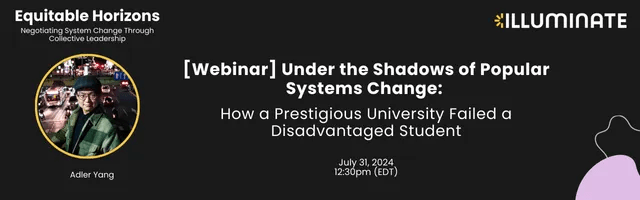
How is an underlying mechanism that drives the meta- and polycrises manifested through our dominant mode of education? How might we make sense of and navigate the seemingly different and potentially conflicting approaches to addressing these crises? How might we transform the system through our ways of living?
In our latest piece for the Equitable Horizons blog series, Adler Yang, examines these questions through the story of Wen, an economically disadvantaged student who excelled in a self-directed learning environment but struggled when she entered a prestigious university.
Adler Yang will also be presenting at Illuminate Systems’ webinar on 12:30, July 31 (EDT) to discuss the research behind the story (A registration link is provided at the bottom of the essay at the link below)
Read it here: https://lnkd.in/eAXD4ZTG
Systemic Design Association newsletter 15 July 2024 – RSD13 launch for October 2024, various associated events, and more
Back issues https://us7.campaign-archive.com/home/?u=b103795a96aabb7defe01e12c&id=d76b6b9648
Subscribe https://systemic-design.us7.list-manage.com/subscribe?u=b103795a96aabb7defe01e12c&id=d76b6b9648
| Systemic Design Association | July 15, 2024 |
| RSD13 registration is open |
| Keeping with the rivers of conversations metaphor, RSD13 is overflowing with contributions to systemic design that promise to deepen your research, writing, and practice. The journey has three parts: tributaries, a channel, and streams. You can explore RSD13-ONLINE tributaries, dive into the RSD13-OSLO channel, or combine all three within the context of the reflective experience of RSD13-Nordmarka Forest. |
| REGISTER ON EVENTBRITE |
| RSD13 tickets |
 |
| Did someone say workshops at OsloMet? |
| Yes, it’s true! Tore Gulden and Frederick Steier are chairing three full days of in-person workshops at OsloMet. RSD13-OSLO ticket holders can kick off their in-person experience on the weekend and Monday before the AHO sessions. We are in the process of contacting the organisers of over 20 workshops, so plan to arrive early and enjoy Oslo. These extraordinary systemic design workshops feature a range of interdisciplinary topics: systemic change, systems thinking, collaboration, transformative impact, spatial/contextual considerations, and practical, hands-on experimentation.When: October 19, 20, 21 at OsloMet |
| RSDX is back at RSD13 |
| Chaired by Peter Jones and Ryan Murphy, the robust RSDX six-day agenda consists of workshops, speakers, and panels proposed by the community. RSDX is October 12 to 15 and 19 and 20, and it wraps around three days of scheduled paper talks and presentations on October 16, 17, and 18. The whole programme is online and all under the affordable RSD13-ONLINE ticket. What to expect: There are currently 13 workshops and 13 speakers/panels for RSDX and 64 papers and 37 presentations slated over the three days dedicated to scholarly work.Good to know: The RSD11 workshop series and Mapping Mondays are part of the evolving space for self-organising, peer-led online systemic design events. Proposals can be forwarded by any SDA member. |
| Design Journeys workshop confirmed |
| For everyone who loves Design Journeys—a new workshop!Peter Jones and Kristel Van Ael have organised an RSD13/RSDX workshop, “Design Journeys through Organisations: Systemic design tools for leadership” based on their popular book. |
| The workshop focuses on assessing prototype canvases and gaining working feedback on new tool designs designed to simulate organisational functions.Pre-requisite: Participants should have prior experience with the Systemic Design Toolkit as a pre-requisite—even if self-trained from the book and tools.How to book it: RSD13-ONLINE ticket holders will receive an email announcing workshop sign-ups. Space is limited and first-come first-served. |
| Update on RSD13 reviewing |
| Collectively, reviewers wrote 117,641 words in just five weeks. Comments encompassed critique, encouragement, and advice. It was an extraordinary effort and feedback from authors has been uniformly appreciative.This year’s collaborative, asynchronous peer-review process sets a new bar for engagement in the RSD cycle. It exemplifies the scholars spiral at work, which intends that reviewing supports the evolution of scholarship by providing appropriate points for contribution, peer feedback, and publication, all within the support of a diverse, creative, interdisciplinary community. In prior years, a selected cadre of reviewers was tasked with reviews; RSD12 opened this up, inviting the hub organisers to assign sub-reviewers across their community of interest. This year, longstanding reviewers and people new to reviewing for systemic design joined the group, creating a distributed network of peers, wider diversity, and a reasonable level of requests for each member.While our go-to reviewers, Birger Sevaldson and Peter Jones, pulled us through by covering 10% of the reviews at the second review stage, the distributed reviewers network, made up of 128 people, contributed 90%. There are 296 reviews for 83 papers and 41 presentations, an average of 2.4 reviews per paper. We made our goal of asking for a manageable number of reviews, with a median of 2 requests per person, which kept reviews fresh, comprehensive, and collegial. The average length of comments ranged from 2374 (high) to 13 (low), with a median of 352 and an average of 414 words. |
| Reviewing Reviewing sessions posted |
| The Reviewing Reviewing conversations, held in April, guided some thinking about the RSD13 process. The review process was adjusted based on the guidance from two conversations on reviewing hosted by Ryan Murphy with Peter Jones, Ray Ison, Houda Khayame, Wendy Ross, Ruth Schmidt, and Katelyn Stenger. Reviewers and authors has been very positive about the process. |
| Our resulting decision guidance focused on readiness for publishing and relevance to systemic design rather than acceptance/rejection. Meta-reviews were done on submissions with more than a two-point spread from reviewers, and (for RSDX) we are considering submissions that were not recommended for hidden gems, panellists, interactive sessions, and early career researcher gatherings.Where to find it: Reviewing reviewing session summaries and video are posted on the RSD website and RSD YouTube channel. |
| GUESS WHOSE COMING TO RSD13-OSLO? |
| SDA General Assemblies | AUGUST 5 & SEPT 23 |
| Reminder: The Systemic Design Association is holding two Extraordinary General Assemblies. The meetings are online and open to everyone who is interested in contributing to a discussion of the association’s operations.EGA-1 Changes to the SDA’s Statutes | August 5, 2024EGA-2 SDA Board Elections | September 23, 2024 |
| GA SIGN UP |
| Only supporting members (who have made a financial contribution within one year of the EGA) can vote at the SDA General Assemblies. Renew your membership or join SDA. |
| NEWS | ADJACENT COMMUNITIES |
| Did you know Systems Thinking Ontario has met over 100 times? The group meets online and convenes at OCADU in central downtown Toronto, so it’s an excellent opportunity to connect with systemic design colleagues in and around Ontario. Looking back to look forward: The first meeting featured Ralph Glanville’s talk on Cybernetics and Creativity on December 6, 2021. |
| At RSD13/RSDX, Zaid Khan and David Ing discuss the group’s focus on learning from fields/topics/perspectives outside systems thinking to learn more about systems thinking and host a discussion about the traps of field-bounded interactions, how we can draw new insights about systems from untraditional places/fields, and building bridges to new communities.Noted: “Our working definition of systems thinking is: understanding the world by exploring parts and wholes. We do this by simultaneously and iteratively using analysis (what parts does this whole contain) and synthesis (which wholes contain this part).”Where to find it: https://wiki.st-on.org/home |
| POSTDOC OPPORTUNITIES | Tecnológico de Monterrey |
| Postdoctoral Researcher for Service Design Research in Health ContextsCurrently, in the School of Architecture, Art and Design, we are seeking a postdoctoral researcher to partner with the Faculty of Excellence and Tec Salud faculty in the design of community health services.Location: Monterrey, MexicoPostdoctoral Researcher in Complex System Visualization (Systemic Design)The School of Architecture, Art and Design is seeking a postdoctoral researcher to conduct collaborative research with the design faculty in visualisation for mapping complex systems. Working with Distinguished Professor Peter Jones, the postdoctoral candidate will collaborate on studies to theorise, refine, and build new concepts in systems visualisation to improve the adoption and understanding of large-scale mapping of complexity for policy proposals, complex strategic missions, and civic and institutional service programs.Location: Tlalpan, Mexico |
| ACKNOWLEDGEMENTS | RSD13 REVIEWERS |
| Based on our review statistics, let’s acknowledge colleagues whose reviews went above and beyond with three spirited awards. Drum roll, please! |
| LAST MILE AWARDGetting us through the finish lineBirger Sevaldson, RSD13 ChairPeter Jones,* Contexts—The Systemic Design Journal, Editor in Chief ARTICULATION AWARDHigher than average number of words per reviewThomas J McLeishVictor UdoewaPerin RuttonshaVanessa RodriguesLisa LeungAndrea CattabrigaBrogan OgilvieSergej van MiddendorpTRUE GRIT AWARDMore than three reviewsAndrzej KlimczukMarie Davidová*Abhay VohraMari Suoheimo**Thomas Maiorana*Adeline HvidstenAshley WorobecCarla SediniChiara Battistoni*Goran MaticJiayi YoungRyan Murphy**SDA board member**RSD13 academic committee member |
The Atlas of Social Complexity – by Brian Castellani and Lasse Gerrits
[Regular readers will know I’m not a fan of ‘the complexity map’ https://stream.syscoi.com/2019/12/21/why-i-hope-we-could-do-better-than-the-castellani-complexity-map/ but this is undoubtedly a major publication]
https://www.atlassocialcomplexity.org/
 Systems Community of Inquiry
You must be logged in to post a comment.