
April 16, 2024
By Gabriele Bammer
Integration and Implementation Sciences (i2S) 3.0: An updated framework to foster expertise for tackling complex problems – Integration and Implementation Insights
A view or perspective on the world
von Uexküll
Jakob Johann von Uexküll – Wikipedia
https://en.wikipedia.org/wiki/Jakob_Johann_von_Uexk%C3%BCll
Umwelt
https://en.wikipedia.org/wiki/Umwelt
https://www.thephilosopher1923.org/post/jakob-von-uexkull-umwelt
Collaborating with teams to experience and think sustainably through games and participation.
INTE.RES.T welcomes you to the GARDEN – the online platform where you can explore the power of systems thinking in games and alternate resources for your development, enlightenment, and nurturing.
IRT
https://www.irt-research.com
This talk introduces “Patterns of Strategy” – a radically different approach to understanding and formulating business strategy which is built on a different paradigm to conventional strategic approaches.
We’ll take you through some of the theory, the practice and illustrate it with some examples. Patterns is “agile strategy” in two ways – first it is a dramatically faster way of developing strategy which means that you can speed up the cadence of formulation and execution. Second, it describes
a strategy as sets of manoeuvres and gives a totally different way to deal with the dynamics of strategic situations allowing the business to become more agile in its strategic environment.
The statistics on the failure of conventional strategy are shocking at 70%-98% failure rate,. We’ll look at why this is and at some of the ways in which conventional strategy is fundamentally flawed and show how Patterns provides a proven alternative.
About Patrick Hoverstadt
Patrick has worked as a consultant since 1995 with organisations of all sizes and internationally across 24 countries in the private, public and third sectors. He specialises in using systemic approaches, working mainly on strategy, organisational design and organisational change.
Patrick is the author of “Fractal Organisation”, a book on organisation design using the Viable System Model published by Wiley in 2008 which has been used used on seven masters programmes around the world. He is co-author of “Patterns of Strategy” a book on a systemic approach to strategy published by Gower in 2017, co-wrote 7 other books, and is the author of ‘The Grammar of Systems’ – a book on how to think like a systems thinker, published in 2022. He chairs SCiO the professional body for systems practitioners and is a Visiting Research Fellow at Cranfield School of Management.
Please note: This session will be recorded in speaker view.
Business StrategyBusiness Agility
Thursday, May 23, 2024 6:30 PM to 7:30 PM BST
Online event
https://www.meetup.com/systemicagility/events/299588054
Patrick Hoverstadt: Agility in business strategy, Thu, May 23, 2024, 6:30 PM | Meetup
Haley Fitzpatrick, Tobias Luthe, and Birger Sevaldson explore methodological plurality and integrate quantitative scientific methods with participatory gigamapping and embodied practices. This longitudinal design inquiry engaged with communities undergoing sustainability transformations across three mountain regions: Ostana, Italy; Hemsedal, Norway; and Mammoth Lakes, California. The authors identify the need for contemplative and psychological practices in systemic design that focus on inner resilience.
#V2003 – 6 DOWNLOADS
https://doi.org/10.58279/v2000
© 2024 Author, published by the Systemic Design Association
Open Access article published under the CC-BY-NC-ND 4.0 International License
Fitzpatrick, H., Luthe, T., & Sevaldson, B. (2024). Methodological Pluralism in Practice: A systemic design approach for place-based sustainability transformations. Contexts—The Systemic Design Journal, 2. https://doi.org/10.58279/v2003
Article Contents show
https://systemic-design.org/contexts/vol2/methodological-pluralism
I’m honored to share a profound and soulful conversation on science and spirituality with Neil Theise, professor of pathology at the NYU Grossman School of Medicine, discoverer of a new human organ (the interstitium), lifelong Zen meditator, and author of the superb book, Notes on Complexity.
🎋🔬🕸️ 218 – Neil Theise on Complexity & Nonduality
https://michaelgarfield.substack.com/p/218
Ruth Baxter, Yorkshire Quality and Safety Research Group, Bradford Institute for Health Research, Rebecca Lawton, School of Psychology, University of Leeds
The Positive Deviance Approach
https://www.cambridge.org/core/books/positive-deviance-approach/506CA2D446210E1FE76740B7F835D87C
Ontology and Antidisciplinarity
Andrew PickeringIn Andrew Barry & Georgina Born (eds.)
Interdisciplinarity: Reconfigurations of the Social and Natural Sciences. Routledge. pp. 209 (2013)
Andrew Pickering, 9 Ontology and Antidisciplinarity – PhilPapers
https://philpapers.org/rec/PICOA
pdf:
(Inspired in a roundabout way by this exchange:)
SOPHIE STRAND on Myths as Maps /312
SOPHIE STRAND on Myths as Maps /312 — FOR THE WILD
https://forthewild.world/listen/sophie-strand-on-myths-as-maps-312
You’ve gotta respect that, in 1985 and 1986, the world’s leading cyberneticians got together and… made themselves a fanzine… about their favourite things!
Volume 1
Click to access Cybernetic_Vol_1_No_1_1985.pdf
Volume 2
[Well, it’s not for me, but it is a thing]
Cliodynamics (from Clio, the muse of history, and dynamics, the study of why things change with time) is the new transdisciplinary area of research at the intersection of historical macrosociology, economic history/cliometrics, mathematical modeling of long-term social processes, and the construction and analysis of historical databases.
Mathematical approaches – modeling historical processes with differential equations or agent-based simulations; sophisticated statistical approaches to data analysis – are a key ingredient in the cliodynamic research program (Why do we need mathematical history?). But ultimately the aim is to discover general principles that explain the functioning and dynamics of actual historical societies.
Cliodynamics: History as Science – Peter Turchin
Peter Turchin’s blog
https://peterturchin.com/cliodynamica
Wikipedia:
https://en.wikipedia.org/wiki/Cliodynamics
Journal
https://escholarship.org/uc/irows_cliodynamics
March 28, 2024
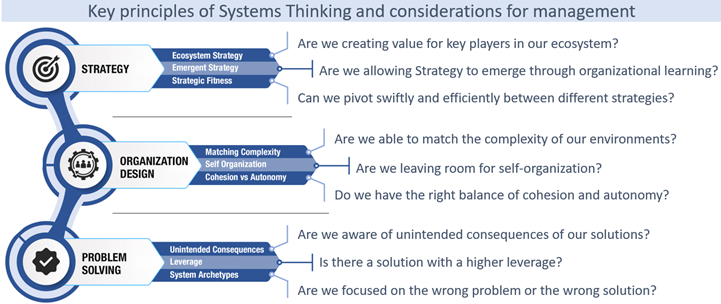
Businesses are operating in environments that are drastically more complex than the times traditional management methods were developed for. A Systems Thinking approach to management that helps us make the transition from viewing businesses as machines to thinking of them as living organisms, from looking at the “parts” to looking at the “whole”, is considered by experts and leading organizations like OECD as the paradigm shift needed to deal with complexity. Incorporating Systems Thinking principles within Strategy, Organizational Design and Problem Solving equips leaders with the tools and perspectives needed to manage in times of complexity.
This paper presents nine key Systems Thinking principles, where each principle is framed as a management question. In addition, Kaustuv also discusses the interesting and often overlooked synergy between Business Architecture and Systems Thinking and argues why Business Architects could be champions of a Systems Thinking approach.
USING A SYSTEMS THINKING APPROACH TO MANAGEMENT – A NECESSARY PARADIGM SHIFT? – Enterprise Architecture Professional Journal
Booking now: Complexity and Culture, the 2024 Complexity and Management Conference – https://lnkd.in/eS4ah78X
The concept of culture in organisations is widely used but often poorly understood. So how do group identities and a sense of belonging emerge, and what methods might we employ to understand them better? How might we do justice to the contradictions and tensions that are constant themes shaping the experience of group life?Working with the intersection of symbolism, politics and culture, Professor Candida Yates will talk about a current research project where she is trying to understand how the community imaginary is developed and sustained. Drawing on work she is undertaking with a community on the south coast of the UK, Professor Yates will give examples of art-based and psycho-social approaches to exploring to the emergence of meaning in a UK maritime community through the exploration of thoughts, feelings, politics and experience.Candida Yates is Professor of Culture and Communication, Bournemouth University.The annual Complexity and Management Conference is intended as an antidote to the sense of drift and thoughtlessness which can afflict managers in organisations because of the sheer complexity and pace of work, and the abstractions of contemporary management discourse. The currency of the conference is conversation, reflection and meaning-making about things that matter to us in and beyond the workplace. Saturday afternoon will be given over to delegate-led workshops to explore the conference theme.The conference begins at 7pm on Friday 7th (unless you attend the one day workshop, which begins at 9.30am) and finishes at 2pm on the 9th June. The fee includes all board and lodging at Roffey Park Institute, Horsham, UK.
Post | LinkedIn
Welcome
This website shares reflections and insights from intentional pattern makers, exploring the patterns of our everyday lives through writing and art.
March 2024 Note: Collaboration takes time! We are currently supporting new contributors as they refine their work. pattern making today is the foreshadowing of what is to come. Sign up for our newsletter to stay in touch!
pattern making
https://www.patternmaking.org
 Systems Community of Inquiry
You must be logged in to post a comment.