I’m honored to share a profound and soulful conversation on science and spirituality with Neil Theise, professor of pathology at the NYU Grossman School of Medicine, discoverer of a new human organ (the interstitium), lifelong Zen meditator, and author of the superb book, Notes on Complexity.
Ruth Baxter, Yorkshire Quality and Safety Research Group, Bradford Institute for Health Research, Rebecca Lawton, School of Psychology, University of Leeds
You’ve gotta respect that, in 1985 and 1986, the world’s leading cyberneticians got together and… made themselves a fanzine… about their favourite things!
Cliodynamics (from Clio, the muse of history, and dynamics, the study of why things change with time) is the new transdisciplinary area of research at the intersection of historical macrosociology, economic history/cliometrics, mathematical modeling of long-term social processes, and the construction and analysis of historical databases.
Mathematical approaches – modeling historical processes with differential equations or agent-based simulations; sophisticated statistical approaches to data analysis – are a key ingredient in the cliodynamic research program (Why do we need mathematical history?). But ultimately the aim is to discover general principles that explain the functioning and dynamics of actual historical societies.
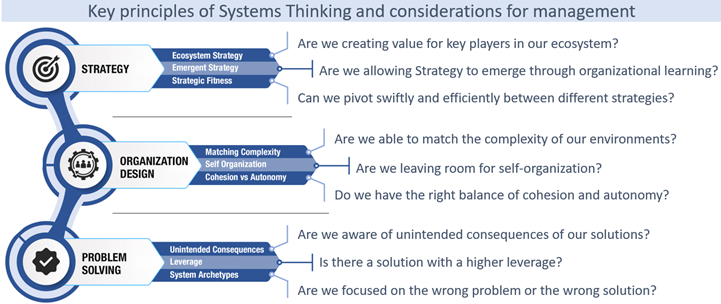
Businesses are operating in environments that are drastically more complex than the times traditional management methods were developed for. A Systems Thinking approach to management that helps us make the transition from viewing businesses as machines to thinking of them as living organisms, from looking at the “parts” to looking at the “whole”, is considered by experts and leading organizations like OECD as the paradigm shift needed to deal with complexity. Incorporating Systems Thinking principles within Strategy, Organizational Design and Problem Solving equips leaders with the tools and perspectives needed to manage in times of complexity.
This paper presents nine key Systems Thinking principles, where each principle is framed as a management question. In addition, Kaustuv also discusses the interesting and often overlooked synergy between Business Architecture and Systems Thinking and argues why Business Architects could be champions of a Systems Thinking approach.
Booking now: Complexity and Culture, the 2024 Complexity and Management Conference – https://lnkd.in/eS4ah78X
The concept of culture in organisations is widely used but often poorly understood. So how do group identities and a sense of belonging emerge, and what methods might we employ to understand them better? How might we do justice to the contradictions and tensions that are constant themes shaping the experience of group life?Working with the intersection of symbolism, politics and culture, Professor Candida Yates will talk about a current research project where she is trying to understand how the community imaginary is developed and sustained. Drawing on work she is undertaking with a community on the south coast of the UK, Professor Yates will give examples of art-based and psycho-social approaches to exploring to the emergence of meaning in a UK maritime community through the exploration of thoughts, feelings, politics and experience.Candida Yates is Professor of Culture and Communication, Bournemouth University.The annual Complexity and Management Conference is intended as an antidote to the sense of drift and thoughtlessness which can afflict managers in organisations because of the sheer complexity and pace of work, and the abstractions of contemporary management discourse. The currency of the conference is conversation, reflection and meaning-making about things that matter to us in and beyond the workplace. Saturday afternoon will be given over to delegate-led workshops to explore the conference theme.The conference begins at 7pm on Friday 7th (unless you attend the one day workshop, which begins at 9.30am) and finishes at 2pm on the 9th June. The fee includes all board and lodging at Roffey Park Institute, Horsham, UK.
This website shares reflections and insights from intentional pattern makers, exploring the patterns of our everyday lives through writing and art.
March 2024 Note: Collaboration takes time! We are currently supporting new contributors as they refine their work. pattern making today is the foreshadowing of what is to come. Sign up for our newsletter to stay in touch!
[Apologies to anyone getting these updates directly, for the influx – I am catching up and also being unusually lenient today – but this is too useful not to share]
Etienne Wenger-Trayner, Beverly Wenger-Trayner, Phil Reid, Claude Bruderlein
a publication of the Social Learning Lab Sesimbra, Portugal
From the back cover:
What does it take to launch and sustain a community of practice initiative? This book helps guide individuals, teams, and organizations through the process.
It is for organizational leaders creating a conducive environment, community leaders launching and sustaining their communities, people in various roles facilitating meetings, activities, and the use of technology, and evaluators accounting for the value communities create.
It reflects the combined experiences of the authors in cultivating communities of practice within and across organizations.
Communities of practicewithin and across organizationsa guidebook (2nd edition)Etienne Wenger-Trayner, Beverly Wenger-Trayner, Phil Reid, Claude Bruderleina publication of the Social Learning LabSesimbra, PortugalFrom the back cover: What does it take to launch and sustain a community of practice initiative? This book helps guide individuals, teams, and organizations through the process.It is for organizational leaders creating a conducive environment, community leaders launching and sustaining their communities, people in various roles facilitating meetings, activities, and the use of technology, and evaluators accounting for the value communities create.It reflects the combined experiences of the authors in cultivating communities of practice within and across organizations.
Imprint: Triarchy Press Edition: Second, revised Published: March 2024 List Price: £15 Format: Paperback Extent: 62pp. Size: 14 x 21.6 cm (8.5×5.5″) ISBN: 978-1-911193-48-7 Tags: Systems Thinking, Power and Love, Society, Genocide, Migration, Immigration, Purity, ToleranceBuy the paperback (£15) Published 5 March 2024, available here now Postage chargesQuantity: Buy the pdf (£10)Click the ‘Buy’ button below. At checkout, click No postage on ebooks from the dropdown. After paying, we will send an immediate confirmation and email your ebook file within 24 hours. PDF ISBN 978-1-911193-63-0 version: bookmarked pdf (pdf text cannot be edited, printed or copied – email us if you need this capability.)Read more reviews of the book
Encounters with the Other How we continue to misunderstand, dehumanize, scorn, humiliate, oppress−and even kill−others.
And how we can stop. Barry OshrySystems Thinking for Societies
Encounters with the OtherHow we continue to misunderstand, dehumanize, scorn, humiliate, oppress−and even kill−others. And how we can stop.Barry OshrySystems Thinking for Societies
[Another one with lots of systems | cybernetics | complexity implications and applications – adding philosophy of disability to the ‘fellow travellers’ list]
Posted on 31 March 2024
In this interview we learn about the main issues in modern-day philosophy of disability, and the relevance of this topic for the European encounter with the Americas.
442. Scott Williams on Disability and the New WorldPosted on 31 March 2024In this interview we learn about the main issues in modern-day philosophy of disability, and the relevance of this topic for the European encounter with the Americas.

 Systems Community of Inquiry
You must be logged in to post a comment.