[Are you bored of Cybersyn yet?! Every damn piece has the same – I now learned, computer-generated – image of the control room, and >50% of them are by either Eden Medina or Evgeny Morozov…. but, to be fair, if I had to choose just one article on Cybersyn, it might be this one!]
Fifty years ago, a military coup violently ended Chile’s political experiment with socialism, and with it the nation’s technological experiment with cybernetic management.
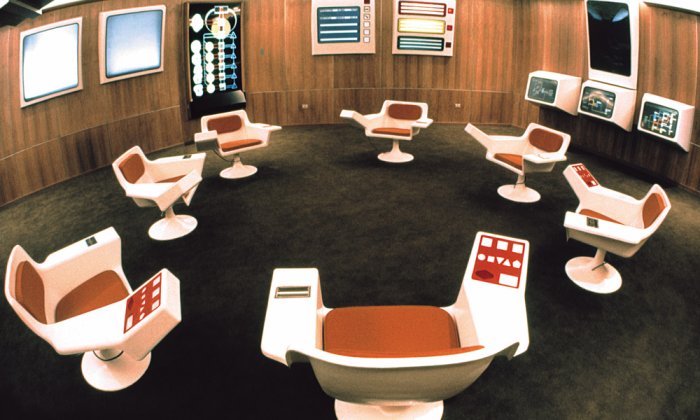
A computer-generated image of Project Cybersyn operations room. Image: Gui Bonsiepe
In the Ecology of Systems Thinking group on Facebook, Orsan Senalp says https://www.facebook.com/groups/ecologyofsystemsthinking/posts/6620027151409706/
This recently translated article of Bogdanov, by John Biggart, gives the most lucid summary of what he has done: https://www.academia.edu/…/Aleksandr_Bogdanovs_From…. There are all the elements of the wonder in this short piece. Gramsci’s absolute historicism, ‘philosophy of praxis’ interpretation, complex analysis of state-society and ideology relationship, and cultural hegemony theory become all parts in Bogdanov of a universal science of organization (the science of praxis to him) that encompassed conceptually all three ‘new scientific paradigms’ of the 20th cc. -developed mainly by scientific intelligencia / managerial classes after Bogdanov was buried. These are the systems theory, cybernetics, and complexity science. These elements were absorbed by the ruling classes and were sources of their success in adapting to the complexities of globalization of capitalism, global expansion of production and market, construction of the financial apparatus, and so on. They significantly increased their capability of ‘reflection’ (based on neo-Marxism & cultural analysis – some elements of which are attacked by the extreme right exactly for this reason under the rubric ‘Cultural Marxism’ [since it is assimilated and used by the ruling class]) and adaptation, through the management of the complexity of population growth, since the post-war era. The incorporation of Gramsci’s and other critical and Cultural Marxist approaches, as well as systems, cybernetics, and complexity theories into the ruling machine, also allowed the rulers to successfully disorganize the left and social opposition and maintain control globally – through the control of civil society by media and other ideological apparatus, like promotion of conspiracy theories, and identity politics, which has dismantled social forces and prevented them from gaining and scaling any capacity to organize their lives scientifically and popularly. Imagine now a founder of Bolshevism who was anti-‘Leninist’, was a companion to Lenin and turned into a most fierce rival to him after 1909, whose work incorporated the most fruitful elements and critically by the Hegel-Marx-Engels line as well as the Mach-Avenarius line (which paved the way to the noe-positivism of Vienna school and Einstein’s relativity theory) plus, included all that characterised as Western / noe-Marxism later on: the absolute historicism, ideology and culture analysis which was integral to the critic of the political economy all were integral in Bogndoav, as in Gramsci, and on top of that he developed Marx and Engel’s method and analysis (which was mistakenly and forcefully locked up into and fossilised in form of Plekhanov-Lenin-Stalin style Diamat) into the first (and from worker’s point of view) version of systems, cybernetics, and complexity paradigms. Well, that should have shaken the world from its fundamentals. The second chance was missed when Althusser attacked Bogdanov, and Hegel, and insisted on being Leninist; while it was Lenin who defended Hegel against Bogdanov. Then we know what happened with Althusser’s students, their post-structuralism, post-modernism, and post-marxism, serving for the survival of the existing system.
Some details about the digitized video files derived from VHS tapes from Heinz von Foerster’s lecture series “Understanding Understanding” (1980) [ver. 20211106 / p. schroeder]
Introduction by Paul Schroeder:
Please see attached page for an image of the list of video files and of the original VHS tapes. In January 2010, exactly when the ASC’s archives were being physically transferred from Illinois to Vienna, Pille Bunnell sent me (Paul Schroeder) a box that contained 11 VHS video tapes that were labeled as being four lectures given by Heinz von Foerster in 1980. The lectures were presented to an audience convened by Werner Erhard, founder of est, Erhard Seminars Training. The series was titled “Understanding Understanding,” and the talks were given in four approximately two hour sessions. As far as I can tell, there is not a complete copy of the talks on these tapes. As you can see from the list of digital video files, there is not a file for “1A” which would be the very first segment of the first lecture, including (presumably, from various titles and labels) an introduction of Heinz by Werner Erhard. To some extent Heinz made up for this with an extended “recapitulation” that began Session 2, that covered all topics from Session 1 and gives indication of the scope of his first session. Other than that missing segment, all remaining segments of the first session, and all parts of the other sessions are present in the digitized files. In addition to the von Foerster lectures, one of the VHS tapes (Tape 1 of Set 2) carries Francisco Varela’s presentation at the 1984 ASC conference, a talk titled “Cybernetics of Autonomy.” This has been digitized, but is not being distributed with the von Foerster lectures. Plans are to distribute it separately via the ASC. Video quality is poor, as it was poor in the original VHS tapes. During the digitization process the video files were saved at smallest scale and resolution. Nevertheless, except for certain segments already flawed in their original format, the videos are viewable, and provide wonderful context for Heinz’s presentations. The audio quality is generally good – except the file 2B has reduced audio volume. It was derived from Set 2 of the VHS tapes, and for some reason the audio on that segment was not as good as in others. It could be that in future rounds of edits this can be improved. These tapes came to me in my role as an intermediary between ASC membership (and officers) and the ASC archives. Now, 10 years after receiving these tapes, I have been able to make a first pass at digitization. Again, the status of the ASC archives is being discussed actively within the Society. Also, there are renewed efforts in other institutions, including the Univ. of Illinois, to devote resources to the preservation of materials related to the history of cybernetics. We now expect that these original VHS tapes will join other Heinz von Foerster materials at Illinois, and where their archivists will provide for archival digitization of the originals and for public and scholarly access to them, while making other derivative digital products available online.
(Links to the book arising from the lectures: https://stream.syscoi.com/2022/01/13/understanding-understanding-essays-on-cybernetics-and-cognition-heinz-von-foerster-2003/ )
Complexity and Management Conference 7-9th June 2024
Chris Moyles writes:
Finding ourselves in our work
In the last few weeks, three people I have been corresponding with have suggested that we might ‘jump on a call’. When I asked one of them what he thought it signified, he replied that he spent so much time at work jumping from one thing to the next that the expression denoted a state of mind, a way of summing up what work feels like.
When I work with groups of managers they tell me similar things, that they are obliged to rush around ‘delivering’ things without a moment’s thought. They are caught up in the game of every day organisational life, consumed by obligations to the plan, the target or the performance indicator. While it’s great to be busy, being so overwhelmed with ‘feeding the beast’ may lead to feelings of alienation and meaninglessness. Contemporary management offers any number of tools, techniques and recipes which deal in abstractions, where people and what they are saying and doing can disappear from view. If we wanted better to find ourselves in our work with colleagues, we wouldn’t necessarily start there.
The annual Complexity and Management Conference is intended as an antidote to the sense of drift and thoughtlessness which can afflict managers in organisations because of the sheer complexity and pace of work, and the abstractions of contemporary management discourse. The currency of the conference is conversation, reflection and meaning-making about things that matter to us in and beyond the workplace.
Beginning with an inaugural dinner in the evening of Friday 7th of June, the formal conference will start on Saturday morning with a thought-provoking key note to encourage the movement of thinking. Thereafter it is reflection and reflexivity continuously till lunchtime Sunday on topics brought by the conference participants themselves.
The conference promises good food, stimulating conversation, and a chance to rediscover oneself in one’s work.
Booking for the conference will begin in the New Year 2024. This is a reminder to put the dates in your diaries, and to prepare something to bring about your workplace dilemmas.
A deeply shocking situation. The @DartingtonTrust, which runs the famous #SchumacherCollege, has announced, without notice or consultation, that all courses have been cancelled or postponed. Just as students have arrived from all over the world to study there.
A deeply shocking situation. The @DartingtonTrust, which runs the famous #SchumacherCollege, has announced, without notice or consultation, that all courses have been cancelled or postponed. Just as students have arrived from all over the world to study there. 🧵
I am part of the cohort that was was due to start an MA at #schumachercollege on Monday – the student body is organising in an incredibly inspiring way – if anyone wants to offer support to students or staff please email: saveschumacher@gmail.com
I am part of the cohort that was was due to start an MA at #schumachercollege on Monday – the student body is organising in an incredibly inspiring way – if anyone wants to offer support to students or staff please email: saveschumacher@gmail.com https://t.co/qKrRpVCH0S
Last places availableThe new edition of the Executive Master in Complexity Management will start on 29 September 2023. An intense journey to discover the complexity that reaches its third edition.
The Master hosts teaching, training, managerial and professional excellence, with an extraordinary team of teachers and experts and with the Scientific Direction and Teaching Coordination of Marinella De Simone, Giuseppe Zollo and Dario Simoncini.
For any information or curiosity, do not hesitate to contact us and request the brochure at: complex.institute@gmail.com
On our site you will find the testimonies of participants in previous editions, the presentation video of the Master and some stories from the Master 2022- 2023.
How to understand the relation between design and research is a longstanding question in design theory and practice. It is also a question in design pedagogy, especially in taught postgraduate programmes where students are expected to engage with and conduct research in formal ways, often for the first time. In this article, we discuss a curriculum that we have developed for introducing research literacy to taught postgraduate students in architecture and design disciplines. The curriculum draws both explicitly and implicitly on an analogy between designing and researching developed through the lens of cybernetics, a transdisciplinary field that relates to both design and science. When cybernetics has been invoked in the context of design, it has usually been as a form of explanatory theory, contributing to the theoretical foundations of design research and its relations with other disciplines. Our approach instead positions cybernetics as a mode of transdisciplinary engagement within students’ own learning where an unfamiliar topic (research) is approached through analogy to a familiar one (design). We begin by contextualizing the curriculum and introducing the rationale for this approach in the context of design research. We then summarize key moments in the curriculum and our observations of its impact in students’ work. We conclude by speculating on the extent to which enacted analogies such as the example presented here may be taken up in other practical situations, and the potential value of doing so in reformulating cybernetics in ways that are practiced (rather than abstract) and methodological (not just explanatory).
Stepping into Systems is our new introductory series to systems change, covering fundamental topics and concepts: What is Systems Change?; The Importance of Systemic Worldviews; and Working Systemically for Transformation. This series has been informed by practitioners from diverse lineages from around the globe to honour the multiplicity of systems practice, and has been created in partnership with Glider.
Our intention is to lay fertile ground for you to navigate the diverse field of systems change and increase your capacity to see the world with a systemic perspective.
This series is for you if you have been curious about systems change and don’t know where to start; if you are seeking a point of view that embraces rather than minimises complexity; and if you want to explore the ‘how’ of systems change rather than the ‘what’.
What are the Open Learning sessions?
We invite you to explore each video with us through three online sessions – one for each film. We’re hosting these alongside practitioners in the field to create space to learn in community, as well as hear from those with a deep systems practice. In hopes we can welcome many people from around the world, embedded in many different ways of knowing, we’re hosting across two timezones: Americas/Europe and Australia/New Zealand.
In each session, we’ll begin by watching the film and then head into a discussion on the concepts and themes that emerge. We’ll get to hear from practitioners in the field and leave space for a Q&A. We will also help you get started on the session’s accompanying worksheet and share resources to support you to apply the learnings to your own work.
[As well as coverage of Cybersyn, includes this fascinating snippet:
Looking closer at the attendee’s list of the 1980 Leipzig Autumn fair, the surprise guest was undoubtedly the Austrian economist Friedrich von Hayek. Contrary to his earlier statements and after his first flying visit through the GDR accompanied by Emilio Barrarecan and Frank Volkster, he let himself be carried away to the following statement: „Socialism is becoming a self-regulating system in the way I had once assumed markets to be. Socialist cybernetics thus establishes a harmonious order by itself.“ ]
Written by Alan Bellows • Non-Fiction • October 2012
Nineteen Seventy ThreeLong-Form/Podcast: Chile’s audacious 1970s-era plan to network and automate the country’s entire economy, hindered by political upheaval and CIA maneuvering.Written by Alan Bellows • Non-Fiction • October 2012
While we do not always use words, communicating what we want to an AI is a conversation — with ourselves as well as with it, a recurring loop with optional steps depending on the complexity of the situation and our request. Any given conversation of this type may include: (a) the human forming an intent, (b) the human expressing that intent as a command or utterance, (c) the AI performing one or more rounds of inference on that command to resolve ambiguities and/or requesting clarifications from the human, (d) the AI showing the inferred meaning of the command and/or its execution on current and future situations or data, (e) the human hopefully correctly recognizing whether the AI’s interpretation actually aligns with their intent. In the process, they may (f) update their model of the AI’s capabilities and characteristics, (g) update their model of the situations in which the AI is executing its interpretation of their intent, (h) confirm or refine their intent, and (i) revise their expression of their intent to the AI, where the loop repeats until the human is satisfied. With these critical cognitive and computational steps within this back-and-forth laid out as a framework, it is easier to anticipate where communication can fail, and design algorithms and interfaces that ameliorate those failure points.

 Newsletter September 2023/01THE THIRD EDITION OF THE EXECUTIVE MASTER IN COMPLEXITY MANAGEMENT IS ABOUT TO START
 This community is a real ecosystem that is inspired by the values of the Global Enaction Manifesto and of which – together with the Complexity Institute – Texture Società Benefit and Nested Società Benefit are an active part .Join the Complexity Institute or renew your membership for 2023!The cost of registering as a Member or Ordinary Member for the whole of 2023 is Euro 40, as a Corporate Partner it is Euro 100 and as a Supporting Partner it is Euro 500. To join for 2023 click hereGLOBALENACTION MANIFESTOFind out more ▶COMPLEXITY LITERACY MEETINGFind out more ▶ASSOCIATED WITH THE COMPLEXITY INSTITUTEFind out more ▶Join the Complexity Institute for 2023Follow the Complexity Institute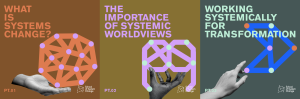
by Francis Irving on August 7, 2015

 Systems Community of Inquiry
You must be logged in to post a comment.