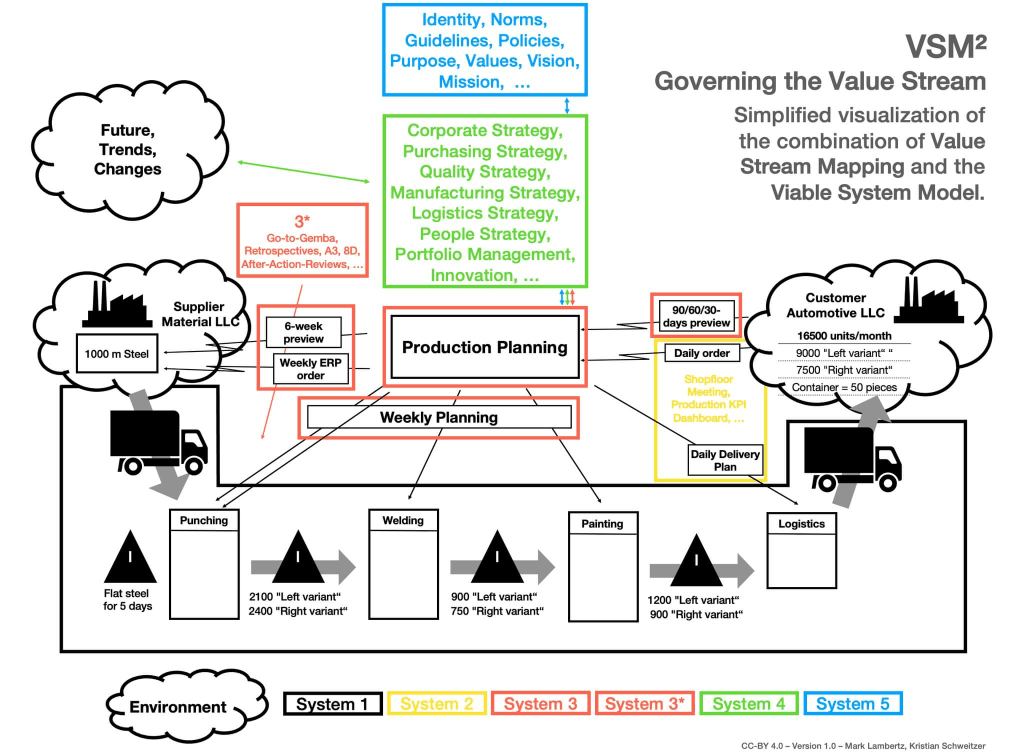
John Flach: four approaches to parsing a cognitive system

Four approaches to parsing a cognitive system. Classically, the information processing approach has parsed the cognitive system into a series of independent stages; others have focused on cognition as a computational system (computer, neural net) but have tended to diminish the components involved in perception and action; ecological psychologists have reacted by emphasizing perception and action – sometimes to the exclusion of computations. However…

continues in source

Post | LinkedIn

Systems approaches in the margin, where they don’t belong. | by Philippe Vandenbroeck | The shiftN Papers | Feb, 2023 | Medium

Philippe VandenbroeckFeb 15·3 min read·ListenSystems approaches in the margin, where they don’t belong.

Systems approaches in the margin, where they don’t belong. | by Philippe Vandenbroeck | The shiftN Papers | Feb, 2023 | Medium

Using ChatGPT to build System Diagrams — Part I | by aruva – empowering ideas | Jan, 2023 | Medium

Using ChatGPT to build System Diagrams — Part I

Using ChatGPT to build System Diagrams — Part I | by aruva – empowering ideas | Jan, 2023 | Medium

Whatever Next ? – Psybertron Asks

Closing – or probably continuing – the circle – this piece by Ian Glendinnig is a good review of Alastair MacIntyre’s ‘After Virtue’, especially in the light of ‘meaning crisis’ related shenanigans. He wrote this in 2008 and added a comment after he saw my 2018 post (here attributed as 2023) on Epistemological crises, dramatice narrative and the philophy of science (MacIntyre, 1955) (https://stream.syscoi.com/2018/09/23/epistemological-crises-dramatic-narrative-and-the-philosophy-of-science-alasdair-mcintyre-the-monist-1977/)

Ian Glendinning

[Caveat – this review may not do the subject justice, but I didn’t really notice how good a read it was until I was well into it, by which point not only did I not have any notes, but I was committed to read on to a conclusion. So from memory …  is the summary (in the bullets) any good ?]

[Post Note – Matt Kundert, in this (2008) post and the comment thread below, has turned-up as a McIntyre reference in my wider “Systems Thinking” context thanks to a (2023) post by Ben Taylor linking to an earlier (1977) piece pre-dating “After Virtue” (1981) by Al McIntyre and reviewed by Matt. And re-reading this post now in 2023, I see a wonderful irony in my use of the word “governance” in my implicitly cybernetic (psyberton-ic) context before I had made the connection explicit. What goes around comes around. ]

I’ve had a copy of Alastair MacIntyre’s (1981, 2nd Ed 1984) “After Virtue” tucked away on a bookshelf for some time. I vaguely remembered I’d bought it on the recommendation of Rev Sam, but no recollection of why it came to be tucked-away unread. [I since discover it’s Sam’s most important read ever – after being turned onto things philosophical by ZMM, like myself, and away from “scientism”, as I already was before I read ZMM, “After Virtue” turned Sam to Christianity and theology. Wow. Matt too claims MacIntyre and After Virtue as an important route to understanding the Greeks.]

Whatever Next ? – Psybertron Asks

From autopoiesis to self-optimization: Toward an enactive model of biological regulation

cxdig's avatarComplexity Digest

Tom Froese, Natalya Weber, Ivan Shpurov, Takashi Ikegami

The theory of autopoiesis has been influential in many areas of theoretical biology, especially in the fields of artificial life and origins of life. However, it has not managed to productively connect with mainstream biology, partly for theoretical reasons, but arguably mainly because deriving specific working hypotheses has been challenging. The theory has recently undergone significant conceptual development in the enactive approach to life and mind. Hidden complexity in the original conception of autopoiesis has been explicated in the service of other operationalizable concepts related to self-individuation: precariousness, adaptivity, and agency. Here we advance these developments by highlighting the interplay of these concepts with considerations from thermodynamics: reversibility, irreversibility, and path-dependence. We interpret this interplay in terms of the self-optimization model, and present modeling results that illustrate how these minimal conditions enable a system to re-organize itself such that it tends toward…

View original post 36 more words

Experiments with Social Network Interventions – Nicholas A. Christakis

cxdig's avatarComplexity Digest


loadYouTubePlayer(‘yt_video_WJ323v8Dfl0_Pu6P2l4rm5R3ltTs’);

Network Science Society Colloquium – January 25, 2023

Nicholas A. Christakis
Experiments with Social Network Interventions

Abstract
Human beings choose their friends, and often their neighbors and co-workers, and we inherit our relatives; and each of the people to whom we are connected also does the same, such that, in the end, we assemble ourselves into face-to-face social networks that obey particular mathematical and sociological rules. Why do we do this? And how might a deep understanding of human social network structure and function be used to intervene in the world to make it better? Here, I will review recent research from our lab describing three classes of interventions involving both offline and online networks: (1) interventions that rewire the connections between people; (2) interventions that manipulate social contagion, modifying the flow of desirable or undesirable properties; and (3) interventions that manipulate the positions of people within network structures…

View original post 202 more words

ASC Series: Language, Evolutionary Leadership and Conscious Evolution – Manuel Manga, Sun, Feb 19, 2023 at 12:00 noon EST, online

Systems Thinking and Practice: A Guide – K4D – Woodhill and Milican (2023)

Systems Thinking and Practice: A guide to concepts, principles and tools for FCDO and partners3rd February 2023Author: Jim Woodhill, Juliet Millican

Systems Thinking and Practice: A Guide – K4D

Reviewed:

Great New Guide to ‘Systems Thinking and Practice’February 8, 2023     By Duncan GreenGreat New Guide to ‘Systems Thinking and Practice’ | From Poverty to Power

Book Review: The Systems Work of Social Change | From Poverty to Power

Book Review: The Systems Work of Social ChangeFebruary 9, 2023     By Duncan Green 

Book Review: The Systems Work of Social Change | From Poverty to Power

CybSoc President’s Series 26: Patrick Hoverstadt and Chris Murray Tickets, Wed 8 Mar 2023 at 17:00 UK time – online (£20, members free)

Mar 08President’s Series 26: Patrick Hoverstadt and Chris MurrayChris Murray discusses the adaptiveness in urban eco-systems in the Intelligent City, Patrick Hoverstadt explores the Grammar of Systems

President’s Series 26: Patrick Hoverstadt and Chris Murray Tickets, Wed 8 Mar 2023 at 17:00 | Eventbrite

6th Nordic STS Conference 2023 – TIK Centre for Technology, Innovation and Culture – disruption and repair in and beyond STS – June 7-9, 2023, University of Oslo

Welcome to the 6th Nordic STS Conference! The theme for this conference is Disruption and Repair in and beyond STS.

Time and place: June 7, 2023 4:00 PM–June 9, 2023 6:00 PM, University library

The Complexity Paradox | Jennifer Garvey Berger

Jennifer Garvey Berger

10/27/2022

The Complexity Paradox | Merion West

UK Chapter, System Dynamics Society – 2023 Conference: March 30th-31st 2023, Southampton UK

Welcome to the system dynamics community across the UK and beyond.

ByUK Chapter of the System Dynamics Society

When and where

Date and time

Thu, 30 Mar 2023, 09:30 – Fri, 31 Mar 2023, 16:00 BST

Location

National Oceanography Centre European Way Southampton SO14 3ZH

UK Chapter, System Dynamics Society – 2023 Conference: March 30th-31st Tickets, Thu 30 Mar 2023 at 09:30 | Eventbrite

World Theories as Analytic-Deductive, Dispersive-Integrative – Coevolving Innovations | David Ing

World Theories as Analytic-Deductive, Dispersive-Integrative February 6, 2023 daviding

World Theories as Analytic-Deductive, Dispersive-Integrative – Coevolving Innovations

Ecosystem leadership as a dynamic capability – Foss, Schmidt, Teece (2023)

Nicolai J. Foss, Jens Schmidt, David J. Teece

https://doi.org/10.1016/j.lrp.2022.102270

Under a Creative Commons license

open access

Abstract

We analyze the role and effect of ecosystem leadership understood as the exercise of effort towards others with the purpose of establishing and maintaining an ecosystem around a focal systemic innovation. While there has been much attention to the firms that sponsor ecosystems in the ecosystem literature, ecosystem leaders are usually characterized in an atheoretical manner, and the emphasis is on, leadership in existing ecosystems, thus neglecting the role leadership might play in ecosystem emergence. We clarify and provide theoretical grounding for the important role of leadership in emerging and maturing ecosystems. Building on transaction cost economics, we conceptualize an ecosystem as a governance structure that enables and sustains coordination and cooperation among multiple economic agents towards a focal innovative value proposition. Our basic argument is that the emergence of such an ecosystems is hampered by coordination and cooperation problems which markets and the price system cannot solve by itself. Resolving these problems requires assistance, and such assistance is what we call ecosystem leadership. To further characterize the exercise of leadership we use Teece’s tripartite dynamic capabilities scheme. Leadership enables ecosystem emergence through three externally-oriented dynamic capabilities: facilitating the formation of a shared vision (sensing), inducing others to make ecosystem-specific investments (seizing) and engaging in ad hoc problem solving to create and maintain stability (reconfiguring/transforming). The latter capability in particular often continues to be important in a mature ecosystem. We provide a characterization of these capabilities and argue that the ecosystem leader role in a mature ecosystem likely stems from having successfully exercised these capabilities and that their exercise also puts the leader in a prime position for value capture. We discuss implications of our arguments for ecosystem theories, for managers and for policy makers.

Ecosystem leadership as a dynamic capability – ScienceDirect