2021/06/16 Keekok Lee | Philosophy of Chinese Medicine 1Posted on April 19, 2023 by daviding — Leave a commentThe philosophy of science underlying Classical Chinese Medicine, in this lecture by Keekok Lee, provides insights into ways in which systems change may be approached, in a process ontology in contrast to the thing ontology underlying Western BioMedicine. This online web video lecture is a complement (and update) to two prior books:
Popularised in the 1960s, “Spaceship Earth” has become a metaphor for the vision turned imperative that all inhabitants of planet Earth be harmoniously united in the mission to preserve their planet. In this talk, I shall draw on works by Niklas Luhmann, Michel Foucault, and Friedrich August von Hayek to argue that fashionable “missionary theories” […]
Apr 14 2023
stephenreid321
What is the metacrisis?
The metacrisis, a term popularized by Daniel Schmachtenberger, refers to the systemic and interdependent nature of the various crises facing humanity, which are driven by the misalignment between our technological capabilities, social systems, and underlying value structures. It highlights the interconnectedness of issues such as environmental degradation, socioeconomic inequality, political instability, and technological risks, emphasizing that the resolution of one crisis cannot be truly achieved without addressing the others. The metacrisis underscores the necessity for a comprehensive, cooperative, and paradigm-shifting approach to problem-solving, demanding a transition from a competitive, zero-sum mindset to one that prioritizes collective well-being, long-term resilience, and the flourishing of all life on Earth.
Story of the match funding round
Between Jul 2022 – Jan 2023, Daniel and Kevin Owocki had three conversations on the metacrisis on the Green Pill podcast:
…continues in source
https://forum.metacrisis.xyz/t/metacrisis-match-funding-round-call-for-applications-and-further-sponsors/443/1
The Integral Stage
By Bruce Alderman / Layman Pascal
GAMEIFYING REALITY w/ Bobby Azarian
Cognitive neuroscientist and science writer, Bobby Azarian, returns to the Integral Stage for a deep and wide-ranging discussion of the emerging scientific paradigm — the complexity science paradigm arising out of the intersections of physics, biology, neuroscience, and information theory — that will likely shape self, culture, and society for the next century. If the universe is now known to be self-organizing through levels of developmental emergence, and if we are, as Carl Sagan once said, “a way for the cosmos to know itself,” what really are the implications of such a view for all the domains of life that matter to us? This perspective, of course, is in its general outlines very similar to the one Ken Wilber outlined in Sex, Ecology, Spirituality, but the science has developed since Wilber published SES; so Bobby and Layman explore those developments, and how they further reinforce, and in some cases update, the synthesis Wilber offered several decades ago. Bobby Azarian is a cognitive neuroscientist (PhD, George Mason University), a science journalist, and author of the book The Romance of Reality: How the Universe Organizes Itself to Create Life, Consciousness, and Cosmic Complexity. He has written for The Atlantic, The New York Times, BBC Future, Scientific American, Slate, The Huffington Post, Quartz, The Daily Beast, Aeon, and others. His research has been published in peer-reviewed journals like Human Brain Mapping, Cognition & Emotion, Acta Psychologica, and Philosophical Transactions of the Royal Society. His Psychology Today blog (Mind in the Machine) has received over 8 million views, making it one of the most popular blogs on the website. He has been a guest on The Joe Rogan Experience, the Michael Shermer Show, The David Pakman Show, The Jim Rutt Show, The Young Turks, the Singularity University podcast, and many others. He helped develop multiple episodes for Season 2 of the YouTube Premium series Mind Field, which won the show its first Emmy nomination. He is a pro at audio and music production, and is currently working on an educational podcast based on his new book.
the last evening of the web meeting cycle on biophilia in which, for four Thursday evenings from 21.00, two people talk and discuss the topic of biophilia declined through different perspectives
COMPLEXITY BEGETS COMPLEXITY: Improvements in measurement tech + exp design reveal complexity across scales, challenging the idea it increases in more than a Russian doll sense from cells to societies. Below—an old thread + new insect/bees results. 1/Nhttps://t.co/TGzSDE6Wstpic.twitter.com/yckJCzlvKa
The Enrico Fermi Research Centre – CREF (Rome) and UNU-MERIT (Maastricht), in collaboration with the Young Scholar Initiative of the Institute of New Economic Thinking are now calling for submissions to the first Economic Fitness and Complexity spring school, which will be held on June 5-9, 2023 in Rome, Italy. The school is an extensive introduction to the economic complexity framework, with theoretical and practical lessons. The first three days will focus on theoretical and practical classes covering the following topics: economic complexity measurement, network theory, machine learning, measurement of relatedness. Theoretical lectures will be followed by coding labs, where participants will have the chance to apply the methodologies introduced in class, and to carry out assigned group projects, focusing on the school core themes. For the last two days of the school, many world-wide renowned scholars have been invited to present their frontier research linking economic complexity with economic…
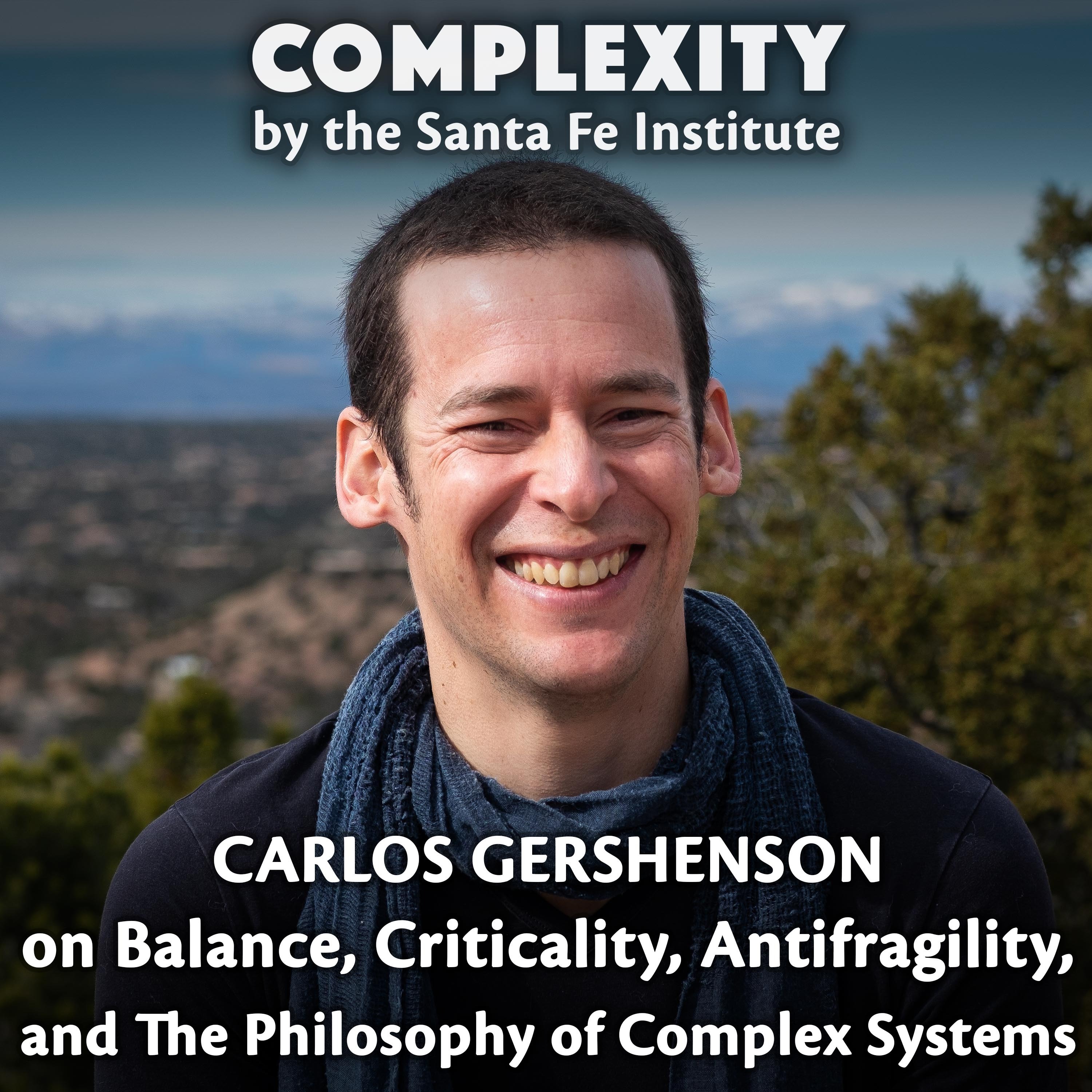
In this episode we speak with Carlos Gershenson, SFI Sabbatical Visitor and professor of computer science at the Universidad Nacional Autónoma de México, where he leads the Self-organizing Systems Lab, among many other titles you can find in our show notes. For the next hour, we’ll discuss his decades of research and writing on a vast array of core complex systems concepts and their intersections with both Western and Eastern philosophical traditions — a first for this podcast.
Many molecular systems operate by harvesting and storing energy from their environments. However, the maintenance of a nonequilibrium state necessary to support energy harvesting itself carries thermodynamic costs. We consider the optimal tradeoff between costs and benefits of energy harvesting in a nonequilibrium steady state, for a system that may be in contact with a fluctuating environment. We find a universal bound on this tradeoff, which leads to closed-form expressions for optimal power output and optimal steady-state distributions for three physically meaningful regimes. Our results are illustrated using a model of a unicyclic network, which is inspired by the logic of biomolecular cycles.
FRANK SCHWEITZER, GEORGES ANDRES, GIONA CASIRAGHI, CHRISTOPH GOTE, RAMONA ROLLER, INGO SCHOLTES, GIACOMO VACCARIO, and CHRISTIAN ZINGG
Advances in Complex SystemsVol. 25, No. 08, 2250014
Resilience denotes the capacity of a system to withstand shocks and its ability to recover from them. We develop a framework to quantify the resilience of highly volatile, non-equilibrium social organizations, such as collectives or collaborating teams. It consists of four steps: (i) delimitation, i.e. narrowing down the target systems, (ii) conceptualization, i.e. identifying how to approach social organizations, (iii) formal representation using a combination of agent-based and network models, (iv) operationalization, i.e. specifying measures and demonstrating how they enter the calculation of resilience. Our framework quantifies two dimensions of resilience, the robustness of social organizations and their adaptivity, and combines them in a novel resilience measure. It allows monitoring resilience instantaneously using longitudinal data instead of an ex-post evaluation.
Background Testing samples of waste water for markers of infectious disease became a widespread method of surveillance during the COVID-19 pandemic. While these data generally correlate well with other indicators of national prevalence, samples that cover localised regions tend to be highly variable over short time scales.
Methods We introduce a procedure for estimating the realtime growth rate of pathogen prevalence using time series data from wastewater sampling. The number of copies of a target gene found in a sample is modelled as time-dependent random variable whose distribution is estimated using maximum likelihood. The output depends on a hyperparameter that controls the sensitivity to variability in the underlying data. We apply this procedure to data reporting the number of copies of the N1 gene of SARS-CoV-2 collected at water treatment works across Scotland between February 2021 and February 2023.
Many real-world systems are connected in a complex directed network, such as food webs, social, or neural networks. Spreading and synchronization processes often occur in such systems, and understanding the percolation transition (formation of a giant connected component) is key to controlling these dynamics. However, unlike in the undirected case, this had not been understood in directed networks with realistic nonrandom architectures. We provide a universal framework in which the percolation threshold for networks to be strongly connected (every node to be able to reach every other) can be analytically predicted on any real-world network and verify this on a diverse dataset. This explains why many real, dense networks are not strongly connected, in contrast to random-graph theory.


 Systems Community of Inquiry
You must be logged in to post a comment.