Vijay Balasubramanian University of Pennsylvania, SFI
The human brain consists of a 100 billion neurons connected by a 100 trillion synapses. In its computational function, each neuron is a simple electrical device. In this sense it is no different, in its conceptual essence, from a transistor or a diode in a silicon microchip, converting input signals into ephemeral voltage pulses that transmit to other neurons. And yet, the collective effect of these tiny electrical flutterings creates the intelligent mind, with its astonishing capacity for perception and action, memory and imagination, affection and indifference. In the words of Ramon y Cajal (1854-1932), a founding figure of neuroscience, neurons are “the mysterious butterflies of the soul, whose beating of wings may one day reveal to us the secrets of the mind.” In this talk, Vijay Balasubramanian will explore current ideas about how this transmutation occurs.
If we want to understand complex constructions, such as ourselves, assembly theory says we must account for the entire history of how such entities came to be.
If we want to understand complex constructions, such as ourselves, assembly theory says we must account for the entire history of how such entities came to be.
Assembly theory explains why, given seemingly infinite combinatorial possibilities, we only observe a certain subset of objects in our universe.
Note the red timers above the platforms…Credit: УНІАН
I have been hunting a white whale for more than a year.
Nearly exactly one year ago, a tweet went viral for noting Kyiv Metro cut back its headways to a train every 2-3 minutes during peak hours and every 6-7 minutes off-peak due to the Russian invasion. Every 6-7 minutes during rush hours would be an unfathomable dream for U.S. and Canadian passenger rail systems. How was this possible, in Kyiv of all places?
A series elevating the voices of women systems thinkers to explore how systems thinkers can work together to make the world a better place.
By System of Systems Thinkers
Date and time
Tuesday, September 26 · 6 – 7:30pm BST
Location
Online
Refund Policy
Contact the organizer to request a refund.
Eventbrite’s fee is nonrefundable.
About this event
1 hour 30 minutes
Mobile eTicket
Sociologist Zeynep Tufekci and other scientists have pointed to “asystemic thinking” — or the inability to think about complex systems and their dynamics — as one of the reasons America experienced costly delays that allowed the COVID virus to spread uncurbed for weeks. Why don’t we see more systems thinking? What are some practical ideas making systems thinking actionable for a greater number of people?
In this session, Linda Booth Sweeney and Somava Saha will explore these questions, and also:
Surface the forces that inhibit widespread systems thinking
Discuss practical, research-based ways to lay a foundation for systems thinking in early childhood and beyond
Celebrate the fusion of cultural wisdom and inclusivity in advancing systems understanding
Get a sneak peek into Linda’s upcoming children’s book, “Apart, Together” (Bazer & Bray, October 2023)
About Linda Booth Sweeney
As an education innovator, author and strategist for healthy socio-ecological systems change, Dr. Linda Booth Sweeney is internationally recognized for her efforts to make systems thinking actionable by a wide range of audiences. In her Systems Leadership Labs, Linda creates experiences for leaders to think differently, and to experiment with language, inner stance, visualization tools and knowledge architecture that better mirrors the complexity they are navigating.
She has made significant contributions to promoting the use of metaphors like the bathtub model to enhance public comprehension of critical issues such as climate change. She is co-author of The Systems Thinking Playbook, The Climate Change Playbook, and numerous other books and journal articles. Linda is currently developing Curious about Connections Conversations (CCC), a research-based facilitation method for use by families, teachers and professionals in a variety of settings. Linda is also an award-winning children’s book author. Her next book, Apart Together, is a gentle introduction to systems thinking for children and will be published by Balzer & Bray in October 2023.
About Somava Saha
Somava Saha, MD, MS (aka Soma Stout) has dedicated her career to improving health, wellbeing and equity through the development of thriving people, organizations and communities. She has worked as a primary care internist and pediatrician in the safety net and a global public health practitioner for over 20 years. She has witnessed and demonstrated sustainable transformation in human and community flourishing around the world.
Currently, Soma serves as President and CEO of Well-being and Equity in the World (WE in the World), as well as Executive Lead of the Well Being In the Nation (WIN) Network, which work together to advance inter-generational well-being and equity. Over the last five years, as Vice President at the Institute for Healthcare Improvement, Dr. Saha founded and led the 100 Million Healthier Lives (100MLives) initiative, which brought together 1850+ partners in 30+ countries reaching more than 500 million people to improve health, wellbeing and equity. She and her team at WE in the World continue to advance and scale the frameworks, tools, and outcomes from this initiative as a core implementation partner in 100MLives.
This series will take place throughout the second half of 2023, so please stay tuned for additional event announcements.
Please support the work of Women in Systems Thinking through a donation when joining the series. However, we do have scholarships available for the whole series and we encourage you to reach out to us at systemofsystemsthinkers@gmail.com if you are in a position where it is not possible for you to donate.
We are feeling powerfully called to remind ourselves of women’s wisdom in this moment and to attempt to model our aspiration of inviting systems thinkers to work together. We invite you join us.
We would also like to thank our wonderful partners and encourage you to learn more about the meaningful work and contributions they make to the field of systems thinking on a daily basis.
Systems Thinking offers us a wealth of insights to design better DAOs. For this session, we have invited two experts in Cybernetics to share their learnings. Angela Espinosa Angela has three decades of experience in Cybernetics in the Centre of Systems Studies, Hull University. She’s now an Emeritus Fellow at the Centre for Systems Studies, a Fellow in the British Cybernetics Society, and an invited professor in several universities in Latin-America and the UK. She’s also devoted to the Metaphorum, an NGO aiming to continue developing Stafford Beer’s legacy. Jon Walker Jon has worked for over 35 years in the co-operative business sector. He has established and co-managed a range of businesses including retail outlets, a manufacturing plant, and a chain of supermarkets. He pioneered the use of the Viable Systems Model, in both large cooperatives and an eco-community, co-authored the book “A Complexity Approach to Sustainability” with Angela, and consulted and run workshops for 4 Universities (in Colombia, Cuba, Spain, Oman, Romania and for the Government of Victoria, Australia) on the use of The Viable System Model. RnDAO Host – Daniel Ospina @_Daniel_Ospina – Twitter @RnDAO__ empower humane collaboration Video produced by David R. Allen
DAOs and the Viable System Model with Angela Espinosa and Jon Walker
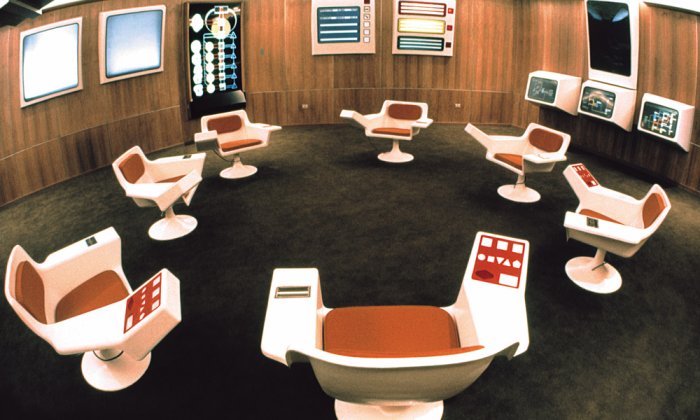
[Are you bored of Cybersyn yet?! Every damn piece has the same – I now learned, computer-generated – image of the control room, and >50% of them are by either Eden Medina or Evgeny Morozov…. but, to be fair, if I had to choose just one article on Cybersyn, it might be this one!]
Fifty years ago, a military coup violently ended Chile’s political experiment with socialism, and with it the nation’s technological experiment with cybernetic management.
A computer-generated image of Project Cybersyn operations room. Image: Gui Bonsiepe
In the Ecology of Systems Thinking group on Facebook, Orsan Senalp says https://www.facebook.com/groups/ecologyofsystemsthinking/posts/6620027151409706/
This recently translated article of Bogdanov, by John Biggart, gives the most lucid summary of what he has done: https://www.academia.edu/…/Aleksandr_Bogdanovs_From…. There are all the elements of the wonder in this short piece. Gramsci’s absolute historicism, ‘philosophy of praxis’ interpretation, complex analysis of state-society and ideology relationship, and cultural hegemony theory become all parts in Bogdanov of a universal science of organization (the science of praxis to him) that encompassed conceptually all three ‘new scientific paradigms’ of the 20th cc. -developed mainly by scientific intelligencia / managerial classes after Bogdanov was buried. These are the systems theory, cybernetics, and complexity science. These elements were absorbed by the ruling classes and were sources of their success in adapting to the complexities of globalization of capitalism, global expansion of production and market, construction of the financial apparatus, and so on. They significantly increased their capability of ‘reflection’ (based on neo-Marxism & cultural analysis – some elements of which are attacked by the extreme right exactly for this reason under the rubric ‘Cultural Marxism’ [since it is assimilated and used by the ruling class]) and adaptation, through the management of the complexity of population growth, since the post-war era. The incorporation of Gramsci’s and other critical and Cultural Marxist approaches, as well as systems, cybernetics, and complexity theories into the ruling machine, also allowed the rulers to successfully disorganize the left and social opposition and maintain control globally – through the control of civil society by media and other ideological apparatus, like promotion of conspiracy theories, and identity politics, which has dismantled social forces and prevented them from gaining and scaling any capacity to organize their lives scientifically and popularly. Imagine now a founder of Bolshevism who was anti-‘Leninist’, was a companion to Lenin and turned into a most fierce rival to him after 1909, whose work incorporated the most fruitful elements and critically by the Hegel-Marx-Engels line as well as the Mach-Avenarius line (which paved the way to the noe-positivism of Vienna school and Einstein’s relativity theory) plus, included all that characterised as Western / noe-Marxism later on: the absolute historicism, ideology and culture analysis which was integral to the critic of the political economy all were integral in Bogndoav, as in Gramsci, and on top of that he developed Marx and Engel’s method and analysis (which was mistakenly and forcefully locked up into and fossilised in form of Plekhanov-Lenin-Stalin style Diamat) into the first (and from worker’s point of view) version of systems, cybernetics, and complexity paradigms. Well, that should have shaken the world from its fundamentals. The second chance was missed when Althusser attacked Bogdanov, and Hegel, and insisted on being Leninist; while it was Lenin who defended Hegel against Bogdanov. Then we know what happened with Althusser’s students, their post-structuralism, post-modernism, and post-marxism, serving for the survival of the existing system.






 Systems Community of Inquiry
You must be logged in to post a comment.