
[A presentation on this today from CybSoc’s 50th anniversary seemed strangely naive in some ways, but generated lots of discussion and thinking]
The Ethical Regulator Theorem
The ethical regulator theorem provides a basis for systematically evaluating the adequacy of existing or proposed designs for systems that make decisions that can have ethical consequences; regardless of whether the regulating agents are humans, machines, cyberanthropic hybrids, organizations, corporations, or government institutions.
The theorem builds upon the law of requisite variety and the good regulator theorem to define nine requisites that are necessary and sufficient for a cybernetic regulator to be both effective and ethical:
Of these nine requisites, only the first six are necessary for a regulator to be effective. If a system does not need to be ethical, the three requisites ethics, integrity, and transparency are optional. |
 |
Super-Ethical Systems
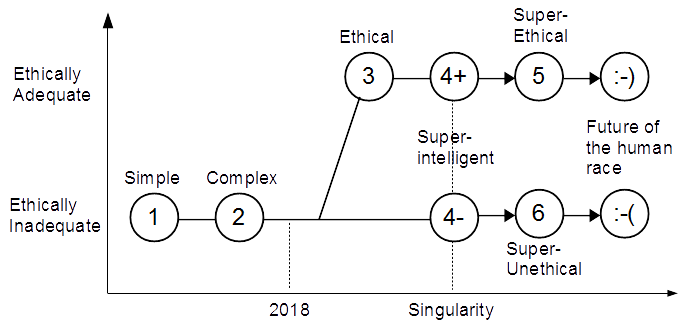
A six-level framework is proposed for classifying cybernetic and superintelligent systems, which highlights a future time-line bifurcation that results in one of two mutually exclusive outcomes:
|
 |
For more information, see the PDF: Cybernetics 3.0: Ethical Systems.
W. Ross Ashby Digital Archive Mirror
This domain also hosts a mirror copy of the W. Ross Ashby Digital Archive for use when the original archive site is unavailable because it has been permanently screwed-up with monetizing malware by Site5, the crap hosting company, and then Error 500’ed to death 😦
Source: Ethical Regulator Theorem
 Systems Community of Inquiry