Interactions and complexity – Gerry McGovern


Source: Interactions and complexity – Gerry McGovern – Customer experience keynote speaker; user experience keynote speaker


Interactions and complexity

“Networks are an essential ingredient in any complex adaptive system,” Eric Beinhocker writes in The Origin of Wealth. “Without interactions between agents, there can be no complexity.”

Think of a printed page in a book for a moment. It may contain complex ideas, but it is relatively simple. It is hard-linked to the page that came before and the one after. It may contain references which leads you to an appendix. However, in many ways, it is what you may call “finished” or “published”.

Webpages have a whole other level of potential. They may in fact be just like that print page if an organization has merely digitized print content and uploaded it on the Web. However, it is usually surrounded by an architecture of links. Sometimes, it may contain live data that gets updated as and when change occurs. Sometimes, it will change based on an action by the one accessing it. That is the true Web. And when it is at its most powerful, it is also at its most complex.

However, this is generally a hidden complexity. Think of Google. It couldn’t be simpler to use: a search box and a click. Its interface has become even more minimal over the years. Up until sometime in 2015, it had a link beside the search box that read, “Advanced Search.” It no longer has that link, even though, year after year, the search algorithm has been refined to become more and more complex.

Google removed the link “Advanced Search” simply because most people didn’t want to do an “advanced” search. “Why, little old me, I’d never be able to do any advanced search. Sounds very complex. Do you need a degree for that?”

Google realized it needed to perform the advanced and complex work for the customer. Thus, instead of the customer going to the advanced section and selecting an option that indicated they wanted to conduct geographical searches, Google sought to identify words in their search behavior that would indicate whether they were searching for a place rather than a thing or person. If Google noticed such “geographic” words, it would include a map in its search results.

We all want the fruits of complexity. Only a few want to undertake the labors of complexity to make things simpler for others. If you consider the history of retail – from barter to Amazon – we see an inexorable shift of complexity away from the buyer and towards the seller. The seller is constantly and relentlessly making it easier to purchase because sellers have done the math. They understand the return on investment when investing in simplicity.

Most other organizations do not invest in simplicity. They constantly calculate the costs of complexity they will incur, ignoring the returns on simplicity. They seek the cheapest ways to get stuff up on the Web (which is why we see so much digitized print content in the form of bulky PDFs on websites).

The Web is not print. It’s a much more complex, networked environment. Those who are investing in complexity, while also investing in simplifying interactions with such complex systems, are reaping the bountiful rewards.

Online Courses – CC Modeling Systems

Paid courses for teachers (I think)

Source: Online Courses – CC Modeling Systems


Online Courses


REGISTER NOW

1st Course in System Dynamics Modeling:
Basic Models

(3 Graduate CE Credits, option)

The first online course in the sequence of System Dynamics (SD) modeling courses is intended for any instructor who does not have experience with SD modeling. The participant will learn to build the models presented using lessons that they could adapt for their own students. The model-building lessons have been used in math and/or science classes, some with students as young as 15 years.  The course is asynchronous.

Prerequisites: 1. Comfort with basic secondary school algebra concepts;  2. Comfort with the content of the course being taught by the participant (within which model-building activities will be added); 3. An interest in expanding the hands-on experiences of the participants’ students; 4. An interest in learning the value that System Dynamics modeling can bring to the learning environment.

The sequence of session topics are listed below:

  • Session 1:  Digital Communication Tools
  • Session 2:  Analyzing Simple Generic Behavior Characteristics
  • Session 3:  Building Simple Models
  • Session 4:  Learning about Feedback and the Importance of Unit Consistency
  • Session 5:  Building Drug Models
  • Session 6:  Building an Epidemic Model
  • Session 7:  Building Models that Produce Oscillations
  • Session 8:  Building Rocket Models and Models for other Trajectories
  • Session 9:  Constructing Your First Model-Building Lessons
  • Session 10:  National Curriculum Standards and Creating Assessments

Each session is divided into sections that involve exploring the new concepts, practicing the new concepts, an assessment, reading and discussion questions, and numerous web resources.  (Maximum 15 participants.)


REGISTER NOW

2nd Course in System Dynamics Modeling:
More Advanced Models

(4 Graduate CE Credits, option)

The second online course in the sequence of System Dynamics (SD) modeling courses is intended for instructors who want to go the next step, building models dealing with more advanced system dynamics concepts. The participant will learn to build the models presented using lessons that they could adapt for their own students. The model-building lessons have been used in math and/or science classes, some with students as young as 15 years.  The course is asynchronous.

Prerequisites: 1st Course in System Dynamics Modeling: Basic Models. Or, participants need: 1. experience building small System Dynamics (SD) models (especially containing exponential structure); 2. the ability to include appropriate, consistent units in an SD model; 3. the ability to recognize and explain reinforcing and balancing feedback loops in an SD model.

The sequence of session topics are listed below:

  • Session 1:  Review of Digital Communication Tools and Review of Course 1
  • Session 2:  Some Scenarios from the “Shape of Change” Book
  • Session 3:  Building Population Models
  • Session 4:  Introduction Dimensionless Multiplier Components
  • Session 5:  Keystone Species and More About Feedback
  • Session 6:  Euler’s Method
  • Session 7:  How Differential Equations Relate to System Dynamics Models
  • Session 8:  Three Model-Building Lesson Structures
  • Session 9:  Constructing Another (3rd) Model-Building Lesson
  • Session 10:  Creating Assessments for Model-Building Lessons, Viewing the Design of a Year-Long Modeling Course for Students; Using Story-Telling feature of Stella

Each session is divided into sections that involve exploring the new concepts, practicing the new concepts, an assessment, reading and discussion questions, and numerous web resources.  (Maximum 15 participants.)


REGISTER NOW

3rd Course in System Dynamics Modeling:
Building Models From the News

(5 Graduate CE Credits, option)

The third online course in the sequence of System Dynamics (SD) modeling courses is intended for instructors who want to learn to build original models whose inspiration arises from news articles or from course content for which there are currently no available SD models. The participant will learn even more advanced SD techniques and practice building some pre-designed models as well as original models. There is a modeling project required for this course that will take the participants through the entire SD modeling method. The model-building lessons have been used in math, science, social science, and/or economics classes, some with students as young as 15 years of age.  Most of the course is asynchronous.  There are parts of two lessons for which a time will be synchronized for group model building.

Prerequisites: 2nd Course in System Dynamics Modeling: More Advanced Models. Or, participants need: 1. experience building System Dynamics (SD) models containing at least 2 – 3 stocks; 2. the ability to design and apply a dimensionless multiplier in an SD model; 3. the ability to define consistent units and identify and explain feedback in an SD model; 4. to understand the meaning of transfer of loop dominance.

The sequence of session topics are listed below:

  • Session 1:  Review of Digital Communication Tools and Review of Course 1 and Course 2 Concepts
  • Session 2:  Information and Material Delays; Supply and Demand Model
  • Session 3:  Verification and Validation; Pollution Model
  • Session 4:  Building a Stock/Flow Diagram From a News Article
  • Session 5:  Starting the Research for Your Team Project; Policy Testing; Urban Growth Model
  • Session 6:  Building the Model for Your Team Project; Start Fishbanks Activity
  • Session 7:  Draft of Project Model Due; Finish Fishbanks Activity
  • Session 8:  Correct Project Model; Complete Model testing; Build Fishbanks Model
  • Session 9:  Determine Potential Successful Policies for Project Model; Policy Testing with Fishbanks; Video Presentation Specified
  • Session 10: Video Presentation Due; Demonstration of C-Roads Climate Change Simulation

Each session is divided into sections that involve exploring the new concepts, practicing the new concepts, an assessment, reading and discussion questions, and numerous web resources.  (Maximum 15 participants.)


Instructors for Course 1:

Anne LaVigne: In collaboration with the Creative Learning Exchange, create materials and experiences that engage people in basic modeling concepts and connect educators to real-world curricular systems being studied in pre-college education.

Diana Fisher: Winner of the Lifetime Achievement Award (2011 – System Dynamics Society); Presidential Award (1995); Intel Innovation in Teaching Award (1996). Teacher of system dynamics modeling at the pre-college and university level for over 20 years.

Instructor for Course 2 and Course 3:

Diana Fisher

Release | The open theory and its enemy

Dr. Steffen Roth's avatarDr Steffen Roth

Roth S. (2019), The open theory and its enemy: Implicit moralisation as epistemological obstacle for general systems theory, Systems Research and Behavioral Science, Vol. 36 No. 3, 1-8 [SSCI .860, Scopus, CABS**].

Article available for download here.

Abstract: Ludwig von Bertalanffy decisively shaped open systems theory as challenge and alternative to the then‐dominant theories of closed systems. This strategic positioning and its success have abetted frequent and frequently implicit moralisations of openness and closeness. In this article, we draw on the concept of autopoietically closed systems to show that the prevailing affirmative bias to openness constitutes an epistemological obstacle to the advancement of general systems theory. We demonstrate how this obstacle can be removed by tetralemmatic decision programmes that facilitate the management of dilemmatic co‐occurrences of and trade‐offs between openness and closeness.

Keywords: autopoietic systems, Bertalanffy, epistemological obstacles, general systems theory, Luhmann, open systems, tetralemma

View original post

The Causal Texture of Organizational Environments – Emery and Trist, 1965


Source: Ackoff Center Weblog: The Causal Texture of Organizational Environments


The Causal Texture of Organizational Environments

F.E. Emery and E.L. Trist, ‘The causal texture of organizational environments’, Human Relations vol.18 (1965), pp. 21-32. Reprinted with Permission

A main problem in the study of organization change is that the environmental contexts in which organizations exists are themselves changing, at an increasing rate, and towards increasing complexity. This point, in itself, scarcely needs labouring. Nevertheless, the characteristics of organisational environments demand consideration for their own sake, if there is to be an advancement of understanding in the behavioural sciences of a great deal that is taking place under the impact of technological change, especially at the present time. This paper is offered as a brief attempt to open up some of the problems, and stems from a belief that progress will be quicker if a certain extension can be made to current thinking about systems. In a general way it may be said that to think in terms of systems seems the most appropriate conceptual response so far available when the phenomena under study – at any level and in any domain – display the character of being organised, and when understanding the nature of the interdependencies constitutes the research task. In the behavioural sciences, the first steps in building a systems theory were taken in connection with the analysis of internal processes in organisms, or organisation, when the parts had to be related to the whole. Examples include the organismic biology of Jennings, Cannon, and Henderson; early Gestalt theory and its later derivatives such as balance theory; and the classical theories of social structure. Many of these problems at the social level. It will show how a greater degree of system-connectedness, of crucial relevance to the organization, many develop in the environment, which is yet not directly a function either of the organization’s own characteristics or of its immediate relations. Both of these, of course, once again become crucial when the response or the organization to what has been happening is considered.

To read this article, click on the link:  

Download 10.1177_001872676501800103.pdf

Bertalanffy – General Systems Theory (full pdf)


Source: (99+) (PDF) Bertalanffy | Nina Pref – Academia.edu

H. Igor Ansoff – Strategic Posture

This is an ‘eccentric’ site in its design and colour scheme, but the content including key diagrams is useful. Above the below content on the page linked is a CV and timeline of Ansoff.

Source: H. Igor Ansoff – Strategic Posture

“Igor Ansoff ‘invented’ strategic planning and strategic management.” Philip Kotler

“Igor Ansoff is the father of strategic management.” Henry Mintzberg

“Truly the godfather of Corporate strategy.” Gary Hamel 

“Igor Ansoff was the father of modern strategic thinking.” Tim Hindle

“In 1965 came the Bible of strategic planning, H. Igor Ansoff’s monumental Corporate Strategy.” Richard Koch

Picture

Guy Parrott
The Ansoff’s matrix and its relevance in today’s marketing
University of Bedfordshire
Malcolm McDonald
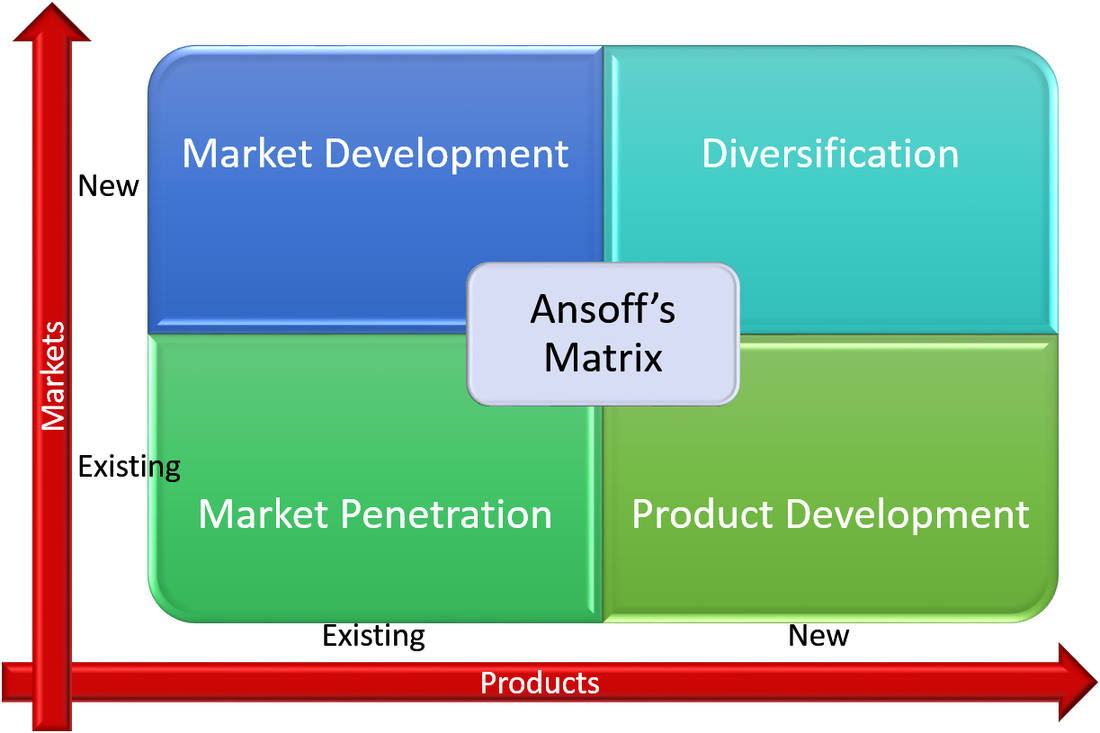
Ansoff Matrix
The Oxford College of Marketing

Highlights in Shaping Theories and Practice of Strategic Thinking

Picture

Picture

Contribution

1.  Founder of the concept of Strategic Management:
.         was the first to coin the term Strategic Planning (1965)
.         and, later on the term Strategic Management (1972)2.  First to introduce the Umbrella Concept suggesting that different solutions are needed under different levels of turbulence of the Environment. These solutions include business and corporate level strategies.3.  Empirically validated theories, proven in thousands of situations around the world

4.  Developed the Strategic Success Diagnosis model to determine and assess an Organization’s external Environment as to:
·         where an Organization is presently,
·         where it should be, and
·         how to do it

5.  The Strategic Success Diagnosis applies to all Environment Serving Organizations, for profit, not-for profit and governmental agencies

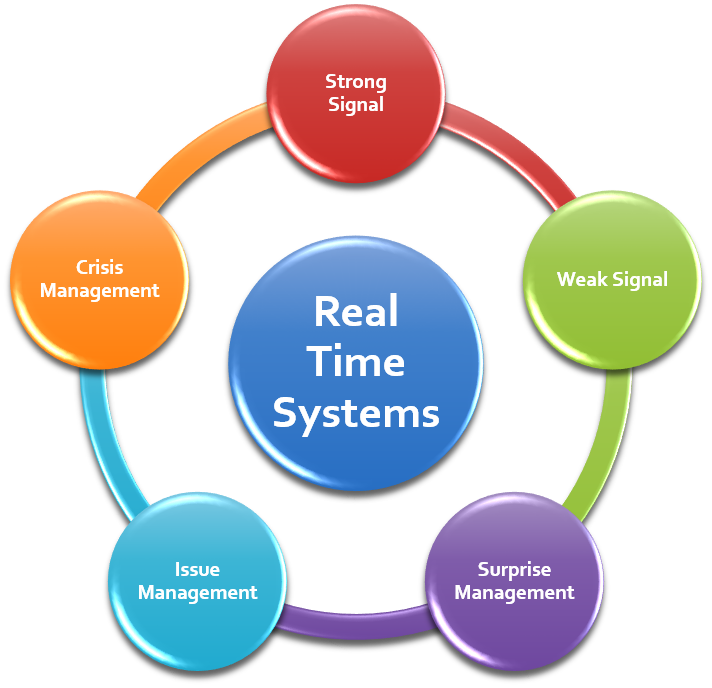
6.  Concentrated on the strategies and capabilities needed at the high levels of turbulence of the Environment by introducing the Real-Time Strategic Management concept

7.  Developed many practical process tools and technologies applied in practice

​Validation

​H. Igor Ansoff came to USIU in 1983 and founded the School of Strategic Management. He is the only one in the field who has validated his theory supported with consistently high results.

There are over 45 Doctorates awarded in the Strategic Management discipline verifying Ansoff’s approach. The findings were empirically validated.  All results are available for review at a special edition Compendium of Strategic Management Research. Graduates of the Strategic Management program, from both the Master’s and the Doctoral programs, are holding high positions in industry and academia around the world.

Major Contributions

Judge the results by the criterion of relevance to reality, and not by the more common criterion of proper attribution to prior work.

​Among the material developed by H. Igor Ansoff, three contributions shaped and influenced theories of strategic thinking: the concept of  environmental turbulence, the contingent strategic success paradigm and real-time strategic management.

Environmental Turbulence

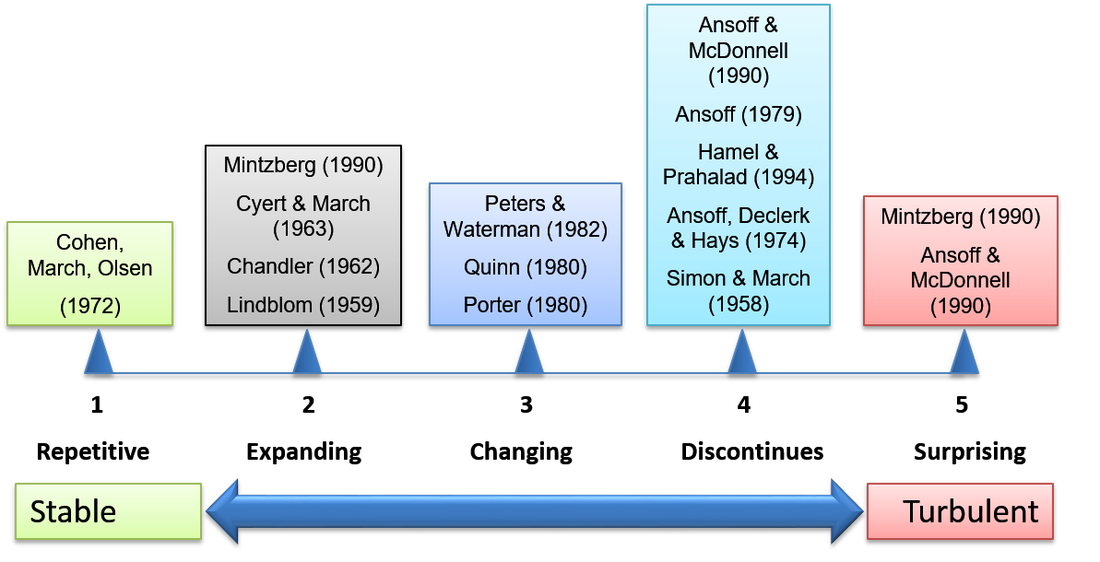
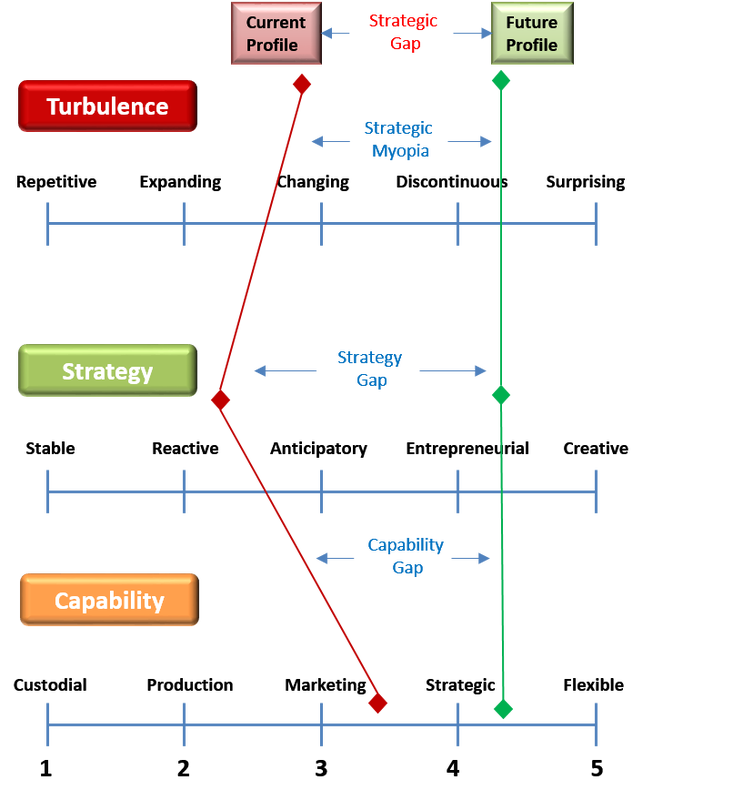
It is a model of the business environment consisting of five turbulence levels, ranging from placid and predictable to highly changeable and unpredictable.  For each level of turbulence, Ansoff hypothesized and proven that a different behavior is needed in each level which optimizes an organization’s profitability (1979).  A simplified description of the levels of turbulence is shown.
In order for an organization to balance both the strategic and operational components, it has to look at both the external and internal environments and align its position to achieve good results. This led to the realization that analysis and interpretation of the organization’s external environment is pivotal to its strategic success.
Ansoff constructed a five-point scale of ‘turbulence levels’.  These are described by a combination of the changeability of events in the environment. The external environment serves as the key indicator for the organization’s strategic position and its inaccurate perception is “strategic myopia”.

Picture

Source: H. Igor Ansoff – Turbulence Levels on which Ansoff’s Prescriptions Optimize Profitability

Contingent Strategic Success Paradigm

​Ansoff used the model of turbulence to construct a strategic success paradigm based on three variables: the turbulence levels of the organization’s environment; the aggressiveness of the organization’s strategic behavior in the environment; and the responsiveness of the organization’s management to changes to the environment.
The paradigm states that the financial performance of an organization is optimized when the aggressiveness and management responsiveness of the organization both match the turbulence of the organization’s environment (1979).
The fact that an organization can be successful at one time and unsuccessful in another led Ansoff to realize that an organization’s strategy has to be aligned with the level of turbulence in which it operates; otherwise its financial performance drops.  A matching triplet was designed to show the link between the environment, strategy and capability.
Ansoff challenges the validity of prescriptions for organizations’ success established in the literature.  His model does not deny the validity of these prescriptions; on the contrary it places them in a context in which each is valid under a particular set of circumstances dependent on the level of turbulence of the environment.  For instance, specific strategic actions could be very appropriate in one level but not so when applied in another level.  In order for organizations to attain maximum profitability, they have to interpret the level of environmental turbulence and align their strategy and capability accordingly.
While some maintain that there is one prescription for success, Ansoff has empirically proven in a total of more than 2,100 cases around the world (1983 – 1999) that different environments call for different corporate responses.
Ansoff developed a diagnostic tool for working managers to diagnose the readiness of their organizations to succeed in turbulent environments.  It enables an organization to identify the existence of any gap between its future environment, its current strategy and its current capability.
Managers can also use the paradigm to select the strategic approach proposed by the academics and consultants which best fit in the appropriate level of turbulence.  There are quite a number of options applicable in each level of turbulence.  However, the same strategic option does not guarantee optimal financial performance under all levels of turbulence.  One can be appropriate for one but inappropriate for another.

Picture

Source: H. Igor Ansoff – Turbulence, Strategy and Capability must Match to Optimize Profitability

Real-time Strategic Management

​Ansoff’s third contribution is in the applicable strategies to be used in high turbulence environments. The distinct characteristics of the real-time strategic management include the following:

1.    Application of strategic diagnosis to assess the organization’s readiness to succeed in the high turbulent environment
2.    Priority attention to ensuring the appropriate mind-set of key managers and the firm’s culture to respond to this type of environment
3.    Anticipation of encountering resistance to change, accompanied by early steps to convert the resistance into acceptance and support of change
4.    Risk estimates assessment surrounding each major strategic decision
5.    Designing the strategic planning and positioning of the organization
6.    Introduction of the real-time strategic control mechanism
7.    Revision mechanism of the organization’s current strategy (when there are indications that it does not longer work)

Picture

Source: H. Igor Ansoff

Strategic Planning in Turbulent Environments: A Social Ecology Approach to Scenarios Ramírez, Rafael and Selsky, John W. (2016)


Source: Strategic Planning in Turbulent Environments: A Social Ecology Approach to Scenarios


Strategic Planning in Turbulent Environments: A Social Ecology Approach to Scenarios

Ramírez, Rafael and Selsky, John W. (2016) Strategic Planning in Turbulent Environments: A Social Ecology Approach to Scenarios. Long Range Planning, 49 (1). pp. 90-102.
[img] PDF 
Download (408kB) | Preview

Abstract

We contrast conventional strategic approaches derived from neoclassical economics with a socio-ecological approach to strategy. We propose that the socio-ecological approach, and specifically the causal textures theory of organizational environments it spawned, helps strategic planners to better engage unpredictable uncertainty that characterizes turbulent environments. To support our argument, we render explicit three principles that have been implicit in causal textures theory. We articulate general strategic planning stances for organizations consistent with each of the three principles, and demonstrate how scenario planning can help to instantiate each principle. We conclude that causal textures theory helps strategic planners to better understand the purpose of scenario planning and helps to guide them on how to make use of scenario planning to effect better strategies in a turbulent environment.

Item Type: Article
Keywords: Strategy; entrepreneurship & global business; Environment uncertainty; High velocity environment; Inter-organizational relationships; Organizational ecology; stakeholder theory; strategy & innovation
Subject(s): Strategy; Entrepreneurship & Global business
Date Deposited: 14 Nov 2014 16:22
Last Modified: 08 Aug 2018 12:56
Funders: None
URI: http://eureka.sbs.ox.ac.uk/id/eprint/5218

Beale Lecture 2019: Mike C Jackson final – The Future of OR Is Present – YouTube

Beale Lecture 2019: Mike C Jackson final – The Future of OR Is Present

Published on 3 Apr 2019

Title: The Future of OR Is Present In 1978, at a conference in York, Russ Ackoff argued that the deficiencies of OR meant ‘The future of OR is past.’ Concentrating on theoretical and methodological advances such as ‘soft OR’ and ‘multi-methodology’, and drawing upon developments in the related trans-discipline of systems thinking, I make the case for an ‘enhanced OR’ capable of helping decision-makers meet the challenges posed by modern-day complexity. Indeed, the future of OR is present. Biography Mike is Emeritus Professor at the University of Hull and Fellow of The OR Society. He received his PhD from the University of Hull, has been awarded two honorary doctorates and authored numerous books. Mike has been a visiting professor at numerous international universities and received an OBE in the Queen’s New Year’s Honours list 2011 for services to higher education and business. His new book, Critical Systems Thinking: Responsible Leadership for a Complex World will be published by John Wiley & Sons in 2019.

Personal History Of Computing – DEV Community

Have not had time to read but apparently has multiple cybernetics references…


Philosophical foundations for digital programming

Source: Personal History Of Computing – DEV Community 👩‍💻👨‍💻


Personal History Of Computing

tuned profile image Lorenzo (Mec-iS)  Apr 14 ・8 min read

Philosophical foundations for digital programming

linked network

Some Introductory words

“After the tool, responding only to his hand; after the machines, covering complex tasks and operations but subject to his will; here he is to delegate automata to take care of managing and thinking in place of himself, on the basis of apparently rational criteria.“ — H.J. Martin, 1988

The Complexity Workshop – Making sense of complexity, April 29 2019, Stockholm | Crisp

Sonja Blignaut, a longtime partner of Dave Snowden and experienced practitioner in Dave Snowden´s work, will facilitate a practical workshop intended to build a bridge between Dave’s thinking and methods and their practical application.

Source: The Complexity Workshop – Making sense of complexity, April 29 2019 | Crisp – Get agile with Crisp


The Complexity Workshop – Making sense of complexity, April 29 2019

Agile

Sonja Blignaut, a longtime partner of Dave Snowden and experienced practitioner in Dave Snowden´s work, will facilitate a practical workshopintended to build a bridge between Dave’s thinking and methods and their practical application. The Cynefin framework and SenseMaker® offer many ways to deal with complex challenges and we believe this practical workshop will maximize the benefit from your time investment in Dave Snowden´s work.

There is a growing awareness that the organizations we work in are more like unpredictable and interconnected ecosystems than predictable machines. In these complex ecosystems, most of our models and “best practices” are no longer effective and managers and decision makers often find that they are not equipped for this new world of work as prevailing management paradigms are based on assumptions of linearity, predictability, and certainty.

The Agile movement has introduced new ways of work that promise organizations a faster, more adaptive response, but it often doesn’t reach their full potential as governing structures and strategies are mostly still rooted in the mechanistic control paradigm. What is becoming increasingly apparent is that organizations that want to become strategically agile and responsive will need to fundamentally shift not only work practices but also how they think, strategize and organize.

In this session, we will explore the nature of complex adaptive systems, the implications of seeing our organizations as such and also answer the practical “so what?” questions in terms of what this means for our work practices.

What do previous participants say?
“I got a lot of energy from the WS. Unconnected ideas, insights, and concepts around working in complexity that I had collected through many years came together in a beautiful way.
It can feel heavy to carry around a lot of ideas without no obvious relationship but when these connections are made everything becomes much lighter and more understandable.”
– Stefan Agnvall

Objectives of the workshop include:

  • Time to make sense of, and integrate the new ideas with your own knowledge and unique context.
  • A model for navigating and working in complex systems, integrating a lot of Daves work.
  • Helping you find suitable contexts and problems in your working environment where you can immediately apply the new thinking.
  • Finding your own language, metaphors, and stories to communicate the ideas effectively to decision-makers.
  • A brief introduction to existing products/processes that might be used as low-risk pilots to introduce the ideas to your organization.

Who Should Attend the Course?

This training is designed for all practitioners and complex thinkers (Agile practitioners, Scrum Masters, Product Owners, Product Managers, Agile coaches, project managers, people managers, architects, designers, developers, DevOps, HR, OD & L&D and anyone else that works in constantly-evolving and dynamic situations) who has done at least one class with Dave Snowden OR is well familiar with Dave’s work and Cynefin. This one-day practical and experimental workshop is ideal for anyone who wants to apply Snowden’s thinking in their teams or their clients in a variety of different ways.

  • Date: 2019-04-29
  • City: Stockholm
  • Language: English
  • There are seats left.

To the registration form

Details

Date April 29, 2019. 09.00-17.00
Participants Max 24
Language English
Venue Crisp, Sveavägen 31, 111 34 Stockholm
Price 7900 SEK. The prices are excl. VAT, incl. lunch and coffee.
Contact academy@crisp.se, +46 8 556 950 15

SoL European Learning Plaza, Hungary 2019 – Global SoL

SoL is continuing… a series of events

Source: SoL European Learning Plaza, Hungary 2019 – Global SoL


24May

SoL European Learning Plaza, Hungary 2019

 May 24 @ 10:00 am – June 2 @ 2:00 pm UTC+2

Spaces for transformation

What does our presence make possible for the benefit of all? 

In order to make anything change, just create the space. That is not create by our actions but by our presence.

Peter Senge, SoL Global Forum 2014


We will never make real headway in our complex issues if we cannot build the capacity to work together across sectors in our societies. 

Peter Senge 


You may choose programs here below, one by one

Registration form: https://docs.google.com/forms/d/e/1FAIpQLSfca0NCfEwK5DdTtDh6l8bTOVBhXtECwzKXri0VaFraKo7IIg/viewform?usp=sf_link

****************************************************************************************************************************************

24th – 26th May, in Bölcske

Spaces for fransformation in art and architecture

Organised by Saint Andras chateau, our strategic partner.

Contact: info@szentandraskastely.hu


***************************************************************************************************************************************

28th May, 10:00 am – 6:00 pm CET, in Budapest

Developing core competencies for systemic, mindfulness based education for the 21st century

Pre-conference workshop for educators, edu-coaches, facilitators

  • Guus Geisen, NL, author and educator, for De Lerende School, NL.
  • Agota Ruzsa, SoL HU, educator and facilitator-coach for Learning Schools

A Collegium Danubius Program of SoL Hungary

Contact: judit.szentirmai@solintezet.hu


****************************************************************************************************************************************

29th May, 10:00 am – 30th May, 1:00 pm CET, in Budapest

What will it take to work together to serve the unfolding future in whatever place we stand?

SoL Open Conference

Systemic dialogues for transformative action (education, business, community…)

Venue to be decided

Contact: judit.szentirmai@solintezet.hu


********************************************************************************************************************************************

30 May, 7:00 pm – 2nd June, 10:00 am CET, in Bölcske

As a living system, how do we reflect on the world as it is and respond to what is wanted and needed now? 

Co-creating Global SoL 4.0

Contact: judit.szentirmai@solintezet.hu


*********************************************************************************************************************************************

2nd June 11:00 am – 6:00 pm CET, in Budapest

Healing and constellating for the wholeness of Europe

Mindful walking and dialogues and constellation through city sites with aware storytelling of European history related to our understanding in the here and now so that we may see and inquire into our sources of collective wounds that want to be healed, connections to be reconnected, emerging patterns to be understood. All these ties that inhibit us from embracing the wholeness of our society and our future of thriving with compassion.

Contact: aruzsa@solhungary.hu

Event Details

 Date:May 24 @ 10:00 am – June 2 @ 2:00 pm UTC+2
 Time: 10:00 am – 2:00 pm
 Venue: Budapest, Hungary
 Address: to de decided
 Organizer Name: SoL Hungary

Top Inspiration, Events and News on Systems Change – The Systems Studio

…excellent stuff from the always excellent Systems Studio.

Subscribe for yourself at http://thesystemstudio.com/our-publications


Source: Top Inspiration, Events and News on Systems Change


Generative Music – Brian Eno – In Motion Magazine


Source: Generative Music – Brian Eno – In Motion Magazine


Generative Music

“Evolving metaphors, in my opinion, is what artists do.”


A talk delivered in San Francisco, June 8, 1996
by Brian Eno

Brian Eno (photo by Nic Paget-Clarke)The following talk was given by Brian Eno at the Imagination Conference in San Francisco, June 8, 1996. Billed as a progressive interactive event featuring original multimedia presentations the Imagination conference featured musician and artist Brian Eno, movie producer and director Spike Lee, and performance artist and musician Laurie Anderson. Each of the three presented their work and ideas in their own way. Brian Eno spoke about a new form of music – Generative Music – and traced its roots and the development of his ideas on it from the mid-sixties until now. For a biography of Brian Eno and description of some of his current work – click here. For Spike Lee’s talk click here. Laurie Anderson played music and sang/performed a set arranged for the evening. In Motion Magazine thanks Capretta Communications in San Francisco for all their help in getting us into the conference and providing materials for this coverage. If you’d like to listen to these talks go to HotWired magazine.


What I am talking about tonight is an idea that really began for me about 25 years ago and has pretty much obsessed me ever since. It began as a musical idea, it began as something I heard in music and gradually I realized that in fact it was an idea that was occurring in all sorts of areas. In the course of this talk what I would like to do is to trace the history of that idea in my own work and in the work of some other people and also to show how the idea suddenly branches out, opens up, and becomes a metaphor for what I consider a very important new body of thinking. I have 45 minutes to do this and I have a clock here as well.

In the mid-sixties, something happened in modern music which really made a division between what had happened prior to that and what was now starting to happen. At the time it was called the new tonalism, or the new tonality. It was a movement away from the classical tradition which had sort of defined progress with becoming more atonal, becoming more chaotic and in a sense becoming less musical in the sense that ordinary people would understand the word music.

Uprooting Racism by Paul Kivel
If you buy these book here a portion of the sale goes to In Motion Magazine.

In the mid-sixties, Terry Riley, Steve Reich, Philip Glass and several others began working with tonal music again. Simple chords, simple intervals, rhythms that you could follow that weren’t in 15/8 and things like that (laughter). Music in fact you could almost dance to.

At the time, the distinguishing characteristic of that music seemed to be that it was tonal, as opposed to atonal. Over the course of time, since then I think another important characteristic has emerged. It was very clear in the first major piece of Terry Riley called In C. Most of you probably know of this piece or some of you probably know it, and many of you may have played it. It’s a very famous piece of music. It consists of 52 bars of music written in the key of C. And the instructions to the musicians are “proceed through those bars at any speed you choose”. So you can begin on bar one, play that for as many times as you want, 20 or 30 times, then move to bar 2, if you don’t like that much just play it once, go on to bar three.

The important thing is each musician move through it at his or her own speed. The effect of that of course is to create a very complicated work of quite unpredictable combinations. If this is performed with a lot of musicians you get a very dense and fascinating web of sound as a result. It’s actually a beautiful piece and having listened to it again recently I think it’s stood the test of time very well. That piece however was not the one which blew my socks off.

That dubious credit goes to another piece of music by a composer called Steve Reich. I think it was his earliest recorded piece. It’s a piece called It’s Gonna Rain, and I would like to listen to a bit of that now.

(It’s Gonna Rain played.)

For many years I was the only person I knew who thought that was a beautiful piece of music (laughter). It’s quite a long piece, it’s about 17 minutes long. It’s produced by a very, very simple process. It’s a loop of a preacher saying “It’s gonna rain”. Identical copies of the loop are being played on two machines at once. Because of the inconsistency of the speed of the machines they gradually slip out of sync with one another. They start to sound like an echo. Then they sound like a cannon, and gradually they start to sound like all sorts of things.

The piece is very, very interesting because it’s tremendously simple. It’s a piece of music that anybody could of made. But the results, sonically, are very complex. What happens when you listen to that piece is that your listening brain becomes habituated in the same way that your eye does if you stare at something for a very long time. If you stare at something for a very long time your eye very quickly cancels the common information, stops seeing it, and only notices the differences. This is what happens with that piece of music.

Quite soon you start hearing very exotic details of the recording itself. For instance you are aware after several minutes that there are thousands of trumpets in there – this is without drugs. With drugs there would probably be millions (laughter). You also become aware that there are birds, there really are birds — in the original loop of tape there are some pigeons or something and they become very prominent as the thing goes on. Most of all, if you know how the piece is made, what you become aware of is that you are getting a huge amount of material and experience from a very, very simple starting point.

Now this completely intrigued me. Partly because I’ve always been lazy, I guess. So I’ve always wanted to set things in motion that would produce far more than I had predicted. Now the Reich piece is really a … what would be called visually a moire pattern.

Can I have the over-head projector please?

Now a moire pattern is when you overlay two identical grids with one another. Here’s one, here’s the other. Now when I overlay them, see what happens, you get a very complicated interaction. You get something that actually you wouldn’t have predicted from these two original identical sheets of paper. This is actually a very good analog of the Steve Reich piece in action. Something happens because of one’s perception rather than because of anything physically happening to these two sheets of plastic which produce an effect that you simply couldn’t have expected or predicted.

I was so impressed by this as a way of composing that I made many, many pieces of music using more complex variations of that. In fact all of the stuff that is called ambient music really — sorry, all the stuff I released called ambient music (laughter), not the stuff those other 2 1/2 million people released called ambient music, — all of my ambient music I should say, really was based on that kind of principle, on the idea that it’s possible to think of a system or a set of rules which once set in motion will create music for you.

Now the wonderful thing about that is that it starts to create music that you’ve never heard before. This is an important point I think. If you move away from the idea of the composer as someone who creates a complete image and then steps back from it, there’s a different way of composing. It’s putting in motion something and letting it make the thing for you.

One of the first pieces I did like that is called “Music for Airports” (applause) , thank you very much. (Shows graphic of Music for Airports). This is in fact a picture of the alien fleet that abducted me last time I was in San Francisco (laughter), and that’s the mother ship just there. It was an awful experience because they stole all my hair (laughter). In fact this really a diagram of Music for Airports.

Music for Airports, at least one of the pieces on there, is structurally very, very simple. There are sung notes, sung by three women and my self. One of the notes repeats every 23 1/2 seconds. It is in fact a long loop running around a series of tubular aluminum chairs in Conny Plank’s studio. The next lowest loop repeats every 25 7/8 seconds or something like that. The third one every 29 15/16 seconds or something. What I mean is they all repeat in cycles that are called incommensurable — they are not likely to come back into sync again.

So this is the piece moving along in time. Your experience of the piece of course is a moment in time, there. So as the piece progresses, what you hear are the various clusterings and configurations of these six basic elements. The basic elements in that particular piece never change. They stay the same. But the piece does appear to have quite a lot of variety. In fact it’s about eight minutes long on that record, but I did have a thirty minute version which I would bore friends who would listen to it.

The thing about pieces like this of course is that they are actually of almost infinite length if the numbers involved are complex enough. They simply don’t ever re-configure in the same way again. This is music for free in a sense. The considerations that are important, then, become questions of how the system works and most important of all what you feed into the system.

I think that the classical composers who came to this way of composing have not thought it about very much. They accepted given instruments and invented systems to reconfigure them. To me that was an important part of it. I think coming from pop music, which of course is a music more than anything else about sound, and about the possibilities of sound in studios, coming to doing this from that background, I think I was well equipped for that.

Music for Airports came out in 1978 to howls of neglect (laughter) in fact it didn’t do at all well in England. But it did do quite well here by comparison. I have an eternal debt to the United States for actually cheering me up a little bit when that record came out. In fact I was so depressed about the response to the record and the other stuff I’d been doing in England that I decided to move to America for a few years, which might be the sign of a weak-willed person who lives off flattery but, you know, there you go (laughter).

One of the first places I came to was San Francisco, I lived here for a while. In fact I practically lived in the Exploratorium. (Laughter and applause) I have my Exploratorium. instant moire in my pocket (laughter). If you haven’t visited the Exploratorium. in the last month you should go — it’s really a good place. If every city had one of those the world would be a much better place.

In the Exploratorium. the thing that absolutely hooked me in the same way as the Steve Reich piece had hooked me was a simple computer demonstration. It was the first thing I’d ever seen on a computer actually, of a game invented by an English mathematician called John Conway. The game was called Life. Modest title for a game.

Life is a very simple game, unlike the one we’re in. It only actually has a few rules, which I will now tell you. You divide up an area into squares. You won’t see the squares on the demonstration I’m about to do. And a square can either be dead or alive. There’s a live square. Here’s another one. There’s another one. There’s another one there.

The rules are very simple. In the next generation, the next click of the clock, the squares are going to change statuses in some way or another. The square which has one or zero neighbors is going to die, a live square that has one or zero neighbors is going to die. A square which has two neighbors is going to survive. A square with three neighbors is going to give birth, is going to come alive, if it isn’t already alive. A square with four or more neighbors is going to die of over crowding.

These are terribly simple rules and you would think it probably couldn’t produce anything very interesting. Conway spent apparently about a year finessing these simple rules. They started out much more complicated than that. He found that those were all the rules you needed to produce something that appeared life-like.

What I have over here, if you can now go to this Mac computer, please. I have a little group of live squares up there. When I hit go I hope they are going to start behaving according to those rules. There they go. I’m sure a lot of you have seen this before. What’s interesting about this is that so much happens. The rules are very, very simple, but this little population here will reconfigure itself, form beautiful patterns, collapse, open up again, do all sorts of things. It will have little pieces that wander around, like this one over here. Little things that never stop blinking, like these ones. What is very interesting is that this is extremely sensitive to the conditions in which you started. If I had drawn it one dot different it would have had a totally different history. This is I think counter-intuitive. One’s intuition doesn’t lead you to believe that something like this would happen. Okay that’s now settled (looking at screen), that will never change from that. It’s settled to a fixed condition. I’ll just show you another one. I’ll show you this one in color because it looks nice. A little treat. (Laughter).

At the Exploratorium, I spent literally weeks playing with this thing. Which just goes to show how idle you can be if you’re unemployed. I was so fascinated, I wanted to train my intuition to grasp this. I wanted this to become intuitive to me. I wanted to be able to understand this message that I’d found in the Steve Reich piece, in the Riley piece, in my own work, and now in this. Very, very simple rules, clustering together, can produce very complex and actually rather beautiful results. I wanted to do that because I felt that this was the most important new idea of the time. Since then I have become more convinced of that, and actually I hope I can partly convince you of that tonight.

Life was the first thing I ever saw on a computer that interested me. Almost the last actually, as well. (laughter). For many, many years I didn’t see anything else. I saw all sorts of work being done on computers, that I thought was basically a reiteration of things that had been better done in other ways. Or that were pointlessly elaborate. I didn’t see many things that had this degree of class to them. A very simple beginnings and a very complex endings.

At the same time as I was working with Life I was also starting to some new pieces of music that used the moire principle, but in a much more sophisticated way. So now I have go back to the overhead (screen). What I started to do was make moires of different types of elements. Not only of single notes or similar sounds, but moires of basically rules about how sounds were made. This gave me some very much more interesting results. As you can see (manipulating lines and shapes on the overhead) Here’s two simple cycles going out of phase, here’s a wiggly one going out of phase, and then hallelujah – New Age music (laughter) for which I am consistently being blamed (laughter).

You can start to build very beautifully complex webs of things from very simple initial ingredients. What I would like to do is play you a piece called Neroli which was released five years ago or something which was another version of this way of working. I’ve only ever had one idea really, and that was this, and everything I’m going to play was a version of this idea. Can you put on Neroli please. I’ll leave this running because it’s a very good piece to talk over.

Can you now put on this Mac, please.

The next thing I ever saw on a computer that really astonished me was a screen-saver by a local lad called Gene Tantra. I don’t now if he’s here tonight I really wanted to invite him but I didn’t have his number. He made a screen-saver for the aptly named Dim company After Dark. This screen-saver which they only released in one of their files because it’s clearly much too good to come out very often was called Stained Glass. Stained Glass unlike almost all other screen-savers looks at its own history. Stained Glass generates images, then it sucks them out, multiplies them, chops them about, collages them together in different ways.

I realized that if you put other screen-savers in the center of Stained Glass, then it would do the same thing to them. What you have is a visual generative piece.

I’ve got three versions of Stained Glass. There’s one along the top there (pointing to overhead screen), this square is another. And then this oblong is a third. At the center of these two is a different screen-saver called Doodles. Now someone in a London magazine, when I said I’d spent a long time looking at screen-savers described this as “rather sad” (laughter) with that infallible cynicism that we English are so good at.

But the reason I was looking at them so closely was because again they picked up that thread of something that uses a tiny amount of information, a minute amount of your computer’s processing power, and produces something that for me is thirty times as beautiful as anything I’ve seen off a huge clunky CD ROM.

I quickly realized that for me this was the future for computers. Computers seen not as ways of crunching huge quantities of data or storing enormous ready-made forests of material, but computers are the way of growing little seeds.

This piece here, this Stained Glass is a very small seed, in fact I think it’s something like 25 K, now for those of you who know what a K is will know that 25 of them isn’t very many (laughter). This is the kind of precise scientific language you can expect this evening (laughter). Just to give you an impression, a CD ROM is, ohh, very much bigger than that (laughter). I’ve never actually worked this out. Something like 30,000 times more information on a CD ROM, I suppose, than is needed to make this work. I think this is about 30,000 times as interesting actually. Partly because it never repeats itself. This thing will go on generating like this, and it will stay pretty much the same, but it will never be identical. This suits me fine. I don’t want big surprises. *I want a certain level of surprise – I’m too old for big surprises, now. (Laughter) – after those aliens.

I thought this has got to be the future of computer music. I’ve seen so many things done on computers that were hopelessly overwrought and complicated and in the end sounded like what I call bubble and squeak music. Or on the other hand, sounded like typical sequencer music, sequencer music where everything is bolted together and it’s all completely, rigidly locked. It would have been great in the 1930s, I’m sure, that music.
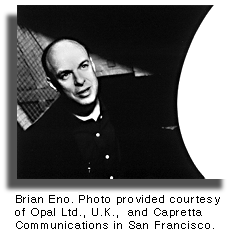
Brian EnoI wanted something that had an organic quality to it. Had some sense of movement and change. Every time you played it something slightly different happened.

So, screen-savers. In fact Gene Tantra’s, as I was saying was the first thing that I saw like that. Subsequently I saw another one by another local lad called Greg Jarvit which is called Bliss, which is another very, very interesting system. Both of those things really impressed me. Mostly because they were economical. I am so thrilled my anything economical. It’s so easy not to be economical and anything that uses a very small amount of information smartly impresses me.

I came to California a couple of years ago with the idea that the right approach to using this new medium called CD ROM was to actually use it not as a way of, as I said storing forests which you then, tediously navigate through. It takes you four minutes to see another bottom on the Prince video (laughter), but I thought how much more exciting it would be to see something that happened like that, immediately, and furthermore happened in a way that you’d never seen it happen before. It seemed to me that this was the answer. To some how use the CD ROM as a way of planting seeds into your computer, and then using the computer to grow those seeds for you.

In fact, although this abstract, Tai Roberts from ION proved to me that it could also be done figuratively, it doesn’t have to be abstract. I don’t have an example of that, in an afternoon Tai managed to put together an animation of a figure which was a generative animation, that’s to say it didn’t rely on calling up a stored video, it relied on having a very small seed and then performing certain operations. They were actually twists and turns from Photoshop performed live on to this seed. In a sense the theory was vindicated, but only in a sense because it never got made in that way.

I went back to England not really having seen the musical thing I’d hoped to find. I had come with a whole proposal for how to make a sort of generative musical system in a computer. It was a muddled proposal because I don’t know enough about computers to frame it properly. But it was fairly detailed and fairly accurate to what has since happened.

When I got back to England, about a year afterwards a letter came through from some people called Sseyo, a company called Sseyo, located in exotic, sunless Beaconsfield, which is about 25 miles north of London. I had been imagining that I would find the answer in San Francisco, but in fact these guys were working just up the M1 (laughter).

They sent me a demo of something they had done. It was a music generating system. I listened to this CD and there were a couple of pieces on it that were clearly in my style. In fact it turned out that they were followers of my music. The interesting thing to me was that the pieces that were in my style were actually very good examples of my style. In fact they were rather better than any I had recently done (laughter). I was rather impressed by this.

I got in touch with them and the next example is really the center of this talk – which is lucky because I’m about half-way through on the clock. Now I need the PC please (to the control room) – it’s only available on PC, I’m sorry to say. (Hissing from audience.) Yes I thoroughly agree, the people from Sseyo are here tonight – hiss louder. We have one supporter of the PC system in the front row here – he’s wearing a white t-shirt … (laughter).

This is a very, very interesting system. It allows you to specify a set of instruments. I should first tell you a little about it technically. This is a computer (laughter). In there there’s a sound card — that’s to say a little synthesizer. And this computer tells that little synthesizer what to play according to the rules that I’ve set in here. Now these rules cover all sorts of things that you might want to do musically. They cover very obvious things like what scale is the piece in. And just to show what that looks like … this is slightly re-configured since I last looked at it. These are scales. Now if I want to have a little bit of minor second in my scale I can do that. A little of this, a bit of that, and a little bit of that, and some of that, and some more of that, and so on and so on. I show you that to indicate that all of the rules are probabilistic — that is to say they are rules that define a kind of envelope of possibilities. The machine is going to improvise within a set of rules, which is to say there’s a greater chance that it’s going to play a fifth, than a flat fifth for example. And so on and so on.

There are rules concerning harmony, that is to say, and a second harmony, play a flat fifth harmony. There are rules concerning how it would move from note to note. Will it move in big steps, or small steps, and in fact in this piece here I have some of the instruments are going to move by big steps, and some by quite small steps. There are a hundred and fifty of these kinds of rules. They govern major considerations like the basic quality of the piece to quite minor ones like exactly how the note wobbles. I’ll play you a bit – is this thing up? – He cried to the empty void (laughter).

This piece of music, which is quite unpredictable and sometimes has quite large gaps in it, as it has chosen to do right now, it’s embarrassing, this music is making itself now. It is not a recording, and I have never heard it play exactly this before. If you don’t believe me I’ll start it again. See. It will start.

This piece, I guess I’ve listened to for a couple of hundred hours or so. I often have it running in my studio, while I’m making records. It’s a very satisfying piece of music. It carries on rebuilding itself. It sometimes pulls a surprise, like this. There’s one very exotic harmony that can only occur under particular conditions and occasionally it pulls it out. What interesting to me is that again it’s very economical. You can use the computer in many other ways while you’re doing this. If you want to use it as a word processor, it’ll carry on making the music in the background.

I’ll play you a part of another piece just to show you that it can do other things. They are so unpredictable, it’s very difficult just to play to people because you can switch it on and say listen to this, and nothing happens.

Having started working with this system I am so thrilled by it. I think there are other generative music systems, but I happen to understand this one and I know it’s a good one. I’m so thrilled by it that it is very difficult for me to listen to records anymore. Putting on a record and knowing I’m going to hear the same thing I did last time has actually become a little bit irksome. It feels quite Victorian to do that (laughter). I think this has really moved up into a new phase of music.

You know up until about a hundred years ago people never heard the same music twice. Of course it was always different. When recording appeared, suddenly you had the wonderful luxury of being able to play music wherever you wanted to, and control it in various ways. But of course it was always the same thing. And now you have this thing which is kind of a new hybrid where you can play the music wherever you want just like a record, but it won’t be the same thing each time. This is actually very thrilling I think.

Now whether you like the music or not is another issue. This just happens to be the music I make. It doesn’t have to sound like this, just to console you (laughter). It’s very good for making techno and all that sort of thing as well. I was informed on the radio the other day that I was the father of industrial music – which is not something I’ve been accused of before (laughter).

I started thinking about the differences between generative and what I would call classical or symphonic music – I have not really decided on a name for the rest of it. And these are the differences. It’s not either or. Music can be anywhere along a line between these two.

Classical music, like classical architecture, like many other classical forms, specifies an entity in advance and then builds it. Generative music doesn’t do that, it specifies a set of rules and then lets them make the thing. In the words of Kevin Kelly’s great book, generative music is out of control, classical music is under control.

Now, out of control means you don’t know quite what it’s apt to do. It has it’s own life. Generative music is unpredictable, classical music is predicted. Generative unrepeatable, classical repeatable. Generative music is unfinished, that’s to say, when you use generative you implicitly don’t know what the end of this is. This is an idea from architects also, from a book called How Buildings Learn, the move of architecture away from the job of making finished monumental entities toward the job of making things that would then be finished by the users, constantly refinished in fact by the users. This is a more humble and much more interesting job for the architect.

Generative music is sensitive to circumstances, that is to say it will react differently depending on its initial condition, on where it’s happening and so on. Where classical music seeks to subdue them. By that I mean classical music seeks a neutral battleground, the flat field. It won’t be comfortable — with a fixed reverberation, — not too many emergencies, and people who don’t cough during the music basically.

Generative forms in general are multi-centered. There’s not a single chain of command which runs from the top of the pyramid to the rank and file below. There are many, many, many web-like modes which become more or less active. You might notice the resemblance here to the difference between broadcasting and the Internet, for example.

You never know who made it. With this generative music that I played you, am I the composer? Are you if you buy the system the composer? Is Jim Coles (?) and his brother who wrote the software the composer? — Who actually composes music like this? Can you describe it as composition exactly when you don’t know what it’s going to be?

Why does an idea like this grab my attention so much? I said at the beginning that what I thought was important about this idea was that it keeps opening out. This notion of a self-generating system, or organisms, keeps becoming a richer and richer idea for me. I see it happening in more and more places.

I think what artists do, and what people who make culture do, is somehow produce simulators where new ideas like this can be explored. If you start to accept the idea of generative music, if you take home one of my not-available-in-the-foyer packs and play it at home, and you know that this is how this thing is made, you start to change your concept about how things can be organized. What you’ve done is moved into a new kind of metaphor. How things are made, and how they evolve. How they look after themselves.

Evolving metaphors, in my opinion, is what artists do. They produce work that gives you the chance to experience in a safe environment, because nothing really happens to you when you looking at artwork, they give you the chance to experience what might be quite dangerous and radical new ideas. They give you a chance to step out of real life into simulator life. A metaphor is a way of explaining something that we’ve experienced in a set of terms, a different set of terms.

There’s a very interesting book by Lakoff and Johnson, that famous thirties singing team, it’s a book about metaphor, it’s called Metaphors We Live By. They give a very clear example of the effect of metaphor. They say we use in our culture the metaphor, argument is war. All of our language about argument “she defeated him”, “he attacked her position”, so on and so on, they are all arguments that relate to fighting.

When we think about the process of arguing, we tend to then reconstrue our possibilities in terms of that metaphor. What Lakoff and Johnson say is suppose that somebody had said argument is dance, suppose that was the dominant metaphor. So instead of it being seen you have the process where one person defeats another, it becomes a process where two people together make something beautiful between them. We could have that metaphor for argument, we don’t.

But do you understand that a shift of that kind produces an entirely different kind of discourse. How the shift from one way of dealing in activity that we all engage in to another changes that activity. Suddenly our language of possibilities is renewed and different.

What I’m saying, I suppose, when I talk about these things here (on his chart of the differences between generative and classical musics), I’m saying we’re saddled with a whole set of metaphors that belong over here. Those are our metaphors about how the world works, how things organize themselves, how things are controlled, what possibilities there are. Generative art in general is a way of not throwing those out, we don’t get rid of old metaphors, we expand them to include more. These things still have value, but we want to include these things as well.

My feeling about artists is that we are metaphor explorers of some kind. … An object of culture does all of the following, it innovates, it recycles, it clearly and explicitly rejects, and it ignores. Any artist’s work that is doing all those four things and is doing all those four things through the metaphors that dominate our thinking.

Published in In Motion Magazine – July 7, 1996

Also see: Brian Eno Biography

For more info on Brian Eno:

Systems Change is Taking Hold! News, Tools, & Updates from CoCreative’s Work

Excellent newsletter from the excellent CoCreative – subscribe at the bottom of their homepage: http://www.cocreativeconsulting.com/


Source: Systems Change is Taking Hold! News, Tools, & Updates from CoCreative’s Work


Systems Change is Taking Hold!

News, Tools, & Updates from CoCreative’s Work

With daily reminders of the complex social and ecological challenges we face, we are encouraged by the bold work of thousands of “systems heroes” around the world. In the year ahead, we’ll be working on new tools, resources, and (shh…) a new learning and support platform to support this growing field.

In this issue of our (admittedly irregular) newsletter, you’ll find tools, learning, and partnerships that are sources of inspiration and hope to us. Inside…

  • 2019 CoCreative Course Schedule

  • Collaborative Learning & Innovation Community (CLIC)

  • Building the Field of Systems Change

  • Tools we’re sharing

  • Resources from the field

CoCreative’s 2019 Course Schedule

Whether you’re contemplating, just getting started or fully engrossed in taking on a complex challenge with others, CoCreative has a course that can support your efforts. We’ve taken the best of over two dozen approaches to collaboration, strategy, and change and designed a training program that can meet your needs.

Here’s what one of the participants; Deborah Chang, recently offered…

CoCreative’s training stands out in three crucial ways. One, they situate their training within the context of your long-term work Sometimes I leave .a training and think, “That was wonderful, but what do I do with it?” With CoCreative, I always walk out with a concrete way to apply their training. Two, CoCreative’s frameworks stand the test of time. I find myself going back to CoCreative’s materials over and over again, even a year later. In fact, my CoCreative training manual is within reach of my desk so that at any moment, I can refer to it when planning my next event. Three, the trainers have unparalleled experience across industries, geographies, and cultures.

No matter what you’re working on, CoCreative’s trainers will be able to support you in adapting their frameworks to your specific context.

Our full course calendar for the year is still in development but here are two open registration courses that you can sign up for now…

Collaborative Innovation Essentials

October 28 – 30 (2.5 days) 

Honolulu, HI

Host: Omidyar Fellows

Along with our core Collaborative Innovation Essentials course, we offer other courses on Collaborative Leadership Essentials, Leveraging Conflict for Innovation, Design & Systems Thinking for Transformational Change, and Advanced Collaborative Leadership. We’re happy to bring any of these courses to your community like we did last year for Health Share of Oregon, the Humboldt Area Foundation, and the Bill & Melinda Gates Foundation.

Building Capacity for Systems Change

Collaborative Learning & Innovation Community (CLIC!)

One of our wonderfully tenacious clients recently asked us, “By the way, did I tell you folks that this work is hard? ☺”

Yes, it is. It’s hard intellectually, emotionally, and sometimes even spiritually, to lead groups of people who don’t know each other, might not trust each other, and maybe don’t even like each other (and who are busy on top of that) to drive complex change across organizational, cultural, and sectoral boundaries. (Just reading that last sentence is hard!)

It’s not all pain and difficulty, of course; there are many moments of joy, connection, victory, and transcendent purpose that help feed our souls.

But embracing the fear and uncertainty along with the joy and purpose is what’s asked of us if we’re going to solve tough, intractable problems that aren’t going away and, in some cases, are getting worse.

That’s why those of us doing systems change work need support for our learning and, well, for our very human selves.

To get more support, many of you that have taken our Collaborative Innovations Essentials course told us that you wanted to stay connected to other practitioners in the field. We’ve listened and launched a new peer-to-peer online support network called CLIC where we can continue to learn and grow together in a safe, supportive learning environment.

Our first CLIC cohort is in process now and was open only to those who completed our basic course. However, we’ll open up the next cohort, launching in September, for anyone who’s interested so let us know if you’re interested in joining.

Building the Field of Systems Change

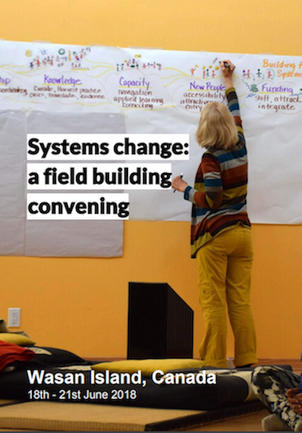
We reported last time on our participation in a groundbreaking gathering on Wasan Island, Canada, of 24 funders and other leaders interested in building the field of systems change.

The dynamic group dove into the challenge of scaling and building the field of system leadership and drafted possible strategies to build the field, including systems of learning and support for current and aspiring systems change leaders.

Want to learn more about what happened there? Here’s the report from that meeting.

One of the key analyses from that group was that, while there are many “toolbases” available for people wanting to do systems change-type work (mostly in the form of web pages with links to many frameworks, methods, and tools) and some good learning opportunities like CoCreative’s courses or the School of Systems Change, these are not reaching the millions of people interested in leading difficult change in their communities and the world. The problem, we’re thinking, is the lack of both visibility and a human component, including connections to other real people working on the same issues.

To test those hypotheses, CoCreative will be conducting a series of empathy interviews with systems change leaders from around the world. The interviewees will be drawn from clients, partners, and grantees of the Wasan Island group along with others. Interested in being interviewed?  Please let us know.

School for Systems Change

Russ has joined the faculty of the School for Systems Change, produced by Forum for the Future. The 6-month program supports emerging systems leaders in learning and practicing five core systems change competencies: Systemic Diagnosis, Strategy Design, Innovation for Impact, Collaboration and Engagement, and Leadership and Learning. There are a few spots still available for Basecamp #6, kicking off in the Americas in July!

Visit the course page for more information.

New Articles, Tools, & Resources

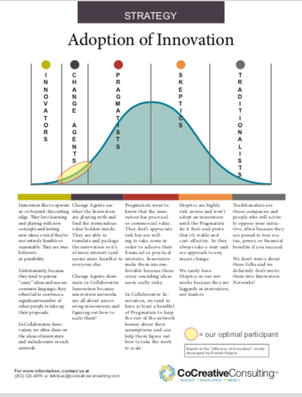
Adoption of Innovation Model (special expanded version)

Based on the pioneering research of Everett Rogers on how innovations spread throughout social networks, this model is helpful for identifying which stakeholders to engage in spreading social innovations too. Our version of the model identifies the unique roles of various groups in developing, translating, and scaling social innovations. (And this secret, expanded version explores how the 5 segments orient toward the future and systems change.)

Collaborative Assessment Tool

Several groups have now used our collaborative assessment tool to collaboratively assess their strengths and places that require more attention in their collaboration. Interested in trying it out with your network? Let us know.

Secret Bonus:
Find More in our Pot ‘o Gold!

While CoCreative shares everything we make and use in our work, we don’t promote everything publicly because some of our resources, like training manuals, change often and we don’t want older versions floating around the Internet. However, as a site subscriber, you have access to our secret stash of manuals, mini-lectures, and experimental stuff in our pot ‘o gold. Enjoy!

What We’re Reading and Learning

Narratives and Storytelling

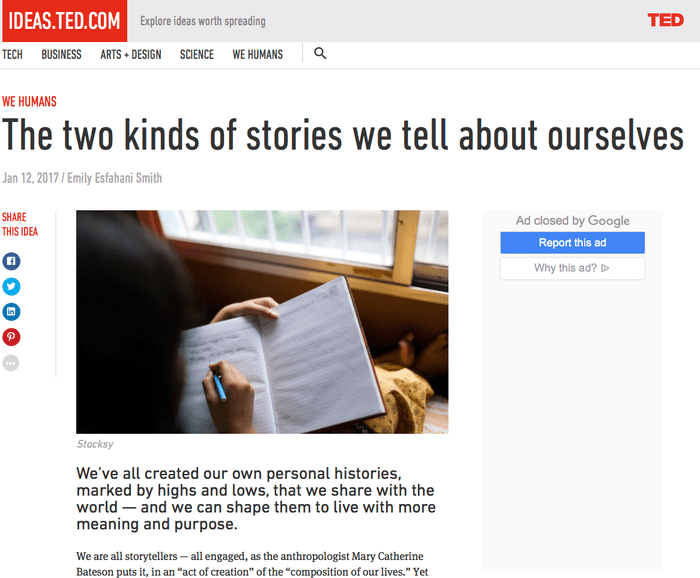
Here’s a brief article from Emily Esfahani Smith, author of The Power of Meaning: Crafting a Life That Matters, on the work by Dan McAdams on “narrative identity” and “narrative choices.” While MacAdams’ work focuses on individual narratives that determine one’s psychological health, the insights are very useful in networks, collaboratives, organizations, and teams.

According to McAdams, people tend to interpret their life stories based on two basic narratives: Either “redemption stories” about how their lives are transitioning from bad to good or “contamination stories” about the opposite. While people who tell themselves redemption stories are more generative and more likely to contribute to society and future generations, they also tend to feel that their lives are more meaningful and experience less anxiety and depression. In addition to these two basic stories, McAdams has found that people who experience more meaning in their lives and work tend to tell stories based on growth, communion, and agency.

From our own observations, we’ve noticed a few things about shaping powerful and meaningful narratives in networks:

  1. There are always competing narratives among participants, based on their participants’ own patterns and tendencies, but one or two narratives will dominate over time based on who’s advancing them, the actual direction and momentum in the work, and the feedback the network is getting from outsiders.

  2. Stories of others’ experiences have a powerful influence on a network’s narrative. When we share stories of how other networks overcame similar challenges, for example, it can powerfully shape a network’s own narrative.

  3. Directionality matters. The power of network narrative is not based on an objective analysis of how things are going at the moment, but include information selected from the participants’ past experience with the network and their future plans together. Even if things are going well now, if the future part of the narrative is pessimistic, the overall narrative is one of decline. That’s why we’ve found that it’s helpful in the second year of a network to really “amp up” the work by picking up the pace and setting more aggressive goals. In general, it’s simply most helpful to frame narratives to start with a negative and end with a positive (e.g. “Things have been difficult but I think we’re the right people to do this.”) than to end with a negative.

  4. It’s helpful to normalize the difficulty in the work. We often do this by pointing out that (1) if the work was easy, someone would have already done it, and (2) the most difficult part of the work for any group is moving from the “diverging and expanding” part of the analysis or solution design to the “converging and deciding” part and that this group is no different, but we have methods to make it work.

Lego Serious Play


Our colleague Ian Jones at Jones Cubed in the UK turned us on to a fascinating duck exercise from the folks at Lego Serious Play. While we’ve experimented with some LSP methods in the past, this one is exceptional in its ability to return many insights from a quick and simple exercise.

The Duck Lego set is comprised of only 6 simple pieces. Give a set to each participant or to pairs or trios and tell them, “Make a duck.” Then be prepared to see as many unique ducks as there are teams. We’ve had groups produce 30 ducks, have used the exercise many times, and have never seen the same duck twice in any session!

We typically use it before doing prototyping with networks to talk about why it’s helpful to be concrete and specific with their prototypes, but it’s also useful in talking about ideation, communications, and mental models. Pere Juarez Vives shares other neuropsychology insights related to the same duck exercise.

You can order the Lego set on Amazon.

(If you want to order the pieces in bulk, it’s a bit more complicated, so send us a note at talktous@cocreativeconsulting.com and we’ll send instructions!)

Other Resources from the Field

Empathy Map Tool

This cool tool will help you to consider the perspectives of the stakeholders your project seeks to serve or affect. This will help you and your team to consider the many forces around your users and customers that affect their experiences.

An Indigenous Approach to Community Wealth Building:
A Lakota Translation

by Stephanie Gutierrez.


Here’s a great resource for anyone doing community wealth building work in rural Native communities. Hear about the importance of storytelling, culture, the embrace of diversity & inclusion and decolonizing important concepts to get to a shared understanding.

Rob Ricigliano “Three beliefs in philanthropy that worry me”

Rob offers thoughts on the importance of humility and truly understanding the context and potential unintended, negative consequences of scaling strategies to tackle complex, dynamic problems.

“Let’s Bust the Lone Hero Myth: The Role of Collective Leadership in Systems Change,” by Reem Rahman, Michela Fenech, Nadine Freeman, Kris Herbst and Dani Matielo. Here you’ll find out why The Avengers may be one of the most popular superhero films! Great model that outlines The Collective Leadership Spectrum for Systems Change.

Best wishes for a creative and collaborative 2019

The CoCreative Team

Biomimicry: 6heads Autumn Walk | 6heads


Source: Biomimicry: 6heads Autumn Walk | 6heads

BIOMIMICRY: 6HEADS AUTUMN WALK

Humans are clever, but without intending to, we have created massive sustainability problems for future generations. Fortunately, solutions to these global challenges are all around us.

Biomimicry is an approach to innovation that seeks sustainable solutions to human challenges by emulating nature’s time-tested patterns and strategies. The goal is to create products, processes, and policies—new ways of living—that are well-adapted to life on earth over the long haul.

The core idea is that nature has already solved many of the problems we are grappling with. Animals, plants, and microbes are the consummate engineers. After billions of years of research and development, failures are fossils, and what surrounds us is the secret to survival.

Our host and guide will be Nicola Peel @ NicolaPeel & EyesOfGaia who is taking us out to learn more about biomimicry.


The trip is on Saturday, 21stSeptember and looks as follows:

OUT:London Victoria to Pulborough@ 8.06am

Arrival @ 9.19am: Meeting up with Nicola

A long walk through nature

Pub lunch & lessons learned

RETURN: Pulborough to London Victoria@ 15.56 (arrival @ 17.13)


Meeting Point:
CAFÉ Nero in London Victoria Station @ 7.45am

Contact
If you have an emergency or trouble on the day/evening itself or before the event please get in touch with me.  Rhys: 07765407208

Eventbrite Link
Please register @ https://www.eventbrite.co.uk/e/6heads-biomimicry-walk-tickets-60144025399

s
search
c
compose new post
r
reply
e
edit
t
go to top
j
go to the next post or comment
k
go to the previous post or comment
o
toggle comment visibility
esc
cancel edit post or comment