The Global Strike from 20-27 September 2019 is to mark the urgency of the climate crisis and to demonstrate that people are no longer willing to continue with business as usual.
In support of this week of strikes, there will be a large group conversation on wellbeing: a topic that is at the heart of the climate change agenda. The strike will bring together many of us to show world leaders that people are demanding significant changes in our societal systems to ensure wellbeing for ourselves and all species on the planet.
You are invited to come and to bring your perspectives, ideas, hopes and stories. Nobody needs to be an expert as wellbeing impacts us all.
Please also invite others: the greater the diversity in the group, the more stories and experiences shape our experience of what wellbeing is for people. Where this conversation will lead cannot be predicted, but the time to be having these conversations is now.
Do Join us by registering for a free place:
We are a group of facilitators experienced in running large group conversations that have come together to support the global Climate Strike week as best we can. We are also a group of people who care deeply about people, nature and the planet. Our intention is to host a number of large group conversations on a range of topics. If you would like to be kept informed of our next events, please email: Jackie@futureconsiderations.com
Tue, September 24, 2019 4:30 PM – 7:00 PM BST
The Archbishop Amigo Jubilee Hall, Lambeth Road London SE1 7HY
After a brief discussion of the diagnoses of others of OR’s ailments, a detailed examination is made of the impacts of academic OR on its practice. These impacts include the dispersion of OR in organizations, the displacement of OR workers, and the dissolution of its interdisciplinarity. Then the changes in OR’s environment which should have evoked adaptive responses from it, but didn’t, are considered. The increasing inappropriateness of OR’s methodology is discussed by focusing on the deficiencies of its concept and practice of optimization, and its pursuit of objectivity. These deficiencies, it is argued, can only be overcome by a comprehensive reconceptualization of the field, its methodology, the way it is practised, and the way students are educated to practise it.
Gaining traction on today’s ever-more complex challenges requires collective leadership. That means practicing new ways of operating at the levels of Self, Team, Organization, and System. This online Fieldbook provides tools and resources for system leaders to use in supporting people and groups as they develop the skills to accelerate progress on intractable problems together.
To make real and lasting change, we need to:
Recognize that we are part of the systems we seek to change: Self
Interact productively with—and learn from—others: Team
Collaborate across internal stakeholder groups: Organization
Work across boundaries to co-create the future: System
Hover over the different segments of the circle, to the left, to identify the modules that will help you build your capacity to become a system leader.
“Tools for transformation and learning will have little impact if not embraced and practiced by the community. Outside helpers like NOS cannot restore the Ensenada; the only ones who can do that are the community members themselves….Many felt that the real aim of environmentalist NGOs was simply to force the fisherman to stop fishing. In turn, it took time for NOS [Noroeste Sustentable] to appreciate that there were strong restoration leaders within the community.”
– Hubert Méndez, leaders of the fishing cooperative OPR
Systems play evolved out of The Rockefeller Foundation Global Fellowship Program on Social Innovation. With learning from that three-year pilot and further research, we identified practical needs of system innovators that aren’t easily met through other platforms. From this, we developed our systems play approach for supporting systems innovators.
Over the next three years, three regional hubs and this on-line hub are being established in a connected, global network of practitioners. Click here to learn more.
Bertha Centre for Social Innovation and Entrepreneurship
…is the first academic centre in Africa dedicated to advancing social innovation and entrepreneurship. It was established at the UCT Graduate School of Business in 2011, in partnership with the Bertha Foundation, which works with leaders who are catalysts for social and economic change and for human rights. The centre pursues social impact towards social justice through teaching, knowledge-building, convening, and projects with a systems lens on social innovation.
Complexity and Management Conference 5-7th June 2020
If collaboration was that straightforward, wouldn’t we all already be doing it? Collaboration is another one of those motherhood-and-apple-pie words which are hard to argue against – is there anyone not in favour of collaboration? At its most simplistic, the invitation to collaborate can be an idealisation which encourages the belief that if we only put aside our differences and work constructively and positively, then everything will turn to the good – as if that were an easy thing to do. But to what extent does the taken-for-granted idea of collaboration encourage setting aside the very differences and conflicts which promote movement and novelty? Is the naïve discourse on collaboration really rather unhelpful?
The Complexity and Management Conference 5-7th June 2020 will explore in greater depth what it means to collaborate together, with the intention of developing a more complex…
JohnnyVon is an implementation of self-replicating automata in continuous two-dimensional space. Two types of particles drift about in a virtual liquid. The particles are automata with discrete internal states but continuous external relationships. Their internal states are governed by finite state machines but their external relationships are governed by a simulated physics that includes Brownian motion, viscosity, and spring-like attractive and repulsive forces. The particles can be assembled into patterns that can encode arbitrary strings of bits. If an arbitrary “seed” pattern is put in a “soup” separate individual particles, the pattern will replicate by assembling the individual particles into copies of itself. We also show that, given sufficient time, a soup of separate individual particles will eventually spontaneously form self-replicating patterns. JohnnyVon has implications for research in nanotechnology, theoretical biology, and artificial life.
Cybernetics for the Twenty-First Century: An Interview with Philosopher Yuk Hui
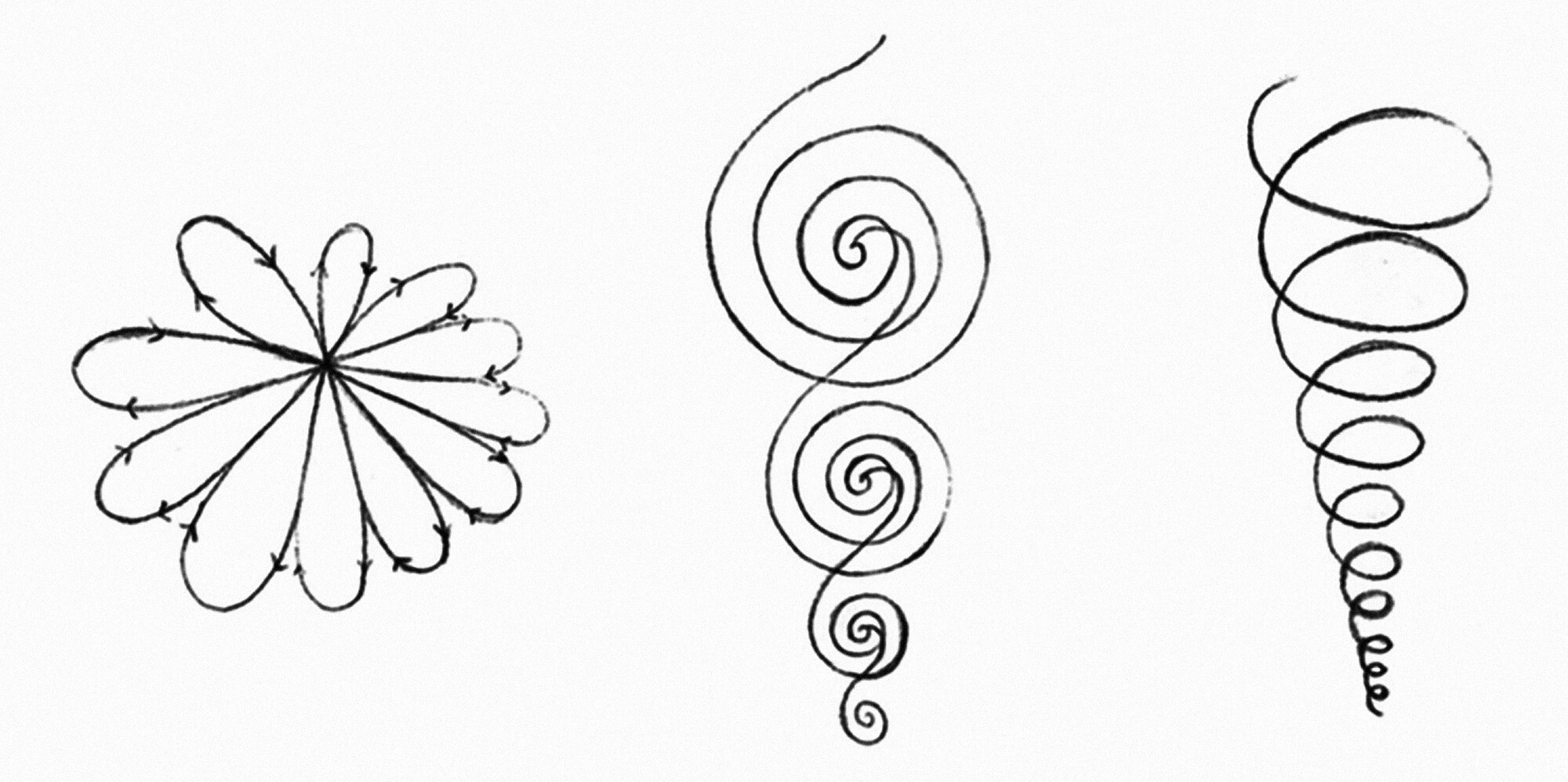
Sketchs of forms of recursion as featured in the book Recursivity and Contingency (2019). Featured in the center is Heidegger’s diagram on Schelling.
In his latest book, Recursivity and Contingency (2019), the Hong Kong philosopher Yuk Hui argues that recursivity is not merely mechanical repetition. He is interested in “irregularity deviating from rules.” He develops what could be called a neovitalist position, which goes beyond the view, dominant in popular culture today, that there is life inside the robot (or soon will be). In the “organology” Hui proposes, a system mimics growth and variation inside its own technical realm. “Recursivity is characterised,” he writes, “by the looping movement of returning to itself in order to determine itself, while every movement is open to contingency, which in turn determines its singularity.”1
Following On the Existence of Digital Objects (2016) and The Question Concerning Technology in China: An Essay in Cosmotechnics (2017), Recursivity and Contingency is Yuk Hui’s third and by far most ambitious book. Divided into five chapters that deal with different eras and thinkers, it starts with Kant’s reflective judgement, which Hui sees as a precursor to recursivity. The book then moves on to Hegel’s reflective logic, which anticipates cybernetics. According to Hui’s organology (and that of Bernard Stiegler), science and technology should be understood as means for returning to life, as paths towards true pluralism, or “multiple cosmotechnics,” to use Hui’s own key concept from his earlier book.
Our understanding of computational possibilities should not be limited to the “disruptive” technologies of Silicon Valley, oriented as they are towards short-term profits. Hui looks beyond this myopic view of technology. His foundational project is to dig into the philosophical foundations of today’s digitality, to examine the episteme that presents itself as a new form of totality (or as a “techno-subconsciousness,” as I have described it elsewhere). How can we think individuation in an age when the online self is surrounded by artificial stupidity and algorithmic exclusion in the name of ruthless profit maximization and state control? Is there a liberated self inside cybernetics?
—Geert Lovink
Geert Lovink: Could you introduce the terms “recursivity” and “contingency”? How do these two terms relate to feedback, which is a central concept in cybernetics? Is it possible to sketch out potential cybernetic technologies that are not based on the principles of the current information revolution?
Yuk Hui: Recursivity is a general term for looping. This is not mere repetition, but rather more like a spiral, where every loop is different as the process moves generally towards an end, whether a closed one or an open one. As a computer science student, I was fascinated by recursion because it is the true spirit of automation: with a few lines of recursive code you can solve a complicated problem that might demand much more code if you tried to solve it in a linear way.
The notion of recursivity represents an epistemological break from the mechanistic worldview that dominated the seventeenth and eighteenth centuries, especially Cartesian mechanism. The most well-known treatise on this break is Immanuel Kant’s 1790 Critique of Judgment, which proposes a reflective judgment whose mode of operation is anti-Cartesian, nonlinear, and self-legitimate (i.e., it derives universal rules from the particular instead of being determined by a priori universal laws). Reflective judgment is central to Kant’s understanding of both beauty and nature, which is why the two parts of his book are dedicated to aesthetic judgment and teleological judgment. Departing from Kant, and with a generalized concept of recursivity, I try to analyze the emergence of two lines of thought related to the concept of the organic in the twentieth century: organicism and organology. The former opens towards a philosophy of biology and the latter a philosophy of life. In the book, I attempt to recontextualize organicism and organology within today’s technical reality.
Contingency is central to recursivity. In the mechanical mode of operation, which is built on linear causation, a contingent event may lead to the collapse of the system. For example, machinery may malfunction and cause an industrial catastrophe. But in the recursive mode of operation, contingency is necessary since it enriches the system and allows it to develop. A living organism can absorb contingency and render it valuable. So can today’s machine learning.
Also-and: postrationalism, metarationalism, emergensia, intellectual light web, inter-intellect, metagame, etc.
Rough initial braindump of people & media & topics related to “The Sensemaking Web”, my favourite emerging corner of the internet.
Managed by: @gwendolynhuot (Twitter handle) / feel free to add comments, which I will add to the doc.
If anyone wants to reuse this data, go ahead!
UPDATE August 22, 2019: CAVEAT! I hear people say that “the map is not the territory” and “not even wrong.” I want to state that “a list is not even a map.” You can’t even imagine how subjective and haphazard and incomplete and misleading this list is, but I still believe it’s useful to share. I would love to see & share someone else’s “Sensemaking Web” notes.
[Headings:]
A: MEMES & TERMS & CONCEPTS
B: SENSEMAKING PODCASTS
C) WEBSITES / COMMUNITIES / ORGS:
D) PEOPLE TO FOLLOW / ON TWITTER:
D2) MORE PEOPLE (SENSEMAKING-ADJACENT)
E) BLOGS:
F) YouTube:
G) UNSORTED
H) Common Interests / Adjacencies (also see “A: MEMES):
The OODA loop was a tool developed by military strategist John Boyd to explain how individuals and organizations can win in uncertain and chaotic environments. It is an Acronym that explains the four steps of decisions making: Observe, Orient, Decide
Proof Finds That All Change Is a Mix of Order and Randomness
All descriptions of change are a unique blend of chance and determinism, according to the sweeping mathematical proof of the “weak Pinsker conjecture.”
That is the nature of one of the most sweeping results in mathematics in recent years. It’s a proof by Tim Austin, a mathematician at the University of California, Los Angeles. Instead of flowers, Austin’s work has to do with some of the most-studied objects in mathematics: the mathematical descriptions of change.
These descriptions, known as dynamical systems, apply to everything from the motion of the planets to fluctuations of the stock market. Wherever dynamical systems occur, mathematicians want to understand basic facts about them. And one of the most basic facts of all is whether dynamical systems, no matter how complex, can be broken up into random and deterministic elements.
This question is the subject of the “weak Pinsker conjecture,” which was first posed in the 1970s. Austin’s proof of the conjecture provides an elegantly intuitive lens through which to think about all manner of bewildering phenomena. He showed that at their heart, each of these dynamical systems is its own blend of chance and determinism.
Fate and Chance
A dynamical system starts with some input, like the position of a pendulum right now, applies some rules, like Newton’s laws of motion, and produces some output, like the pendulum’s position a second later. Importantly, dynamical systems allow you to repeat this process: You can take the pendulum’s new position, apply the same rules, and get its position another second later.
Dynamical systems also arise in purely mathematical form. You could choose a starting number, apply a rule that says “multiply your number by 2,” and output a new number. This system also allows you to feed the resulting number back into the rule to produce more values.
Certain types of dynamical systems have the property that they can be expressed as a combination of two simpler dynamical systems. The two systems operate independently of one another but can be merged to form the more complex system. To take an example, imagine a dynamical system that moves a point around on the surface of a cylinder: You input one point, apply the rules, and get out another point.
This system can be decomposed into two simpler systems. The first is a dynamical system that moves a point around on a circle. The second is a system that moves a point up and down along a vertical line. By combining the two — the movement around the circle with the movement up and down the line — you get the more complicated movement of a point on a cylinder.
Lucy Reading-Ikkanda/Quanta Magazine
“Rather than study the whole dynamical system, you want to break it into parts, the smallest parts that make sense to study,” said Kathryn Lindsey, a mathematician at Boston College.
There are two natural candidates for what these building blocks might be. The first are dynamical systems that are completely deterministic, like our example of the pendulum. If you know the position of the pendulum at one moment in time, you can predict its position indefinitely far into the future.
The second type of dynamical system is one that is completely random. For example, imagine a dynamical system with the following rule: Flip a coin. If it lands heads, walk to the left; if tails, walk to the right. The resulting path would be completely random, meaning that even if you know everything about the path up to a certain point, that information will do nothing to help you predict the next step.
While some dynamical systems are purely random, and others are completely deterministic, most fall somewhere in between — they’re blends of both. For example, imagine a twist on our random walk. This time, you’re on a flower-lined path where the colors of the flowers are themselves random. Our rule is the same: Coin flip comes up heads, move to the left; tails, move right. What is the sequence of colors of flowers that you visit?
At first you might think that it’s random. After all, the colors themselves have been assigned at random, and your motion is random. But once you have visited one color of flower, the odds are higher that you’ll visit that same flower again in the future, just by virtue of being close to it. The sequence of colors will not itself be purely random.
“If you’re at red right now, then that amplifies the chance you’ll see red two steps from now, because it could happen that you’ll go left and then right and end up back at the same place,” said Austin.
This “random walk in random scenery” system generates an output — a sequence of colors — that is partly random and partly not. In 1960 the mathematician Mark Pinsker conjectured that a certain large class of dynamical systems* have this feature: They’re each a mix of a random dynamical system mixed with a deterministic one.
“If the [original Pinsker conjecture] had been true, it would have been an amazing description of the world,” said Assaf Naor, a mathematician at Princeton University. Yet Pinsker was wrong. In 1973 Donald Ornstein proved Pinsker’s conjecture false. “It was an overly ambitious formulation,” said Bryna Kra, a mathematician at Northwestern University.
It often happens in math that after a sweeping conjecture is proven false, mathematicians attempt a more modest version of the statement. In 1977 mathematician Jean-Paul Thouvenot proposed the weak Pinsker conjecture. He softened the original formulation, conjecturing that the dynamical systems Pinsker had in mind are the product of a completely random system combined with a system that is almost completely deterministic.
The introduction of the qualifier “almost” distinguished Thouvenot’s conjecture from Pinsker’s. By it, he meant that the simple deterministic system needed to have at least a trace of randomness in it. That trace could be vanishingly small, but it needed to be there. And as long as it was, Thouvenot asserted, Pinsker’s vision would hold.
“It was close to the initial conjecture, and Thouvenot showed if it were true, it had a whole list of beautiful applications,” said Naor.
In the following decades, mathematicians made little progress on a proof of the weak Pinsker conjecture. The lack of traction started to make Thouvenot think that even his scaled-down formulation was going to turn out to be wrong. “At one point I thought it would go the opposite, it would not be universal,” he said.
Then Tim Austin came along.
A Stepwise Solution
Proving the weak Pinsker conjecture required finding a precise way to run a dynamical system through a kind of sieve — something that would separate its random and almost-deterministic elements. Previous work on the problem had established that the small random elements were the hardest to isolate.
“The small [random] factors are much harder to capture, and this is the heart of the proof, to find a way to capture the small [random] structure,” said Thouvenot.
Austin managed to understand the small, random elements in a dynamical system through a shift in perspective. Dynamical systems operate on continuous space, like a point moving over the surface of a cylinder or a pendulum swinging through space. Within these spaces, points move in continuous arcs according to the rules of the dynamical systems that govern them. These dynamical systems also continue for infinitely many steps — you can let them run forever.
But in his proof, Austin left smooth, continuous space behind and forgot about dynamical systems running forever. Instead he started to analyze what happens when you let them run for a discrete amount of time, like 1 million steps. In this, he was executing a method envisioned by Thouvenot.
“Thouvenot’s big contribution was that he figured out that if you can do the right kind of math with long finite strings” you can prove properties of the dynamical system, said Austin. “My contribution was to come in and prove the thing you need about the long finite strings.”
Austin thought about a dynamical system as outputting a sequence of 1s and 0s. If the dynamical system is the flip of a coin, it’s easy to see how to do this: Call heads 1 and tails 0. But any dynamical system can be used to generate a binary sequence, just by splitting the space in which it operates into two (not necessarily equal) parts.
Lucy Reading-Ikkanda/Quanta Magazine
With the example of a dynamical system on the cylinder, for instance, if your point lands in one part of the cylinder, you call the output of the system 1, and if it lands in the other part of the cylinder, you call the output 0.
Austin analyzed these binary sequences using a tool from information theory called “Hamming cubes.” Imagine a cube made by vertices connected by edges. Each vertex gets assigned three binary digits — 001 or 101, say. Every time you move from one vertex to another, one of those three digits will flip.
Hamming cubes can be far more complex than our simple example — involving far more edges and vertices in more than three dimensions — but they all have the property that the distance between any two vertices — that is, the number of edges that you need to traverse to get from one vertex to another — is equal to the number of places the strings of information on those two vertices differ. So 000 is one edge away from 001, two edges away from 011 and three from 111.
Lucy Reading-Ikkanda/Quanta Magazine
In order to isolate the random and deterministic elements that make up a more complicated dynamical system, Austin thought about how frequently a dynamical system produces a given sequences of 1s and 0s as represented on the Hamming cube. He proved that the sequences are distributed on the Hamming cube in a certain way. They cluster into a small number of subregions on the cube — this clustering reflects the determinism in the system — but are distributed among the sequences within those clusters in a randomlike way, which reflects the system’s randomness.
The roundabout method turned out to be a necessary path for solving a problem that had defied direct approaches.
“I was surprised not so much that [weak Pinsker] is true or false, but that one could prove it, because it seemed like a very subtle problem,” said Lewis Bowen, a mathematician at the University of Texas, Austin. “Before the proof we were largely ignorant about whether something like this could be done.”
Austin’s result imposes a basic structure on a wide range of dynamical systems. For mathematicians, who often find themselves swimming among objects that feel related even if they can’t say exactly how, the proof reveals a strict geography. They now have a guide to these dynamical systems, though exactly what discoveries the guide will yield remains open.
“Mathematicians are always interested in what the building blocks of something are,” said Lindsey. “[Austin’s proof] is a really nice result that probably will have lots of applications in pure math, but I myself don’t know what they will be.”
In a new blog post on the CECAN website, Dione Hills suggests that a knowledge of complexity and complex adaptive systems can help in understanding why some evaluations run into serious difficulties.
The blog post takes as its starting point a recently published book on ‘Evaluation Failure’ in which experienced evaluators describe 22 evaluations that went badly wrong, and what learning they took away from these. The choice of evaluation design, in itself, was rarely seen to be the primary cause of difficulties. In most cases, there were dynamics at play in the policies or programmes under evaluation which got in the way of, and sometimes totally prevented, an effective evaluation to be undertaken.
The evaluators often felt blamed themselves – and their lack of experience – for these evaluations being unsuccessful, describing their failure to spot and address ‘red flags’ at an early stage, or in some cases, not ‘calling time’ on an evaluation that was clearly going no-where. But an alternative view is to see these dynamics as having provided insight into – and data about – the policies and programmes themselves, particularly if interpreted through a ‘complexity lens’. Drawing on insights from complexity science, several of the dynamics described in the book can be understood in terms of key characteristics of complex dynamic systems. Inherently unpredictable, such systems are very vulnerable to changes in their wider context, often riven with tension and lack of agreement between different stakeholder groups involved, with individuals or groups in key ‘gatekeeping’ roles sometimes failing to allow the evaluator access to data, or rejecting well-evidenced findings.
Understanding all of this in complexity terms does not, of course, not guarantee that the difficulties can be overcome. However, taking this view of evaluation failure does highlight the importance of evaluators having ‘soft skills’ in being able to ‘read’ organisational dynamics, manage conflict and communicate clearly, as well as having ‘hard’ technical skills in evaluation design and research methods. Opportunities to learn these skills are sadly lacking in the evaluation field, and it hoped that the Tavistock Institute can address this gap soon, in developing new courses for evaluators drawing on Tavistock based understanding of group and organisational behaviour
This topic will also be explored in Dione’s keynote speech at the upcoming Norwegian Evaluation Conference next month (Sept 19-20th).

 A System Leader’s Fieldbook














 Is th
Is th


 Systems Community of Inquiry