
Source: Complex Systems Leadership Program – WICKED LAB
|
|||||||||||||||||
|
|||||||||||||||||
|
Source: Complex Systems Leadership Program – WICKED LAB
|
|||||||||||||||||
|
|||||||||||||||||
|
Some people begin their organisation with a clear vision, a solid purpose, and a business plan that shows their unique value proposition. We did not do this. Instead, about a decade ago, we three (and soon four) friends created a website based around our implicit values: friendship, curiosity, development, and generosity. We figured now the hard work of creating our firm was over (once we had a website, what more could we need?). Now we could turn to finding and supporting our clients. That was about a decade ago, and while we have grown our ideas and our practices along with our client work, we have also grown our firm itself. And along the way, we have tried to create a new sort of consulting firm, one founded on these values and enacted in a different way. We oriented around questions and not answers. We created a financial model that didn’t return money to anyone based on the work of anyone else. We were deliberately developmental before that was a common term, and we talked about our growing edges with each other and swam in a sea of feedback from one another.
Then we grew.
…
Continues in source: https://www.linkedin.com/pulse/cultivating-our-leadership-being-ledand-misledby-garvey-berger/
I’m *finally* announcing the launch of TWO podcasts in 2020 –
Transduction: the systems, complexity, and cybernetics podcast
and
Joy and work: the (public) service transformation podcast, leading transformation
who *must* I have as a guest?
Let me have names – and email addresses – please – or email me at benjamin.taylor@redquadrant.com
Or people can go direct:
STEP ONE – scheduling – book a slot here
https://doodle.com/meetme/qc/3CgY7BXefq
STEP TWO – do a short survey as appropriate:
Transduction: the systems, complexity, and cybernetics podcast
https://www.surveymonkey.co.uk/r/transduction
Joy and work: the (public) service transformation podcast, leading transformation
https://www.surveymonkey.co.uk/r/joyandwork

Social ecology and environmental psychology described @dstokols@Social_Ecology , interviewed by @katiepatrick . References #WilliamsJames on attention. Book on Social Ecology in the Digital Age released in 2018.
[01:02 Katie Patrick] Can you explain what social ecology is, and also what environmental psychology is, and how they’re different and how they fit together.
[01:11 Dan Stokols] Well, social ecology grew out of the field of ecology which started in biology back in the 1800s and it’s basically looking at the interrelationships between organisms and their environments — their living environments, other species as well as abiotic features of the environment, climate topography, and that kind of thing.
[01:29]And those biological principles were applied to human communities in the early 1900’s. And that field became known as human ecology. But it was almost a literal translation of Darwinian assumptions about how different kinds of organisms adapt to their environments, only applied…
View original post 547 more words
The English language insists that there are things, objects, creatures, all sorts of discrete stuff. This is what we teach our children…
Often relationships are the reality that creates what we take to be real. This goes so much against what we have been brought up to see…
Call for Nominations: Editor-in-Chief for IEEE Transactions on Cybernetics Nomination Deadline: 10 December 2019 Please submit nominations to: Enrique Herrera-Viedma, SMCS Vice President-Publications, via email to viedma@decsai.ugr.es.
Excellent barn-busting romp from ‘ComplexWales’ –
Tinkering with Thinkering
Stop! Just stop it! Now, right now! You know who you all are. I’ve just about had e-bloody-nough of you lot and your Tinkering with Thinkering.
Design Thinking, Leadership Thinking, Coproduction Thinking, Nudge Thinking, Anthropocene Thinking, Humanistic Thinking, Innovation Thinking, Lean Thinking, Complexity Thinking, Ergonomic Thinking, Behavioural Thinking, Creative Thinking, Positive Thinking, Safety Thinking, bloody Systems Thinking and all the other similarly pointless linguistic redundancies.
I’m going to start with Systems Thinking. That phrase has caused all kinds of bother, having been used over the years to mean all sorts of things: from a bit of Pot Noodle Project Management (just add water) to achieving some sort of Quantum Transcendence (a near-Buddha orbit). Arguably invented by the early Cyberneticians, the phrase in terms of its contemporary lexicon should be synonymous with Russ Ackoff, but similar phrases have been attributed to all kinds of clever bods over the years. Ironically in talking about systems, they were typically hidden away in the depths of their silos of physics, engineering, mathematics, biology, psychology, computation and philosophy going all the way back to a couple of ancient oriental geezers. I could write this solely in Lao Tzu memes, but way down at the other end of the thinking scale, let’s get something clear before we start. Peter Senge did not invent Systems Thinking and his bastardisation into all those rules and shared vision claptrap, has caused decades of painful top down abuse. Even if that’s not what he meant, that’s what has happened and if I could go back in time just for a moment, I’d ignore the genocidal despots and take out Senge. It’s that bad.
First of all of course, there were systems, lots of them in one form or another, then a few people noticed them and started thinking about how those systems actually worked. Then someone started thinking about people who were thinking about systems, who in turn thought about how people thinking about thinking about systems, were thinking and so on and so forth in an ever decreasing circle of navel gazing, in the pretentious pursuit of profundity. In reality that sort of thinking should be called metaphysics which albeit unfashionable, is one of the myriad ways of thinking systematically, that is Philosophy. Systems Thinking is not simply thinking systematically, as you can do that and legitimately invent all kinds of nonsense that has nothing to do with how the Universe actually works. And boy have we got some of that claptrap in close proximity to the word System: mostly spiralling around some happyclappy who has drawn their 5/7/9/12 point list of equivocal platitudes into a shape that they peddle furiously.
And on that note Systems Thinking is always peddled as something positive. Now, getting momentarily scientific, there are such things as closed systems. Ordered, teleological, designed, mechanical and controlled and there are concepts, methods and tools that are perfectly applicable in these sorts of spaces. Reliability, Lean and Six Sigma (Lean on speed) to name but a few, that are often collectively referred to within Systems Thinking. There are also such things as open systems. Complex, adaptive, emergent, alive and dynamic and there are very different concepts, methods and tools that are applicable in these sorts of spaces. Nonlinearity, storytelling and sense-making and these are also referred to within Systems Thinking. All systems are nested, I know, but trying to apply closed system methods in an open system, causes most of the organisational disasters that we are currently confronting.
The universe is made of systems, or at least that’s how humans – on average 1.9 arms + 1.9 legs + 1.0 thinking appendage – have come to know a bit about the universe, by studying its myriad systems. Traditionally this has been reductively; studying systems by breaking them down into their bits. Over the past 70 years however we’ve also tried to study systems holistically; by making sense of their cumulative effects. Go on define system, I dare you. Well, before you try, don’t get all het up as the best brains in the world so far, pretty much agree that there is no single definition of a system. There are some reliable characteristics and if you got two out of three, you’re probably right:
A system has bits that affect each other directly, indirectly and occasionally both and neither.
A system has at least one effect that is not present in any of its bits.
A system has a boundary that is typically where you place its proper noun, beyond which the affect and effect of its bits, are manifest.
In reality there is no such thing as Systems Thinking, it’s little more than a catchy phrase nailed to the back of a 70 year old bulging bandwagon.Continues on link below…
Stop! Just stop it! Now, right now! You know who you all are. I’ve just about had e-bloody-nough of you lot and your Tinkering with Thinkering.
Design Thinking, Leadership Thinking, Coproduction Thinking, Nudge Thinking, Anthropocene Thinking, Humanistic Thinking, Innovation Thinking, Lean Thinking, Complexity Thinking, Ergonomic Thinking, Behavioural Thinking, Creative Thinking, Positive Thinking, Safety Thinking, bloody Systems Thinking and all the other similarly pointless linguistic redundancies.
I’m going to start with Systems Thinking. That phrase has caused all kinds of bother, having been used over the years to mean all sorts of things: from a bit of Pot Noodle Project Management (just add water) to achieving some sort of Quantum Transcendence (a near-Buddha orbit). Arguably invented by the early Cyberneticians, the phrase in terms of its contemporary lexicon should be synonymous with Russ Ackoff, but similar phrases have been attributed to all kinds of clever bods over the years. Ironically in…
View original post 2,423 more words
Excellent cybernetic thinking from Sonja Blignaut, as usual.
Source: Reconceptualising organisations: from complicated machines to flowing streams.

I’ve often wondered about the seeming detour my life took when I chose to study meteorology. Looking at the work I do now, something like industrial psychology or business sciences seems more appropriate. Recently though, a new penny has dropped: weather systems are flow systems. As I’ve come to see flow as one of the primary lenses to use to understand and structure a system, I’ve realised that studying the dynamics of weather (and other natural) systems were, in a way, the perfect preparation for the emerging trajectory of my work.
Over the last few years, I have come to realise that the interplay between flow, constraints and options is key to understanding how to navigate and thrive in complexity. With “flow”, I mean flow in the broadest sense of the word. There are some flows that we are very familiar with: workflow, process flow, cash flow, data flow, information flow … however, we need to broaden our thinking.
In machines, there is a specific ‘inflow’ and a specific ‘outflow’. In organisms, everything flows. (Nicolson, 2018)
Too often we still view organisations through a mechanistic lens and this impacts on the flows we pay attention to. If we see them instead as living systems, organisms or ecosystems, it soon becomes clear that flow is central to every aspect of the organisation.
Whatever else they may be, living systems are highly stabilised flows of energy and matter. Machines may take part in various processes, but organisms are themselves processes. (Nicolson, 2018)
If we look at organisations not as machines, but as living entities — ecosystems or organisms, we have to look at them as flow systems. Flow, therefore, becomes a beneficial lens to help us think about new ways of working, new organisational structures and new forms of management.
continues in source: Reconceptualising organisations: from complicated machines to flowing streams.
Hayek and The Sensory Order, 1920
See tweet below
Pask – The meaning of cybernetics in the behavioural sciences, 1970
Click to access pask%20meaning%20of%20cybernetics%20in%20behavioural%20sciences.pdf
Parallel Distributed Processing, 1987
See tweet and links below.
The Pigeon in the Machine. The Concept of Control in Behaviorism and Cybernetics, An Teixeira Pinto, 2015
Another tweet stream from David Chapman which touches powerfully on cybernetics – maybe… Hayek was a cybernetician? (Though, of course, my attention has been drawn before to Hayek’s 1974 speech – https://stream.syscoi.com/2019/09/23/econpapers-the-pretence-of-knowledge-hayeks-nobel-prize-lecture-1974/ and https://stream.syscoi.com/2019/10/28/the-anti-socialist-origins-of-big-data-the-nation-greg-grandin/ – which could be seen as a riposte to Beer and Cybernsyn –
I’m going to leave all this here because I know it is connected, but I do have a life to lead!
Parallel Distributed Processing, of which David began the tweet stream saying “The founding text of the 1980s version of “neural” network nonsense was titled Parallel Distributed Processing. Its important central idea was forgotten because people latched onto the easy-to-understand error backpropagation algorithm instead.”, looks like it’s all available online at stanford.edu/~jlmcc/papers/ (just increment the chapter number)
Also worthy of interrogation…
Source: The Tragedy of “The Tragedy of the Commons” – Scientific American Blog Network
The man who wrote one of environmentalism’s most-cited essays was a racist, eugenicist, nativist and Islamaphobe—plus his argument was wrong

Fifty years ago, University of California professor Garrett Hardin penned an influential essay in the journal Science. Hardin saw all humans as selfish herders: we worry that our neighbors’ cattle will graze the best grass. So, we send more of our cows out to consume that grass first. We take it first, before someone else steals our share. This creates a vicious cycle of environmental degradation that Hardin described as the “tragedy of the commons.”
continues in source: The Tragedy of “The Tragedy of the Commons” – Scientific American Blog Network
A really interesting piece, the argument of which is that by developing cybernetics and building feedback systems, we came to understand ourselves, the world, and our place in the world differently. Worthy of interrogation…
Source: Reworlding: The Art of Living Systems – Experiental Space Research Lab – Medium

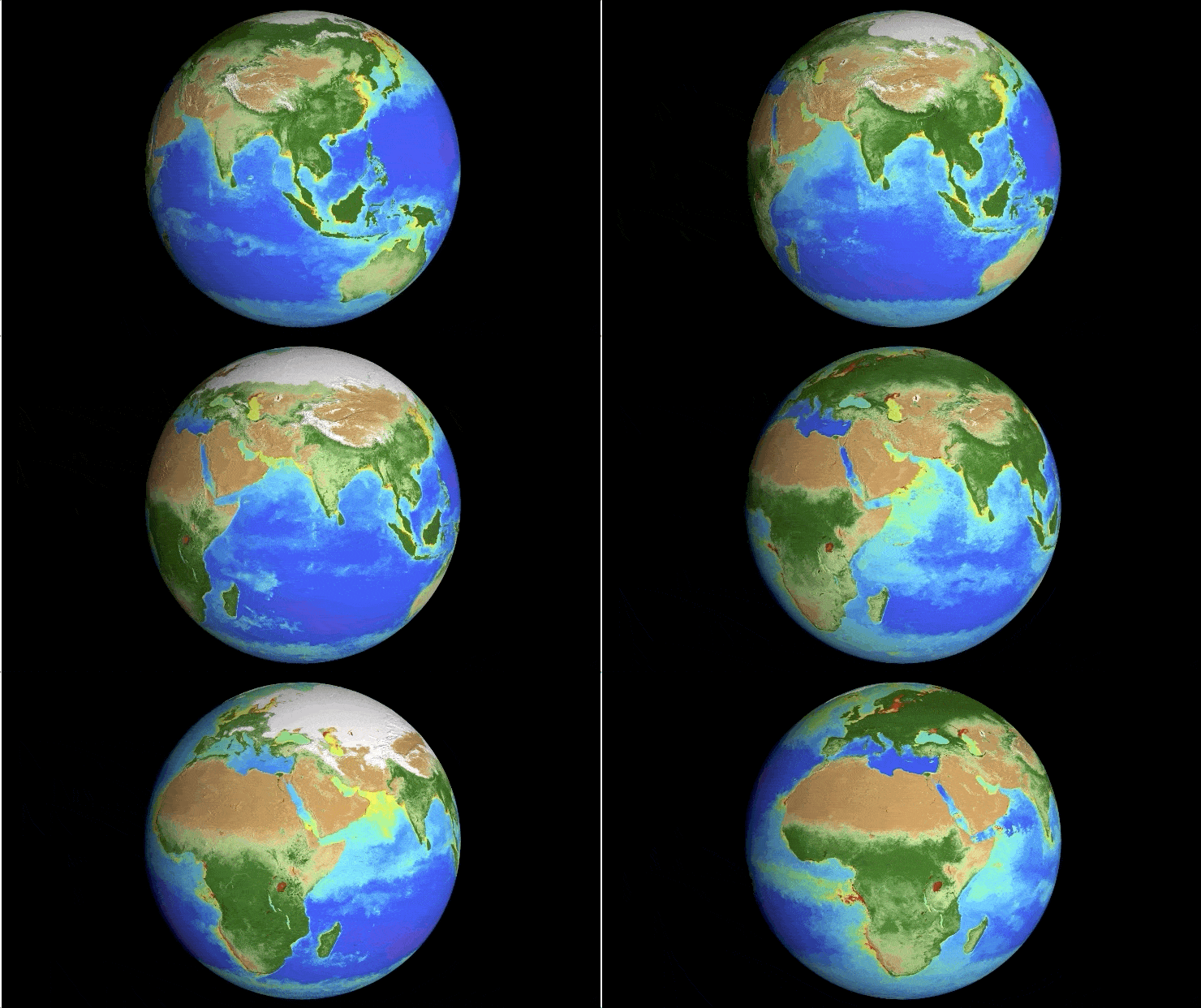
As our ecologic crisis deepens, art can provide the unique insights necessary to light our path forward. This Fall, the artists in Gray Area’s Experiential Space Research Lab have been exploring this potential of immersive art as a tool for understanding. Our call for participation, Reworlding: The Art of Living Systems, invited artists with diverse backgrounds to develop novel experiences for thinking like a living planet. Since the first meeting in August, the artists have been developing an immersive exhibition to reveal intimate entanglements amongst Earth’s living forms — and how to make the planetary personal.
With the support of the Knight Foundation, Gray Area has been collaborating with Gaian Systems, a collaboration between the design studio Spherical and literature and science scholar Bruce Clarke, the 2018–2019 Blumberg/NASA Chair in Astrobiology at the Library of Congress. This post introduces the broader context of these explorations in Earth Systems Science for the Research Lab.
The most unexpected discovery of the Space Age is that Earth is alive. Far from being a cosmic backwater or a passive vessel for random organisms, it is the matrix and dynamic extension of all life as we know it. Over several billion years, living systems have transformed and regulated Earth’s planetary environment. From oxygenating the global atmosphere to lubricating the tectonic plates to myceliating the soils, living systems have bent the planet to their own needs. Now, under the influence of human technologies, this reshaping continues at a rapidly accelerated pace.
continues in source: Reworlding: The Art of Living Systems – Experiental Space Research Lab – Medium
The Role of Hierarchy in Self-Organizing Systems
A Note on the Hierarchy-Team Debate
Organizational Learning, Circularity and Double-Linking
Circular organizing and triple loop learning
Domination, Self-Determination and Circular Organizing
Climbing up and down the hierarchy of accountability: Implications for organization design
try to look beyond the eye-bleedingly annoying website design and the apparently-obligatory ‘everything is changing, digitalization and VUCA’ ‘imperative’ – in fact, I recommend you download the pdf and skip straight to chapter 2 – this ‘platform, project swam, and plexus’ model looks like a really interesting instantiation of the Viable Systems Model
Source: studie_68_nextgencorp_en / Sternstewart
We do not just want to keep up, we want to win. Win against the established competition and against start-ups and the Valley. We want to increase decision speed. Silo thinking and traditional hierarchies drive us crazy. Cost-efficiency remains on the agenda and we consistently apply new, digital technologies. We have to get employees convinced and offer them new development paths. The megatrend digitalization and our VUCA world demand a fundamental rethinking of the organization of a company.
But how to do it? We should begin to transform our entire company into a Next Generation Corporation (NextGenCorp). This is an organization consisting of a platform, project swarm and a radically new plexus. We believe both together are possible: flexibility and entrepreneurial freedom while at the same time realizing best practices and scaling economies.
We first separate the platform and the project swarm and then align both towards a common goal in the entrepreneurial plexus. We organize the platform by processes and digitalize it proactively. We eliminate bureaucracy and hierarchies through a swarm of projects. We give the entrepreneurs in the company the freedom to use the platform and mandate the swarm. We believe in a revolutionary and holistic target picture and a flexible roadmap for implementation.
Stern Stewart & Co. is the independent strategy boutique. With a truly entrepreneurial team of independent thinking personalities.
The center of gravity of an open universe of cutting edge know-how. Advising clients in strategy, transaction, performance and
transformation.
A timeline showing significant Cybernetic animals and events, the dates being the creation or announcement of the cybernetic models.
[There’s significant confusion between ‘cybernetics’ the set of thinking and theories and insights, all around purposeful or goal-seeking activity in complexity, and robotics – and that is because they came from the same roots. This collection of robots or ‘cybernetic creatures’ covers the range from slightly gimmicky to deeply fascinating (and demonstrates swarming and ‘collective sensemaking’ behaviour long before swarms and boids), but they all use feedback loops to make sense of an unknown, unknowable, and irreducibly complex world in pursuit of a goal – and of course, in so doing, demonstrate the cybernetic roots of agent-based modelling. Of course, everything is so deeply intertwingled that this ought no longer to be surprising to me. I just bought and read RM Currie’s classic ‘work study’ from 1960, the historical section of which draws links (and divergences) between Robert Owen, Perronet, Babbage, FW Taylor, Adam Smith, , the Gilbreths, Bedaux, Cripps, TWI, and thereby between work study, the invention of computing, the human potential movement, capitalism, lean, and this stuff…]


 Systems Community of Inquiry
You must be logged in to post a comment.