Philosophy of alternative stable states: teleonomy meets teleology – Systems Changes – Open Learning Commons – David Ing


via Philosophy of alternative stable states: teleonomy meets teleology – Systems Changes – Open Learning Commons

Apr 29, Apr 30

Underlying many of the approaches to “systems change” is teleology – “a reason or explanation for something as a function of its end, purpose, or goal”. Moving beyond social systems into other domains (e.g. biology, ecology) raises questions about whether nature has an end or purpose.

An alternative philosophy is based on teleonomy – “the quality of apparent purposefulness and of goal-directedness of structures and functions in living organisms”. This came up in a recent meeting. I then had some online communications with @Zemina .

The philosophy of science that I’ve taken on is not teleology – goal-directed behavior – but teleonomy https://en.wikipedia.org/wiki/Teleonomy – that essentially means that you don’t work from the future-backwards, but that you are able to program options for your future.

See more in source.

via Philosophy of alternative stable states: teleonomy meets teleology – Systems Changes – Open Learning Commons

I note with interest that in David’s Open Innovation Learning book (a section of the post signposts to a section of this for more), he points to Aristotle’s four causes:

Aristotle offered four explanations of why in four causes:

(i) material cause (that out of which)

(ii) the formal cause (the account of what it-is-to-be)

(iii) the efficient cause (the primary source of change or rest)

(iv) the final cause (the end, that for the sake of which a thing is done

This is pretty powerful stuff to play around with, and reminds me of my distinction, for organisations, between

(1) espoused purpose – the mission statement

(2) de facto purpose or POSIWID – the actual behaviour and outcomes which the organisation is producing (see forthcoming podcast interview with Allenna Leonard for more on this) an

(3) deep, meaningful purpose – the empowering purpose to which the organisation could aspire (usually neither of the above)


Video – Allenna Leonard | “Stafford Beer’s Fifty Years of Applied Epistemology Or, what else besides the VSM?” | Hull University Centre for Systems Studies | November 17, 2015

via 20151017-AllennaLeonard – YouTube


Timothy F. H. Allen – Hierarchy Theory and ecology (and more)

This is pretty much curated by David Ing (thanks as always David).

A lovely nine-minute, three-question video:


slightly longer:

David’s summary of that piece:

https://stream.syscoi.com/2018/07/30/the-power-of-profit-in-ecology-timothy-f-h-allen-2017-tedxmadison/

Wikipedia: Timothy F. H. Allen – Wikipedia

Profile piece on his retirement: https://badgerherald.com/news/2010/01/27/professor-timothy-al/

And David’s pic of him at the American Cybernetics Association:


Tenth International Conference on Complex Systems — ICCS 2020 will be an online event.

cxdig's avatarComplexity Digest

Due to the ongoing COVID-19 outbreak, the Executive Committee has made the decision to move ICCS 2020 to an online-only event.

While the outlook for the unprecedented challenges we are facing from COVID-19 remain uncertain, our values are clearer than ever. The health and safety of our communities—academic, local, and business—are of the utmost priority. Further, we know as complex systems scientists that we must play our part by endeavoring to fragment our physical contact networks, yet strengthen our virtual social networks. We also remain committed to the pursuit of creating and sharing knowledge, and wish to honor our promise to provide a rich forum in which to do this. It is with these tenets in mind that we made the decision to make ICCS 2020 a 100% online-only event.

What you need to know:

  • The dates remain the same: July 26th – July 31st 2020

  • Registration has reopened, but…

View original post 108 more words

Register Now: Open Studio April 30, 2020 – Literature Connects, with Linda Booth Sweeney, via the Waters Centre for Systems Thinking

On twitter, Linda Booth Sweeney says:

Looking for activities to promote #wholesystemslearning at home? Join me April 30 9 am PDT for a fun @WatersCenterST OpenStudios session. Registration here: mailchi.mp/9c44e0fee332/i

links: Register Now: Open Studio April 30, Literature Connects 

Register today for the April 30th Open Studio! More information on this session can be found below. We are excited to announce that Linda Booth Sweeney, systems educator and award-winning author, will be joining us live in the 9 a.m. PDT session. We will make her interview available via recording in the 12 p.m. and 4 p.m. PDT sessions.

We can’t wait to see you in the Open Studio!

Register Now!

Open Studio: Literature Connects – Registration Open. Click here. 

Thursday, April 30

9 a.m. PDT
12 p.m. PDT
4 p.m. PDT
.

A helpful time converter can be found here. 


Session Description: 

There is no end to the connections that can be made between literature and systems thinking. This Open Studio will highlight a variety of books and the meaningful connections that can be made within and between the text and systems thinking Habits and tools. This session will feature some special guests sharing their favorite books and best systems thinking connections.


Please note, we will not be releasing the recording of this session, so if you are interested, be sure you attend! More information on the Open Studio and other upcoming sessions can be found below. 

The days after – a learning community to build back better

Excuse me for putting a business link here (I do it rarely) – but this is a community, principally focused on UK public services, and communities, voluntary sector – all of those with a primary focus on citizen and community outcomes) – to learn the lessons and build back better. We will be introducing systems concepts, and learning systems lessons, on an ongoing basis.

The days after – a learning community to build back better

-> We’ve been dynamic to deal with the crisis – amazing things have been achieved.
— How do we learn from these breakthroughs?
-> Things are still chaotic and confusing! And will be for some time as the ramifications continue.
— How do we make sense of things right now and for the future?
How do we prepare for a real reboot in ‘the days after’ the crisis?

We at the Public Service Transformation Academy have been working with some core organisations to start to think about these questions – and are now expanding to set up a wider learning community. There is no obligation and no charge. This is a place to share and build learning together.

Membership is open to anyone from any organisation with a primary focus on citizen and community outcomes – public services at any level, community and voluntary sector organisations, and others who deliver vital public services. The focus will be on the UK; those from other countries are welcome to join to share learning.
To join, email benjamin.taylor@publicservicetransformation.org

The group will meet fortnightly online, 2-3.30pm on Wednesdays.

The first virtual round table will take place on 13 May: what will we face in ‘the days after’?
An active online scenario planning session – and a look at the ‘three horizons’ model for future thinking.

The second virtual round table will take place on 27 May: how can we do radical rebuilding?
This will look at application of the ‘five worlds’ and ‘five key leadership practices’ applied not to organisations, but to creating place-based, emergent, learning systems.

Further dates to be planned. A core group will meet on the ‘off weeks’ to plan and input, and materials from each session will be shared with all participants. The community is supported with free groups on WhatsApp and groups.io

To join, email benjamin.taylor@publicservicetransformation.org

From the Public Service Transformation Academy (www.publicservicetransformation.org / www.twitter.com/servicereform) sponsored by RedQuadrant (www.redquadrant.com / www.twitter.com/redquadrant).

Topological portraits of multiscale coordination dynamics

cxdig's avatarComplexity Digest

Zhang, M., Kalies, W., Kelso, J., Tognoli, E. (2020). Topological portraits of multiscale coordination dynamics. Journal of Neuroscience Methods https://dx.doi.org/10.1016/j.jneumeth.2020.108672


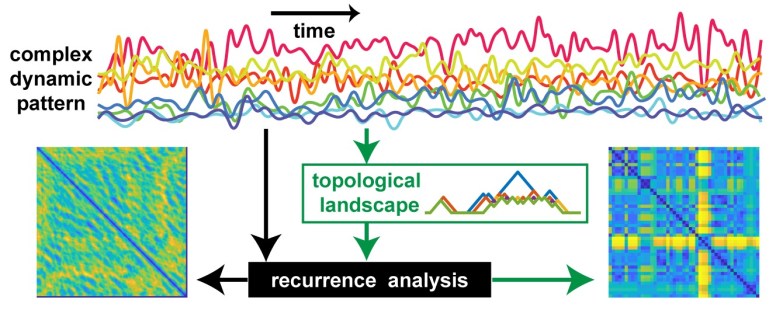
Living systems exhibit complex yet organized behavior on multiple spatiotemporal scales. To investigate the nature of multiscale coordination in living systems, one needs a meaningful and systematic way to quantify the complex dynamics, a challenge in both theoretical and empirical realms. The present work shows how integrating approaches from computational algebraic topology and dynamical systems may help us meet this challenge. In particular, we focus on the application of multiscale topological analysis to coordinated rhythmic processes. First, theoretical arguments are introduced as to why certain topological features and their scale-dependency are highly relevant to understanding complex collective dynamics. Second, we propose a method to capture such dynamically relevant topological information using persistent homology, which allows us to effectively construct a multiscale topological portrait of rhythmic coordination. Finally, the method…

View original post 122 more words

Think structurally about ‘effects’ from COVID-19

Three systemic points (but at the ‘technical’ not ‘adaptive’ level):

  1. We’ve had the earthquake, now comes the tsunami, then the aftershock waves… we shouldn’t expect the effects to be in
  2. Second and n order effects – re working from home – implications on business and real estate, and emergency preparedness and stockpiling for the future etc..
  3. And we should expect interesting oscillation via the Bullwhip effect – Wikipedia

Transformation Maps – World Economic Forum

https://www.weforum.org/strategic-intelligence

https://www.weforum.org/communities/transformation-map-co-curator-community

https://forum.frontiersin.org/stephan-mergenthaler-wef-digital-transformation-maps

Transformation Maps


via What is a Transformation Map? | World Economic Forum

The World Economic Forum’s Transformation Maps – a constantly refreshed repository of knowledge about global issues, from climate change to the future of work – are now publicly available for the first time and free of charge. But what are they? And what can we do with them?

What exactly are the Transformation Maps?

Transformation Maps are the World Economic Forum’s dynamic knowledge tool. They help users to explore and make sense of the complex and interlinked forces that are transforming economies, industries and global issues. The maps present insights written by experts along with machine-curated content. Together, this allows users to visualise and understand more than 120 topics and the connections and inter-dependencies between them, helping in turn to support more informed decision-making by leaders.

https://intelligence.weforum.org/topics/a1Gb0000000LGk6EAG?tab=publications

Strategic Intelligence
The maps harness the Forum network’s collective intelligence as well as the knowledge and insights generated through our activities, communities and events. And because the Transformation Maps are interlinked, they provide a single place for users to understand each topic from multiple perspectives. Each of the maps has a feed with the latest research and analysis drawn from leading research institutions and media outlets around the world.

As an example, imagine you are a student or government official, and you need up-to-date information about the dynamics of over-fishing. The Transformation Map on Oceans, curated with the University of California in Santa Barbara, has a dedicated “key issue” section dealing with this. The over-fishing section in turn links to a number of related maps, among them the Illicit Economy Transformation Map, curated with the Global Initiative against Transnational Organised Crime. This map notes, among other things, how criminals are profiting from natural resources, including fish, in a way that threatens global biodiversity.


https://www.weforum.org/videos/introducing-transformation-maps

Introducing Transformation Maps

Alternatively you could explore the topic of over-fishing from a governance perspective by consulting the map on Global Governance, curated with the University of Oxford, or through the lens of possible innovative solutions by exploring the Innovation map, curated by Nesta, an innovation foundation. There are thousands of other possible pathways throughout the interlinked Transformation Maps, which shift according to developments in the real world, reflecting and helping to demystify our complex planet.

Why do you cover this selection of topics?

The Transformation Maps cover issues that are relevant to the World Economic Forum and the people and organisations we work with. Broadly speaking, these are topics of global importance that require leaders from across different sectors to work together, from urbanization to inclusive economic growth. The list of topics is continuously reviewed and updated.

Who curates the Transformation Maps?

Most of the maps are co-curated by a leading university, think tank or international organization. Their content is subject to continuous peer review and adjustment by the Forum and its network of experts. Many co-curators come from institutions that are members of the Forum’s Global University Leaders Forum (GULF) community.

  • The new elite universities, refugees as a country, young global leaders of 2017
  • These 3 maps show what’s powering the world
  • Is the information revolution transforming power?
  • What do co-curators do?

    A co-curator works with the Forum to identify and explain the key trends or drivers of change for their particular topic, drawing on their expertise and the latest research in their field as well as the insights from various Forum activities and communities. They explore how the key trends affecting their subject are in turn affected by other Transformation Map topics – covering industries, countries or regions, or global issues – and in doing so, the curators create a record of the connections and inter-dependencies between the different topics. These relationships are clearly represented in the maps’ graphic representations and accompanying texts, enabling a greater understanding of the complex web of influences that surround each issue.

    Why do articles and publications appear alongside the maps?

    Each Transformation Map has a dynamic feed of the latest research and analysis drawn from leading research institutions and media outlets around the world. These feeds enable users to access the latest research on a topic by clicking on a link that will take them back to the original source. The research and analysis contained in the feeds does not necessarily represent the views, opinions or positions of the World Economic Forum.

    Business ecosystem – Wikipedia

    I thought this was only jargon – now I discover it’s a book and a thing – thought the summaries make it sound the most half-baked, half-understood concept. (I suspect that the book is quite good on description, but turning that into prescription leads to some nonsense, but that’s only on a quick glance…)

    via Business ecosystem – Wikipedia

    https://www.bcg.com/en-gb/publications/2019/do-you-need-business-ecosystem.aspx

    https://www.investopedia.com/terms/b/business-ecosystem.asp

    Seeing Like a State – James Scott

    A seminal resource, so just pulling together the links here.

    The wikipedia is quite good:
    https://en.wikipedia.org/wiki/Seeing_Like_a_State

    There are a number of good references on the old model.report (now no longer supported, so all the activity has moved here to syscoi.com): https://model.report/search?utf8=%E2%9C%93&q=%22seeing+like+a+state%22&what=all&order=relevance

    You will find lots of rich references in Aidan Ward and Philip Hellyer’s ‘Gently Serious’ Medium publication, e.g.: https://stream.syscoi.com/2019/03/01/healing-the-metabolic-rift-gentlyserious-medium/

    Relevant:
    https://stream.syscoi.com/2018/05/01/improvement-legibility-ecosystems-and-change/

    https://stream.syscoi.com/2019/11/21/the-efficiency-destroying-magic-of-tidying-up-florent-crivello/

    How do Systems Changes become natural practice? – Coevolving Innovations – David Ing

    A series of pieces on coevolving.com from January-March of this year, which I’ll be linking out one per week (but all are on David Ing’s blog already). Here is 5/5

    via How do Systems Changes become natural practice? – Coevolving Innovations

    How do Systems Changes become natural practice?

    The 1995 article by Spinosa, Flores & Dreyfus on “Disclosing New Worlds” was assigned reading preceding the fourth of four lectures for the Systemic Design course in the Master’s program in Strategic Foresight and Innovation at OCAD University.  In previous years, this topic was a detail practically undiscussed, as digging into social theory and the phenomenology following Heidegger is deep.  Peter Jonesand I are fans of ideas expanded into the 1999 book. I was privileged to visit personally with Fernando Flores in Berkeley in 2012, as I was organizing the ISSS 2012 meeting.  Contextualizing this body of work for a university course led into correlated advances in situated learning and communities of practice.

    A preface to the lecture included The Practice Turn in Contemporary Theory, and revisiting Change as Three Steps to clarify what Kurt Lewin did and did not write.

    The agenda was in four sections. In the timebox available, the lecture covered the first two:

    • A. Situated Learning + History-making
      • Legitimate Peripheral Participation + Practices (Lave, Wenger)
      • Skill Acquisition + Disclosing New Worlds (Dreyfus, Spinosa)
    • B. Commitment + Language-Action Perspective
      • Conversations for Action (Flores)
      • Deliverables, procedures, capacities, relationships

    Slides for the last two sections were ready to go, but foregone in favour of other course work priorities.

    • C. Argumentation + Pattern Language
      • IBIS (Rittel), Timeless Way of Building (Alexancer)
      • Architectural Programming c.f. Designing
    • [postscript] (Open Innovation Learning)
      • Quality-generating sequencing; Affordances wayfaring; Anticipatory appreciating
      • Innovation learning for; Innovation learning by; Innovation learning alongside

    This fourth lecture is available on Youtube as streaming web video.

    For those who prefer to watch while disconnected from the Internet, here are downloadable video files.

    Video H.264 MP4 WebM
    March 6
    (1h21m)
    [20200306_OCADU_Ing HD m4v]
    (HD 2972kbps 1.8GB)
    [20200306_OCADU_Ing nHD m4v]
    (nHD 836kps 570MB)
    [20200306_OCADU_Ing HD webm]
    (HD VP8 611kbps 454MB)
    [20200306_OCADU_Ing nHD webm]
    (nHD VP8 163kbps 182MB)

    The full slide deck is also downloadable from the Coevolving Commons.

    How do Systems Changes become natural practice?

    The presentation slides were paced at slightly different rates.

    • The March 4 full-time cohort had a discussion after section A (Situated Learning + History-making) before proceeding to section B (Commitment + Language-Action Perspective).
    • The March 6 part-time cohort went through both sections before entering into a longer discussion.

    The digital audio has versions boosted by 3db in the case playback isn’t loud enough on an audio player.

    Audio
    March 4
    (1h14m)
    [20200304_OCADU_Ing HistoryMakingCommitment .mp3]
    (68MB)
    [2020304_OCADU_Ing HistoryMakingCommitment plus3db.mp3]
    (68MB)
    March 6
    (1h21m)
    [2020306_OCADU_Ing HistoryMakingCommitment.mp3]
    (75MB)
    [20200306_OCADU_Ing HistoryMakingCommitment plus3db.mp3]
    (75MB)

    The latter two sections of slides (i.e. C, and Postscript) may be covered in some other venue, sometime.

    References

    Cummings, Stephen, Todd Bridgman, and Kenneth G Brown. 2016. “Unfreezing Change as Three Steps: Rethinking Kurt Lewin’s Legacy for Change Management.” Human Relations 69 (1): 33–60. https://doi.org/10.1177/0018726715577707.

    Spinosa, Charles, Fernando Flores, and Hubert Dreyfus. 1995. “Disclosing New Worlds: Entrepreneurship, Democratic Action, and the Cultivation of Solidarity.” Inquiry 38 (1–2): 3–63. https://doi.org/10.1080/00201749508602373.

    Spinosa, Charles, Fernando Flores, and Hubert L. Dreyfus. 1999. Disclosing New Worlds: Entrepreneurship, Democratic Action, and the Cultivation of Solidarity. MIT Press.

    Schatzki, Theodore R. 2001. “Introduction — Practice Theory.” In The Practice Turn in Contemporary Theory, edited by Theodore R. Schatzki, Karin Knorr-Cetina, and Elke von Savigny. Routledge. http://doi.org/10.4324/9780203977453.

    RSD8 2019 « Systemic Design – proceedings


    via RSD8 2019 « Systemic Design


    RSD8 2019

    Proceedings of Relating Systems Thinking and Design (RSD8) 2019 Symposium 

    Editor: Peter Jones, OCAD University
    Editorial Team: Carlos Teixeira, IIT Institute of Design, Jananda Lima, Ana Matic, Goran Matic, OCAD University

    Citation: Author. (2019). Article title. In Proceedings of Relating Systems Thinking and Design (RSD8) 2019 Symposium. IIT Institute of Design, Chicago, October 13-15, 2019.

    Published by: Systemic Design Association
    ISSN 2371-8404 

    The proceedings are published and available online as open access documents.

    Published Articles

    All articles and abstracts are copyright (c) 2019 by the respective authors, unless stated otherwise.

    Keynote & Plenaries

    • Carlos Teixeira: Design Strategy in Complex Spaces of Innovation
    • Chris Rudd: Community-Empowered Systems Change
    • Saskia Sassen: Dressed in Wall Street Suits and Algorithmic Math Assemblages of Complex Predatory Formations
    • Terry Irwin: Transition Design: Designing for Systems-Level Change and Transitions Toward More Sustainable Futures
    • Charles Bezerra: Towards the Whole—A Tribute to Charles L. Owen

    Health and Well-Being

    • Gyuchan Thomas Jun & Aneurin Canham: Systemic Analysis of a Large-Scale Organisation Failure in UK Healthcare
    • Zichao Nie, Francesco Zurlo, Elisabetta Camussi & Chiara Annovazzi: Potential Therapeutic Effects on Design for Psychological Well-being
    • Natalia Radywyl: Designing for Systems of Service in NYC Homeless Shelters
    • Cheryl Hsu & Hayley Lapalme: Hospitals as Anchor Institutions: Eco-Systemic Leadership to Nourish Patient, Community, and Planetary Health

    Flourishing Settlement Ecologies

    • Marie Davidova: Breathing Walls for Cross-Species Co-Living Adaptation in Built Environment: The Bio-Climatic Layers in Systemic Approach to Architectural Performance
    • Xue Pei, Carla Sedini & Francesco Zurlo: Co-Designing a Walkable City for the Elderly
    • Amina Pereno & Silvia Barbero: A Systemic District for Sustainable Tourism: Co-Designing Interconnected Networks for Enhancing the Natural and Cultural Heritage of Local Ecosystems
    • Palak Dudan: Unpacking Gentrification 2.0: A Systems-Oriented Design Study Uncovering Underlying Systemic Forces in the Context of Access to Housing

    Social Systems Labs & Methodology

    • Linda Blaasvær & Birger Sevaldson: The Democracy Design Compass
    • Andreas Wettre, Birger Sevaldson & Palak Dudani: Bridging Silos: A New Workshop Method for Training Silo Busting
    • Cheryl Hsu & Adrienne Pacini: Designing Systems Outcomes as Desirable Side Effects: Reflections from the CMHC Solutions Labs
    • Philippe Gauthier, Marie D. Martel, Sébastien Proulx & Johanne Broch: Towards Impact Design for Public Services: Assess Impact is to Care is to Design is to Assess Impact

    Mapping & Methodology

    • Ryan Murphy, Jennifer DeCoste & Heather Laird: Open Social Mapping: Participatory Modeling of Social Systems
    • Joanna Boehnert & Simon Mair: Mapping Productivity, Energy, and Wellbeing
    • Gordon Rowland: Developing Systemic Design Tools: The CHRIIS Model

    Organizations & Services

    • Tim Tompson & Murray Stubbs: Fractal Market Map: A Visual Tool to Understand and Shape a Business’s Most Critical Relationships
    • Juan de la Rosa, Leon Paul Hovanesian Ii & Karolina Kohler: Using Systemic Design for the Understanding and Evolving of Organizational Culture
    • Kirk Weigand & Peter Jones: Collaborative Foresight for Long-Range Problem Discovery in Complex R&D
    • Sofie Wass & Lise Amy Hansen: Inclusive Worklife Innovation – Reflections on Problem Framing and Solution Spaces Across Systems

    Conversations on Systemic Design (I & II)

    • Shanu Sharma: Modelling Stigmergy: Evolutionary Framework for System Design
    • Tore Gulden: Not-Play and Play: How Acting Cybernetically Happens in Human Play
    • Piotr Michura: Eigenforms of Time
    • Birger Sevaldson: What is Systemic Design? Practices Beyond Modeling & Analysis
    • Ben Sweeting: The Generator as a Paradigm for Systemic Design
    • Benedicte Wildhagen and Tone Bergan: Outside in: Activation and Impact through Improved Understanding

    Systems Change

    • Leah Zaidi: Using Culture for Systems Change
    • Zaid Khan & David Ing: Paying Attention to Where Attention is Placed in the Rise of System(s) Change(s)
    • Mieke van der Bijl-Brouwer, Tyler Key, et al.: Improving Well-being in Universities- a Transdisciplinary Systems Change Approach
    • Aishwarya Narvekar, Aishwarya Rane, Kamal Dahiya, Pankaj Yadav & Praveen Nahar: Design as a Tool for Reformation in the Juvenile Justice System through a Participatory Approach

    Transition to Ecological Economies

    • Ashwathy Satheesan: Designing for Second Life: Systemic Design for Sustainable Packaging in Appliance Manufacturing Industry
    • Perin Ruttonsha: Resetting the Growth Curve
    • Tom Snow: Divisions to Integrations: An Ecological and Economic Foundation Supporting Regenerative Modes of Production
    • Ahmed Ansari, Francis Carter & Sofia Bosch Gomez: Practice-led Pedagogy for Socio-Technical Transitions: A Case Study in Systems Thinking

    Systems of Governance

    • Michael Arnold Mages: Designing Difficult Community Conversations for Multiple Stakeholders
    • Heather Chaplin: Reimagining Local News to Fulfill its Democratic Function
    • Juan de La Rosa, Stan Ruecker, Claudia Grisales & Carolina Giraldo: Systemic Design for Democratic Engagement: Where the Bottom-up and Top-down Process Meet
    • Nenad Rava: Integrated Policy, Sustainable Development Goals, and New Change and Governance Models: Case Study of the UN’s Joint SDG Fund

    Workshops and Activity Groups

    Workshops

    1. Tangible Thinking: Materializing How We Imagine and Understand Systems, Experiences, and Relationships
      Dan Lockton, Lisa Brawley, Manuela Aguirre Ulloa, Matt Prindible, Laura Forlano, Karianne Rygh, John Fass, Katie Herzog & Bettina Nissen
    2. Probing the Future, Acting Today a Workshop into Learning from the Far Future and its Possible Consequences for the Present 
      Rosa de Vries, Tanja Enninga, Caroline Maessen & Remko van der Lugt
    3. Visualizing Systems: Applying Good Practices from the SystemViz Project Peter Stoyko
    4. What’s the Worst That Could Happen? Creative Visualization Tools for Ethical Foresight
      Sydney Luken, Jonathan Healey, J.R. Osborn & Evan Barba
    5. DesignShop for Systemic Transformation
      Dee Brooks, Ziyan Hossain & Leah Zaidi
    6. Designing Sustainable Futures with the Systemic Design Toolkit Kristel Van Ael, et al.
    7. Core Shifts for Emerging Desired Futures: Unpacking the Collective Unconscious
      Jananda Lima & Tieni Meninato
    8. What’s in a Name? Edge-ucating through Gameification, Exploring the Edges of Communities and Eco-systems in their Contexts
      Susu Nousala, David Ing, Marco Cataffo, Filippo Fabrocini & Thomas Marlowe
    9. Getting the Whole System into the… Map: Addressing Key Issues in Open Social Mapping
      Ryan Murphy, Jennifer DeCoste & Heather Laird

    Activity Groups

    Planning Activities for Systems and Services

    1. A Method to Include System Mapping in Strategic Planning
      Alana Boltwood & Fran Quintero Rawlings
    2. Developing Strategic Narratives: Designing Services as Systems Majid Iqbal

    Systemic Design in Social Justice

    1. Informed Empathy: Tool, Practice, System 
      Shefali Bohra, Supreetha Krishnan, Vaidehie Chiplunkar, Awanee Joshi, Swayamsiddha Priyadarshi, Praveen Nahar & Sahil Thappa
    2. Feminist Design: Methodologies for Equity and Inclusion Ali Place
    3. Creating More Human Cities: Exploring Methods for Strengthening and Sustaining Community
      Ruben Ocampo, Tim Tompson & Murray Stubbs

    Innovation Transitions

    1. Disruption, Innovation, Opportunity: The Power of Circularity within the Commercial Built Environment
      Stephanie Rebello, Rebecca Black, Jale Gonulkapan Suder & Chantal Frenette
    2. Principles-Based Designing for Transition
      Tara Campbell & Ariana Lutterman

    Exhibition: System Maps & Prototypes

    via RSD8 2019 « Systemic Design

    Textures of completion | Meaningness

    Textures of completion
    The complete stance, the way of being that recognizes the inseparability of nebulosity and pattern, shows up in characteristic textures. For example: wonder, play, and creation

    via Textures of completion | Meaningness


    And not really related but a very interesting debate (sound quality not great) on philosophy of mind – multiple references to Maturana and Varela, some tangential touching on aspects of the recent conversations around ‘mental models’

    Bringing together some recent and old threads on #systemsthinking is #complexity is #cybernetics

    Mahoo, @SystemsNinja, asked me (possibly michievously):

    Hey @antlerboy tell us why complexity thinking is systems thinking, is cybernetics? Nerd face

    Here’s my reply:

    You tryna stop me working, or what??

    I have some of this prepped, off of facebook, so here goes…

    Complexity, cybernetics, and systems thinking are an extended family recognisable by a whole set of similarities (and some controversies) which draw from the same roots and influences, and share the same governing intent – understanding.

    My ‘acid test’ is that I believe you cannot make a distinction between systems thinking and complexity which will not ‘sweep in’ to each ‘discipline’ something avowedly part of the ‘other’, and ‘sweep’ out from each something which claims it belongs.

    some of the roots are demonstrated here:
    some quotes on the theme #complexitythinking is #systemsthinking (is #cybernetics)

    Look at the Macy conferences, for a start. Look at the overlaps between the early thinkers, the shared thinking, the shared learning societies.
    The field is transdisciplinary (and indeed meta-disciplinary), so naturally it has diverse expression and form.

    So, why do people believe there is a difference? There are indeed tribes wearing each of the three badges (and some who wear more than one) – and if you squint, you can see some differences between them. But it relies on squinting – narrowing down to what you want to focus on.

    Well, there are many reasons why it suits people to say ‘my work is *this* and not *this*’ (it’s the rule of tables – if someone has a table saying ‘left side old, bad, right side new, good’ – they are trying to sell you something).

    We might call it ‘wrecking synergy to stake out territory. A nice piece on that concept is here: https://model.report/s/xacytg/wrecking_synergy_to_stake_out_territory (formatting not good as exhumed from the internet graveyard)

    A good example of that is Castellani’s ‘complexity map’, which is to me a piece of fundamentally poor scholarship for this reason https://stream.syscoi.com/2019/12/21/why-i-hope-we-could-do-better-than-the-castellani-complexity-map/

    There are others who I won’t name either because they’re nice people out to learn, or so argumentative as to not allow me to get to bed. (But if you search the model.report archives for ‘curmudgeons’ and ‘popularisers’ you will find some materiel).

    What tends to happen (other than simply eliding or ignoring bits of the history which show the overlap across the family resemblance) is that you pick a somewhat populist, simplistic version of the thing you want to do down, you straw-man it a bit further, and thereby produce a strangulated version of the ‘other’ (and announce This Is Wot Everyone Kno as The Thing). Then you post five or seven or 13 points showing why your brand overcomes and surpasses (usually not encompasses) the weaker, wrong part of the family. And that way we are all a little the poorer. Note that there are, in fact, many members of our extended family we potentially aren’t *that* proud of, bless their hearts… but we tolerate them and recognise they don’t represent any particular chunk of the family tree in full.

    The risk of this sort of thing (‘down with this sort of thing!’) is what caused me to create the ‘four quadrants of thinking threats’ https://www.dropbox.com/s/1ritpobdoexr5qy/four%20quadrants%20of%20thinking%20threats.pdf?dl=0 – systems / complexity / cybernetics thinkers are prone to move into one of the four corners – it’s imperative we try to full ourselves towards the middle…

    (this has a modicum of discussion about the quadrants: https://stream.syscoi.com/2019/05/12/four-quadrants-of-systems-thinking-threats-revisited-and-complexity/ )

    See also for a magisterial take on the topic, the first comment in this link , Gerald Midgely’s excellent facebook comment at https://www.facebook.com/groups/774241602654986/permalink/2067256553353478/

    …The constraints on that topic make a huge difference to the possible outcomes that could be concluded – so much so that diametrically opposite findings would arise from different ways of bounding the understandings of Systems and Complexity. In my view, a great PhD on this would have to start by acknowledging the diversity of paradigms (and perspectives within the paradigms) in both fields, so this is not a simplistic question of “theory A says X and theory B says Y”. So, for example, there are systems methodologies that are strong on exploring multiple perspectives, and others that are weak on this. Likewise, there are complexity approaches that are both strong and weak on perspective-taking. So a really strong analysis would, I think, look at the diversity; the various aims that the diversity of approaches are trying to achieve; the various critiques of the different approaches; and then map each approach onto that territory of aims and critiques. Once that has been done, it should be possible to look for patterns – identify how the two research fields differ in terms of number and diversity of approaches, aims that are unique in one field compared to the other, aims that are common across both fields, aims that are very strongly featured in one field, etc. If you’re serious about doing a PhD on this (or a related topic), we could talk by skype. I should flag straight away though that we don’t have funded scholarships. I have a bunch of PhD students, but most are studying part-time and paying for themselves.

    For some practical examples, have a look at these two papers and tell me what you learn about the difference or not:
    https://stream.syscoi.com/2020/04/13/guiding-the-self-organization-of-cyber-physical-systems-gershenon-2020-cf-beyond-hierarchy-a-complexity-management-perspective-espinosa-harnden-and-walker-2007/

    A good chapter IIRC: https://stream.syscoi.com/2019/11/13/complexity-and-systems-thinking-january-2011-merali-and-allen/

    A good series of papers IIRC:
    https://stream.syscoi.com/2019/06/04/systems-theory-and-complexity-emergence-complexity-and-organization-richardson-2004/

    And an enquiry:
    https://stream.syscoi.com/2019/02/02/are-there-any-developed-methods-specific-to-complexitytheory-other-than-agent-based-modelling/

    So. All three labels are multiply defined and probably ‘essentially contested’. And, at the end of the day, it doesn’t matter – there are a bunch of good ideas, which can also steer you wrong – let’s use them.

    Where it hurts (us all) is when people feel a need to define their work by doing ‘systems thinking’ down – explicitly or implicitly, subtly or not – in comparing themselves to the model they hold of some crap form of systems thinking. So in fighting against this nonsense, I’m partly creating the pain which I think we should all avoid by doing our work and not putting down other disciplines. But it’s a double bind – you let the mud stick as if you deserve it, or you get down in the mud and wrastle…

    I would that I have nothing ‘against’ any person who chooses to label themselves as complexity; I love to hear about and explore and share their work (and will critique it or not based on what my limited understanding suggests it deserves – lord knows there are some poor, limited, self-limiting attempts at systems thinking too – I try to help nudge them to deeper awareness always). I *believe this is all part of the same learning and exploration*, and it turns out to be much harder to make an argument for overlap across and distinctions within-not-between, than it is to straw-man something and define your thing as different. Every time I get into this argument, I discover that my antagonist has picked one view of one set of practices, and held this up as *being* the whole.

    And there *are*, of course, some more or less unsatisfactory ways you could try to make a distinction (subject to the arguments above) – at a SCiO group presentation, the only true distinction people form all three ‘camps’ could divine was a set of emotional biases of practitioners. But any definition of ‘complexity’ will fall short by some standards – as I’m arguing – so I won’t go into that here. (SCiO is the systems practitioner organisation – www.systemspractice.org – formerly Systems and Cybernetics in Organisation, now Systems and Complexity in Organisation cos it is undeniably trendier and why not?)

    I’ll end with McCulloch on the Macy conferences:
    “Even then, working in our shirt sleeves for days on end, at every meeting …. we were unable to behave in a familiar friendly or even civil manner. The first five meetings were intolerable. Some participants left in tears never to return. Margaret Mead records that in the heat of battle she broke a tooth and did not even notice it until after the meeting.”
    There has never been an agreed definition, and there probably never will be.

    A thousand years ago, you asked ‘Hey @antlerboy, tell us why complexity thinking is systems thinking, is cybernetics?’. The answer is there is no ‘is’ of identity (I’m borrowing Wittgestein’s ‘family resemblances’ concept), but the overlaps are so many and varied, as are the distinctions within the field, that meaningful distinctions can really only be made of small subsets across the space – or for polemical reasons.

    Er, so why did you ask?


    I can’t I’m being a public intellectual