Authors: Ximena Dávila Humberto Maturana Abstract: In this essay, the authors invite us to take a different look at the fundamental phenomena of education today, imagining an event that can guide us to follow a co-drift that results in a reflective transformation of education for the year 2021. This invitation is accepted with … READ MORE
Authors: Ximena Dávila Humberto Maturana Abstract: This essay proposes the replacement of leadership as a way of managing organizations by co-inspirational management. The authors affirm that we currently live in a post-post modern era, whose main characteristic is that human beings know what we know we know and we understand what we understand that we understand …. READ MORE
Autores: Humberto Maturana, Jorge Mpodozis Resumen: El problema de la evolución de las especies es una cuestión que desde hace mucho tiempo preocupa al hombre. La naturaleza compleja de este problema hizo que durante mucho tiempo su discusión suscitara controversias muy profundas, en las que se entremezclaban aspectos científicos, teológicos y filosóficos. Hoy dia ya hay consenso en…
Este escrito es parte del libro Pérdida y duelos. Intersubjetividades en contexto de la Fundación Mente – Mind International Foundation, departamento de investigación y promoción del conocer humano. Editores: Modernel, P. y Bahamones, J. (agosto 2019) pp 73-91. El duelo como dolor de la pérdida de un ser amado, es el resultado de la aceptación…
¿Cómo generar, realizar y conservar una comunidad humana que desea vivir en el amar, la responsabilidad social, el bien-estar, el respeto por sus orígenes y la armonía con la biosfera que nos hace posibles? Te invitamos a leer el artículo haciendo click en el botón «Descargar Artículo». –
En el sentir mítico, la palabra navidad hace referencia al nacimiento del Dios niño con el comienzo de la primavera al fin del invierno en el hemisferio norte; entre nosotros la navidad no tiene que ver con el fin del invierno, lo que nos conmueve es la alegría de la íntima relación materno-paterno infantil que…
Never has the interdependence of our world been experienced by so many, so directly, so rapidly and so simultaneously. Our response to one threat, Covid-19, has unleashed a deluge of secondary and tertiary consequences that have swept the globe faster than the virus itself. The butterfly effect has taken on new dimensions as the hard reality of system interdependence at multiple levels is brought directly into our homes and news feeds:
Individually, an innocuous bus journey sends a stranger to intensive care in a fortnight.
Societally, health charities are warning that actions taken in response to one health crisis – Covid-19 – could lead to up to 11,000 deaths of women in childbirth globally because of another – namely, 9.5m women not getting access to family planning intervention.
Governmentally, some systemic consequences of decision-making are there for all to see, others less immediately apparent – for example, Trump’s false proclamation of testing availability “for anyone that wants one” ended up actually reducing the availability of tests by immediately increasing demand. It even reduced the already scarce supply of protective masks, which must be disposed of after testing.
Students will be studying coronavirus for years. What lessons will we learn? What changes will it bring? Covid-19 presents many clear examples of effective systemic action, and stark lessons in the consequences of non-systemic thinking. Leaders and decision-makers everywhere are being compelled to think broader and deeper about causation and consequence. Decisions taken, even words spoken, without systemic awareness can have – indeed have had – profoundly damaging effects.
Intellectual Pursuits (Rethinking Systems Thinking)
Systems changes as situated c.f. ideal-seeking
A. Value(s), Judgment, Soft Systems Thinking
Appreciative Systems (Vickers, Checkland)
Policy, impacts and consequences of systems changes
B. Service Systems (c.f. Production Systems)
Science of Service Systems (Spohrer, Kijima)
Material-products c.f. information-services as systems changes
C. Socio-Technical Systems Perspective
Tavistock Institute + Legacy (Trist, Emery, Ramirez)
Coproduction and design principles guiding systems changes
For April, we’ll continue with the online, modified program, following the agenda for a lecture in the Systemic Design course, of the master’s program in Strategic Foresight & Innovation at OCADU. As in the March session, we still step through the slides slowly, and nurture a conversation that encourages participants to develop a personal appreciation through collective sensemaking.
Venue:
We will meet online. Please register on Eventbrite, and the web link will be sent to you.
Suggested pre-reading:
Keeners may want to listen to the video or digital audio of the lecture at:
A training session is just the expression of the coach and what he thinks his role is.
Within each team there can be 20 different game models because of the players.
Should coaches see themselves as designers (architects of an environment)?
Can we design context to create situations where the player decides so that they can connect their intentions with actions?
What coaches are doing with players is more or less what governing sports bodies, or federations or coach education institutions are doing with the coaches.
We can possibly learn more (about football) from attending a seminar on culture than one given by a professional coach
Those who only know about football, don’t know about football (Cesar Menotti)
Self-organization offers a promising approach for designing adaptive systems. Given the inherent complexity of most cyber-physical systems, adaptivity is desired, as predictability is limited. Here I summarize different concepts and approaches that can facilitate self-organization in cyber-physical systems, and thus be exploited for design. Then I mention real-world examples of systems where self-organization has managed to provide solutions that outperform classical approaches, in particular related to urban mobility. Finally, I identify when a centralized, distributed, or self-organizing control is more appropriate.
Purpose – This paper aims to contribute to current research on complexity management by re-visiting Beer’s paradigm on control and self-organization and explaining its usefulness to support non-hierarchical organizations and networks and its complementarities to new development in complexity sciences. Design/methodology/approach – The paper explains the current crisis of hierarchical structures and then summarises new proposals on non-hierarchical organizations from the perspective of complexity sciences. It then summarises Beer’s provenance of control and, in particular, the ideas of requisite variety and meta-systemic management. It explains how these ideas transform the way of approaching management and presents examples of real-life businesses transformed by following this approach. Findings – The analysis highlights limitations in current management theory and practice that can be overcome by embracing the paradigm of control suggested by some of the pioneer cybernetitians. It shows that the model has unprecedented powers to describe and analyse the network characteristics of contemporary social organizations from the perspective of effective management and lays down a new and democratic paradigm of control. Research limitations/implications – This paper concentrates on explaining the main arguments of meta-systemic management suggested originally by Beer and exploring its implications for managing complex networked organizations; more applied research would be convenient to experiment the suggested model. Originality/value – This study hopefully has shown that core ideas from the tradition of cybernetics add
Overview also at https://www.emerald.com/insight/content/doi/10.1108/03684920710746995/full/html
Readable and dowloadable (in a slightly weird system) at https://vdocuments.mx/beyond-hierarchy-a-complexity-management-perspective.html
via David Ing (click ‘youtube’ bottom right on each video to open in youtube and see the chat)
1. Some context for this LIVE @earthinstitute conversation at noon (US Eastern) on lessons from the #COVID19 pandemic and related economic turmoil that might reshape development/wellbeing pathways going forward. Join Herman Daly and @KateRaworthhttps://t.co/brTzNVbXjY
I plunged myself into working across the education, food, technology, biotech, organisational and governance sectors after exiting a path that had already been paved out for me in academic science.
I left academic science to find the others — those who were committed to doing something as I watched the Earth burn. I was sitting in one of the world’s top biofuel labs and literally thinking to myself, I’m sitting here and watching the world burn. After a stint in climate activism and the fossil fuel divestment movement and realising that was pretty much pointless, I left.
I set out with enough energy to fuel full time self-directed research into the alternative options available to change the economic system, unwind climate change, stop ecological destruction, champion new forms of education, save lives, teach and design a master’s course, run a farming and land project, begin consulting, testing ideas through workshops, and have countless conversations with others who were signposted as ‘changemakers’.
In the process, something in me has died a little bit. I miss the analytic and rational approach from my days in the laboratory. In the world of “changemakers” I have seen so much work being fuelled by fantasy ideology and a sort of totally delusional psychological denial about the possibility of what is going to work, on what scale, and for whom. I think I have witnessed the birth (or growth, or rebirth) of a kind of new spiritual bypass — a form of spiritual belief which lets us feel good about doing work/projects that feel and look good, but don’t do good.
There’s a big shift underway. Digital platforms of the past were all about social connection. In the 2020’s they’re becoming ‘ecosystems’ of innovative organizations coming together to solve social issues and improve economic growth. Without a next-generation digital platform too few of these ecosystems have the capability to scale to their full potential. That’s where shapeable comes in.
We provide an efficient, low-risk, modular approach. This lets you choose solutions for your existing needs, one which grows with you, one step at a time, or even as standalone products. You get maximum impact with minimum overheads.
Step 1. Frame your Challenge
Gain insights from global thought leadership and trend spotting, and frame the goals you wish to deliver on, as a desirable future. You can uncover and publish the data stories and research that shine a light on large-scale systemic change and the narrative market which drives public and political opinion.
Frame Plan
Challenge and System framing
Narrative Markets & Data Stories
Insights & Trends Feed
Step 2. Map the Complexity
Your network gets a shared strategy framework, revealing who is working on what across all stakeholders. By connecting your directory of Startups, Corporates, Investors, Researchers and Policy-makers, you can enable meaningful cross-sector partnerships. The domain expertise of your innovators and global experts is mapped into an explorable knowledge graph.
Map Plan
Systems Mapping
Stakeholder Organization Profiles
Innovator & Startup Profiles
Includes:
Frame Plan
Step 3. Shape new Solutions
We help your network to align itself around shared interests and topics, build pathways to collaboration, measure change, and discover opportunities for investment. Our framework lets you benchmark the state-of-play across cities and topics, explore the hubs of local innovators and experts, and review cross-sector innovations.
Shape Plan
Impact Stories
City Hubs & Innovator Communities
Impact Metrics & Benchmarking
Includes:
Map Plan
Frame Plam
Step 4. Accelerate Market Networks
Let your community self-request services and assistance – to gain funding, expertise, market access, or run pilots. For large scale collaborations you can bring multi-disciplinary partnerships together around industry topics, policies, product and service opportunities, and increase speed-to-market.
Accelerate Plan
Market Requests
Topic Working Groups
State of the Ecosystem Reporting
Ecosystem as a Service (EaaS)
Own your data, secured and portable. Connect to existing business systems.
Share the collective data and insights with your entire business ecosystem for even greater collaboration.
Resources have been moved to the Thinking Tools Studio.If you are a registered user on our website, your login will no longer be valid. You will need to register for the Thinking Tools Studio here to access resources.
Just launched: NEW Habits of a Systems Thinker artwork! Check them out here.
Crew of RFA Wave Ruler helping to clear flood debris, Tortola, British Virgin Islands.
Since time began there have been major crises. Pandemics, flooding, famine, terrorist attacks – we cannot be certain when they will happen, only that they will.
We might not have certainty in terms of the ‘what’ or the ‘when’ – but we do have certainty in ‘how’ we approach crises and deal with their effects.
In this blog post, we want to explain how systems thinking is an appropriate, strategic response to a crisis and we would also like to share an approach with you.
But first, a little about us and our interest in this topic.
I (Gary) obtained my PhD in Systems Thinking and Information Management at Aston University, Birmingham. I’ve worked for Kyoto University in Japan looking at systems thinking approaches in earthquake response, before joining the UK Government Operational Research Service. I have a lot of experience of supporting crisis response for national and local governments.
I (Duncan) am a Professor of Operational Research and Critical Systems at Alliance Manchester Business School and the Humanitarian and Conflict Response Institute at Manchester University. My area of expertise is on emergencies across the world and how systems thinking and operational research techniques can be used to address them.
The case for systems thinking during a crisis
We know that a crisis becomes more complex for a number of reasons. Decisions need to be made quickly; many people have to work together, often for the first time; high levels of uncertainty and stress; and too much or too little information (or false information) all add complexity.
Seen from above, however, we can observe evolving relationships between ideas, people and things during a crisis.
So for that reason, crises lend themselves to a systems thinking approach.
One systems thinking approach that has been used to support crisis management is the Viable System Model (VSM).
The beauty of VSM is that it highlights where there are faults in a system and offers a way to correct them with an ‘ideal’ model. To form the ideal model, there are 5 systems to consider and each system must be operating well itself (and with the others) to ensure the system is viable (i.e. it can continue to meet its objectives).
We’ll show this using the example of a search and rescue team attending a flood:
Implementation (known as System 1)
Models the operational elements performing the primary activities needed to accomplish the organisation’s purpose.
In our example the search is conducted by a highly trained search team who will look for survivors.
Coordination (known as System 2)
Co-ordinates the primary activities of System 1, ensuring behaviour of System 1 elements complement each other.
In practice this means ensuring different teams search different areas to cover a wider area and avoid duplication.
Control (known as System 3)
Manages and controls System 1, and also determines resource allocation. It has a special audit facility to delve into System 1 to examine specific information.
So in practice this might mean deciding the number of teams needed and providing them with the correct equipment such as inflatable boats. It might also mean a team leader may ask a more experienced member to assess the performance of a new recruit.
Intelligence (known as System 4)
Scans the environment to develop strategic options for adaptation.
So this would involve constantly scanning the environment for changes, for example if a flood defence is newly breached.
Policy (known as System 5)
Sets the system’s overall purpose, direction and values. The system uses these to inform final decisions.
In practice this could mean making final decisions, such as prioritising political and strategic demands and considering operational constraints.
A key feature of the VSM approach is that each viable system modelled can repeatedly be embedded in other systems.
For example, the search and rescue team (consisting of 5 people) might be embedded within a national capability (consisting of 20 different teams), which itself is embedded within an international relief effort (consisting of 30 national teams).
Analysing viable systems using recursion provides analysts with an integrated, contextual understanding of a situation and helps them to pinpoint where failings may be present.
A method to apply VSM
VSM provides the model. Viable System Diagnosis (VSD) provides a method to apply it.
VSD enables the rigorous building and analysis of VSM models by posing a series of questions.
When these questions are answered, these provide a detailed account of what and how activities are undertaken. Analysts can then identify system faults.
These case studies show that VSM was useful for asking deep questions about how the systems worked and who was involved in making the systems work.
It also identified where information was being processed and by whom. Through this integrated approach, the VSM identified where structural, process and communication problems were occurring, which led to a range of solutions for delivering more effective approaches to crisis management.
If you have any examples of where systems thinking approaches have been successfully applied in a crisis, please get in touch by commenting below. If you’re working on a crisis response and you want to share how a systems approach is helping your work, we would really like to hear from you.


 Carlos Gershenson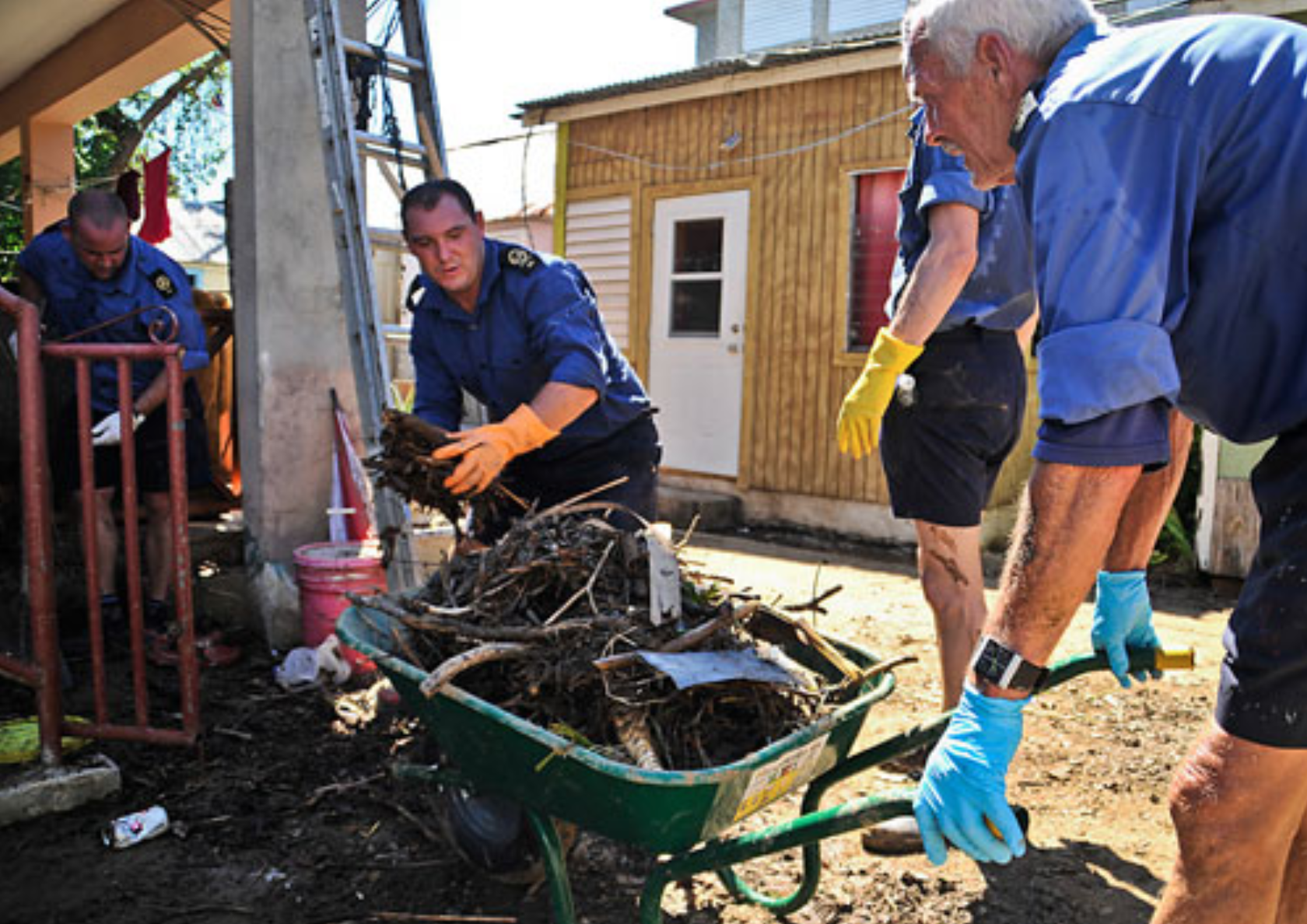
 Systems Community of Inquiry
You must be logged in to post a comment.