Professor Steve Easterbook has a blog (which I’m unlikely to pick up because there’s no email signup) at http://www.easterbrook.ca/steve/
via Systems Thinking for Global Problems
CSC2720H Systems Thinking for Global Problems
Note:
- Course Seminars are scheduled for Tuesday afternoons, 1pm – 4pm, starting on January 7th, 2020.
- Location: Room FE
328326, 371 Bloor Street West, Toronto. ( Note switch of room, across the corridor from the original room!)
 - Instructor: Prof Steve Easterbrook, Dept of Computer Science.
- For computer science grad students, this course fulfills breadth requirements in:
- Methodology 4 (Human-Centered and Interdisciplinary Computing) *and*
- Research Area 15 (Emerging areas in interdisciplinary computer science)
- Note: You cannot take this course for credit if you previously took my course CSC2602 in Winter 2013, nor if you took any instance of DGC2003.
About the Course
This course is unlike any other graduate course you have taken. You will play games, solve puzzles, and tell stories. Each activity will create a system around you, with its own dynamics. Sometimes you will try to beat the system and discover you cannot. Other times you will discover you can change a system by changing your perspective of it. In the process, you will discover how complex patterns of behaviour can arise from simple structures and simple rules. You will draw on such insights to develop a deeper understanding of how the world works. You will start to see the systems around you in a whole new light, and you will develop a new mental toolkit for analyzing complex global issues, modeling their structure and behaviour, and understanding how and why change happens.
Along the way, you will read about the theory and practice of systems thinking, trace the history of the key ideas, and discover how they have been applied. You will explore how systems thinking provides new ways of studying the relationships between the most important global challenges of the twenty-first century, including globalization, climate change, conflict, democracy, energy, health & wellbeing, and food security.
Key topics will include:
- General Systems Theory, developed by Bertalanffy for understanding biological systems;
- Cybernetics: the study of feedback and control in living organisms, machines, and organizations;
- Systems Dynamics approaches for modelling and analyzing non-linear feedback mechanisms in complex systems;
- Complexity science and complex adaptive systems;
- The role of computational modelling and simulation as a central tool for understanding systems
- Philosophical roots of systems thinking as a counterpoint to the reductionism used widely across the natural sciences;
- Emergent concepts from systems thinking, such as limits to growth, planetary boundaries, tipping points, sustainability, resilience, and chaos;
- Soft Systems Methodology and Critical System Theory for engaging multiple stakeholders in processes of change;
- Use of systems thinking to explore competing perspectives, trans-disciplinary synthesis, and modeling of global dynamics.
Course Requirements:
- Class participation: Show up, do stuff, get credit.
- Oral presentation: Research and present a 5 minute talk on a topic to be determined. Bonus marks if you do it as a Pecha Kucha. You must negotiate you choice beforehand, so we don’t have duplicates.
- Term paper: Topic is negotiable. Suggestion: A case study applying ideas from the course to your own research work – preferably something that could be published, although there’s no requirement to seek publication. (Due by the end of the term; length & style should be typical for the journal you would publish it in).
Note: This is the sixth incarnation of this course. It was originally developed in the summer of 2012 as part of the Dynamics of Global Change Collaborative Program, and taught again in the summer of 2013. It then migrated to the Computer Science department in the winter terms 2014 and 2016. The previous course pages are archived at:
- DGC2003, Summer of 2012 (note this version was quite a bit shorter!)
- DGC2003, Summer of 2013
- CSC2720, Winter 2014
- CSC2720, Winter 2016
- CSC2720, Winter 2018
Some similar courses at other Universities exist, and may have useful material relevant to this course:
- Martin Bunch’s course ENV4523 Systems Thinking in Environmental Studies at York U;
- David Ing & colleagues’ course CS0004 Systemic Thinking of Sustainable Communities at Aalto U
- James Kay’s old course The Epistemology of Systems Thinking at U Waterloo
- Tibbs et al course on Systems Thinking in a Complex World at Schumacher College
If you’re looking for more opportunities to meet systems thinkers and discuss how we can apply systems thinking to solve important societal problems, you might be interested in the Systems Thinking Ontario group, which meets in Toronto every month.
Course Outline (Draft – may change!)
Note: Some of this page still refers to the version of the course taught in the winter of 2018. I’ll update the outline and readings list as we go through the course.
| Seminar Topic & Notes | Notes and Background Readings | |
|---|---|---|
| (1) Tues Jan 7, 2020 |
Introduction & Basics
|
Notes:
For next seminar:
|
| (2) Tues Jan 14, 2020 |
Feedback Loops
|
Notes:
For next seminar:
|
| (3) Tues Jan 21, 2020 |
Flows and Limits
|
Notes:
For next seminar:
|
| (4) Tues Jan 28, 2020 |
Delay and Inertia
|
Notes:
For next seminar:
|
| (5) Tues Feb 4, 2020 |
Resilience and Collapse
|
Notes:
For next seminar:
|
| (6) Tues Feb 11, 2020 |
Systems Analysis
|
Notes:
For next seminar:
|
| Tues Feb 18, 2020 |
No Seminar – Reading Week | |
| (7) Tues Feb 25, 2020 |
Chaos and Complexity
|
Notes:
For next seminar:
|
| (8) Tues March 3, 2020 |
Complex Adaptive Systems
|
Notes:
For next seminar:
|
| (9) Tues Mar 10, 2020 |
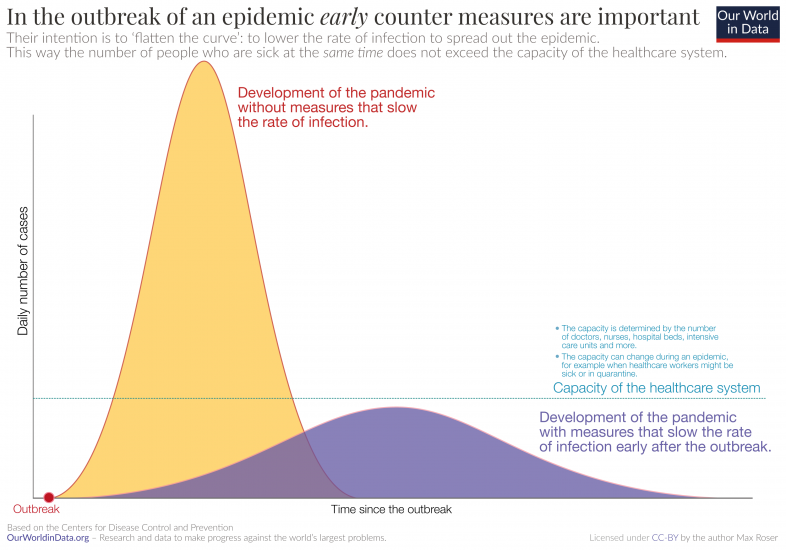
Pandemics and Systems Change
|
Notes:
For next seminar: |
| (10) Tues Mar 17, 2020 |
No Seminar – A pause while we figure out how to take the course online due to COVID-19 pandemic | |
| Tues Mar 24, 2020 |
Pandemics
|
Notes:
For next seminar:
|
| (11) Tues Mar 31, 2020 |
Interpretive Systems Thinking
|
Notes:
For next seminar:
|
| (12) Tues April 7, 2020 |
Critical Systems Thinking
|
Notes:
|
Useful Material
Books
- Meadows DH. Thinking in systems: A primer. Chelsea Green Publishing; 2008.
- Meadows is the main text we’ll use for the first half of the course. Its a book I thorooughly recommend buying (as you’ll want to re-read it every few years). It’s a very readable introduction to the basics of systems dynamics.
- Weinberg GM. An Introduction to General Systems Theory. Dorset House; 2001.
- Weinberg is an interesting alternative to Meadows, especially appropriate for those with a background in the physical sciences, because he spends a lot of time contrasting systems thinking with the traditional reductionism used in science. For a review of Weinberg’s book, see here
- Jackson MC. Systems Approaches to Management. Springer; 2000.
- A very detailed account of the history and philosophical roots of different strands of systems thinking. It’s comprehensive, but that makes it a little heavy going to read.
- Ramage M, Shipp K. Systems Thinkers. Springer; 2009.
- This book is about 30 of the most prominent people in the development of the field. For each person, it provides a brief biography, and an excerpt from their writings (so they speak in their own words). This will be very useful as a source book for your presentations.
- Walker BH, Salt D. Resilience thinking: sustaining ecosystems and people in a changing world. Island Press; 2006.
- Applies systems thinking to explore how to make socio-ecological systems more resilient to future shocks. Resilience is an important systems concept – it refers to the ability of a system to withstand sudden changes. The book includes five major case studies, interleaved with the conceptual chapters. Excellent reading!
- Garvey J. The ethics of climate change: right and wrong in a warming world. Continuum International Publishing; 2008.
- Excellent book on the overall idea of what an ethical response to the challenge of climate change even means. It’s not specifically about systems thinking, but Garvey is certainly a systems thinker. He demonstrates that climate change is unusual as an ethical problem,because the causes and consequences are smeared out across time and space. He then frames the central question as how we divide up a shared limited resource: the atmosphere as a carbon sink. I reviewed the book here.
- Booth Sweeney L. The systems thinking playbook: Exercises to Stretch and Build Learning and Systems Thinking Capabilities. Chelsea Green Publishing; 2010.
- This is the book from which most of the activities on the course are taken. I suggest *not* reading this until after the end of the course – the exercises will work better if you experience them before reading about them.
- Downey AB. Think Complexity. Green Tea Press; 2011.
- For anyone who likes programming (in Python), this book covers many of the key ideas on complexity science, chaos, and self-organising systems, with a whole series of programming examples so you can build your own simulations models. And the book is free online – just click the link!
- Gundersson L, Holling CS. Panarchy: Understanding Transformations In Human And Natural Systems. Island Press; 2002.
- This book extends some of the ideas of systems dynamics to talk about why systems change and why collapse occurs.
Media
- The Movie Mindwalk, based on the work of Fritjof Capra
- A series of videos of Russell Ackoff at U Penn, and in particular, watch this one on an exercise at Bell Labs on reinventing the telephone system.
- A Collection of visualizations of multiple scales
- The Impossible Hamster – a cautionary tale about limits to exponential growth
- …and on the topic of exponential growth, here’s a classic lecture by Al Bartlett on exponentials
- The Model Library at the Systems Wiki – contains many examples of causal loop diagrams, stock and flow models, etc.
- If Russ Ackoff had given a TED Talk… – YouTube Uses systems thinking to explain why Quality Management programs have not been successful (but the style is rather dry).
- RSA Animate: The Power of Networks
- RSA Animate: Crisis of Capitalism Explores how capitalism fails to solve its problems. Introduces systemic risk, and the need for new ways of thinking.
- 300 Years of FOSSIL FUELS in 300 Seconds – YouTube Talks about how the industrial society has been driven by cheap oil. Introduces the idea of resilience (but doesn’t really explain how to get it).
- David Keith’s unusual climate change idea | Video on TED.com. Mainly about geoengineering, and why we need to consider it.
- Elizabeth Pisani: Sex, drugs and HIV — let’s get rational | Video on TED.com. Systems thinking applied to HIV and policy.
- Johan Rockstrom: Let the environment guide our development | Video on TED.com. Planetary boundaries.
- Alex Steffen sees a sustainable future | Video on TED.com Quick defn of sustainability.
- Dave Snowden’s keynote talk at XP2012 on Complexity Thinking (as compared to Systems Thinking and Design Thinking)
Papers
Introductory Papers
- Richardson KA, Midgley G. Systems Theory and Complexity: part 4 The evolution of systems thinking. Emergence: Complexity & Organization. 2007;9(1-2):163-180.
- Sterman JD. All models are wrong: reflections on becoming a systems scientist. System Dynamics Review. 2002;18(4):501-531.
- Ackoff RL, Gharajedaghi J. Reflections on systems and their models. Systems Research. 1996;13(1):13-23.
- Beer S. What is cybernetics? Kybernetes. 2002;31(2):209-219.
- Ackoff RL. Towards a System of Systems Concepts. Management Science. 1971;17(11):661-671.
- Warfield JN, Perino Jr GH. The Problematique: Evolution of an Idea. Systems Research and Behavioral Science. 1999;16:221-226.
- Davoudi S. Resilience: A Bridging Concept or a Dead End? Planning Theory & Practice. 2012;(May):299-333.
- Randers J. Global collapse – Fact or fiction? Futures. 2008;40(10):853-864.
- Bausch K. The Global Problematique and the Club of Rome. Transformation Dialogues, Jan 2011.
Modeling
- Kim DH. Guidelines for Drawing Causal Loop Diagrams. The Systems Thinker. 1992;3.
- Richardson, G. P. (1986). Problems with causal-loop diagrams. System Dynamics Review, 2(2), 158â170.
- Warren, K. (2004). Why has feedback systems thinking struggled to influence strategy and policy formulation? Suggestive evidence, explanations and solutions. Systems Research and Behavioral Science, 21(4), 331-347.
- Ljung, L. (2010). Perspectives on system identification. Annual Reviews in Control, 34(1), 1–12.
Applications
The Global Problematique
-
- Slaughter, R., & Riedy, C. (2009). Understanding and resolving the global problematique: Assessing the balance between progressive & socially conservative foresight. Foresight, 11(5), 21–39. doi:10.1108/14636680910994941
- Rittel HWJ, Webber MM. Dilemmas in a General Theory of Planning. Policy Sciences. 1973;4:155-169.
- Ackoff R. Systems, messes and interactive planning. In: Ackoff RL, ed. Redesigning the Future. John Wiley & Sons Inc; 1974.
- Steffen W, Sanderson A, Tyson PD, et al. Global Change and the Earth System: A Planet Under Pressure. Springer-Verlag; 2004.
- Rockstrom J, Steffen W, Noone K, et al. A Safe Operating Space for Humanity. Nature. 2009;461(7263):472-475.
(see also,
- to critiques of the Planetary Boundaries Concept)
- Dai L, Vorselen D, Korolev KS, Gore J. Generic Indicators for Loss of Resilience Before a Tipping Point Leading to Population Collapse. Science. 2012;336(6085):1175-1177.
- Barnosky AD, Hadly E a., Bascompte J, et al. Approaching a state shift in Earth’s biosphere. Nature. 2012;486(7401):52-58.
Limits to Growth
- Hall, C. A. S., & Klitgaard, K. A. (2012). Are There Limits to Growth? Examining the Evidence. In Energy and the Wealth of Nations. New York, NY: Springer New York.
- Morecroft, J. (2012). Metaphorical Models for Limits to Growth and Industrialisation. Systems Research and Behavioral Science, 1–37.
- Randers, J. (2012). The Real Message of The Limits to Growth A Plea for Forward-Looking Global Policy. GAIA-Ecological Perspectives for Science and Society, 2, 102–105.
- Sterman, J. D. (2012). Sustaining Sustainability: Creating a Systems Science in a Fragmented Academy and Polarized World. In M. P. Weinstein & R. E. Turner (Eds.), Sustainability Science: The Emerging Paradigm and the Urban Environment (pp. 21–58). New York, NY: Springer New York.
- Turner, G. M. (2008).A comparison of The Limits to Growth with 30 years of reality. Global Environmental Change, 18(3), 397–411.
Climate Change
- Kartha S, Siebert CK, Mathur R, et al. A Copenhagen Prognosis: Towards a Safe Climate Future. 2009.
- Sterman JD, Sweeney LB. Cloudy skies: assessing public understanding of global warming. System Dynamics Review. 2002;18(2):207-240.
- Cronin M, Gonzalez C, Sterman JD. Why don’t well-educated adults understand accumulation? A challenge to researchers, educators, and citizens. Organizational Behavior and Human Decision Processes. 2009;108(1):116-130.
- Sterman JD. Communicating climate change risks in a skeptical world. Climatic Change. 2011;108(4):811-826.
- Lenton TM, Held H, Kriegler E, et al. Tipping elements in the Earth’s climate system. Proceedings of the National Academy of Sciences of the United States of America. 2008;105(6):1786-93.
- Jamieson D. The Moral and Political Challenges of Climate Change. In: Moser SC, Dilling L, eds. Creating A Climate for Change. Cambridge University Press; 2006:475-482.
Peak Oil
- de Castro C, Miguel LJ, Mediavilla M. The role of non conventional oil in the attenuation of peak oil. Energy Policy. 2009;37(5):1825-1833.
- Bardi U. The mineral economy: a model for the shape of oil production curves. Energy Policy. 2005;33(1):53-61.
- Hall C a. S, Klitgaard K a. Peak Oil, Market Crash and the Quest for Sustainability: Economic Consequences of Declining EROI. In: Energy. New York, NY: Springer New York; 2012:369-384.
Agriculture
- Foley J, Ramankutty N, Brauman K a., et al. Solutions for a cultivated planet. Nature. 2011;478:337-342.
Advanced Topics
- Manson SM. Simplifying complexity: a review of complexity theory. Geoforum. 2001;32(3):405-414.
- Flood RL. Liberating Systems Theory: Toward Critical Systems Thinking. Human Relations. 1990;43(1):49-75.
- Midgely G, Munlo I, Brown M. The theory and practice of boundary critique: developing housing services for older people. The Journal of the Operational Research Society. 1998;49(5):467-478.
- Holling CS. Understanding the Complexity of Economic, Ecological, and Social Systems. Ecosystems. 2001;4(5):390-405.
- Biggs R, Westley FR, Carpenter SR. Navigating the Back Loop: Fostering Social Innovation and Transformation in Ecosystem Management. Ecology And Society. 2010;15(2):9.
- Westley FR, Antadze N. Making a difference: strategies for scaling social innovation for greater impact. The Public Sector Innovation Journal. 2010;15(2).
- Tsoukas H, Hatch MJ. Complex Thinking, Complex Practice: The Case for a Narrative Approach to Organizational Complexity. Human Relations. 2001;54(8):979-1013.
On Teaching Systems Thinking
- Ing D. Systems Thinking Courses In The Masters Programme On Creative Sustainability At Aalto University: Reflections On Design And Delivery Of The 2010-2011 Sessions. In: Proceedings of the 55th Annual Meeting of the ISSS.; 2011:1-26.
- Kay JJ, Foster JA. About Teaching Systems Thinking. In: Savage G, Roe P, eds. Proceedings of the HKK conference.; 1999:165-172.
- Sterman, J. D. (2010). Does formal system dynamics training improve people’s understanding of accumulation? System Dynamics Review, 26(4), 316â334.
- Norman, C. D. (2013). Teaching systems thinking and complexity theory in health sciences. Journal of evaluation in clinical practice, 19(6), 1087â9.
Other Sources
- Robert Horn’s Mural on the History of Systems Thinking Ideas (seems to be no longer available, but there’s an early sketch still)
- American Society for Cybernetics’ Timeline for the history of Cybernetics
- The International Society for Systems Sciences’ Primer on Systems Theory
- David Ing’s readings on philosophical aspects of systems thinking
- List of System Archetypes at Wikipedia
- What is Systems Thinking? at Pegasus Communications
 Systems Community of Inquiry