Much as celebrities appear on all the podcasts I have subscribed to when they have something to promote, now the Soviet internet – founded on cybernetics – is appearing all over…
Norbert Wiener’s book Control and Communication in the Animal and the Machine was published in the US in 1948. He called this new subject “Cybernetics”, resurrecting the Greek word kybernetes meaning governance, steerman, pilot. The term first appeared in an essay by Andre Marie Ampere (the same man after whom the unit of electric current is called) on civil government that he believed did need some control. Wiener was of the same opinion, but his interests were much wider. With today’s terminology we could call his vision the communications, control, computer symbiosis.
The book, in due course, reached the Soviet Union, where it fell into the hands of philosophers. They were not amused. They could recognise an assault on the fundamentals of Socialism when they saw one. The titles of some of their articles clearly demonstrated their disapproval: “Cybernetics, an American Pseudo-Science”, “Cybernetics, a Science of Obscurantists,” “The Science of Modern Slaveholders”. An extract from the Concise Dictionary of Philosophy, as late as 1954, retains this scepticism: “Cybernetics clearly reflects one of the basic features of the bourgeois worldview — its inhumanity, striving to transform workers into an extension of the machine, into a tool of production, and an instrument of war.”ADVERTISINGAds by Teads
It was never easy to rebut Soviet theories based on ideology. Trofim Lysenko managed to ruin Soviet genetics and agriculture by his theory of the inheritability of acquired characteristics, supported strongly by Stalin. Lysenko flourished for nearly three decades and was discredited only after Stalin’s death. Fortunately for Soviet science the philosophers’ stronghold on cybernetics was weakened by scientists and engineers eager to get involved with that “Obscurantist” science.
An autonomous agent is something that can both reproduce itself and do at least one thermodynamic work cycle. It turns out that this is true of all free-living cells, excepting weird special cases. They all do work cycles, just like the bacterium spinning its flagellum as it swims up the glucose gradient. The cells in your body are busy doing work cycles all the time.
Introduction
Stuart Kauffman is a theoretical biologist who studies the origin of life and the origins of molecular organization. Thirty- five years ago, he developed the Kauffman models, which are random networks exhibiting a kind of self-organization that he terms “order for free.” Kauffman is not easy. His models are rigorous, mathematical, and, to many of his colleagues, somewhat difficult to understand. A key to his worldview is the notion that convergent rather than divergent flow plays the deciding role in the evolution of life. He believes that the complex systems best able to adapt are those poised on the border between chaos and disorder.
Kauffman asks a question that goes beyond those asked by other evolutionary theorists: if selection is operating all the time, how do we build a theory that combines self-organization (order for free) and selection? The answer lies in a “new” biology, somewhat similar to that proposed by Brian Goodwin, in which natural selection is married to structuralism.
Lately, Kauffman says that he has been “hamstrung by the fact that I don’t see how you can see ahead of time what the variables will be. You begin science by stating the configuration space. You know the variables, you know the laws, you know the forces, and the whole question is, how does the thing work in that space? If you can’t see ahead of time what the variables are, the microscopic variables for example for the biosphere, how do you get started on the job of an integrated theory? I don’t know how to do that. I understand what the paleontologists do, but they’re dealing with the past. How do we get started on something where we could talk about the future of a biosphere?”
“There is a chance that there are general laws. I’ve thought about four of them. One of them says that autonomous agents have to live the most complex game that they can. The second has to do with the construction of ecosystems. The third has to do with Per Bak’s self-organized criticality in ecosystems. And the fourth concerns the idea of the adjacent possible. It just may be the case that biospheres on average keep expanding into the adjacent possible. By doing so they increase the diversity of what can happen next. It may be that biospheres, as a secular trend, maximize the rate of exploration of the adjacent possible. If they did it too fast, they would destroy their own internal organization, so there may be internal gating mechanisms. This is why I call this an average secular trend, since they explore the adjacent possible as fast as they can get away with it. There’s a lot of neat science to be done to unpack that, and I’m thinking about it.”
All videos and livestreaming via https://www.wosc2020.org/videos
WOSC 2020
Online event 16th to 17th of September 2020
Programme and Video presentations
Key contributors to WOSC 2021 Congress kindly agreed to record in advance of the event a 10/15 minutes (video or ppt) presentations focused on their WOSC 2020 themes.
The content of the WOSC 2020 Online event will consist of the published videos and the on-line round-table programme.
Roundtable participants will have the opportunity to hear in advance the views of other participants. For their contributions to the roundtables they may prepare ppt presentations for talks of no more than 10 minutes. Discussions will be moderated as will be questions of registered people to the event (these questions will be filtered by the moderator before reaching the roundtable).
Technology: We will use the Zoom platform and the sessions will have technical moderators.
Programme: The two days online event will start the 16th and finish the 17th of September. Each of the first two days will last for four hours to allow spreading time zones in the programme. After the on-line event a three hours meeting of members of the WOSC 2020/2021 Strategic, Organisational and Programme committees will take place.
View less…
16th September Scheduled programme:
8:00 Colombia, 9:00 East USA, 14:00 UK, 15:00 EU, 16:00 Moscow, 23:00 Melbourne
Igor Perko, Raul Espejo and Vladimir Lepskiy. Introduction to the organizational aspects of the online event and the preparations for WOSC 2021 (up to 15 minutes);
Questions from participants will be accepted and will be answered at the end or later during the on-line event.
Roundtables Part I
8:15 Colombia 9:15 East USA, 14:15 UK, 15:15 EU, 16:15 Moscow, 23:15 Melbourne
Theme 1: “Philosophical and methodological foundations for the development of the systems approach and cybernetics”
Moderator: Raul Espejo (UK) (plus technical moderator and interpreter for Q/A)
Michael C. Jackson (UK), Vladimir Lepskiy (Russia), Michael Lissack (USA), Dmitry Novikov (Russia), Stuart Umpleby (USA), Clas-Otto Wene (Sweden)
Participants will have up to 10 minutes to introduce their contributions, optionally supported by ppt, which will be followed by discussions among them.
Open discussion: online questions (about five questions and 3 minutes per Q/A); online external participants will be asked to send questions in advance and moderators will put them forward to table participants.
Online coffee break (15 minutes).
Roundtables Part II
10:30 Colombia, 11:30 East USA, 16:30 UK, 17:30 EU, 18:30 Moscow, 01:30 Melbourne;
Theme 2 “The cybernetics of society, ecology and governance”
Moderator: Allenna Leonard (USA), Tatiana Medvedeva (Russia) (plus a technical moderator and an interpreter for Q/A)
Ray Ison (Australia), Bernard Scott (UK), Georgiy Malinetskiy (Russia), Boris Slavin (Russia), German Bula (Colombia), Shann Turnbull (Australia)
Participants will have up to 10 minutes to introduce their contributions, optionally supported by ppt, which will be followed by discussions among them.
Open discussion: online questions (about five questions and 3 minutes per Q/A); online external participants will be asked to send questions in advance and moderators will put them forward to table participants.
First day programme finishes at:
13:00 Colombia, 14:00 East USA, 19:00 UK, 20:00 EU, 21:00 Moscow 04:00 Melbourne
(15 minutes of introduction, open discussion and answers to questions)
Roundtables Part III
8:15 Colombia 9:15 East USA, 14:15 UK, 15:15 EU, 16:15 Moscow,23:15 Melbourne
Theme 3 “Technology and humanity: co-developing a hybrid reality”.
Moderator: Igor Perko (Slovenia), (plus technical moderator and an interpreter for Q/As)
Christoph Stuckelberger (Switzerland), Alexander Ageev (Russia), Francesco Caputo (Italy), Alexander Raikov (Russia), Mikhail Goubko (Russia), Andrei Khrennikov (Swedish), Teodora Ivanusa (Slovenia):
Participants will have up to 10 minutes to introduce their contributions, optionally supported by ppt, which will be followed by discussions among them.
Open discussion: online questions (about five questions and 3 minutes per Q/A); online external participants will be asked to send questions in advance and moderators will put them forward to table participants.
Theme 4 “The creation of new areas of knowledge from the transdisciplinarity of systems sciences and cybernetics”
Moderator: Sergio Barile (Italy)/ Marialuisa Saviano (Italy), (plus technical moderator and an interpreter for Q/As)
Alfonso Reyes (Colombia), Jose Perez Rios (Spain), Aleksander Kovriga (Russia), Tom Scholte (Canada), Clive Holtham (UK) Alexander Koblyakov (Russia), George Kleiner (Russia), Igor Gundarov (Russia)
Videos, published within the WOSC 2020 On-line event
To advance the communication between the peers, WOSC Congress section coordinators kindly agreed to highlight in their contributions possible topics to develop in WOSC 2021 in the form short -15 minute videos or alternately presentations.
As these will be published throughout September on WOSC2020, YouTube, and Facebook, please be free to watch, comment and share them with your peers.
Theme 1
Carlos Senna Figueiredo (Brasil)
Viacheslav Maracha (Russia)
Timofei Nestik (Russia)
Theme 2
Sandro Schlindwein: sustainability (Brasil)
Alexandre Perez Casares (Spain)
Angela Espinosa (UK)
Igor F. Kefeli (Russia)
Denis Zhurenkov (Russia; Anton Saveliev (Russia)
Zoraida Mendiwelso Bendek (UK) and Matjaz Mulej (Slovenia)
Theme 3
Massimiliano Pirani (Italy)
Jerzy Josefczyk (Poland)
Stefano Armenia (Italy)
Sifeng Liu & Yingjie Yang (China-UK)
Peter Ototsky (Russia) and Francesco Caputo (Italy)
[Content warning for description of child abuse and rape in the link, which is behind a ‘click to expand’ content warning in the text]
Interindependence
The concept of interindependence is simple. If I wish to stay independent, others with whom I closely relate must also be independent. Since we are interlinked in the world it becomes our interindependence–one womyn’s independence maintained by the independence of another–that allows each to maintain our individuality and uniqueness.
The concept is implicitly recognized in modern physics by the principle that we are not observers of the physical world but participants therein. Even the action of observing influences the outcome of the world as observed. This independence that I speak of is not to be confused, though it often is, with selfishness, aggression or the inability to deal with others. It is none of these. The independence I speak of is a personal awareness of one’s own power, one’s own ability to navigate the rivers of life. It is the ability of an 8-year-old to walk out into the dark night, alone, and have the strength to know that she will survive. It is the ability to avoid the quicksand of helplessness. We must have the ability to say, this is who I am without reference to anyone else and without reflection in someone else’s eyes. While we are a composite of our experiences, we are more than that. We are the essence of ourselves and of how we use those experiences, prior relationships, family, to become ourselves. Yes, I exist in relation to other people, but I must know myself alone.
In our common understanding of the meaning of independence, we think of not becoming dependent on someone else. But we must also think of not letting someone else become dependent on us. An example is the facilitation of our daughters’ growth. They are dependent on us as babies and the entire process of their growing up is to become independent. As good mothers we feel a constant tension between pushing them toward less dependence, yet holding them back out of fear.
Likewise mothers grow if their adult daughters do not allow them to become dependent either economically or emotionally. We are all familiar with the elder parents who now fear to venture from their houses without the helping/restricting hand of their grown daughter. Even flowers sheltered from the wind and rain do not grow. At the first storm they die.
The essence of all laws of nature is self-consistency, i.e., each thing obeys its own internal pattern (independence as I define it) and interdependence, i.e., each property determines all the rest. Thus, if each lesbian’s behaviors define mine, each lesbian must remain independent for me to do so–interindependence is born.
Interindependence: A New Concept in Relationships
by Dianne Post
In Lesbian Ethics, Vol 4 No 1, Spring 1990
I saw a woman sleeping. In her sleep, she dreamt life stood before her and held in each hand a gift: in the one hand love, in the other freedom–and she said to the woman, “Choose.”
And the woman waited long: and she said, “Freedom.”
And life said, “Thou hast well chosen, if thou hadst said ‘love’ 1 would have given thee that thou didst ask for; and I would have gone from thee, and returned to thee no more. Now, the day will come when I shall return. On that day I shall bear both gifts in one hand.”
Journal of Physics A: Mathematical and Theoretical
This study investigates the dynamics of traffic containing human-driven vehicles along with a fraction of self-organized artificial intelligence (AI) autonomous vehicles (AVs) on multilane freeways. We propose guidelines for the development of AI agents, such that a small fraction of AVs forms local constellations that significantly accelerate the entire traffic flow while reducing fuel consumption and increasing safety. Specifically, we report a 40% enhancement in traffic flow efficiency and up to 27% reduction in fuel consumption even when only 5% of vehicles are autonomous. This scenario does not require changes to current infrastructure or communication between vehicles; it only requires proper regulations. The results indicate that more efficient, safer, faster, and greener traffic flow can be realized in the near future.
Agility can be part of a potential “science of adaptation”
Cybernetic theory can be used to model how adaptation happens, and how opportunities are converted and help to simulate agile strategies
Sports analytics is closely related to agile problem-solving and this concept of adaptation science
As with sports tactics, we could rehearse agile tactics to execute them more reliably
The concepts of “stress-testing” and “adaptive opportunity cost” can also help to strategise
Predicting Successful Decision-Making
I believe that agility can become part of a scientific theory of adaptation, and I have been building simulations to explore some of these ideas. However, in order for agility to become a science, it must be shown to complement and add to the existing science of economic decision-making. In order to add something new to existing microeconomics and decision-making science, a science of agility would offer a different way of looking at familiar problems. It could be the case that the science of successful decision-making is not only predicted by assuming people are rational and having aligned incentives such as bonuses with the desired outcome as classical economics dictates. The more recent idea of behavioural economists that “nudging” people with inherent cognitive biases to make better decisions may also not be the full story. I believe that indeed there is a scientific “gap” in the market for predicting successful adaptation by individuals and organisations. So, it is my contention that successful decision-making is predicted by having the capacity for adaptation and using it wisely. I believe that this capacity for adaptation is nothing more than the ability to move resources around in order to take opportunities as they emerge. To be able to adapt in this way well is to behave with “agility,” as the name implies. There is, however, some conceptual development needed to make good on the promise of this idea. So, let’s consider the ingredients of an agile theory of adaptation.
Learn how to address wicked problems by taking a complexity-based approach to systems change.
Presented by Dr Sharon Zivkovic and Emily Humphreys
In this FREE webinar you’ll learn why wicked problems can’t be addressed with just projects and programs.
We will illustrate why a complexity, solution ecosystem and systemic innovation approach is best suited to addressing wicked problems, and demonstrate how communities and governments can work this way.
Join us in this FREE 45 min webinar as we introduce and discuss:
Different types of problems
Approaches for addressing different problem types
Academic interest in taking a complexity approach
Practitioner interest in taking a complexity approach
How to take a complexity approach
Wicked Lab’s approach to addressing wicked problems
We will also be demonstrating Wicked Lab’s online Tool for Systemic Change and announce the dates for our next Complex Systems Leadership Program in June 2020
Wicked Lab is helping communities and governments address wicked problems with award-winning research that embraces complexity to create systemic change.
With education programs and an online tool to map, track and measure systemic impact, Wicked Lab enables communities, nonprofits and governments to address the multi-casual and interconnected nature of wicked problems.
Wicked Lab is an Australian social enterprise co-founded by Dr Sharon Zivkovic and Emily Humphreys
Sharon is the Chief Innovation Officer of Wicked Lab. She has been working with diverse community stakeholders to address community problems for 20 years. In 2001 Sharon received the Enterprising Woman of the Year Award in recognition of her contribution towards creating strong and enterprising communities. In 2012 she received the Best Overall Paper Award at the International Social Innovation Research Conference for a paper that describes the model that underpins Wicked Lab’s approach and in 2016 she received a Fresh Scientist award for her use of complexity science to address complex problems.
Emily is CEO of Wicked Lab. She is an experienced commercialization professional with a masters in Science and Technology Commercialisation and has worked with numerous organisations to translate research into tools for practitioners.
Public health agencies tasked with improving the health of communities are poorly supported by many ‘business-as-usual’ funding practices. It is commonplace to call for more funding for health promotion, but additional funding could do more harm than good if, at the same time, we do not critically examine the micro-processes that lead to health enablement – micro-processes that are instigated or amplified by funding. We are currently engaged in a university-and-policy research partnership to identify how funding mechanisms may better serve the practice of community-based health promotion. We propose three primary considerations to inform the way funds are used to enable community-based health promotion. The first is a broader understanding and legitimising of the ‘soft infrastructure’ or resources required to enhance a community’s capacity for change. The second is recognition of social relationships as key to increasing the availability and management of resources within communities. The third consideration understands communities to be complex systems and argues that funding models are needed to support the dynamic evolution of these systems. By neglecting these considerations, current funding practices may inadvertently privilege communities with pre-existing capacity for change, potentially perpetuating inequalities in health. To begin to address these issues, aspects of funding processes (e.g., stability, guidance, evaluation, and feedback requirements) could be designed to better support the flourishing of community practice. Above all, funders must recognise that they are actors in the health system and they, like other actors, should be reflexive and accountable for their actions.
• Systemic-level action can either facilitate or hinder change.
• The realities of systemic change often alienate philanthropists and investors.
• A new funding structure has to come into being to support systemic change.
Systemic change is on everyone’s lips in 2020. The pandemic is laying bare the flaws of our politicians, institutions and healthcare systems. Pushed to the background, progress on climate action remains woefully slow. Wealth inequality continues to rise. Gender parity appears unlikely to happen for a hundred years. Black people keep dying in police custody.
Browse the blog of your favourite organization, private or public, and there’s probably an article there urging that something should be done about these systemic problems; these texts are often heavy on outrage and light on logistics.
“The purpose of a system is what it does”, or POSIWID for short, is a dictum coined by Stafford Beer, a leading Systems Thinker in the field of cybernetics; and the creator of management cybernetics – the application of cybernetic principles to the management of large organisations.
To use Beer’s own words, from a talk he gave at the University of Valladolid, in 2002:
It stands for a bald fact, which makes a better starting point in seeking understanding than familiar attributions of good intentions, prejudices about expectations, moral judgements, or sheer ignorance of circumstances
POSIWID is an important Systems Thinking concept and has several implications when thinking about, and/or working on complex systems, be they political, social or business related. Firstly, it is a question to reflect upon when analysing a given situation – to go deeper and investigate what is really going on. Richard Veryard puts it well in his blog “Exploring the Purpose of Things” when he suggests:
Ignore the official purpose of the system, ignore what the designers and custodians of a system say, and concentrate on its actual behaviour. Conversely, if there is some unexplained pattern of behaviour, look for a system whose purpose this pattern reveals.
In the field of politics, this stance can be very profound, particularly in the age of fake news and disinformation. It seems, increasingly, that nothing is as it appears. Also in the corporate world, where at the time of writing, serious questions are being asked of Facebook; and the gap between what it says and what it does – an interesting example of “unexplained patterns of behaviour”.
But it is equally relevant to the design of services and service operations, not least in the more ‘political’ areas of law enforcement, education and health. Always focus on actual behaviour, not on intentions. When ‘side effects’, or ‘unintended consequences’, reveal that the behaviour of the system is poorly understood, it is necessary to go deeper, to gain a better understanding of the system you are working on.
Secondly, it requires designers to take care when defining the purpose of a service, or service operation. As designers, this is typically one of the first things we want to do. But, what we are actually defining is the ‘intended purpose’; and this may be very different from the actual purpose of the service or service operation under investigation, which may be multiple and contingent upon certain events, or conditions. The system’s actual purpose comes from its emergent properties and this is best determined by observing its behaviour. This is why the ‘discovery’ phase of a project is so critical, to first understand the situation under investigation, e.g. the actual, rather than the perceived nature of demand.
Further Reading….
There is not a lot of published material that explores POSIWID and its implications, but I can recommend Dan Lockton paper, “POSIWID and determinism in design for behaviour change” (2012). And I’ve already included a link to Richard Veryard’s blog, but you should definitely catch his short critique on some common errors when applying POSIWID.
This session welcomes papers which discuss and critique the philosophical and methodological foundations of different systems approaches. Relevant papers will examine the manner in which the theoretical underpinnings of a systems approach (or approaches) impact – for better or worse – on its ability to address issues arising from the complexity of our highly interconnected world. Contributions that suggest how systems methodologies, and their theoretical assumptions, can be modified to make them more successful in practice will be welcome. As will contributions that debate how different systems approaches can be used in combination to manage complexity.
1.2 Critical Systems Thinking Michael Jackson 12 views•31 Aug 2020 1 0 SHARE SAVE WOSCORG 53 subscribers SUBSCRIBED This session welcomes papers which discuss and critique the philosophical and methodological foundations of different systems approaches. Relevant papers will examine the manner in which the theoretical underpinnings of a systems approach (or approaches) impact – for better or worse – on its ability to address issues arising from the complexity of our highly interconnected world. Contributions that suggest how systems methodologies, and their theoretical assumptions, can be modified to make them more successful in practice will be welcome. As will contributions that debate how different systems approaches can be used in combination to manage complexity. Papers that reflect on what ‘improvement’ means, from a systems perspective, are encouraged. Finally, papers that demonstrate the case they make by using examples of practical application will be much appreciated. SHOW LESS
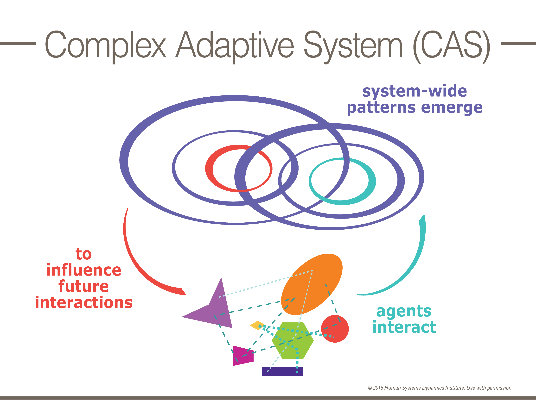
My particular take on complexity and systems is called human systems dynamics (HSD). It is a field of theory and practice that applies principles of complex adaptive systems to help people see, understand, and influence emergent patterns in complex human systems. HSD is applicable at all scales of human experience from intrapersonal reflection and cognition through global patterns of economic and cultural interaction (Eoyang, 1997). For more information about the models and methods of HSD, visit our website www.hsdinstitute.org. Here, I would like to introduce the basic features of the theory and practice that form the foundation of HSD.
HSD theory is drawn from the field of complex adaptive systems (Dooley, 1997). In this approach, a system is defined as a collection of agents that interact to generate system-wide patterns. Those patterns then constrain…





 Systems Community of Inquiry