Meaningful perception | Metarationality

As I always say, I think David Chapman is one of our greatest liiving cyberneticians, and I think this demonstrates why. Big ideas, patiently illustrated.

source:

Meaningful perception | Metarationality

In The Cells of the Eggplant

Leveling up technical work with context and purpose

Meaningful perception

Raven
All ravens are black. Image courtesy Casey Horner

Understanding perception as meaning-saturated resolves several of the difficulties Part One found rationalism faces.

Recall from “Is this an eggplant which I see before me?” that the usual rationalist assumption is that perception’s job is to deliver an objective description of your physical environment. “Objective” would mean that it is independent of your theories, of your projects, and of anything that cannot be sensed at this moment, such as recent events. We saw that, for several in-principle reasons, this seems impossible.

Fortunately, that isn’t what we need from perception. In routine, practical activity, what we want perception to tell us is: what are the meaningful aspects of the situation we’re in right now? And what possibilities for ongoing activity do they suggest? The answers depend on what we know, what we can do, what we’re are up to right now, and what else is going on.

Unsurprisingly, then, scientific study of perception shows that it does not attempt to deliver objective descriptions; and shows how perception does operate on a task-dependent, contextual, meaning-saturated and knowledge-saturated basis.

The science is fascinating, and I’d love to review it in detail here, but that would take another book.1 Instead, I will explain just enough that you can understand how routine, reasonable activity cooperates with perception to address issues that rationality unaided cannot.

I will discuss only vision, because it’s the most important human sense, and the best understood scientifically. In this chapter, we’ll return to questions posed in “Is this an eggplant I see before me?” There we asked: what is the interface between perception and rationality? Here, our question will be: what is the interface between vision and reasonable activity? What is the division of labor? And the answer will be that they are intimately entwined, with no hard boundary between them. Seeing is an aspect of doing, not a separate, encapsulated function. This implies that what we perceive is, for better or worse, inevitably affected by what we are up to at the time.

Rationality also depends on perception, of course. We use perception in building objective, rational theories. However, this use is mediated through reasonableness, which limits how objective theories can be—as we’ll see in Part Three.

In Part Three, we’ll also come to understand how the nature and limits of perception and cognition force the rather awkward ways formal rationality must work in the material world. As a hint: how much of your technical, rational work could you do if you were blindfolded? Which parts can you do without looking at a computer screen or at your lab equipment?2 What does that tell you about the nature of rationality?

continues in source:

Meaningful perception | Metarationality

Improvisation Blog: Bio-drama and new ways of teaching

source:

Improvisation Blog: Bio-drama and new ways of teaching

Friday, 18 December 2020

Bio-drama and new ways of teaching

For a few years now I’ve been exploring with John Torday how the many profound aporia we live with (what we seem to accept as “wicked problems” – climate change, inequality, homelessness, educational problems, health, geopolitics, etc) result from some gap in our understanding of how human consciousness came to be: to put it simply, it is Bateson’s “gap between the way people think and the way nature works”. In excluding the possibility of a deeper and more coherent narrative, we have grown to believe that our profound problems cannot not exist. But I am now asking a question that was once asked by Jiddhu Krishnamurti to David Bohm – is it possible for humans to have no “problems” at all

continues in source:

Improvisation Blog: Bio-drama and new ways of teaching

Want to create recipes for transformation? Join the launch of the Cookbook for systems change! | Nordic cooperation

source:

Want to create recipes for transformation? Join the launch of the Cookbook for systems change! | Nordic cooperation

Want to create recipes for transformation? Join the launch of the Cookbook for systems change!

17.12.20 | News

Ilustration eatforum sin granulado

Photographer norden.orgMailFacebookLinkedinTwitterSign up to newsletterHow do we create innovative strategies that help us address the greatest societal challenges of our time? On 26 January you are invited to explore the key learnings from the new Cookbook for systems change – Nordic innovation strategies for sustainable food systems.

The Cookbook for systems change -Nordic innovation strategies for sustainable food, by Nordic Food Policy Lab of the Nordic Council of Ministers, Stockholm Resilience Centre and EAT, lays out an inclusive Nordic approach to research and innovation-oriented missions. By exploiting entry points and breaking grand challenges down into a portfolio of actionable place-based demonstrators, these Nordic innovation strategies provide a systemic approach to tackle complex challenges – starting with our food systems.

Momentum is building among policy-makers for the adoption of more experimental approaches.

Join us on 26 January!

Are you interested in learning about the approach, and how Nordic research and innovation agencies are collaborating to apply it in practice? Join us for the launch of this Cookbook and a special 2×30 minute crash course starting off with a debate on the need for a mission-based approach, followed by a tour of the Cookbook for systems change – Nordic innovation strategies for sustainable food.

The Cookbook for systems change is about the role that a strong public innovation system can play alongside the pathways towards sustainable food systems. The book provides the ingredients – templates for developing interventions, guides for how to get started and examples of cross-cutting projects – that can be used to create recipes for change. It also offers a new, emergent way to work with complex and dynamic systems.

Demystifying systems change: introducing a mission-approach to food systems transformation

Date: 26 January, 2021

Time: 10:00-11:00 (CET)

Facebook event: Join the launch of the Cookbook for systems change!

Live-stream (Zoom): Details to come in January

The line-up:

  • Sebastian Hielm – Finnish Ministry of Agriculture and Forestry
  • Representative from a Nordic Innovation agency (TBC)
  • Authors of the Cookbook for systems change

Take a sneak peek at the book here!

About

The Cookbook for systems change is the result of a collaboration between the Nordic Food Policy Lab of the Nordic Council of Ministers, Stockholm Resilience Centre and EAT, and forms part of the joint initiative with the following organizations to establish a first shared Nordic mission:

  • Design and Architecture Norway
  • Danish Design Centre
  • EIT Climate-KIC
  • EIT Food
  • Formas
  • Innovation Norway
  • Nordic Innovation
  • Matis
  • Research Council Norway
  • Sitra
  • Vinnova

The Cookbook is funded by EIT Climate-KIC as a part of the Deep Demonstrations on Resilient Food Systems and Diets. It is written by Afton Halloran (editor), Amanda Wood, Florencia Aguirre, Marie Persson, Marius Weschke and Ove Kenneth Nodland.

source:

Want to create recipes for transformation? Join the launch of the Cookbook for systems change! | Nordic cooperation

Systems Leadership Rapid Review by Harry Begg – GOV.UK

source:

Systems Leadership Rapid Review by Harry Begg – GOV.UK

Research and analysis

Systems Leadership Rapid Review by Harry Begg

Published 15 December 2020

Contents

  1. 1.Introduction and Background
  2. 2.What is systems leadership?
  3. 3.What does social science literature tell us about the potential for leadership and leader development to instil positive change for complex policy problems?
  4. 4.What behaviours and capabilities do effective leaders and organisations exhibit when they are tackling systemic issues?
  5. 5.What does the literature tell us about the conditions of success and failure where systems-based approaches are used?
  6. 6.State of existing research and recommendations for future work
  7. 7.References
  8. 8.Appendix 1
  9. 9.Appendix 2

Print this page

1. Introduction and Background

This is a rapid review of the literature on the concept of systems leadership conducted for the National Leadership Centre in January 2020. The project has been delivered on an aggressive timeline and is not intended as a full systematic review of scholarly and other relevant literature. Instead, it is a scoping of the literature which uses a combination of academic databases and qualitative scholarly initiative to understand how scholars and practitioners are answering the following questions:

  • What is systems leadership and how is it defined in relation to other approaches to leadership?
  • What are the conditions of success and failure observed in public service delivery where systems approaches are used?
  • What behaviours and practices do effective leaders and organisations exhibit when they are tackling systemic issues?
  • How might these behaviours and practices be learned, encouraged and institutionalised? And how can factors leading to failure be limited?

1.1 This review is organised as follows:

  • Section 1 covers definitions.
  • Section 2 is about existing debates in social science literature that are pertinent when considering systems leaders and systems leadership.
  • Section 3 is about what behaviours and capabilities systems leaders are thought to exhibit and possible ways of categorising those qualities.
  • Section 4 is about how organisations can use systems thinking to respond to issues facing them.
  • Section 5 provides a high-level assessment on the state of existing research and recommendations for the NLC going forward.
  • Appendix 1 contains Google Trends analysis about use of the term “systems leadership” and other relevant concepts.
  • Appendix 2 contains a select list of useful resources and institutions and journals conducting high calibre research for those seeking further reading.

1.2 Research Methodology:

As stated, this is not a systematic review of the literature. Rather it is a bespoke and qualitative high-level review. It used a very large academic library database to conduct the search as well as more intuition-derived “snowballing” techniques, such as surveying the citations in particularly good articles. A brief overview of the approach taken is set out below.

  • Following agreement of the search terms with the NLC, the University of Oxford’s academic database Searching Oxford Libraries Online (SOLO) was used for searching for citations. This is one of the world’s most comprehensive library databases.
  • The databases of several renowned business journals were also used, most notably the Harvard Business Review and the MIT Sloan Management Review, entries in which are less likely to appear in SOLO searches.
  • In the initial scoping exercise, the search terms “systems leadership,” “public sector systems” and “complex systems” were used. These articles were reviewed before employing a “snowballing” method (pursuing references of references and using citation-tracking software) to find further relevant literature.
  • The search of the literature was generally restricted to articles published since 2008 in English. Since the number of articles yielded from searches is far greater than the number that are either relevant to the research and/or possible to review in a constrained time frame, a degree of discretion was required in choosing which articles to review.
    • Choices about which articles to focus on were based on publication type and reputation (e.g. Leadership Quarterly is a well-known journal with research output highly pertinent to this project) and subject or discipline area. Similarly, dictionary terms or very short newspaper articles identified through the database search were also excluded.
    • Literature from social science disciplines (e.g. sociology) and professional journals (e.g. business school research) was also deemed more useful to this research project than, for example, applied science journals.
    • Existing knowledge of the leadership studies field was also a factor in decisions of inclusion and exclusion of articles. For example, the work of the Harvard Kennedy School Center for Public Leadership is well-regarded, and its webpages were consulted for useful resources and references.
  • Searches made yielded many thousands of database entries of varying relevance to the review. In total, 148 items were identified for inclusion in the rapid review. In addition, advice was sought from several experts from inside and outside academia, several of whom are quoted in this review, and who provided further scholarly direction.
  • In sum, this rapid review is not comprehensive. Experience and scholarly instincts were used to focus in on what is likely to matter most to those studying systems leadership in policy contexts.

Harry Begg

continues in source:

Systems Leadership Rapid Review by Harry Begg – GOV.UK

Act to live! Viability in times of uncertainty – metaphorum

Act to live! Viability in times of uncertainty – metaphorum

Act to live! Viability in times of uncertainty 14th Metaphorum Conference11-13 June 2021, Leuven, Belgium

A conference specifically focused around Stafford Beer and the Viable Systems Model and Team Syntegrity.

All problems, whether they are regarded as problems of recognition, or classification, or indeed decision, are problems about uncertainty. 

Stafford Beer

Welcome one and all.

In the last nine months, the COVID19 pandemic has brought dramatic changes to all our lives. In this conference, we will be exploring the many and various ways in which Stafford’s ideas can help to address the exploding uncertainty of emerging social and business landscapes. We will focus on examples of innovative action research developing Beer’s theory and tools and critically reflecting on effective practice. For the first time, we will be introducing participatory design. We will be asking your views on the most interesting talks and giving more time to those which are the most popular. Everyone who registers will be asked to vote in the spring after the abstracts have been selected. Details will follow. 

Venue

The 14th Metaphorum conference will take place in De Hoorn Conference Centre in Leuven1, Belgium. Leuven is a 15min train or drive from the Brussels Airport.

Address: Sluisstraat 79, 3000 Leuven.

The pre-conference evening on Friday, 11 June, will be at another location, to be announced soon.

Program

Friday, 11 June

Get-together dinner and pre-conference session.

Saturday, 12 June

Morning: welcome, keynote, two parallel streams, each talk one hour (for the most popular talks), four talks in all.

Afternoon: sessions in format PechaKucha2presentation + discussion. There will be 3 parallel streams, each talk for half an hour, twelve talks in all. 

Sunday, 13 June

Singletrack interactive session. Details will follow.

A detailed program will be published in the spring of 2021.

Accommodation

There are plenty of accommodation options in Leuven. An excellent combination in terms of price, quality, and proximity is Novotel Leuven. Accommodation is also offered at the conference venue, De Hoorn

Call for Contributions

The theme of the conference is:

Act to live! Viability in times of uncertainty

Uncertainty requires action and learning from it.

Uncertainty implies the notion of not knowing. Knowledge in human affairs, surely those involving an uncertain future, only develops when taking the risk of action. The reflective practitioner,  involving herself into the action and the research, embodying cybernetics, the art of governance, is invited to contribute to this Metaphorum conference.

The conference will provide her with a platform to discuss and deepen her research, hence applying to this call does not require a full-fledged paper, only a description of the environment, the aims and the actual status of her research/practice.

Those contributions which exemplify the generative character of the tools that Stafford Beer crafted will be selected for the longer time slots during the Saturday morning. How has the reflective practitioner made these models and concepts her own, to help her to deal with tensions and conflicts in the social systems in which she is actively involved?

As Leuven has been named the European Capital of Innovation 2020, the contributions should exemplify novel ways of using Stafford’s tools. In a world which has changed greatly since Stafford lived and worked, the continuing and future relevance of his work should be stressed.

To submit your proposal, select “Speaker” in your registration form.

Registration

Due to the inevitable uncertainty with Covid19 and vaccines, we are asking everyone who intends to attend, to register their interest now without paying the conference fee. Payment will be asked once we have more confidence that everyone can travel and that the conference can go ahead in June. The Fee will be £125. 

If there is a problem and the conference has to be delayed, we will inform everyone as soon as we know, and reschedule the conference, probably at the same venue in Leuven, later in the year.

The £125 covers the venue for all day Saturday and Sunday. We will find another venue for Friday night. Sandwiches are provided on Saturday, but we will all need to buy the other meals and teas and coffees which will be available at the venue.

source:

Act to live! Viability in times of uncertainty – metaphorum

Chapter 20 “ORDER FOR FREE” – Stuart Kauffman (1995)| Edge.org

Excerpted from The Third Culture: Beyond the Scientific Revolution by John Brockman (Simon & Schuster, 1995) . Copyright © 1995 by John Brockman. All rights reserved.

source:

Chapter 20 “ORDER FOR FREE” | Edge.org

Chapter 20 “ORDER FOR FREE”

Stuart A. Kauffman [5.7.96]

Brian Goodwin: Stuart is primarily interested in the emergence of order in evolutionary systems. That’s his fix. It’s exactly the same as mine, in terms of the orientation towards biology, but he uses a very different approach. Our approaches are complementary with respect to the same problem: How do you understand emergent novelty in evolution? Emergent order? Stuart’s great contributions are there.?

__________

STUART KAUFFMAN is a biologist; professor of biochemistry at the University of Pennsylvania and a professor at the Santa Fe Institute; author of Origins of Order: Self Organization and Selection in Evolution (1993), and coauthor with George Johnson of At Home in the Universe (1995).

continues with all kinds of interesting comments:

Chapter 20 “ORDER FOR FREE” | Edge.org

The myth of Kurt Lewin and the rhetoric of collective memory in social psychology textbooks – Billing (2015)

Proving once again that it is always, always worth investigating the source of a classic quote (in this case: “A businessman once stated that ‘there is nothing as practical as a good theory’” (1943/1999, p. 336)) – very much like (to misquote):

Hacker: “neither a borrower nor a lender be, humphrey. William shakespeare”

Sir Humphrey: “Polonius, Minister”

(PDF) The myth of Kurt Lewin and the rhetoric of collective memory in social psychology textbooks

The myth of Kurt Lewin and the rhetoric of collective memory in social psychology textbooks

  • July 2015 Theory & Psychology 25(6)

November 2015

Abstract

This article examines how social psychology textbooks represent Kurt Lewin and his contribution to social psychology. Many textbooks describe Lewin as the father of social psychology, using a conventional, passive-voiced trope to do so. The rhetorical meaning of this trope is analysed to show that textbooks are invoking a collective memory, which closes down views of the past, rather than making a historical argument, which opens up the past for examination. This depiction of Lewin typically involves forgetting his critical views about statistics and experimentation. When textbooks cite Lewin’s famous motto “there is nothing as practical as a good theory,” they tend to ascribe it a special status. In doing so, they change its meaning subtly and treat it as a truth that needs no empirical validation. By their rhetoric, omissions, and avoidance of historical sources, textbooks recreate Lewin as a mythic figure rather than a historical one.

source:

(PDF) The myth of Kurt Lewin and the rhetoric of collective memory in social psychology textbooks

Cybernetics, AI, and Ethical Conversations – Design+Conversation – Paul Pangaro

source:

Cybernetics, AI, and Ethical Conversations – Design+Conversation
“As a designer, I shall act always so as to increase 
 the total number of choices for a user.”

POSTED ON BY PAUL PANGARO

Cybernetics, AI, and Ethical Conversations

Quote above: An approach to interface design based on Heinz von Foerster’s Ethical Imperative where “choices” are distinguished from “options” — options are anything that is possible, while choices are only those options that are viable and well-suited to this user in this moment.

More and more, today’s AI makes the world we see and the world we live in — and we need to respond. In a presentation hosted by the AiTech Agora at TU DelftPaul Pangaro responds with a proposal for collaboration that bridges AI and cybernetics with conversation.

Click for video of presentation.          Click for full abstract and slides.

“Pandemic” comes from “all” and “people”, meaning something negative that effects us all. While not biological, today’s AI foments polarization, pushes irrelevant products, spreads social bias, and surveils our lives. AI touches billions and sways more of us,  in more invasive and uncontrolled ways, every day.

AI came out of cybernetics, a practice that evolved from a series of trans-disciplinary conversations called the Macy Meetings. This history offers a way forward.

Macy Meetings –> #NewMacy Meetings
Click for PDF of presentation

Pangaro argues for a revival of trans-disciplinary conversations — for #NewMacyMeetings — to respond to the wicked challenges of  today’s AI. Beyond being trans-disciplinary, conversations for the 21st-century must also be trans-global and trans-generational. Only then can we prioritize our technology for universal human values.

Pangaro’s talk proposes how cybernetic models of conversation may enable the design of interactions that are cooperative, ethical, and humane, whether human-to-human or human–to-machine.

“I shall act always to create conditions such that others 
 may converse — with others and with themselves.”

Click for video of presentation.          Click for full abstract and slides.

source:

Cybernetics, AI, and Ethical Conversations – Design+Conversation

System Literacy • System Literacy Dyanamics • Kumu

The systemic and non systemic concepts portrayed in this mind map were identified at an ISSS workshop on system literacy in Corvallis July 2019. Gathered here as a whole we can see the relationship of systems knowledge and the capability ultimately to act with greater appreciation and understanding. In contrast around the whole we can see a cycle of pain and suffering which results when a system approach is not taken.

System Literacy • System Literacy Dyanamics • Kumu

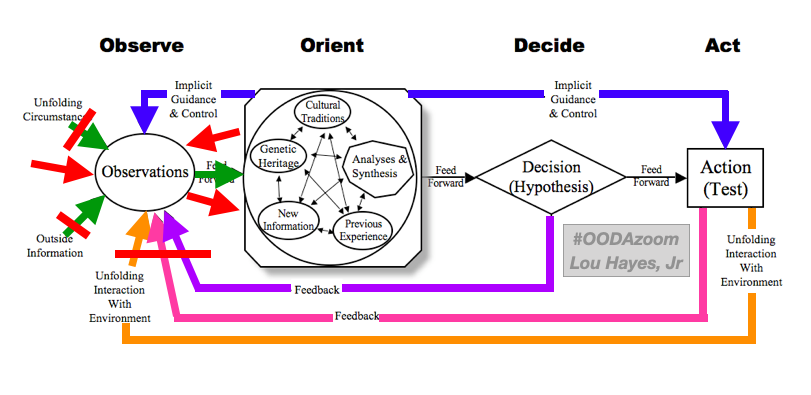
OODA: It’s About The Pathways!

source:

OODA: It’s About The Pathways!

OODA: It’s About The Pathways!

I get asked a lot, by OODA “outsiders” about where some specific cognitive issue sits in the OODA diagram. Things like confirmation bias, or Recognition Primed Decision Making, or prejudice. 
The answer, more times than not, lays not in any of the Observe, Orient, Decide, or Act “phases”…but rather in various routes, combinations, cycles, or pathways. And over time, how things change. 
Like in much of complexity, it’s less about the nodes and more about the interactions. This is no different.

continues in source:

OODA: It’s About The Pathways!

IFSR Conversations: 21st December 18:00 CET – Pamela Buckel and Louis Klein: The complexity of the challenges of the Anthropocene in the 21st century requires systemic solution

IFSR Conversations: 21st December 18:00 CET

Pamela Buckle (IFSR) and Louis Klein (IFSR) are going to host and continue our regular IFSR Conversations on Zoom. The complexity of the challenges of the Anthropocene in the 21st century requires systemic solution. It requires systems thinking, systems practice and systems being. Together we explore our collective potential.

To participate in this IFSR Conversation just follow the link when it is time to start:
https://us02web.zoom.us/j/84886318420.

Cycles and the Cyclic Nature of Systems – SEBoK

source

Cycles and the Cyclic Nature of Systems – SEBoK

Cycles and the Cyclic Nature of Systems

Cycles and the Cyclic Nature of Systems


Lead Author: Gary SmithContributing Authors: Olaf Brugman, Helene Finadori, John Kineman, Tom Marzolf, George Mobus, Peter Tuddenham, Lynn Rasmussen, Hillary Sillitto, William Smith, Len Troncale, Tyler Volk


This article is part of the Systems Science knowledge area (KA). “Cycle” is one of many concepts within general system theory that have been studied within systems science. A cycle is “a series of events that are regularly repeated in the same order; or move in or follow a regularly repeated sequence of events” according to the Oxford English Dictionary (2020). Cycles “define and make things. Equally things contain Cycles.” (Volk 1995) Mobus and Kalton describe a cycle as a temporal pattern (2015). The Foundation for the Study of Cycles describe a cycle as, “A series of events that is regularly repeated in the same order. The longer and more regular the series is repeated, the more predictable it becomes, until it cannot reasonably be considered a coincidence.” (2020) “Circularity is the essence of the early notion of feedback (circular causality). The notion of circularity is found in recursive computation (the use of DO loops, for example)”. (Krippendorf 1984)

This article illustrates a General System Concept and its patterns of measurable instantiation. Additionally a number of frameworks that incorporate cyclic behaviour are highlighted and the pattern of relationships between these models, the phases of system emergence and the practice of system engineering are illustrated.

Source and the Systems Engineering Body of Knowledge

Cycles and the Cyclic Nature of Systems – SEBoK

Causal diagrams, causal models

Causal Diagrams: Pitfalls and Tips

I can’t quite piece together the overall links between causal models, causal diagrams, and causal directed acyclic graphs (DAGs) – but there’s an EdX course:

https://www.edx.org/course/causal-diagrams-draw-your-assumptions-before-your

A very messy wikipedia article

https://en.wikipedia.org/wiki/Causal_model

Some very old university stuff: http://causality.cs.ucla.edu/blog/index.php/about/

pdf paper: causal diagrams in theory and practice

Directed acyclic graphs: a tool for causal studies in paediatrics: https://www.nature.com/articles/s41390-018-0071-3

source

Causal Diagrams: Pitfalls and Tips

J Epidemiol. 2020; 30(4): 153–162.Published online 2020 Apr 5. Prepublished online 2020 Feb 1. doi: 10.2188/jea.JE20190192PMCID: PMC7064555PMID: 32009103

Causal Diagrams: Pitfalls and Tips

Etsuji Suzuki,1Tomohiro Shinozaki,2 and Eiji Yamamoto3Author informationArticle notesCopyright and License informationDisclaimerThis article has been cited by other articles in PMC.Go to:

Abstract

Graphical models are useful tools in causal inference, and causal directed acyclic graphs (DAGs) are used extensively to determine the variables for which it is sufficient to control for confounding to estimate causal effects. We discuss the following ten pitfalls and tips that are easily overlooked when using DAGs: 1) Each node on DAGs corresponds to a random variable and not its realized values; 2) The presence or absence of arrows in DAGs corresponds to the presence or absence of individual causal effect in the population; 3) “Non-manipulable” variables and their arrows should be drawn with care; 4) It is preferable to draw DAGs for the total population, rather than for the exposed or unexposed groups; 5) DAGs are primarily useful to examine the presence of confounding in distribution in the notion of confounding in expectation; 6) Although DAGs provide qualitative differences of causal structures, they cannot describe details of how to adjust for confounding; 7) DAGs can be used to illustrate the consequences of matching and the appropriate handling of matched variables in cohort and case-control studies; 8) When explicitly accounting for temporal order in DAGs, it is necessary to use separate nodes for each timing; 9) In certain cases, DAGs with signed edges can be used in drawing conclusions about the direction of bias; and 10) DAGs can be (and should be) used to describe not only confounding bias but also other forms of bias. We also discuss recent developments of graphical models and their future directions.Key words: bias, causal inference, causality, confounding, directed acyclic graphs

continues with full article in source:

Causal Diagrams: Pitfalls and Tips

John Friend’s Strategic Choice Approach

source

Strategic Choice Approach

Strategic Choice Approach

The Strategic Choice Approach is used in face to face workshops of a decision making group.

Strategic choice is viewed as an ongoing process in which the planned management of uncertainty plays a crucial role.

The Strategic Choice Approach:

  1. Focuses on decisions to be made in a particular planning situation, whatever their timescale and whatever their substance.
  2. Highlights the subtle judgements involved in agreeing how to handle the uncertainties which surround the decision to be addressed – whether these be technical, political or procedural.
  3. The approach is an incremental one, rather than one which looks towards an end product of a comprehensive strategy at some future point in time. This principle is expressed through a framework known as a `commitment package’. In this, an explicit balance is agreed between decisions to be made now and those to be left open until specified time horizons in the future.
  4. The approach is interactive, in the sense that it is designed not for use by experts in a backroom setting, but as a framework for communication and collaboration between people with different backgrounds and skills.

The Essential Framework.

There are three key elements of analysis which are used in structuring problems and working towards decisions

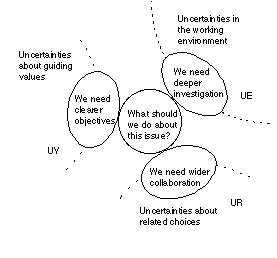
uncertainty boundariesThe Decision AreaThe Comparison AreaThe Uncertainty Area – divides into three broad categoriesUncertainties to do with the working environmentUncertainties to do with guiding valuesUncertainties to do with related choices
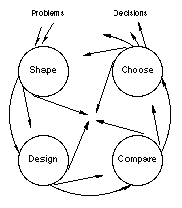
four modes of strategic choiceThere are four modes of strategic choiceShapingDesigningComparingChoosing

Software

The Strategic Choice Approach was originally developed using flip charts and wall space, however, a software package called “Strategic Advisor” or “STRAD” for short was developed and released in February 1991. The intention of this software package is to support individuals and small groups in the more informal use of the approach.

References

  • Friend, John. “New directions in software for strategic choice”. European Journal of Operational Research. 1992, 61, pp 154-164.
  • Friend, JK. & Hickling, A. “Planning Under pressure: the Strategic Choice Approach”. 1987. Pergamon (Urban and Regional Planning Series, Volume 37). Oxford.

from a selection of ‘decision support tools’

Strategic Choice Approach

Donna Haraway – Wikipedia

Thanks to a recent Cybernetics Society talk by Professor Peter Kawalek, Director of the Centre for Information Management

Donna Haraway

Donna J. Haraway (born September 6, 1944) is an American Professor Emerita in the History of Consciousness Department and Feminist Studies Department at the University of California, Santa Cruz, United States.[1] She is a prominent scholar in the field of science and technology studies, described in the early 1990s as a “feminist and postmodernist“.[2] Haraway is the author of numerous foundational books and essays that bring together questions of science and feminism, such as “A Cyborg Manifesto: Science, Technology, and Socialist-Feminism in the Late Twentieth Century” (1985) and “Situated Knowledges: The Science Question in Feminism and the Privilege of Partial Perspective” (1988).[3][4] Additionally, for her contributions to the intersection of information technology and feminist theory, Haraway is widely cited in works related to Human Computer Interaction (HCI). Her Situated Knowledges and Cyborg Manifesto publications in particular, have sparked discussion within the HCI community regarding framing the positionality from which research and systems are designed. She is also a leading scholar in contemporary ecofeminism, associated with post-humanism and new materialism movements.[5][6] Her work criticizes anthropocentrism, emphasizes the self-organizing powers of nonhuman processes, and explores dissonant relations between those processes and cultural practices, rethinking sources of ethics.[7]

Haraway has taught Women’s Studies and the History of Science at the University of Hawaii and Johns Hopkins University. Haraway’s works have contributed to the study of both human-machine and human-animal relations. Her works have sparked debate in primatologyphilosophy, and developmental biology.[8] Haraway participated in a collaborative exchange with the feminist theorist Lynn Randolph from 1990 to 1996. Their engagement with specific ideas relating to feminism, technoscience, political consciousness, and other social issues, formed the images and narrative of Haraway’s book Modest_Witness for which she received the Society for Social Studies of Science‘s (4S) Ludwik Fleck Prize in 1999.[9][10] In 2000, Haraway was awarded the Society for Social Studies of Science’s John Desmond Bernal Prize for her distinguished contributions to the field of science and technology studies.[11] Haraway serves on the advisory board for numerous academic journals, including differencesSignsJournal of Women in Culture and SocietyContemporary Women’s Writing, and Environmental Humanities.[12][13][14]

Wikipedia continues:

Donna Haraway – Wikipedia

HARI KUNZRU02.01.1997 12:00 PM

You Are Cyborg

https://www.wired.com/1997/02/ffharaway/

ISSUE 9 / NATUREDECEMBER 07, 2019

Donna Haraway at her desk, smiling.
Donna Haraway in her home in Santa Cruz. A still from Donna Haraway: Story Telling for Earthly Survival, a film by Fabrizio Terranova.

A Giant Bumptious Litter: Donna Haraway on Truth, Technology, and Resisting Extinction

https://logicmag.io/nature/a-giant-bumptious-litter/

A Cyborg Manifesto

https://en.wikipedia.org/wiki/A_Cyborg_Manifesto