Start time where you are: Saturday August 13 – 2:00 AM
$15.00
Join Scott Davies for a salon on cybernetics from its foundations to present.
Cybernetics is, according to one of its pioneers, Norbert Wiener, concerned with “Control and communication in the animal and the machine.” Cybernetics is, as its core, the study of feedback models in social and biological systems. While most closely related to systems theory, AI and complexity science, cybernetics can be applied to all manner of topics as varied as biology, economics, management theory and even architecture and the arts.
In this Salon, returning host Scott Davies will provide an introduction and overview to a field of study which is often misunderstood and at times maligned as a result. Starting from its origins in the middle of the twentieth century with Norbert Weiner and the legendary Macy Conferences, through the field’s heyday in the 1960s and 1970s, this Salon will explore the field’s development up to the present day. We’ll discuss the field’s relevance in the modern day and whether this field of study can help provide insight and perspective to the challenges of our day.
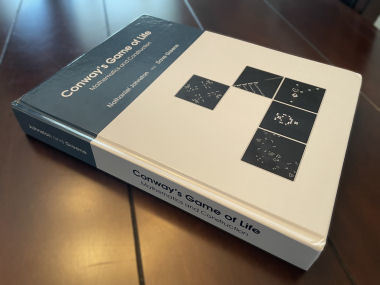
This book provides an introduction to Conway’s Game of Life, the interesting mathematics behind it, and the methods used to construct many of its most interesting patterns. Lots of small “building block”-style patterns (especially in the first four or so chapters of this book) were found via brute-force or other computer searches, and the book does not go into the details of how these searches were implemented. However, from that point on it tries to guide the reader through the thought processes and ideas that are needed to combine those patterns into more interesting composite ones.
While the book largely follows the history of the Game of Life, that is not its primary purpose. Rather, it is a by-product of the fact that most recently discovered patterns build upon patterns and techniques that were developed earlier. The goal of this book is to demystify the…
Biological Robots: Perspectives on an Emerging Interdisciplinary Field D. Blackiston, S. Kriegman, J. Bongard, M. Levin Advances in science and engineering often reveal the limitations of classical approaches initially used to understand, predict, and control phenomena. With progress, conceptual categories must often be re-evaluated to better track recently discovered invariants across disciplines. It is essential to refine frameworks and resolve conflicting boundaries between disciplines such that they better facilitate, not restrict, experimental approaches and capabilities. In this essay, we discuss issues at the intersection of developmental biology, computer science, and robotics. In the context of biological robots, we explore changes across concepts and previously distinct fields that are driven by recent advances in materials, information, and life sciences. Herein, each author provides their own perspective on the subject, framed by their own disciplinary training. We argue that as with computation, certain aspects of developmental biology and robotics are not tied…
#TIL than in 1998, some absolute MAD LADS at the BBC organised for some blind people to touch an elephant 😀
BBC Radio 4 Extra – 90 by 90 The Full Set, 1998: Touching The Elephant
https://bbc.in/3PqNeYA
includes:
“The early ones were literally Nazis who were interned after the war. Concepts like Fuhrer-prinzip had to be cleaned up for US audiences.”
“Cybernetics is later. Systems theory emerged in 1930s Germany, Bertalanffy was in the Nazi party.”
“The pre war categories were often racial, while the post war US work was actively trying to purge all racial and biological characteristics from their conceptions of human agents. Which is why they are often so abstract.”
Creative Systemic Research Platform Instituteis an institution aiming to promote research and development of non-profit projects. We focus on investigating the skills needed for Community Resilience, supported by ecological practices and systemic and creative learning.Existing since 2017 as a non-profit research group, we evolved in December 2020 into the CSRP Institute.
I’m talking about them at the free SCiO — Systems and Complexity in Organisation evening session tonight (18:30–20:30 UK time), and I’m sharing the session with David Ing who is four years into a ten-year ‘systems changes’ journey.
There are many approaches and a lot of words wasted about these topics. Some of it is really good, some of it is risible, and much has little to do with systems thinking or systems practice.
‘Systems Leadership’ can mean anything from systems thinking-informed traditional #leadership to better leadership of an organised set of institutions — like a ‘healthcare system’, to…
David Ing, “Systems Changes Learning: Recasting and reifying rhythmic shifts for doing, alongside thinking and making”, The Journal of Sustaiable Smart Behavior , August 2022, in press
In 2022, the Systems Changes Learning Circle is in its fourth year of 10-year journey on “Rethinking Systems Thinking”. In a contextural action learning approach, the Circle has elevated rhythmic shifts as the feature that both resonates with practitioners in the field, and fits with a post-colonial philosophy of science bridging classical Chinese thought with Western professional practices. This multiparadigm inquiry recasts and reifies the activities of doing (praxis), thinking (theoria) and making (poiesis). The facility with this approach is deepened through three levels: (i) educating of attention, orienting novices towards contrasting modes of thought; (ii) learning for co-relating, lending a way for practitioners to critically appreciate their situations, and (iii) learning for articulating, aiding mentors to guide groups productively through mutual learning.
Citation
David Ing, “Systems Changes Learning: Recasting and reifying rhythmic shifts for doing, alongside thinking and making”, The Journal of Sustaiable Smart Behavior, August 2022, in press
Is the subject of systems change(s), as a whole, distinct from a reduction into (i) systems and (ii) changes? For practice, theory and methods to be authentically rigourous, the philosophy underlying an approach to systems changes can be explicated. An appreciative systems framework surfaces presumptions of (i) what are and are not systems changes; (ii) when, where, and for whom, systems changes are prioritized for attention; and (iii) how systems changes should be addressed. Philosophies of (i) architectural design; (ii) ecological anthropology, and (iii) Classical Chinese Medicine are explored through multiparadigm inquiry, and open theorizing. The resulting influence of these three philosophies is considered, leading to a philosophy of systems rhythms more explicitly proposed as a foundation on which to approach systems changes.
Kenneth Stanley: Why Greatness Cannot Be Planned: The Myth of the Objective
Why Greatness Cannot Be Planned: The Myth of the Objective Kenneth O. Stanley, Associate Professor, University of Central Florida In artificial intelligence and elsewhere, it has long been assumed that the best way to achieve an ambitious outcome is to set it as an explicit objective and then to measure progress on the road to its achievement. Upending this conventional wisdom, a series of unusual experiments in machine learning has shown that, for a broad class of outcomes, the very act of setting objectives can block their achievement. More fundamentally, the same so-called “objective paradox” applies not only in computer algorithms but across many human endeavors: Often, to achieve our highest aspirations, we must be willing to abandon them. As a corollary, collaboration can sometimes thwart innovation by tacitly forcing its participants into an objective-driven mindset. The moral is both sobering and liberating: We can potentially achieve more by following a non-objective yet still principled path, after throwing off the shackles of objectives, metrics, and mandated outcomes.
Our global civilization faces multiple systemic threats.The inevitable deeply disruptive transition will lead…EITHER to untold pain and suffering – via chaosOR (maybe) to a New Era – via conscious evolution.On this site, we curate the content of some of the people and organizations who are consciously working directly or indirectly on Humanity’s Transition.Watch the video to learn more, and please Support Us if you can.Explore. Learn. Inform your decisions.



 Systems Community of Inquiry
You must be logged in to post a comment.