
Connecting lived experiences of systems conveners in governancewith Paula Chies Schommer and Rachel Gondo
Connecting lived experiences of systems conveners in governance | by Florencia Guerzovich | Jun, 2022 | Medium
Author Archives: antlerboy - Benjamin P Taylor
Nervous System: Cybernetics and the Birth of Computer Ethics | Legaltech News
COMMENTARYNervous System: Cybernetics and the Birth of Computer EthicsThe origin of the idea of ‘cyber’ wasn’t just about security, but rather ethics and psychology. This month’s history of cybersecurity examines the work of American mathematician and physicist Norbert Wiener and the beginnings of ‘cybernetics.’June 08, 2022 at 10:00 AM 6 minute readInnovationBy David Kalat, BRG
Nervous System: Cybernetics and the Birth of Computer Ethics | Legaltech News
A really nice little article that it is worthing signing up to get past the sign-in wall (free) to read.
The Centre for Systems Studies at the University of Hull (UK) – Systems Approaches to Child Protection Wed, Jun 22, 2022 3:00PM BST
Systems Approaches to Child ProtectionWed, Jun 22, 2022 3:00 PM – 5:00 PM BST
Registration
On Facebook, Gerald Midgley says:
The Centre for Systems Studies at the University of Hull (UK) is hosting a seminar with two presenters at 3-5pm (UK time) on Wednesday 22 June. The focus will be ‘SYSTEMS APPROACHES TO CHILD PROTECTION’. Details of the two talks are below. Please register for the event at this web site: https://attendee.gotowebinar.com/regi…/1237358922890229259
‘TRANSFORMING THE RUNAWAY CHILD PROTECTION SYSTEM’, by Andy Bilson (University of Central Lancashire).
The child protection system in England is in runaway mode. Child protection investigations have tripled, whilst the number of child deaths and children found to have been physically or sexually abused is little changed. The system impacts on a considerable proportion of children, and has become increasingly investigative and focused on parental shortcomings (what has been termed ‘institutionalized parental blame’). The number of children separated from families has increased dramatically, and the costs of placement are soaring, so no funds remain to offer help to families. Can a systems approach to the use of research, especially one that makes oppressed groups visible, reverse these trends? Andy Bilson will present his work so far, and open a conversation about the way forward.
‘THE CREATIVE AND FLEXIBLE APPLICATION OF SYSTEMS METHODOLOGIES FOR CHILD PROTECTION: A CASE STUDY FROM INDIA’, by Rajneesh Chowdhury (University of Hull).
Although at the policy level, India is committed to providing a safe, just and equitable environment for children, there is little evidence that such commitments have effectively trickled down to having real, on-the-ground impacts. Several organizational, administrative and competency-related issues pose serious impediments to the operation of the institutional structures that protect and uphold children’s rights and child protection in India. Poverty and lack of awareness are significant factors that lead to violations of children’s rights. This presentation will explore the application of systems methodologies in a creative and flexible manner to design an intervention for children’s rights and child protection in India. A case-study with the Universal Team for Social Action and Health (UTSAH), a non-governmental organization (NGO) specializing in child protection, will be discussed. The intervention was designed around the deployment of Critical Systems Heuristics (CSH), which helped in unfolding and increasing understanding of tensions in the system; gaps between what ought to happen and what actually happens; the challenges of social inclusion and exclusion; and the lack of clarity about the stakes that stakeholders have, and what their issues are. The intervention design involved the application of CSH with two tools: CATWOE (a mnemonic for Customers, Actors, Transformation, Worldview, Owners and Environment) from Soft Systems Methodology, and an assumption-surfacing tool from Strategic Assumption Surfacing and Testing. A program of action was designed through this intervention, which will be presented in two phases: the first phase has already been implemented, and covers children’s rights and child protection case management, police reforms and community sensitization; the second phase is planned to begin soon, and covers a visionary fellowship program for senior-level police officers and managers to address system change. A reflection on the case will be provided in light of Holistic Flexibility, a conceptual lens in systems thinking that calls for greater creativity and flexibility in systems thinking and practice.
Once again, here is the link for registering for the event: https://attendee.gotowebinar.com/regi…/1237358922890229259
June 21 and 22, Solstice Soirée(s) — Illuminate Systems
JUNE 21 EVENT
We invite you to come reflect, connect, celebrate (y)our wins, set intentions, and honor the solstice together. There will be time to learn more about Illuminate and network collaborations and what’s on the horizon for our collective work towards systems change for a just, equitable and regenerative future for all. Hear from some of your network comrades about their involvement and vision for this workConnect and reflect with others working to transform some of today’s most complex challengesLearn about existing and emerging opportunities to deepen our collective (un)learning and actionWe will be offering the Soirée on two different days and times to accommodate multiple time zones. Speakers and content may vary. You are welcome to attend both!
*Note that the event on the 21st and 22nd have unique registration links*
Link June 21 Solstice Soirée — Illuminate Systems (and 22 June link is available there too) – explore if you want to joint the Illuminate systems change community (it’s free)
Synthesis Map Expo 2022 #1 from OCADU – Systems Thinking Ontario Mon, Jun 13, 2022 at 6:30 PM EDT online
Jun 13Synthesis Map Expo 2022 #1 from OCADU — Systems Thinking Ontario
by David Ing
Mon, June 13, 20226:30 PM – 8:30 PM EDT
Online
One in a series of presentations of synthesis maps created in systemic design courses at OCADU graduate programsAbout this eventSynthesis maps are rich visualizations that illustrate the real-world complexity of systemic challenges, and typically used to not only “map system problems” but to propose design recommendations for systems change and policies (from health to public policy, from service experiences to social change) from evidence gathered in stakeholder research. Policymakers and organizational stakeholders use synthesis maps for strategic advising, long-term planning, and considering interventions for social and systemic challenges (wicked problems).Please see: https://wiki.st-on.org/2022-06-13 for more detailsOpen-minded novices and learners are always welcomed. We’ll try to keep the conversations understandable by the layman, and entertain questions for clarification.To be notified of future sessions, please join the Google Group: http://bit.ly/st-on
Synthesis Map Expo 2022 #1 from OCADU — Systems Thinking Ontario Registration, Mon, Jun 13, 2022 at 6:30 PM | Eventbrite
The Fin Ray® Paper Kit – Technology for schools – Learning Systems – Festo Didactic
The Fin Ray® Paper KitTail fins of bony fish do not bend away from the compressive force – as would be expected – in the event of a compressive load, but instead bend in the direction of the compressive force. This initially surprising feature enables highly efficient force transmission of the fish to the surrounding medium of water. When the fish moves by flapping its tail, the tail fin assumes the (concave) shape of a ladle (with the open side in the direction of the flapping of the fin). The water volume enclosed by the tail fin is accelerated to the rear, propelling the fish forwards in the process. The adaptive change in shape of the tail fin is a reason for the good force transmission. From a technical point of view, the tail fin of the bony fish is a design which has been optimised in terms of lateral force application in the course of evolution.
The Fin Ray® Paper Kit – Technology for schools – Learning Systems – Festo Didactic
Also https://www.nature.com/articles/ncomms2751
The function of fin rays as proprioceptive sensors in fish
Home – Systems View LAB
Designed and co-facilitated by Fritjof Capra and Jen Mason, the Systems View Lab is an interactive, online learning experience for executive teams who wish to develop and deepen their systems thinking capabilities and explore the applications of a Systems View of Life within the specific context of their organization.
Home – Systems View LAB
Cybernetics Society – President’s Series : Astrobiology and Cybernetics, Wed 15 Jun 2022 at 17:00 UK time
Peter Kawalek takes a look at information while Clément Vidal considers how cybernetics might help in the search for extraterrestrial life
President’s Series : Astrobiology and Cybernetics Tickets, Wed 15 Jun 2022 at 17:00 | Eventbrite
Demystifying systems change – practical action for social change Tuesday, 28 June, 2022 4pm UK time (via Microsoft Teams)
Academy for Social Justice
Academy Online Seminar
featuring
Jo Rogers | Senior Manager | Fulfilling Lives South East
Rebecca Rieley | Senior Manager & Systems Change Lead | Fulfilling Lives South East
Emily Page | Systems Change Project Assistant | Fulfilling Lives South East
How do we instigate, nurture, and achieve systems change? How do we build momentum and shift systems that were previously thought to be too fixed or too big? What systems change methods can be used to achieve better outcomes for those experiencing multiple and complex needs (MCN)?
Join the Fulfilling Lives South East team as they unpack these questions and demonstrate the impact and legacy of the programme’s systems change work over the last 8 years, whilst highlighting the importance of working together in partnership.
In this free seminar, the team will share key highlights from their recently published Ripple Effect reports that take a deep dive into pragmatic approaches for nurturing systems change and shares their perspective on the foundations for systems thinking.
The speakers will also share how they put systems change into practice and draw attention to where they feel support systems still need to change to improve outcomes for people experiencing multiple disadvantage.
This event will be held online via Microsoft Teams from 16.00 to 17.15. For further details or to request your free seminar place please click here: https://www.eventbrite.co.uk/e/demystifying-systems-change-practical-action-for-social-change-registration-352859110097
PLEASE NOTE that places are limited so please be sure you can attend before booking. You must also be an Academy member in order to attend any events. If you are not yet a member you will be prompted to join when registering to attend this event.
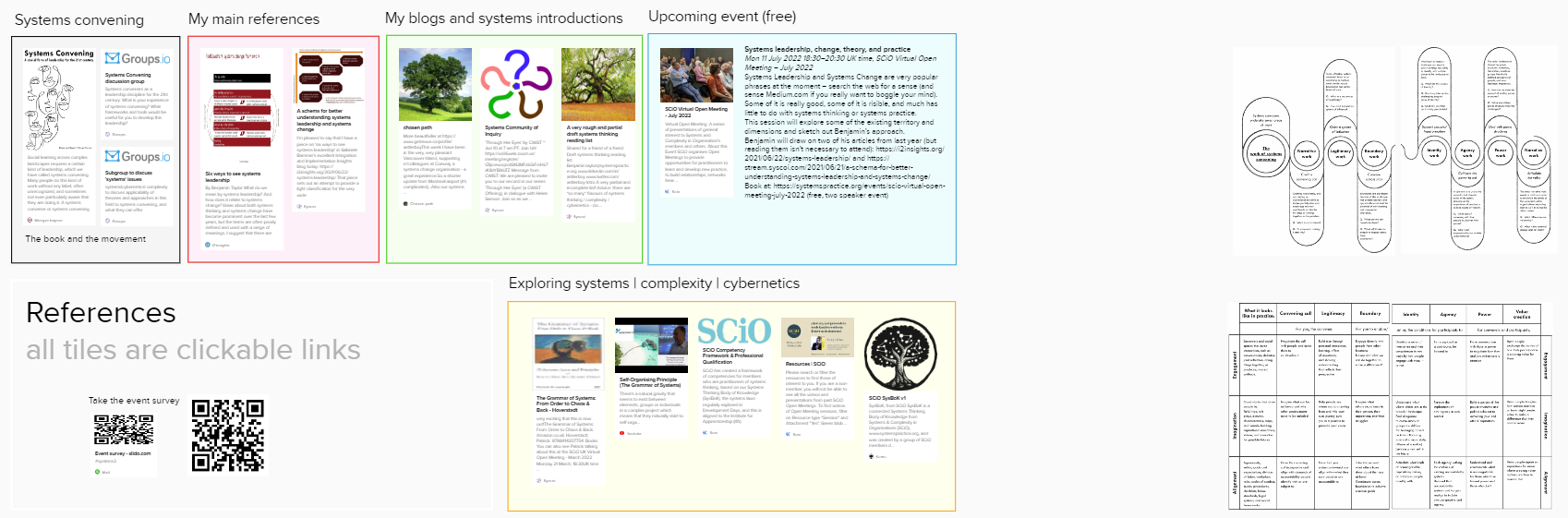
Systems convening, systems thinking, systems practice – Monday 13 June 2022, 12:30pm UK time

As I’m sending reminders to the 80 people (!) who have signed up for this short session, I thought I would remind people here, too.
So, this is the final reminder here that the session takes place next Monday, 13 June at 12:30pm UK time.
The signup link is athttps://us06web.zoom.us/meeting/register/tZEudeGprD0vH9JKdOCaj7utfGUoM5AGVu-r
When you sign up you will get a personal link direct from Zoom – I don’t have access to this link (which may go to your spam), but if you have any problems joining, you can go direct to the signup page and sign up again – doing so after the start time should take you directly in to the zoom.
The session will be recorded and transcribed, and both will be shared with participants and publicly, please do not join if you aren’t comfortable with this.
We will use two tools during the session which are open now…
View original post 72 more words
Improvisation Blog: The Cybernetics of the Trimtab Society
Saturday, 4 June 2022The Cybernetics of the Trimtab SocietyOver the last seven years, I’ve been heavily involved in a medical diagnostic project which unites human and machine judgement. This has always been cybernetic in my mind (and it was cybernetic insights which led to some pretty cool machine learning that sits behind it). It’s about to be commercialised which is very exciting, not least because the technology is applicable to fields far beyond medical diagnostics – education, management, organisational risk and public health are all within scope of potential application.
Continues in source: Improvisation Blog: The Cybernetics of the Trimtab Society
The emergence of polarization in coevolving networks

Jiazhen Liu, Shengda Huang, Nathan Aden, Neil Johnson, Chaoming Song
Polarization is a ubiquitous phenomenon in social systems. Empirical studies show substantial evidence for opinion polarization across social media. Recent modeling works show qualitatively that polarization emerges in coevolving networks by integrating reinforcing mechanisms and network evolution. However, a quantitative and comprehensive theoretical framework capturing generic mechanisms governing polarization remains unaddressed. In this paper, we discover a universal scaling law for opinion distributions, characterized by a set of scaling exponents. These exponents classify social systems into polarization and depolarization phases. We find two generic mechanisms governing the polarization dynamics, and propose a coevolving framework that counts for opinion dynamics and network evolution simultaneously. We show analytically three different phases including polarization, partial polarization, and depolarization, and the corresponding phase diagram. In the polarized phase, our theory predicts that a bi-polarized community structure emerges naturally from the coevolving dynamics. These theoretical…
View original post 35 more words
Searching for Life, Mindful of Lyfe’s Possibilities
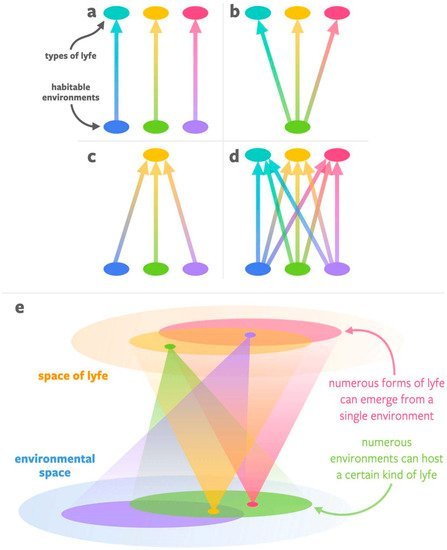
Searching for Life, Mindful of Lyfe’s Possibilities
by Michael L. Wong, Stuart Bartlett, Sihe Chen, and Louisa Tierney
We are embarking on a new age of astrobiology, one in which numerous interplanetary missions and telescopes will be designed, built, and launched with the explicit goal of finding evidence for life beyond Earth. Such a profound aim warrants caution and responsibility when interpreting and disseminating results. Scientists must take care not to overstate (or over-imply) confidence in life detection when evidence is lacking, or only incremental advances have been made. Recently, there has been a call for the community to create standards of evidence for the detection and reporting of biosignatures. In this perspective, we wish to highlight a critical but often understated element to the discussion of biosignatures: Life detection studies are deeply entwined with and rely upon our (often preconceived) notions of what life is, the origins of life…
View original post 115 more words
PRE-LAUNCH: Reclaiming Our Freedom and Accountability with Peter Block | The Great Community Collaborative Tomorrow, June 14:00pm – 5:30pm BST
PRE-LAUNCH: Reclaiming Our Freedom and Accountability with Peter BlockTomorrow, June 14:00pm – 5:30pm BSTZoom MeetingAdd to CalendarGoingMaybeNot Going31 members are goingThe last two years have put many of us in touch with our world differently. Many of us have been given a fresh opportunity to revisit the ways in which, and from where, we work. We are reconsidering the social contract. We are in touch newly with people from around the world. New movements are shaking up old norms. Reconciliation, restoration, and the common good are calling out for our attention.We can reclaim our capacity to produce our own wellbeing in our communities, workplaces, in our faith, schools, journalism, art, and architecture. Peter Block, author and convenor, suggests that most activists believe a change in leadership will change things. He doesn’t agree. Just as he believes the reader writes the book, so do the people create their leaders.Beginning this coming September, Peter will be alongside us for a year-long exploration of the world we live in now, what we don’t understand, and the philosophic insights that can guide us in producing together the world we wish to live in. For two hours on the first Wednesday of the month, we’ll put Peter on the Spot with what’s alive in our worlds and so catalyze lively reflection and dialogue amongst us.There is nothing as practical as a good theory. During our series, we will make visible where the common good is occurring right now, where the theory is in practice. All of this aids us in moving towards what is possible.Join us for this, the first of three FREE pre-launch conversations to hear more about our plans, reflect on possibilities, and to shape the conversations to come. Simply click on the ‘Going’ button above to RSVP, you will then have access the meeting link.
PRE-LAUNCH: Reclaiming Our Freedom and Accountability with Peter Block | The Great Community Collaborative
How the Brain ‘Constructs’ the Outside World – György Buzsáki
How the Brain ‘Constructs’ the Outside WorldNeural activity probes your physical surroundings to select just the information needed to survive and flourishBy György Buzsáki on June 1, 2022Scientific American June 2022 Issue
How the Brain ‘Constructs’ the Outside World – Scientific American
 Systems Community of Inquiry
You must be logged in to post a comment.