Thank you for registering for the Catalyst 2030 “Beyond the Bounds of your Organisation: Systems Influencing and Why it Matters” workshop that happened last Friday. It was wonderful to be able to collaborate with those who made it!
Here are a few follow up items from the workshop:
You can access the chat and slides from the session in this folder here.
You can access the video recording on the Catalyst 2030 YouTube here.
It’s not too late to register for other workshops hosted by Catalyst 2030. Join us at 16:30 CET today for our first “Fundraising Masterclass: Demystifying the Complexities of the Funder Landscape” by registering here.
This is a message from me (Benjamin/@antlerboy) on a personal basis – I’m very excited about this!
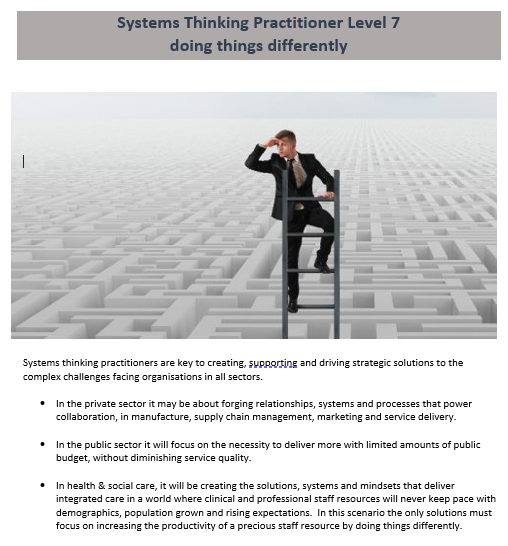
Everyone from the United Nations to the OECD to old bastions of management thinking like Harvard Business review recognises that systems hinking and handling complexity are the key skills for the future.
Can these skills — which are so core to innovation — be formalised? Professionalised?
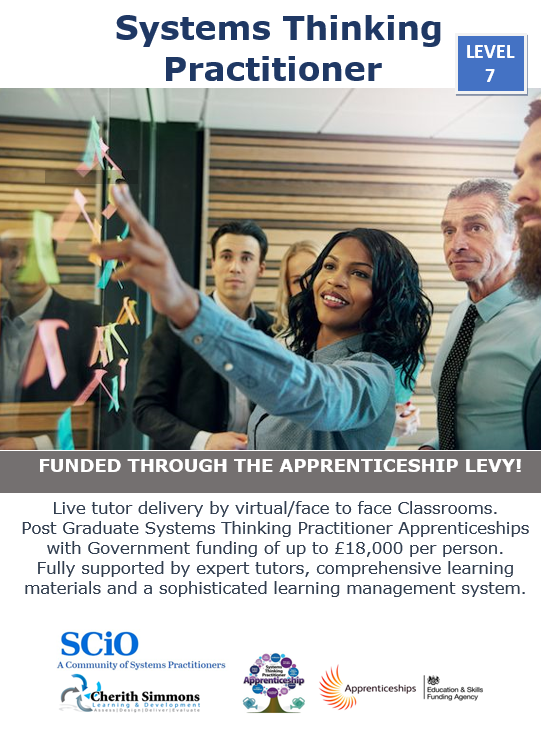
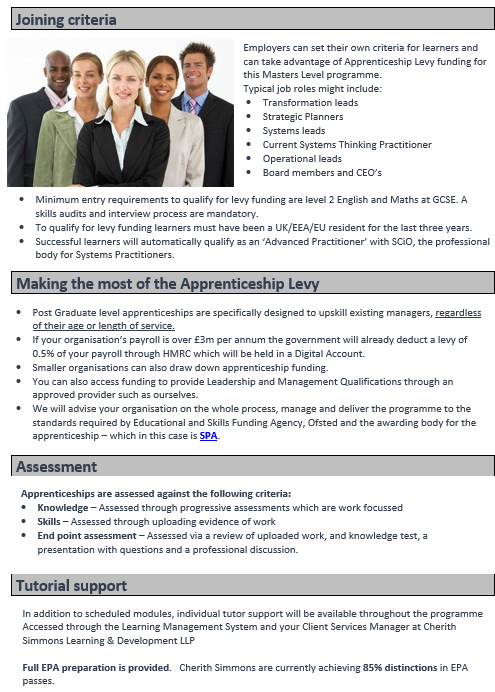
We’re supplying world-class systems practitioner-tutors and supporting curriculum and approach for Cherith Simmons Learning and Development who provide the Level 7 Systems Thinking Practitioner Apprenticeship.
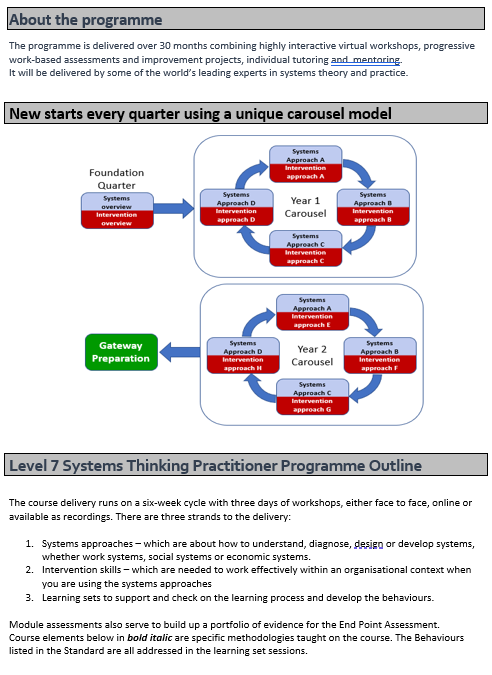
For those in England and Wales, this opens up the potential of this two-and-a-half year, day release, post-graduate qualification with government funding of up to £18,000 per person, fully supported by expert tutors, comprehensive learning materials, and a learning management system that actually supports learning.
There are many risks and issues with professionalising a field, of which we are well aware.
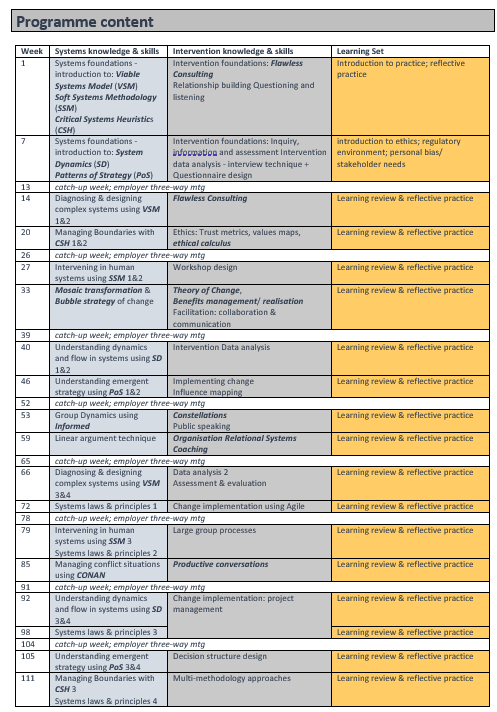
This is a practice-based, portfolio assessed programme which draws on core systems approaches and practice skills, where you’ll be supported in your job to actually put the learning into practice right away — and evaluated on how you do so, and how you build in continual learning.
I think it’s a real breakthrough — and just the start of a new phase of creating more and more serious systems practitioners, more and more recognition — and more impact on real human challenges.
What could you do with a recognised system thinking practitioner qualification, and support from world-class experts to take your work to the next level?
Other apprenticeship providers are available — this is only part of the start of much wider professional capability development.
And if you aren’t eligible for post-graduate adult apprenticeships in UK and Wales, don’t worry! Both Cherith Simmons and SCiO direct will be offering versions of the core training from the apprenticeship much more widely — you can also seek professional accreditation from SCiO for your portfolio of systems practice work: https://systemspractice.org/page/scio-competency-framework-professional-qualification
I have recently been reading upon the renowned British-American architect and design theorist, Christopher Alexander.
Alexander is known for the idea of pattern languages. A pattern is a collection of a known problem discussed with a solution for the problem. As Alexander explains it:
Now, a pattern is an old idea. The new idea in the book was to organize implicit knowledge about how people solve recurring problems when they go about building things.
For example, if you are building a house you need to go from outside to inside and there are centuries of experiments on how to do this in a “just so” way. Sometimes the transition is marked not by just a door but by a change in elevation (steps, large, small, straight, or curved), or a shaded path, or through a court yard.
We wrote up this knowledge in the form of a pattern about entrance…
Join Murray Robinson and Shane Gibson in a conversation with Alidad Hamidi about Systems Thinking. Systems Thinking is about understanding that the whole is greater than the sum of the parts. It is the interactions between things that drive the outcome. For example, cutting costs locally often increases costs globally. One person’s solution is often another person’s problem. To solve the real problem, we need to bring people together to agree on the issue, the goal and the scope of the system. Then we need to keep asking why until we can create a model of how everything interacts. Then we can design a solution, try it out and see what happens to the system as a whole. As we are doing this, we need to look at the interactions between our system and other systems. And we need to look outside the agile community for ideas and solutions.
Annual Mike Jackson Lecture5 April 2022The Fifth Discipline: Making the Future a Friendly Place for HumankindThe Centre for Systems Studies is delighted to announce the 2022 Annual Mike Jackson Lecture on Systems Thinking, which will be delivered by Dr Peter Senge, the internationally acclaimed thought leader, named by the Financial Times as one of The World’s Top Management Gurus.
Defining the Ecosystem Domain: Ecosystems, Arenas and Jobs-to-be-doneHow to map an Ecosystem? Let’s explore how to create a manageable breakdownSimone CiceroMarch 04, 2022
This is lightly edited (so errors all mine) from Keryck/”Mori Totebag” in The Abs-Tract Organization Discord Server (for metamodernist left-wing discussion – see https://abs-tract.org/).
I thought it was particularly interesting because it sweeps in so much, and for the single core concept ‘copoiesis’ (which I can find a *few* mentions of online, in an artistic context).
Post one: semipermeable membranes & autopoesis —mutually reinforced white supremacist systemic institutions
> {re: “White Supremacy as Living System” by Irami Osei-Frimpong
inside and outside, and a membrane, yup
i call that collective (“outside”), autonomy‐agency (“inside”) and prehension‐agency (“semipermeable membrane”)
the outside of white supremacy is White Habitus, the inside is White Chauvinism, and the membrane is White Fragility (though that term is abused) especially in the white family and church (not letting some things in that would challenge their internal dynamics) & blaxploitation (taking in black ppl [and occasional other racialized ppls] into their metabolism then spitting them out when no longer useful to White supremacy).
ppl who aren’t white can start to take on these facets of behavior through coercion, artificial scarcity, the caste system inextricable of capitalism has a way that allows white supremacy to hyperexploit Black ppl (and indigenous, but im focused on Irami’s topic primarily).
Irami Osei-Frimpong – The Funky Academic
White Supremacy: A Living System
Post two: a perhaps “systemic conspiracy” against the co-poetic aspect of human subjectivity
a perhaps “systemic conspiracy” against the co-poetic aspect of human subjectivity, rendering humans ill-equipped to imagine an ethics that fully addresses our basic needs for care, encounter, sharing of trauma, trauma healing, resistance of narcissism, compassion-informed empathy rather than a passive empathy as automatic process that is never given institutional protection and support.
she traces this neglect of copoeisis to monotheism, through Christendom, and into the commodity fetishism that capitalism supplies as our only source of temporary relief of trauma (cheap thrills, so to speak, without consummate humanizing care).
she relates this neglect to the historical subjugation of both pregnancy & human creativity in general to serve the ruling class structures in a way that disarms everyday ppl from resisting dehumanization in ethics, philosophy, economy, art, and even language.
———————COPOESIS + feminism,,,
without robust interdisciplinary and societal/layperson recognition of COpoesis, not just the autopoesis that phallic ideals over-emphasize, ethics & philosophy remain incapable of addressing human affairs appropriately & sustainably
———
anti-abortion & feminine-antagonistic arguments are based on a failure to move beyond classical non-ethical thinking on Life-Drive & Death-Drive, which only think in service of the reproduction of non-human & non-subjects (“life-drive” in Freud is about reproduction of germ cells, “libido” in Lacan is about splitting and cocoons of amoeba & lamella, etc…).
autopoesis by itself fails to take into account the copoeisis that is integral to human subjectivity, whose groundwork is laid by interconnection in late pregnancy (when nervous system is fully formed, but prior to birth) of the pre-subjective affects of people as a social species, through birth and early post-natal catastrophic learning events that shape how humans relate to both other humans, non-humans and themselves as a full subject later on in life.
the prevalence of non-human, un-humanized life-drive (though still relevance) eschew people’s ability to construct ethics that take copoesis, empathy, sharing, the groundwork of subjectivity, etc, into account—rendering these attempted ethics inappropriate and incomplete for human needs and desires.
this is also reflected in language (and what some languages, to varying degrees, don’t adequately symbolize), so our ethics—thus also therapy ethics—and linguistics currently need metafeminist philosophy in order to make sense of the tension between feminist activism & prevailing symbols and concepts regarding gender, pregnancy, femininity, eroticism, choice, subjectivity, needs, etc.
Bracha L Ettinger Metafeminist and Feminist Notes. Oxytocin Mothering the World, London March 2019
Procreate Project
Post three: digital stupor, isolation, narcissism and retraumatization
an effect of this neglect of copoeisis is the addiction to “digital stupor” that prevents us from dealing with trauma together, and leads us to retraumatize ourselves in this stupor and narcissistically compete and attack each other for instant gratification without compassion, in an accelerated space that makes our connection stronger but our interconnection more and more anti-social & incapable of creating spaces of healing or growth for each other (unless we resist the instantaneousness of the very media we use to communicate)
Castello di Rivoli Museo d’Arte Contemporanea
XII. Digital PTSD. The Practice of Art and Its Impact on Digital Trauma | Bracha Ettinger
Comment from Benjamin David Steele
“autopoesis by itself fails to take into account the copoeisis that is integral to human subjectivity, whose groundwork is laid by interconnection in late pregnancy (when nervous system is fully formed, but prior to birth) of the pre-subjective affects of people as a social species, through birth and early post-natal catastrophic learning events that shape how humans relate to both other humans, non-humans and themselves as a full subject later on in life.”
That deeply resonates with me. I’ve never heard the term copoeisis. It is a good term for getting at the intrinsic social nature of humans (and many other species) that is deep within our biology. This can be understood also in terms of epigenetics. I’m often reminded of the mice who were shocked into jumping after smelling a scent and for many generations following the mice kept jumping simply with the scent. The 7 generations of jumping mice would be the equivalent of 2-3 centuries of human society.
Now think about all of the major events and social institutions (from genocide to slavery) that potentially exist within this epigenetic reach of intergenerational trauma. But the same applies for positive changes in recent history, such as increased education and literacy, not to mention the effective treatment of most infectious diseases. This is why progress can only be measured over the very long term. Public health does have immediate effects. And yet policies we implement now might not show their full effect until the centuries following.
Whether for company mergers, for the restructuring of an enterprise, for targeting new corporate markets or for achieving new goals in any institution, the Oroborus Foundation methodically determines the best solution. And it does so quickly, with concrete measures that bring clear results.
In today’s post, I am looking at the Ohno Circle in light of Heidegger’s ideas. I will try to stay away from the neologisms used by Heidegger and will only scratch the surface of his deep insights. One of the best explanations of Ohno Circle comes from one of his students, Teruyuki Minoura, the past President and CEO of Toyota Motor Manufacturing North America, Inc. He had a first-hand experience of it. Minoura noted:
Mr. Ohno often would draw a circle on the floor in the middle of a bottleneck area, and he would make us stand in that circle all day long and watch the process. He wanted us to watch and ask “why?” over and over.
You may have heard about the five “why’s” in TPS. Mr. Ohno felt that if we stood in that circle, watching and asking “why?”, better ideas would come to us. He realized…
Stewart Brand@stewartbrandChris Alexander is gone. I owe him a great deal. Many do.For me it began with his NOTES ON THE SYNTHESIS OF FORM in 1964, soared with A PATTERN LANGUAGE in 1977, and culminated with all the help he gave to my HOW BUILDINGS LEARN (1987-1994).
Chris Alexander is gone. I owe him a great deal. Many do.
For me it began with his NOTES ON THE SYNTHESIS OF FORM in 1964, soared with A PATTERN LANGUAGE in 1977, and culminated with all the help he gave to my HOW BUILDINGS LEARN (1987-1994).


 4,868Downloads30Episodes
 Systems Community of Inquiry
You must be logged in to post a comment.