
Author Archives: antlerboy - Benjamin P Taylor
UK Level 7 Systems thinking practitioner apprenticeship / Institute for Apprenticeships and Technical Education
SYSTEMS THINKING PRACTITIONER
Systems thinking practitioner / Institute for Apprenticeships and Technical Education
As providers start to train the first apprentices, a good time to refresh on this. The specification and requirements for the post-graduate-level apprenticeship (which doesn’t have a specific degree requirement) are above.
The official providers page is:
https://findapprenticeshiptraining.apprenticeships.education.gov.uk/courses/556
Providers I know of:
- JGA: https://www.jga-group.com/systems-thinking-practitioner-apprenticeship-level-7/
- Cranfield: https://www.cranfield.ac.uk/about/masterships/masterships-courses/systems-thinking-practitioner-standard
- Exeter: https://www.exeter.ac.uk/study/degreeapprenticeships/programmes/systemsthinkingpractitioner/
- The Open University: https://www.open.ac.uk/business/apprenticeships/higher-and-degree-apprenticeships-england/systems-thinking-practitioner (video: https://www.youtube.com/watch?v=Vn36gjj5ixI)
- Birmingham: https://www.birmingham.ac.uk/university/colleges/socsci/bli/programmes/systems-thinking-leadership-da.aspx
- Together Training: https://www.togethertraining.co.uk/systemthinkingpractitionerlevel7
- UK College of Business: https://www.ukcollegeofbusiness.org/courses/systems-thinking-practitioner/
- Skills Training UK (can’t find specific link): https://www.skillstraininguk.com/apprenticeships-16-65
Declaration of interest: I’ve been in the second or third tier of people who have supported this process from professional qualification to Trailblazer Committee to setting up the apprenticeship proper, and am on the board of SCiO http://systemspractice.org/ which is the professional body, will be the ‘end point assessor’ through an arms-length company, and is providing skilled trainers on an agency basis and curriculum input at least one provider.
Navigating from system mapping to innovation portfolios: a look at the transition to Circular Economy in the Western Balkans – Transitions Hub
Navigating from system mapping to innovation portfolios: a look at the transition to Circular Economy in the Western Balkans
Navigating from system mapping to innovation portfolios: a look at the transition to Circular Economy in the Western Balkans – Transitions Hub
ABCD: Origin and Essence by John McKnight – Nurture Development
ABCD: ORIGIN AND ESSENCE BY JOHN MCKNIGHT
ABCD: Origin and Essence by John McKnight – Nurture Development
Key papers:
Mapping for Emergence – Emerge
source
Mapping for Emergence – Emerge
THEO COX, RUFUS POLLOCK AND ANNA KATHARINA SCHAFFNER
MAPPING FOR EMERGENCE
Life Itself and Emerge will join forces to map the emergent metamodern ecosystem. But what is so great about social network mapping? Why does it matter, and how can it help?
INTRODUCTION
Life Itself and Emerge are excited to be joining forces to map a social change ecosystem emerging in recent years. In this, we are building on our existing work, for example Life Itself’s recently released State of Sensemaking directory and its earlier reports and Emerge’s portfolio of insight essays and profiles.
The ecosystem is still emerging and ill-defined. Reflecting this, there has been no clear name for it. For now, we are using the label “Metamodern” – though we remain mindful of the variety of existing options e.g. the sensemaking web, the metamodern movement or meta tribe, the liminal web, the ten tribes of transformation, the intellectual deep web, and the Emergentsia.
Why MapWhy map in the first place? What is so great about mapping, when we are already culturally inclined to mistake our many existing maps for the territory?
Geographic maps help to orient ourselves in the physical world. Social network mapping does the same in the social space. It makes networks visible to themselves and to the outside world. This has important benefits: actors can understand their position within and relationship to the larger network. They can find others. And people outside these networks can see that actors are not lone warriors but part of something bigger with discernible and shared features.
Going further, maps can reveal and visualize the deeper patterns that connect. This can be catalytic – understanding the wider system in which we are embedded, as well as the broader cultural shifts, trends and developments in which we partake, can enhance our self-understanding, facilitate new relationships and create points of connection of which we may not previously have been aware.
Moreover, maps can catalyze coherence. While many social change pioneers are working to counter social fragmentation, ironically, the social change space itself is highly fragmented. This fragmentation leads to a loss of energy, resources and effectiveness. We, too, need to find better ways to collaborate and to divide work between us – for our goals are complex and momentous. This can mean working together on specific initiatives, or identifying what are our unique gifts to the space and what, perhaps, we can pass to others. Thus, in addition to enhancing our self-understanding and strengthening our identity inside and out, mapping can help catalyze a more cohesive and focused approach in the way we work with each other.
CONTEXT: A NEW ECOSYSTEM IS EMERGING
We sense that a new ecosystem, or ecosystem of ecosystems, is emerging. A growing number of people, organizations and initiatives are taking alternative approaches to social change, which diverge from and go beyond the more established spaces in civil society and the social economy.
The ecosystem as we understand it is highly heterogeneous – even disparate. However, there are commonalities. The most basic common denominator is the belief that social change should be paradigmatic, integrated (e.g. inner and outer transformation must go hand in hand) and engaged.
We also see emerging commonalities in key views which we have termed: post-individualism, (w)holism and culture-making (in the form of new norms and narratives).
There is also a focus on complexity, systems and emergence, on developmental models, spirituality and practice, and on sensemaking, different forms of knowledge and what Indra Adnan calls ‘cosmo-local’ activism. Other commonalities include an interest in decentralized governance, new narratives, alternative social imaginaries and regenerative culture.
Nonetheless, the boundaries, relationships and patterns of influences in the ecosystem remain blurry, with our present awareness feeling like it only touches the tip of the iceberg. Questions that remain unclear include who exactly comprises the ecosystem, how activities and visions relate to one another, where the coherences and tensions lie and how it might evolve.
AN OPPORTUNITY: HOW MAPPING MATTERS
Charting this new territory is valuable for two main reasons. First, and most importantly, mapping makes it identifiable and visible. This supports engagement with the broader “mainstream” which is vital as we move from philosophizing about social transformation towards taking the kinds of action that make it a reality. Second, it helps the ecosystem’s coherence, cohesiveness and self-awareness. This supports connection both within and without the space leading to greater and better collaboration. It supports a better division of labor meaning greater efficiency and effectiveness . And, finally, it supports members to situate themselves and their work in a broader context.
Mapping makes the ecosystem identifiable and visible
We take each of these two points in turn. Mapping provides the ecosystem with a coherent identity, allowing a visible whole to emerge from what can otherwise seem like disconnected parts. What can otherwise appear as a disparate set of actors is seen as a collective whole, perhaps even a budding movement. This will give a more concrete access point to interested outside parties and early adopters, making it easier for others to discover and engage with this ecosystem and its constituents.
Following from this, the ecosystem presents a more coherent and united front when engaging with external actors such as funders, academics and policy-makers. This boosts the credibility and effectiveness of our shared efforts.
Finally, this ecosystem as a space of integration contains multiple important convergences of both ideas and effort. One example: the convergence of complexity science, evolutionary biology and cognitive science support the insights of ancient wisdom traditions around interbeing and interdependence. However, these convergences are not very visible, especially to those outside the space (in part, due to varying terminology etc). In mapping the ecosystem, these convergences in ideas, efforts and practices become visible. This connects the ecosystem to the broader landscape and also brings insights and coherence more widely. Concretely, this reduces the duplicative work of repeated explanation and legitimation currently undertaken by many aligned actors, particularly as they attempt to secure funding or achieve impact in more mainstream contexts.
Mapping brings coherence and cohesiveness
This brings us to our second major point: helping the ecosystem to become more self-aware will increase the capacity of its members to achieve their goals. Here, a mapping effort enables actors to connect and collaborate better with others doing related work. It also helps them situate themselves and their activities in a broader context. The result of this will be greater consistency and division of labor across individual organizations and actors, fostering an increased willingness to collaborate and play to our unique advantages.
At present, many actors in the space hold a vague awareness that there are others out there doing similar work to theirs. Perhaps, they even have a sense of who they may be. However, in many cases, this is about as far as this understanding goes, meaning efforts are often duplicated and strategies are not aligned as effectively as they could be.
Similarly, many of us feel compelled to engage in a large and often quite disparate number of activities, from hosting events and creating media to undertaking research and developing practice. Closer connections and awareness of specialisms within the ecosystem is the first step to facilitating greater focus at the level of individual organizations, opening the possibility for collaboration around certain areas to replace formerly ‘in-house’ activities. This would enable more resources to be directed at what each of us do best, allowing us to become more cause-oriented. Ultimately, greater focus and collaboration are key to realizing our shared visions.
VISION FOR THE INITIATIVE
The nature and the scale of our goals for this mapping initiative make collaboration a key to success. Life Itself and Emerge are excited to be working together to scale and develop this work and welcome the participation of others. We also want to ensure it can be as useful as possible to the wider ecosystem – not just an academic exercise.
Life Itself has already started with the launch of a directory and analysis of the ecosystem. Together we will continue to add new organizations. We will start to supplement these with personal profiles of key actors in the ecosystem. In that way, we hope that the directory can also function as a ‘who is who’ in the space for those who want to learn more about it.
In the more medium term, we want to add more analytical depth to the map. Our current ideas include analyzing trends in key concepts and ideas over time, mapping where organizations sit relative to one another based on core characteristics, and perhaps even charting their roles and functions within the ecosystem.
We also envisage this as a ‘mapping plus’ effort where we reflect critically on how and why we do the mapping, what exactly it is that we are mapping and how we can explain and put into a broader historical context the trends and synergies we see emerging.
GET INVOLVED
Finally, we would love to receive input and contribution at this early stage. If you would like to provide suggestions or get involved then please head over to https://ecosystem.lifeitself.us/contribute. Here are some of the ways to help out:
+ Provide feedback on the project so far, or ideas about which features or foci you think would be most useful going forward.
+ Suggest organisations to add (or improvements to current entries – especially on your organization!).
+ Coding and design on the project backend and visualizations.
+ Let us know if you wish to work more directly on the project, or are already undertaking work which you think would be complementary.
+ Resourcing: We would welcome the sharing of any opportunities for resourcing, or offers of direct support! We are currently undertaking the project using only our own internal resources, which limits the scope and speed of our activities. Additional resources could make a big difference to sustaining and expanding this work.
We look forward to hearing from you, and hope you can continue to join us as we venture forward to chart this new and exciting territory.
MAPPING FOR EMERGENCE
Mapping for Emergence – Emerge
Job: Senior Research Assistant in Systems Thinking, Faculty of Business and Law, Northumbria University
source:
Senior Research Assistant in Systems Thinking
Senior Research Assistant in Systems Thinking
Faculty of Business and Law
We are seeking to recruit a researcher with expertise in systems thinking and communications to work at Northumbria University’s Business School as part of the Complexity and Learning research interest group to support a range of projects.
The researcher be immersed in the cross-disciplinary environment of the group’s leads Hannah Hesselgreaves and Rob Wilson and to conduct collaborative research that addresses issues of systems and complexity thinking in local places. The researcher will also work closely with the Centre’s external partners, who will provide real-world contexts and settings in which our research will be communicated.
For this post, we are seeking a researcher with expertise in systems thinking, communications and project management. It is expected the successful candidate will have a PhD (or equivalent experience) in the systems area or a closely related field, and will have a track record or interest in relational systems approaches to public services. You will have an emergent record of organisation and publication in relevant conferences and journals in these fields. Since the research conducted across the group is highly collaborative and applied, ideally the successful candidate will have experience of working within the field of public service reform or/and demonstrate a strong network in relation to them. Excellent communication skills and ambition to collaborate across disciplines and to wider stakeholders, as well as familiarity with both quantitative and qualitative research methods is essential.
It is expected that there will be a need to travel around the UK and the North East of England for short periods in order to work with partners and to conduct engagements and studies, although this is highly dependent on the restrictions related to the COVID-19 pandemic. Occasional weekend work may also be necessary but compensated for in time off elsewhere.
For an informal discussion about the post, please contact Professor Rob Wilson (Rob.Wilson@northumbria.ac.uk).
To apply for this vacancy please click ‘Apply Now’, and submit a covering letter, CV including research /education statements, and grants and publications list. Please highlight your highest quality research outputs up to a maximum of 4. In addition, candidates are asked to provide copies of the top 2 research outputs (Journal / book chapter /practice-based portfolio). Where possible candidates are asked to combine all of these documents into a single file.
If you are successful in your application for this role, you will be employed by Northumbria University Services Limited. Further details can be found at https://www.northumbria.ac.uk/work-for-us/nu-services-limited/
Northumbria University takes pride in, and values, the quality and diversity of our staff. We welcome applications from all members of the community. The University holds an Athena SWAN Bronze award in recognition of our commitment to improving employment practices for the advancement of gender equality and is a member of the Euraxess network, which delivers information and support to professional researchers.
Please note this vacancy will close on 03/01/2022APPLY NOW
Further information
Job info
Faculty of Business and Law
Ref: BAL/21/9812
Salary: £28,981 – £35,223
Location: Newcastle upon Tyne
Grade: 5
Closing date: 03/01/2022
Contract Type: Fixed Term For 6 Months
Working Type: Part Time Wednesdays-Fridays
Senior Research Assistant in Systems Thinking
Senior Research Assistant in Systems Thinking
Complex Change in a Complex Environment | Debbie Sorkin
Complex Change in a Complex Environment Dec 9, 2021
Complex Change in a Complex Environment | Leadership
Socialist Cyborgs
Socialist Cyborgs Victor Petrov How Bulgaria tried—and failed—to save communism by computerizing the 1980s generation.
Socialist Cyborgs
The Cybernetic Ethos of Cryptocurrencies – Doria (2020)
The Cybernetic Ethos of Cryptocurrencies: Economic and Social Dimensions Doria, Luigi.Partecipazione e Conflitto; Milan Vol. 13, Iss. 1, (2020): 384-408. DOI:10.1285/i20356609v13i1p384
The Cybernetic Ethos of Cryptocurrencies: – ProQuest
Also at
http://siba-ese.unisalento.it/index.php/paco/article/view/21994/18566
Which leads me to the definition of ‘cybernetization’:
https://second.wiki/wiki/kybernetisierung
And (via the source, Evgeny Morozov)
also leads me to
https://www.the-syllabus.com/about
which (published also by Morozov) looks deeply cybernetic..
notes and links from ‘When meaning loses its meaning’, with Nora Bateson & Dave Snowden
Original post was here:
Update email with links etc:
| We’d like to start by saying a huge thank you to all who either attended or listened back to the conversation between Dave and Nora last week. For those of you with the URL open awaiting an opportune moment to listen in, you’re in for a treat! “The margins of meaning… is where novelty emerges” During this first open dialogue, Nora and Dave weaved a concoction of theory, practice, and of course story around the “necessary blur” and ambiguity required in the exploration of living systems. Tracing the frictions around attempts to remove uncertainty through organisational complexity and the sometimes trivialisation of the body of theory as it transfers across contexts, they entangled and disentangled concepts and mobilising metaphors such as “abduction”, “hope” and “rigour” through culture, time and place. |
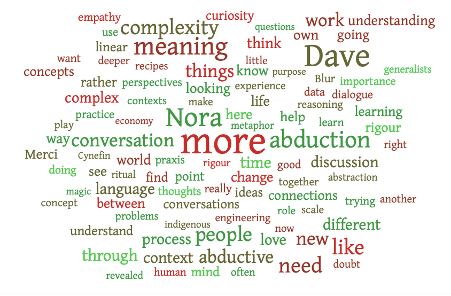
| Unsurprisingly, although the chat function was switched off – due to the numbers of those attending and the desire to allow people to fully focus in – there was a lovely buzz in the Q&A, as can be seen in the wordcloud below. For those of you who shared comments and questions, we have these saved and will be using them to guide future conversations… so please watch this space and we will follow up very soon with the next event. |
| For now, we share a list of references mentioned for you all to get your teeth into. Charles Sanders Peirce, the original reference on the abductive process. This is an encyclopaedic source, but his original writings are easily discoverable for anyone who wants to dig deeper: The children’s party story and how we all know how to deal with complexity in daily lifeThe NHS Sensemaking Series Part one: Foundations for Complexity with Nora Bateson and Dave Snowden Jürgen Moltmann, Theology of Hope: On the Ground and the Implications of a Christian Eschatology, translated by Margaret Kohl Hope without Optimism by Terry EagletonGregory Bateson on abduction, from Mind and Nature; A Necessary unityWarm Data Lab and People Need People (online) training with Nora Bateson: https://warmdatalab.net/ Warm Data and Iced Lemonade: A deeply human response to complexity is possibleEva Jablonka on epigeneticsBook extractFree-to-access paper published by the Royal Society: The Journey (film)Small changes around climate change: The project that started it alland the Cynefin Centre climate change programmeR. S. Thomas, The Bright FieldDavid Graeber and David Wengrow, The Dawn of EverythingA New Word to Describe an Aspect of Living Systems: Aphanipoiesis by Nora BatesonSymmathesy: a word in progress by Nora Bateson. Proceedings of the 59th Annual Meeting of the ISSS 2015. Flexuous curves: Flexuous focusFlexuous flightReference on the Numinous: Rudolf Otto and The Idea of the HolyIntroduction to poetry, by Billy CollinsExaptation Boisot on abstraction and codification To finish with a lovely reminder from Nora: “life is not like a wristwatch”, so let’s all take a leaf out of Alice’s book and keep ourselves open to as many impossible things before breakfast as we “possibly” can…until we meet again (all credit goes to one of our participants for this quote!). |
On Hayek’s “Kinds of Order in Society”
Piece by Donald J Boudreaux:
Original piece:
https://oll.libertyfund.org/page/hayek-on-kinds-of-order-in-society
Systems Sciences | Things thinkers should discuss — four expert systems science views of humanity’s growth trap from ISSS | Jessie Henshaw on Facebook
Things thinkers should discuss — four expert systems science views of humanity’s growth trap. Join ISSS.org, where a real future is taking shape. All systems develop by growth, but do they all grow till they die? Bill Rees – it’s a system, stupid https://vimeo.com/653271779?embedded=true… Joe Tainter – declining innovation https://vimeo.com/653477237?embedded=true… Jessie Henshaw – natural growth https://vimeo.com/621095242?embedded=true… Charlie Hall – limits to growth – https://vimeo.com/621095242?embedded=true…
Systems Sciences | Things thinkers should discuss — four expert systems science views of humanity’s growth trap | Facebook
The Theory of Graceful Extensibility: Basic rules that govern adaptive systems – Woods (2018)
The Theory of Graceful Extensibility: Basic rules that govern adaptive systems December 2018Environment Systems and Decisions 38(5) Follow journal DOI: 10.1007/s10669-018-9708-3 David D Woods
(PDF) The Theory of Graceful Extensibility: Basic rules that govern adaptive systems
The Theory of Graceful Extensibility: Basic rules that govern adaptive systems
- December 2018
- Environment Systems and Decisions 38(5)
- Follow journal
Remembering Ralph Stacey

The following is a longer obituary of Ralph Stacey which was commissioned by Group-analytic Contexts, and which I share here with their permission. It turns in particular on his relationship with the group analytic community, but some of his key ideas about complexity may be relevant for people working in other contexts.
Obituary Ralph Stacey 10/9/42 – 4/9/21

Ralph Stacey, economist, group analyst, Professor of Management at the University of Hertfordshire (UH) for 30 years, and much loved husband, partner, father, grandfather and colleague, died in September this year a few days short of his 79th birthday. His death was sudden and shocking, although for many years previously he had experienced quite chronic ill health. Physically frailer than some in their late 70s, Ralph was nonetheless intellectually robust right till the end. As an internationally renowned academic who developed pioneering ideas about the importance of the complexity sciences…
View original post 3,174 more words
IT’S NOT ALL IN THE NUMBERS: GREGORY CHAITIN EXPLAINS GÖDEL’S MATHEMATICAL COMPLEXITIES
IT’S NOT ALL IN THE NUMBERS: GREGORY CHAITIN EXPLAINS GÖDEL’S MATHEMATICAL COMPLEXITIES
Gregory Chaitin“In any non-trivial axiomatic system,” stated Austrian mathematician and logician Kurt Gödel (1906 – 1978), “there are true theorems which cannot be proven.”
This finding forms the basis of Gödel’s groundbreaking Incompleteness Theorem, demonstrating that the establishment of a set of axioms encompassing all of mathematics would never succeed.
When it was first made public in 1931, the theorem revolutionized the field of mathematics and logic, disproving the prevailing belief that mathematics could be explained with the correct set of axioms.
Gregory Chaitin is at the IBM Thomas J. Watson Research Center in Yorktown Heights, New York. He is the discoverer of the celebrated Omega number, and has devoted his life to developing a complexity-based view of incompleteness. He calls this subject “algorithmic information theory,” and has published eleven books and numerous papers, some of which may be found on his website at http://www.cs.umaine.edu/~chaitin.
Continues in source:
https://web.archive.org/web/20091106003330/http://simplycharly.com/godel/gregory_chaitin_interview.htm
 Systems Community of Inquiry
You must be logged in to post a comment.