Why this social change agent wants you to ‘fail better’ | MIT Sloan

source:

Why this social change agent wants you to ‘fail better’ | MIT Sloan

Why this social change agent wants you to ‘fail better’

by Kara Baskin

 Aug 17, 2021

Why It Matters

Kara Penn learns from “smart mistakes” as she works bringing community development, management, and systems thinking to bear on social issues.Share 

“Improved failure” might sound like an oxymoron. Not for Kara Penn, who explains how bold managers can exploit, design, and use failure as an asset in “Fail Better: Design Smart Mistakes and Succeed Sooner,” which she co-wrote with MIT Sloan senior lecturerAnjali Sastry.Work smart with our Thinking Forward newsletterInsights from MIT experts, delivered every Tuesday morning.Email Address 

As founder and principal consultant at Denver-based Mission Spark, Penn harnesses ideas from community development, management, and systems thinking to improve the social sector — a nod to her previous positions as a counselor at a juvenile detention facility, business advisor to low-income Southeast Asian artists, and nonprofit consultant.

We talked with Penn, MBA ’07, about the power of collaboration, the role of reflection in generating ideas, and why we all need to be systems-thinkers.

Continues in source:

Why this social change agent wants you to ‘fail better’ | MIT Sloan

Complexity Management Theory: Motivation for Ideological Rigidity and Social Conflict – Peterson and Flanders (2002)

Complexity Management Theory: Motivation for Ideological Rigidity and Social Conflict

(10) (PDF) Complexity Management Theory: Motivation for Ideological Rigidity and Social Conflict

Complexity Management Theory: Motivation for Ideological Rigidity and Social Conflict

  • December 2002 Cortex 38(3):429-58

We are doomed to formulate conceptual structures that are much simpler than the complex phenomena they are attempting to account for. These simple conceptual structures shield us, pragmatically, from real-world complexity, but also fail, frequently, as some aspect of what we did not take into consideration makes itself manifest. The failure of our concepts dysregulates our emotions and generates anxiety, necessarily, as the unconstrained world is challenging and dangerous. Such dysregulation can turn us into rigid, totalitarian dogmatists, as we strive to maintain the structure of our no longer valid beliefs. Alternatively, we can face the underlying complexity of experience, voluntarily, gather new information, and recast and reconfigure the structures that underly our habitable worlds.

Systems Thinking and the Jungian Framework – Systems Changes – Open Learning Commons

Systems Thinking and the Jungian Framework

Systems Thinking and the Jungian Framework – Systems Changes – Open Learning Commons

The Impossibility of Automating Ambiguity | Birhane (2021)

The Impossibility of Automating Ambiguity

The Impossibility of Automating Ambiguity | Artificial Life | MIT Press

June 11 2021

The Impossibility of Automating Ambiguity 

Abeba BirhaneAuthor and Article Information

Artificial Life (2021) 27 (1): 44–61

https://doi.org/10.1162/artl_a_00336

Abstract

On the one hand, complexity science and enactive and embodied cognitive science approaches emphasize that people, as complex adaptive systems, are ambiguous, indeterminable, and inherently unpredictable. On the other, Machine Learning (ML) systems that claim to predict human behaviour are becoming ubiquitous in all spheres of social life. I contend that ubiquitous Artificial Intelligence (AI) and ML systems are close descendants of the Cartesian and Newtonian worldview in so far as they are tools that fundamentally sort, categorize, and classify the world, and forecast the future. Through the practice of clustering, sorting, and predicting human behaviour and action, these systems impose order, equilibrium, and stability to the active, fluid, messy, and unpredictable nature of human behaviour and the social world at large. Grounded in complexity science and enactive and embodied cognitive science approaches, this article emphasizes why people, embedded in social systems, are indeterminable and unpredictable. When ML systems “pick up” patterns and clusters, this often amounts to identifying historically and socially held norms, conventions, and stereotypes. Machine prediction of social behaviour, I argue, is not only erroneous but also presents real harm to those at the margins of society.Complexitymachine learningartificial intelligenceembodimentequityracial justice

Systems Change Through Local Economies – conference September 24-26, 2021

SYSTEMS CHANGE THROUGH LOCAL ECONOMIES SEPTEMBER 24-26, 2021 FREE ONLINE CONFERENCE

Systems Change Through Local Economies – Systems Change Alliance

Lee Kee Kok – Life and thought 20210415 – YouTube

In the www.systemschanges.com chat on chat.diglife.coop, David Ing says:

Keekok Lee was interviewed in April 2021 by the Global University for Sustainability, at https://youtu.be/BmaOTvwg2R8?t=3507 . I listened to the whole talk (while bicycling), and have provided the link with the index to 58m27s of a rather long life history running 1h52m40s. I’m a completist, so I didn’t mind the first hour going back about family history (there’s are variations on the surname Lee in Chinese), and hearing about her childhood growing up in Malaysia. Keekok attended the University of Malaya (that would become the National University of Singapore).

At the halfway point of the recording, the question turns to Chinese philosophy, and Keekok going to Oxford U. to study for a B.Phil. She was thoroughly trained in the tradition of analytic philosophy in the British Empire. (She traces the idea that “there’s no such thing as Chinese philosophy” back to Kant, and then chains that forward to Heidegger)

It wasn’t until she retired that Keekok turned to looking into Chinese philosophy. She relates some personal stories (e.g. her son having a spleen injury that was treated by a doctor of Traditional Chinese Medicine who happened to be visiting in Manchester). The net is that the books published by Keekok are relatively recent, well-researched, and don’t require digging back further in history to understand background.

2021/08/09 Normal Accidents, High Reliability, Wicked Messes | Coevolving Innovations

2021/08/09 Normal Accidents, High Reliability, Wicked Messes | Coevolving Innovations

2021/08/09 Normal Accidents, High Reliability, Wicked Messes

Submitted by daviding on Tue, 08/10/2021 – 01:55

Discussion Leader

David Ing

Session Description

The original announcement is at https://wiki.st-on.org/2021-08-09.

Have we learned from brushes with disaster, or have we become complacent about complexities in everyday life?

On March 28, 1979, an accident with a nuclear reactor occurred at Three Mile Island, Pennsylvania. Twelve days earlier, an Academy Awards winning film The China Syndrome had opened with a story fictionalized from a 1975 fire at a nuclear plant in Brown’s Ferry, Alabama, raising public awareness of an issue. For a Presidential Commission on the Accident at Three Mile Island, sociologist Charles Perrow contributed organizational analysis report. On a sabbatical to the Center for Advanced Study in the Behavioral Sciences in 1981-1982, that report expanded to include other high-risk systems, becoming the Normal Accidents book, published in 1984.

continues in source

2021/08/09 Normal Accidents, High Reliability, Wicked Messes

2021/08/09 Normal Accidents, High Reliability, Wicked Messes | Coevolving Innovations

Integral Ecology, and the Laudato Si’ Action Platform – Systems Changes – Open Learning Commons

Integral Ecology, and the Laudato Si’ Action Platform – Systems Changes – Open Learning Commons

Integral Ecology, and the Laudato Si’ Action Platform

Systems Changesecologicalspirituality

daviding20h

Integral Ecology is a term originating from the papal encyclical issued in 2015 under the title Laudato Sí , by Pope Francis. Marina Fischer-Kowalski wrote a short review of an invitation to a June 2019 convention at the Vatican.

Integral Ecology has been picked up in the USA, with “Pope Francis promotes integral ecology to combat ‘culture of waste’” | September 2019 | America (The Jesuit Review) at Pope Francis promotes integral ecology to combat ‘culture of waste’ | America Magazine

continues in source

Integral Ecology, and the Laudato Si’ Action Platform Systems Changes ecological spirituality

Integral Ecology, and the Laudato Si’ Action Platform – Systems Changes – Open Learning Commons

The Cybernetics of Complexity:

Brilliant from Harish.

Harish's avatarHarish's Notebook - My notes... Lean, Cybernetics, Quality & Data Science.

In today’s post, I am looking the second order view of complexity. While I was thinking of a good title for this post, I went from “A constructivist walks into a Complexity bar” to “The Chernobyl model of Complexity”. Finally, I settled with “The Cybernetics of Complexity.” What I am looking at is not new by any means. I am inspired by the ideas of Ross Ashby, Stafford Beer, Heinz von Foerster, Haridimos Tsoukas, Mary Jo Hatch and Ralph Stacey.

I start from the basic premise that complexity is a description rather than a property of a phenomenon. This would indicate that the complexity is dependent on the one doing the describing, i.e., the observer. Complexity is a description, which means it needs someone describing it. This is the observer. The same thing can be perceived as complex and complicated by two different people. Tsoukas and Hatch explain this further:

View original post 2,435 more words

CECAN Webinar – Developing Systems Approaches in the Water Sector Tuesday 21 September 2021, 13:00 – 14:00 BST

CECAN Webinar – Developing Systems Approaches in the Water Sector

Webinar Registration – Zoom
View this email in your browser
 CECAN Webinar:

Developing Systems Approaches in the Water Sector Tuesday 21st September 2021, 13:00 – 14:00 BST

Presenter: Brendan Bromwich, Principal Engineer, Asset Management and Investment Planning, Mott MacDonald


You are warmly invited to join us for the following CECAN Webinar…Webinar Overview: There is a consistent appeal for a systems approach to be applied to water and environmental problems in new and emerging policy in England and Wales. Mott MacDonald and CECAN have a fruitful collaboration developing practical responses to this appeal. Systemic approaches that bridge engineering systems, such as infrastructure, with social-ecological systems, such as catchments or landscapes, create particular challenges for systems management. These challenges can be addressed by recognising and accommodating different implicit assumptions around risk, system boundaries, control and optimisation of systems that different organisations may hold. The webinar will review the application of Participatory Systems Mapping and Plural Rationality in practical system challenges in water and environment. We will draw on project experience including Water Resources South East’s Regional Resilience Plan and Defra’s Systems Analysis for Water Resources. We will conclude by looking at emerging challenges in the water sector including nested operation of catchment, regional and national water resource management systems. Presenter Biography: Brendan Bromwich is principal engineer with Mott MacDonald’s Asset Management and Investment Planning group. His work bridges infrastructure, environment and social dimensions of water and environmental problems with a focus on management and governance arrangements for systems. Currently, he mainly works on resilience in the water sector, investment appraisal and regional planning. Previously, he led the UN’s response to the environmental dimension of the Darfur crisis, developing an interdisciplinary approach to environmental peacebuilding and reconstruction, which he subsequently analysed as a PhD thesis. He is co-editor of the Oxford handbook of food water and society and co-author of the Hydraulic design of side weirs and author of a number of publications relating to social aspects of environmental change.
How to Join: This talk will take place via a Zoom Webinar – please click here to register for a place. After registering, you will receive a confirmation email containing information about joining the webinar. In case you are unable to attend, a recording of the webinar will be uploaded to our website following the event.REGISTER FOR CECAN WEBINAR

Finally – I’m seen! | Wenger-Trayner

source:

Finally – I’m seen! | Wenger-Trayner

Finally – I’m seen!

by Bev Wenger-Trayner | Jun 7, 2020 | All entriesSystems convening | 0 commentsSeen - systems conveners

Systems conveners: essential workers long term

In 2014, we wrote a chapter on what we called “systems conveners,” people who work to increase learning capability across a whole social landscape that includes many practices, institutions, and stakeholders. It’s not just about big acts of leadership or leadership on a large scale. It is also about taking leadership to bring a broader perspective into local efforts to make a difference.

Continues in source

Finally – I’m seen! | Wenger-Trayner

Introduction to Collaborative Innovation – paid course for Systems Change with CoCreative

I have found CoCreative to be very practical and grounded in the systems change space, combining deep theoretical understanding with a lot of experience, so I expect this will be good.

Introduction to Collaborative Innovation (September, 2021, $475)

Registration Is Underway!
Introduction to Collaborative Innovation (September, 2021, $475)
How do I get started in building a systems change collaborative?Whom do I need to engage as I move forward, and when (and how)?How do I get people to volunteer their time for this work when they’re all so busy?How am I going to get these people to agree to do something meaningful together, and actually do it?
This course is designed for changemakers, leaders, facilitators, collective impact backbone staff, and consultants who are working on vexing problems that can only be addressed using a collaborative approach. In 3, 3-hour sessions we’ll help build your capacity to lead multi-stakeholder collaboration to help groups Connect, Align, Learn, and Make what they need to effect systemic change.
 One recent participant noted:
It was so joyful to connect with people from around the world, tackling similar challenges. I loved the practical approaches to working through complex issues with diverse groups.”
 
SESSION ONE
COURSE SCHEDULE
September 14, 16 & 21, 2021Pacific US:   6:00 am – 9:00 am
Eastern US:  9:00 am – 12:00 pm
CEST:  3:00 pm – 6:00 pmSign me up!SESSION TWO
COURSE SCHEDULE
September 14, 16, & 21, 2021
Pacific US:   2:00 pm – 5:00 pm 
Eastern US:  5:00 pm – 8:00 pm 

September 15, 17, & 22, 2021
NZDT:  9:00 am – 12:00 pmSign me up!

Intelligence as information processing: brains, swarms, and computers

cxdig's avatarComplexity Digest

Carlos Gershenson
There is no agreed definition of intelligence, so it is problematic to simply ask whether brains, swarms, computers, or other systems are intelligent or not. To compare the potential intelligence exhibited by different cognitive systems, I use the common approach used by artificial intelligence and artificial life: Instead of studying the substrate of systems, let us focus on their organization. This organization can be measured with information. Thus, I apply an informationist epistemology to describe cognitive systems, including brains and computers. This allows me to frame the usefulness and limitations of the brain-computer analogy in different contexts. I also use this perspective to discuss the evolution and ecology of intelligence.

Read the full article at: arxiv.org

View original post

Unlocking The Sustainability Potential Of Circular Processes By Applying Systems Thinking

Unlocking The Sustainability Potential Of Circular Processes By Applying Systems Thinking

Unlocking The Sustainability Potential Of Circular Processes By Applying Systems Thinking

The System Work of Social Change – Book Launch

The System Work of Social Change – Book Launch

Webinar Registration – Zoom

Full newsletter for Catalyst 2020:


It is time to think about (and do)
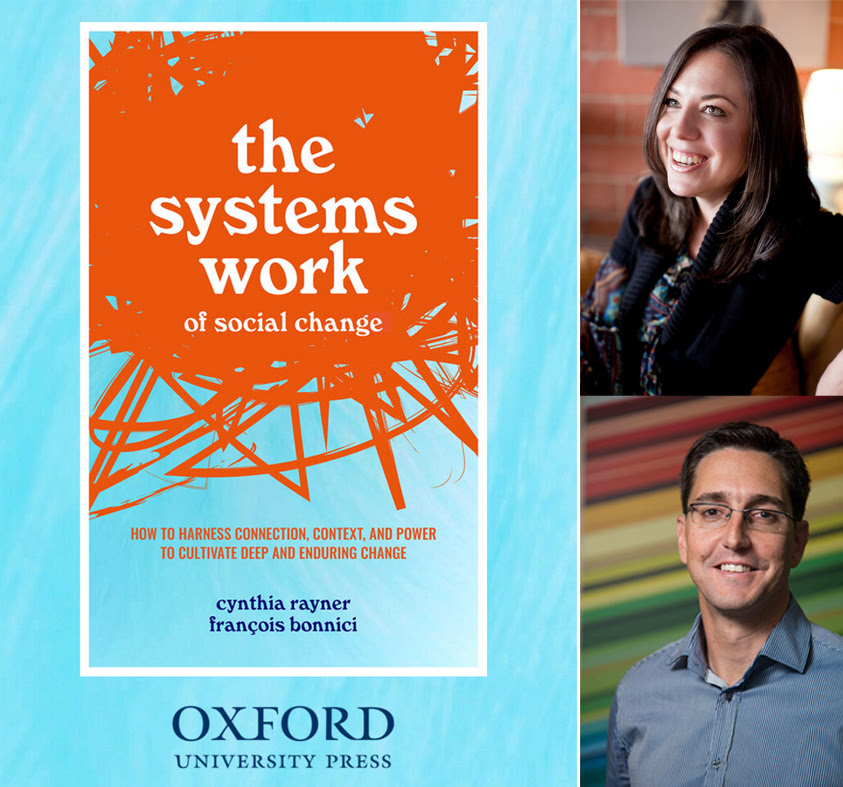
systems change differentlyNeed hope in dark times? A new book The Systems Work of Social Change, launching on September 1, offers a fresh – and deeply hopeful – take on mending a broken world. Simple, but radical, this book distills 200 years of social change-making and presents innovative and workable examples of how to do things differently.
 
“It will guide those who work in and think about systems change for a generation. A breakthrough book.”   – Stephan Chambers, Director, Marshall Institute, London School of Economics and Political Science 
Attend the launch
Sign up for updates

From Stigma to PrideThe Systems Work of Social Change by Cynthia Rayner and François Bonnici draws on research of over 200 years of social change literature, hundreds of interviews, and 8 in-depth case studies from the Schwab Foundation’s community of committed social changemakers. Mothers to Mothers (m2m), a new C2030 member, is one of the featured organisations. Headed by Frank Beadle de Palomo, m2m is an excellent example of an organisation that has built a impactful and responsive network that is ensuring broader agency for people and communities across Africa. 

Click here to read the excerpt
We asked. You answered. How can we do better?For the first time in the one and a half year existence of the Catalyst 2030 network, a Midterm Strategy Review was conducted as part of an ongoing monitoring, evaluation and learning framework. We wanted to assess how working together can accelerate change and how the collective “we” can do better.
Click here to read more about what the survey revealed
C2030 MEMBER SPOTLIGHT

Celebrating successDream a Dream, a C2030 member based in India, is determined to empower children and young people from vulnerable backgrounds to overcome adversity and thrive in a fast-changing world. And with the nationwide impact of the Covid-19 pandemic in India, they have stepped in and worked relentlessly to support young people and communities.

Click here for an update of what Dream a Dream, has been up to the past few months
 

Empowering young global citizens
What is the role of entrepreneurship in impacting the youth ecosystem? How can education help the youth adapt to post-pandemic realities?

Kenneth Kwok, founder of KIDsforSDGs, a Catalyst 2030 member, uses the 6Ps Approach to advocate for youth leadership and entrepreneurship as ways to empower young global citizens. 
Read more here
 

Building food securityNigeria, Africa’s most populous nation, is projected to become the third most populous country in the world by 2050, after China and India. The ability to consistently meet the food demands of the growing population is crucial to food security. That is why the work of social entrepreneur and Catalyst 2030 member, Uche Daniel Jumbo, is critical.

Uche is the CEO of GoodFood Agric Enterprises, a business that grows easily affordable staple foods such as plantain, banana, vegetables and meat. GoodFood is also involved in the production, processing and packaging of food products.

The business is addressing SDG 1: No Poverty through the provision of employment and training for the young and vulnerable. It is also addressing SDG 2: Zero Hunger through the provision of quality, healthy and affordable staple food for Nigerians. Eventually, it hopes to achieve inclusive food systems that can sustainably benefit Nigerians as a whole and the world at large.

Click here to find out more, or to collaborate, you can contact Uche at +234 802 911 8429 or Email: goodfood2019giz@gmail.com
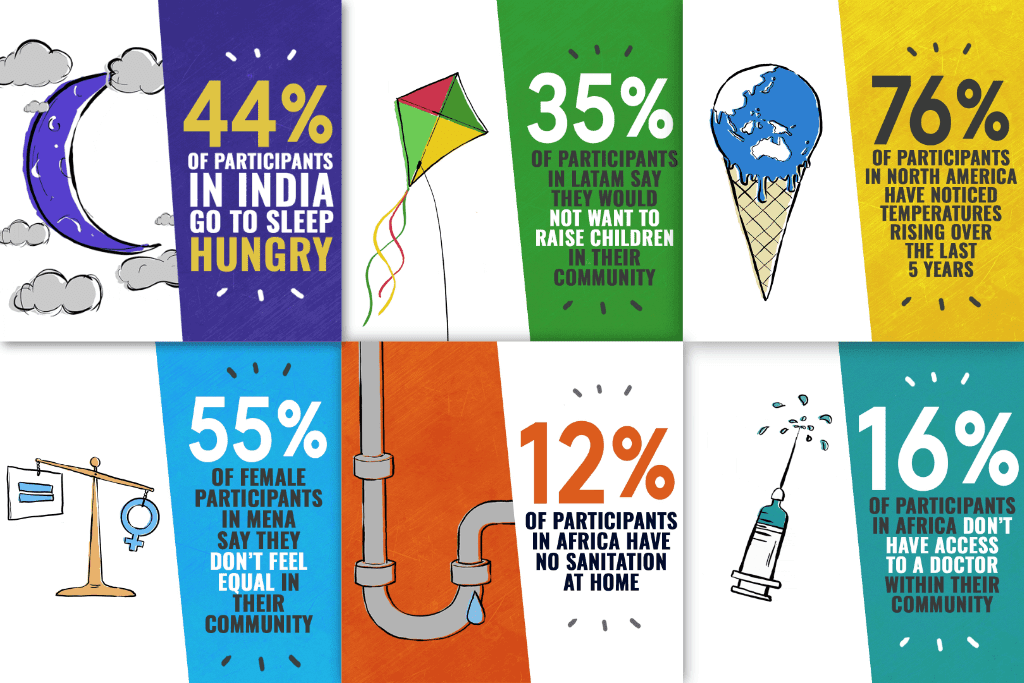
Is your voice part of the People’s Report?The playful People’s Report survey has a very serious intent. It is designed to reach people all over the world and to find out exactly what their lived experiences are. Do they have clean water? Can their children go to school? Do they feel safe? The results of the survey will be taken to the world’s leaders at the UN in September. We want the people who are making decisions on our behalf to know the situations that we face and the needs that need to be met.So, are you ready to give 5 minutes of your time to change the world? Click here to take part.
News from the Secretariat
 NEWS FROM THE WORKING GROUPSWorking Group 7 – Engaging the Private Sector: report launched  ‘How & Why Corporates & Social Enterprises Should Partner to Achieve the Sustainable Development Goals’Working Group 11 – Next Economies: report ‘An Investigation into Financing Transformation’ launching on July 15, please contact Steve Waddell

Working Group 13 – Systems Change Learning:  Recognising the gap in practical and actionable tools for SE who undergo systems change efforts. Proposing solutions here! Please email Debbi Brock or Brendon Johnson to build these learning opportunities! 

COLLABORATION CORNERReferral ToolkitMembers can bring in collaborators aligned to our values & vision, e.g. to help with group/chapter activities. Please invite collaborators in your network to our community!Our next Conversation Cafe is coming up next week, on Wednesday August 18th at 4pm CEST. It is a great place to meet your fellow C2030 members and to find synergies and collaboration opportunities.
Zoom link: https://us06web.zoom.us/j/89228448032
Looking forward to seeing you there!