The Case of the Distinguished Observer:

Harish's avatarHarish's Notebook - My notes... Lean, Cybernetics, Quality & Data Science.

In today’s post, I am looking at observation. This will be a general overview and I will follow up with more posts in the future. I am inspired by the ideas of George Spencer-Brown (GSB), Niklas Luhman, Dirk Baecker and Heinz von Foerster. In Cybernetics, observation does not mean just to utilize your eyes and look at something. It has a deeper “sensemaking” type meaning. Observation in Cybernetics does not follow the rigid subject-object relationship. Toth Benedek explains this:

Heinz von Foerster tried to develop a point of view that replaces the linear and rigid structure of the object-subject (observer-observed) distinction. According to von Foerster, the observer is really constructed by the observed and vice versa: ‘observation’ is nothing else but the circular relation between them. Observation as a relation defines the observer and the observed, so the observer refers not only to the observed, but also to himself by…

View original post 1,418 more words

Rapid Transition Lab: Towards healthy, sustainable and just Swedish and planetary food system

Rapid Transition Lab: Towards healthy, sustainable and just Swedish and planetary food system. Cool initiative from @DarkMatter_Labs @vinnovase @sthlmresilience !

(3) Mikael Seppälä on Twitter: “Rapid Transition Lab: Towards healthy, sustainable and just Swedish and planetary food system. Cool initiative from @DarkMatter_Labs @vinnovase @sthlmresilience! #systemschange #foodsystems #systemsthinking https://t.co/lWZepUql9d https://t.co/JH4DBsKdGJ” / Twitter

Illuminate Luminary Fund | Illuminate

source (inside the Illuminate Mighty Networks – joining required)

Illuminate Luminary Fund | Illuminate

Illuminate Luminary Fund

Request for proposal: deadline 9/15

What is Illuminate? 

A collaborative network committed to cultivating the field and practice of systems change towards a just, equitable and regenerative future for all.

Our aim is to facilitate connectivity that leverages existing resources, practice and experience in a nimble, light way.  We create opportunities to connect field builders, learn from each other and use our collective power to advance systems practice and engage and support the development of many more practitioners. 

Why should I listen? 

The Illuminate network is growing. We have leveraged our collective networks to engage more deeply and more internationally, to meet the needs of the emerging field of systems change in its many expressions and practices. 

This is an invitation to join Illuminate at a pivotal stage and contribute to our shared learning and inquiries. We invite you to submit a proposal specifically in one of two areas:

  1. New Systems Change Learning Communities: Regional or thematic communities of practice in new geographic locations (outside of the UK, US and Canada) 
  2. New Edgy Inquiries: Inquiries about the edges of the field of systems change practice 

We invite proposals for $10,000 for each inquiry/learning community

Background 

The “dominant” and “formal” field and practice of systems change has been historically occupied by white, academic, western ways of knowing, being, and doing. And much of our current network is centered around the UK, US and Canada.  

As a network, we recognize that there are many ways into the work of systems change, including movement building, social justice and change, facilitation and through many lineages of practice and experiences.  We intend to expand our community and to create communities of learning and inquiry from multiple contexts and locations. 

We want to make new friends, meet new colleagues to help us learn more collectively about what works and what doesn’t in systems change practice. 

We want to build the Illuminate network by engaging in live inquiries. 

Our objectives:

  • Connect the field of systems change
  • Illuminate practitioners and thought leaders who are working on the edges of the current field
  • Support and share learning across the field of systems change
  • Advance practice of systems change
  • Strengthen the learning and integration of equity, justice, and systems change 

Who we are: Our collaborators

  • Turtle Island Institute
  • McConnell Foundation
  • Emergence Collective
  • Systems Sanctuary
  • Mastercard Foundation
  • CoCreative
  • School for Systems Change
  • LankellyChase Foundation
  • CKX (Community Knowledge Exchange)
  • RWJ Foundation
  • Institute for Strategic Clarity
  • Chandler Foundation
  • Pisces Foundation
  • Inner Activist
  • Catalyst 2030
  • Omidyar Group
  • Garfield Foundation
  • Academy for Systems Change

More specifically 

New Systems Change Learning Communities (Node)

Regional communities of practice and inquiries in new geographic locations (outside of UK, US and Canada)

  • You have identified a gap in the systems change field and you want to convene a group of systems change practitioners regionally to support learning and advance the field of practice. 
  • We would love to find people/formations who are passionately experimenting with the tools and frameworks of systems change practice in regions outside of the US and the UK
  • Illuminate has several other nodes focused on connecting systems change capacity builders, funders, and curriculum in academia. Examples of current nodes in the network: River Delta Capacity Builders, Funders node, Curriculum node. 
  • We’d love to know – what are the live questions about how to do systems change in your region? How widespread is the practice? 
  • With the $10k we will invite you to convene friends, colleagues and other stakeholders in your world who are also passionate about creating the conditions for systems change and create gatherings to strengthen and relationships between you 
  • We are open-minded about what this could look like and would love to hear your ideas 
  • You, as leader of the node will be invited to the Learning cohort in Illuminate, where we convene all the leaders of the nodes around the project to stop, reflect and build relationships together to make collective sense of what we’re learning about systems change 
  • You will build your international network and have seed money to build your network locally 
  • We are looking for people who already have a mental list of people to convene at your first gathering. 

New Edgy Inquiries:

Inquiries about the edges of the field of systems change practice 

  • You have a field level question that you know others are asking and will help advance the field and practice of systems change.  
  • Examples include: what is the role of bridging in systems change from non-dominant locations? What is the relationship between healing self and healing systems?
  • Systems change is an emerging field of practice with a growing number of tools and frameworks which can be helpful in different contexts 
  • You will have a burning question – that you have a hunch (or actually you know) would generate unique insight about systems change 
  • You might not call yourself a systems change practitioner, but your work is all about using different methods to create meaningful systemic change 
  • You, as leader of the node will be invited to the Learning cohort in Illuminate, where we convene all the leaders of the nodes around the project to stop, reflect and build relationships together to make collective sense of what we’re learning about systems change 
  • You will build your international network and have seed money to build your network locally 
  • We are looking for people who already have a mental list of people to convene at your first gathering. 

Our selection process 

We will prioritize: 

  • applicants from diverse communities and contexts outside of the usual actors in the emerging systems change field. 
  • Communities and inquiries that have a clear integration of equity and justice across their proposal.

Criteria

  • You are a systems change leader with the capacity to convene other systems change leaders and practitioners
  • You are working in a community that would benefit from convening and learning
  • You are able to convene a group of practitioners from your network of at least 30 people who would come if you asked them to explore questions about how to shift systems in service of equity and justice and a regenerative future for all. We recognize that people might not call it ‘systems change.’

Please fill out the google application form here.

Deadline: September 15, 2021Posted Thu, August 5

Illuminate Luminary Fund Request for proposal: deadline 9/15

Illuminate Luminary Fund | Illuminate

Systems convening: leadership for the 21st century | Centre For Public Impact (CPI)

source:

Systems convening: leadership for the 21st century | Centre For Public Impact (CPI)

August 5th, 2021

Shaheen WarrenProgramme Manager, Europe

Jenny OppenheimerProgramme Manager, Lankelly Chase

Systems convening: leadership for the 21st century

Article highlights


.@CPI_foundation has partnered w/ @LankellyChase @theRSAorg @WengerTrayner to develop a new book ‘Systems Convening: A crucial form of leadership for the 21st century’Share article

“As a form of cross-boundary leadership, systems convening is an approach well suited to the most complex of challenges, with the potential to help all institutions thrive in the 21st century.” Learn more in our new book.Share article

Why is #systemsconvening important? It elevates a different kind of leadership, it’s a better approach to sharing power, it understands the importance of earned legitimacy and it provides the tools to embrace complexity.Share article

COVID-19 and the ensuing global pandemic has represented the greatest public health challenge of a generation. Yet, this is just one of a number of complex global challenges that we face: an expansive list that also includes climate change, growing inequality, food security, migration, and many others. It is undeniable that both state and non-state actors are being asked to solve increasingly complex problems. 

So how might we respond to these challenges, and what questions need to be explored along the way? Often in our work, we focus on how people make their best contribution: What leadership is required when dealing with the greatest complexity faced by a generation? What skills and capabilities are valued and most impactful? Do we already have the tools and techniques to respond to 21st century challenges, and if yes, where does this expertise exist? 

Enter Systems convening.

continues in source:

Systems convening: leadership for the 21st century | Centre For Public Impact (CPI)

Something new has been named: #systemsconvening

antlerboy - Benjamin P Taylor's avatarchosen path

Do you know systems conveners? Are you one?

The new book from Bev and Etienne Wenger-Trayner starts:

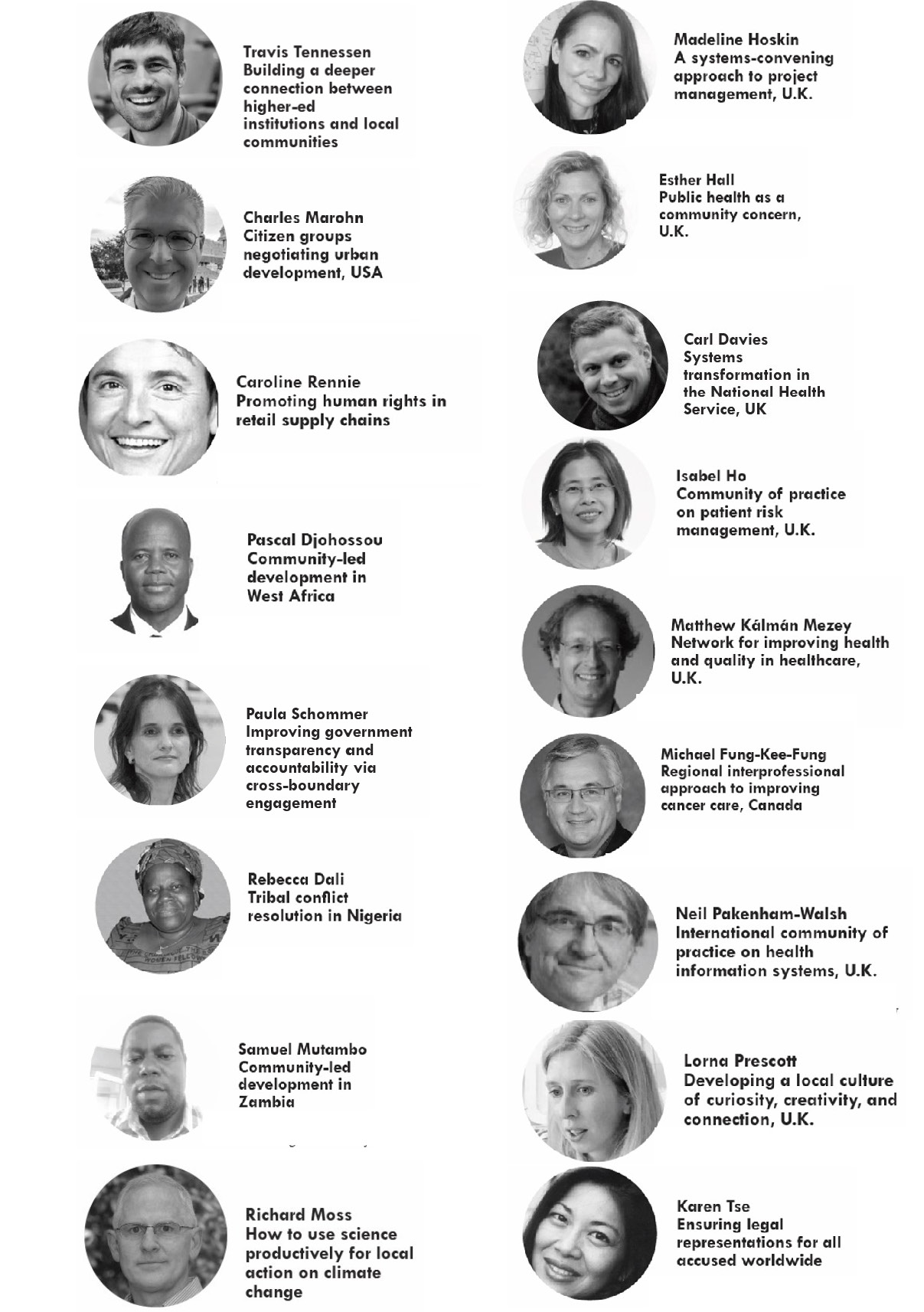
“You may not have heard about them; what they do is rarely in their job description. You may not even be aware of what they do; they tend to act as enablers rather than taking credit or seeking the spotlight. But they are here— working on sustainable change, across challenging silos, in complex social landscapes, amid changing circumstances. We call them systems conveners.”

Let me be clear: such people have been around forever. But it takes a special kind of expertise to identify the thing and, as they say, shine a light on it.

As the person who named communities of practice, and associated concepts like legitimate peripheral participant, Etienne Wenger-Trayner is uniquely good at this; many of the interviewees have been in tears of gratitude at being recognised.

Systems conveners are deeply…

View original post 351 more words

Systems Thinking Ontario – 2021-08-09

August 9 (the second Monday of the month) is the 92nd meeting for Systems Thinking Ontario. The registration will be on Eventbrite at https://normal-accidents-st-on.eventbrite.ca.

Systems Thinking Ontario – 2021-08-09

2021-08-09

August 9 (the second Monday of the month) is the 92nd meeting for Systems Thinking Ontario. The registration will be on Eventbrite at https://normal-accidents-st-on.eventbrite.ca.

Normal Accidents, High Reliability, Wicked Messes

Have we learned from brushes with disaster, or have we become complacent about complexities in everyday life?

On March 28, 1979, an accident with a nuclear reactor occurred at Three Mile Island, Pennsylvania. Twelve days earlier, an Academy Awards winning film The China Syndrome had opened with a story fictionalized from a 1975 fire at a nuclear plant in Brown’s Ferry, Alabama, raising public awareness of an issue. For a Presidential Commission on the Accident at Three Mile Island, sociologist Charles Perrow contributed organizational analysis report. On a sabbatical to the Center for Advanced Study in the Behavioral Sciences in 1981-1982, that report expanded to include other high-risk systems, becoming the Normal Accidents book, published in 1984.

In the 1990s, a group at Berkeley initiated by Todd LaPorte noticed some high-hazard organizations who able to consistently manage risks to be failure-free. The organizations included the (i) Air Traffic Control System (FAA); (ii) Electric Operations and Power Generations Departments (Pacific Gas and Electric); and (ii) peacetime flight operations in the U.S. Navy. These cases were studies as High Reliability Organizations.

Many of the researchers continue to meet in the Center for Catastrophic Risk Management (CCRM). In the study of complexity, Ian Mitroff has labelled some situations as wicked messes.

This Systems Thinking Ontario session will be led as a discussion group by David Ing. A short introduction will be provided. Participants will then be encouraged to contribute their impressions of the pre-readings, relate their experiences and/or ask questions.

Venue:

Suggested pre-reading:

Articles in reflection:

Original works:

Agenda

https://www.gstatic.com/atari/embeds/5de913a2354e93acf4d43c4db53928e5/intermediate-frame-minified.html?jsh=m%3B%2F_%2Fscs%2Fapps-static%2F_%2Fjs%2Fk%3Doz.gapi.en_GB.tmPnhifxyTQ.O%2Fam%3DAQ%2Fd%3D1%2Frs%3DAGLTcCNwoIQ3FEHTItd0ffFEpbwP-CV1_g%2Fm%3D__features__&r=817086818

An Interesting Window View“, CC-BY JL Johnson 2012. [Three Mile Island, by Harrisburg International Airport]

Post-meeting artifacts

Bloggers are encouraged to write about their learning and experiences at the meeting. Links will be added to this page.

Identity Management in an Institution of Higher Education: A Case Study Using Structural Coupling and Fractal Enterprise Model | Bider and Perjons (2021)

Identity Management in an Institution of Higher Education: A Case Study Using Structural Coupling and Fractal Enterprise Model

Identity Management in an Institution of Higher Education: A Case Study Using Structural Coupling and Fractal Enterprise Model | Bider | Complex Systems Informatics and Modeling Quarterly

Boundary critique and its implications for conflict prevention | Midgley and Pinzon (2011)

pdf

[PDF] Boundary critique and its implications for conflict prevention | Semantic Scholar

Boundary critique and its implications for conflict prevention

This paper reviews developments in the theory of boundary critique, which has been used in a number of OR projects to support conflict resolution. The authors argue that this theory (and associated models) is also useful for conflict prevention. It indicates the need to support people in discussing their differences before conflict arises. Potential conflicts can be reframed through dialogue focusing on values, and participative governance can institutionalise fair processes for making decisions in the absence of consensus. Some of the boundary critique models also support people in recognising and countering the systemic conditions that enable stereotyping, stigmatisation and the victimisation of minorities. The paper ends by presenting a new model that was originally developed to inform mediation practice, but also has implications for conflict prevention. This helps explain how different interpretations of a common concern arise, and suggests ways to improve mutual understanding between people and/or reframe the common concern in order to defuse a potential conflict. 

View on Taylor & Francis

pdf at researchgate.net

more in source including pdf link:

[PDF] Boundary critique and its implications for conflict prevention | Semantic Scholar

Expertise in research integration and implementation for tackling complex problems: when is it needed, where can it be found and how can it be strengthened? | Bammer et al (2020)

source:

Expertise in research integration and implementation for tackling complex problems: when is it needed, where can it be found and how can it be strengthened? | Humanities and Social Sciences Communications

Expertise in research integration and implementation for tackling complex problems: when is it needed, where can it be found and how can it be strengthened?

Palgrave Communications volume 6, Article number: 5 (2020) Cite this article

Abstract

Expertise in research integration and implementation is an essential but often overlooked component of tackling complex societal and environmental problems. We focus on expertise relevant to any complex problem, especially contributory expertise, divided into ‘knowing-that’ and ‘knowing-how.’ We also deal with interactional expertise and the fact that much expertise is tacit. We explore three questions. First, in examining ‘when is expertise in research integration and implementation required?,’ we review tasks essential (a) to developing more comprehensive understandings of complex problems, plus possible ways to address them, and (b) for supporting implementation of those understandings into government policy, community practice, business and social innovation, or other initiatives. Second, in considering ‘where can expertise in research integration and implementation currently be found?,’ we describe three realms: (a) specific approaches, including interdisciplinarity, transdisciplinarity, systems thinking and sustainability science; (b) case-based experience that is independent of these specific approaches; and (c) research examining elements of integration and implementation, specifically considering unknowns and fostering innovation. We highlight examples of expertise in each realm and demonstrate how fragmentation currently precludes clear identification of research integration and implementation expertise. Third, in exploring ‘what is required to strengthen expertise in research integration and implementation?,’ we propose building a knowledge bank. We delve into three key challenges: compiling existing expertise, indexing and organising the expertise to make it widely accessible, and understanding and overcoming the core reasons for the existing fragmentation. A growing knowledge bank of expertise in research integration and implementation on the one hand, and accumulating success in addressing complex societal and environmental problems on the other, will form a virtuous cycle so that each strengthens the other. Building a coalition of researchers and institutions will ensure this expertise and its application are valued and sustained.

continues in source:

Expertise in research integration and implementation for tackling complex problems: when is it needed, where can it be found and how can it be strengthened? | Humanities and Social Sciences Communications

Systems Change | Ashoka Europe Fellowship Program (paid training)

I assume that the course content is much deeper than the outline might seem to suggest.

Systems Change

Systems Change | Ashoka Europe Fellowship Program

Systems Change

“I found the whole course to be extremely useful and effective: it helped us move forward and look at our system journey in a larger picture.”

(Feedback from former participant of the Systems Change course)

Download the System Change flyer here!

Registrations are open!

Please register until August 24, 2021.

Apply Here!

What is this module all about? 

Look Deeper: Aim For Systems Change! 

In this essential strategy course, we share back the key insights Ashoka has learned from its Fellows on their most powerful strategies to achieve systems change.

The systems change course consists of 8 modules to craft your own systems change strategy based on proven frameworks for scaling social impact in any sector. Each module contains videos explaining the main frameworks and how to apply them to the exercises of the workbook which build on each other to produce a complete system change strategy in the end.

Join this course to analyse your system and identify a range of practical interventions to scale your impact on the system – without necessarily growing your organization. This is an opportunity to meet some of the most innovative social entrepreneurs and deep dive into systems change strategies together.

We are convinced: To make a longer-lasting difference and maximise the impact of available resources, social change must ultimately address the root causes and systemic drivers that are producing a social problem. By taking an indirect impact approach such as changing policies, industry norms, power structures, incentives, mindsets and more, social entrepreneurs can shift a system to produce better outcomes itself and as a result achieve a significantly greater and longer lasting change.

For a brief high-level introduction to systems change, read a summary of key concepts here. For some practical case studies and insights listen to our systems change podcast series with Ashoka Fellows from around the world.

Module Timeline

The time requirement for this course is a minimum of 3 hours per module, for more advanced results 4-5h. This includes at least 1.5h+ to watch the videos and complete the exercises plus a 1.5h peer-learning session for each module where participants share and discuss their strategy progress and insights based on the completed exercises.

Access to the online learning modules including videos, workbook with exercises, and additional resources is provided two weeks before the start of the course. Exercise results and insights are then discussed in the below facilitated group sessions for peer-to-peer learning.

Bi-weekly sessions Wednesdays, 2- 3:30pm CET starting September 2021.

8/09 Module 1: Introduction: What Systems Change is and Why it Matters

22/09 Module 2: The Power of Root Cause Analysis

6/10 Module 3: Systems Analysis: Find your Targeted System Change

20/10 Module 4: Map Your Systems Change Story

3/11 Module 5: Ways to Achieve your Goal: Deep dive into your Systems Change


 Weekly sessions Wednesdays, 2-3:30pm CET in November 2021.

10/11 Module 6: Leverage the Power of Systemic Collaboration

17/11 Module 7: Develop New Leadership Skills for Systems Change

24/11 Module 8 & Final Workshop: Align Funding and Evaluation with Systems Change & Final Workshop. 

What is needed to institutionalise transdisciplinarity? – Integration and Implementation Insights

source:

What is needed to institutionalise transdisciplinarity? – Integration and Implementation Insights

What is needed to institutionalise transdisciplinarity?

August 3, 2021

By Gabriele Bammer

What are the indicators that transdisciplinarity has been institutionalised? How close is it? What still needs to be done to achieve institutionalisation?

Transdisciplinary teaching and research are becoming more common in universities and a range of research organisations. So how will we know that transdisciplinarity is an integral and accepted part of the research and higher education scene, nationally and internationally?

I suggest that there are two primary criteria:

  1. The expertise required to undertake transdisciplinary research is recognized and codified
  2. Acknowledged transdisciplinary experts are given an equal voice with established disciplines when research and higher education policy are made and when funding is allocated.

On these criteria, it is fair to say that transdisciplinarity is not even close to being institutionalised. As colleagues and I have suggested in How can expertise in research integration and implementation help tackle complex problems? we are only beginning to define the expertise that transdisciplinarians have. In addition, when transdisciplinarity is discussed at the research policy and higher education tables, it is rare for those involved to be acknowledged transdisciplinary experts. Similarly, acknowledged transdisciplinary experts are not yet routinely involved either in setting the policies of funding organisations or in reviewing relevant grants.

Nevertheless, there is growing acknowledgement of the importance of transdisciplinarity, along with funding for projects that tackle complex problems. Those interested in leveraging these advances to achieve institutionalization must:

  1. Unite!
  2. Organise!
  3. Respond!
  4. Fight!

Why are these actions necessary and how can they best be achieved?

continues in source

What is needed to institutionalise transdisciplinarity? – Integration and Implementation Insights

Nature Is Not a Machine—We Treat It So at Our Peril

Jeremy's avatarPatterns of Meaning


First published as “Nature Is a Jazz Band, Not a Machine” by Institute of Art and Ideas | News on July 30, 2021.


From genetic engineering to geoengineering, we treat nature as though it’s a machine. This view of nature is deeply embedded in Western thought, but it’s a fundamental misconception with potentially disastrous consequences.

Climate change, avers Rex Tillerson, ex-CEO of ExxonMobil and erstwhile US Secretary of State, “is an engineering problem, and it has engineering solutions.” This brief statement encapsulates how the metaphor of the machine underlies the way our mainstream culture views the natural world. It also hints at the grievous dangers involved in perceiving nature in this way.

Rex Tillerson: a powerful and highly destructive proponent of treating nature as an engineering problem

This mechanistic worldview has deep roots in Western thought. The great pioneers of the Scientific Revolution, such as Galileo, Kepler, and…

View original post 2,176 more words

Soft Systems Methodology: Puzzles and Organisations – Neil Richardson

Soft Systems Methodology: Puzzles and Organisations by Neil Richardson Published: 26 June 2021

Soft Systems Methodology: Puzzles and Organisations

Cybernetics Society AGM Keynote 2021: Delia Pembrey MacNamara – and other CybSoc videos

Cybernetics Society AGM Keynote 2021: Delia Pembry MacNamara

Cybernetics Society AGM Keynote 2021: Delia Pembry MacNamara – YouTube

See the rest of the channel at

https://www.youtube.com/channel/UCdp8cnKqLZxkgM8fmCO7TCA

Minimal physicalism as a scale-free substrate for cognition and consciousness | Fields, Glazebrook, Levin (2021)

Minimal physicalism as a scale-free substrate for cognition and consciousness

Minimal physicalism as a scale-free substrate for cognition and consciousness | Neuroscience of Consciousness | Oxford Academic

Minimal physicalism as a scale-free substrate for cognition and consciousness 

Chris FieldsJames F GlazebrookMichael Levin

Neuroscience of Consciousness, Volume 2021, Issue 2, 2021, niab013, https://doi.org/10.1093/nc/niab013

Published: 02 August 2021 Article history

Abstract

Theories of consciousness and cognition that assume a neural substrate automatically regard phylogenetically basal, nonneural systems as nonconscious and noncognitive. Here, we advance a scale-free characterization of consciousness and cognition that regards basal systems, including synthetic constructs, as not only informative about the structure and function of experience in more complex systems but also as offering distinct advantages for experimental manipulation. Our “minimal physicalist” approach makes no assumptions beyond those of quantum information theory, and hence is applicable from the molecular scale upwards. We show that standard concepts including integrated information, state broadcasting via small-world networks, and hierarchical Bayesian inference emerge naturally in this setting, and that common phenomena including stigmergic memory, perceptual coarse-graining, and attention switching follow directly from the thermodynamic requirements of classical computation. We show that the self-representation that lies at the heart of human autonoetic awareness can be traced as far back as, and serves the same basic functions as, the stress response in bacteria and other basal systems.