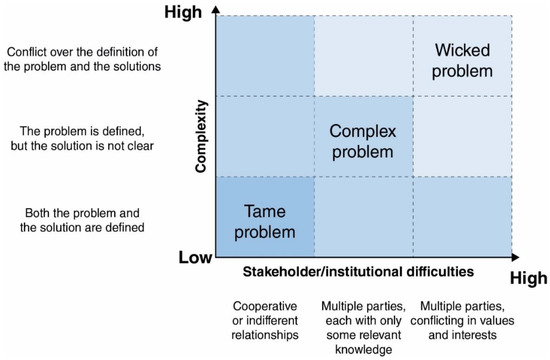
Transformability is increasingly promoted as a way of moving societies toward more sustainable futures in the era of the Anthropocene, mostly because the concept of resilience has fallen short in many instances where impacts on social-ecological systems are continuous, varied, and usually unknown. While such transformations can play a crucial role in improving the sustainability of social-ecological systems, they may lead to unexpected and undesirable outcomes. This literature review on social-ecological transformability and wicked problems seeks to shed light on and acknowledge some of the limitations of transformability regarding unforeseen conditions. We argue that wicked problems arise in transformation initiatives in the presence of high complexity, deep uncertainty, deep conflicts, and divergence among stakeholders, as well as scale mismatches concerning spatial, temporal, and institutional processes. Our findings may explain why some transformation initiatives fail to generate expected changes on the ground, mainly in two cases: (a) a polarized configuration that maintains the status quo of the system to be transformed and (b) an unforeseen transformation that causes the system to lurch from crisis to crisis. To conclude, we recommend using diagnostic questions to prevent wicked problems in social-ecological transformations. View Full-TextKeywords: social-ecological system; resilience; transformability; sustainability; wicked problems; social complexity; uncertainty▼ Show Figures
Figure 1This is an open access article distributed under the Creative Commons Attribution License which permits unrestricted use, distribution, and reproduction in any medium, provided the original work is properly cited
Sign up to receive the link to the release webinar and all the news about the Whitepaper launch directly in your inbox
JOIN
Stay Tuned.
Public Release on November 20th
Do you want to know what will be the new foundations of platform-ecosystem thinking in a context of constant change?
Be the first to discover the results and gain awareness.
GET EARLY ADOPTER KIT
With your kit you will be the first to receive:
149 €
One fine printed copy of the White Paper shipped to your address
A personal mention in the whitepaper credits
Early access to digital releases of the White Paper in Beta on November 12th
Exclusive Q&A with the lead author, Simone Cicero, on November 19th before the public launch
Special interactive access to the Whitepaper sensemaking Webinar on December 18th
A lifetime 20% discount to all Boundaryless events
The context
It was in 2013 when we released our first version of Platform Design Toolkit.
On October 2016, we published the Platform Design Toolkit 2.0 and the companion White Paper “From business modeling to platform design” becoming real pioneers of a new way of thinking organizations and products. The Toolkit and the White Paper have been fundamental since then in instigating and shaping the practice of Platform Design with a community that today counts more than sixty thousand adopters worldwide.
We’ve been active in research and consulting with an impressive range of stakeholders: from Fortune 500s to startups, from organizational transformation pioneers such as Chinese Haier group to United Nations. Such experience puts Boundaryless among the leaders of Platform-Ecosystems thinking worldwide.
After more than three years we’re now aware that the context and scope of platform-ecosystem thinking have changed and have grown widely: New Foundations of Platform-Ecosystem Thinking are now needed.
This is what this white paper is all about: we plan to release this fundamental piece of content in Creative Commons over the summer of 2020.
The ESSENTIAL BALANCES eBook is now available for pre-order in Australia, Brazil, Canada, France, Germany, India, Italy, Japan, Mexico, Netherlands, Spain, UK, and the US.
The ESSENTIAL BALANCES eBook is now available for pre-order in Australia, Brazil, Canada, France, Germany, India, Italy, Japan, Mexico, Netherlands, Spain, UK, and the US.
The ESSENTIAL BALANCES eBook is now available for pre-order in Australia, Brazil, Canada, France, Germany, India, Italy, Japan, Mexico, Netherlands, Spain, UK, and the US. Coming soon. Release date: 27 Nov 2020 Pre-order your copy. Country links in the thread below
Jeremy England: Low rattling: a principle for understanding emergent computing behavior in driven many-body collectives
Publication date 2020-10-21Topics self-organizationTalk by Jeremy England of the Department of Physics, Georgia Institute of Technology. Given to the Redwood Center for Theoretical Neuroscience at UC Berkeley, via Zoom. Abstract:Self-organization is frequently observed in active collectives, from ant rafts to molecular motor assemblies. General principles describing self-organization away from equilibrium have been challenging to identify. We offer a unifying framework that models the behavior of complex systems as largely random, while capturing their driven response properties. Such a “low-rattling principle” enables prediction and control of fine-tuned emergent properties in disordered mechanical networks, random spin glasses, and robot swarms. Jeremy England is a Principal Research Scientist in the Department of Physics at the Georgia Institute of Technology. He serves as a Senior Director in Artificial Intelligence and Machine Learning at GlaxoSmithKline. From 2011 to 2019, he was Assistant and then Associate Professor in the Department of Physics at MIT, where he led a research group in studying the nonequilibrium statistical mechanics of life-like self-organization.
From Wikipedia, the free encyclopediaJump to navigationJump to searchFor the computer game, see Independence War 2: Edge of Chaos.“The truly creative changes and the big shifts occur right at the edge of chaos,” said Dr. Robert Bilder, a psychiatry and psychology professor at UCLA’s Semel Institute for Neuroscience and Human Behavior.[1]
The edge of chaos is a transition space between order and disorder that is hypothesized to exist within a wide variety of systems. This transition zone is a region of bounded instability that engenders a constant dynamic interplay between order and disorder.[2]
The phrase edge of chaos was coined by mathematicianDoyne Farmer to describe the transition phenomenon discovered by computer scientistChristopher Langton. The phrase originally refers to an area in the range of a variable, λ (lambda), which was varied while examining the behavior of a cellular automaton (CA). As λ varied, the behavior of the CA went through a phase transition of behaviors. Langton found a small area conducive to produce CAs capable of universal computation. At around the same time physicistJames P. Crutchfield and others used the phrase onset of chaos to describe more or less the same concept.
In the sciences in general, the phrase has come to refer to a metaphor that some physical, biological, economic and socialsystems operate in a region between order and either complete randomness or chaos, where the complexity is maximal. The generality and significance of the idea, however, has since been called into question by Melanie Mitchell and others. The phrase has also been borrowed by the business community and is sometimes used inappropriately and in contexts that are far from the original scope of the meaning of the term.
Adaptation plays a vital role for all living organisms and systems. All of them are constantly changing their inner properties to better fit in the current environment.[7] The most important instruments for the adaptation are the self-adjusting parameters inherent for many natural systems. The prominent feature of systems with self-adjusting parameters is an ability to avoid chaos. The name for this phenomenon is “Adaptation to the edge of chaos”.
Adaptation to the edge of chaos refers to the idea that many complex adaptive systems seem to intuitively evolve toward a regime near the boundary between chaos and order.[8] Physics has shown that edge of chaos is the optimal settings for control of a system.[9] It is also an optional setting that can influence the ability of a physical system to perform primitive functions for computation.[10]
Because of the importance of adaptation in many natural systems, adaptation to the edge of the chaos takes a prominent position in many scientific researches. Physicists demonstrated that adaptation to state at the boundary of chaos and order occurs in population of cellular automata rules which optimize the performance evolving with a genetic algorithm.[11][12] Another example of this phenomenon is the self-organized criticality in avalanche and earthquake models.[13]
The simplest model for chaotic dynamics is the logistic map. Self-adjusting logistic map dynamics exhibit adaptation to the edge of chaos.[14] Theoretical analysis allowed prediction of the location of the narrow parameter regime near the boundary to which the system evolves.[15]
Funders invited to test practical tools for place-based systemic change
John Hitchin describes the scenarios and issues that move people to begin to work differently and invites funders to test some practical tools to help places and organisations move towards systemic change in a place.
At Renaisi we talk and write about place a lot. We have worked in neighbourhoods and places for years, we have tried to define it, categorise it, and support lots of places and organisations to learn within it.
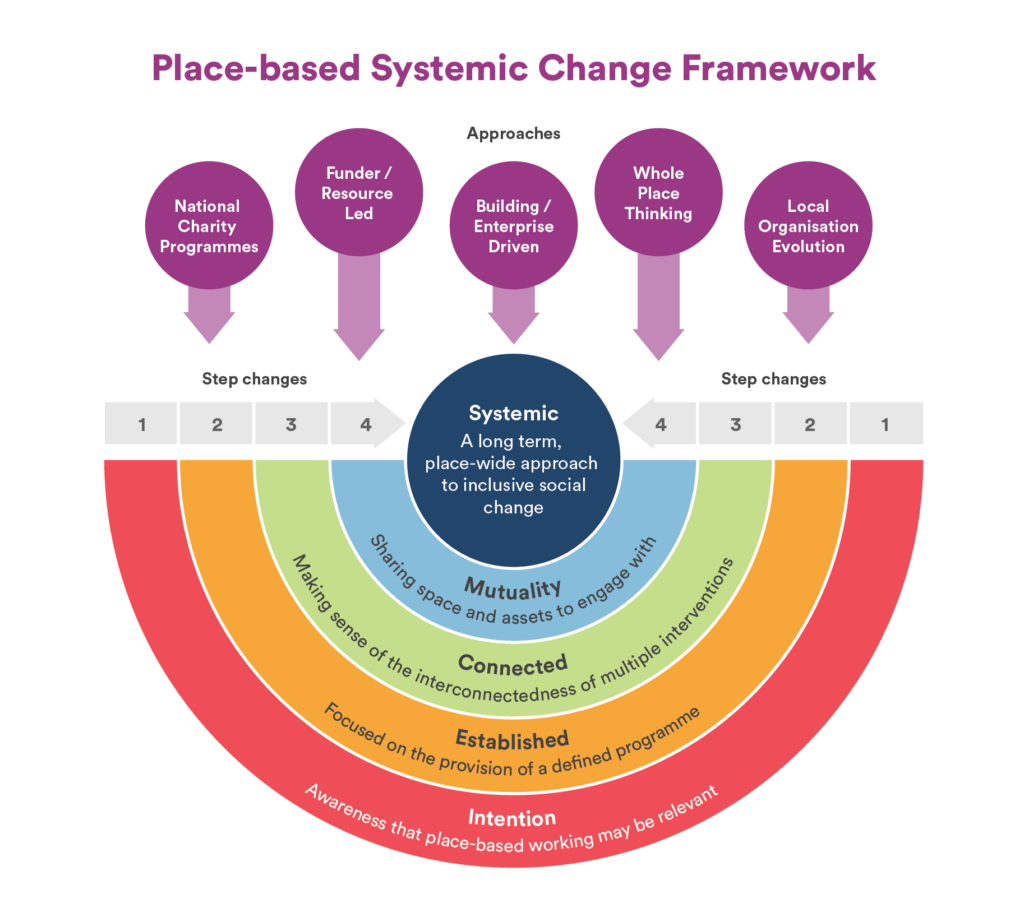
Recently we led an enquiry into ‘place-based systemic change’ with support from Save the Children UK and a steering group of charities and funders. We created a framework for thinking, acting and funding in a way that uses place as the vehicle for social change, with long-term, systemic change being the outcome.
John Hitchin will be presenting the learning from the Funding Place-Based Systemic Change project with the chair of the project steering group, Natsayi Sithole of Save the Children UK and Stephen Skeet from Volunteering Matters online at 12.30-2pm on 4th November. Register here.
What is place-based systemic change?
We define place-based systemic change as an approach to social change, rather than an outcome of it, that is defined by focus, time horizon, approach, scale and intentionality.
What’s interesting when you start to look across the areas where work of this kind is happening, is that there tends to be a set of issues which encourage them to start a new or different way of working. These triggers include, but are not limited to, things like siloed local bureaucracies, good things slipping through the gaps, valuing process over relationships and an inequity of outcomes.
When organisations or individuals repeatedly butt up against these issues it can lead to a malaise, or it can ignite a desire for a different way of working and thinking about social change. What then happens is funders, commissioners, providers, and communities need to get together to think differently about how to make change happen in their area.
Why is place-based systemic change hard to fund?
In the second learning paper we highlighted the sorts of issues that can make it hard to fund in a place based and systemic way. You can find that paper here, but a short list of questions for funders to think about is:
Strategy – how does place fit with your ambitions and strategy?
Place – which places are you thinking about and why?
Role – what role do you want to take on?
Partnership – who are you going to work with and how? (there should be no heroes here)
Once you’ve started to explore these questions, then we believe our framework can really help with both the language of change, and the thinking about the needs of the place, and how it can move on.
In our research we found that funders were taking on different roles (the convenor, the instigator the holder of ambition), but our work on developing the framework highlighted types or changes in practice that could be invested in and are important to consider. These ‘step-changes’ moved places and organisations towards more systemic practice.
Get involved
We think this is an important conversation and we’re interested in talking to funders about testing some practical tools that help places and organisations move through the steps in the framework.
John Hitchin will be presenting the learning from the Funding Place-Based Systemic Change project with the chair of the project steering group, Natsayi Sithole of Save the Children UK and Stephen Skeet from Volunteering Matters online at 12.30-2pm on 4th November.Register to attend the Funding Place-Based Systemic Change event.
Get involved in the place-based systemic change project
Find out how you can get involved in a community of places and organisations thinking and working differently to achieve systemic social change.
In the Funding Place-based Systemic Change project, we built a framework for thinking, acting and funding in a way that focusses on using place as the vehicle for social change with long-term, systemic change being the intended outcome.
We see place-based systemic change as an approach to social change, rather than an outcome of it, that is defined by focus, time horizon, approach, scale and intentionality.
This working definition doesn’t refer to any one type of organisation or approach. Through our research we saw lots of examples – from large national charities to small community organisations and our framework is approach agnostic.
We grouped the approaches but what is more important are the stages that the different organisations and approaches shared:
Intention – an awareness that place-based working may be relevant
Established – focus on the provision of a defined programme
Connection – making sense of the interconnectedness of multiple interventions
Mutuality – sharing space and assets to engage with
Systemic – a long-term, place-wide approach to social change
What was interesting is how organisations move through the framework to do more systemic work. Sometimes they do it with support, sometimes it was individual or organisational effort and resources.
The really interesting place-based practice is in the movement from ‘connected’ to ‘mutuality’. This is the point at which organisations are trying to push the boundaries of their approach into systemic work collaborating with partners.
Find out more and get involved
We think this is an important conversation and the Funding Place-Based Systemic Change learning papers are just the start of how we understand and improve the way in which place-based systemic work is resourced and supported in the UK.
While there are examples of impact, the project showed that no organisation is currently working systemically because it requires all funders, commissioners and stakeholders in the place and the system to work together.
In the next phase of this work we’re inviting:
1.Places and organisations that are moving towards systemic change to join a community of practice.
2. Funders who are interested in the steps towards systemic change to test some practical tools to help places and organisations move through the steps in the framework.
Register below if you’d like to be involved.
Register for the event
John Hitchin will be presenting the learning from the Funding Place-Based Systemic Change project with the chair of the project steering group, Natsayi Sithole of Save the Children UK, and Stephen Skeet from Volunteering Matters online at 12.30-2pm on 4th November.Register to attend the Funding Place-Based Systemic Change event.
Recently there have been a lot of discussions about which is best – Lean, Six Sigma or Theory of Constraints? Is Lean Six Sigma better than Lean or Six Sigma?
In this brief post, I will try to view this question from my viewpoint. There is a saying based on the 9th century Zen Buddhist teacher Qingyuan Weixin which I have paraphrased loosely below;
“At first I saw the mountain as a mountain. Then when I learned more and more, I realized that the mountain is not a mountain. But now that I have learned it even more, I see that the mountain is a mountain again.”
If you change the term mountain with “Lean” and “a set of tools”, we can paraphrase it as follows;
“At first I saw Lean as a set of tools. Then I learned more and more, I realized that Lean is not a set…
I recently came across Dr. Donald Hoffman’s idea of Fitness-Beats-Truth or FBT Theorem. This is the idea that evolution stamps out true perceptions. In other words, an organism is more likely to survive if it does not have a true and accurate perception. As Hoffman explains it:
Suppose there is an objective reality of some kind. Then the FBT Theorem says that natural selection does not shape us to perceive the structure of that reality. It shapes us to perceive fitness points, and how to get them… The FBT Theorem has been tested and confirmed in many simulations. They reveal that Truth often goes extinct even if Fitness is far less complex.
Hoffman suggests that natural selection did not shape us to perceive the structure of an objective reality. Evolution gave us a less complex but efficient perceptual network that takes shortcuts to perceive “fitness points.” Evolution by natural selection…
The COVID‐19 pandemic is a crisis with high complexity and should be understood as such by scholarship. A complexity science approach situates increasingly divergent ideological and epistemological perspectives about the crisis within the practical exigencies of containment and mitigation measures. We ask which of the seven stages of soft systems methodology contributes to deeper understandings about COVID‐19 as a policy issue, beyond the contributions of current and conventional perspectives. The discussion outlines implications for practice and places them within broader debates about tensions between scientific facts and political values.
Is it possible to organise complex ecosystems to achieve a shared purpose? Indeed is it possible to organise something which by nature is emergent, uncertain and comprised up of autonomous and semi-autonomous parts? Often with powerful agents? Are there clear guidelines that might help?
The questions this chapter seeks to answer.
What are the general principles of large systems design? For example – does a shared sense of purpose exist or is latent and requires articulation? What are the activities taking place in the system and are they broadly understood?
What are the characteristics of large systems leadership?Achieving progress among diverse, often conflicting part of a large scale systems requires different skills from those running an enterprise.
What is Street Epistemology?While definitions vary, it’s generally accepted that Street Epistemology is a conversational tool that helps people reflect on the quality of their reasons and the reliability of their methods used to derive one’s confidence level in their deeply-held beliefs.Why use Street Epistemology?Although practitioners’ objecives will differ, Street Epistemology is generally used to understand a claim, identify the actual reasons and reliability of the method supporting the claim, and see if one’s confidence in their claim is justified.Where to use Street Epistemology?While every venue has pros and cons, Street Epistemology can be practiced virtually anywhere, including face-to-face, video chat, audio chat, text chat, and social media, just to name a few.When to use Street Epistemology?If you have willing participants and applied good judgment of the situation, it’s probably a great time to use Street Epistemology on someone’s claim with them.Who is Street Epistemology for?While this method originated in the atheist community, we think everyone should learn Street Epistemology, regardless of where someone happens to stand on any claim.How to use Street Epistemology?This website is your entry point to all of the resources and communities currently available to help you learn, practice, conduct, and improve Street Epistemology, and we’re very happy to have you here.https://www.youtube-nocookie.com/embed/DwkU4-AyT7gFeatured Video of the Month
In 1990, specialists from the Russian School of Transdisciplinarity began to develop the type of systems transdisciplinarity proposed by Erich Jantsch in 1972. He argued for the coordination of all disciplines and interdisciplines in the education and innovation system on the basis of a generalized axiomatic and an emerging epistemological pattern.
Since this approach has a philosophical rationale, conceptual and methodological basis, and appropriate technological methods, it can be considered as an independent metadiscipline – systems transdisciplinarity.
Transdisciplinarity as a meta-discipline has the following basic attributes:
a meta-theory; and,
a meta-narrative.
The purpose of the meta-theory of transdisciplinarity is to create a picture of the one and only world. Disciplinary (local) pictures of the world, in this case, are considered as abstract models of certain areas (fragments) of the one and only world. As a result, the meta-theory of transdisciplinarity appears to be a scheme that defines the way and context of building scientific models of the researched areas (fragments) of reality. Such a scheme, because of its abstract nature, provides a transdisciplinary interpretation of the results of modeling the fragments of reality within the framework of different disciplinary and interdisciplinary approaches.
Meta-narrative is a universal system of notions, signs, symbols, and models, which aims to create a single type of description of objects and the presentation of interrelated events in the picture of the one and only world. This meta-narrative summarizes the knowledge and languages of scientific disciplines, as well as cultural and semantic discourses (areas of interaction).
General provisions of a systems transdisciplinary approach
The systems transdisciplinary approach is based on the philosophic principles of unicentrism. In a broad sense, unicentrism is a position in philosophy and in science that is based on the problem of the correlation between the unity and its fragments.
This position is based on the isomorphism (similarity) of the general order of the structure of fragments of space, the attributes of information, and the periods of time that are able to describe the one and only world. Any objects at all levels of the reality of the one and only world are its natural elements and fragments.
Therefore, the main condition for the existence of the one and only world is the existence of a general order in it (transdisciplinary system). As the name implies, it follows that this order must manifest itself everywhere: in every element and fragment of this world and in every interaction of these elements and fragments at every level of reality.
As a result, the same order should ensure the achievement of activity goals and results of all these elements and fragments. In addition, it should synchronize these goals and results. For this reason, the one and only world is a One Orderly Medium.
Therefore, the order determining unity is not revealed in the course of systems transdisciplinary research of a complex object. It is not formed subjectively as happens in other types of systems approaches. Instead, it is postulated through systems transdisciplinary models of the spatial, informational, and temporal units of order:
The model of a spatial unit of order provides substantiation for the physical and/or logical object boundaries and the nature of relations between elements within these boundaries.
The model of an informational unit of order provides substantiation for the necessary and sufficient amount of information on the object.
The model of a temporal unit of order shows the organization of converting the internal potency of an object from the original volume to the results that will be used in the subsequent processes of its conversion.
The world in the form of vertical functional assembly and the system in the form of the general order, which make the conditions for the unity of this assembly, are close to the vision of Ludwig von Bertalanffy with respect to the general systems theory. In 1968 he wrote:
A unitary conception of the world may be based, not upon the possibly futile and certainly farfetched hope finally to reduce all levels of reality to the level of physics, but rather on the isomorphy of laws in different fields. Speaking in “material” language, it means that the world, i.e., the total of observable events, shows structural uniformities, manifesting themselves by isomorphic traces of order in the different levels or realms. (pp. 48-49)
Recognising transdisciplinarity as a metadiscipline
Endowing transdisciplinarity with the traditional attributes of scientific discipline – philosophical substantiation, concept, methodology, technological solutions – makes it possible to organically integrate it into the existing classification of scientific directions and scientific approaches.
In turn, the creation of textbooks, manuals, and training programs, as well as the organization of special training and retraining of teachers will allow us to organically integrate this transdisciplinary meta-discipline into the educational process of universities. This will then make it possible to change the attitude towards the transdisciplinarity of academic researchers and practitioners as a marginal experience not integrated into the structure of universities.
What do you think of the proposal that systemic transdisciplinarity is a metadiscipline? How would you like to see it integrated into the educational processes of universities? What problems can arise with such a targeted reform of higher education?
To find out more: Mokiy, V. S. (2019). International standard of transdisciplinary education and transdisciplinary competence. Informing Science: the International Journal of an Emerging Transdiscipline, 22: 73-90. (Online – open access) (DOI): https://doi.org/10.28945/4480
References: Bertalanffy, L. V. (1968). General system theory: Foundations, development, applications. George Braziller: New York, United States of America
Jantsch, E. (1972). Towards interdisciplinarity and transdisciplinarity in education and innovation. In Interdisciplinarity: Problems of teaching and research in universities. OECD Publication 99, 105-106, Paris, France. (Online): https://archive.org/details/ERIC_ED061895/page/n101
Biography: Vladimir Mokiy PhD is Head of the Russian School of Transdisciplinarity and Director of the Institute of Transdisciplinary Technologies, Nalchik, Russia. His research focuses on creating the philosophy and methodology of a systems transdisciplinary approach as an independent scientific discipline.
2 thoughts on “Systems transdisciplinarity as a metadiscipline”
Teodor GHITESCUI consider that the transdisciplinary approach is synonymous with the systemic approach with the two currents: cybernetic and realistic, which are distinguished by understanding and applying the concepts of “information-interaction” and by descriptive and mathematical modeling of systems. The treatment of “transdisciplinarity” as a meta-science, I do not think is possible not only from the perspective of the biological limits of the human intellect but also from the perspective of the professionalization of the new generations towards narrow specializations due to the division of labor.I believe that the “transdisciplinary” approach to knowledge presupposes the acceptance by most intellectuals, similarly, of the semantics of a minimum number of concepts, models and principles common to all sciences, based on the isomorphism of systems even if each science has as object of study a certain system.It should be promoted in higher education, especially in managerial, economic and legal fields, the areas most susceptible to intellectual manipulation by ignoring the common results of the basic sciences (mother tongue, mathematics, physics, chemistry, biology). In fact, transdisciplinarity (the systemic approach) should be the basis for preparing all specialists for the teaching profession!After decades of studies and experience in management and execution positions in three different fields: military, economic and educational, I found that the lack of consensual understanding of basic concepts of knowledge, such as energy, process, system, information, natural self-adaptability, human self-adaptability, etc., is the main cause of the absurdities existing in higher education and implicitly in the current types of government of nations.For example, the consensual misunderstanding of the concept of “energy” (transdisciplinary concept, because it is the universal cause of all transformations in nature and society), leads to the absurdity of positioning the education system in sector III-services, ie where nothing new happens it just moves money from one pocket to another. Also due to this conceptual dissonance in the current pedagogy and in the law of education, THE PRODUCT OF SCIENTIFIC EDUCATION AND RESEARCH IS NOT CLARIFIED, from the perspective of the common results of the fundamental sciences.If not even the most performing intellectuals can reach consensus on even 5 concepts (system, energy, information, self-adaptability) and approx. 9 universal principles, based on the isomorphism of systems, the NEED FOR A SYSTEMIC (transdisciplinary) APPROACH TO SCIENTIFIC KNOWLEDGE IS OBVIOUS!The practical problems that could arise could be: 1. What to start with? I believe that the training of teachers should be rethought through a new pedagogy, systemic pedagogy, through which to promote this type of approach. A model: https://www.academia.edu/38067783/Presentation_The_Systemic_Pedagogy_and_the_Performance_of_the_Future_Education; 2. Which governments will accept such an approach, which will simplify knowledge so much that dogmatic intellectual manipulation will no longer be possible?Reply
Gerald MidgleyI find myself both agreeing and disagreeing with your proposal.First the agreement. It worries me that the meaning of ‘transdisciplinarity’ is being watered down in some research communities. The idea that transdisciplinary research involves the development of theoretical and/or methodological ideas that go beyond the boundaries of the conventional disciplines is really important. However, for a lot of people, transdisciplinarity now means problem-focused research in partnership with decision makers and stakeholders. This is transcendent in the sense that it goes beyond just academic researchers, and the problem focus means the work could end up going beyond one discipline, but it seems to me that this is little more than “big interdisciplinarity”. What makes transdisciplinarity different from interdisciplinarity is that there are theoretical and/or methodological ideas being researched, and these are transferable/adaptable so they can be transported into other domains. In this respect, transdisciplinarity has the characteristics of a discipline, in that a specialist language evolves. You call it a “meta-discipline”. I would not use the term “meta” myself, but that is a relatively small difference between us. In many other respects I agree with you on the need for a transdisciplinarity that does not throw the baby (transferable theory and methodology) out with the bathwater in the rush to build a stakeholder-focused research practice.Now the disagreement. It seems that your “one and only world” focus reduces transdisciplinary inquiry to something that is very traditional in terms of the sciences: the pursuit of truths (with all the epistemological caveats that need to accompany that word). Yes, this is consistent with the original work of Bertalanffy and Jantsch. However, I spent the first decade of my research career arguing against this, saying that we need multiple ideals of inquiry: truth, yes, but also ‘rightness’ and ‘subjective understanding’. The problem is, a transdisciplinarity that only focuses on questions of truth marginalizes more than half of what is needed in systems inquiry. What about all the methodologies developed by systems thinkers to support people in deciding on normative action? It is a problem that non-systemic science marginalizes the normative and subjective, and I argue that we should not reproduce this problem in the field of systems science.My way forward on this is to argue that pursuing the ideal of the unity of science is dependent on methodological pluralism, and this requires a new systems philosophy that allows for multiple types of inquiry with truth, rightness and subjective understanding (and understanding their interactions) as goals. I could end up writing a whole essay on this, but that would be pointless, as I have written many such essays before. Let me instead just recommend a single one of my papers. I have written the reference and copied the abstract below.Midgley G (2001). Rethinking the Unity of Science. ‘International Journal of General Systems’, 30, 379-409.This paper reconstructs the traditional systems notion of the unity of science to take account of criticisms that have been made of it over the years. It then examines a number of disciplinary sciences, comparing them with systems science. It is shown that disciplinary scientists embrace different philosophical and methodological positions, depending on their chosen subject areas. This presents a major problem for systems science. Systems science brings all the subject areas from the disciplines together, and with them come their associated philosophical and methodological ideas. These rub together abrasively, and the result is that the integrity of systems science itself is brought into question. The solution proposed in this paper is the promotion of methodological pluralism. This involves the development of a philosophical theory that explains the methodological diversity that is needed if we are to conduct transdisciplinary research. The paper ends with the presentation of a pluralist theory that begins the job of freeing systems science from methodological and philosophical restrictions.Reply
Systems transdisciplinarity as a metadiscipline October 27, 2020 By Vladimir Mokiy
A synthesis of work done over my undergrad, and a generator of future thought: project maplesync
ABSTRACT: Exploring price systems as emergently designed information technology: a heuristic approach for externalities with climate change applications







 Gerald Midgley
 Systems Community of Inquiry


You must be logged in to post a comment.