Systems practices — what might these be? – Anna Birney, School of System Change – Medium


Source: Systems practices — what might these be? – School of System Change – Medium

Systems practices — what might these be?

Anna Birney
Anna Birney
Oct 4 · 5 min read

At the School of System Change we support people to navigate multiple approaches, tools and methods for systems change, because we believe there are many ways to do this work. Regularly, we are asked “How do you know whether what we are doing is systemic?”. Through our programmes we work with and draw on a wealth of practitioners across this emerging field. What we started to notice was a set of “systemic practices” that we think are at work across multiple approaches and tools practitioners use. Currently there are ten (a few more have joined the family since an earlier rendition we called The ways of a systems thinker — and there are, of course more). They come in no particular order. Below we offer a couple of short paragraphs of elucidation — drawing on some of the theory behind these practices. We would welcome feedback to help evolve these to the next level!

These systemic practices have collaboratively curated, in particular with Jennifer Berman, Anna Warrington, Laura Winn and myself.

HEADLINES – SEE SOURCE FOR DETAILS

  • Enable the system to see itself, hold the whole picture
  • Work at different levels concurrently
  • Identify connections and how parts interact
  • Engage different perspectives
  • Understand agency, power, and responsibility
  • Work with activating and resisting forces
  • Consider different timescales and consequences over time
  • Understand patterns to make effective interventions
  • Embrace complexity, constantly learning and adapting
  • Constantly question assumptions

School of System Change

We are equipping people with the capabilities to lead system change initiatives addressing complex sustainability challenges. The School offers flexible access to the best learning experiences, tools, case studies from the field, while growing the community of practice.

Anna Birney

WRITTEN BY

Cultivating #systemschange | Director @forum4thefuture | Launching School of System Change | Passion #inquiry #livingsystems #livingchange

School of System Change

School of System Change

We are equipping people with the capabilities to lead system change initiatives addressing complex sustainability challenges. The School offers flexible access to the best learning experiences, tools, case studies from the field, while growing the community of practice.

Continues – and comment and clap – in source: Systems practices — what might these be? – School of System Change – Medium


Improvisation Blog: Design for an Institution

Source: Improvisation Blog: Design for an Institution

Wednesday, 2 October 2019

Design for an Institution

To paraphrase Ashby’s “Design for a brain”, it might be asked “How does an institution produce adaptive behaviour?” But of course, institutions often don’t produce adaptive behaviour, or their adaptations lead them to adopt patterns of behavior which are more rigid – which is the harbinger of death for an organism, but institutions seem to be large enough to withstand environmental challenges that they continue to survive even without apparently adapting.

One way of answering this problem is to argue that institutions, in whatever form they come, and in whatever state of adaptability, conserve information. An institution might lose a quantity of information in response to an environmental threat, but maintain some stable behaviour despite this. It’s internal processes maintain that new set of information. This is, I think, like what happens when institutions are challenged by a complex environment and become more conservative. They discard a lot of information and replace it with rigid categories, often upheld by computer technology and metrics. But the computer-coordinated information-preservation function with a limited information set is surprisingly resilient. However, for human beings existing within this kind of institution, life can be miserable. This is because human beings are capable of far richer information processing than the institution allows – effectively they are suppressed. There may be distinct phases of information loss and preservation.

But if institutions are information-preserving entities, then rigid low-information preserving entities will not be able to compete with richer information-preserving entities. If information preservation is the criteria for “institution-ness”, then new ways of preserving information with technology may well be possible which might challenge traditional institutional models. So what is a basic “design for an institution”?

Continues in source: Improvisation Blog: Design for an Institution

Measuring complexity

cxdig's avatarComplexity Digest

Complexity is heterogenous, involving nonlinearity, self-organisation, diversity, adaptive behaviour, among other things. It is therefore obviously worth asking whether purported measures of complexity measure aggregate phenomena, or individual aspects of complexity and if so which. This paper uses a recently developed rigorous framework for understanding complexity to answer this question about measurement. The approach is two-fold: find measures of individual aspects of complexity on the one hand, and explain measures of complexity on the other. We illustrate the conceptual framework of complexity science and how it links the foundations to the practised science with examples from different scientific fields and of various aspects of complexity. Furthermore, we analyse a selection of purported measures of complexity that have found wide application and explain why and how they measure aspects of complexity. This work gives the reader a tool to take any existing measure of complexity and analyse it, and to take…

View original post 20 more words

Collective Irrationality and Positive Feedback

cxdig's avatarComplexity Digest

Recent experiments on ants and slime moulds have assessed the degree to which they make rational decisions when presented with a number of alternative food sources or shelter. Ants and slime moulds are just two examples of a wide range of species and biological processes that use positive feedback mechanisms to reach decisions. Here we use a generic, experimentally validated model of positive feedback between group members to show that the probability of taking the best of options depends crucially on the strength of feedback. We show how the probability of choosing the best option can be maximized by applying an optimal feedback strength. Importantly, this optimal value depends on the number of options, so that when we change the number of options the preference of the group changes, producing apparent “irrationalities”. We thus reinterpret the idea that collectives show “rational” or “irrational” preferences as being a necessary consequence of…

View original post 56 more words

Rule of 72 – First Florida Credit Union


Source: Rule of 72 – First Florida Credit Union

Rule of 72

Everyone has some idea of what it means to be money smart – however, whether or not you’ve acted on that idea is a different story! There are a few nuggets of financial wisdom that have become clichés, albeit practical ones. Curb your spending. Pay off your debt. Contribute to your savings early and often. Compound Interest is your friend. Start saving now and watch your money grow.

Being financially responsible starts with putting some of those clichés into action, but in doing some research into saving strategies, you might be in for an unpleasant surprise. You might do some quick calculations with current interest rates and come to the sobering realization that the effects of saving your money aren’t as mind-blowing as you thought. Why is that?

The economic landscape has changed a lot in the past 20 years. Our parents saw a time where it was possible to put your money away in a certificate of deposit (CD) with interest rates upwards of 10%. Strategically utilizing investments with that kind of return was a smart move and a great way to grow your money over time.

Unfortunately, those days of 10% interest rates seem to have disappeared along with the era of acid-wash jeans and Troll dolls. Current interest rates are at historic lows, and the Federal Reserve predicts that the trend is going to stick around for a while. Saving is, of course, still a crucial part of your financial well-being, but what’s the best way to grow your money and beat inflation when interest rates are low? Consider the following strategies:


Check Your Expectations.

There’s no way to sugarcoat it; interest rates are low right now. As a result, your investments – even with the mighty power of compound interest – just aren’t going to perform as well as they would have in the past.

Countering the effects of inflation is another resulting challenge. But don’t get too discouraged—as a young investor, time is on your side.

Even low-yield investment products can generate significant wealth over long periods of time (we’re talking decades), but it’s important to stay realistic with your long-term savings goals.

Will your investment allow you to buy your own island when you retire? It’s highly doubtful, but with some foresight and planning, your investment can allow you to retire comfortably and with peace of mind.

Rule of 72: Modest increases in interest rates have a dramatic effect on the doubling time.
Rule of 72: To find when you can expect your money to double, just divide 72 by the annual interest rate.


Be Realistic.

If you want to be realistic about your investment earnings and help plan for your future, the Rule of 72 is a handy tool to quickly estimate how many years it will take to double your investment at a given rate. The Rule of 72 works with investments that have compounding interest.

You simply divide 72 by the rate of annual return (that’s your interest rate). What results is an approximation of how many years it will take for you to double your investment.

For example, if you park $1,000 in a CD yielding 3% interest, it will take 24 years to double (72/3=24).

The Rule of 72 allows you to do some quick, back-of-the-envelope math when comparing different investment options or when planning out your long-term financial goals.


Plan Ahead.

Benjamin Franklin said it best, “Money makes money. And the money that money makes, makes money.” Plan ahead and learn to use compound interest and the Rule of 72 to your financial benefit.

Time is compound interest’s best friend. Consider looking into investment products – such as dividend-paying stocks—that contribute to the effects of compound interest.

Throw a long-term investment period into the mix and you have a recipe for some compound interest benefits. Keep in mind that, as with any investment vehicle, nothing is guaranteed and you are always taking on an element of risk.

Diversifying your investment portfolio is a sound way to minimize (though not completely eliminate) your investment risk.


Rule of 72: Ben Franklin explained compound interest best. Money makes money. And the money that money makes, makes money.

At the end of the day, interest rates – just like the economy itself – are unpredictable. Planning ahead is smart, but no amount of researching and strategizing will give you complete immunity from the twists and turns of market forces.


#ISSS2015 Berlin – Judith Rosen – Redefining Objectivity


Redefining Scientific Objectivity
By Judith Rosen
(So that it’s finally appropriate for
biological systems…)
What’s wrong with The
Machine Metaphor of Rene
Descartes?
• Machines are created by human beings for human purposes, to ex...
What is “Health”?
• The World Health Organization has defined it
thusly:
“Health is a state of complete physical, mental
a...
Anticipatory Systems Theory
• Explains the differences between living and non-living systems.
• Living organisms are examp...
What is an Anticipatory
System?
• Robert Rosen wrote:
• "The present volume is intended as a contribution to the theory
of...
What does that MEAN?
Living Organisms as Anticipatory Systems
• The Rosennean definition for “INFORMATION” is: “Anything that can
be the answer...
Sensory Capacity as Information-
Gathering Capacity.
What is “food”?
• The answer depends on who is hungry.
An internal value for “Health”…
• Depends on an internal value for “Self”: Health of
what? Health of Self.
• Therefore, th...
Life, Survival, Reproduction…
• … are all future-based activities
• With a future-based perspective
• And a future-based (...
The Optimality Scale
• Co-arising with the Self-model and the definition for
Health (of-Self), there arises the means for ...
Descartes’ Definition of Objectivity
• “All systems in the universe can be
thought of as being like a machine.”
This is “T...
The Legacy of the Machine
Metaphor in Human Systems
• All concept of intrinsic “function” was
outlawed in Science as being...
Is this “Optimal”?
• Industrial agriculture
• Giant hospitals where patients and their families
are treated like cogs in a...
Natural, complex, Anticipatory behavior
that clearly has both information and
sophisticated information-processing
capabil...
What should be the definition for
Scientific Objectivity, under the
circumstances?
• I humbly suggest something along thes...
Science then becomes synonymous
with verifiable truth, independent
accountability, and integrity
• We need to be able to t...
See you all in Boulder, Colorado
at ISSS 2016!
#ISSS2015 Berlin - Judith Rosen - Redefining Objectivity

#ISSS2015 Berlin – Judith Rosen – Redefining Objectivity

409 views
  • Share
  • Unlike
  • Download

Published on 

http://www.isss2015berlin.com – see the presentation recorded live.
The

Published in: Science
antlerboy
  • Be the first to comment

 #ISSS2015 Berlin – Judith Rosen – Redefining Objectivity

  1. 1. Redefining Scientific Objectivity By Judith Rosen (So that it’s finally appropriate for biological systems…)
  2. 2. What’s wrong with The Machine Metaphor of Rene Descartes? • Machines are created by human beings for human purposes, to extend human capacities or possibilities, in some way. • This capacity for creating technologies to serve functional needs is not unique to human beings. It’s a high level Anticipatory behavior pattern. • BUT… why should a hermit crab try to get itself into the empty mindset of its shell? Where’s the value in that?
  3. 3. What is “Health”? • The World Health Organization has defined it thusly: “Health is a state of complete physical, mental and social well-being and not merely the absence of disease or infirmity.” http://www.who.int/about/definition/en/print.html Question: Where does the value for “Health” come from?
  4. 4. Anticipatory Systems Theory • Explains the differences between living and non-living systems. • Living organisms are examples of naturally self-organizing Anticipatory Systems • A.S. Describes the Characteristics of Life from a scientific framework.
  5. 5. What is an Anticipatory System? • Robert Rosen wrote: • “The present volume is intended as a contribution to the theory of those systems which contain internal predictive models of themselves and/or of their environments and which utilize the predictions of their models to control their present behavior.” • “Systems of this type have a variety of properties which are unique to them. It is most important to understand these properties, for many reasons. We shall argue that much, if not most, biological behavior is model-based in this sense. This is true at every level, from the molecular to the cellular to the physiological to the behavioral. Moreover, model-based behavior is the essence of social and political activity. An understanding of the characteristics of model-based behavior is thus central to any technology we wish to develop to control such systems, or to modify their model-based behavior in new ways.”
  6. 6. What does that MEAN?
  7. 7. Living Organisms as Anticipatory Systems • The Rosennean definition for “INFORMATION” is: “Anything that can be the answer to a question.” That requires the existence of a question-asker: A living organism. There must be a need of some kind, which pre-exists either the asking of the question or seeking of the answer. • What is definable as “information” depends on perspective. One organism’s information might be another organism’s incidental and meaningless noise. • “Information” is, therefore, a relational label and entirely context dependent: It is not a quality intrinsic to the thing or phenomena or percept, on their own. The designation of information arises through interaction between a living organism, its internal predictive models, and aspects of its environment. • Being a model-guided system means that information is a component of the system, itself. • It is part of the pattern of life that organisms seek out, ingest, and metabolize information just as they do energy, from the environment. Information is “digested” (processed, interpreted) and perhaps encoded into new models or used to activate current models and generate guidance for behavior of the system.
  8. 8. Sensory Capacity as Information- Gathering Capacity.
  9. 9. What is “food”? • The answer depends on who is hungry.
  10. 10. An internal value for “Health”… • Depends on an internal value for “Self”: Health of what? Health of Self. • Therefore, the value for “Health” will change if the “Self” model changes. In reproduction of many species, one or both parents seem to encode offspring into their self-model and sometimes put the health of the offspring ahead of their own as an independent organism– sometimes, to a lethal degree. Death after reproducing is a common pattern. • The internal value for Health will guide the activities of metabolism and repair (the two functional capacities that arise/emerge along with LIFE). • Robert Rosen’s concept of an “M,R-System” as a model for a living organism, where M is metabolism and R is repair. Both are Anticipatory processes…
  11. 11. Life, Survival, Reproduction… • … are all future-based activities • With a future-based perspective • And a future-based (Anticipatory) control strategy.
  12. 12. The Optimality Scale • Co-arising with the Self-model and the definition for Health (of-Self), there arises the means for evaluating (predicting) the risk or benefit of any given percept. This is the perspective of each organism. • I call this The Optimality Scale: the full range of “good” or “bad” that any given percept can represent. • As such, the range of optimality is unique to the perspective of each organism.
  13. 13. Descartes’ Definition of Objectivity • “All systems in the universe can be thought of as being like a machine.” This is “The Machine Metaphor”. • Therefore, the perspective of all living organisms must be like a machine’s (as we imagine it to be…) • Scientific detachment from all bias or preferences (total objectivity) became synonymous with Science, itself. • Any and every area of human activity that wished to become “more scientific” also became machine like.
  14. 14. The Legacy of the Machine Metaphor in Human Systems • All concept of intrinsic “function” was outlawed in Science as being non-objective. • Mechanistic concepts and techniques in Science were applied across the board, even to ecosystems and organisms. They were treated like they were not significantly different from the atoms and elements of which they were “made”. • Even disciplines devoted to human health became machine-like and factory-like.
  15. 15. Is this “Optimal”? • Industrial agriculture • Giant hospitals where patients and their families are treated like cogs in an impersonal machine instead of the hospital’s reason for being. • Education becomes industrialized where the discussion centers around “standardization”– of our children’s minds. It’s a production line. • Business, regardless of what product or service is being sold, is based on a single, imposed human goal: money. With that as “the” goal, the optimality scale is based entirely on how well that goal is achieved. This is true even in arenas like education, health care, and law enforcement (private prisons).
  16. 16. Natural, complex, Anticipatory behavior that clearly has both information and sophisticated information-processing capability involved… https://www.youtube.com/watch?v=XSKh-GLQn4E The self organization of new life (as seen watching a timelapse of the embryonic development of a fruitfly larva) • Monarch butterfly migration • Human immune function, including model- based error behaviors like allergies.
  17. 17. What should be the definition for Scientific Objectivity, under the circumstances? • I humbly suggest something along these lines: • “The simple fact, which every scientist should know, is that “objectivity” in science means only that one must not let non scientific issues intervene in scientific judgments. Not religion, not politics, not social exigencies, must intervene, any more than personal self-interest in the form of direct financial or academic rewards. To do otherwise is to falsify, as surely and as reprehensibly as if one presents false data. • “In short, scientific objectivity, the refusal to be a “social actor” while doing science, is one of the few thin safeguards of civilization itself. The integrity of this process, and of those who have maintained it, is one of the few glorious things of which our species can boast. The “isms” pass; each epoch has its own, to which it demands this integrity be sacrificed; laughing at the “isms” which preceded it, and deploring the devastations perpetrated in their name, while in the very process of perpetrating its own.” ~ Robert Rosen
  18. 18. Science then becomes synonymous with verifiable truth, independent accountability, and integrity • We need to be able to trust the information our science generates • We need to make sure that the process of science as well as the practitioners of it are unfettered by intellectual debts to private interests or fear based on beliefs and assumptions.

Design & Systems Thinking and Complexity – John Mortimer – Medium


Source: Design & Systems Thinking and Complexity – John Mortimer – Medium

Design & Systems Thinking and Complexity

Making sense of our organisations

Systems thinking with regard to organisations is conceptually very simple, it is a particular way of looking at the organisation, its environment, customers, and its place in the industry it is in, and everything that it is a part of it. When people start to see their organisation and role by seeing with a systems thinking mindset, they gain a perspective of it that is whole and interconnected, and this leads them to understand how it can work in a fundamentally different way to traditional reductionist understanding. However, if you search for definitions of Systems Thinking it often creates more confusion than it solves. I would encourage those who wish to find out to search for definitions that they understand.

The more difficult part of this, is getting to that place of thinking systemically. Unfortunately there are no clear ways of doing that, and there are as many weird and wonderful interpretations of how to get there that is related to systems thinking. I will use Design Thinking as a comparison, because there are similarities due to the fact that they are both ways of seeing and understanding that are more fundamental to rational and mental analysis.


Continues in source: Design & Systems Thinking and Complexity – John Mortimer – Medium

The Right Requirement – Professor Joseph Kasser


Source: The Right Requirement

The Right Requirement

Professor Joseph Kasser

Contact information

jkasser @ therightrequirement.com

+61 (0) 436 028 393


Site Navigation

The Holistic Thinking Perspectives

systems thinking and beyond 

To learn more about the Holistic Thinking Perspectives, read Holistic Thinking: Creating innovative solutions to complex problems (Solution Engineering)

Contact me If you have a need for someone to:

  1. Help with a complex problem.
  2. Determine if a project is going to be successful.
  3. Audit the quality of a post graduate course.
  4. Provide corporate training in solving complex problems, systems thinking, systems engineering or project management
  5. Teach a postgraduate course online or face to face as a visiting professor for a semester.
  6. Create a postgraduate course complete with lecturer notes, PowerPoint slides, problem-based learning exercise, flipped classroom exercises, etc.
  7. Create a postgraduate degree.
  8. Convert a face-to-face course to distance format.
  9. Assist with something else.

Contact information

jkasser @ therightrequirement.com

+61 (0) 436 028 393

Training Partners


Why you should become a systems thinker

You get an advantage over other people who are not systems thinkers. Systems thinkers see things from different perspectives which allows them to identify issues other people cannot. This gives them the advantage.

Why you should go beyond systems thinking

Traditional systems thinking has focused on the Functional and Operational perspectives of systems as typified by the often seen Causal Loops. While systems thinking provides an understanding of the situation, holistic thinking goes beyond systems thinking to identify solutions. This allows the holistic thinker to create innovative solutions while their colleagues are still reacting to problems.

Holistic Thinking

In the past teaching and learning systems thinking has been difficult and has mainly focused on Causal Loops. That has now changed, expanding the concepts developed under a grant to Cranfield University from the Leverhulme Trust in 2007, the nine Holistic Thinking Perspectives have provided a standard set of perspectives and a way to use them that have helped many workshop and seminar participants to improve their problem solving skills by improving their thinking.


Source: The Right Requirement


CECAN Webinar recording: The Human, Learning, Systems approach to managing in complexity, with Toby Lowe | CECAN


Source: CECAN Webinar: The Human, Learning, Systems approach to managing in complexity | CECAN

CECAN Webinar: The Human, Learning, Systems approach to managing in complexity

Toby Lowe Webinar

 n 1st October 2019, Dr Toby Lowe, Senior Lecturer in Public Leadership and Management at Newcastle Business School, hosted our CECAN Webinar: ‘The Human, Learning, Systems approach to managing in complexity’.

Attended by around 60 participants, the webinar discussed the challenge of creating complexity-informed evaluation by seeing it as a public management challenge. How can public management adopt a more complexity-informed approach? The session outlined an emerging complexity-informed approach to public management: the Human, Learning, Systems (HLS) approach. The HLS approach involves public services responding to the variety of human need through bespoke service provision, using learning as the engine for performance improvement and stewarding the health of the systems which produce social outcomes.

If you were unable to join the webinar, you can watch/listen to the session via our YouTube channel below. We are also pleased to be able to share a PDF version of the PowerPoint slides, please click here to view.


Invitation ‘ Evolving organizations, systemically viewed ‘ (SCiO) 17 October at 18h30, Belgium

Uitnodiging ‘Evoluerende organisaties systemisch bekeken’ (SCiO) – 17 oktober om 18u30

De afgelopen jaren is de aandacht naar de wijze waarop we organisaties anders kunnen vormgeven enorm toegenomen. Het is een zoektocht naar meer flexibele organisatievormen, waarbij men put uit een waaier van nieuwe benaderingen (Holacracy, Agile, Spotify, Lean, Sociocracy 3.0, Liquid O, Semco, Socio-technical approach,…). Ze delen eenzelfde bedoeling, namelijk beter overleven in een omgeving die voortdurend verandert. De centrale vraag is deze naar de wijze waarop je de samenhang van het geheel in een verregaande decentralisatie kan waarborgen.

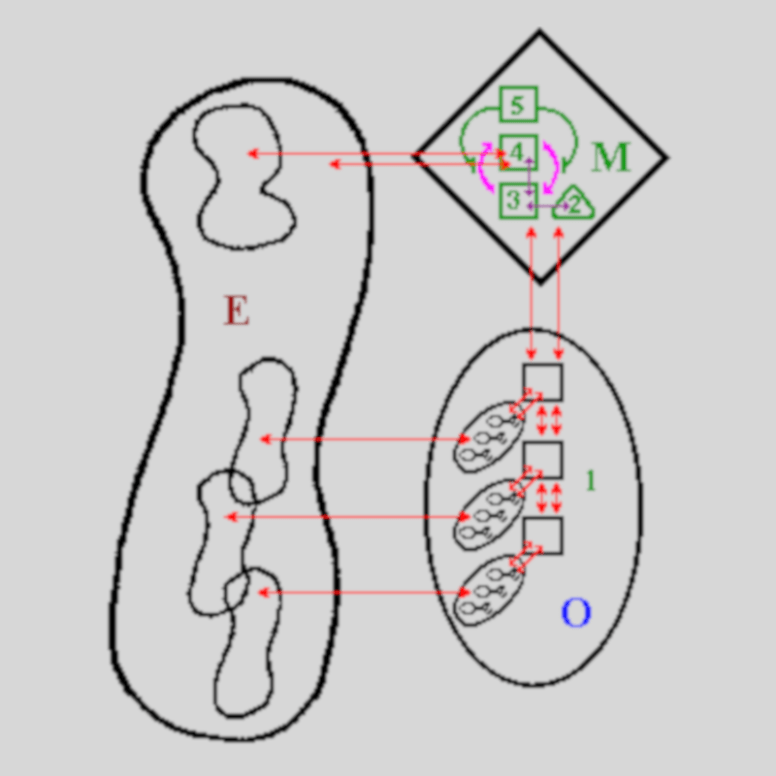
De Viable Systems benadering geeft hier een coherent antwoord op. Het is een benadering die in de jaren zeventig en tachtig van vorige eeuw is ontwikkeld door Stafford Beer en die veelvuldig wordt gebruikt bij het begrijpen van organisaties en het opnieuw ontwerpen ervan. In de UK groepeert de Society for Cybernetics in Organizations (http://www.scio.org.uk/) een zeer uitgebreid netwerk van top managers en bedrijfskundigen die systeembenaderingen toepassen in de manier waarop ze hun organisatie laten evolueren.

We nodigen je graag uit voor de eerste bijeenkomst. Wil je er graag bij zijn? Schrijf je in via jan@connectransform.be

Google translation:
Invitation ‘ Evolving organizations systemically viewed ‘ (SCiO)
17 October at 18h30

In recent years, attention has increased enormously to the way in which we can shape organisations differently. It is a quest for more flexible organisational forms, where one draws from a range of new approaches (Holacracy, Agile, Spotify, Lean, Sociocracy 3.0, Liquid O, Semco, Socio-Technical approach,…).

They share the same intent, namely better survival in an environment that is constantly changing. The central question is the way in which you can guarantee the coherence of the whole in a far-reaching decentralisation. The Viable Systems approach provides a coherent response to this. It is an approach developed by Stafford Beer in the Seventies and eighties of last century and which is widely used in understanding organizations and re-designing Its.

Systems and Complexity in Organisation ( http://www.systemspractice.org) is already, in the UK, a very extensive network of top managers and business practitioners who apply system approaches in the way they evolve their organization. SCiO is now international and we would like to invite you to the first Belgian meeting.

Would you like to be there? Sign up via jan@connectransform.be

https://media.licdn.com/dms/image/C4D22AQGSGdjmrYyzfg/feedshare-shrink_800/0?e=1573084800&v=beta&t=yNNGa1EzF1r8rJfEZrbK0SLTpiG8RbeUhVwclED1EUI

Jan’s post on LinkedIn: https://www.linkedin.com/posts/jan-de-visch-469580_uitnodiging-evoluerende-organisaties-systemisch-activity-6584860403182907392-PRxQ/

Neutral and niche forces as drivers of species selection

cxdig's avatarComplexity Digest

The evolutionary and ecological processes behind the origin of species are among the most fundamental problems in biology. In fact, many theoretical hypothesis on different type of speciation have been proposed. In particular, models of sympatric speciation leading to the formation of new species without geographical isolation, are based on the niche hypothesis: the diversification of the population is induced by the competition for a limited set of available resources. Interestingly, neutral models of evolution have shown that stochastic forces are sufficient to generate coexistence of different species. In this work, we put forward this dichotomy within the context of species formation, studying how neutral and niche forces contribute to sympatric speciation in a model ecosystem. In particular, we study the evolution of a population of individuals with asexual reproduction whose inherited characters or phenotypes are specified by both niche-based and neutral traits. We analyze the stationary state of the…

View original post 69 more words

Systems Change Is All about Shifting Power – Cyndi Suarez


Source: Systems Change Is All about Shifting Power – Non Profit News | Nonprofit Quarterly

Systems Change Is All about Shifting Power

October 1, 2019

Image by OpenClipart-Vectors from Pixabay

“How do you shift power in a system?” It is a question I hear and entertain more and more lately, as many of us in nonprofits have worked for decades to create systems change, more often than not with little or underwhelming result.

In the classic systems thinking essay, “Leverage Points: Places to Intervene in a System,” Donella Meadows writes, “Leverage points are points of power in a system.” So, systems change is all about shifting power. However, the implementation of systems change often ignores this central aspect.

Revisiting the top five leverage points in the system begins to illuminate the extent of the change that is brought just by even one of these. In increasing order of effectiveness, they are:

5. The power to set the rules of the system
4. The power to change or evolve the structure of the system
3. The power to set the goals of the system
2. The power to set the paradigm of the system
1. The power to transcend the paradigm of the system

Regarding the power to set the rules—incentives, punishments, constraints—Meadows writes, “If you want to understand the deepest malfunctions of systems, pay attention to the rules, and to who has power over them.” For example, capitalism is a system where the rules are designed by owners of corporations, run by corporations, for the benefit of corporations—which is why all others are made subordinate by it. Nonprofits, which themselves require a corporate board and leading executives that make organizational decisions, by design are systems where the power to make rules is monopolized by an elite, and thus, ultimately, are, at their core, not very different from for-profit corporations.

Meadows sees the ability to change the system, self-organization, as “the most stunning thing that living systems and social systems can do.” They do this by “creating whole new structures and behaviors.” She notes that in biological systems, “that power is called evolution.” The ability to self-organize is the foundation for resilience in a system. Meadows observes, “A system that can evolve can survive almost any change, by changing itself.” Self-organization relies on its own set of rules that govern “how, where, and what the system can add onto or subtract from itself under what conditions.” It balances what exists with new patterns that respond to current reality. However, as this leverage point is high up in the system, those who have this power oftentimes have the least incentive, or knowledge of how, to evolve the system. This is why the empowerment-speak of nonprofits rings so hollow.

The goals in a system determine its structure and rules, along with the other leverage points beneath these. Meadows writes, “Like all technologies, it depends upon who is wielding it, with what goal.” Further, goals are not what the system says, but what it does. System-level goals include survival, resilience, differentiation, and evolution. Often, people in a system do not know what the actual goals are. Sometimes this is intentional. I see this a lot in racial justice work, where the change goals are usually set by and for the dominant, or elites, in the system because they are the ones with the power to set those goals. This likely contributes to the common discrepancy between what we say and what we do, which is why understanding the power to set goals and who wields it is critical to any systems change work, including racial justice efforts. Not only are systems change processes inherently about power shifting, in our society, power shifting processes are inherently racial justice processes. When undergoing systems change, then, it is critical to understand that there need to be new, power-explicit, system-level goals, and these should be designed to address its power hierarchies.

Paradigms—models, patterns, or standards—are the source of systems. They shape the nature of reality in the system, goals, and everything that flows from these. Meadows illustrates: “The ancient Egyptians built pyramids because they believed in an afterlife. We build skyscrapers because we believe that space in downtown cities is enormously valuable.” It is harder to change the paradigm than just about anything else in the system. That’s why the ability to change paradigms is the highest leverage point. However, Meadows points out, “there’s nothing necessarily physical or expensive or even slow in the process of paradigm change…all it takes is a click in the mind, a falling of scales from the eyes, a new way of seeing.”

Meadows asks, “So how do you change paradigms?” And answers, “In a nutshell, you keep pointing at the anomalies and failures in the old paradigm, you keep speaking louder and with assurance from the new one, you insert people with the new paradigm in places of public visibility and power. You don’t waste time with reactionaries.” In my experience in the sector, the paradigm is set by the leading executives, especially the founding ones. In the typical hierarchical organization, the leading executives not only manage the staff beneath, but the board above. This system flaw—hindered communication—is a drawback to any system change because power preserves itself and, most powerfully, through control of the paradigm. That is why executive transitions are so challenging: the goal is change, but the practice—again, by those leading the change, usually the elite—is to control the change; to be seen to change while changing as little as possible.

Finally, as aforementioned, the highest leverage point in a system is the power to shift the paradigm. Meadows defines this as the power “to keep oneself unattached in the arena of paradigms, to stay flexible, to realize that no paradigm is ‘true,’ that everyone [has] a tremendously limited understanding of an immense and amazing universe that is far beyond human comprehension.” Though most of us cling to our paradigms, Meadows observes that “everyone who has managed to entertain that idea, for a moment or for a lifetime, has found it to be the basis for radical empowerment.” Appropriately, she calls this “mastery over paradigms.”

By now, system thinking has become deracinated, devoid of its true power implications. This quick review reminds us of what system change actually requires. What would it look like if systems change efforts, especially racial justice ones, were oriented around these five top leverage points? If they do not, then we should at least stop saying we are doing systems change work.

Source: Systems Change Is All about Shifting Power – Non Profit News | Nonprofit Quarterly

An exercise: meta-rational phenomena | Meaningness


Source: An exercise: meta-rational phenomena | Meaningness

An exercise: meta-rational phenomena

Title slide: Leveling Up Systems in a Whitewater World

As an experiment in communicating meta-rationality, I led an interactive unconference session with a brief presentation followed by an exercise discussion. I hope to develop a workshop on meta-rational thinking, and the exercise I posed might be a part of the curriculum.

Slides are here. The rest of this post explains the exercise, which won’t be clear from the slides alone.

Most of us who work with rational systems at a moderately advanced level also practice meta-rationality. “Meta-rationality” means not taking a rational system for granted, but reflecting on how it is working in practice, and acting more effectively better by going beyond its bounds.

Unfortunately, we are not usually particularly good at this. Because the category “meta-rationality” has rarely been pointed out, and its value has rarely been explained, it is not taught in classes; its methods are not studied by either theorists or practitioners; and so it is mainly overlooked and underdeveloped.

Continues in source: An exercise: meta-rational phenomena | Meaningness

Stanislaus County project brings new methods, people together | Modesto Bee

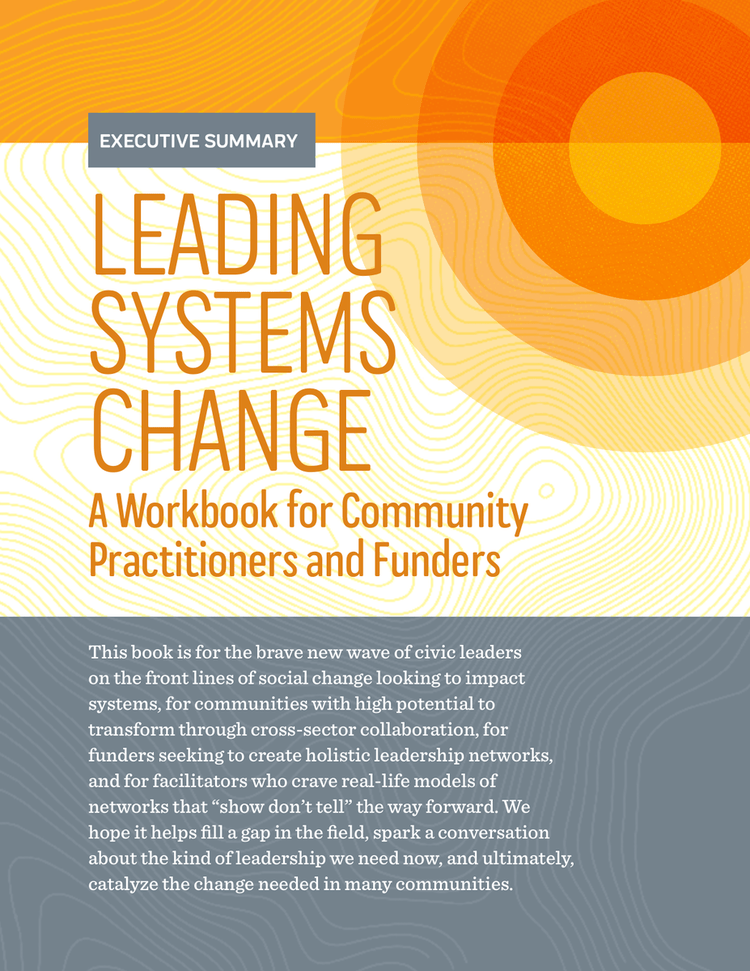
Hot lead from the Modesto Bee leads to the Leading Systems Change book http://newleadershipnetwork.org/book/ and detailed links to resources – http://newleadershipnetwork.org/tools-and-resources/

FOR ANYONE LEADING COMMUNITY CHANGE, THIS BOOK IS FOR YOU

A toolkit for 21st century social change

What’s Inside

This workbook is broken down into nine different chapters. These chapters are intentionally designed to help provoke thought and facilitate discussion for many different types of system change concepts. The first four chapters tell of the who, why and how of this book. Chapters 5, 6, and 7 educate about the Arc of Learning. The remaining chapters discuss how to take the knowledge, resources and tools you have as a leader or funder and to put it to action.


Source: Stanislaus County project brings new methods, people together | Modesto Bee


How Post-Its, Macklemore and design are helping build a better Modesto

 
Jaylen French and Bob Barzan brainstorming ideas at Designing the Future of Stanislaus County on Sept. 27 at Greens on Tenth.  MFIGUEROA@MODBEE.COM

What do Post-It notes, Macklemore and design have to do with making the valley better?

More than you might realize, according to a new book focused on the ways the Central Valley — particularly Stanislaus County — is tackling its most complicated problems. Government, business and community leaders gathered in downtown Modesto to discuss the new workbook, “Leading Systems Change,” Friday afternoon and learn from its methods.

The session highlighted the work of the New Leadership Network, a four-year, $1.5 million project from The James Irvine Foundation that seeks to train and develop emerging leaders. Stanislaus County was selected to host one of the networks, along with Fresno.

About 50 people were part of the local network, ranging from members of municipal government, law enforcement, nonprofits, businesses, educators and more.

Explore where you live.

Subscribe for 12 FREE weeks of unlimited digital access.

SAVE NOW

“It’s not often we have a book really written about our community,” said Marian Kaanon, President/CEO of the Stanislaus Community Foundation which is the network’s local operating partner. “It is nice to see our community represented in the way we know it and live it.”

The goal of the group is to harness creative ideas from a diverse range of people, and use that to spawn new ideas to address problems or bring innovations to a community.

MF Designing Future1.jpg
Thomas Both, Director of Designing for Social Systems at the Stanford d.school, addresses the room at Designing the Future of Stanislaus County on Sept. 27 at Greens on Tenth. Maria Figueroa MFIGUEROA@MODBEE.COM

Which is where the Post-Its come in. Some 50 people took part in the events, which used the “show, don’t tell”-method of discussing the New Leadership Network’s methods.

So as part of the event the audience got up out of their seats to brainstorm, with Post-It notes, on blank boards posing three open-ended topics. They were about creating ways to boost who feels included in public spaces, creating ways to inspire creative confidence in each other, and creating ways to tell our county’s story as inspirational and inclusive.

Questions and thoughts were then scrawled onto Post-Its and discussed. In Stanislaus County, those mass brainstorms have led to a few real-world projects already.

They include the Glorious Modesto project, which was inspired by Seattle rapper Macklemore’s music video “Glorious” which was filmed in and around Modesto with his grandmother, who lives here. The civic self-esteem effort includes T-shirts and postcards with funds used to support creative projects in the city.

“It’s about telling a different story about Stanislaus County. It’s about changing the perception of residents and mobilizing them to share better stories,” said Reggie Rucker, who is part of the network and works for the Downtown Modesto Partnership. “If a superstar can have that much joy in a single day in Modesto, who are we to not feel glorious about Modesto?”

MF Designing Future3.jpg
Amanda Hughes, Program Director for the Stanislaus Community Foundation, discusses ideas with group at Designing the Future of Stanislaus County on Sept. 27 at Greens on Tenth. Maria Figueroa MFIGUEROA@MODBEE.COM

The Modesto Design Collective (MO.DE), another community partner with the network, discussed the way design can be used to shape and change public perception. The Stanford d. School hosted some of workshops for network members. MO.DE just finished hosting Modesto Architecture & Design Week (MADWEEK), celebrating the region’s architecture and design.

“Collaborating on complicated issues with people we don’t work with everyday, that’s the secret sauce,” said New Leadership Network Program Director Adene Sacks.

For participants and network members like Lee Davis, who lives in Modesto and works as the co-director for the Center for Social Design at Maryland Institute College of Art, the experience is already having an impact.

“It fundamentally changes how a lot of us think about ourselves as change makers in the community,” he said.

Complexity and Macroeconomics – 27 November 10am London UK

Source: Event Details | Rebuild Macro

Wed, 27 Nov | The National Institute Of Economic and S

Complexity and Macroeconomics

We hold a one-day conference to discuss complexity science in macroeconomics, together with the OECD’s NAEC initiative.

Time & Location

27 Nov, 10:00
The National Institute Of Economic and S, 2 Dean Trench St, Westminster, London SW1P 3HE, UK

About the Event

We are holding a one-day conference to discuss complexity science in macroeconomics, being organised with the OECD’s New Approaches to Economic Challenges (NAEC) initiative. The event will be held at the National Institute of Economic and Social Research on the 27 November 2019.

More information on the speakers, agenda and how to register will be released shortly.

Source: Event Details | Rebuild Macro


s
search
c
compose new post
r
reply
e
edit
t
go to top
j
go to the next post or comment
k
go to the previous post or comment
o
toggle comment visibility
esc
cancel edit post or comment